Prevod
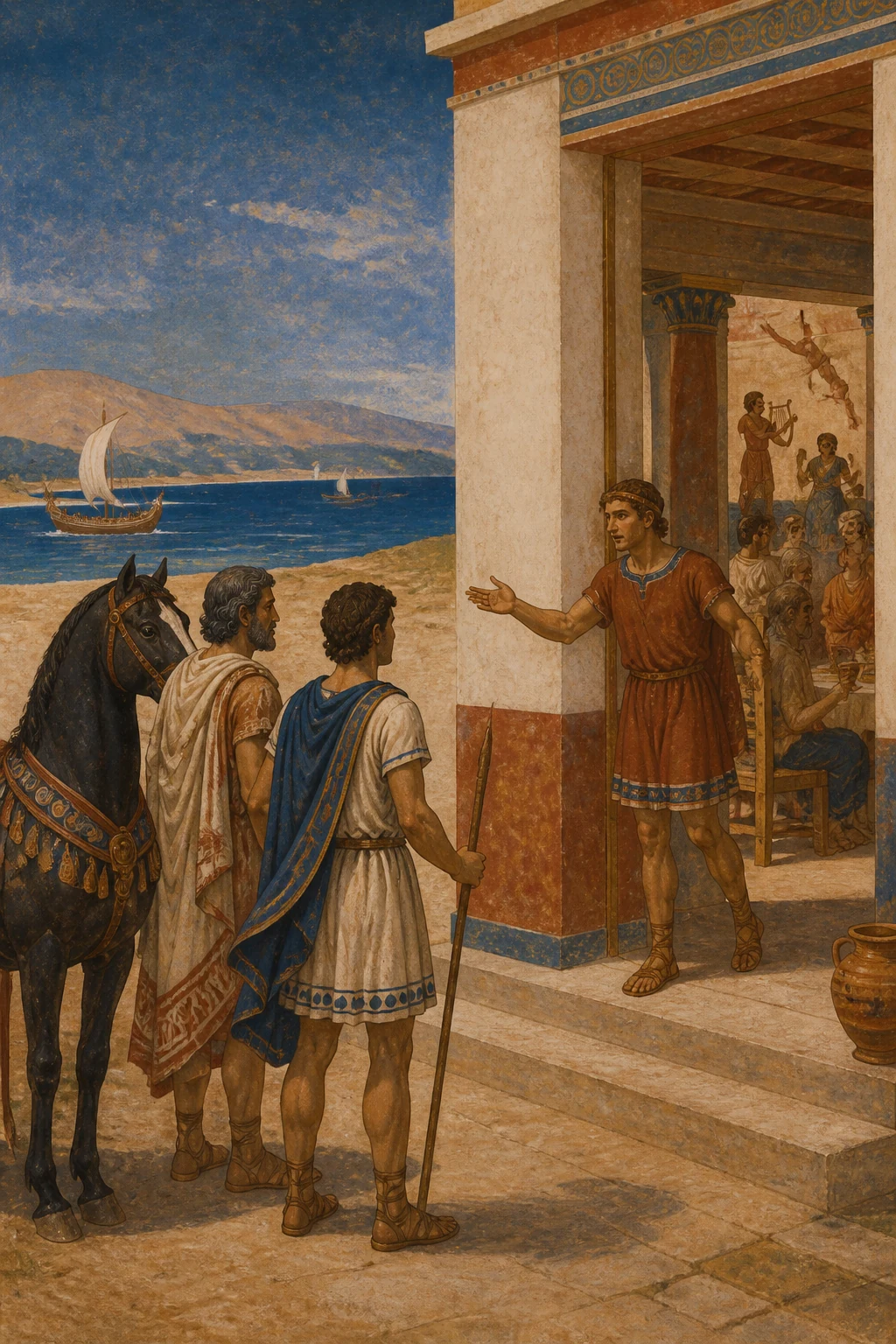
The Sun rose from the lovely lake into the brazen vault of heaven, to shine upon the immortals and upon mortal men across the grain-giving earth. They reached Pylos, the well-built city of Neleus, where the people were sacrificing on the seashore, offering jet-black bulls to the dark-haired Earth-shaker.
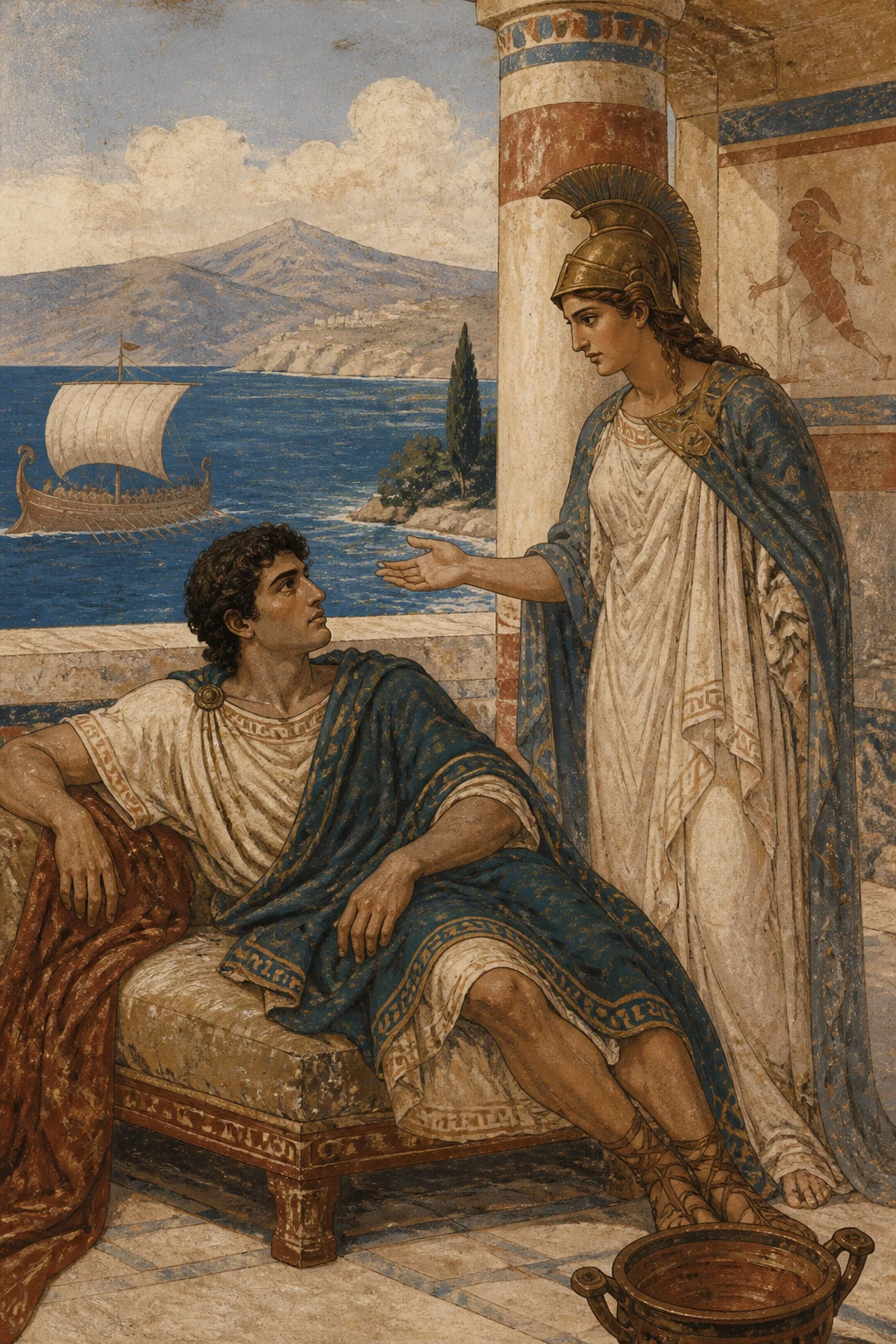
There were nine companies, with five hundred seated in each, and each company had brought forward nine bulls. While they were tasting the entrails and burning the thighbones for the god, the voyagers sailed straight in, took down and furled the sails of their trim ship, moored her, and stepped ashore. Telemachus came out of the ship, and Athena led the way.
The goddess, bright-eyed Athena, spoke to him first: “Telemachus, you must not be shy now, not in the least. This is why you have sailed the sea: to learn of your father, where the earth conceals him and what fate has overtaken him.
“Come now, go straight to Nestor, tamer of horses. Let us learn what knowledge he holds within his heart. Ask him yourself to tell you the truth. He will not lie; he is a man of great wisdom.”
Thoughtful Telemachus answered her: “Mentor, how shall I approach him? How shall I greet him? I have no experience yet in skillful speech, and a young man feels shy about questioning his elders.”
The goddess, bright-eyed Athena, answered him: “Telemachus, some things you will think of yourself, and a god will put the rest into your mind. For I do not believe you were born and brought to manhood without the gods’ goodwill.”
With these words Pallas Athena led swiftly on, and he followed in the goddess’s footsteps. They came to the gathering of the men of Pylos and the places where they sat. There Nestor was seated with his sons, while his companions busied themselves around him preparing the feast, roasting some of the meat and threading more upon spits.
As soon as they saw the strangers, they all came crowding forward, clasped their hands in welcome, and invited them to sit. Peisistratus, Nestor’s son, was the first to approach. He took them both by the hand and seated them at the feast on soft fleeces spread upon the seashore, beside his brother Thrasymedes and his father. He gave them portions of the entrails and poured wine into a golden cup. Offering it respectfully to Pallas Athena, daughter of Zeus who bears the aegis, he said: “Pray now, stranger, to Lord Poseidon, for it is his feast that you have come upon here.
“When you have poured a libation and prayed, as custom requires, give your companion too the cup of honey-sweet wine to make his offering. I imagine he also prays to the immortals, for all men have need of the gods.
“But he is younger, of my own age, so I shall give the golden cup to you first.” With these words he placed the cup of sweet wine in her hand. Athena was pleased with his wisdom and sense of what was right, since he had given her the golden cup first. At once she prayed earnestly to Lord Poseidon: “Hear me, Poseidon, holder of the earth, and do not begrudge us the fulfillment of the things we pray for.
“First grant glory to Nestor and his sons; then reward all the people of Pylos with gracious gifts for this splendid sacrifice. Grant also that Telemachus and I may return when we have accomplished the purpose for which we came here in our swift black ship.”
So she prayed, and herself brought all her prayers to fulfillment. She gave Telemachus the beautiful two-handled cup, and the dear son of Odysseus prayed in the same way. When the others had roasted the outer flesh and drawn it from the spits, they divided it into portions and feasted on the glorious banquet.
When they had eaten and drunk their fill, Nestor, the horseman of Gerenia, began to speak: “Now that our guests have enjoyed their meal, it is a better time to question them and ask who they are.
“Strangers, who are you? From where have you sailed the watery ways? Are you bound on some business, or do you roam at random over the sea like pirates, who wander at the risk of their lives, bringing harm to foreign shores?”
Thoughtful Telemachus answered him boldly, for Athena herself had put courage into his heart, so that he might ask about his absent father and win a good name among men: “Nestor, son of Neleus, great glory of the Achaeans, you ask where we come from, and I will tell you.
“We have come from Ithaca, beneath Mount Neion. The business of which I speak is my own, not the people’s. I am seeking news of my father’s far-famed deeds, hoping to hear something of noble, steadfast Odysseus, who, they say, once fought beside you and sacked the city of the Trojans.
“Of all the others who fought against the Trojans, we have heard where each met his bitter death. But the son of Cronus has left even his death unknown. No one can say for certain where he perished, whether he was overcome on land by enemies or out at sea among the waves of Amphitrite.
“That is why I come now as a suppliant to your knees, asking whether you will tell me of his grievous death, if perhaps you saw it with your own eyes or heard the story from some other wanderer. For his mother bore him to a life of sorrow beyond all others.
“Do not soften anything out of regard or pity for me, but tell me plainly what you witnessed. I beg you, if ever my father, good Odysseus, made you a promise in word or deed and fulfilled it in the land of the Trojans, where you Achaeans suffered so much, remember it now, and tell me the whole truth.”
Nestor, the horseman of Gerenia, answered him: “My friend, you have brought back to mind the sorrows we endured in that land, we sons of the Achaeans whose strength was unyielding: all we suffered as we ranged with our ships over the misty sea in search of plunder wherever Achilles led, and all we endured fighting around the great city of King Priam. There our best men fell.
“There lies warlike Ajax, there Achilles, there Patroclus, a counselor equal to the gods; there lies my own dear son, strong and blameless Antilochus, outstanding in speed of foot and as a warrior. And beyond these we suffered many other woes. What mortal man could tell them all?
“Not even if you stayed five years or six, asking about all the hardships the noble Achaeans endured there. Before the tale was done, you would weary of it and return to your own country. For nine years we labored to bring ruin upon them with every kind of stratagem, and only at last did the son of Cronus bring our work to fulfillment.
“There no one ever cared to pit his cunning openly against your father’s, for noble Odysseus surpassed us all by far in every kind of craft—your father, if you truly are his son. Wonder takes hold of me as I look at you.
“Your way of speaking is so like his; no one would have thought so young a man could speak so much as he did. Throughout our time there, noble Odysseus and I never spoke at odds in assembly or in council. With one heart, with forethought and wise counsel, we considered how things might turn out best for the Argives.
“But when we had sacked Priam’s steep city and embarked in our ships, a god scattered the Achaeans. Then Zeus planned a grievous homecoming for the Argives, for not all of them were wise or just. So many met an evil fate through the deadly anger of the bright-eyed daughter of a mighty father.
“She set the two sons of Atreus at odds. They called all the Achaeans to an assembly, rashly and against all proper order, at sunset; and the sons of the Achaeans came heavy with wine. Then the brothers explained why they had gathered the army.
“Menelaus urged all the Achaeans to turn their thoughts to sailing home over the sea’s broad back. But this did not please Agamemnon at all. He wished to hold the army back and offer sacred hecatombs, hoping to appease Athena’s terrible anger—the fool, who did not know she would not be persuaded! The minds of the everlasting gods are not quickly turned.
“So the two stood exchanging bitter words, and the well-greaved Achaeans leapt up with a tremendous shout, divided between the two proposals. We passed the night nursing angry thoughts against one another, for Zeus was preparing further misery for us. At dawn some of us hauled our ships into the shining sea and loaded aboard our possessions and the deep-girdled women.
“Half the army stayed behind with Agamemnon, son of Atreus, shepherd of the people. The other half embarked and rowed away. Our ships sailed swiftly, for a god had smoothed the sea where the great creatures swim.
“We reached Tenedos and made sacrifices to the gods, eager to get home. But cruel Zeus had no thought yet of letting us return; he stirred up a second bitter quarrel.
“Some turned their curved ships about and sailed back with wise Lord Odysseus, master of many devices, to please Agamemnon, son of Atreus. But I fled with all the ships that followed me, for I knew a god was devising trouble.
“The warlike son of Tydeus fled too, urging his companions on. Fair-haired Menelaus sailed after us later and caught up with us at Lesbos, as we were considering the long voyage: whether to sail north of rugged Chios toward the island of Psyria, keeping Chios itself on our left, or south of Chios past windy Mimas.
“We asked the god to show us a sign. He gave us one, bidding us cut straight across the open sea to Euboea, so that we might escape disaster as quickly as possible. A shrill wind rose and blew behind us, and our ships sped swiftly over the fish-filled ways. By night they reached Geraestus, where we offered many bulls’ thighbones to Poseidon, having crossed that great expanse of sea.
“It was the fourth day when the companions of Diomedes, son of Tydeus, tamer of horses, brought their trim ships to rest in Argos. But I held on toward Pylos, and the wind never dropped from the moment the god first sent it blowing.
“So I came home, dear child, without news, and I know nothing of which Achaeans were saved and which were lost. But whatever I have heard while sitting here in my halls you shall learn, as is only right; I shall hide nothing from you.
“They say the spear-fighting Myrmidons came safely home, led by the glorious son of great-hearted Achilles, and that Philoctetes too returned safely, the splendid son of Poeas. Idomeneus brought back to Crete all his companions who had escaped the war; the sea robbed him of none.
“As for the son of Atreus, even you in your distant home have heard how he returned and how Aegisthus contrived his grievous death. Yet Aegisthus paid a dreadful price. How good it is for a dead man to leave a son behind! For that son took vengeance on his father’s murderer, crafty Aegisthus, who had killed his famous father.
“You too, my friend—for I see how tall and handsome you are—must be brave, so that men yet unborn may speak well of you.” Thoughtful Telemachus answered him: “Nestor, son of Neleus, great glory of the Achaeans, indeed he took his vengeance, and the Achaeans will spread his fame far and wide for future generations to hear. If only the gods would give me such strength to punish the suitors for their painful outrages! In their insolence they devise wicked things against me.
“But the gods have spun no such happiness for me or for my father. As things are, I must endure.” Nestor, the horseman of Gerenia, answered him: “My friend, since you have spoken of this and reminded me, they say that many suitors for your mother’s hand are plotting evil in your halls against your will. Tell me, do you submit willingly, or have the people throughout your land turned against you, obeying some divine command?
“Who knows whether your father may yet return and punish their violence, either alone or with all the Achaeans at his back? If only bright-eyed Athena would choose to love you as she cherished glorious Odysseus in the land of the Trojans, where we Achaeans suffered so much! Never have I seen the gods show their love so openly as Pallas Athena did when she stood beside him for all to see. If she would love you so and take you to her heart, some of those men would soon forget all thought of marriage.”
Thoughtful Telemachus answered him: “Old sir, I do not think those words will ever come true. What you say is too great; it overwhelms me. I cannot hope such things would happen for me, even if the gods should wish it.”
Then the goddess, bright-eyed Athena, said to him: “Telemachus, what a word has escaped the barrier of your teeth! A god, if he wishes, can easily save a man even from far away. For my part, I would rather suffer many hardships and then come home and see the day of my return than reach my own hearth only to die there, as Agamemnon died through the treachery of Aegisthus and his own wife.
“Yet even the gods cannot ward off death, which comes to all alike, from a man they love, once the fatal doom of death that lays men low has seized him.” Thoughtful Telemachus answered her: “Mentor, let us speak of this no more, though it grieves us. There is no longer any true hope of his return; the immortals have already appointed death and black doom for him.
“But now I wish to ask Nestor about another matter, for he knows more than other men of justice and sound judgment. They say he has reigned through three generations of men; when I look at him, he seems to me like an immortal.
“Nestor, son of Neleus, tell me truly: how did the son of Atreus die, wide-ruling Agamemnon? Where was Menelaus? What death did crafty Aegisthus devise for him, that he killed a man far better than himself?
“Was Menelaus not in Achaean Argos? Was he wandering somewhere else among foreign peoples, so that Aegisthus took courage and killed him?” Nestor, the horseman of Gerenia, answered him: “Then I shall tell you the whole truth, my child.
“You can imagine for yourself what would have happened if fair-haired Menelaus, son of Atreus, had returned from Troy and found Aegisthus still alive in the palace. No one would have heaped a mound of earth over his dead body. Dogs and birds would have devoured him as he lay on the plain far from the city, and not one Achaean woman would have mourned him. For dreadful indeed was the deed he planned.
“While we were there, struggling through our many ordeals, he sat at ease in a quiet corner of horse-pasturing Argos, constantly seeking to charm Agamemnon’s wife with his words. At first noble Clytemnestra refused the shameful deed, for her heart was sound. There was also a bard beside her, whom the son of Atreus, as he left for Troy, had earnestly charged to guard his wife.
“But when the gods’ decree at last bound her to her downfall, Aegisthus took the bard away to a deserted island and left him as prey and spoil for the birds. Then, willing himself and she willing too, he brought her to his house.
“He burned many thighbones upon the gods’ sacred altars and hung up many offerings, woven fabrics and gold, having accomplished a mighty deed he had never hoped in his heart to achieve. Now the son of Atreus and I were sailing together on our way from Troy, in friendship with each other. But when we reached holy Sounion, the headland of Athens, Phoebus Apollo approached Menelaus’s helmsman and killed him with his gentle arrows as he held the steering oar of the speeding ship. This was Phrontis, son of Onetor, who surpassed all other men in steering a ship when storms bore down.
“So Menelaus was held there, eager though he was to continue his voyage, until he could bury his companion and pay him funeral honors. But when he too set out over the wine-dark sea in his hollow ships and came swiftly to the steep headland of Malea, far-seeing Zeus devised a hateful voyage for him. He poured down the blast of shrieking winds, and monstrous waves swelled high as mountains.
“He split the fleet, driving some of the ships toward Crete, where the Cydonians lived beside the streams of the Iardanus. There is a smooth, sheer rock rising from the sea at the far edge of Gortyn, in the misty deep. There the South Wind drives a great wave against the western headland toward Phaestus, and a little rock holds back the mighty water.
“Some of the ships came there, and the men barely escaped death, while the waves smashed their ships against the reefs. But five dark-prowed ships were swept by wind and water to Egypt.
“So Menelaus wandered there with his ships among peoples of foreign speech, gathering much wealth and gold, while at home Aegisthus devised his grievous deeds. For seven years he ruled over Mycenae, rich in gold, after killing the son of Atreus, and the people were subject to him.
“But in the eighth year noble Orestes returned from Athens to bring him ruin. He killed his father’s murderer, crafty Aegisthus, who had slain his famous father. After killing him, Orestes gave the Argives a funeral feast for his hateful mother and cowardly Aegisthus. That very day Menelaus, good at the war cry, came home, bringing all the treasure his ships could carry.
“You too, my friend, must not wander long away from home, leaving your possessions and such arrogant men in your halls. They may divide your wealth among them and devour it all, leaving you to find that your journey has been in vain.
“Still, I urge and advise you to visit Menelaus. He has only lately returned from abroad, from peoples so distant that a man once driven off his course by storms into that vast sea could scarcely hope in his heart to return. Not even birds make their way back from there within a year, so great and terrible is that expanse.
“Go now with your ship and your companions. Or if you wish to travel by land, a chariot and horses are at your disposal, and my sons are here to guide you to lovely Lacedaemon, where fair-haired Menelaus lives.
“Ask him yourself to tell you the truth. He will not lie; he is a man of great wisdom.” So he spoke, and the sun went down and darkness came on.
Then the goddess, bright-eyed Athena, spoke among them: “Old sir, you have told this tale as it should be told. But come, cut out the tongues and mix the wine, so that we may pour libations to Poseidon and the other immortals and then think of sleep. It is time.
“Already the light has gone down into darkness, and it is not fitting to linger long at the gods’ feast; we should be going.” So spoke the daughter of Zeus, and they obeyed her. Heralds poured water over their hands, and young men filled the mixing bowls to the brim with wine and served it to everyone, first pouring a few drops into the cups as an offering. They cast the tongues into the fire, then stood and poured libations.
When they had poured their offerings and drunk as much as they wished, Athena and godlike Telemachus both prepared to return to their hollow ship. But Nestor held them back with reproachful words: “May Zeus and the other immortal gods forbid that you should leave my house for your swift ship, as though you had come to some utterly destitute man who had neither clothing nor enough cloaks and blankets in his house for himself and his guests to sleep in comfort!
“I have cloaks and fine blankets in plenty. Surely the dear son of such a man as Odysseus shall not sleep upon a ship’s deck while I am alive, nor afterward while sons of mine remain in these halls to welcome any guest who comes to my house.”
The goddess, bright-eyed Athena, answered him: “You have spoken well, dear old friend. Telemachus should do as you say, for that is much better. He will go with you now and sleep in your halls, while I return to the black ship to encourage the crew and tell them all they need to know.
“For I alone among them can claim to be an older man. The others who have followed us out of friendship are younger, all of them the age of great-hearted Telemachus. I shall sleep beside the hollow black ship tonight, and in the morning I shall go to the great-hearted Cauconians, where a debt is owed me, neither recent nor small. Since this young man has come to your house, send him on with a chariot and your son, and give him the fleetest and strongest horses you have.”
With these words bright-eyed Athena departed in the shape of a sea eagle, and amazement seized all who saw her. The old man marveled at what his own eyes had witnessed. He took Telemachus by the hand and addressed him: “My friend, I do not think you will prove a coward or a weakling, if the gods already attend you as guides while you are so young.
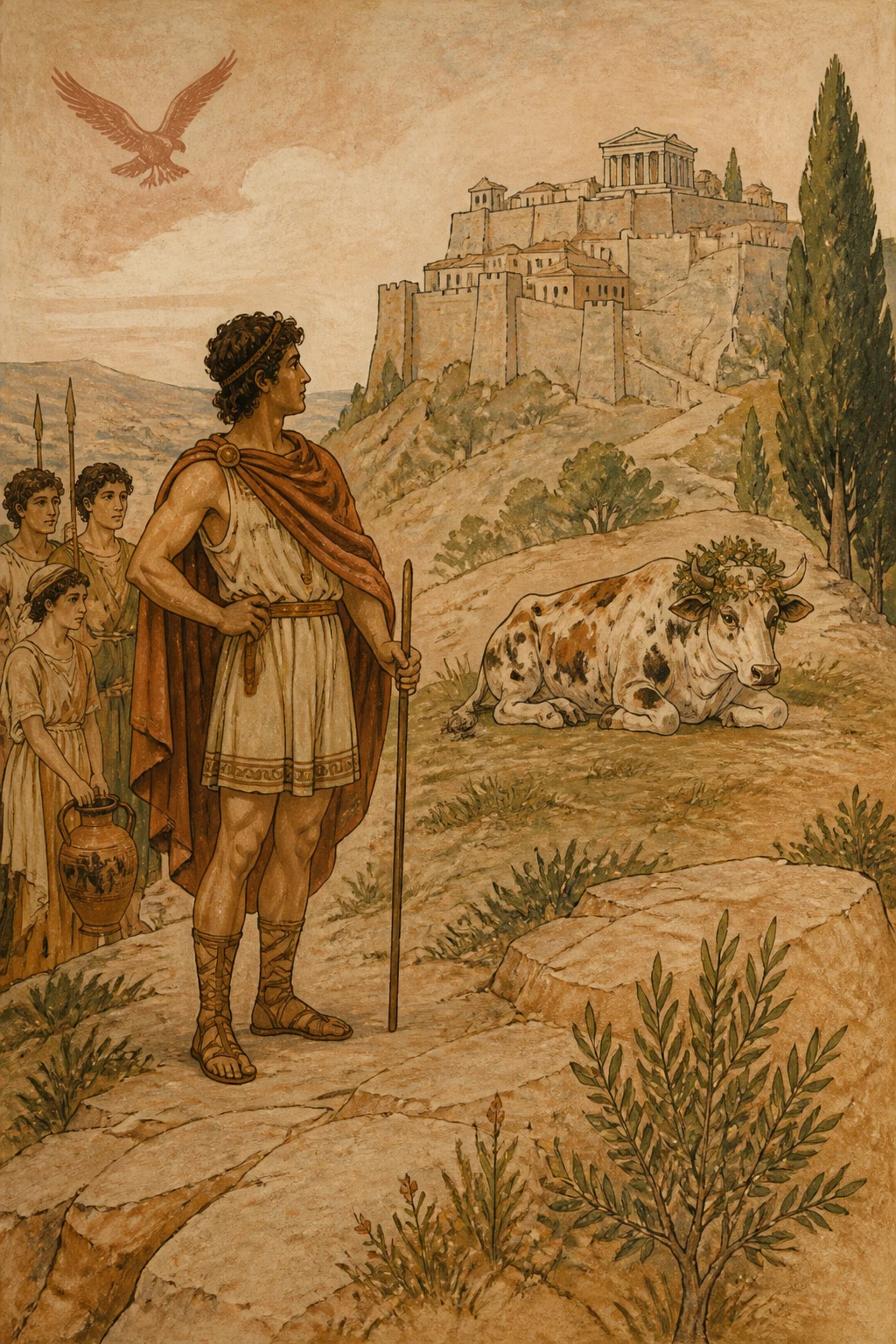
“For this was no other of those who dwell on Olympus than Zeus’s daughter, glorious Tritogeneia, who honored your noble father too among the Argives. Be gracious, Queen, and grant good fame to me, to my children, and to my honored wife. I in turn will sacrifice to you a yearling heifer, broad-browed and unbroken, which no man has yet brought beneath the yoke. I will offer her to you with gold spread around her horns.”
So he prayed, and Pallas Athena heard him. Then Nestor, the horseman of Gerenia, led his sons and sons-in-law to his beautiful house. When they reached the glorious palace of the king, they sat in order upon chairs and seats. For his guests the old man mixed a bowl of sweet wine, which the housekeeper had opened in its eleventh year, unfastening the cover of the jar. From this wine the old man mixed a bowl, and as he poured libations he prayed earnestly to Athena, daughter of Zeus who bears the aegis.
When they had poured their offerings and drunk as much as they wished, the others went home to their beds. But Nestor, the horseman of Gerenia, gave Telemachus, dear son of noble Odysseus, a bed there in the echoing portico, on a frame of pierced wood. Beside him lay Peisistratus, skilled with the ash spear, a leader of men, the only son in the palace who was still unmarried. Nestor himself slept in the inner room of his lofty house, where his wife, the mistress of the household, prepared his bed and bedding.
When early-born, rosy-fingered Dawn appeared, Nestor, the horseman of Gerenia, rose from bed. He went out and sat upon the polished stones before his lofty doors, white and gleaming with oil. On these Neleus once used to sit, a counselor equal to the gods; but he had long since succumbed to death and gone to Hades. Now Nestor of Gerenia, guardian of the Achaeans, sat there holding his scepter. His sons came out of their chambers and gathered around him: Echephron, Stratius, Perseus, Aretus, and godlike Thrasymedes.
Then the hero Peisistratus joined them as the sixth. They brought godlike Telemachus and seated him beside them. Nestor, the horseman of Gerenia, began to speak: “My dear children, make haste and fulfill my wish, so that before all other gods I may win the favor of Athena, who came to me in visible presence at the god’s abundant feast.
“Come, let one of you go to the plain for a heifer, so that she may be here as soon as possible, and let the herdsman drive her. Let another go to great-hearted Telemachus’s black ship and bring all his companions, leaving only two behind. And let another summon Laerces the goldsmith here, to spread gold around the heifer’s horns.
“The rest of you remain together here, and tell the serving women inside the glorious palace to prepare a feast and bring out seats, firewood, and clear water.” So he spoke, and they all busied themselves. The heifer came from the plain, the companions of great-hearted Telemachus came from his swift, trim ship, and the smith arrived holding the bronze tools of his craft: an anvil, a hammer, and well-made tongs with which he worked the gold. Athena too came to receive the sacrifice. The old horseman Nestor gave the gold, and the smith skillfully fitted it around the heifer’s horns, so that the goddess might be pleased at the sight of her adornment.
Stratius and noble Echephron led the heifer by the horns. Aretus came from the storeroom carrying water for their hands in a flower-patterned basin, and in his other hand a basket of barley. Thrasymedes, steadfast in battle, stood nearby with a sharp axe in his hand, ready to strike the heifer.
Perseus held the bowl for the blood. The old horseman Nestor began the rite with the washing of hands and the scattering of barley. He prayed earnestly to Athena as he made the first offering, cutting hairs from the heifer’s head and casting them into the fire.
When they had prayed and scattered the barley, Nestor’s high-spirited son Thrasymedes stepped close and struck. The axe severed the sinews of the neck and broke the heifer’s strength. Nestor’s daughters, his daughters-in-law, and his honored wife Eurydice, eldest of Clymenus’s daughters, raised the ritual cry.
The men lifted the heifer from the broad earth and held her while Peisistratus, leader of men, cut her throat. When the dark blood had flowed out and the life had left her bones, they quickly cut her up. At once they cut out the thighbones in the proper manner, wrapped them in a double layer of fat, and laid pieces of raw flesh over them.
The old man burned them on split wood and poured gleaming wine over them, while young men stood beside him holding five-pronged forks. When the thighbones had burned and they had tasted the entrails, they cut the rest into pieces, threaded them on spits, and roasted them, holding the pointed spits in their hands.
Meanwhile beautiful Polycaste, youngest daughter of Nestor, son of Neleus, bathed Telemachus. When she had washed him and richly anointed him with oil, she clothed him in a fine cloak and tunic. He stepped from the bath like an immortal in bearing, then went and sat beside Nestor, shepherd of the people.
When they had roasted the outer flesh and drawn it from the spits, they sat down to feast, and noble men attended them, pouring wine into golden cups. When they had eaten and drunk their fill, Nestor, the horseman of Gerenia, began to speak: “My sons, come, bring the fine-maned horses and harness them to the chariot for Telemachus, so that he may be on his way.”
So he spoke, and they readily heard and obeyed. Quickly they harnessed the swift horses to the chariot. The housekeeper stowed bread and wine aboard, with delicacies such as kings cherished by Zeus eat.
Telemachus mounted the beautiful chariot. Beside him Peisistratus, Nestor’s son, leader of men, stepped aboard and took the reins in his hands. He flicked the whip to start the horses, and the pair flew forward eagerly onto the plain, leaving behind the steep citadel of Pylos.
All day they ran, the yoke swaying between them. The sun sank, and all the roads grew dark. They reached Pherae and the house of Diocles, son of Ortilochus, whose father was the river Alpheus.
There they spent the night, and he set before them the fare due to guests. When early-born, rosy-fingered Dawn appeared, they harnessed the horses and mounted the richly wrought chariot. They drove out through the gateway and the echoing portico. Peisistratus flicked the whip to start the horses, and the pair flew forward eagerly.
They came to the wheat-bearing plain and pressed on with their journey, so swiftly did the horses carry them. The sun sank, and all the roads grew dark.