O besedilu
Telemah obišče Menelaja
- Vir
- Odiseja
- Avtor
- Homer
- Jezik branja
- English
- Jezik izvirnika
- Ancient Greek
- Čas branja
- 42 min branja
- Obseg
- 33 strani
- Naslov izvirnika
- Telemachus Visits Menelaus
O izvirniku
Odiseja
Dolga vrnitev domov čez morja, otoke, preizkušnje in prepoznavanja. Bralni jezik je English, izvirnik pa prihaja iz vira Odiseja v jeziku Ancient Greek.
Besedilo
Telemah obišče Menelaja
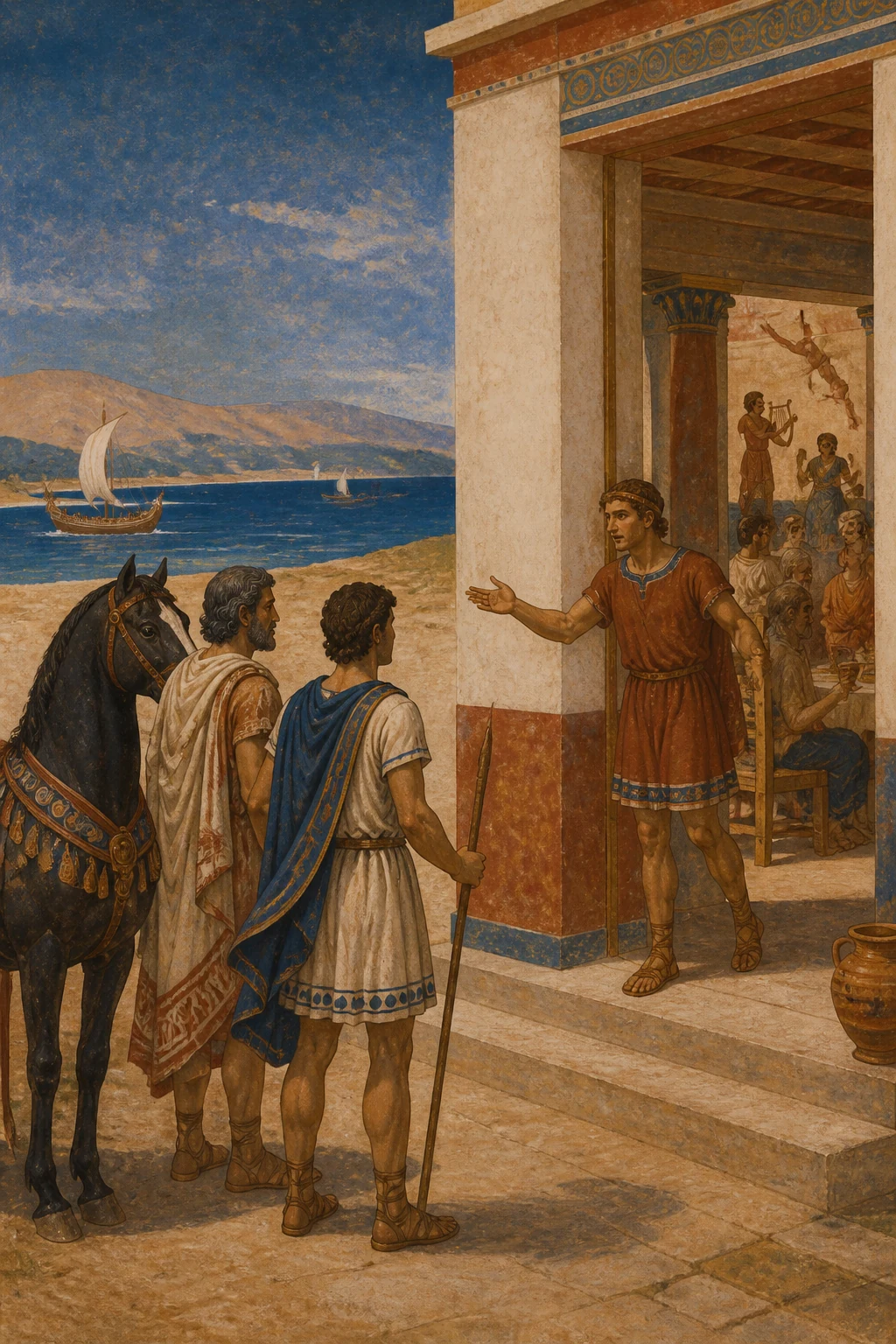
They came to Lacedaemon, hollow among the hills and deep in ravines, and drove to the palace of glorious Menelaus. They found him at home, giving a wedding feast to many kinsmen for his son and his peerless daughter.
His daughter he was sending to the son of Achilles, breaker of men. Long ago at Troy he had promised and pledged to give her to him, and now the gods were bringing their marriage to fulfillment. With horses and chariots he was sending her on her way to the Myrmidons’ renowned city, where her bridegroom ruled.
For his son he was bringing Alector’s daughter from Sparta: that son was sturdy Megapenthes, born to him in his later years by a slave woman. To Helen the gods had granted no more children after she first bore her lovely daughter, Hermione, who had the beauty of golden Aphrodite.
So the neighbors and kinsmen of glorious Menelaus feasted joyfully throughout his great, high-roofed hall. Among them a godlike bard sang to his lyre, while two tumblers, taking their cue from his song, whirled through the company.
Meanwhile the two travelers, heroic Telemachus and Nestor’s splendid son, halted with their horses at the palace gates. Lord Eteoneus, the diligent servant of glorious Menelaus, came out and saw them. He hurried through the palace to tell the shepherd of the people, and, standing close beside him, spoke these winged words: “Menelaus, cherished by Zeus, there are two strangers here, two men who look as though they come from the line of mighty Zeus.
“Tell me, shall we unyoke their swift horses, or send them on to someone else who will welcome them?” Fair-haired Menelaus answered him in deep displeasure: “Eteoneus, son of Boethous, you were no fool before, but now you babble foolishly like a child.
“You and I ate at many strangers’ tables before we reached this place, hoping that Zeus might at last put an end to our misery. Unyoke the strangers’ horses, and bring the men inside to feast.”
So he spoke, and Eteoneus hurried out of the hall, calling other diligent servants to come with him. They unyoked the sweating horses, tied them at the mangers, and set out spelt for them, mixing white barley with it. They leaned the chariot against the gleaming entrance wall and led the men into the splendid house. As the travelers looked about the palace of the king cherished by Zeus, they marveled: through the high-roofed home of glorious Menelaus shone a radiance like the sun’s or the moon’s.
When they had delighted their eyes with gazing, they stepped into polished bathing tubs. The serving women washed them and anointed them with oil, then dressed them in thick, soft cloaks and tunics. They took their seats beside Menelaus, son of Atreus.
A maid brought water in a lovely golden pitcher and poured it over a silver basin for them to wash their hands, then drew a polished table beside them. The worthy housekeeper brought bread and set it before them, adding many dishes and giving freely of all she had.
The carver lifted platters of every kind of meat and set them down, and placed golden cups beside them. Fair-haired Menelaus welcomed the two and said: “Help yourselves to food, and be glad. After you have eaten, we will ask who you are. Your parents’ lineage has not been lost in you: you come from kings cherished by Zeus, men who bear the scepter. Base men could never father sons like you.”
With that, he took up the rich roast chine of an ox, which had been set before him as his portion of honor, and placed it beside them. They reached out for the good food spread before them.
When they had satisfied their desire for food and drink, Telemachus spoke to Nestor’s son, leaning his head close so the others would not hear: “Look, son of Nestor, dear to my heart, at the flash of bronze throughout these echoing halls, and the gold, the amber, the silver and ivory!
“Surely the court of Olympian Zeus must look like this within. Such untold riches! I am filled with awe to see them.” Fair-haired Menelaus understood what he was saying, and addressed them with winged words: “Dear children, no mortal could rival Zeus: his halls and treasures are everlasting. But among men there may be one who rivals me in wealth—or perhaps there is not. For I suffered much and wandered far before bringing these riches home in my ships, and it was in the eighth year that I returned. I wandered through Cyprus, Phoenicia, and Egypt; I came to the Ethiopians, the Sidonians, the Erembians, and Libya, where lambs are born with horns.
“There the sheep bear young three times in the course of a year. Neither master nor shepherd ever lacks cheese or meat or sweet milk, for the ewes yield milk throughout the year.
“While I wandered through those lands, gathering a great store of wealth, another man killed my brother in secret, when he least expected it, through the treachery of his accursed wife. So there is little joy for me in ruling over these possessions.
“You must have heard of this from your fathers, whoever they may be: how greatly I suffered, and how I lost a well-established house that held many splendid treasures.
“Would that I lived here with only a third of what I own, and those men were safe who perished long ago on the broad plains of Troy, far from horse-pasturing Argos. Yet I mourn and grieve for them all. Often, sitting in these halls, I give my heart its fill of weeping, and then again I stop; for a man soon has enough of chilling grief.
“But of all those men, deeply as I mourn them, there is none I grieve for as I do for one, whose memory makes sleep and food hateful to me. No Achaean labored as Odysseus labored, or endured so much. Yet his suffering was to be his own, and mine an undying sorrow for him: he has been gone so long, and we do not even know whether he is alive or dead. Surely old Laertes mourns him, and wise Penelope, and Telemachus, whom he left a newborn child at home.”
His words stirred in Telemachus a longing to weep for his father. At the mention of him, tears fell from his eyes to the ground, and with both hands he raised his purple cloak before his face. Menelaus noticed, and pondered in his heart whether to let him speak of his father on his own, or first question him and test him on every point.
While he turned these thoughts over in his mind, Helen came out of her fragrant, high-roofed chamber, like Artemis of the golden distaff. Adreste set a finely made chair for her, Alcippe brought a rug of soft wool, and Phylo carried a silver basket, a gift from Alcandre, wife of Polybus, who lived in Egyptian Thebes, where the houses hold the greatest stores of wealth. Polybus had given Menelaus two silver bathing tubs, two tripods, and ten talents of gold.
His wife, in her turn, had given Helen lovely gifts of her own: a golden distaff and a silver basket on wheels, its rim finished in gold. This was the basket the maid Phylo brought and set beside her, filled with finely spun yarn. Across it lay the distaff, wound with violet-dark wool.
Helen sat down in her chair, with a footstool beneath her feet, and at once began to question her husband: “Menelaus, cherished by Zeus, do we know who these men claim to be, who have come to our house?
“Shall I speak falsely, or tell the truth? My heart urges me to speak. Never, I think, have I seen such a likeness in man or woman—I am amazed as I look—as the likeness of this young man to the son of great-hearted Odysseus, Telemachus, whom he left a newborn child at home when you Achaeans came to Troy, bent on fierce war for the sake of shameless me.”
Fair-haired Menelaus answered her: “Now I too see the likeness, wife, just as you do. Those are his feet, his hands, the glance of his eyes, his head, and the hair above it.
“Only a moment ago I was remembering Odysseus and telling of the suffering and hardship he endured for my sake, and this young man shed bitter tears, raising his purple cloak before his eyes.”
Then Peisistratus, Nestor’s son, answered him: “Menelaus, son of Atreus, cherished by Zeus, leader of the people, he is indeed that man’s son, as you say. But he is modest, and feels it would be wrong, on this first visit, to speak out boldly before you, whose voice delights us both as though a god were speaking.
“The horseman Nestor of Gerenia sent me to accompany him as his guide. He longed to see you, hoping you might offer him some counsel or some help. A son whose father is away has many troubles in his house, if there are no others to defend him. So it is now with Telemachus: his father is gone, and there is no one else among his people who can ward off his ruin.”
Fair-haired Menelaus answered him: “Ah, then the son of a man very dear to me has come to my house, a man who endured many struggles for my sake! I had thought to welcome him, when he returned, more warmly than any other Argive, if Olympian Zeus, whose voice carries far, had granted us both a homeward voyage over the sea in our swift ships.
“I would have settled a city in Argos for him and built him a house, bringing him from Ithaca with his possessions, his son, and all his people. I would have emptied one of the cities round about, cities under my own rule.
“Then, living here, we would have met often, and nothing would have parted us in our friendship and delight in one another, until death’s black cloud enfolded us.
“But the god himself must have begrudged us this, for he has denied that unhappy man alone his homecoming.” So he spoke, stirring in them all a longing to weep. Argive Helen, daughter of Zeus, wept, and Telemachus and Menelaus, son of Atreus, wept as well. Nor did Nestor’s son keep his eyes dry, for in his heart he remembered noble Antilochus, whom the glorious son of shining Dawn had killed. Thinking of him, he spoke these winged words: “Son of Atreus, whenever we spoke of you at home and questioned one another, old Nestor used to say that you were wise beyond all other men.
“So now, if it is possible, listen to me. I take no pleasure in mourning after supper; early-born Dawn will come again. Not that I think it wrong to weep for a mortal who has died and met his fate.
“This is the only honor we can pay to wretched mortals: to cut our hair and let the tears fall down our cheeks. I too have lost a brother, and by no means the least of the Argives. You must have known him; I myself never met or saw him. But they say Antilochus surpassed the rest, both in the swiftness of his running and as a warrior.”
Fair-haired Menelaus answered him: “My friend, you have spoken as a wise man would speak and act, even one much older than yourself. You are the son of such a father, and so your words are wise. It is easy to recognize the offspring of a man for whom the son of Cronus spins good fortune, both in marriage and at birth. So he has blessed Nestor through all his days, granting him a prosperous old age in his halls, and sons who are wise and foremost with the spear.
“Let us put aside the weeping that has overcome us, and turn again to supper. Let them pour water over our hands. There will still be time at dawn for Telemachus and me to speak fully with one another.”
So he spoke, and Asphalion, the diligent servant of glorious Menelaus, poured water over their hands. They reached out for the good food spread before them. Then Helen, daughter of Zeus, had another thought. Into the wine they were drinking she slipped a drug that stilled all grief and anger and banished the memory of every sorrow.
Whoever swallowed it, once it was mingled in the bowl, would let no tear fall down his cheeks that day, not even if his mother and father died, or if before his very eyes men cut down his brother or his dear son with the sword.
Such were the cunning, healing drugs the daughter of Zeus possessed, gifts from Polydamna, wife of Thon, in Egypt, where the grain-giving earth yields drugs in abundance, many healing and many harmful mingled together. There every man is a physician, skilled beyond all other men, for they are of the race of Paeeon.
When she had added the drug and ordered the wine to be poured, she spoke again: “Menelaus, son of Atreus, cherished by Zeus, and you, sons of noble men: Zeus gives good and evil now to one man, now to another, for he has power over all things. Sit here in the hall and feast, and take pleasure in stories. I will tell you one suited to the hour.
“I could not tell or even name all the ordeals of steadfast Odysseus. But here is one thing that strong man dared and endured in the land of the Trojans, where you Achaeans suffered so much.
“He battered his own body with disfiguring blows, flung miserable rags about his shoulders, and, looking like a slave, slipped into the enemy’s broad-streeted city. Disguising himself, he took on the likeness of another man, a beggar—nothing like the man he was beside the Achaean ships.
“In that guise he entered the Trojans’ city, and none of them suspected him. I alone recognized him as he was, and questioned him, but he cunningly evaded me. Yet when I had bathed him and anointed him with oil and clothed him, and sworn a solemn oath not to reveal Odysseus to the Trojans until he had reached the swift ships and the huts, then at last he told me all the Achaeans’ plans.
“After killing many Trojans with his long-edged bronze sword, he returned to the Argives, bringing back much knowledge. The other Trojan women cried out in grief, but my heart rejoiced, for already I had turned toward going home again. I mourned the blindness Aphrodite had brought upon me when she led me there from my own dear country, leaving behind my daughter, my marriage chamber, and a husband who lacked nothing, either in wisdom or in looks.”
Fair-haired Menelaus answered her: “Yes, wife, you have told all this truly. I have come to know the counsel and the minds of many heroes, and have traveled over much of the earth, but never have my eyes beheld a heart like that of steadfast Odysseus.
“Here is another thing that strong man dared and endured, inside the polished wooden horse, where all the best of us Argives sat, bringing slaughter and death to the Trojans. You came there then—some divine power must have prompted you, wishing to grant the Trojans glory—and godlike Deiphobus followed you.
“Three times you circled our hollow hiding place, feeling it with your hands, and called out the names of the best of the Danaans, imitating the voices of all the Argives’ wives. I and the son of Tydeus and noble Odysseus, sitting within, heard you calling.
“The two of us were eager to spring up and either come out or answer at once from inside, but Odysseus held us back and checked us, eager though we were. All the other sons of the Achaeans kept silent, but Anticlus alone wanted to answer you. Odysseus pressed his strong hands firmly over his mouth and saved all the Achaeans. He held him until Pallas Athena led you away.”
Then thoughtful Telemachus answered him: “Menelaus, son of Atreus, cherished by Zeus, leader of the people, that makes it all the more bitter. None of this kept cruel destruction from him, not even if the heart within him was iron.
“But come, send us to our beds, so that we may lie down now and enjoy sweet sleep.” So he spoke, and Argive Helen ordered the serving women to set beds beneath the portico, lay fine purple coverlets on them, spread rugs above, and provide thick, soft cloaks to draw over themselves.
The women went out of the hall with torches in their hands and made the beds, and a herald led the guests out. There in the forecourt of the palace heroic Telemachus and Nestor’s splendid son lay down to sleep. But the son of Atreus slept in an inner chamber of the lofty house, and beside him lay Helen in her flowing robe, loveliest of women.
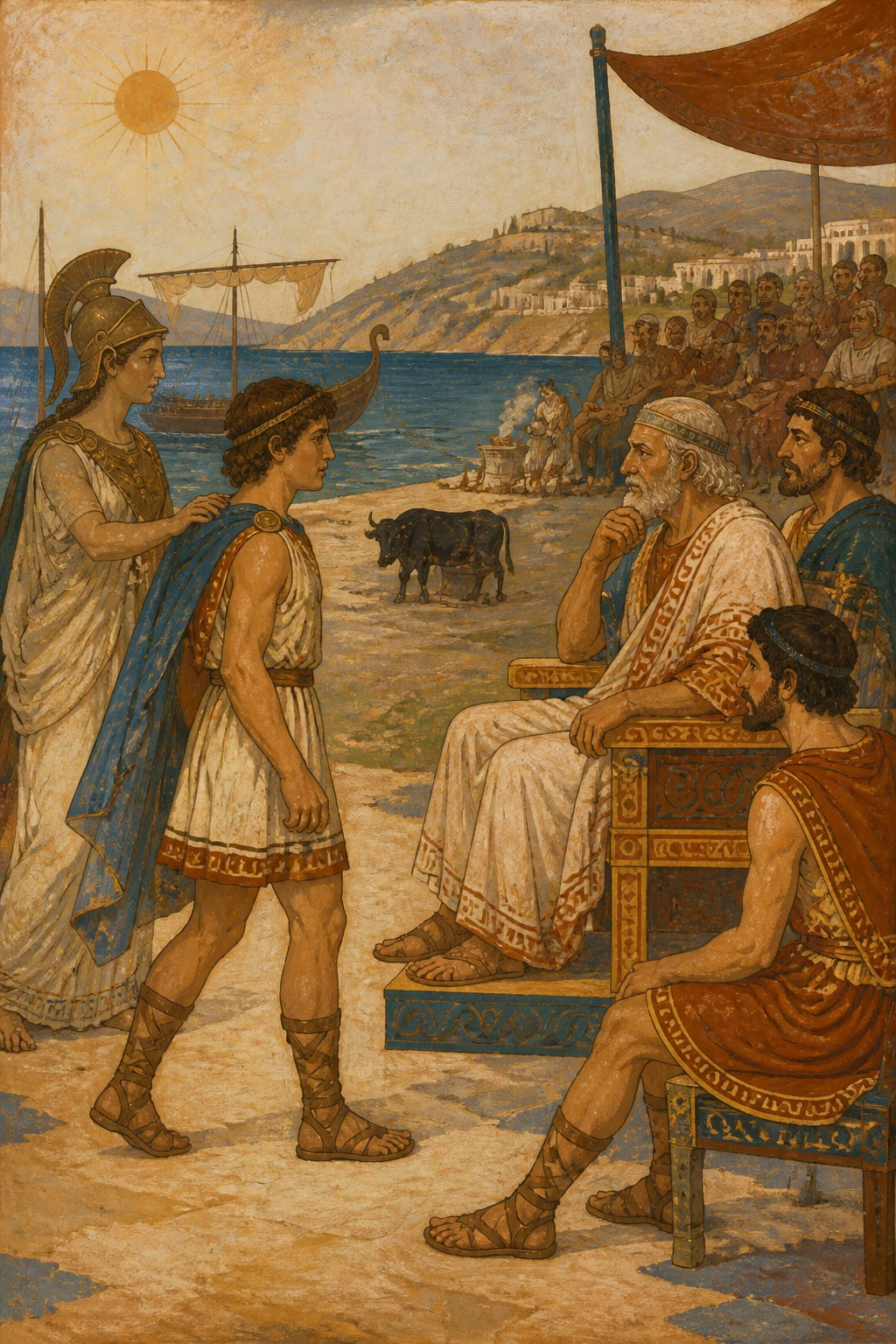
When early-born, rosy-fingered Dawn appeared, Menelaus, master of the war cry, rose from his bed and dressed. He slung his sharp sword over his shoulder, bound fine sandals beneath his shining feet, and came out of the chamber looking like a god. He sat beside Telemachus, addressed him by name, and said: “What need has brought you here, heroic Telemachus, over the sea’s broad back to splendid Lacedaemon?
“Is it a public matter or your own? Tell me truly.” Thoughtful Telemachus answered him: “Menelaus, son of Atreus, cherished by Zeus, leader of the people, I have come to ask if you can tell me any news of my father.
“My house is being devoured, my rich estates are ruined, and my home is filled with enemies who endlessly slaughter my flocking sheep and shambling, curved-horned cattle: my mother’s suitors, men of outrageous arrogance.
“That is why I come now as a suppliant to your knees, hoping you will tell me of his grievous death, whether you witnessed it with your own eyes or heard the tale from some other wanderer. For surely his mother bore him to a life of sorrow beyond all others.
“Do not soften your words out of regard or pity for me, but tell me plainly what you saw. I beg you, if ever my father, good Odysseus, promised you anything in word or deed and fulfilled it in the land of the Trojans, where you Achaeans suffered so much, remember it now, and tell me the truth.”
Fair-haired Menelaus answered him in deep distress: “Ah, so they would lie in the bed of a stout-hearted man, cowards though they are! Just as a doe may lay her newborn, suckling fawns in a mighty lion’s thicket, then roam the mountain slopes and grassy valleys to graze, and the lion comes back to his lair and brings a hideous death upon the pair, so Odysseus will bring a hideous death upon those men.
“Father Zeus, Athena, and Apollo, grant that he may meet the suitors as he was that day in well-built Lesbos, when he rose to wrestle Philomeleides in a challenge and threw him mightily, to the delight of all the Achaeans! If Odysseus came among the suitors as he was then, their lives would be short and their courtship bitter.
“But as for what you ask and beg of me, I will not stray from the truth or deceive you. Of all that the truthful Old Man of the Sea told me, I will not hide or withhold a word.
“The gods were still holding me in Egypt, though I longed to return here, because I had not offered them full sacrifices. The gods always wish their commands to be remembered. Now there is an island in the surging sea off Egypt, which men call Pharos, as far away as a hollow ship can sail in a whole day with a clear, fair wind blowing behind her. There is a harbor with good anchorage, from which men launch their shapely ships upon the sea after drawing fresh water.
“There the gods held me for twenty days, and never did the seaward breezes rise, those winds that carry ships over the broad back of the sea. All our provisions would have failed, and the men’s strength with them, had not a goddess pitied me and saved me: Eidothea, daughter of mighty Proteus, the Old Man of the Sea. It was her heart above all that I moved.
“She met me as I wandered alone, apart from my companions. They were always roaming about the island, fishing with curved hooks, for hunger tormented their bellies. She stood close beside me and said: ‘Stranger, are you so utterly foolish and feeble-minded, or do you give up willingly and find pleasure in suffering?
“‘You have been held on this island so long, and cannot find a way of escape, while your companions’ hearts are failing.’ So she spoke, and I answered her: ‘Whoever you may be among the goddesses, I will tell you that I am not held here willingly. I must have offended the immortals who dwell in the wide heavens.
“‘But tell me—for the gods know everything—which immortal binds me here and bars my journey, and how I may return across the fish-filled sea.’ So I spoke, and the divine goddess answered at once: ‘Then, stranger, I will tell you the whole truth.
“‘There comes to this place the truthful Old Man of the Sea, immortal Proteus of Egypt, who knows the depths of every sea and serves Poseidon. They say he is my father, who begot me.
“‘If somehow you could lie in wait for him and seize him, he would tell you your course, the length of your voyage, and how to make your way home over the fish-filled sea. And if you wished, cherished of Zeus, he could tell you what good and evil have happened in your halls while you have been away on your long and troubled journey.’
“So she spoke, and I answered her: ‘Then you yourself must devise an ambush for the divine old man, lest he see me first or learn of it and escape. It is hard for a mortal man to overpower a god.’
“So I spoke, and the divine goddess answered at once: ‘Then, stranger, I will tell you the whole truth. When the sun has climbed to the middle of the heavens, the truthful Old Man of the Sea comes out of the water, shrouded in the dark ripple raised by the West Wind, and lies down to sleep beneath the hollow caves. Around him sleep in herds the seals, the brood of the lovely sea goddess, emerging from the gray water and breathing the pungent smell of the deep.
“‘There I will take you at the first light of dawn and lay you in a row. Choose three companions, the best you have beside your well-benched ships. I will tell you all the old man’s wiles.
“‘First he will go among the seals and count them. When he has counted and inspected them all, he will lie down in their midst like a shepherd among his flock of sheep. As soon as you see him settled there to sleep, then you must summon all your strength and force and hold him fast, however fiercely he struggles to escape.
“‘He will try you by becoming every creature that moves upon the earth, and water, and wondrous blazing fire. But you must hold him without flinching and grip him all the harder. When at last he speaks and questions you, in the shape you saw when he lay down, then, hero, cease your violence and release the old man. Ask him which god is angry with you, and how you may return across the fish-filled sea.’
“With that she plunged beneath the surging water. I went back toward the ships where they stood on the sands, my heart troubled with many thoughts as I walked. When I reached the ship and the sea, we prepared our supper, and immortal night came on. Then we lay down to sleep beside the breaking waves.
“When early-born, rosy-fingered Dawn appeared, I walked along the shore of the wide-wayed sea, praying earnestly to the gods. With me I took three companions whom I trusted most in every undertaking.
“Meanwhile the goddess had plunged into the sea’s broad bosom and brought back four sealskins, all freshly flayed, devising a trap for her father. She hollowed out beds in the sand and sat waiting. When we came close, she laid us in a row and threw a skin over each of us.
“That would have been a most dreadful ambush, for the deadly stench of the sea-fed seals tormented us terribly. Who could lie beside a creature of the deep? But she herself saved us, devising a great relief: she brought sweet-smelling ambrosia and placed it beneath each man’s nose, banishing the creatures’ stench.
“All morning we waited with patient hearts. The seals came up in herds out of the sea and lay down in rows beside the breaking surf. At noon the old man emerged from the water, found the sleek seals, and went among them all, counting them. He counted us first among the creatures, never suspecting any trick. Then he too lay down.
“With a shout we rushed upon him and flung our arms about him. The old man did not forget his cunning arts: first he became a thick-maned lion, then a serpent, a leopard, and a great boar. He turned into flowing water and a tall, leafy tree. But we held fast without flinching, our hearts steadfast.
“When at last the old man, master of wiles, grew weary, he questioned me and said: ‘Son of Atreus, which of the gods helped you devise this plan, to ambush and seize me against my will? What do you want?’
“So he spoke, and I answered him: ‘You know, old man. Why try to put me off with questions? I have been held on this island so long, and cannot find a way of escape, and the heart within me is failing.
“‘But tell me—for the gods know everything—which immortal binds me here and bars my journey, and how I may return across the fish-filled sea.’ So I spoke, and he answered me at once: ‘You should have offered fine sacrifices to Zeus and the other gods before embarking, so that you might reach your own country swiftly, sailing over the wine-dark sea.
“‘For it is not your fate to see your loved ones, or reach your well-built house and your native land, until you have returned to the waters of Egypt’s heaven-fed river and offered holy sacrifices to the immortal gods who dwell in the wide heavens. Then the gods will grant you the voyage you desire.’
“So he spoke, and my heart broke within me, because he bade me cross the misty sea to Egypt once again, a long and arduous journey. Yet even so I answered him: ‘Old man, I will do all this as you command.
“‘But come, tell me this, and tell me truly: did all the Achaeans whom Nestor and I left behind when we sailed from Troy reach home unharmed with their ships? Or did any man die a bitter death aboard his ship, or in the arms of those he loved, after he had seen the war through to its end?’
“So I spoke, and he answered me at once: ‘Son of Atreus, why question me about these things? You have no need to know or learn what is in my mind. I tell you, you will not remain long without tears once you have heard it all.
“‘Many of those men were slain, and many survived. But only two leaders of the bronze-clad Achaeans perished on their homeward journey—as for the fighting, you were there yourself. One other is still alive, held somewhere on the broad sea.
“‘Ajax perished with his long-oared ships. At first Poseidon drove him against the great rocks of Gyrae and saved him from the sea. He would have escaped his doom, hated though he was by Athena, had he not uttered a boastful word in his great blindness: he declared that, despite the gods, he had escaped the sea’s vast gulf.
“‘Poseidon heard his boast. At once he took his trident in his sturdy hands, struck the rock of Gyrae, and split it apart. One part remained where it was, but the broken piece on which Ajax sat when he made his reckless boast fell into the sea and carried him down into the vast and surging waters.
“‘So he perished there, swallowing the brine. Your brother escaped the fates of death in his hollow ships, for queenly Hera saved him. But just as he was about to reach the steep headland of Malea, a storm wind seized him and carried him, groaning heavily, over the fish-filled sea to the far edge of the country where Thyestes had once made his home, and where Aegisthus, son of Thyestes, then lived.
“‘But when a safe return seemed possible even from there, the gods turned the wind again, and they reached home. In joy he stepped onto his native soil, touching and kissing the land of his fathers. Many hot tears streamed from him, so gladly did he look upon his country.’
From his lookout a watchman caught sight of him—a man whom crafty Aegisthus had taken there and stationed, promising him two talents of gold as his reward. For a whole year he had kept watch, lest Agamemnon slip past unseen and remember his fierce fighting strength.
He went to the palace to bring the news to the shepherd of the people. At once Aegisthus devised a treacherous scheme: he chose twenty of the best men in the land and set them in ambush, while elsewhere he ordered a feast prepared.
Then he went with horses and chariot to invite Agamemnon, shepherd of the people, plotting a dreadful deed. He brought him up to the palace, unsuspecting of his doom, feasted him, and killed him as a man slaughters an ox at its manger.
Not one of the companions who had followed the son of Atreus survived, nor any of Aegisthus’ men: all were killed in the hall. So he spoke, and my heart broke within me. I sat down on the sand and wept; I had no wish to live any longer or look upon the sunlight.
But when I had had my fill of weeping and rolling on the ground, the unerring Old Man of the Sea said to me: ‘Son of Atreus, weep no longer like this, without cease. We shall gain nothing by it. Instead, make every effort to reach your native land as quickly as you can.
‘For either you will find him still alive, or Orestes will have killed him before you come, and you may arrive in time for his funeral feast.’ So he spoke, and my heart and proud spirit warmed again within my breast, despite my grief. I addressed him with winged words: ‘Now I know the fate of these two. But name the third man, who is still held somewhere on the wide sea, alive or dead. Though it grieves me, I wish to hear.’
So I spoke, and at once he answered: ‘The son of Laertes, whose home is in Ithaca. I saw him on an island, shedding bitter tears in the halls of the nymph Calypso, who holds him there against his will. He cannot reach his native land, for he has neither ships with oars nor companions to carry him over the broad back of the sea.
‘But you, Menelaus, cherished by Zeus, are not destined to die and meet your fate in horse-pasturing Argos. The immortals will send you to the Elysian plain at the ends of the earth, where fair-haired Rhadamanthus dwells and life is easiest for mortals. No snow falls there, no fierce winter storms, nor any rain; Ocean always sends up the clear-blowing breezes of the West Wind to refresh mankind. This will be yours because Helen is your wife, and in their eyes you are the son-in-law of Zeus.’
With these words he sank beneath the surging sea. I went back to the ships with my godlike companions, my heart troubled by many thoughts as I walked. When we had reached the ships and the sea, we prepared our supper, and immortal night came on. Then we lay down to sleep beside the breaking waves.
When early-born, rosy-fingered Dawn appeared, first we dragged our ships into the shining sea and set up masts and sails aboard the well-balanced vessels. Then we too climbed aboard and sat down at the benches, and, seated in rows, struck the grey sea with our oars.
Back to Egypt’s heaven-fed river I brought my ships, and there I offered full and perfect sacrifices of a hundred beasts. When I had appeased the wrath of the everlasting gods, I raised a burial mound for Agamemnon, so that his fame might never die.
When all this was done, I set out for home. The immortals gave me a fair wind and brought me swiftly to my dear native land. But come, stay here in my palace until the eleventh or twelfth day. Then I will send you off in fitting style and give you splendid gifts: three horses and a polished chariot. Besides these, I will give you a beautiful cup, so that, whenever you pour libations to the immortal gods, you may remember me all your days.”
Then thoughtful Telemachus answered him: “Son of Atreus, do not keep me here too long. Indeed, I could bear to sit beside you for a whole year without longing for home or my parents, so deeply do I delight in listening to your tales and words. But already my companions in sacred Pylos are growing anxious for me, while you keep me here.
“Whatever gift you give me, let it be something I can keep as a treasure. I will not take horses to Ithaca, but leave them here for your own delight. For you rule over a broad plain where lotus grows in plenty, and sedge, wheat, spelt, and wide-eared white barley.
“But Ithaca has neither broad courses for horses nor any meadowland. It is a pasture for goats, and dearer to me than a land of horses. None of the islands that lie out in the sea is fit for driving horses or rich in meadows, and Ithaca least of all.”
So he spoke, and Menelaus, good at the war cry, smiled. He stroked him with his hand and said: “You are of noble blood, dear child; your words make that plain. So I will change these gifts for you, as I readily can.
“Of all the treasures stored in my house, I will give you the loveliest and most precious. I will give you a finely wrought mixing bowl, all of silver, with its rim finished in gold, the work of Hephaestus. The hero Phaedimus, king of the Sidonians, gave it to me when his house sheltered me on my journey home. This is what I wish to give you.”
While they spoke together in this way, guests came to the godlike king’s palace for the feast. They drove sheep before them and brought heartening wine, while their wives, in lovely headdresses, sent bread for them.
So they busied themselves with dinner in the halls. Meanwhile, before Odysseus’ palace, the suitors amused themselves by throwing discuses and javelins on the levelled ground where they always played, full of insolent pride.
Antinous and godlike Eurymachus sat apart, the leaders of the suitors and by far the foremost among them in prowess. Noemon, son of Phronius, came up to them and questioned Antinous: “Antinous, do we happen to know—or do we not—when Telemachus is coming back from sandy Pylos?
“He sailed away with my ship, and now I need it to cross to spacious Elis. I have twelve brood mares there, with sturdy young mules at their sides, not yet broken. I should like to bring one of them back and train it.”
So he spoke, and they were astonished. They had not thought that Telemachus had gone to Neleus’ Pylos, but supposed he was somewhere out in the country, with the flocks or the swineherd. Antinous, son of Eupeithes, answered him: “Tell me the truth: when did he go, and what young men went with him? The pick of Ithaca, or his own hired hands and slaves? He would be capable of that too.
“And tell me this truly, so that I may be sure: did he seize your black ship by force against your will, or did you give it to him willingly when he asked you?” Noemon, son of Phronius, answered: “I gave it to him willingly. What else could anyone have done, when a man like him, with such cares weighing on his heart, asked for it? It would have been hard to refuse the gift.
“The young men who went with him are the best in the land after ourselves. And I saw Mentor go aboard as their leader—or a god who resembled him in every way. But this puzzles me: I saw noble Mentor here yesterday at dawn, though he had sailed for Pylos with them.”
With these words he went away to his father’s house, leaving both men filled with angry indignation. They made the suitors sit down together and stop their games. Then Antinous, son of Eupeithes, spoke among them, deeply vexed. His dark heart swelled with fury, and his eyes were like blazing fire: “Well now! What an astounding feat Telemachus has accomplished in his insolence—this voyage! We said he would never carry it through.
“Against the will of so many of us, a mere boy has gone off just like that, launching a ship and choosing the finest men in the land. This is only the beginning of the trouble he will cause us. May Zeus destroy his strength before he reaches full manhood!
“But come, give me a swift ship and twenty companions, so that I can lie in wait for him and watch for his return in the strait between Ithaca and rugged Samos. Then this voyage in search of his father will come to a bitter end.”
So he spoke, and they all approved and urged him on. Then they rose and went into Odysseus’ house. But Penelope did not long remain ignorant of the plans the suitors were brooding over in secret. The herald Medon told her: he had heard their counsels from outside the courtyard while they wove their plot within.
He went through the house to bring the news to Penelope. As he stepped across the threshold, she said to him: “Herald, why have the noble suitors sent you? To tell godlike Odysseus’ maids to leave their work and prepare a feast for them?
“Would that they might give up their courting and their gatherings elsewhere, and eat their last and final meal here now! You who gather here so often and devour this great livelihood, wise Telemachus’ wealth—did you never hear your fathers tell, when you were children, what Odysseus was like among them? He never did or said anything unjust to anyone in the land, though that is the way of godlike kings: they may hate one man and favour another.
“But he never wronged any man at all. Your own hearts and shameful deeds are plain to see: kindness done is met with no gratitude afterward.” Then Medon, a man of sound judgment, answered her: “My queen, if only this were the worst of it!
“But the suitors are planning something far greater and more terrible—may the son of Cronus never bring it to pass. They mean to kill Telemachus with the sharp bronze as he comes home. For he has gone to sacred Pylos and holy Lacedaemon to seek news of his father.”
So he spoke, and her knees and heart gave way beneath her. For a long while she could not speak; her eyes filled with tears, and her strong voice failed her. At last she answered him: “Herald, why has my child gone away? There was no need for him to board swift ships, those horses of the sea that carry men over the wide waters.
“Was it so that even his name should perish from among mankind?” Then Medon, a man of sound judgment, answered her: “I do not know whether some god urged him on or his own heart moved him to go to Pylos, to learn whether his father would return, or what fate had overtaken him.”
With these words he went away through Odysseus’ house. Soul-consuming grief poured over her. She could no longer bear to sit on any of the many chairs in the house, but sank down on the threshold of her finely built chamber, lamenting pitifully. Around her all the maids in the house, young and old, joined in her mourning.
Sobbing bitterly, Penelope spoke to them: “Listen, my friends. Of all the women born and raised in my time, the Olympian has given me the greatest sorrow. First I lost my noble, lion-hearted husband, who excelled among the Danaans in every kind of valour—a noble man, whose fame runs wide through Hellas and the heart of Argos.
“And now the storm winds have snatched my beloved son away from the halls, without a word, and I never heard that he was leaving. Cruel women! Not one of you thought to wake me from my bed, though you knew full well when he went aboard the hollow black ship.
“Had I learned that he was planning this journey, he would surely have stayed, eager though he was to go—or else he would have left me dead in these halls. But let someone quickly call old Dolius, my servant, whom my father gave me when I came here, and who tends my orchard with its many trees. Let him go at once and sit beside Laertes and tell him all this. Perhaps Laertes may devise some plan and go out among the people to plead with them, when they are bent on destroying his descendant, the son of godlike Odysseus.”
Then her dear nurse Eurycleia answered: “Dear child, kill me with the pitiless bronze or let me live here in the house, but I will hide nothing from you. I knew all this, and gave him whatever he asked for, bread and sweet wine. But he made me swear a solemn oath not to tell you until the twelfth day had come, unless you yourself missed him and heard that he had gone, so that you would not mar your lovely flesh with weeping.
“But wash yourself, put clean clothing on your body, and go upstairs with your serving women to pray to Athena, daughter of aegis-bearing Zeus. She can save him even from death.
“And do not trouble the old man, troubled as he is already. For I do not think the blessed gods utterly hate the line of Arcesius. Surely one of that line will yet remain to possess this high-roofed house and the rich fields far away.”
So she spoke, and soothed Penelope’s sobbing and checked the tears in her eyes. She washed herself, put clean clothing on her body, and went upstairs with her serving women. There she placed barley grains in a basket and prayed to Athena: “Hear me, unwearied daughter of aegis-bearing Zeus! If ever resourceful Odysseus burned the rich thigh bones of an ox or sheep for you here in his halls, remember those offerings now. Save my dear son, and turn aside the suitors in their wicked arrogance.”
With these words she raised a sacred cry, and the goddess heard her prayer. The suitors clamoured through the shadowy halls, and one of those arrogant young men would say: “Surely our much-courted queen is preparing a marriage for us, and has no idea that death is being prepared for her son.”
So they spoke, not knowing how matters would turn out. Then Antinous addressed them: “You fools, all of you, avoid such boastful talk, lest someone carry it upstairs.
“Come, let us rise in silence and carry out the plan on which we have all agreed.” With these words he chose twenty of the best men, and they went down to the swift ship and the seashore.
First they dragged the ship into deep water, set the mast and sails aboard the black vessel, and fitted the oars into their leather loops, all in proper order. They spread the white sail, and their proud servants brought them their weapons.
They moored the ship well out in the water and went ashore. There they took their supper and waited for evening to come. Meanwhile, wise Penelope lay in her upstairs room without food, having tasted neither meat nor drink, wondering whether her blameless son would escape death or fall at the hands of the arrogant suitors.
As a lion, hemmed in by a crowd of men, turns fearfully from thought to thought when they close their cunning ring around him, so her thoughts tormented her, until sweet sleep came over her. She lay back and slept, and all her limbs relaxed.
Then the goddess, bright-eyed Athena, thought of another course. She made a phantom in the likeness of a woman, Iphthime, daughter of great-hearted Icarius, whom Eumelus had married and taken to his home in Pherae.
She sent it to godlike Odysseus’ house to make the grieving, lamenting Penelope cease her weeping and tearful mourning. It slipped into her room beside the strap of the door bolt, stood above her head, and spoke to her: “Are you asleep, Penelope, with your dear heart so troubled?
“The gods who live at ease do not wish you to weep or grieve, for your son will still return. He has done no wrong against the gods.” Then wise Penelope answered, sleeping sweetly at the gates of dreams: “Why have you come here, sister? You have never visited me before, for your home is very far away. And now you tell me to cease from the misery and the many sorrows that torment my heart and spirit! First I lost my noble, lion-hearted husband, who excelled among the Danaans in every kind of valour—a noble man, whose fame runs wide through Hellas and the heart of Argos. And now my beloved son has gone away in a hollow ship, a mere child, unversed in hardship or the dealings of men.
“For him I mourn even more than for his father. I tremble and fear for him, lest some harm befall him, either among the people of the land to which he has gone or out at sea. For many enemies are plotting against him, eager to kill him before he reaches his native land.”
The shadowy phantom answered her: “Take heart, and do not be so terribly afraid. For he has such a guide beside him as other men have prayed to have at their side, powerful as she is: Pallas Athena. She pities you in your grief, and it was she who sent me here to tell you this.”
Then wise Penelope answered: “If you are indeed a goddess, and have heard a goddess’ voice, tell me also of that unhappy man. Is he still alive somewhere, looking upon the sunlight, or is he dead already, in the house of Hades?”
The shadowy phantom answered her: “Of him I will not speak with certainty, whether he is alive or dead. It is wrong to utter empty words.” With that it slipped past the bolt of the doorpost and vanished into the breath of the winds. Icarius’ daughter started from her sleep, and her heart was warmed because so clear a dream had come to her in the depth of night.
Meanwhile the suitors had gone aboard and were sailing the watery ways, plotting a cruel death for Telemachus. There is a rocky island in the midst of the sea, between Ithaca and rugged Samos, called Asteris. It is small, but has sheltered harbours on either side. There the Achaeans waited in ambush for him.
Izvirnik
Telemachus Visits Menelaus
Naslednje strani prikazujejo izvirno besedilo za primerjavo.
οἱ δʼ ἷξον κοίλην Λακεδαίμονα κητώεσσαν, πρὸς δʼ ἄρα δώματʼ ἔλων Μενελάου κυδαλίμοιο. τὸν δʼ εὗρον δαινύντα γάμον πολλοῖσιν ἔτῃσιν υἱέος ἠδὲ θυγατρὸς ἀμύμονος ᾧ ἐνὶ οἴκῳ. τὴν μὲν Ἀχιλλῆος ῥηξήνορος υἱέι πέμπεν· ἐν Τροίῃ γὰρ πρῶτον ὑπέσχετο καὶ κατένευσε δωσέμεναι, τοῖσιν δὲ θεοὶ γάμον ἐξετέλειον. τὴν ἄρʼ ὅ γʼ ἔνθʼ ἵπποισι καὶ ἅρμασι πέμπε νέεσθαι Μυρμιδόνων προτὶ ἄστυ περικλυτόν, οἷσιν ἄνασσεν.
υἱέι δὲ Σπάρτηθεν Ἀλέκτορος ἤγετο κούρην, ὅς οἱ τηλύγετος γένετο κρατερὸς Μεγαπένθης ἐκ δούλης· Ἑλένῃ δὲ θεοὶ γόνον οὐκέτʼ ἔφαινον, ἐπεὶ δὴ τὸ πρῶτον ἐγείνατο παῖδʼ ἐρατεινήν, Ἑρμιόνην, ἣ εἶδος ἔχε χρυσέης Ἀφροδίτης. ὣς οἱ μὲν δαίνυντο καθʼ ὑψερεφὲς μέγα δῶμα γείτονες ἠδὲ ἔται Μενελάου κυδαλίμοιο, τερπόμενοι· μετὰ δέ σφιν ἐμέλπετο θεῖος ἀοιδὸς φορμίζων, δοιὼ δὲ κυβιστητῆρε κατʼ αὐτούς, μολπῆς ἐξάρχοντος, ἐδίνευον κατὰ μέσσους.
τὼ δʼ αὖτʼ ἐν προθύροισι δόμων αὐτώ τε καὶ ἵππω, Τηλέμαχός θʼ ἥρως καὶ Νέστορος ἀγλαὸς υἱός, στῆσαν· ὁ δὲ προμολὼν ἴδετο κρείων Ἐτεωνεύς, ὀτρηρὸς θεράπων Μενελάου κυδαλίμοιο, βῆ δʼ ἴμεν ἀγγελέων διὰ δώματα ποιμένι λαῶν, ἀγχοῦ δʼ ἱστάμενος ἔπεα πτερόεντα προσηύδα· ξείνω δή τινε τώδε, διοτρεφὲς ὦ Μενέλαε, ἄνδρε δύω, γενεῇ δὲ Διὸς μεγάλοιο ἔικτον. ἀλλʼ εἴπʼ, ἤ σφωιν καταλύσομεν ὠκέας ἵππους, ἦ ἄλλον πέμπωμεν ἱκανέμεν, ὅς κε φιλήσῃ.
τὸν δὲ μέγʼ ὀχθήσας προσέφη ξανθὸς Μενέλαος· οὐ μὲν νήπιος ἦσθα, Βοηθοΐδη Ἐτεωνεῦ, τὸ πρίν· ἀτὰρ μὲν νῦν γε πάϊς ὣς νήπια βάζεις. ἦ μὲν δὴ νῶι ξεινήια πολλὰ φαγόντε ἄλλων ἀνθρώπων δεῦρʼ ἱκόμεθʼ, αἴ κέ ποθι Ζεὺς ἐξοπίσω περ παύσῃ ὀιζύος. ἀλλὰ λύʼ ἵππους ξείνων, ἐς δʼ αὐτοὺς προτέρω ἄγε θοινηθῆναι. ὣς φάθʼ, ὁ δὲ μεγάροιο διέσσυτο, κέκλετο δʼ ἄλλους ὀτρηροὺς θεράποντας ἅμα σπέσθαι ἑοῖ αὐτῷ.
οἱ δʼ ἵππους μὲν λῦσαν ὑπὸ ζυγοῦ ἱδρώοντας, καὶ τοὺς μὲν κατέδησαν ἐφʼ ἱππείῃσι κάπῃσι, πὰρ δʼ ἔβαλον ζειάς, ἀνὰ δὲ κρῖ λευκὸν ἔμιξαν, ἅρματα δʼ ἔκλιναν πρὸς ἐνώπια παμφανόωντα, αὐτοὺς δʼ εἰσῆγον θεῖον δόμον. οἱ δὲ ἰδόντες θαύμαζον κατὰ δῶμα διοτρεφέος βασιλῆος· ὥς τε γὰρ ἠελίου αἴγλη πέλεν ἠὲ σελήνης δῶμα καθʼ ὑψερεφὲς Μενελάου κυδαλίμοιο. αὐτὰρ ἐπεὶ τάρπησαν ὁρώμενοι ὀφθαλμοῖσιν, ἔς ῥʼ ἀσαμίνθους βάντες ἐυξέστας λούσαντο.
τοὺς δʼ ἐπεὶ οὖν δμῳαὶ λοῦσαν καὶ χρῖσαν ἐλαίῳ, ἀμφὶ δʼ ἄρα χλαίνας οὔλας βάλον ἠδὲ χιτῶνας, ἔς ῥα θρόνους ἕζοντο παρʼ Ἀτρεΐδην Μενέλαον. χέρνιβα δʼ ἀμφίπολος προχόῳ ἐπέχευε φέρουσα καλῇ χρυσείῃ ὑπὲρ ἀργυρέοιο λέβητος, νίψασθαι· παρὰ δὲ ξεστὴν ἐτάνυσσε τράπεζαν. σῖτον δʼ αἰδοίη ταμίη παρέθηκε φέρουσα, εἴδατα πόλλʼ ἐπιθεῖσα, χαριζομένη παρεόντων. δαιτρὸς δὲ κρειῶν πίνακας παρέθηκεν ἀείρας παντοίων, παρὰ δέ σφι τίθει χρύσεια κύπελλα.
τὼ καὶ δεικνύμενος προσέφη ξανθὸς Μενέλαος· σίτου θʼ ἅπτεσθον καὶ χαίρετον. αὐτὰρ ἔπειτα δείπνου πασσαμένω εἰρησόμεθʼ, οἵ τινές ἐστον ἀνδρῶν· οὐ γὰρ σφῷν γε γένος ἀπόλωλε τοκήων, ἀλλʼ ἀνδρῶν γένος ἐστὲ διοτρεφέων βασιλήων σκηπτούχων, ἐπεὶ οὔ κε κακοὶ τοιούσδε τέκοιεν. ὣς φάτο, καί σφιν νῶτα βοὸς παρὰ πίονα θῆκεν ὄπτʼ ἐν χερσὶν ἑλών, τά ῥά οἱ γέρα πάρθεσαν αὐτῷ. οἱ δʼ ἐπʼ ὀνείαθʼ ἑτοῖμα προκείμενα χεῖρας ἴαλλον.
αὐτὰρ ἐπεὶ πόσιος καὶ ἐδητύος ἐξ ἔρον ἕντο, δὴ τότε Τηλέμαχος προσεφώνεε Νέστορος υἱόν, ἄγχι σχὼν κεφαλήν, ἵνα μὴ πευθοίαθʼ οἱ ἄλλοι· φράζεο, Νεστορίδη, τῷ ἐμῷ κεχαρισμένε θυμῷ, χαλκοῦ τε στεροπὴν κὰδ δώματα ἠχήεντα χρυσοῦ τʼ ἠλέκτρου τε καὶ ἀργύρου ἠδʼ ἐλέφαντος. Ζηνός που τοιήδε γʼ Ὀλυμπίου ἔνδοθεν αὐλή, ὅσσα τάδʼ ἄσπετα πολλά· σέβας μʼ ἔχει εἰσορόωντα. τοῦ δʼ ἀγορεύοντος ξύνετο ξανθὸς Μενέλαος, καί σφεας φωνήσας ἔπεα πτερόεντα προσηύδα· τέκνα φίλʼ, ἦ τοι Ζηνὶ βροτῶν οὐκ ἄν τις ἐρίζοι· ἀθάνατοι γὰρ τοῦ γε δόμοι καὶ κτήματʼ ἔασιν·
ἀνδρῶν δʼ ἤ κέν τίς μοι ἐρίσσεται, ἠὲ καὶ οὐκί, κτήμασιν. ἦ γὰρ πολλὰ παθὼν καὶ πόλλʼ ἐπαληθεὶς ἠγαγόμην ἐν νηυσὶ καὶ ὀγδοάτῳ ἔτει ἦλθον, Κύπρον Φοινίκην τε καὶ Αἰγυπτίους ἐπαληθείς, Αἰθίοπάς θʼ ἱκόμην καὶ Σιδονίους καὶ Ἐρεμβοὺς καὶ Λιβύην, ἵνα τʼ ἄρνες ἄφαρ κεραοὶ τελέθουσι. τρὶς γὰρ τίκτει μῆλα τελεσφόρον εἰς ἐνιαυτόν. ἔνθα μὲν οὔτε ἄναξ ἐπιδευὴς οὔτε τι ποιμὴν τυροῦ καὶ κρειῶν οὐδὲ γλυκεροῖο γάλακτος, ἀλλʼ αἰεὶ παρέχουσιν ἐπηετανὸν γάλα θῆσθαι.
ἧος ἐγὼ περὶ κεῖνα πολὺν βίοτον συναγείρων ἠλώμην, τῆός μοι ἀδελφεὸν ἄλλος ἔπεφνεν λάθρῃ, ἀνωιστί, δόλῳ οὐλομένης ἀλόχοιο· ὣς οὔ τοι χαίρων τοῖσδε κτεάτεσσιν ἀνάσσω. καὶ πατέρων τάδε μέλλετʼ ἀκουέμεν, οἵ τινες ὑμῖν εἰσίν, ἐπεὶ μάλα πολλὰ πάθον, καὶ ἀπώλεσα οἶκον εὖ μάλα ναιετάοντα, κεχανδότα πολλὰ καὶ ἐσθλά. ὧν ὄφελον τριτάτην περ ἔχων ἐν δώμασι μοῖραν ναίειν, οἱ δʼ ἄνδρες σόοι ἔμμεναι, οἳ τότʼ ὄλοντο Τροίῃ ἐν εὐρείῃ ἑκὰς Ἄργεος ἱπποβότοιο.
ἀλλʼ ἔμπης πάντας μὲν ὀδυρόμενος καὶ ἀχεύων πολλάκις ἐν μεγάροισι καθήμενος ἡμετέροισιν ἄλλοτε μέν τε γόῳ φρένα τέρπομαι, ἄλλοτε δʼ αὖτε παύομαι· αἰψηρὸς δὲ κόρος κρυεροῖο γόοιο. τῶν πάντων οὐ τόσσον ὀδύρομαι, ἀχνύμενός περ, ὡς ἑνός, ὅς τέ μοι ὕπνον ἀπεχθαίρει καὶ ἐδωδὴν μνωομένῳ, ἐπεὶ οὔ τις Ἀχαιῶν τόσσʼ ἐμόγησεν, ὅσσʼ Ὀδυσεὺς ἐμόγησε καὶ ἤρατο. τῷ δʼ ἄρʼ ἔμελλεν αὐτῷ κήδεʼ ἔσεσθαι, ἐμοὶ δʼ ἄχος αἰὲν ἄλαστον κείνου, ὅπως δὴ δηρὸν ἀποίχεται, οὐδέ τι ἴδμεν, ζώει ὅ γʼ ἦ τέθνηκεν. ὀδύρονταί νύ που αὐτὸν Λαέρτης θʼ ὁ γέρων καὶ ἐχέφρων Πηνελόπεια
Τηλέμαχός θʼ, ὃν ἔλειπε νέον γεγαῶτʼ ἐνὶ οἴκῳ. ὣς φάτο, τῷ δʼ ἄρα πατρὸς ὑφʼ ἵμερον ὦρσε γόοιο. δάκρυ δʼ ἀπὸ βλεφάρων χαμάδις βάλε πατρὸς ἀκούσας, χλαῖναν πορφυρέην ἄντʼ ὀφθαλμοῖιν ἀνασχὼν ἀμφοτέρῃσιν χερσί. νόησε δέ μιν Μενέλαος, μερμήριξε δʼ ἔπειτα κατὰ φρένα καὶ κατὰ θυμόν, ἠέ μιν αὐτὸν πατρὸς ἐάσειε μνησθῆναι ἦ πρῶτʼ ἐξερέοιτο ἕκαστά τε πειρήσαιτο. ἧος ὁ ταῦθʼ ὥρμαινε κατὰ φρένα καὶ κατὰ θυμόν, ἐκ δʼ Ἑλένη θαλάμοιο θυώδεος ὑψορόφοιο ἤλυθεν Ἀρτέμιδι χρυσηλακάτῳ ἐικυῖα.
τῇ δʼ ἄρʼ ἅμʼ Ἀδρήστη κλισίην εὔτυκτον ἔθηκεν, Ἀλκίππη δὲ τάπητα φέρεν μαλακοῦ ἐρίοιο, Φυλὼ δʼ ἀργύρεον τάλαρον φέρε, τόν οἱ ἔθηκεν Ἀλκάνδρη, Πολύβοιο δάμαρ, ὃς ἔναιʼ ἐνὶ Θήβῃς Αἰγυπτίῃς, ὅθι πλεῖστα δόμοις ἐν κτήματα κεῖται· ὃς Μενελάῳ δῶκε δύʼ ἀργυρέας ἀσαμίνθους, δοιοὺς δὲ τρίποδας, δέκα δὲ χρυσοῖο τάλαντα. χωρὶς δʼ αὖθʼ Ἑλένῃ ἄλοχος πόρε κάλλιμα δῶρα· χρυσέην τʼ ἠλακάτην τάλαρόν θʼ ὑπόκυκλον ὄπασσεν ἀργύρεον, χρυσῷ δʼ ἐπὶ χείλεα κεκράαντο.
τόν ῥά οἱ ἀμφίπολος Φυλὼ παρέθηκε φέρουσα νήματος ἀσκητοῖο βεβυσμένον· αὐτὰρ ἐπʼ αὐτῷ ἠλακάτη τετάνυστο ἰοδνεφὲς εἶρος ἔχουσα. ἕζετο δʼ ἐν κλισμῷ, ὑπὸ δὲ θρῆνυς ποσὶν ἦεν. αὐτίκα δʼ ἥ γʼ ἐπέεσσι πόσιν ἐρέεινεν ἕκαστα· ἴδμεν δή, Μενέλαε διοτρεφές, οἵ τινες οἵδε ἀνδρῶν εὐχετόωνται ἱκανέμεν ἡμέτερον δῶ; ψεύσομαι ἦ ἔτυμον ἐρέω; κέλεται δέ με θυμός. οὐ γάρ πώ τινά φημι ἐοικότα ὧδε ἰδέσθαι οὔτʼ ἄνδρʼ οὔτε γυναῖκα, σέβας μʼ ἔχει εἰσορόωσαν, ὡς ὅδʼ Ὀδυσσῆος μεγαλήτορος υἷι ἔοικε, Τηλεμάχῳ, τὸν ἔλειπε νέον γεγαῶτʼ ἐνὶ οἴκῳ
κεῖνος ἀνήρ, ὅτʼ ἐμεῖο κυνώπιδος εἵνεκʼ Ἀχαιοὶ ἤλθεθʼ ὑπὸ Τροίην πόλεμον θρασὺν ὁρμαίνοντες. τὴν δʼ ἀπαμειβόμενος προσέφη ξανθὸς Μενέλαος· οὕτω νῦν καὶ ἐγὼ νοέω, γύναι, ὡς σὺ ἐίσκεις· κείνου γὰρ τοιοίδε πόδες τοιαίδε τε χεῖρες ὀφθαλμῶν τε βολαὶ κεφαλή τʼ ἐφύπερθέ τε χαῖται. καὶ νῦν ἦ τοι ἐγὼ μεμνημένος ἀμφʼ Ὀδυσῆι μυθεόμην, ὅσα κεῖνος ὀιζύσας ἐμόγησεν ἀμφʼ ἐμοί, αὐτὰρ ὁ πικρὸν ὑπʼ ὀφρύσι δάκρυον εἶβε, χλαῖναν πορφυρέην ἄντʼ ὀφθαλμοῖιν ἀνασχών.
τὸν δʼ αὖ Νεστορίδης Πεισίστρατος ἀντίον ηὔδα· Ἀτρεΐδη Μενέλαε διοτρεφές, ὄρχαμε λαῶν, κείνου μέν τοι ὅδʼ υἱὸς ἐτήτυμον, ὡς ἀγορεύεις· ἀλλὰ σαόφρων ἐστί, νεμεσσᾶται δʼ ἐνὶ θυμῷ ὧδʼ ἐλθὼν τὸ πρῶτον ἐπεσβολίας ἀναφαίνειν ἄντα σέθεν, τοῦ νῶι θεοῦ ὣς τερπόμεθʼ αὐδῇ. αὐτὰρ ἐμὲ προέηκε Γερήνιος ἱππότα Νέστωρ τῷ ἅμα πομπὸν ἕπεσθαι· ἐέλδετο γάρ σε ἰδέσθαι, ὄφρα οἱ ἤ τι ἔπος ὑποθήσεαι ἠέ τι ἔργον.
πολλὰ γὰρ ἄλγεʼ ἔχει πατρὸς πάϊς οἰχομένοιο ἐν μεγάροις, ᾧ μὴ ἄλλοι ἀοσσητῆρες ἔωσιν, ὡς νῦν Τηλεμάχῳ ὁ μὲν οἴχεται, οὐδέ οἱ ἄλλοι εἴσʼ οἵ κεν κατὰ δῆμον ἀλάλκοιεν κακότητα. τὸν δʼ ἀπαμειβόμενος προσέφη ξανθὸς Μενέλαος· ὢ πόποι, ἦ μάλα δὴ φίλου ἀνέρος υἱὸς ἐμὸν δῶ ἵκεθʼ, ὃς εἵνεκʼ ἐμεῖο πολέας ἐμόγησεν ἀέθλους· καί μιν ἔφην ἐλθόντα φιλησέμεν ἔξοχον ἄλλων Ἀργείων, εἰ νῶιν ὑπεὶρ ἅλα νόστον ἔδωκε νηυσὶ θοῇσι γενέσθαι Ὀλύμπιος εὐρύοπα Ζεύς.
καί κέ οἱ Ἄργεϊ νάσσα πόλιν καὶ δώματʼ ἔτευξα, ἐξ Ἰθάκης ἀγαγὼν σὺν κτήμασι καὶ τέκεϊ ᾧ καὶ πᾶσιν λαοῖσι, μίαν πόλιν ἐξαλαπάξας, αἳ περιναιετάουσιν, ἀνάσσονται δʼ ἐμοὶ αὐτῷ. καί κε θάμʼ ἐνθάδʼ ἐόντες ἐμισγόμεθʼ· οὐδέ κεν ἡμέας ἄλλο διέκρινεν φιλέοντέ τε τερπομένω τε, πρίν γʼ ὅτε δὴ θανάτοιο μέλαν νέφος ἀμφεκάλυψεν. ἀλλὰ τὰ μέν που μέλλεν ἀγάσσεσθαι θεὸς αὐτός, ὃς κεῖνον δύστηνον ἀνόστιμον οἶον ἔθηκεν.
ὣς φάτο, τοῖσι δὲ πᾶσιν ὑφʼ ἵμερον ὦρσε γόοιο. κλαῖε μὲν Ἀργείη Ἑλένη, Διὸς ἐκγεγαυῖα, κλαῖε δὲ Τηλέμαχός τε καὶ Ἀτρεΐδης Μενέλαος, οὐδʼ ἄρα Νέστορος υἱὸς ἀδακρύτω ἔχεν ὄσσε· μνήσατο γὰρ κατὰ θυμὸν ἀμύμονος Ἀντιλόχοιο, τόν ῥʼ Ἠοῦς ἔκτεινε φαεινῆς ἀγλαὸς υἱός· τοῦ ὅ γʼ ἐπιμνησθεὶς ἔπεα πτερόεντʼ ἀγόρευεν· Ἀτρεΐδη, περὶ μέν σε βροτῶν πεπνυμένον εἶναι Νέστωρ φάσχʼ ὁ γέρων, ὅτʼ ἐπιμνησαίμεθα σεῖο οἷσιν ἐνὶ μεγάροισι, καὶ ἀλλήλους ἐρέοιμεν.
καὶ νῦν, εἴ τί που ἔστι, πίθοιό μοι· οὐ γὰρ ἐγώ γε τέρπομʼ ὀδυρόμενος μεταδόρπιος, ἀλλὰ καὶ ἠὼς ἔσσεται ἠριγένεια· νεμεσσῶμαί γε μὲν οὐδὲν κλαίειν ὅς κε θάνῃσι βροτῶν καὶ πότμον ἐπίσπῃ. τοῦτό νυ καὶ γέρας οἶον ὀιζυροῖσι βροτοῖσιν, κείρασθαί τε κόμην βαλέειν τʼ ἀπὸ δάκρυ παρειῶν. καὶ γὰρ ἐμὸς τέθνηκεν ἀδελφεός, οὔ τι κάκιστος Ἀργείων· μέλλεις δὲ σὺ ἴδμεναι· οὐ γὰρ ἐγώ γε ἤντησʼ οὐδὲ ἴδον· περὶ δʼ ἄλλων φασὶ γενέσθαι Ἀντίλοχον, πέρι μὲν θείειν ταχὺν ἠδὲ μαχητήν.
τὸν δʼ ἀπαμειβόμενος προσέφη ξανθὸς Μενέλαος· ὦ φίλʼ, ἐπεὶ τόσα εἶπες, ὅσʼ ἂν πεπνυμένος ἀνὴρ εἴποι καὶ ῥέξειε, καὶ ὃς προγενέστερος εἴη· τοίου γὰρ καὶ πατρός, ὃ καὶ πεπνυμένα βάζεις, ῥεῖα δʼ ἀρίγνωτος γόνος ἀνέρος ᾧ τε Κρονίων ὄλβον ἐπικλώσῃ γαμέοντί τε γεινομένῳ τε, ὡς νῦν Νέστορι δῶκε διαμπερὲς ἤματα πάντα αὐτὸν μὲν λιπαρῶς γηρασκέμεν ἐν μεγάροισιν, υἱέας αὖ πινυτούς τε καὶ ἔγχεσιν εἶναι ἀρίστους.
ἡμεῖς δὲ κλαυθμὸν μὲν ἐάσομεν, ὃς πρὶν ἐτύχθη, δόρπου δʼ ἐξαῦτις μνησώμεθα, χερσὶ δʼ ἐφʼ ὕδωρ χευάντων. μῦθοι δὲ καὶ ἠῶθέν περ ἔσονται Τηλεμάχῳ καὶ ἐμοὶ διαειπέμεν ἀλλήλοισιν. ὣς ἔφατʼ, Ἀσφαλίων δʼ ἄρʼ ὕδωρ ἐπὶ χεῖρας ἔχευεν, ὀτρηρὸς θεράπων Μενελάου κυδαλίμοιο. οἱ δʼ ἐπʼ ὀνείαθʼ ἑτοῖμα προκείμενα χεῖρας ἴαλλον. ἔνθʼ αὖτʼ ἄλλʼ ἐνόησʼ Ἑλένη Διὸς ἐκγεγαυῖα· αὐτίκʼ ἄρʼ εἰς οἶνον βάλε φάρμακον, ἔνθεν ἔπινον, νηπενθές τʼ ἄχολόν τε, κακῶν ἐπίληθον ἁπάντων.
ὃς τὸ καταβρόξειεν, ἐπὴν κρητῆρι μιγείη, οὔ κεν ἐφημέριός γε βάλοι κατὰ δάκρυ παρειῶν, οὐδʼ εἴ οἱ κατατεθναίη μήτηρ τε πατήρ τε, οὐδʼ εἴ οἱ προπάροιθεν ἀδελφεὸν ἢ φίλον υἱὸν χαλκῷ δηιόῳεν, ὁ δʼ ὀφθαλμοῖσιν ὁρῷτο. τοῖα Διὸς θυγάτηρ ἔχε φάρμακα μητιόεντα, ἐσθλά, τά οἱ Πολύδαμνα πόρεν, Θῶνος παράκοιτις Αἰγυπτίη, τῇ πλεῖστα φέρει ζείδωρος ἄρουρα φάρμακα, πολλὰ μὲν ἐσθλὰ μεμιγμένα πολλὰ δὲ λυγρά· ἰητρὸς δὲ ἕκαστος ἐπιστάμενος περὶ πάντων ἀνθρώπων· ἦ γὰρ Παιήονός εἰσι γενέθλης.
αὐτὰρ ἐπεί ῥʼ ἐνέηκε κέλευσέ τε οἰνοχοῆσαι, ἐξαῦτις μύθοισιν ἀμειβομένη προσέειπεν· Ἀτρεΐδη Μενέλαε διοτρεφὲς ἠδὲ καὶ οἵδε ἀνδρῶν ἐσθλῶν παῖδες· ἀτὰρ θεὸς ἄλλοτε ἄλλῳ Ζεὺς ἀγαθόν τε κακόν τε διδοῖ· δύναται γὰρ ἅπαντα· ἦ τοι νῦν δαίνυσθε καθήμενοι ἐν μεγάροισι καὶ μύθοις τέρπεσθε· ἐοικότα γὰρ καταλέξω. πάντα μὲν οὐκ ἂν ἐγὼ μυθήσομαι οὐδʼ ὀνομήνω, ὅσσοι Ὀδυσσῆος ταλασίφρονός εἰσιν ἄεθλοι· ἀλλʼ οἷον τόδʼ ἔρεξε καὶ ἔτλη καρτερὸς ἀνὴρ δήμῳ ἔνι Τρώων, ὅθι πάσχετε πήματʼ Ἀχαιοί.
αὐτόν μιν πληγῇσιν ἀεικελίῃσι δαμάσσας, σπεῖρα κάκʼ ἀμφʼ ὤμοισι βαλών, οἰκῆι ἐοικώς, ἀνδρῶν δυσμενέων κατέδυ πόλιν εὐρυάγυιαν· ἄλλῳ δʼ αὐτὸν φωτὶ κατακρύπτων ἤισκε, δέκτῃ, ὃς οὐδὲν τοῖος ἔην ἐπὶ νηυσὶν Ἀχαιῶν. τῷ ἴκελος κατέδυ Τρώων πόλιν, οἱ δʼ ἀβάκησαν πάντες· ἐγὼ δέ μιν οἴη ἀνέγνων τοῖον ἐόντα, καί μιν ἀνηρώτων· ὁ δὲ κερδοσύνῃ ἀλέεινεν. ἀλλʼ ὅτε δή μιν ἐγὼ λόεον καὶ χρῖον ἐλαίῳ, ἀμφὶ δὲ εἵματα ἕσσα καὶ ὤμοσα καρτερὸν ὅρκον μὴ μὲν πρὶν Ὀδυσῆα μετὰ Τρώεσσʼ ἀναφῆναι, πρίν γε τὸν ἐς νῆάς τε θοὰς κλισίας τʼ ἀφικέσθαι,
καὶ τότε δή μοι πάντα νόον κατέλεξεν Ἀχαιῶν. πολλοὺς δὲ Τρώων κτείνας ταναήκεϊ χαλκῷ ἦλθε μετʼ Ἀργείους, κατὰ δὲ φρόνιν ἤγαγε πολλήν. ἔνθʼ ἄλλαι Τρῳαὶ λίγʼ ἐκώκυον· αὐτὰρ ἐμὸν κῆρ χαῖρʼ, ἐπεὶ ἤδη μοι κραδίη τέτραπτο νέεσθαι ἂψ οἶκόνδʼ, ἄτην δὲ μετέστενον, ἣν Ἀφροδίτη δῶχʼ, ὅτε μʼ ἤγαγε κεῖσε φίλης ἀπὸ πατρίδος αἴης, παῖδά τʼ ἐμὴν νοσφισσαμένην θάλαμόν τε πόσιν τε οὔ τευ δευόμενον, οὔτʼ ἂρ φρένας οὔτε τι εἶδος.
τὴν δʼ ἀπαμειβόμενος προσέφη ξανθὸς Μενέλαος· ναὶ δὴ ταῦτά γε πάντα, γύναι, κατὰ μοῖραν ἔειπες. ἤδη μὲν πολέων ἐδάην βουλήν τε νόον τε ἀνδρῶν ἡρώων, πολλὴν δʼ ἐπελήλυθα γαῖαν· ἀλλʼ οὔ πω τοιοῦτον ἐγὼν ἴδον ὀφθαλμοῖσιν, οἷον Ὀδυσσῆος ταλασίφρονος ἔσκε φίλον κῆρ. οἷον καὶ τόδʼ ἔρεξε καὶ ἔτλη καρτερὸς ἀνὴρ ἵππῳ ἔνι ξεστῷ, ἵνʼ ἐνήμεθα πάντες ἄριστοι Ἀργείων Τρώεσσι φόνον καὶ κῆρα φέροντες.
ἦλθες ἔπειτα σὺ κεῖσε· κελευσέμεναι δέ σʼ ἔμελλε δαίμων, ὃς Τρώεσσιν ἐβούλετο κῦδος ὀρέξαι· καί τοι Δηΐφοβος θεοείκελος ἕσπετʼ ἰούσῃ. τρὶς δὲ περίστειξας κοῖλον λόχον ἀμφαφόωσα, ἐκ δʼ ὀνομακλήδην Δαναῶν ὀνόμαζες ἀρίστους, πάντων Ἀργείων φωνὴν ἴσκουσʼ ἀλόχοισιν. αὐτὰρ ἐγὼ καὶ Τυδεΐδης καὶ δῖος Ὀδυσσεὺς ἥμενοι ἐν μέσσοισιν ἀκούσαμεν ὡς ἐβόησας. νῶι μὲν ἀμφοτέρω μενεήναμεν ὁρμηθέντε ἢ ἐξελθέμεναι, ἢ ἔνδοθεν αἶψʼ ὑπακοῦσαι· ἀλλʼ Ὀδυσεὺς κατέρυκε καὶ ἔσχεθεν ἱεμένω περ.
ἔνθʼ ἄλλοι μὲν πάντες ἀκὴν ἔσαν υἷες Ἀχαιῶν, Ἄντικλος δὲ σέ γʼ οἶος ἀμείψασθαι ἐπέεσσιν ἤθελεν. ἀλλʼ Ὀδυσεὺς ἐπὶ μάστακα χερσὶ πίεζεν νωλεμέως κρατερῇσι, σάωσε δὲ πάντας Ἀχαιούς· τόφρα δʼ ἔχʼ, ὄφρα σε νόσφιν ἀπήγαγε Παλλὰς Ἀθήνη. τὸν δʼ αὖ Τηλέμαχος πεπνυμένος ἀντίον ηὔδα· Ἀτρεΐδη Μενέλαε διοτρεφές, ὄρχαμε λαῶν, ἄλγιον· οὐ γάρ οἵ τι τάδʼ ἤρκεσε λυγρὸν ὄλεθρον, οὐδʼ εἴ οἱ κραδίη γε σιδηρέη ἔνδοθεν ἦεν.
ἀλλʼ ἄγετʼ εἰς εὐνὴν τράπεθʼ ἡμέας, ὄφρα καὶ ἤδη ὕπνῳ ὕπο γλυκερῷ ταρπώμεθα κοιμηθέντες. ὣς ἔφατʼ, Ἀργείη δʼ Ἑλένη δμῳῇσι κέλευσεν δέμνιʼ ὑπʼ αἰθούσῃ θέμεναι καὶ ῥήγεα καλὰ πορφύρεʼ ἐμβαλέειν στορέσαι τʼ ἐφύπερθε τάπητας, χλαίνας τʼ ἐνθέμεναι οὔλας καθύπερθεν ἕσασθαι. αἱ δʼ ἴσαν ἐκ μεγάροιο δάος μετὰ χερσὶν ἔχουσαι, δέμνια δὲ στόρεσαν· ἐκ δὲ ξείνους ἄγε κῆρυξ. οἱ μὲν ἄρʼ ἐν προδόμῳ δόμου αὐτόθι κοιμήσαντο, Τηλέμαχός θʼ ἥρως καὶ Νέστορος ἀγλαὸς υἱός· Ἀτρεΐδης δὲ καθεῦδε μυχῷ δόμου ὑψηλοῖο, πὰρ δʼ Ἑλένη τανύπεπλος ἐλέξατο, δῖα γυναικῶν.
ἦμος δʼ ἠριγένεια φάνη ῥοδοδάκτυλος Ἠώς, ὤρνυτʼ ἄρʼ ἐξ εὐνῆφι βοὴν ἀγαθὸς Μενέλαος εἵματα ἑσσάμενος, περὶ δὲ ξίφος ὀξὺ θέτʼ ὤμῳ, ποσσὶ δʼ ὑπὸ λιπαροῖσιν ἐδήσατο καλὰ πέδιλα, βῆ δʼ ἴμεν ἐκ θαλάμοιο θεῷ ἐναλίγκιος ἄντην, Τηλεμάχῳ δὲ παρῖζεν, ἔπος τʼ ἔφατʼ ἔκ τʼ ὀνόμαζεν· τίπτε δέ σε χρειὼ δεῦρʼ ἤγαγε, Τηλέμαχʼ ἥρως, ἐς Λακεδαίμονα δῖαν, ἐπʼ εὐρέα νῶτα θαλάσσης; δήμιον ἦ ἴδιον; τόδε μοι νημερτὲς ἐνίσπες.
τὸν δʼ αὖ Τηλέμαχος πεπνυμένος ἀντίον ηὔδα· Ἀτρεΐδη Μενέλαε διοτρεφές, ὄρχαμε λαῶν, ἤλυθον, εἴ τινά μοι κληηδόνα πατρὸς ἐνίσποις. ἐσθίεταί μοι οἶκος, ὄλωλε δὲ πίονα ἔργα, δυσμενέων δʼ ἀνδρῶν πλεῖος δόμος, οἵ τέ μοι αἰεὶ μῆλʼ ἁδινὰ σφάζουσι καὶ εἰλίποδας ἕλικας βοῦς, μητρὸς ἐμῆς μνηστῆρες ὑπέρβιον ὕβριν ἔχοντες. τοὔνεκα νῦν τὰ σὰ γούναθʼ ἱκάνομαι, αἴ κʼ ἐθέλῃσθα κείνου λυγρὸν ὄλεθρον ἐνισπεῖν, εἴ που ὄπωπας ὀφθαλμοῖσι τεοῖσιν ἢ ἄλλου μῦθον ἄκουσας πλαζομένου· περὶ γάρ μιν ὀιζυρὸν τέκε μήτηρ.
μηδέ τί μʼ αἰδόμενος μειλίσσεο μηδʼ ἐλεαίρων, ἀλλʼ εὖ μοι κατάλεξον ὅπως ἤντησας ὀπωπῆς. λίσσομαι, εἴ ποτέ τοί τι πατὴρ ἐμός, ἐσθλὸς Ὀδυσσεὺς ἢ ἔπος ἠέ τι ἔργον ὑποστὰς ἐξετέλεσσε δήμῳ ἔνι Τρώων, ὅθι πάσχετε πήματʼ Ἀχαιοί, τῶν νῦν μοι μνῆσαι, καί μοι νημερτὲς ἐνίσπες. τὸν δὲ μέγʼ ὀχθήσας προσέφη ξανθὸς Μενέλαος· ὢ πόποι, ἦ μάλα δὴ κρατερόφρονος ἀνδρὸς ἐν εὐνῇ ἤθελον εὐνηθῆναι ἀνάλκιδες αὐτοὶ ἐόντες.
ὡς δʼ ὁπότʼ ἐν ξυλόχῳ ἔλαφος κρατεροῖο λέοντος νεβροὺς κοιμήσασα νεηγενέας γαλαθηνοὺς κνημοὺς ἐξερέῃσι καὶ ἄγκεα ποιήεντα βοσκομένη, ὁ δʼ ἔπειτα ἑὴν εἰσήλυθεν εὐνήν, ἀμφοτέροισι δὲ τοῖσιν ἀεικέα πότμον ἐφῆκεν, ὣς Ὀδυσεὺς κείνοισιν ἀεικέα πότμον ἐφήσει. αἲ γάρ, Ζεῦ τε πάτερ καὶ Ἀθηναίη καὶ Ἄπολλον, τοῖος ἐών, οἷός ποτʼ ἐυκτιμένῃ ἐνὶ Λέσβῳ ἐξ ἔριδος Φιλομηλεΐδῃ ἐπάλαισεν ἀναστάς, κὰδ δʼ ἔβαλε κρατερῶς, κεχάροντο δὲ πάντες Ἀχαιοί, τοῖος ἐὼν μνηστῆρσιν ὁμιλήσειεν Ὀδυσσεύς· πάντες κʼ ὠκύμοροί τε γενοίατο πικρόγαμοί τε.
ταῦτα δʼ ἅ μʼ εἰρωτᾷς καὶ λίσσεαι, οὐκ ἂν ἐγώ γε ἄλλα παρὲξ εἴποιμι παρακλιδόν, οὐδʼ ἀπατήσω, ἀλλὰ τὰ μέν μοι ἔειπε γέρων ἅλιος νημερτής, τῶν οὐδέν τοι ἐγὼ κρύψω ἔπος οὐδʼ ἐπικεύσω. Αἰγύπτῳ μʼ ἔτι δεῦρο θεοὶ μεμαῶτα νέεσθαι ἔσχον, ἐπεὶ οὔ σφιν ἔρεξα τεληέσσας ἑκατόμβας. οἱ δʼ αἰεὶ βούλοντο θεοὶ μεμνῆσθαι ἐφετμέων. νῆσος ἔπειτά τις ἔστι πολυκλύστῳ ἐνὶ πόντῳ Αἰγύπτου προπάροιθε, Φάρον δέ ἑ κικλήσκουσι, τόσσον ἄνευθʼ ὅσσον τε πανημερίη γλαφυρὴ νηῦς ἤνυσεν, ᾗ λιγὺς οὖρος ἐπιπνείῃσιν ὄπισθεν· ἐν δὲ λιμὴν ἐύορμος, ὅθεν τʼ ἀπὸ νῆας ἐίσας
ἐς πόντον βάλλουσιν, ἀφυσσάμενοι μέλαν ὕδωρ. ἔνθα μʼ ἐείκοσιν ἤματʼ ἔχον θεοί, οὐδέ ποτʼ οὖροι πνείοντες φαίνονθʼ ἁλιαέες, οἵ ῥά τε νηῶν πομπῆες γίγνονται ἐπʼ εὐρέα νῶτα θαλάσσης. καί νύ κεν ἤια πάντα κατέφθιτο καὶ μένεʼ ἀνδρῶν, εἰ μή τίς με θεῶν ὀλοφύρατο καί μʼ ἐσάωσε, Πρωτέος ἰφθίμου θυγάτηρ ἁλίοιο γέροντος, Εἰδοθέη· τῇ γάρ ῥα μάλιστά γε θυμὸν ὄρινα. ἥ μʼ οἴῳ ἔρροντι συνήντετο νόσφιν ἑταίρων· αἰεὶ γὰρ περὶ νῆσον ἀλώμενοι ἰχθυάασκον γναμπτοῖς ἀγκίστροισιν, ἔτειρε δὲ γαστέρα λιμός.
ἡ δέ μευ ἄγχι στᾶσα ἔπος φάτο φώνησέν τε· νήπιός εἰς, ὦ ξεῖνε, λίην τόσον ἠδὲ χαλίφρων, ἦε ἑκὼν μεθίεις καὶ τέρπεαι ἄλγεα πάσχων; ὡς δὴ δήθʼ ἐνὶ νήσῳ ἐρύκεαι, οὐδέ τι τέκμωρ εὑρέμεναι δύνασαι, μινύθει δέ τοι ἦτορ ἑταίρων. ὣς ἔφατʼ, αὐτὰρ ἐγώ μιν ἀμειβόμενος προσέειπον· ἐκ μέν τοι ἐρέω, ἥ τις σύ πέρ ἐσσι θεάων, ὡς ἐγὼ οὔ τι ἑκὼν κατερύκομαι, ἀλλά νυ μέλλω ἀθανάτους ἀλιτέσθαι, οἳ οὐρανὸν εὐρὺν ἔχουσιν.
ἀλλὰ σύ πέρ μοι εἰπέ, θεοὶ δέ τε πάντα ἴσασιν, ὅς τίς μʼ ἀθανάτων πεδάᾳ καὶ ἔδησε κελεύθου, νόστον θʼ, ὡς ἐπὶ πόντον ἐλεύσομαι ἰχθυόεντα. ὣς ἐφάμην, ἡ δʼ αὐτίκʼ ἀμείβετο δῖα θεάων· τοιγὰρ ἐγώ τοι, ξεῖνε, μάλʼ ἀτρεκέως ἀγορεύσω. πωλεῖταί τις δεῦρο γέρων ἅλιος νημερτὴς ἀθάνατος Πρωτεὺς Αἰγύπτιος, ὅς τε θαλάσσης πάσης βένθεα οἶδε, Ποσειδάωνος ὑποδμώς· τὸν δέ τʼ ἐμόν φασιν πατέρʼ ἔμμεναι ἠδὲ τεκέσθαι.
τόν γʼ εἴ πως σὺ δύναιο λοχησάμενος λελαβέσθαι, ὅς κέν τοι εἴπῃσιν ὁδὸν καὶ μέτρα κελεύθου νόστον θʼ, ὡς ἐπὶ πόντον ἐλεύσεαι ἰχθυόεντα. καὶ δέ κέ τοι εἴπῃσι, διοτρεφές, αἴ κʼ ἐθέλῃσθα, ὅττι τοι ἐν μεγάροισι κακόν τʼ ἀγαθόν τε τέτυκται οἰχομένοιο σέθεν δολιχὴν ὁδὸν ἀργαλέην τε. ὣς ἔφατʼ, αὐτὰρ ἐγώ μιν ἀμειβόμενος προσέειπον· αὐτὴ νῦν φράζευ σὺ λόχον θείοιο γέροντος, μή πώς με προϊδὼν ἠὲ προδαεὶς ἀλέηται· ἀργαλέος γάρ τʼ ἐστὶ θεὸς βροτῷ ἀνδρὶ δαμῆναι.
ὣς ἐφάμην, ἡ δʼ αὐτίκʼ ἀμείβετο δῖα θεάων· τοιγὰρ ἐγώ τοι, ξεῖνε, μάλʼ ἀτρεκέως ἀγορεύσω. ἦμος δʼ ἠέλιος μέσον οὐρανὸν ἀμφιβεβήκῃ, τῆμος ἄρʼ ἐξ ἁλὸς εἶσι γέρων ἅλιος νημερτὴς πνοιῇ ὕπο Ζεφύροιο μελαίνῃ φρικὶ καλυφθείς, ἐκ δʼ ἐλθὼν κοιμᾶται ὑπὸ σπέσσι γλαφυροῖσιν· ἀμφὶ δέ μιν φῶκαι νέποδες καλῆς ἁλοσύδνης ἁθρόαι εὕδουσιν, πολιῆς ἁλὸς ἐξαναδῦσαι, πικρὸν ἀποπνείουσαι ἁλὸς πολυβενθέος ὀδμήν.
ἔνθα σʼ ἐγὼν ἀγαγοῦσα ἅμʼ ἠοῖ φαινομένηφιν εὐνάσω ἑξείης· σὺ δʼ ἐὺ κρίνασθαι ἑταίρους τρεῖς, οἵ τοι παρὰ νηυσὶν ἐυσσέλμοισιν ἄριστοι. πάντα δέ τοι ἐρέω ὀλοφώια τοῖο γέροντος. φώκας μέν τοι πρῶτον ἀριθμήσει καὶ ἔπεισιν· αὐτὰρ ἐπὴν πάσας πεμπάσσεται ἠδὲ ἴδηται, λέξεται ἐν μέσσῃσι νομεὺς ὣς πώεσι μήλων. τὸν μὲν ἐπὴν δὴ πρῶτα κατευνηθέντα ἴδησθε, καὶ τότʼ ἔπειθʼ ὑμῖν μελέτω κάρτος τε βίη τε, αὖθι δʼ ἔχειν μεμαῶτα καὶ ἐσσύμενόν περ ἀλύξαι.
πάντα δὲ γιγνόμενος πειρήσεται, ὅσσʼ ἐπὶ γαῖαν ἑρπετὰ γίγνονται, καὶ ὕδωρ καὶ θεσπιδαὲς πῦρ· ὑμεῖς δʼ ἀστεμφέως ἐχέμεν μᾶλλόν τε πιέζειν. ἀλλʼ ὅτε κεν δή σʼ αὐτὸς ἀνείρηται ἐπέεσσι, τοῖος ἐὼν οἷόν κε κατευνηθέντα ἴδησθε, καὶ τότε δὴ σχέσθαι τε βίης λῦσαί τε γέροντα, ἥρως, εἴρεσθαι δέ, θεῶν ὅς τίς σε χαλέπτει, νόστον θʼ, ὡς ἐπὶ πόντον ἐλεύσεαι ἰχθυόεντα. ὣς εἰποῦσʼ ὑπὸ πόντον ἐδύσετο κυμαίνοντα.
αὐτὰρ ἐγὼν ἐπὶ νῆας, ὅθʼ ἕστασαν ἐν ψαμάθοισιν, ἤια· πολλὰ δέ μοι κραδίη πόρφυρε κιόντι. αὐτὰρ ἐπεί ῥʼ ἐπὶ νῆα κατήλυθον ἠδὲ θάλασσαν, δόρπον θʼ ὁπλισάμεσθʼ, ἐπί τʼ ἤλυθεν ἀμβροσίη νύξ· δὴ τότε κοιμήθημεν ἐπὶ ῥηγμῖνι θαλάσσης. ἦμος δʼ ἠριγένεια φάνη ῥοδοδάκτυλος Ἠώς, καὶ τότε δὴ παρὰ θῖνα θαλάσσης εὐρυπόροιο ἤια πολλὰ θεοὺς γουνούμενος· αὐτὰρ ἑταίρους τρεῖς ἄγον, οἷσι μάλιστα πεποίθεα πᾶσαν ἐπʼ ἰθύν.
τόφρα δʼ ἄρʼ ἥ γʼ ὑποδῦσα θαλάσσης εὐρέα κόλπον τέσσαρα φωκάων ἐκ πόντου δέρματʼ ἔνεικε· πάντα δʼ ἔσαν νεόδαρτα· δόλον δʼ ἐπεμήδετο πατρί. εὐνὰς δʼ ἐν ψαμάθοισι διαγλάψασʼ ἁλίῃσιν ἧστο μένουσʼ· ἡμεῖς δὲ μάλα σχεδὸν ἤλθομεν αὐτῆς· ἑξείης δʼ εὔνησε, βάλεν δʼ ἐπὶ δέρμα ἑκάστῳ. ἔνθα κεν αἰνότατος λόχος ἔπλετο· τεῖρε γὰρ αἰνῶς φωκάων ἁλιοτρεφέων ὀλοώτατος ὀδμή· τίς γάρ κʼ εἰναλίῳ παρὰ κήτεϊ κοιμηθείη; ἀλλʼ αὐτὴ ἐσάωσε καὶ ἐφράσατο μέγʼ ὄνειαρ· ἀμβροσίην ὑπὸ ῥῖνα ἑκάστῳ θῆκε φέρουσα ἡδὺ μάλα πνείουσαν, ὄλεσσε δὲ κήτεος ὀδμήν.
πᾶσαν δʼ ἠοίην μένομεν τετληότι θυμῷ· φῶκαι δʼ ἐξ ἁλὸς ἦλθον ἀολλέες. αἱ μὲν ἔπειτα ἑξῆς εὐνάζοντο παρὰ ῥηγμῖνι θαλάσσης· ἔνδιος δʼ ὁ γέρων ἦλθʼ ἐξ ἁλός, εὗρε δὲ φώκας ζατρεφέας, πάσας δʼ ἄρʼ ἐπῴχετο, λέκτο δʼ ἀριθμόν· ἐν δʼ ἡμέας πρώτους λέγε κήτεσιν, οὐδέ τι θυμῷ ὠΐσθη δόλον εἶναι· ἔπειτα δὲ λέκτο καὶ αὐτός. ἡμεῖς δὲ ἰάχοντες ἐπεσσύμεθʼ, ἀμφὶ δὲ χεῖρας βάλλομεν· οὐδʼ ὁ γέρων δολίης ἐπελήθετο τέχνης, ἀλλʼ ἦ τοι πρώτιστα λέων γένετʼ ἠυγένειος, αὐτὰρ ἔπειτα δράκων καὶ πάρδαλις ἠδὲ μέγας σῦς· γίγνετο δʼ ὑγρὸν ὕδωρ καὶ δένδρεον ὑψιπέτηλον·
ἡμεῖς δʼ ἀστεμφέως ἔχομεν τετληότι θυμῷ. ἀλλʼ ὅτε δή ῥʼ ἀνίαζʼ ὁ γέρων ὀλοφώια εἰδώς, καὶ τότε δή μʼ ἐπέεσσιν ἀνειρόμενος προσέειπε· τίς νύ τοι, Ἀτρέος υἱέ, θεῶν συμφράσσατο βουλάς, ὄφρα μʼ ἕλοις ἀέκοντα λοχησάμενος; τέο σε χρή; ὣς ἔφατʼ, αὐτὰρ ἐγώ μιν ἀμειβόμενος προσέειπον· οἶσθα, γέρον, τί με ταῦτα παρατροπέων ἐρεείνεις; ὡς δὴ δήθʼ ἐνὶ νήσῳ ἐρύκομαι, οὐδέ τι τέκμωρ εὑρέμεναι δύναμαι, μινύθει δέ μοι ἔνδοθεν ἦτορ.
ἀλλὰ σύ πέρ μοι εἰπέ, θεοὶ δέ τε πάντα ἴσασιν, ὅς τίς μʼ ἀθανάτων πεδάᾳ καὶ ἔδησε κελεύθου, νόστον θʼ, ὡς ἐπὶ πόντον ἐλεύσομαι ἰχθυόεντα. ὣς ἐφάμην, ὁ δέ μʼ αὐτίκʼ ἀμειβόμενος προσέειπεν· ἀλλὰ μάλʼ ὤφελλες Διί τʼ ἄλλοισίν τε θεοῖσι ῥέξας ἱερὰ κάλʼ ἀναβαινέμεν, ὄφρα τάχιστα σὴν ἐς πατρίδʼ ἵκοιο πλέων ἐπὶ οἴνοπα πόντον. οὐ γάρ τοι πρὶν μοῖρα φίλους τʼ ἰδέειν καὶ ἱκέσθαι οἶκον ἐυκτίμενον καὶ σὴν ἐς πατρίδα γαῖαν, πρίν γʼ ὅτʼ ἂν Αἰγύπτοιο, διιπετέος ποταμοῖο, αὖτις ὕδωρ ἔλθῃς ῥέξῃς θʼ ἱερὰς ἑκατόμβας ἀθανάτοισι θεοῖσι, τοὶ οὐρανὸν εὐρὺν ἔχουσι·
καὶ τότε τοι δώσουσιν ὁδὸν θεοί, ἣν σὺ μενοινᾷς. ὣς ἔφατʼ, αὐτὰρ ἐμοί γε κατεκλάσθη φίλον ἦτορ, οὕνεκά μʼ αὖτις ἄνωγεν ἐπʼ ἠεροειδέα πόντον Αἴγυπτόνδʼ ἰέναι, δολιχὴν ὁδὸν ἀργαλέην τε. ἀλλὰ καὶ ὣς μύθοισιν ἀμειβόμενος προσέειπον· ταῦτα μὲν οὕτω δὴ τελέω, γέρον, ὡς σὺ κελεύεις. ἀλλʼ ἄγε μοι τόδε εἰπὲ καὶ ἀτρεκέως κατάλεξον, ἢ πάντες σὺν νηυσὶν ἀπήμονες ἦλθον Ἀχαιοί, οὓς Νέστωρ καὶ ἐγὼ λίπομεν Τροίηθεν ἰόντες, ἦέ τις ὤλετʼ ὀλέθρῳ ἀδευκέι ἧς ἐπὶ νηὸς ἠὲ φίλων ἐν χερσίν, ἐπεὶ πόλεμον τολύπευσεν.
ὣς ἐφάμην, ὁ δέ μʼ αὐτίκʼ ἀμειβόμενος προσέειπεν· Ἀτρεΐδη, τί με ταῦτα διείρεαι; οὐδέ τί σε χρὴ ἴδμεναι, οὐδὲ δαῆναι ἐμὸν νόον· οὐδέ σέ φημι δὴν ἄκλαυτον ἔσεσθαι, ἐπὴν ἐὺ πάντα πύθηαι. πολλοὶ μὲν γὰρ τῶν γε δάμεν, πολλοὶ δὲ λίποντο· ἀρχοὶ δʼ αὖ δύο μοῦνοι Ἀχαιῶν χαλκοχιτώνων ἐν νόστῳ ἀπόλοντο· μάχῃ δέ τε καὶ σὺ παρῆσθα. εἷς δʼ ἔτι που ζωὸς κατερύκεται εὐρέι πόντῳ. Αἴας μὲν μετὰ νηυσὶ δάμη δολιχηρέτμοισι.
Γυρῇσίν μιν πρῶτα Ποσειδάων ἐπέλασσεν πέτρῃσιν μεγάλῃσι καὶ ἐξεσάωσε θαλάσσης· καί νύ κεν ἔκφυγε κῆρα καὶ ἐχθόμενός περ Ἀθήνῃ, εἰ μὴ ὑπερφίαλον ἔπος ἔκβαλε καὶ μέγʼ ἀάσθη· φῆ ῥʼ ἀέκητι θεῶν φυγέειν μέγα λαῖτμα θαλάσσης. τοῦ δὲ Ποσειδάων μεγάλʼ ἔκλυεν αὐδήσαντος· αὐτίκʼ ἔπειτα τρίαιναν ἑλὼν χερσὶ στιβαρῇσιν ἤλασε Γυραίην πέτρην, ἀπὸ δʼ ἔσχισεν αὐτήν· καὶ τὸ μὲν αὐτόθι μεῖνε, τὸ δὲ τρύφος ἔμπεσε πόντῳ, τῷ ῥʼ Αἴας τὸ πρῶτον ἐφεζόμενος μέγʼ ἀάσθη· τὸν δʼ ἐφόρει κατὰ πόντον ἀπείρονα κυμαίνοντα.
ὣς ὁ μὲν ἔνθʼ ἀπόλωλεν, ἐπεὶ πίεν ἁλμυρὸν ὕδωρ. σὸς δέ που ἔκφυγε κῆρας ἀδελφεὸς ἠδʼ ὑπάλυξεν ἐν νηυσὶ γλαφυρῇσι· σάωσε δὲ πότνια Ἥρη. ἀλλʼ ὅτε δὴ τάχʼ ἔμελλε Μαλειάων ὄρος αἰπὺ ἵξεσθαι, τότε δή μιν ἀναρπάξασα θύελλα πόντον ἐπʼ ἰχθυόεντα φέρεν βαρέα στενάχοντα, ἀγροῦ ἐπʼ ἐσχατιήν, ὅθι δώματα ναῖε Θυέστης τὸ πρίν, ἀτὰρ τότʼ ἔναιε Θυεστιάδης Αἴγισθος. ἀλλʼ ὅτε δὴ καὶ κεῖθεν ἐφαίνετο νόστος ἀπήμων, ἂψ δὲ θεοὶ οὖρον στρέψαν, καὶ οἴκαδʼ ἵκοντο, ἦ τοι ὁ μὲν χαίρων ἐπεβήσετο πατρίδος αἴης καὶ κύνει ἁπτόμενος ἣν πατρίδα· πολλὰ δʼ ἀπʼ αὐτοῦ
δάκρυα θερμὰ χέοντʼ, ἐπεὶ ἀσπασίως ἴδε γαῖαν. τὸν δʼ ἄρʼ ἀπὸ σκοπιῆς εἶδε σκοπός, ὅν ῥα καθεῖσεν Αἴγισθος δολόμητις ἄγων, ὑπὸ δʼ ἔσχετο μισθὸν χρυσοῦ δοιὰ τάλαντα· φύλασσε δʼ ὅ γʼ εἰς ἐνιαυτόν, μή ἑ λάθοι παριών, μνήσαιτο δὲ θούριδος ἀλκῆς. βῆ δʼ ἴμεν ἀγγελέων πρὸς δώματα ποιμένι λαῶν. αὐτίκα δʼ Αἴγισθος δολίην ἐφράσσατο τέχνην· κρινάμενος κατὰ δῆμον ἐείκοσι φῶτας ἀρίστους εἷσε λόχον, ἑτέρωθι δʼ ἀνώγει δαῖτα πένεσθαι.
αὐτὰρ ὁ βῆ καλέων Ἀγαμέμνονα, ποιμένα λαῶν ἵπποισιν καὶ ὄχεσφιν, ἀεικέα μερμηρίζων. τὸν δʼ οὐκ εἰδότʼ ὄλεθρον ἀνήγαγε καὶ κατέπεφνεν δειπνίσσας, ὥς τίς τε κατέκτανε βοῦν ἐπὶ φάτνῃ. οὐδέ τις Ἀτρεΐδεω ἑτάρων λίπεθʼ οἵ οἱ ἕποντο, οὐδέ τις Αἰγίσθου, ἀλλʼ ἔκταθεν ἐν μεγάροισιν. ὣς ἔφατʼ, αὐτὰρ ἐμοί γε κατεκλάσθη φίλον ἦτορ, κλαῖον δʼ ἐν ψαμάθοισι καθήμενος, οὐδέ νύ μοι κῆρ ἤθελʼ ἔτι ζώειν καὶ ὁρᾶν φάος ἠελίοιο.
αὐτὰρ ἐπεὶ κλαίων τε κυλινδόμενός τε κορέσθην, δὴ τότε με προσέειπε γέρων ἅλιος νημερτής· μηκέτι, Ἀτρέος υἱέ, πολὺν χρόνον ἀσκελὲς οὕτω κλαῖʼ, ἐπεὶ οὐκ ἄνυσίν τινα δήομεν· ἀλλὰ τάχιστα πείρα ὅπως κεν δὴ σὴν πατρίδα γαῖαν ἵκηαι. ἢ γάρ μιν ζωόν γε κιχήσεαι, ἤ κεν Ὀρέστης κτεῖνεν ὑποφθάμενος, σὺ δέ κεν τάφου ἀντιβολήσαις. ὣς ἔφατʼ, αὐτὰρ ἐμοὶ κραδίη καὶ θυμὸς ἀγήνωρ αὖτις ἐνὶ στήθεσσι καὶ ἀχνυμένῳ περ ἰάνθη, καί μιν φωνήσας ἔπεα πτερόεντα προσηύδων· τούτους μὲν δὴ οἶδα· σὺ δὲ τρίτον ἄνδρʼ ὀνόμαζε, ὅς τις ἔτι ζωὸς κατερύκεται εὐρέι πόντῳ
ἠὲ θανών· ἐθέλω δὲ καὶ ἀχνύμενός περ ἀκοῦσαι. ὣς ἐφάμην, ὁ δέ μʼ αὐτίκʼ ἀμειβόμενος προσέειπεν· υἱὸς Λαέρτεω, Ἰθάκῃ ἔνι οἰκία ναίων· τὸν δʼ ἴδον ἐν νήσῳ θαλερὸν κατὰ δάκρυ χέοντα, νύμφης ἐν μεγάροισι Καλυψοῦς, ἥ μιν ἀνάγκῃ ἴσχει· ὁ δʼ οὐ δύναται ἣν πατρίδα γαῖαν ἱκέσθαι· οὐ γάρ οἱ πάρα νῆες ἐπήρετμοι καὶ ἑταῖροι, οἵ κέν μιν πέμποιεν ἐπʼ εὐρέα νῶτα θαλάσσης. σοὶ δʼ οὐ θέσφατόν ἐστι, διοτρεφὲς ὦ Μενέλαε, Ἄργει ἐν ἱπποβότῳ θανέειν καὶ πότμον ἐπισπεῖν, ἀλλά σʼ ἐς Ἠλύσιον πεδίον καὶ πείρατα γαίης ἀθάνατοι πέμψουσιν, ὅθι ξανθὸς Ῥαδάμανθυς,
τῇ περ ῥηίστη βιοτὴ πέλει ἀνθρώποισιν· οὐ νιφετός, οὔτʼ ἂρ χειμὼν πολὺς οὔτε ποτʼ ὄμβρος, ἀλλʼ αἰεὶ Ζεφύροιο λιγὺ πνείοντος ἀήτας Ὠκεανὸς ἀνίησιν ἀναψύχειν ἀνθρώπους· οὕνεκʼ ἔχεις Ἑλένην καί σφιν γαμβρὸς Διός ἐσσι. ὣς εἰπὼν ὑπὸ πόντον ἐδύσετο κυμαίνοντα. αὐτὰρ ἐγὼν ἐπὶ νῆας ἅμʼ ἀντιθέοις ἑτάροισιν ἤια, πολλὰ δέ μοι κραδίη πόρφυρε κιόντι. αὐτὰρ ἐπεί ῥʼ ἐπὶ νῆα κατήλθομεν ἠδὲ θάλασσαν, δόρπον θʼ ὁπλισάμεσθʼ, ἐπί τʼ ἤλυθεν ἀμβροσίη νύξ, δὴ τότε κοιμήθημεν ἐπὶ ῥηγμῖνι θαλάσσης.
ἦμος δʼ ἠριγένεια φάνη ῥοδοδάκτυλος Ἠώς, νῆας μὲν πάμπρωτον ἐρύσσαμεν εἰς ἅλα δῖαν, ἐν δʼ ἱστοὺς τιθέμεσθα καὶ ἱστία νηυσὶν ἐίσῃς, ἂν δὲ καὶ αὐτοὶ βάντες ἐπὶ κληῖσι καθῖζον· ἑξῆς δʼ ἑζόμενοι πολιὴν ἅλα τύπτον ἐρετμοῖς. ἂψ δʼ εἰς Αἰγύπτοιο διιπετέος ποταμοῖο στῆσα νέας, καὶ ἔρεξα τεληέσσας ἑκατόμβας. αὐτὰρ ἐπεὶ κατέπαυσα θεῶν χόλον αἰὲν ἐόντων, χεῦʼ Ἀγαμέμνονι τύμβον, ἵνʼ ἄσβεστον κλέος εἴη.
ταῦτα τελευτήσας νεόμην, ἔδοσαν δέ μοι οὖρον ἀθάνατοι, τοί μʼ ὦκα φίλην ἐς πατρίδʼ ἔπεμψαν. ἀλλʼ ἄγε νῦν ἐπίμεινον ἐνὶ μεγάροισιν ἐμοῖσιν, ὄφρα κεν ἑνδεκάτη τε δυωδεκάτη τε γένηται· καὶ τότε σʼ εὖ πέμψω, δώσω δέ τοι ἀγλαὰ δῶρα, τρεῖς ἵππους καὶ δίφρον ἐύξοον· αὐτὰρ ἔπειτα δώσω καλὸν ἄλεισον, ἵνα σπένδῃσθα θεοῖσιν ἀθανάτοις ἐμέθεν μεμνημένος ἤματα πάντα. τὸν δʼ αὖ Τηλέμαχος πεπνυμένος ἀντίον ηὔδα· Ἀτρεΐδη, μὴ δή με πολὺν χρόνον ἐνθάδʼ ἔρυκε.
καὶ γάρ κʼ εἰς ἐνιαυτὸν ἐγὼ παρὰ σοί γʼ ἀνεχοίμην ἥμενος, οὐδέ κέ μʼ οἴκου ἕλοι πόθος οὐδὲ τοκήων· αἰνῶς γὰρ μύθοισιν ἔπεσσί τε σοῖσιν ἀκούων τέρπομαι. ἀλλʼ ἤδη μοι ἀνιάζουσιν ἑταῖροι ἐν Πύλῳ ἠγαθέῃ· σὺ δέ με χρόνον ἐνθάδʼ ἐρύκεις. δῶρον δʼ ὅττι κέ μοι δοίης, κειμήλιον ἔστω· ἵππους δʼ εἰς Ἰθάκην οὐκ ἄξομαι, ἀλλὰ σοὶ αὐτῷ ἐνθάδε λείψω ἄγαλμα· σὺ γὰρ πεδίοιο ἀνάσσεις εὐρέος, ᾧ ἔνι μὲν λωτὸς πολύς, ἐν δὲ κύπειρον πυροί τε ζειαί τε ἰδʼ εὐρυφυὲς κρῖ λευκόν.
ἐν δʼ Ἰθάκῃ οὔτʼ ἂρ δρόμοι εὐρέες οὔτε τι λειμών· αἰγίβοτος, καὶ μᾶλλον ἐπήρατος ἱπποβότοιο. οὐ γάρ τις νήσων ἱππήλατος οὐδʼ ἐυλείμων, αἵ θʼ ἁλὶ κεκλίαται· Ἰθάκη δέ τε καὶ περὶ πασέων. ὣς φάτο, μείδησεν δὲ βοὴν ἀγαθὸς Μενέλαος, χειρί τέ μιν κατέρεξεν ἔπος τʼ ἔφατʼ ἔκ τʼ ὀνόμαζεν· αἵματός εἰς ἀγαθοῖο, φίλον τέκος, οἷʼ ἀγορεύεις· τοιγὰρ ἐγώ τοι ταῦτα μεταστήσω· δύναμαι γάρ.
δώρων δʼ ὅσσʼ ἐν ἐμῷ οἴκῳ κειμήλια κεῖται, δώσω ὃ κάλλιστον καὶ τιμηέστατόν ἐστιν· δώσω τοι κρητῆρα τετυγμένον· ἀργύρεος δὲ ἔστιν ἅπας, χρυσῷ δʼ ἐπὶ χείλεα κεκράανται, ἔργον δʼ Ἡφαίστοιο. πόρεν δέ ἑ Φαίδιμος ἥρως, Σιδονίων βασιλεύς, ὅθʼ ἑὸς δόμος ἀμφεκάλυψε κεῖσέ με νοστήσαντα· τεῒν δʼ ἐθέλω τόδʼ ὀπάσσαι. ὣς οἱ μὲν τοιαῦτα πρὸς ἀλλήλους ἀγόρευον, δαιτυμόνες δʼ ἐς δώματʼ ἴσαν θείου βασιλῆος.
οἱ δʼ ἦγον μὲν μῆλα, φέρον δʼ ἐυήνορα οἶνον· σῖτον δέ σφʼ ἄλοχοι καλλικρήδεμνοι ἔπεμπον. ὣς οἱ μὲν περὶ δεῖπνον ἐνὶ μεγάροισι πένοντο. μνηστῆρες δὲ πάροιθεν Ὀδυσσῆος μεγάροιο δίσκοισιν τέρποντο καὶ αἰγανέῃσιν ἱέντες ἐν τυκτῷ δαπέδῳ, ὅθι περ πάρος, ὕβριν ἔχοντες. Ἀντίνοος δὲ καθῆστο καὶ Εὐρύμαχος θεοειδής, ἀρχοὶ μνηστήρων, ἀρετῇ δʼ ἔσαν ἔξοχʼ ἄριστοι. τοῖς δʼ υἱὸς Φρονίοιο Νοήμων ἐγγύθεν ἐλθὼν Ἀντίνοον μύθοισιν ἀνειρόμενος προσέειπεν· Ἀντίνοʼ, ἦ ῥά τι ἴδμεν ἐνὶ φρεσίν, ἦε καὶ οὐκί, ὁππότε Τηλέμαχος νεῖτʼ ἐκ Πύλου ἠμαθόεντος;
νῆά μοι οἴχετʼ ἄγων· ἐμὲ δὲ χρεὼ γίγνεται αὐτῆς Ἤλιδʼ ἐς εὐρύχορον διαβήμεναι, ἔνθα μοι ἵπποι δώδεκα θήλειαι, ὑπὸ δʼ ἡμίονοι ταλαεργοὶ ἀδμῆτες· τῶν κέν τινʼ ἐλασσάμενος δαμασαίμην. ὣς ἔφαθʼ, οἱ δʼ ἀνὰ θυμὸν ἐθάμβεον· οὐ γὰρ ἔφαντο ἐς Πύλον οἴχεσθαι Νηλήιον, ἀλλά που αὐτοῦ ἀγρῶν ἢ μήλοισι παρέμμεναι ἠὲ συβώτῃ. τὸν δʼ αὖτʼ Ἀντίνοος προσέφη Ἐυπείθεος υἱός· νημερτές μοι ἔνισπε, πότʼ ᾤχετο καὶ τίνες αὐτῷ κοῦροι ἕποντʼ; Ἰθάκης ἐξαίρετοι, ἦ ἑοὶ αὐτοῦ θῆτές τε δμῶές τε; δύναιτό κε καὶ τὸ τελέσσαι.
καί μοι τοῦτʼ ἀγόρευσον ἐτήτυμον, ὄφρʼ ἐὺ εἰδῶ, ἤ σε βίῃ ἀέκοντος ἀπηύρα νῆα μέλαιναν, ἦε ἑκών οἱ δῶκας, ἐπεὶ προσπτύξατο μύθῳ. τὸν δʼ υἱὸς Φρονίοιο Νοήμων ἀντίον ηὔδα· αὐτὸς ἑκών οἱ δῶκα· τί κεν ῥέξειε καὶ ἄλλος, ὁππότʼ ἀνὴρ τοιοῦτος ἔχων μελεδήματα θυμῷ αἰτίζῃ; χαλεπόν κεν ἀνήνασθαι δόσιν εἴη. κοῦροι δʼ, οἳ κατὰ δῆμον ἀριστεύουσι μεθʼ ἡμέας, οἵ οἱ ἕποντʼ· ἐν δʼ ἀρχὸν ἐγὼ βαίνοντʼ ἐνόησα Μέντορα, ἠὲ θεόν, τῷ δʼ αὐτῷ πάντα ἐῴκει.
ἀλλὰ τὸ θαυμάζω· ἴδον ἐνθάδε Μέντορα δῖον χθιζὸν ὑπηοῖον, τότε δʼ ἔμβη νηὶ Πύλονδε. ὣς ἄρα φωνήσας ἀπέβη πρὸς δώματα πατρός, τοῖσιν δʼ ἀμφοτέροισιν ἀγάσσατο θυμὸς ἀγήνωρ. μνηστῆρας δʼ ἄμυδις κάθισαν καὶ παῦσαν ἀέθλων. τοῖσιν δʼ Ἀντίνοος μετέφη Εὐπείθεος υἱός, ἀχνύμενος· μένεος δὲ μέγα φρένες ἀμφιμέλαιναι πίμπλαντʼ, ὄσσε δέ οἱ πυρὶ λαμπετόωντι ἐίκτην· ὢ πόποι, ἦ μέγα ἔργον ὑπερφιάλως ἐτελέσθη Τηλεμάχῳ ὁδὸς ἥδε· φάμεν δέ οἱ οὐ τελέεσθαι.
ἐκ τοσσῶνδʼ ἀέκητι νέος πάϊς οἴχεται αὔτως νῆα ἐρυσσάμενος, κρίνας τʼ ἀνὰ δῆμον ἀρίστους. ἄρξει καὶ προτέρω κακὸν ἔμμεναι· ἀλλά οἱ αὐτῷ Ζεὺς ὀλέσειε βίην, πρὶν ἥβης μέτρον ἱκέσθαι. ἀλλʼ ἄγε μοι δότε νῆα θοὴν καὶ εἴκοσʼ ἑταίρους, ὄφρα μιν αὐτὸν ἰόντα λοχήσομαι ἠδὲ φυλάξω ἐν πορθμῷ Ἰθάκης τε Σάμοιό τε παιπαλοέσσης, ὡς ἂν ἐπισμυγερῶς ναυτίλλεται εἵνεκα πατρός. ὣς ἔφαθʼ, οἱ δʼ ἄρα πάντες ἐπῄνεον ἠδʼ ἐκέλευον.
αὐτίκʼ ἔπειτʼ ἀνστάντες ἔβαν δόμον εἰς Ὀδυσῆος. οὐδʼ ἄρα Πηνελόπεια πολὺν χρόνον ἦεν ἄπυστος μύθων, οὓς μνηστῆρες ἐνὶ φρεσὶ βυσσοδόμευον· κῆρυξ γάρ οἱ ἔειπε Μέδων, ὃς ἐπεύθετο βουλὰς αὐλῆς ἐκτὸς ἐών· οἱ δʼ ἔνδοθι μῆτιν ὕφαινον. βῆ δʼ ἴμεν ἀγγελέων διὰ δώματα Πηνελοπείῃ· τὸν δὲ κατʼ οὐδοῦ βάντα προσηύδα Πηνελόπεια· κῆρυξ, τίπτε δέ σε πρόεσαν μνηστῆρες ἀγαυοί; ἦ εἰπέμεναι δμῳῇσιν Ὀδυσσῆος θείοιο ἔργων παύσασθαι, σφίσι δʼ αὐτοῖς δαῖτα πένεσθαι; μὴ μνηστεύσαντες μηδʼ ἄλλοθʼ ὁμιλήσαντες ὕστατα καὶ πύματα νῦν ἐνθάδε δειπνήσειαν·
οἳ θάμʼ ἀγειρόμενοι βίοτον κατακείρετε πολλόν, κτῆσιν Τηλεμάχοιο δαΐφρονος· οὐδέ τι πατρῶν ὑμετέρων τὸ πρόσθεν ἀκούετε, παῖδες ἐόντες, οἷος Ὀδυσσεὺς ἔσκε μεθʼ ὑμετέροισι τοκεῦσιν, οὔτε τινὰ ῥέξας ἐξαίσιον οὔτε τι εἰπὼν ἐν δήμῳ, ἥ τʼ ἐστὶ δίκη θείων βασιλήων· ἄλλον κʼ ἐχθαίρῃσι βροτῶν, ἄλλον κε φιλοίη. κεῖνος δʼ οὔ ποτε πάμπαν ἀτάσθαλον ἄνδρα ἐώργει. ἀλλʼ ὁ μὲν ὑμέτερος θυμὸς καὶ ἀεικέα ἔργα φαίνεται, οὐδέ τίς ἐστι χάρις μετόπισθʼ ἐυεργέων.
τὴν δʼ αὖτε προσέειπε Μέδων πεπνυμένα εἰδώς· αἲ γὰρ δή, βασίλεια, τόδε πλεῖστον κακὸν εἴη. ἀλλὰ πολὺ μεῖζόν τε καὶ ἀργαλεώτερον ἄλλο μνηστῆρες φράζονται, ὃ μὴ τελέσειε Κρονίων· Τηλέμαχον μεμάασι κατακτάμεν ὀξέι χαλκῷ οἴκαδε νισόμενον· ὁ δʼ ἔβη μετὰ πατρὸς ἀκουὴν ἐς Πύλον ἠγαθέην ἠδʼ ἐς Λακεδαίμονα δῖαν. ὣς φάτο, τῆς δʼ αὐτοῦ λύτο γούνατα καὶ φίλον ἦτορ, δὴν δέ μιν ἀμφασίη ἐπέων λάβε· τὼ δέ οἱ ὄσσε δακρυόφι πλῆσθεν, θαλερὴ δέ οἱ ἔσχετο φωνή.
ὀψὲ δὲ δή μιν ἔπεσσιν ἀμειβομένη προσέειπε· κῆρυξ, τίπτε δέ μοι πάϊς οἴχεται; οὐδέ τί μιν χρεὼ νηῶν ὠκυπόρων ἐπιβαινέμεν, αἵ θʼ ἁλὸς ἵπποι ἀνδράσι γίγνονται, περόωσι δὲ πουλὺν ἐφʼ ὑγρήν. ἦ ἵνα μηδʼ ὄνομʼ αὐτοῦ ἐν ἀνθρώποισι λίπηται; τὴν δʼ ἠμείβετʼ ἔπειτα Μέδων πεπνυμένα εἰδώς· οὐκ οἶδʼ ἤ τίς μιν θεὸς ὤρορεν, ἦε καὶ αὐτοῦ θυμὸς ἐφωρμήθη ἴμεν ἐς Πύλον, ὄφρα πύθηται πατρὸς ἑοῦ ἢ νόστον ἢ ὅν τινα πότμον ἐπέσπεν.
ὣς ἄρα φωνήσας ἀπέβη κατὰ δῶμʼ Ὀδυσῆος. τὴν δʼ ἄχος ἀμφεχύθη θυμοφθόρον, οὐδʼ ἄρʼ ἔτʼ ἔτλη δίφρῳ ἐφέζεσθαι πολλῶν κατὰ οἶκον ἐόντων, ἀλλʼ ἄρʼ ἐπʼ οὐδοῦ ἷζε πολυκμήτου θαλάμοιο οἴκτρʼ ὀλοφυρομένη· περὶ δὲ δμῳαὶ μινύριζον πᾶσαι, ὅσαι κατὰ δώματʼ ἔσαν νέαι ἠδὲ παλαιαί. τῇς δʼ ἁδινὸν γοόωσα μετηύδα Πηνελόπεια· κλῦτε, φίλαι· πέρι γάρ μοι Ὀλύμπιος ἄλγεʼ ἔδωκεν ἐκ πασέων, ὅσσαι μοι ὁμοῦ τράφεν ἠδʼ ἐγένοντο· ἣ πρὶν μὲν πόσιν ἐσθλὸν ἀπώλεσα θυμολέοντα, παντοίῃς ἀρετῇσι κεκασμένον ἐν Δαναοῖσιν, ἐσθλόν, τοῦ κλέος εὐρὺ καθʼ Ἑλλάδα καὶ μέσον Ἄργος.
νῦν αὖ παῖδʼ ἀγαπητὸν ἀνηρείψαντο θύελλαι ἀκλέα ἐκ μεγάρων, οὐδʼ ὁρμηθέντος ἄκουσα. σχέτλιαι, οὐδʼ ὑμεῖς περ ἐνὶ φρεσὶ θέσθε ἑκάστη ἐκ λεχέων μʼ ἀνεγεῖραι, ἐπιστάμεναι σάφα θυμῷ, ὁππότʼ ἐκεῖνος ἔβη κοίλην ἐπὶ νῆα μέλαιναν. εἰ γὰρ ἐγὼ πυθόμην ταύτην ὁδὸν ὁρμαίνοντα, τῷ κε μάλʼ ἤ κεν ἔμεινε καὶ ἐσσύμενός περ ὁδοῖο, ἤ κέ με τεθνηκυῖαν ἐνὶ μεγάροισιν ἔλειπεν. ἀλλά τις ὀτρηρῶς Δολίον καλέσειε γέροντα, δμῶʼ ἐμόν, ὅν μοι δῶκε πατὴρ ἔτι δεῦρο κιούσῃ, καί μοι κῆπον ἔχει πολυδένδρεον, ὄφρα τάχιστα Λαέρτῃ τάδε πάντα παρεζόμενος καταλέξῃ,
εἰ δή πού τινα κεῖνος ἐνὶ φρεσὶ μῆτιν ὑφήνας ἐξελθὼν λαοῖσιν ὀδύρεται, οἳ μεμάασιν ὃν καὶ Ὀδυσσῆος φθῖσαι γόνον ἀντιθέοιο. τὴν δʼ αὖτε προσέειπε φίλη τροφὸς Εὐρύκλεια· νύμφα φίλη, σὺ μὲν ἄρ με κατάκτανε νηλέι χαλκῷ ἢ ἔα ἐν μεγάρῳ· μῦθον δέ τοι οὐκ ἐπικεύσω. ᾔδεʼ ἐγὼ τάδε πάντα, πόρον δέ οἱ ὅσσʼ ἐκέλευε, σῖτον καὶ μέθυ ἡδύ· ἐμεῦ δʼ ἕλετο μέγαν ὅρκον μὴ πρὶν σοὶ ἐρέειν, πρὶν δωδεκάτην γε γενέσθαι ἢ σʼ αὐτὴν ποθέσαι καὶ ἀφορμηθέντος ἀκοῦσαι, ὡς ἂν μὴ κλαίουσα κατὰ χρόα καλὸν ἰάπτῃς.
ἀλλʼ ὑδρηναμένη, καθαρὰ χροῒ εἵμαθʼ ἑλοῦσα, εἰς ὑπερῷʼ ἀναβᾶσα σὺν ἀμφιπόλοισι γυναιξὶν εὔχεʼ Ἀθηναίῃ κούρῃ Διὸς αἰγιόχοιο· ἡ γάρ κέν μιν ἔπειτα καὶ ἐκ θανάτοιο σαώσαι. μηδὲ γέροντα κάκου κεκακωμένον· οὐ γὰρ ὀίω πάγχυ θεοῖς μακάρεσσι γονὴν Ἀρκεισιάδαο ἔχθεσθʼ, ἀλλʼ ἔτι πού τις ἐπέσσεται ὅς κεν ἔχῃσι δώματά θʼ ὑψερεφέα καὶ ἀπόπροθι πίονας ἀγρούς. ὣς φάτο, τῆς δʼ εὔνησε γόον, σχέθε δʼ ὄσσε γόοιο.
ἡ δʼ ὑδρηναμένη, καθαρὰ χροῒ εἵμαθʼ ἑλοῦσα εἰς ὑπερῷʼ ἀνέβαινε σὺν ἀμφιπόλοισι γυναιξίν, ἐν δʼ ἔθετʼ οὐλοχύτας κανέῳ, ἠρᾶτο δʼ Ἀθήνῃ· κλῦθί μευ, αἰγιόχοιο Διὸς τέκος, Ἀτρυτώνη, εἴ ποτέ τοι πολύμητις ἐνὶ μεγάροισιν Ὀδυσσεὺς ἢ βοὸς ἢ ὄϊος κατὰ πίονα μηρίʼ ἔκηε, τῶν νῦν μοι μνῆσαι, καί μοι φίλον υἷα σάωσον, μνηστῆρας δʼ ἀπάλαλκε κακῶς ὑπερηνορέοντας. ὣς εἰποῦσʼ ὀλόλυξε, θεὰ δέ οἱ ἔκλυεν ἀρῆς.
μνηστῆρες δʼ ὁμάδησαν ἀνὰ μέγαρα σκιόεντα· ὧδε δέ τις εἴπεσκε νέων ὑπερηνορεόντων· ἦ μάλα δὴ γάμον ἄμμι πολυμνήστη βασίλεια ἀρτύει, οὐδέ τι οἶδεν ὅ οἱ φόνος υἷι τέτυκται. ὣς ἄρα τις εἴπεσκε, τὰ δʼ οὐκ ἴσαν ὡς ἐτέτυκτο. τοῖσιν δʼ Ἀντίνοος ἀγορήσατο καὶ μετέειπε· δαιμόνιοι, μύθους μὲν ὑπερφιάλους ἀλέασθε πάντας ὁμῶς, μή πού τις ἀπαγγείλῃσι καὶ εἴσω. ἀλλʼ ἄγε σιγῇ τοῖον ἀναστάντες τελέωμεν μῦθον, ὃ δὴ καὶ πᾶσιν ἐνὶ φρεσὶν ἤραρεν ἡμῖν.
ὣς εἰπὼν ἐκρίνατʼ ἐείκοσι φῶτας ἀρίστους, βὰν δʼ ἰέναι ἐπὶ νῆα θοὴν καὶ θῖνα θαλάσσης. νῆα μὲν οὖν πάμπρωτον ἁλὸς βένθοσδε ἔρυσσαν, ἐν δʼ ἱστόν τʼ ἐτίθεντο καὶ ἱστία νηὶ μελαίνῃ, ἠρτύναντο δʼ ἐρετμὰ τροποῖς ἐν δερματίνοισιν, πάντα κατὰ μοῖραν, ἀνά θʼ ἱστία λευκὰ πέτασσαν· τεύχεα δέ σφʼ ἤνεικαν ὑπέρθυμοι θεράποντες. ὑψοῦ δʼ ἐν νοτίῳ τήν γʼ ὥρμισαν, ἐκ δʼ ἔβαν αὐτοί· ἔνθα δὲ δόρπον ἕλοντο, μένον δʼ ἐπὶ ἕσπερον ἐλθεῖν.
ἡ δʼ ὑπερωίῳ αὖθι περίφρων Πηνελόπεια κεῖτʼ ἄρʼ ἄσιτος, ἄπαστος ἐδητύος ἠδὲ ποτῆτος, ὁρμαίνουσʼ ἤ οἱ θάνατον φύγοι υἱὸς ἀμύμων, ἦ ὅ γʼ ὑπὸ μνηστῆρσιν ὑπερφιάλοισι δαμείη. ὅσσα δὲ μερμήριξε λέων ἀνδρῶν ἐν ὁμίλῳ δείσας, ὁππότε μιν δόλιον περὶ κύκλον ἄγωσι, τόσσα μιν ὁρμαίνουσαν ἐπήλυθε νήδυμος ὕπνος· εὗδε δʼ ἀνακλινθεῖσα, λύθεν δέ οἱ ἅψεα πάντα. ἔνθʼ αὖτʼ ἄλλʼ ἐνόησε θεά, γλαυκῶπις Ἀθήνη· εἴδωλον ποίησε, δέμας δʼ ἤικτο γυναικί, Ἰφθίμῃ, κούρῃ μεγαλήτορος Ἰκαρίοιο, τὴν Εὔμηλος ὄπυιε Φερῇς ἔνι οἰκία ναίων.
πέμπε δέ μιν πρὸς δώματʼ Ὀδυσσῆος θείοιο, ἧος Πηνελόπειαν ὀδυρομένην γοόωσαν παύσειε κλαυθμοῖο γόοιό τε δακρυόεντος. ἐς θάλαμον δʼ εἰσῆλθε παρὰ κληῖδος ἱμάντα, στῆ δʼ ἄρʼ ὑπὲρ κεφαλῆς, καί μιν πρὸς μῦθον ἔειπεν· εὕδεις, Πηνελόπεια, φίλον τετιημένη ἦτορ; οὐ μέν σʼ οὐδὲ ἐῶσι θεοὶ ῥεῖα ζώοντες κλαίειν οὐδʼ ἀκάχησθαι, ἐπεί ῥʼ ἔτι νόστιμός ἐστι σὸς παῖς· οὐ μὲν γάρ τι θεοῖς ἀλιτήμενός ἐστι.
τὴν δʼ ἠμείβετʼ ἔπειτα περίφρων Πηνελόπεια, ἡδὺ μάλα κνώσσουσʼ ἐν ὀνειρείῃσι πύλῃσιν· τίπτε, κασιγνήτη, δεῦρʼ ἤλυθες; οὔ τι πάρος γε πωλέʼ, ἐπεὶ μάλα πολλὸν ἀπόπροθι δώματα ναίεις· καί με κέλεαι παύσασθαι ὀιζύος ἠδʼ ὀδυνάων πολλέων, αἵ μʼ ἐρέθουσι κατὰ φρένα καὶ κατὰ θυμόν, ἣ πρὶν μὲν πόσιν ἐσθλὸν ἀπώλεσα θυμολέοντα, παντοίῃς ἀρετῇσι κεκασμένον ἐν Δαναοῖσιν, ἐσθλόν, τοῦ κλέος εὐρὺ καθʼ Ἑλλάδα καὶ μέσον Ἄργος· νῦν αὖ παῖς ἀγαπητὸς ἔβη κοίλης ἐπὶ νηός, νήπιος, οὔτε πόνων ἐὺ εἰδὼς οὔτʼ ἀγοράων.
τοῦ δὴ ἐγὼ καὶ μᾶλλον ὀδύρομαι ἤ περ ἐκείνου· τοῦ δʼ ἀμφιτρομέω καὶ δείδια, μή τι πάθῃσιν, ἢ ὅ γε τῶν ἐνὶ δήμῳ, ἵνʼ οἴχεται, ἢ ἐνὶ πόντῳ· δυσμενέες γὰρ πολλοὶ ἐπʼ αὐτῷ μηχανόωνται, ἱέμενοι κτεῖναι πρὶν πατρίδα γαῖαν ἱκέσθαι. τὴν δʼ ἀπαμειβόμενον προσέφη εἴδωλον ἀμαυρόν· θάρσει, μηδέ τι πάγχυ μετὰ φρεσὶ δείδιθι λίην· τοίη γάρ οἱ πομπὸς ἅμʼ ἔρχεται, ἥν τε καὶ ἄλλοι ἀνέρες ἠρήσαντο παρεστάμεναι, δύναται γάρ, Παλλὰς Ἀθηναίη· σὲ δʼ ὀδυρομένην ἐλεαίρει· ἣ νῦν με προέηκε τεῒν τάδε μυθήσασθαι.
τὴν δʼ αὖτε προσέειπε περίφρων Πηνελόπεια· εἰ μὲν δὴ θεός ἐσσι θεοῖό τε ἔκλυες αὐδῆς, εἰ δʼ ἄγε μοι καὶ κεῖνον ὀιζυρὸν κατάλεξον, ἤ που ἔτι ζώει καὶ ὁρᾷ φάος ἠελίοιο, ἦ ἤδη τέθνηκε καὶ εἰν Ἀίδαο δόμοισι. τὴν δʼ ἀπαμειβόμενον προσέφη εἴδωλον ἀμαυρόν· οὐ μέν τοι κεῖνόν γε διηνεκέως ἀγορεύσω, ζώει ὅ γʼ ἦ τέθνηκε· κακὸν δʼ ἀνεμώλια βάζειν. ὣς εἰπὸν σταθμοῖο παρὰ κληῖδα λιάσθη ἐς πνοιὰς ἀνέμων. ἡ δʼ ἐξ ὕπνου ἀνόρουσε κούρη Ἰκαρίοιο· φίλον δέ οἱ ἦτορ ἰάνθη, ὥς οἱ ἐναργὲς ὄνειρον ἐπέσσυτο νυκτὸς ἀμολγῷ.
μνηστῆρες δʼ ἀναβάντες ἐπέπλεον ὑγρὰ κέλευθα Τηλεμάχῳ φόνον αἰπὺν ἐνὶ φρεσὶν ὁρμαίνοντες. ἔστι δέ τις νῆσος μέσσῃ ἁλὶ πετρήεσσα, μεσσηγὺς Ἰθάκης τε Σάμοιό τε παιπαλοέσσης, Ἀστερίς, οὐ μεγάλη· λιμένες δʼ ἔνι ναύλοχοι αὐτῇ ἀμφίδυμοι· τῇ τόν γε μένον λοχόωντες Ἀχαιοί.
Nadaljuj z branjem