Prevod
When early-born, rosy-fingered Dawn appeared, Odysseus’ beloved son rose from his bed and dressed. He slung a sharp sword over his shoulder, bound fine sandals beneath his gleaming feet, and stepped from his chamber, godlike in bearing.
At once he ordered the clear-voiced heralds to summon the long-haired Achaeans to assembly. They gave the summons, and the people gathered swiftly. When all had come together, he set out for the assembly, a bronze spear in his hand. He was not alone: two swift dogs followed him.
Athena shed a wondrous grace upon him, and all the people gazed in admiration as he approached. He sat in his father’s seat, and the elders made way for him. Then the old hero Aegyptius began to address them, a man bent with age and rich in knowledge.
His own beloved son, the spearman Antiphus, had sailed in the hollow ships with godlike Odysseus to Ilium, land of fine horses. The savage Cyclops had killed him in his cavern, making him the last of his companions he prepared for supper.
Aegyptius had three other sons: one, Eurynomus, kept company with the suitors, while two always tended their father’s lands. Yet even so he could not forget the lost one, but mourned and grieved for him.
Shedding tears for his son, he addressed the assembly: “Listen now, men of Ithaca, to what I have to say. Never have we held an assembly or a council since noble Odysseus sailed away in the hollow ships.
“Who has called us together now? What pressing need has come upon him, whether he is one of the young men or of the older generation? Has he heard some news of the army’s return, news he could plainly tell us because he was the first to hear it?
“Or is there some other public matter he wishes to bring before us? He seems to me a worthy man, one who would serve us well. May Zeus grant him the good his heart desires.” So he spoke, and Odysseus’ beloved son rejoiced at the auspicious words. He did not stay seated long, but rose, eager to speak, and stood in the midst of the assembly. The herald Peisenor, a man of sound judgment, placed the staff in his hand.
First he turned to the old man and said, “Sir, the man you seek is not far away, as you will soon discover. It was I who called the people together, for sorrow weighs most heavily on me.
“I have heard no news of the army’s return that I could plainly tell you as the first to learn it, nor have I any other public matter to announce or discuss. It is my own need that brings me here, for a double misfortune has fallen upon my house. First I lost my noble father, who once ruled over you here and was gentle as a father to you all. And now there is another, far greater evil, which will soon shatter my whole household and utterly destroy my livelihood.
“Suitors have beset my mother against her will, beloved sons of the leading men among you. They shrink from going to the house of her father, Icarius, so that he himself might arrange his daughter’s marriage and give her to a man of his choosing, one who found favor with him. Instead they haunt our house day after day, slaughtering oxen, sheep, and fat goats, feasting and drinking our sparkling wine without restraint. Our great wealth is being eaten away. There is no man here like Odysseus to drive this ruin from the house.
“We are not strong enough to drive it off ourselves. Indeed, we would prove wretched fighters, untrained in battle. I would defend myself if only I had the strength. What is happening can no longer be endured: my house is being destroyed, and without a shred of decency. You yourselves should feel outrage. Think of your shame before the neighboring peoples who live around us. Fear the anger of the gods, lest in their indignation at these wicked deeds they turn against you.
“I implore you by Olympian Zeus and by Themis, who calls men’s assemblies together and dissolves them: hold back, my friends, and leave me alone to be worn down by my bitter grief. Unless, indeed, my noble father Odysseus once harmed the well-greaved Achaeans out of hatred, and you are now repaying his deeds by harming me in hatred, urging these men on. It would be better for me if you yourselves devoured my treasures and my flocks.
“If you were the ones who consumed them, there might someday be repayment. We would go through the town, pressing our claims and demanding our goods back until everything was restored. But now you fill my heart with grief for which there is no remedy.”
So he spoke in anger, and dashed the staff to the ground, bursting into tears. Pity seized all the people. The rest sat silent, and no one dared answer Telemachus with harsh words. Antinous alone replied: “Telemachus, you boastful speaker, headstrong and unbridled! What a speech you have made, shaming us and trying to fasten blame upon us!
“It is not the Achaean suitors who are to blame, but your own dear mother, whose cunning knows no equal. Already it is the third year, and soon it will be the fourth, since she began deceiving the hearts of the Achaeans.
“She gives hope to all, makes promises to each man, and sends him messages, while her mind is set on something else. And she devised this further trick: she set up a great loom in her hall and began weaving a fine, vast web. Then she said to us, ‘Young men, my suitors, now that noble Odysseus is dead, eager though you are for my marriage, wait until I finish this cloth, so that my spinning will not go to waste. It is a burial shroud for the hero Laertes, against the day when the dreadful doom of grievous death lays him low, lest any Achaean woman in the land reproach me
“‘if a man who amassed such wealth should lie without a shroud.’ So she spoke, and our proud hearts were persuaded. By day she would weave at the great loom, but at night, when she had set torches beside her, she would unravel it.
“For three years she kept her trick concealed and deceived the Achaeans. But when the fourth year came and the seasons rolled round, one of her women who knew the truth told us, and we caught her unraveling the splendid web.
“So she finished it, unwillingly, under compulsion. And now this is the suitors’ answer to you, so that you may know it in your heart, and all the Achaeans may know it too: send your mother away and tell her to marry whichever man her father bids her choose and she herself finds pleasing.
“But if she goes on tormenting the sons of the Achaeans much longer, intent on the gifts Athena has bestowed on her beyond all other women—her skill in exquisite handiwork, her good sense, and such cunning as we have never heard of even among the fair-haired Achaean women of old, Tyro, Alcmene, and lovely-crowned Mycene—then she will learn her mistake. None of those women had thoughts to match Penelope’s, but this scheme of hers was ill conceived.
“For your livelihood and possessions will be consumed as long as she clings to the purpose the gods have now put in her heart. She wins great glory for herself, but brings you the loss of a great fortune.
“We will not go back to our farms or anywhere else until she marries whichever Achaean she chooses.” Then thoughtful Telemachus answered him: “Antinous, I cannot drive from this house against her will the woman who bore and reared me. My father is somewhere far away, whether alive or dead. And it would be a heavy burden to repay Icarius all that I must if I chose to send my mother away.
“Her father would bring trouble upon me, and a god would add more, for as my mother left the house she would call down the dreadful Furies upon me. And men would condemn me. No, I will never speak that command.
“But if your own hearts feel any shame, leave my halls and arrange your feasts elsewhere, eating your own provisions in one another’s houses by turns. If, however, you think it better and more profitable to destroy one man’s livelihood without repayment, then eat your fill. I will call upon the everlasting gods, in the hope that Zeus may grant that these deeds be paid for.
“Then you may perish here within this house, and no vengeance be taken for you.” So Telemachus spoke, and far-seeing Zeus sent two eagles flying down from a mountain peak. For a while they flew with the breath of the wind, close together, their wings outstretched. But when they reached the middle of the clamorous assembly, they wheeled above it, beating their strong wings, and stared down at every head, their gaze foretelling destruction. Then they tore at one another’s cheeks and necks with their talons and darted away to the right, across the houses and the town.
The people were astonished at the birds they had seen with their own eyes, and pondered in their hearts what would come to pass. Then the old hero Halitherses, son of Mastor, spoke to them. Of all men of his generation, he was the most skilled in understanding birds and interpreting omens. With goodwill toward them he addressed the assembly: “Listen now, men of Ithaca, to what I have to say. I speak especially to the suitors, to make this plain to them: a great calamity is rolling toward them. Odysseus will not remain far from his loved ones much longer. Perhaps he is already close at hand, sowing death and destruction for them all. And trouble will fall on many others of us who inhabit clear-seen Ithaca. Let us consider well beforehand how to stop them. Better still, let them stop of their own accord: it will be far better for them, and soon.
“I do not prophesy without experience, but with certain knowledge. For I declare that everything has come to pass for Odysseus as I foretold when the Argives sailed for Ilium and resourceful Odysseus went with them.
“I said that after suffering many hardships and losing all his companions, he would come home in the twentieth year, unknown to everyone. And now all this is coming true.” Then Eurymachus, son of Polybus, answered him: “Old man, go home and prophesy to your own children, so that no harm may come to them hereafter. I am far better than you at interpreting these things.
“Many birds fly about in the sunlight, and not all bring omens. As for Odysseus, he has perished far away. I wish you had perished with him. Then you would not be spouting so many prophecies, or stirring up Telemachus in his anger, hoping he will give you a present to take home.
“But I will tell you this, and it will surely happen: if you, with your store of ancient knowledge, use your words to coax a younger man into anger, it will be worse for him in the first place, and for all your words he will accomplish nothing. As for you, old man, we will impose a fine that will grieve your heart to pay. It will be a bitter burden.
“And before you all I myself will give Telemachus this advice: let him order his mother to return to her father’s house. Her family will arrange the marriage and furnish her with a generous dowry, as much as a beloved daughter ought to take with her.
“For I do not think the sons of the Achaeans will abandon their troublesome courtship before then. We fear no one—not Telemachus, for all his flow of words. Nor do we heed your prophecies, old man, which will come to nothing and only make us hate you more.
“His wealth will go on being wretchedly consumed, and no compensation will ever be made, as long as she keeps the Achaeans waiting for her marriage. Day after day we wait and contend for her because of her excellence, instead of seeking other women whom each of us might fittingly marry.”
Then thoughtful Telemachus answered him: “Eurymachus, and all you other noble suitors, I will no longer plead with you about these matters or discuss them. The gods and all the Achaeans know the truth already.
“But give me a swift ship and twenty companions to make the journey with me, out and home. I am going to Sparta and sandy Pylos to seek news of my long-absent father’s return. Perhaps some mortal can tell me something, or I may hear a report from Zeus, whose word above all carries news among mankind. If I hear that my father is alive and coming home, then, hard-pressed though I am, I could endure another year. But if I hear that he is dead and gone, I will return to my own dear country, raise a mound for him, and pay him all the rich funeral honors that are fitting. Then I will give my mother to a husband.”
When he had spoken, he sat down. Then Mentor rose among them, a companion of noble Odysseus. When Odysseus sailed, he entrusted his whole household to him, bidding them obey the old man and bidding him keep everything safe. With goodwill toward them, Mentor addressed the assembly: “Listen now, men of Ithaca, to what I have to say. Let no sceptered king ever again be kindly, gentle, or gracious, or keep justice in his heart. Let him be harsh forever and do lawless deeds, since not one of the people he ruled remembers godlike Odysseus, though he was gentle as a father to them.
“Yet it is not so much the arrogant suitors I resent for the violent deeds their wicked minds devise. They stake their own lives as they forcibly devour the household of Odysseus, declaring that he will never return.
“It is the rest of the people who anger me now. You all sit silent, and never speak a word of rebuke to check the suitors, though they are few and you are many.” Then Leocritus, son of Euenor, answered him: “Mentor, you troublemaker, you witless fool! What are you saying, urging the people to stop us? It would be hard even for a greater number to fight us over our feast.
“Even if Odysseus of Ithaca himself returned and found the noble suitors feasting in his house, and took it into his head to drive them from the hall, his wife would have no joy in his return, much as she longs for him. He would meet a shameful death here if he fought against so many. You have spoken foolishly.
“Come now, let everyone disperse and go about his work. Mentor and Halitherses will help this fellow on his journey: they have been his father’s friends from the beginning. Yet I think he will sit in Ithaca a long time, waiting for news, and never make this voyage.”
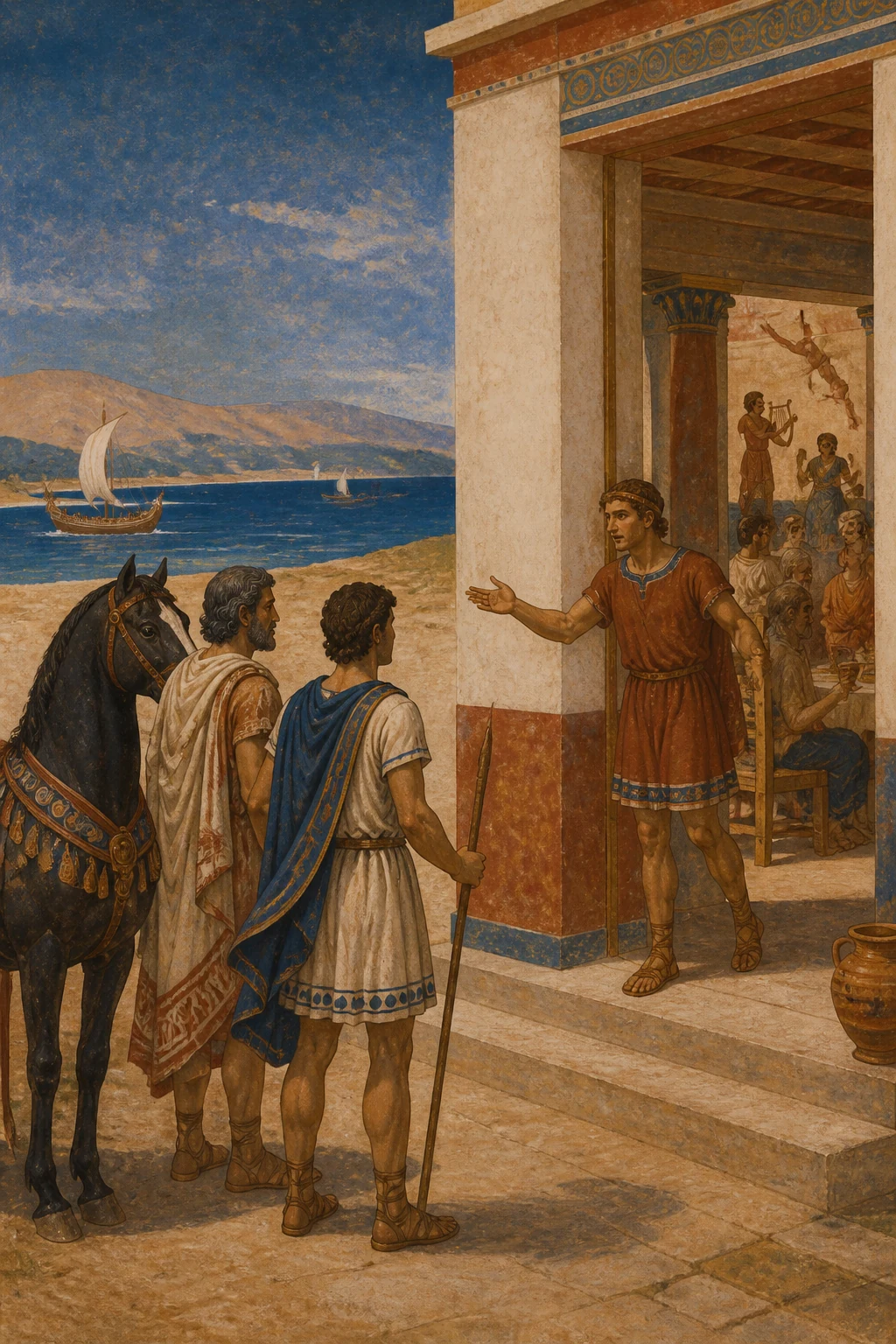
So he spoke, and swiftly broke up the assembly. The people dispersed, each to his own home, while the suitors went to the house of godlike Odysseus. Telemachus walked apart along the seashore, washed his hands in the gray sea, and prayed to Athena: “Hear me, god who came to our house yesterday and urged me to sail over the misty sea in search of news of my long-absent father’s return. The Achaeans are thwarting all this, above all the suitors in their wicked arrogance.”
So he prayed, and Athena drew near, taking Mentor’s form and voice. She addressed him with winged words: “Telemachus, you will not prove a coward or a fool in the days to come, if your father’s noble spirit has indeed been instilled in you. What a man he was for bringing word and deed to fulfillment! If you are like him, your voyage will be neither fruitless nor unfinished.
“But if you are not truly the son of Odysseus and Penelope, then I have no hope that you will accomplish what you intend. Few sons are their fathers’ equals: most are worse, and only a few are better.
“But since you will not prove a coward or a fool, and Odysseus’ cunning has not wholly deserted you, there is hope that you will bring these plans to fulfillment. So leave the foolish suitors to their schemes and purposes. They have neither sense nor justice, and do not know that death and dark doom stand close beside them: all will perish in a single day.
“The voyage you desire will not be delayed much longer. Such a friend of your father am I that I will equip a swift ship for you and go with you myself. Now return to the house and mingle with the suitors. Prepare provisions and pack them in containers: wine in jars, and barley meal, the marrow of men, in stout leather bags. I will quickly gather volunteers from among the people. There are many ships in sea-girt Ithaca, new and old. I will look them over and choose the best; then we will quickly fit her out and launch her on the open sea.”
So spoke Athena, daughter of Zeus. Telemachus lingered no longer when he heard the goddess’s voice. He set out for home, troubled at heart, and found the arrogant suitors in the halls, skinning goats and singeing fat hogs in the courtyard.
Antinous came straight toward Telemachus with a laugh, clasped his hand, and said, “Telemachus, you boastful speaker, headstrong and unbridled, let no more bitter schemes or speeches trouble your heart. Come, eat and drink with me as you used to.
“The Achaeans will provide everything you need—a ship and picked oarsmen—so that you can reach holy Pylos without delay and seek news of your illustrious father.” Then thoughtful Telemachus answered him: “Antinous, I cannot feast quietly among you overbearing men and take my ease and pleasure.
“Was it not enough, you suitors, that you wasted so much of my fine property while I was still a child? Now I am grown, and by listening to others I understand what is happening, and the spirit within me is gathering strength. I will try to bring a deadly doom upon you, whether I go to Pylos or remain here in this land.
“Go I shall, and the voyage I speak of will not be in vain. I will travel as a passenger, since I have no ship or oarsmen of my own: that, it seems, is how you thought to serve your interests best.” With that he easily drew his hand from Antinous’ grasp. The suitors went about preparing their feast in the house.
They mocked and taunted him. One of the arrogant young men would say, “Telemachus is certainly plotting our murder! Perhaps he will bring men to defend him from sandy Pylos, or even Sparta, so fiercely is he bent on going. Or perhaps he means to visit Ephyra, that fertile land, and bring back deadly poisons to drop into the mixing bowl and kill us all.”
Then another of the arrogant young men would say, “Who knows? He may sail off in a hollow ship and perish far from his friends, wandering like Odysseus. That would give us still more trouble! We would have to divide all his property among ourselves, and leave the house for his mother and whoever marries her.”
So they spoke. Meanwhile he went down to his father’s spacious, high-roofed storeroom, where gold and bronze lay piled, clothes filled the chests, and there was fragrant oil in abundance. Jars of mellow, sweet old wine stood there too, holding the pure, divine drink, ranged neatly against the wall, against the day when Odysseus might come home after his many sufferings.
The close-fitting double doors were shut and locked. Within, a woman kept watch by night and day, guarding everything with seasoned care: Eurycleia, daughter of Ops, son of Peisenor.
Telemachus called her into the storeroom and said, “Nurse, come, draw me some sweet wine into jars—the best after the wine you are saving for that unhappy man, still hoping that Zeus-born Odysseus may return from somewhere, having escaped death and doom.
“Fill twelve jars and fit them all with lids. Then pour barley meal into well-sewn leather bags: twenty measures of ground barley. Keep this to yourself, and have everything ready together. I will take it away this evening, when my mother has gone upstairs and is thinking of bed.
“I am going to Sparta and sandy Pylos to seek news of my dear father’s return, in the hope that I may hear something.” So he spoke, and his dear nurse Eurycleia cried aloud. Lamenting, she addressed him with winged words: “Why, dear child, has such a thought come into your mind? Where do you mean to go, across the wide earth, you, our only, cherished son? Zeus-born Odysseus has perished far from his country, among a foreign people.
“The moment you leave, these men will plot evil behind your back, to kill you by treachery and divide all this among themselves. No, stay here, tending what is yours. You have no need to wander over the barren sea and suffer hardship.”
Then thoughtful Telemachus answered her: “Take heart, nurse. This plan is not without a god’s guidance. But swear not to tell my dear mother until the eleventh or twelfth day has come, unless she misses me herself and hears that I have gone. I would not have her spoil her lovely skin with weeping.”
So he spoke, and the old woman swore the great oath of the gods. When she had sworn and completed the oath, she at once drew wine into jars for him and poured barley meal into well-sewn leather bags.
Telemachus returned to the hall and mingled with the suitors. Then the goddess, bright-eyed Athena, devised another plan. Taking Telemachus’ likeness, she went through every part of the town, approaching each man in turn and bidding him gather beside the swift ship at evening.
She also asked the noble Noemon, son of Phronius, for a swift ship, and he readily promised her one. The sun set, and all the streets grew dark. Then she drew the swift ship down to the sea and put aboard all the gear that well-benched ships carry.
She moored her at the harbor’s edge, and the good companions gathered round her in a body. The goddess encouraged each man. Then bright-eyed Athena devised another plan. She went to the house of godlike Odysseus and poured sweet sleep over the suitors, befuddling them as they drank and making the cups fall from their hands.
They rose to go to bed in their homes throughout the town, and did not sit much longer, for sleep was falling on their eyelids. Then bright-eyed Athena called Telemachus out of the stately hall and spoke to him, taking Mentor’s form and voice: “Telemachus, your well-greaved companions are already sitting at the oars, waiting for you to set out. Come, let us not delay the voyage any longer.”
With these words Pallas Athena led the way swiftly, and he followed in the goddess’s footsteps. When they came down to the ship and the sea, they found their long-haired companions waiting on the shore.
Then Telemachus, strong with a sacred strength, addressed them: “Come, friends, let us fetch the provisions. Everything is ready together in the house. My mother knows nothing of this, nor do the other serving women. Only one has heard our plan.”
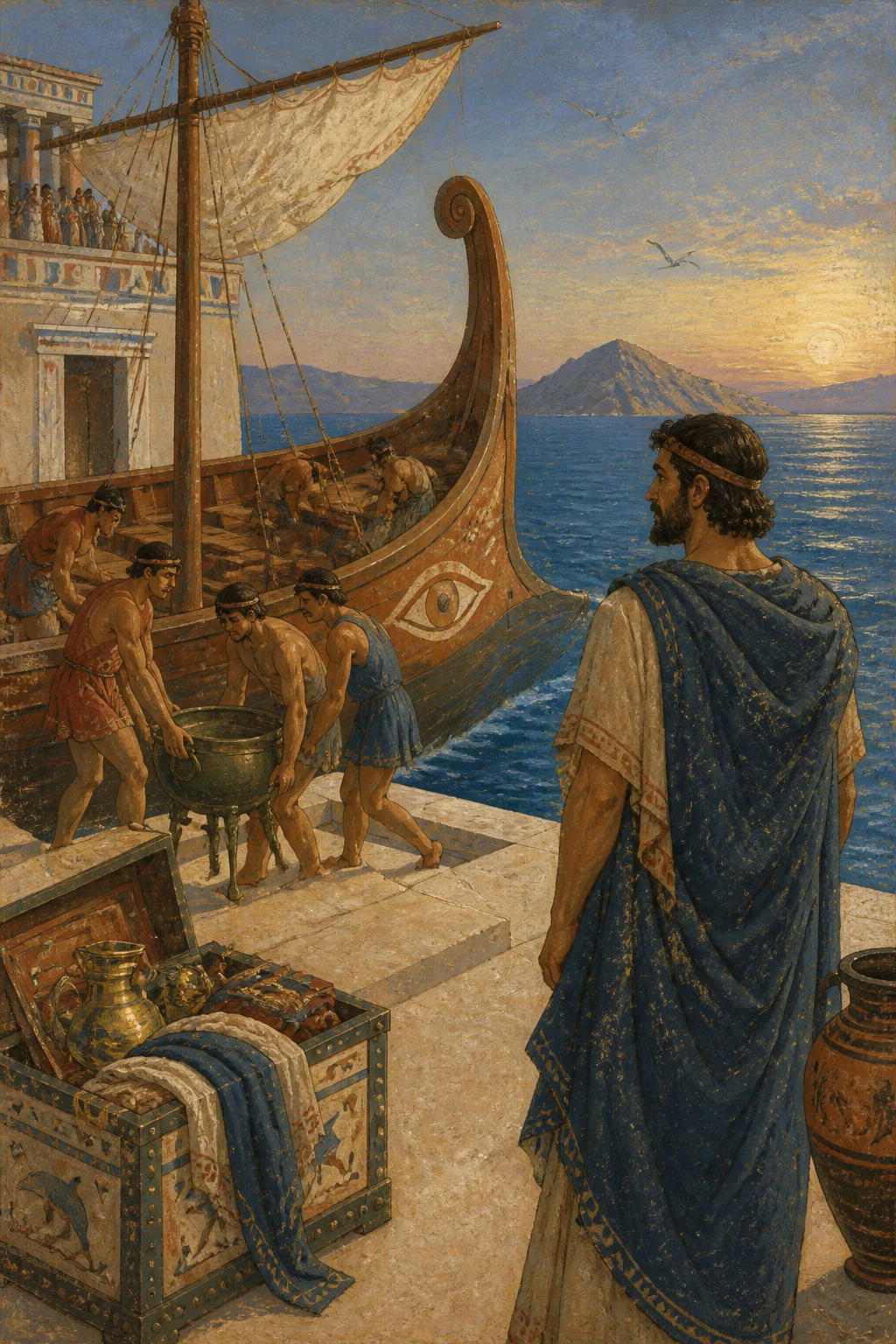
With that he led the way, and they followed. They carried everything down and stowed it aboard the well-benched ship, as Odysseus’ beloved son directed. Then Telemachus boarded, Athena going before him. She sat in the stern, and Telemachus took his seat beside her. The men cast off the stern cables, climbed aboard, and sat down at the oarlocks.
Bright-eyed Athena sent them a favorable wind, a strong west wind singing over the wine-dark sea. Telemachus urged his companions on and ordered them to lay hold of the rigging. They obeyed his call.
They raised the fir mast, set it in its hollow socket, and secured it with forestays. Then they hoisted the white sail with twisted oxhide ropes. The wind filled the belly of the sail, and as the ship moved on, the dark wave roared loudly about her stem. She raced over the waves, making her way.
When they had made the rigging fast throughout the swift black ship, they set out mixing bowls brimming with wine and poured libations to the immortal, everlasting gods, above all to the bright-eyed daughter of Zeus.
All night and into the dawn the ship sped on her course.