Prevod
1. Prometheus fashioned human beings from water and earth and gave them fire as well, hiding it in a fennel stalk without Zeus’s knowledge. When Zeus discovered this, he ordered Hephaestus to nail his body to Mount Caucasus, a mountain in Scythia. Nailed there, Prometheus remained bound for many years. Each day an eagle swooped down upon him and devoured the lobes of his liver, which grew back during the night. Such was the punishment Prometheus paid for stealing fire, until Heracles later set him free, as we shall relate in our account of Heracles.
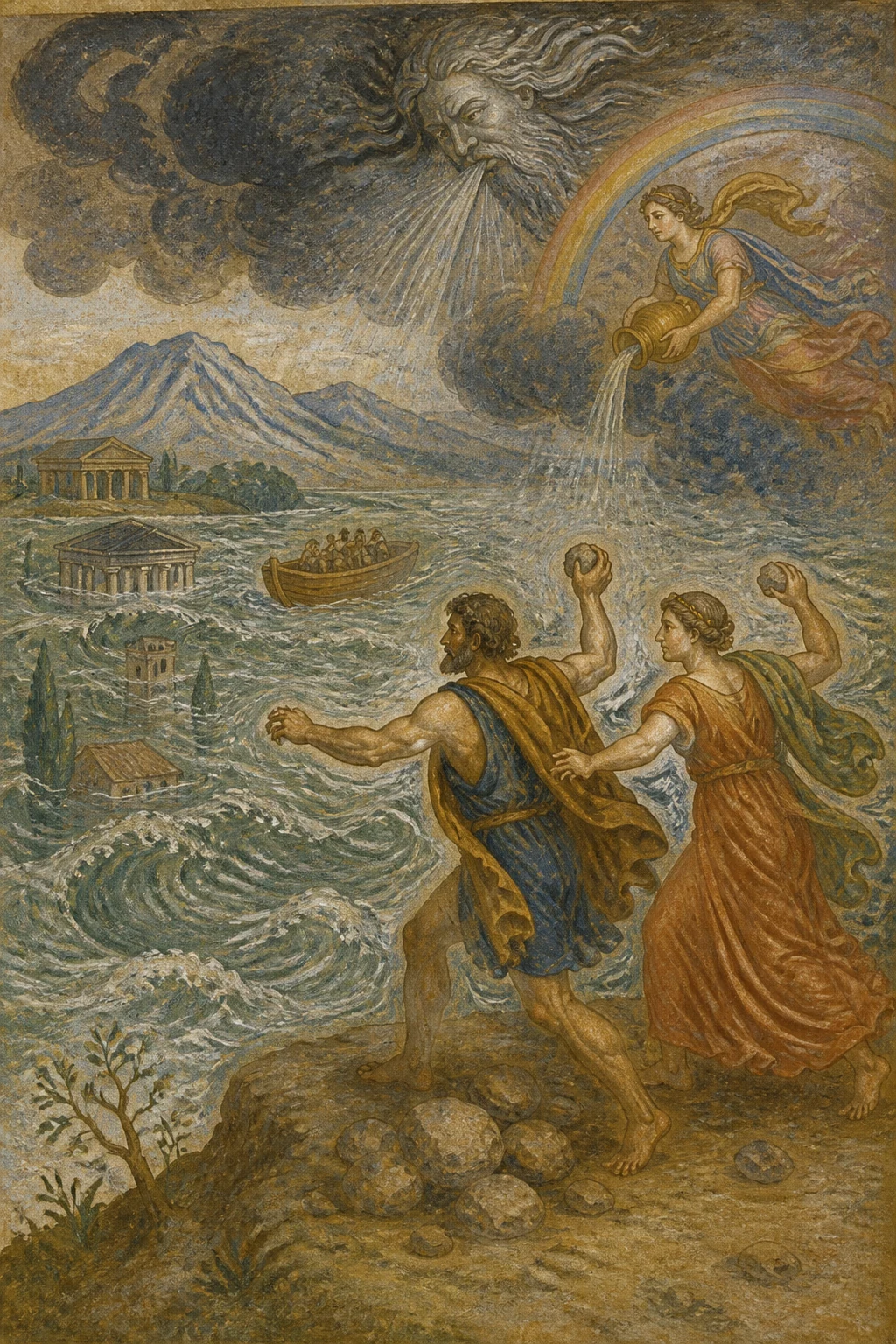
2. Prometheus had a son, Deucalion. As king of the lands around Phthia, he married Pyrrha, the daughter of Epimetheus and Pandora, the first woman fashioned by the gods. When Zeus decided to destroy the race of bronze, Deucalion, on Prometheus’s advice, built a chest, stored provisions in it, and boarded it with Pyrrha. Zeus poured down torrents of rain from heaven and flooded most of Greece, so that all its people perished except a few who fled to the high mountains nearby. At that time the mountains of Thessaly also split apart, and all the land beyond the Isthmus and the Peloponnese was submerged. After drifting across the sea in his chest for nine days and as many nights, Deucalion came to rest on Mount Parnassus. There, when the rains ceased, he stepped out and offered sacrifice to Zeus, the god of escape. Zeus sent Hermes to him and allowed him to choose whatever he wished; he chose to have people around him. At Zeus’s bidding, he picked up stones and threw them over his head. Those Deucalion threw became men, and those Pyrrha threw became women. Hence people were figuratively called laoi, from laas, the word for stone. Pyrrha bore Deucalion three children: first Hellen, whom some say was fathered by Zeus; second Amphictyon, who ruled Attica after Cranaus; and a daughter, Protogenia, who bore Aethlius to Zeus.
3. Hellen and the nymph Orseis had three sons: Dorus, Xuthus, and Aeolus. Hellen named the people then called Greeks Hellenes after himself, and divided the land among his sons. Xuthus received the Peloponnese and had two sons by Creusa, daughter of Erechtheus: Achaeus and Ion, from whom the Achaeans and Ionians take their names. Dorus received the land across from the Peloponnese and called its inhabitants Dorians after himself. Aeolus ruled the lands around Thessaly and called their inhabitants Aeolians. He married Enarete, daughter of Deimachus, and had seven sons—Cretheus, Sisyphus, Athamas, Salmoneus, Deion, Magnes, and Perieres—and five daughters: Canace, Alcyone, Pisidice, Calyce, and Perimede. Perimede bore Hippodamas and Orestes to Achelous, while Pisidice bore Antiphus and Actor to Myrmidon.
4. Alcyone married Ceyx, son of Eosphorus. They were ruined by their arrogance: he called his wife Hera, and she called her husband Zeus. Zeus turned them into birds, making her a kingfisher and him a gannet. Canace bore Poseidon five sons: Hopleus, Nireus, Epopeus, Aloeus, and Triopas. Aloeus married Iphimedia, daughter of Triopas. She fell in love with Poseidon and would often go down to the sea, scoop up its waves in her hands, and pour the water into her bosom. Poseidon lay with her, and she bore two sons, Otus and Ephialtes, who were known as the Aloadae. Each year they grew a cubit in breadth and a fathom in height. By the time they were nine years old, they were nine cubits broad and nine fathoms tall, and planned to make war on the gods. They piled Ossa upon Olympus and Pelion upon Ossa, threatening to climb into heaven by way of these mountains. They declared that they would fill the sea with mountains and turn it into dry land, and make the land a sea. Ephialtes sought Hera’s hand, and Otus that of Artemis. They also bound Ares, but Hermes secretly freed him. Artemis killed the Aloadae on Naxos by a trick: changing her form into that of a deer, she leaped between them, and in their eagerness to strike the animal they hurled their spears at one another.
5. Calyce and Aethlius had a son, Endymion, who led Aeolians out of Thessaly and settled Elis. Some, however, say that he was a son of Zeus. He was so surpassingly beautiful that Selene fell in love with him. Zeus granted him whatever he wished, and he chose to sleep forever, remaining immortal and untouched by age.
6. Endymion and a naiad nymph—or, as some say, Iphianassa—had a son, Aetolus. After killing Apis, son of Phoroneus, he fled to the land of the Curetes. There he killed the sons of Phthia and Apollo—Dorus, Laodocus, and Polypoetes—who had welcomed him, and named the country Aetolia after himself.
7. Aetolus and Pronoe, daughter of Phorbus, had two sons, Pleuron and Calydon, after whom the cities in Aetolia were named. Pleuron married Xanthippe, daughter of Dorus, and had a son, Agenor, and three daughters, Sterope, Stratonice, and Laophonte. Calydon and Aeolia, daughter of Amythaon, had two daughters, Epicaste and Protogenia; the latter bore Oxylus to Ares. Agenor, son of Pleuron, married Epicaste, daughter of Calydon, and had Porthaon and Demonice. Demonice bore Ares four sons: Evenus, Molus, Pylus, and Thestius.
8. Evenus had a daughter, Marpessa. While Apollo was courting her, Idas, son of Aphareus, carried her off in a winged chariot he had received from Poseidon. Evenus pursued them in his chariot as far as the river Lycormas. Unable to overtake them, he slaughtered his horses and threw himself into the river, which is called the Evenus after him.
9. Idas reached Messenia, where Apollo met him and took the girl away. As they fought over who should marry her, Zeus separated them and allowed the maiden herself to choose which of the two she wished to live with. Fearing that Apollo might abandon her when she grew old, she chose Idas for her husband.
10. Thestius had three daughters by Eurythemis, daughter of Cleoboea—Althaea, Leda, and Hypermnestra—and four sons: Iphiclus, Euippus, Plexippus, and Eurypylus. Porthaon and Euryte, daughter of Hippodamas, had five sons—Oeneus, Agrius, Alcathous, Melas, and Leucopeus—and a daughter, Sterope, who is said to have borne the Sirens to Achelous.