O besedilu
Enej v Laciju
- Vir
- Ovidove preobrazbe
- Avtor
- Ovid
- Jezik branja
- English
- Jezik izvirnika
- Latin
- Čas branja
- 7 min branja
- Obseg
- 6 strani
- Naslov izvirnika
- Aeneas in Latium
O izvirniku
Ovidove preobrazbe
Pesniški tok antičnih preobrazb, kjer bogovi, ljudje in narava stalno menjavajo obliko. Bralni jezik je English, izvirnik pa prihaja iz vira Ovidove preobrazbe v jeziku Latin.
Besedilo
Enej v Laciju
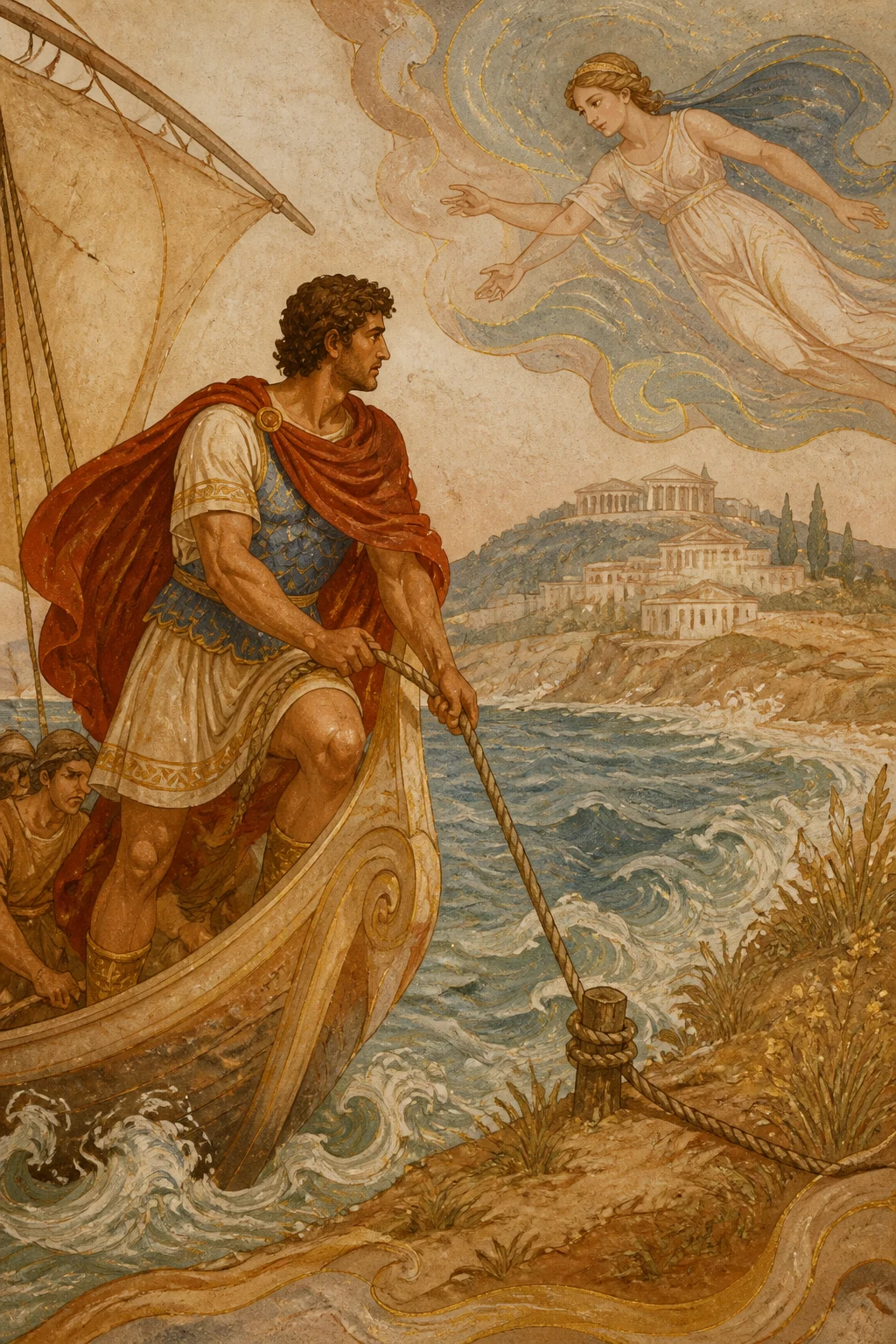
Macareus had finished. The urn of Aeneas’s nurse, laid in a marble tomb, bore this brief inscription: HERE MY FOSTER-SON, FAMED FOR HIS DEVOTION, BURNED ME, CAIETA, WITH THE FIRE HE OWED ME, HAVING SAVED ME FROM THE ARGIVE FLAMES. The rope that held the ship to the grassy bank is loosed, and they leave far behind the snares and dwelling of the ill-famed goddess, making for the groves where, dark with shade, the Tiber pours into the sea, laden with yellow sand.
Aeneas wins the home and daughter of Latinus, son of Faunus, though not without warfare: he must take up arms against a fierce people, and Turnus rages for his promised bride. All Etruria joins the struggle in Latium, and long they strive for a hard-won victory with anxious arms. Each side increases its strength with foreign forces, and many defend the Rutulian camp, many the Trojan. Nor had Aeneas gone in vain to Evander’s walls, but Venulus had come in vain to the city of the exiled Diomedes: under Iapygian Daunus, that hero had founded a mighty city and held the lands given with his bride.
But when Venulus had delivered Turnus’s message and asked for help, the Aetolian hero pleaded lack of strength: he would not commit his father-in-law’s people to battle, and had none of his own countrymen left to arm. “And lest you think these mere excuses, though recalling them renews my bitter grief, I will endure the telling. After lofty Ilium was burned and Pergamum fed the Grecian flames, and the hero of Narycus, who stole a maiden from the virgin goddess, spread among us all the punishment he alone deserved, we Greeks were scattered, swept by winds over hostile seas, enduring lightning, darkness, rain, the wrath of heaven
and ocean, and Caphereus to crown our ruin. Not to delay you with each sorrowful disaster in turn, Greece then might have moved even Priam to tears. Yet the care of warlike Minerva saved me, snatching me from the waves; but once again I was driven from my native fields, and gracious Venus, remembering her ancient wound, exacted vengeance. Such hardships I endured upon the deep seas, such hardships in warfare on land, that I often called those men fortunate whom the storm we all shared and cruel Caphereus drowned in the waves, and wished I had been among them.
My companions, having suffered the worst in war and at sea, lost heart and begged for an end to our wandering. But Acmon, fiery by nature, and now embittered by disaster, said, ‘What is left, men, that our endurance would now refuse to bear? What more can Cytherea do to us—even if she wishes it? While we fear worse things, we leave ourselves open to wounds; but when our lot is at its worst, fear lies beneath our feet: the height of misery is free from care.
Let her herself hear me, and hate, as she does, every man under Diomedes: we all despise her hatred, and her mighty power costs us dear indeed!’ With words like these Acmon of Pleuron provoked the angry Venus, goading her wrath to life again. A few approved his speech; the greater number of us, his friends, rebuked Acmon. As he tried to answer, his voice grew thin, and so did the passage of his voice; his hair turned into feathers, and feathers covered his altered neck, his breast and back. His arms received longer plumes, and his elbows curved into weightless wings.
Most of each foot became toes; his mouth hardened into horn and narrowed to a point. Lycus marvelled at him, and Idas, Nycteus with Rhexenor, and Abas; and while they marvelled, they assumed the same shape, and most of my company rose into the air and wheeled about the oars on beating wings. If you ask the shape of these birds of uncertain kind, though not swans, they closely resemble white swans.
With barely a handful of my men, I hold this home and the parched fields of Iapygian Daunus, as his son-in-law.” So far spoke the descendant of Oeneus. Venulus left the Calydonian realm, the bays of the Peucetians, and the fields of Messapia. There he saw caves, shaded by thick woods and dripping among slender reeds, which goat-legged Pan now inhabits, though once they belonged to nymphs.
An Apulian shepherd in that country frightened them, driving them away and startling them at first with sudden terror. But soon, recovering their wits and scorning their pursuer, they moved their feet in time and formed a dance. The shepherd mocked them, aping their movements with rustic leaps, and added coarse abuse and obscene words. His mouth did not fall silent until a tree enclosed his throat: for by the tree and its sap you may know his character.
The wild olive’s bitter berries preserve the mark of his tongue: into them passed the harshness of his words. When the envoys returned from there, bringing word that Aetolian aid had been denied them, the Rutulians fought the war they had begun without those forces, and much blood was shed on either side. And now Turnus brought ravenous torches against the pine-built ships: what the waves had spared feared fire.
Already Mulciber was burning pitch and wax and all else that fed the flames, climbing the tall mast towards the sails; the benches of the curving hulls were smoking, when the holy Mother of the Gods, remembering that these pines had been felled on Ida’s summit, filled the air with the clang of beaten bronze and the droning of boxwood pipes. Riding her tamed lions through the airy heavens, she cried, “In vain, Turnus, does your sacrilegious hand hurl fire! I shall rescue them: never with my consent shall devouring flames consume these limbs and portions of my woods.”
As the goddess spoke, thunder sounded, and after the thunder heavy rain poured down with bouncing hail. The sons of Astraeus stirred the air and swollen sea with sudden clashes, and the brothers went to battle. With the strength of one of them, the gracious Mother snapped the hempen moorings of the Phrygian fleet, carried the ships headlong out, and sank them beneath the sea.
Their timbers softened, their wood turned into flesh; the curving sterns were changed to the shapes of heads, the oars became toes and swimming legs. What had been their sides remained their sides; the keel beneath the centre of each ship became a backbone. The rigging turned to flowing hair, the yardarms into arms; their colour remained sea-blue. The waters they had feared they now stirred in their maiden games, sea-nymphs born upon the rugged mountains, sporting in the gentle sea, untroubled by their origins.
Yet they did not forget how many dangers they had so often suffered on the deep, and often held out their hands beneath storm-tossed ships—unless a ship bore Greeks. Still mindful of the Phrygian catastrophe, they hated the Pelasgians, and looked with delight upon the wreckage of the Neritian ship, and with delight they saw Alcinous’s vessel stiffen, and stone grow over its wooden frame.
There was hope that, once the fleet had come alive as sea-nymphs, fear of the marvel might make the Rutulian abandon the war. He persisted. Each side had gods to aid it, and each possessed courage to match the gods. No longer was it a kingdom given in marriage, nor a father-in-law’s sceptre, nor you, maiden Lavinia, they sought, but victory alone; ashamed to lay down their arms, they fought on. At last Venus saw her son’s weapons triumph: Turnus fell, and Ardea fell, called mighty while Turnus lived. After a foreign sword had taken him and her houses lay buried in warm ash, from the midst of the ruins a bird, unknown till then, rose into the air and beat the ashes with its wings.
Its cry, its leanness, its pallor—all befitted a captured city; even the city’s name remained in the bird, and Ardea mourns herself with her own wings.
Izvirnik
Aeneas in Latium
Naslednje strani prikazujejo izvirno besedilo za primerjavo.
Source ID: ovid_metamorphoses_story_095 Citation: Ovid, Metamorphoses 14.441-14.580 Original language: Latin Source: PerseusDL canonical-latinLit Source URL: https://github.com/PerseusDL/canonical-latinLit/blob/master/data/phi0959/phi006/phi0959.phi006.perseus-lat2.xml Segmentation certainty: medium 441: Finierat Macareus. Urnaque Aeneia nutrix 442: condita marmoreo tumulo breve carmen habebat: 443: HIC ME CAIETAM NOTAE PIETATIS ALUMNUS 444: EREPTAM ARGOLICO QUO DEBUIT IGNE CREMAVIT.
445: Solvitur herboso religatus ab aggere funis, 446: et procul insidias infamataeque relinquunt 447: tecta deae lucosque petunt, ubi nubilus umbra 448: in mare cum flava prorumpit Thybris harena; 449: Faunigenaeque domo potitur nataque Latini, 450: non sine Marte tamen: bellum cum gente feroci 451: suscipitur, pactaque furit pro coniuge Turnus. 452: Concurrit Latio Tyrrhenia tota, diuque 453: ardua sollicitis victoria quaeritur armis.
454: Auget uterque suas externo robore vires, 455: et multi Rutulos, multi Troiana tuentur 456: castra. Neque Aeneas Euandri ad moenia frustra, 457: at Venulus frustra profugi Diomedis ad urbem 458: venerat: ille quidem sub Iapyge maxima Dauno 459: moenia condiderat dotaliaque arva tenebat. 460: Sed Venulus Turni postquam mandata peregit 461: auxilium petiit, vires Aetolius heros 462: excusat: nec se aut soceri committere pugnae 463: velle sui populos, aut quos e gente suorum 464: armet habere ullos, “neve haec commenta putetis, 465: admonitu quamquam luctus renoventur amari
466: perpetiar memorare tamen. Postquam alta cremata est 467: Ilion et Danaas paverunt Pergama flammas, 468: Naryciusque heros, a virgine virgine rapta, 469: quam meruit poenam solus, digessit in omnes, 470: spargimur et ventis inimica per aequora rapti 471: fulmina, noctem, imbres, iram caelique marisque 472: perpetimur Danai cumulumque Capherea cladis. 473: Neve morer referens tristes ex ordine casus, 474: Graecia tum potuit Priamo quoque flenda videri.
475: Me tamen armiferae servatum cura Minervae 476: fluctibus eripuit, patriis sed rursus ab agris 477: pellor, et antiquo memores de vulnere poenas 478: exigit alma Venus, tantosque per alta labores 479: aequora sustinui, tantos terrestribus armis, 480: ut mihi felices sint illi saepe vocati, 481: quos communis hiems importunusque Caphereus 482: mersit aquis, vellemque horum pars una fuissem.
483: Ultima iam passi comites belloque fretoque 484: deficiunt finemque rogant erroris, at Acmon 485: fervidus ingenio, tum vero et cladibus asper, 486: “quid superest, quod iam patientia nostra recuset 487: ferre, viri?” dixit; “quid habet Cytherea, quod ultra 488: (velle puta!) faciat? Nam dum peiora timentur, 489: est locus in vulnus: sors autem ubi pessima rerum, 490: sub pedibus timor est securaque summa malorum.
491: Audiat ipsa licet, et, quod facit, oderit omnes 492: sub Diomede viros, odium tamen illius omnes 493: spernimus: et magno stat magna potentia nobis!” 494: Talibus iratam Venerem Pleuronius Acmon 495: instimulat verbis stimulisque resuscitat iram. 496: Dicta placent paucis: numeri maioris amici 497: Acmona corripimus; cui respondere volenti 498: vox pariter vocisque via est tenuata, comaeque 499: in plumas abeunt, plumis nova colla teguntur 500: pectoraque et tergum, maiores bracchia pennas 501: accipiunt, cubitusque leves sinuatur in alas.
502: Magna pedis digitos pars occupat, oraque cornu 503: indurata rigent finemque in acumine ponunt. 504: Hunc Lycus, hunc Idas et cum Rhexenore Nycteus, 505: hunc miratur Abas: et dum mirantur, eandem 506: accipiunt faciem, numerusque ex agmine maior 507: subvolat et remos plausis circumvolat alis. 508: Si volucrum quae sit dubiarum forma, requiris, 509: ut non cygnorum, sic albis proxima cygnis.
510: Vix equidem has sedes et Iapygis arida Dauni 511: arva gener teneo minima cum parte meorum.” 512: Hactenus Oenides. Venulus Calydonia regna 513: Peucetiosque sinus Messapiaque arva relinquit. 514: In quibus antra videt, quae multa nubila silva 515: et levibus cannis manantia semicaper Pan 516: nunc tenet, at quodam tenuerunt tempore nymphae. 517: Apulus has illa pastor regione fugatas 518: terruit et primo subita formidine movit, 519: mox, ubi mens rediit et contempsere sequentem, 520: ad numerum motis pedibus duxere choreas.
521: Improbat has pastor, saltuque imitatus agresti 522: addidit obscenis convicia rustica dictis, 523: nec prius os tacuit, quam guttura condidit arbor: 524: arbore enim sucoque licet cognoscere mores; 525: quippe notam linguae bacis oleaster amaris 526: exhibet: asperitas verborum cessit in illas. 527: Hinc ubi legati rediere, negata ferentes 528: arma Aetola sibi, Rutuli sine viribus illis 529: bella instructa gerunt, multumque ab utraque cruoris 530: parte datur; fert ecce avidas in pinea Turnus 531: texta faces, ignesque timent, quibus unda pepercit.
532: Iamque picem et ceras alimentaque cetera flammae 533: Mulciber urebat perque altum ad carbasa malum 534: ibat, et incurvae fumabant transtra carinae: 535: cum memor has pinus Idaeo vertice caesas 536: sancta deum genetrix tinnitibus aera pulsi 537: aeris et inflati complevit murmure buxi, 538: perque leves domitis invecta leonibus auras 539: “inrita sacrilega iactas incendia dextra, 540: Turne!” ait. “Eripiam, nec me patiente cremabit 541: ignis edax nemorum partes et membra meorum.”
542: Intonuit dicente dea, tonitrumque secuti 543: cum saliente graves ceciderunt grandine nimbi, 544: aeraque et tumidum subitis concursibus aequor 545: Astraei turbant et eunt in proelia fratres. 546: E quibus alma parens unius viribus usa 547: stuppea praerupit Phrygiae retinacula puppis 548: fertque rates pronas medioque sub aequore mergit; 549: robore mollito lignoque in corpora verso 550: in capitum facies puppes mutantur aduncae, 551: in digitos abeunt et crura natantia remi, 552: quodque prius fuerat, latus est mediisque carina 553: subdita navigiis spinae mutatur in usum,
554: lina comae molles, antemnae bracchia fiunt, 555: caerulus, ut fuerat, color est; quasque ante timebant, 556: illas virgineis exercent lusibus undas 557: naides aequoreae durisque in montibus ortae 558: molle fretum celebrant nec eas sua tangit origo. 559: Non tamen oblitae, quam multa pericula saepe 560: pertulerint pelago, iactatis saepe carinis 561: supposuere manus, nisi siqua vehebat Achivos: 562: cladis adhuc Phrygiae memores, odere Pelasgos 563: Neritiaeque ratis viderunt fragmina laetis 564: vultibus et laetis videre rigescere puppem 565: vultibus Alcinoi saxumque increscere ligno.
566: Spes erat, in nymphas animata classe marinas, 567: posse metu monstri Rutulum desistere bello: 568: perstat, habetque deos pars utraque, quodque deorum est 569: instar, habent animos; nec iam dotalia regna 570: nec sceptrum soceri, nec te, Lavinia virgo, 571: sed vicisse petunt deponendique pudore 572: bella gerunt, tandemque Venus victricia nati 573: arma videt, Turnusque cadit, cadit Ardea, Turno 574: sospite dicta potens. Quem postquam barbarus ensis 575: abstulit et tepida latuerunt tecta favilla, 576: congerie e media tum primum cognita praepes 577: subvolat et cineres plausis everberat alis.
578: Et sonus et macies et pallor et omnia, captam 579: quae deceant urbem, nomen quoque mansit in illa 580: urbis; et ipsa suis deplangitur Ardea pennis.
Nadaljuj z branjem