Prevod
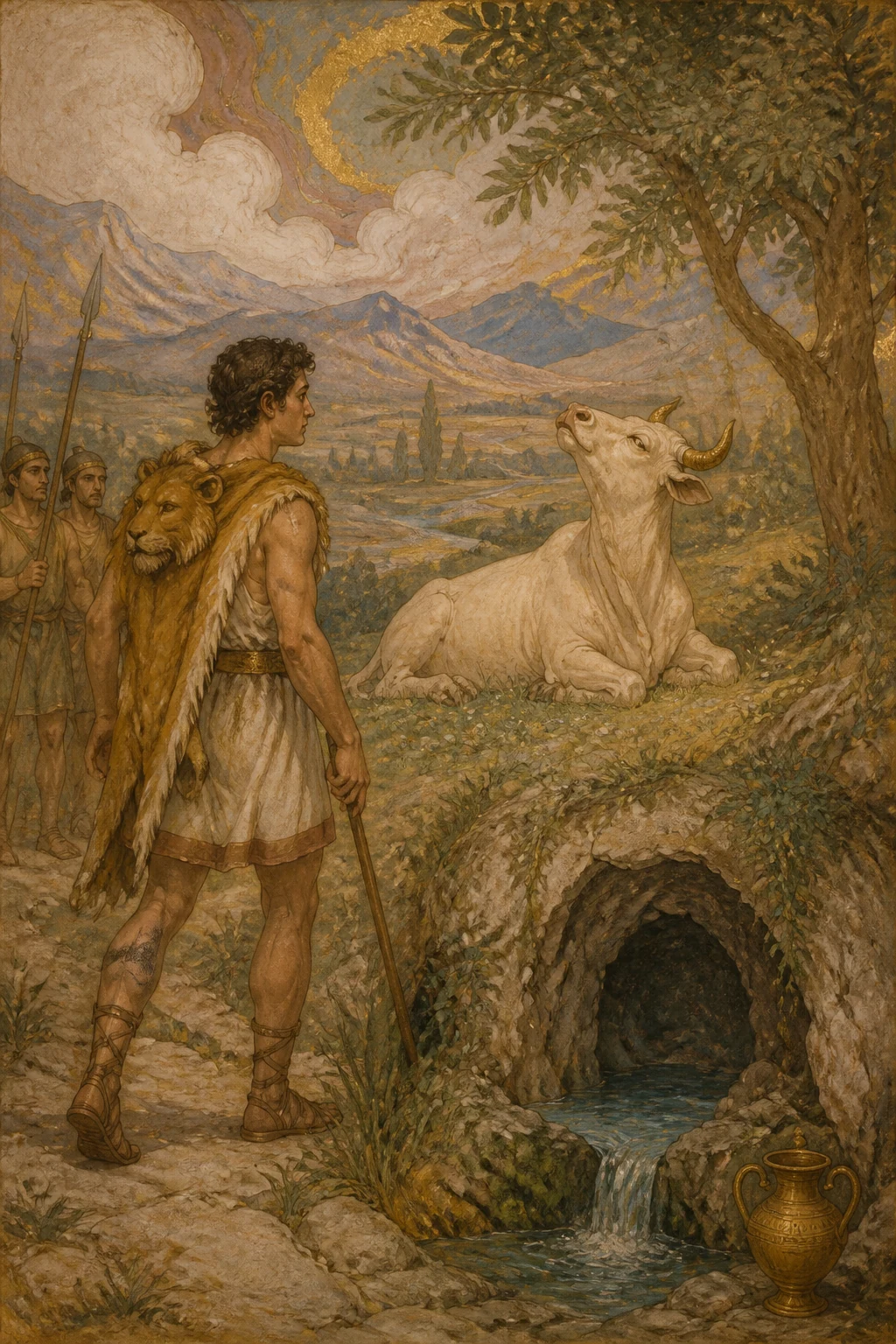
1. Such, then, are the stories told of Demeter. But Gaia, enraged over the fate of the Titans, bore the Giants to Uranus. Their bodies were unsurpassed in size and their strength invincible. Terrible to behold, they had long, thick hair hanging from their heads and chins, and their legs were covered with serpents’ scales. Some say they were born at Phlegra, others at Pallene. They hurled rocks and blazing oaks into heaven. Foremost among them were Porphyrion and Alcyoneus, who was immortal so long as he fought in the land of his birth. It was he who drove away the cattle of Helios from Erytheia. Now the gods had received an oracle declaring that none of the Giants could be killed by gods alone, but that they would perish if a mortal joined the gods in battle. When Gaia learned this, she searched for a herb that would prevent them from being killed even by a mortal. But Zeus forbade Dawn, the Moon, and the Sun to shine, and gathered the herb himself before Gaia could find it. Then, through Athena, he summoned Heracles to fight beside the gods. Heracles first shot Alcyoneus with an arrow, but when the Giant fell to the ground, his strength revived. On Athena’s advice, Heracles dragged him beyond the borders of Pallene.
2. Thus Alcyoneus died. During the battle Porphyrion attacked Heracles and Hera. But Zeus filled him with desire for Hera, and as he tore her robes and tried to rape her, she cried out for help. Zeus struck him with a thunderbolt, and Heracles shot him dead. Of the remaining Giants, Ephialtes was shot in the left eye by Apollo and in the right by Heracles. Dionysus killed Eurytus with his thyrsus, Hecate killed Clytius with torches, and Hephaestus struck Mimas with red-hot masses of metal.
Athena hurled the island of Sicily upon Enceladus as he fled, and flayed Pallas, using his skin to cover her own body during the battle. Pursued through the sea by Poseidon, Polybotes reached Cos; Poseidon tore off a piece of the island and hurled it upon him—the piece now called Nisyros. Wearing the helmet of Hades, Hermes killed Hippolytus in the battle, while Artemis killed † Gration, and the Fates fought with bronze clubs and killed Agrius and Thoon. Zeus struck the others with thunderbolts and destroyed them, and Heracles shot every one of them as they lay dying.
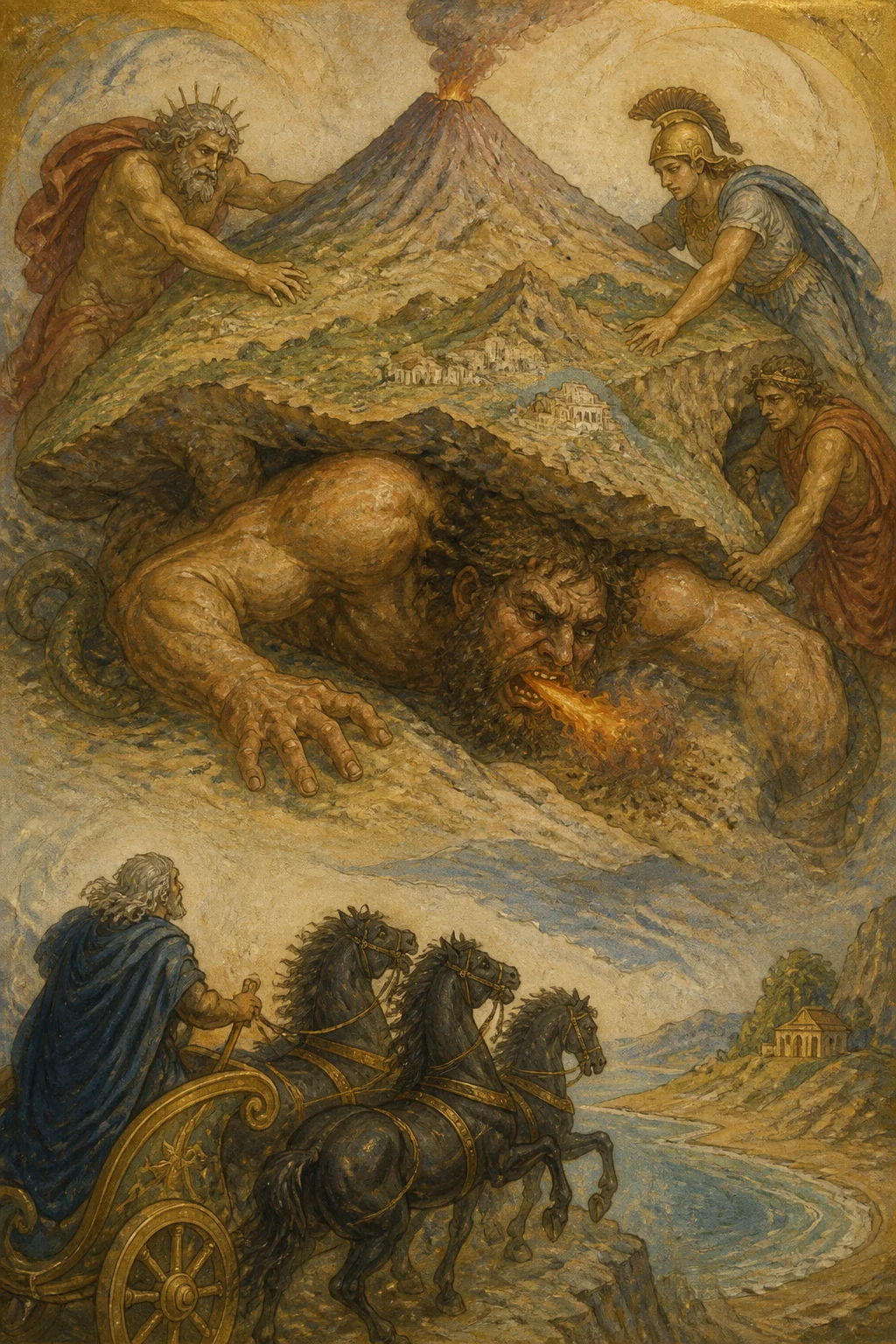
3. When the gods had overcome the Giants, Gaia, still more enraged, coupled with Tartarus and bore Typhon in Cilicia, a creature whose nature mingled man and beast. In both size and strength he surpassed all the offspring of Gaia. Down to his thighs he had a human form of such enormous size that he towered above every mountain, and his head often brushed the stars. One hand stretched out to the west and the other to the east, and from them sprang a hundred serpents’ heads. Below his thighs were immense coils of vipers, whose bodies stretched up to his very head and gave out a great hissing. His whole body was winged, shaggy hair streamed in the wind from his head and cheeks, and fire flashed from his eyes. Such was Typhon’s nature and size as he rushed at heaven itself, hurling blazing rocks amid hisses and roars, while a great whirlwind of flame poured from his mouth. When the gods saw him charging at heaven, they fled to Egypt, and as he pursued them, they changed their forms into animals. While Typhon was still far away, Zeus hurled thunderbolts at him; when he drew near, Zeus struck him with an adamantine sickle and pursued him as he fled as far as Mount Casius, which rises above Syria. There, seeing him badly wounded, Zeus closed with him in hand-to-hand combat. But Typhon wound his coils around Zeus and held him fast, wrested away the sickle, and cut the sinews of his hands and feet. Then he lifted Zeus onto his shoulders, carried him across the sea to Cilicia, and laid him in the Corycian cave. He also hid the sinews there, wrapped in a bearskin, and set the she-dragon Delphyne to guard them; this maiden was half beast. But Hermes and Aegipan stole the sinews and secretly fitted them back into Zeus. With his strength restored, Zeus suddenly swept down from heaven in a chariot drawn by winged horses, and, hurling thunderbolts, pursued Typhon to the mountain called Nysa. There the Fates deceived the fugitive: persuaded that he would gain greater strength, he tasted the short-lived fruits. Pursued once more, he came to Thrace, and in the fighting around Mount Haemus he hurled whole mountains. But the thunderbolt drove them back upon him, and he spilled a great flood of blood upon the mountain. From this, they say, the mountain was named Haemus. As he set out to flee across the Sicilian Sea, Zeus hurled Mount Etna in Sicily upon him. This mountain is immense, and to this day, they say, the thunderbolts hurled against him cause it to belch fire. But let this be enough of these matters.