Waltey
Potop in kamni Devkaliona in Pire
Ovidove preobrazbe · OvidO besedilu
Potop in kamni Devkaliona in Pire
- Vir
- Ovidove preobrazbe
- Avtor
- Ovid
- Jezik branja
- English
- Jezik izvirnika
- Latin
- Čas branja
- 9 min branja
- Obseg
- 7 strani
- Naslov izvirnika
- The Flood and the Stones of Deucalion and Pyrrha
O izvirniku
Ovidove preobrazbe
Pesniški tok antičnih preobrazb, kjer bogovi, ljudje in narava stalno menjavajo obliko. Bralni jezik je English, izvirnik pa prihaja iz vira Ovidove preobrazbe v jeziku Latin.
Besedilo
Potop in kamni Devkaliona in Pire
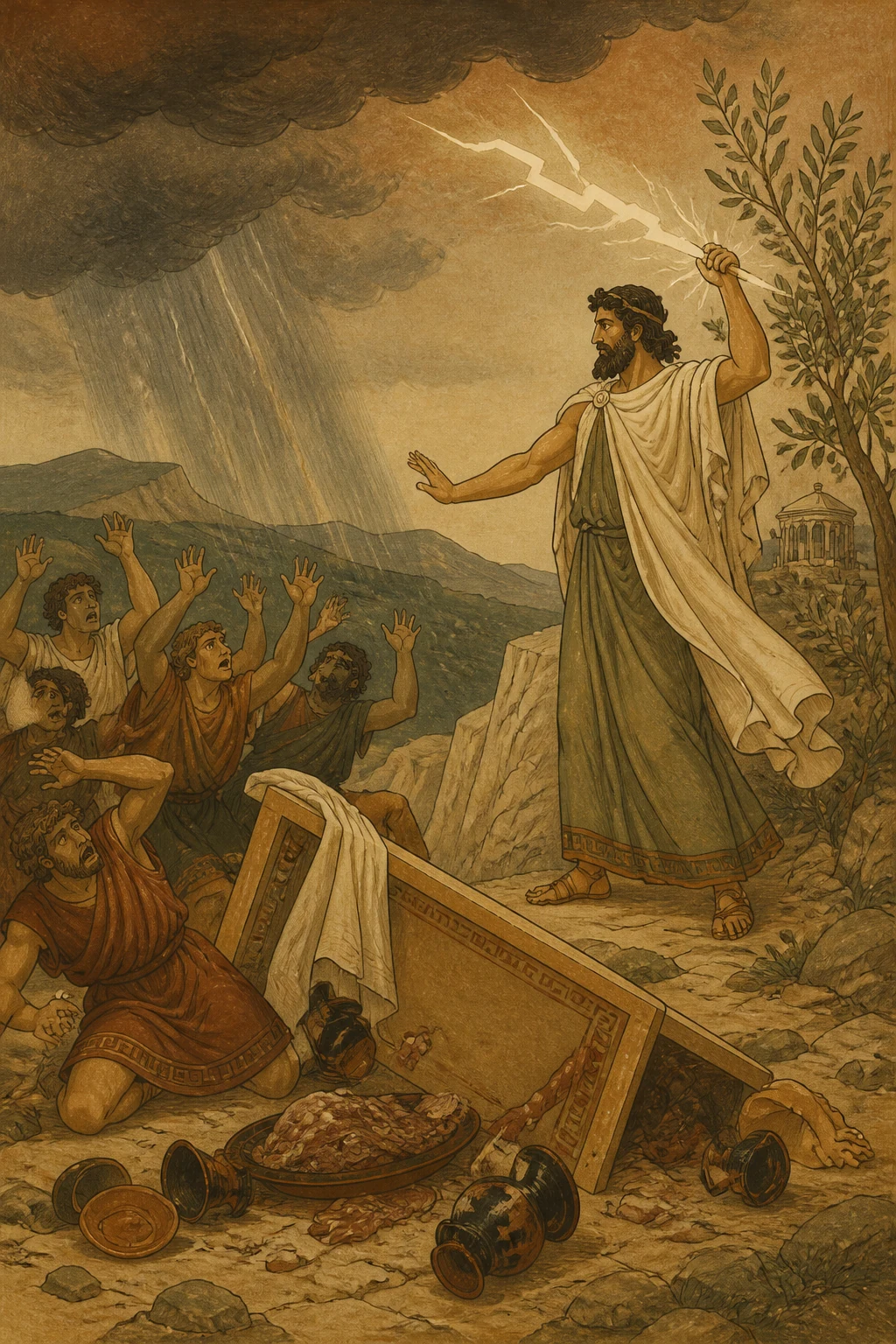
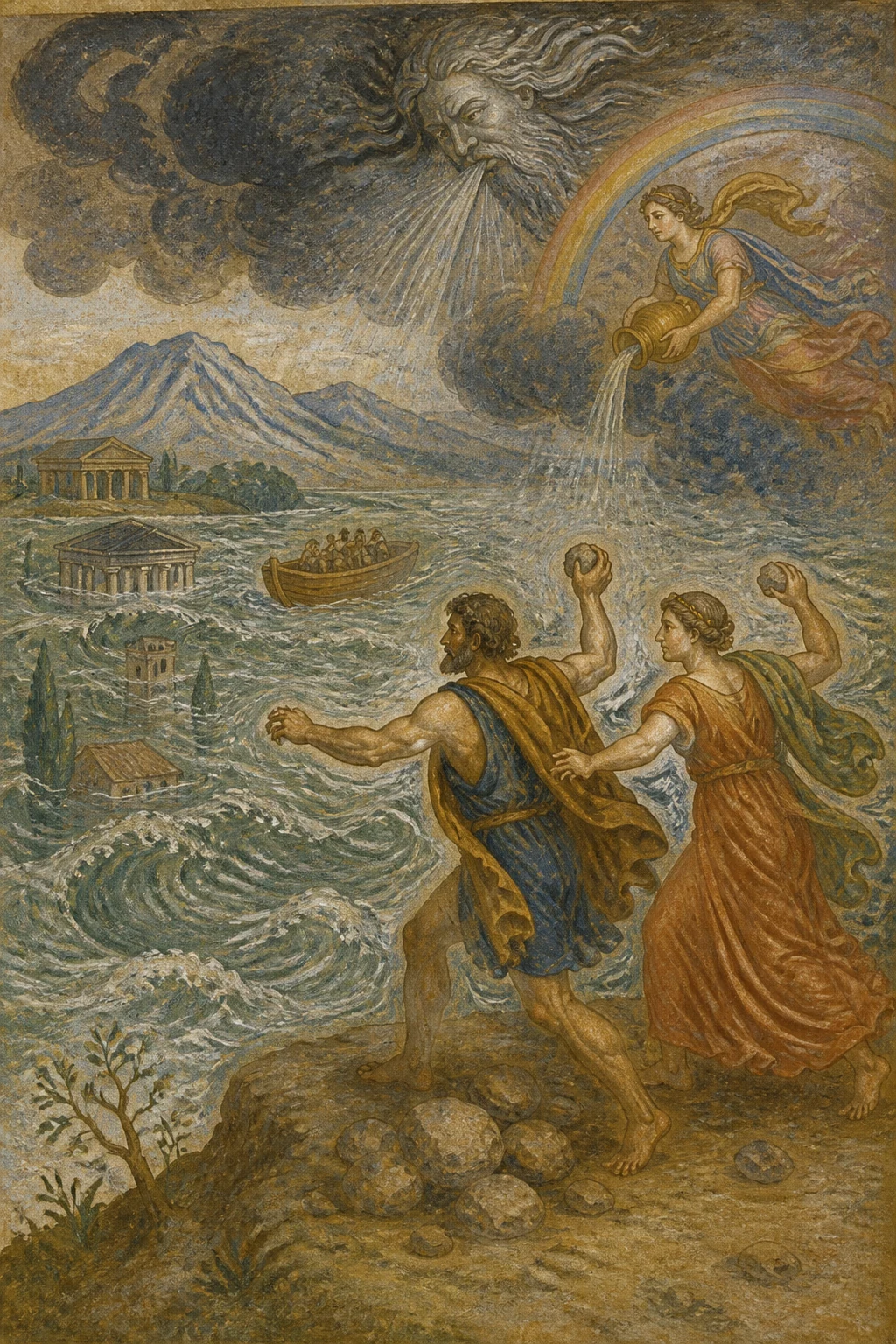
And now he was about to scatter thunderbolts over all the earth, but feared that the sacred ether, from so many fires, might catch flame, and the vast vault of heaven blaze. He remembered, too, that fate had appointed a time when sea and earth and the royal halls of heaven would catch and burn, and the whole fabric of the world struggle in the flames. The weapons forged by the Cyclopes’ hands were laid aside: he chose a different punishment—to destroy the mortal race beneath the waters and send rain pouring from all heaven.
At once he shut the North Wind in the caves of Aeolus, with all the other winds that drive away the gathering clouds, and unleashed the South Wind. On dripping wings the South Wind flew, his terrifying face shrouded in pitch-black darkness; his beard was heavy with rain, water streamed from his white hair; mists lay upon his brow, his wings and robes dripped dew.
And when his hand squeezed the clouds that hung far and wide, a crash rang out, and dense rain poured from heaven. Iris, Juno’s messenger, clad in her many colors, drew up water, bringing fresh sustenance to the clouds. The crops were beaten flat; the farmer’s hopes lay ruined and mourned, and all the long year’s labor came to nothing. Nor was Jupiter’s anger content with his own realm of heaven: his sea-blue brother came to his aid with waters of his own.
He summoned the rivers. When they had entered the dwelling of their sovereign, he said, “There is no need now for lengthy exhortation. Pour out all your strength: that is what we need! Open your dwellings, remove all barriers, and give your rivers wholly unbridled freedom!” He gave his orders; they returned and opened their springs’ mouths, and rolled in headlong, unchecked torrents to the sea.
The god himself struck the earth with his trident: it trembled and with its shaking opened pathways for the waters. The rivers burst their bounds and rushed across the open plains, sweeping away crops and orchards, cattle and men alike, houses and inner shrines, with all their sacred treasures. If any house remained, able to withstand so great a disaster without falling, still the rising water covered its roof, and submerged towers vanished beneath the flood.
And now there was no distinction between sea and land: all was ocean, and the ocean had no shores. One man took refuge on a hill; another sat in a curved boat, plying his oars where he had lately plowed; one sailed above his crops or over the roof of a sunken farmhouse; another caught a fish in an elm’s topmost branches. As chance would have it, an anchor lodged in a green meadow, or curved hulls scraped the vineyards beneath them; and where slender goats had lately cropped the grass, ungainly seals now settled their bodies.
The Nereids marveled at groves and cities and houses beneath the water; dolphins occupied the woods, darting among high branches and striking the swaying oaks. The wolf swam among sheep; tawny lions were borne on the waves, and tigers too; neither his lightning strength could save the boar, nor his swift legs the stag swept helplessly away. After searching long for land on which to alight, the wandering bird fell into the sea on weary wings.
The boundless ocean, freed of all restraint, had buried the hills, and unfamiliar waves were beating against mountain peaks. Most were swept away by the water; those whom the water spared were overcome by lingering hunger, with no food to sustain them. Phocis separates the Aonian fields from those of Oeta, a fertile country while it was land, but at that time part of the sea, a broad expanse of sudden waters.
There a steep mountain reaches toward the stars with twin summits, Parnassus by name, its peaks rising above the clouds. Here Deucalion, borne in a little boat with his wife, came to rest—for the sea had covered everything else— and they worshiped the Corycian nymphs, the mountain’s deities, and prophetic Themis, who then held the oracle. No man was better than he, none more devoted to justice, nor was any woman more reverent toward the gods than she.
When Jupiter saw the world lying beneath a watery waste, and that out of so many thousands only one man survived, and out of so many thousands only one woman, both blameless, both worshipers of the gods, he scattered the clouds, and, driving the rain away with the North Wind, revealed the earth to heaven and heaven to the earth. The sea’s fury, too, subsided. Laying aside his three-pronged weapon, the ruler of the deep soothed the waters, and summoned sea-blue Triton, rising above the depths, his shoulders encrusted with living shellfish, and ordered him to blow his sounding conch and give the signal for waves and rivers to retreat. Triton took up his hollow, spiraling horn,
which broadens from its narrow tip into a spreading mouth, the horn whose voice, when it takes breath in mid-ocean, fills the shores beneath both the rising and the setting sun. Now, too, when it touched the god’s lips, wet with the spray of his dripping beard, and sounded the retreat as ordered, it was heard by all the waters of the earth and sea, and every wave that heard it was restrained.
Now the sea had shores; riverbeds held their brimming streams; the rivers sank, and hills were seen emerging; the ground rose, the land spread as the waters dwindled, and after long days the woods revealed their bare treetops, their leaves still holding the mud the flood had left behind. The world had been restored. But when Deucalion saw it empty, and a profound silence reigning over the desolate lands, he spoke to Pyrrha through welling tears: “O sister, wife, only woman left alive, bound to me by our common blood, our fathers being brothers, then by marriage, and now by these very dangers, in all the lands beheld by the setting and the rising sun,
we two are the whole people; the sea has taken all the rest. Even now we cannot be sure enough that our own lives are safe; the clouds still fill me with dread. What would your feelings be, poor soul, if fate had rescued you without me? How could you bear your fear alone? Who would console you in your grief? For believe me, if the sea had taken you as well, I would follow you, my wife, and the sea would have me too.
If only I could renew the nations through my father’s arts, and breathe souls into molded earth! Now the mortal race survives in us two alone— so the gods have willed—and we remain mankind’s only specimens.” He finished, and they wept. They resolved to pray to the heavenly goddess and seek help through her sacred oracle. Without delay they went together to the waters of Cephisus, which, though not yet clear, now flowed within their familiar channel.
There they scooped up water and sprinkled it over their clothes and heads, then turned their steps toward the holy goddess’s shrine, whose gables were pale with unsightly moss, and whose altars stood without fire. When they reached the temple steps, both fell face down upon the ground and, trembling, kissed the cold stone. “If righteous prayers,” they said, “can move the powers of heaven to soften, if the anger of the gods can be turned aside, tell us, Themis, by what means the ruin of our race may be repaired, and help our drowned world, gentlest goddess.”
The goddess was moved and gave this oracle: “Leave the temple, veil your heads, loosen your girded garments, and cast behind your backs the bones of your great mother.” For a long time they stood astonished. Pyrrha was the first to break the silence, refusing to obey the goddess’s command; with trembling lips she begged forgiveness, afraid to offend her mother’s shade by casting away her bones.
Meanwhile they pondered the oracle’s words, veiled in dark obscurity, turning them over in their minds and together. Then the son of Prometheus soothed the daughter of Epimetheus with gentle words: “Either my judgment deceives me,” he said, “or the oracle is holy and urges no impious act. The great mother is Earth; I think the stones within her body are what she calls her bones. These we are told to throw behind us.”
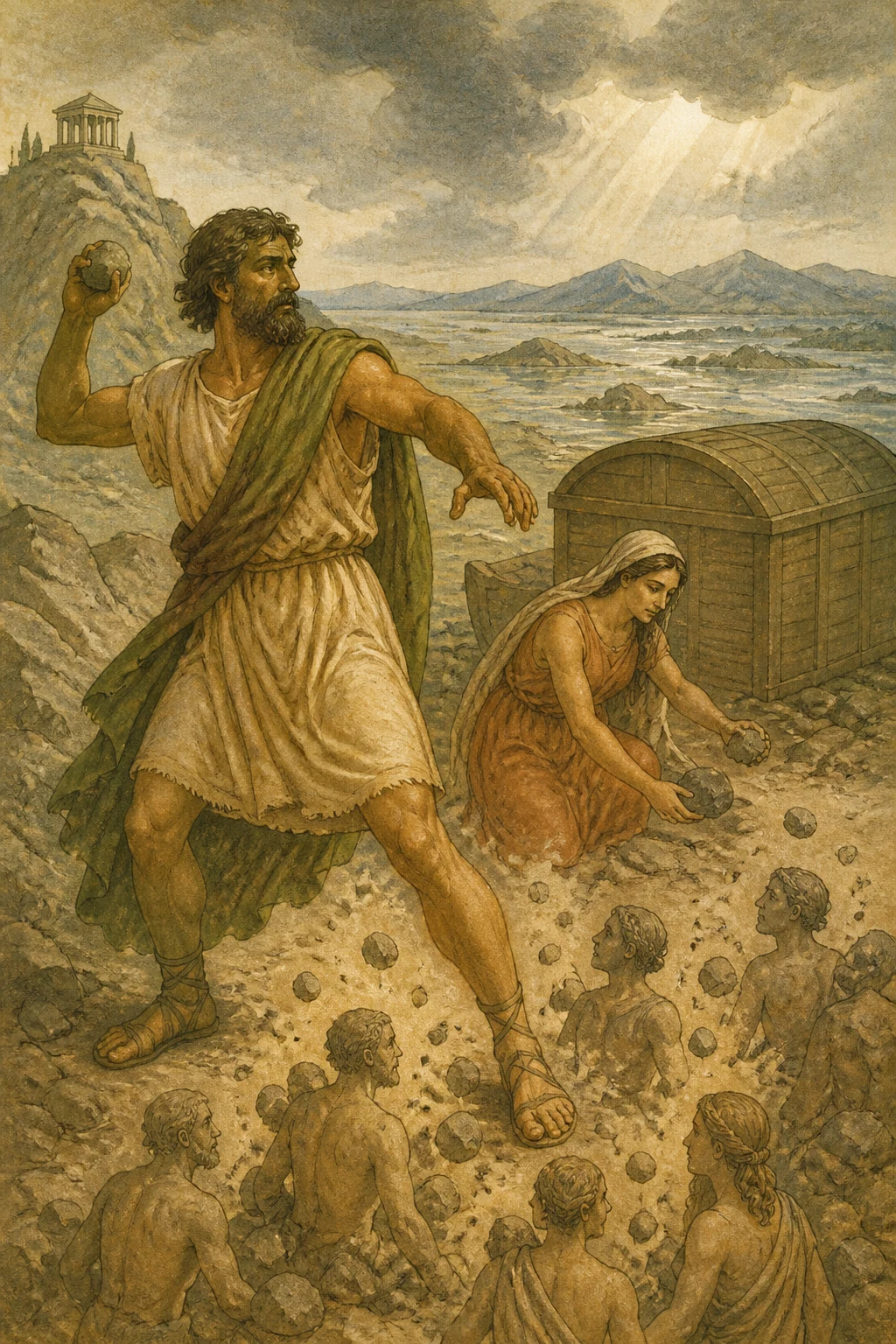
Though the Titan’s daughter was moved by her husband’s reading, her hope remained uncertain: both were so doubtful of heaven’s bidding. But what harm could there be in trying? They departed, veiled their heads, unbound their tunics, and cast the stones behind their footsteps as commanded. The stones—who would believe it, were antiquity not witness?— began to lose their hardness and rigidity, slowly softening, and as they softened, taking shape.
Soon, as they grew and acquired a gentler nature, a human form could be discerned, though still indistinct, like a figure begun in marble but not yet fully finished, closely resembling a rough-hewn statue. Yet whatever part of them was earthy and moist with any fluid changed to serve as flesh; what was solid and unyielding turned to bone; what had been a vein remained beneath the same name.
And in a little while, through the power of the gods, the stones thrown by the man’s hands took on the forms of men, and woman was restored from those the woman threw. Hence we are a hardy race, well schooled in toil, and give proof of the source from which we sprang.
Izvirnik
The Flood and the Stones of Deucalion and Pyrrha
Naslednje strani prikazujejo izvirno besedilo za primerjavo.
Source ID: ovid_metamorphoses_story_005 Citation: Ovid, Metamorphoses 1.253-1.415 Original language: Latin Source: PerseusDL canonical-latinLit Source URL: https://github.com/PerseusDL/canonical-latinLit/blob/master/data/phi0959/phi006/phi0959.phi006.perseus-lat2.xml Segmentation certainty: medium 253: Iamque erat in totas sparsurus fulmina terras: 254: sed timuit, ne forte sacer tot ab ignibus aether 255: conciperet flammas longusque ardesceret axis: 256: esse quoque in fatis reminiscitur, adfore tempus, 257: quo mare, quo tellus correptaque regia caeli 258: ardeat et mundi moles obsessa laboret.
259: Tela reponuntur manibus fabricata Cyclopum: 260: poena placet diversa, genus mortale sub undis 261: perdere et ex omni nimbos demittere caelo. 262: Protinus Aeoliis Aquilonem claudit in antris 263: et quaecumque fugant inductas flamina nubes 264: emittitque Notum. Madidis Notus evolat alis, 265: terribilem picea tectus caligine vultum: 266: barba gravis nimbis, canis fluit unda capillis; 267: fronte sedent nebulae, rorant pennaeque sinusque.
268: Utque manu late pendentia nubila pressit, 269: fit fragor: hinc densi funduntur ab aethere nimbi. 270: Nuntia Iunonis varios induta colores 271: concipit Iris aquas alimentaque nubibus adfert. 272: Sternuntur segetes et deplorata coloni 273: vota iacent, longique perit labor inritus anni. 274: Nec caelo contenta suo est Iovis ira, sed illum 275: caeruleus frater iuvat auxiliaribus undis.
276: Convocat hic amnes. Qui postquam tecta tyranni 277: intravere sui, “non est hortamine longo 278: nunc” ait “utendum. Vires effundite vestras: 279: sic opus est! aperite domos ac mole remota 280: fluminibus vestris totas inmittite habenas!” 281: Iusserat; hi redeunt ac fontibus ora relaxant 282: et defrenato volvuntur in aequora cursu. 283: Ipse tridente suo terram percussit: at illa 284: intremuit motuque vias patefecit aquarum.
285: Exspatiata ruunt per apertos flumina campos 286: cumque satis arbusta simul pecudesque virosque 287: tectaque cumque suis rapiunt penetralia sacris. 288: Siqua domus mansit potuitque resistere tanto 289: indeiecta malo, culmen tamen altior huius 290: unda tegit, pressaeque latent sub gurgite turres. 291: Iamque mare et tellus nullum discrimen habebant: 292: omnia pontus erant; deerant quoque litora ponto.
293: Occupat hic collem, cumba sedet alter adunca 294: et ducit remos illic, ubi nuper ararat, 295: ille supra segetes aut mersae culmina villae 296: navigat, hic summa piscem deprendit in ulmo. 297: Figitur in viridi, si fors tulit, ancora prato, 298: aut subiecta terunt curvae vineta carinae; 299: et, modo qua graciles gramen carpsere capellae, 300: nunc ibi deformes ponunt sua corpora phocae.
301: Mirantur sub aqua lucos urbesque domosque 302: Nereides, silvasque tenent delphines et altis 303: incursant ramis agitataque robora pulsant. 304: Nat lupus inter oves, fulvos vehit unda leones, 305: unda vehit tigres, nec vires fulminis apro, 306: crura nec ablato prosunt velocia cervo. 307: Quaesitisque diu terris, ubi sistere possit, 308: in mare lassatis volucris vaga decidit alis.
309: Obruerat tumulos inmensa licentia ponti, 310: pulsabantque novi montana cacumina fluctus. 311: Maxima pars unda rapitur; quibus unda pepercit, 312: illos longa domant inopi ieiunia victu. 313: Separat Aonios Oetaeis Phocis ab arvis, 314: terra ferax, dum terra fuit, sed tempore in illo 315: pars maris et latus subitarum campus aquarum. 316: Mons ibi verticibus petit arduus astra duobus, 317: nomine Parnasus, superantque cacumina nubes.
318: Hic ubi Deucalion (nam cetera texerat aequor) 319: cum consorte tori parva rate vectus adhaesit, 320: Corycidas nymphas et numina montis adorant 321: fatidicamque Themin, quae tunc oracla tenebat. 322: Non illo melior quisquam nec amantior aequi 323: vir fuit aut illa metuentior ulla deorum. 324: Iuppiter ut liquidis stagnare paludibus orbem 325: et superesse virum de tot modo milibus unum, 326: et superesse videt de tot modo milibus unam, 327: innocuos ambo, cultores numinis ambo, 328: nubila disiecit nimbisque aquilone remotis 329: et caelo terras ostendit et aethera terris.
330: Nec maris ira manet, positoque tricuspide telo 331: mulcet aquas rector pelagi supraque profundum 332: exstantem atque umeros innato murice tectum 333: caeruleum Tritona vocat conchaeque sonanti 334: inspirare iubet fluctusque et flumina signo 335: iam revocare dato. Cava bucina sumitur illi, 336: tortilis, in latum quae turbine crescit ab imo, 337: bucina, quae medio concepit ubi aera ponto, 338: litora voce replet sub utroque iacentia Phoebo.
339: Tunc quoque, ut ora dei madida rorantia barba 340: contigit et cecinit iussos inflata receptus, 341: omnibus audita est telluris et aequoris undis, 342: et quibus est undis audita, coercuit omnes. 343: Iam mare litus habet, plenos capit alveus amnes, 344: flumina subsidunt collesque exire videntur, 345: surgit humus, crescunt loca decrescentibus undis, 346: postque diem longam nudata cacumina silvae 347: ostendunt limumque tenent in fronde relictum.
348: Redditus orbis erat. Quem postquam vidit inanem 349: et desolatas agere alta silentia terras, 350: Deucalion lacrimis ita Pyrrham adfatur obortis: 351: “O soror, o coniunx, o femina sola superstes, 352: quam commune mihi genus et patruelis origo, 353: deinde torus iunxit, nunc ipsa pericula iungunt, 354: terrarum, quascumque vident occasus et ortus, 355: nos duo turba sumus; possedit cetera pontus.
356: Haec quoque adhuc vitae non est fiducia nostrae 357: certa satis; terrent etiam nunc nubila mentem. 358: Quis tibi, si sine me fatis erepta fuisses, 359: nunc animus, miseranda, foret? quo sola timorem 360: ferre modo posses? quo consolante doleres? 361: Namque ego (crede mihi) si te quoque pontus haberet, 362: te sequerer, coniunx, et me quoque pontus haberet.
363: O utinam possim populos reparare paternis 364: artibus atque animas formatae infundere terrae! 365: Nunc genus in nobis restat mortale duobus 366: (sic visum superis) hominumque exempla manemus.” 367: Dixerat, et flebant. Placuit caeleste precari 368: numen et auxilium per sacras quaerere sortes. 369: Nulla mora est: adeunt pariter Cephisidas undas, 370: ut nondum liquidas, sic iam vada nota secantes.
371: Inde ubi libatos inroravere liquores 372: vestibus et capiti, flectunt vestigia sanctae 373: ad delubra deae, quorum fastigia turpi 374: pallebant musco stabantque sine ignibus arae. 375: Ut templi tetigere gradus, procumbit uterque 376: pronus humi gelidoque pavens dedit oscula saxo 377: atque ita “si precibus” dixerunt “numina iustis 378: victa remollescunt, si flectitur ira deorum, 379: dic, Themi, qua generis damnum reparabile nostri 380: arte sit, et mersis fer opem, mitissima, rebus.”
381: Mota dea est sortemque dedit: “Discedite templo 382: et velate caput cinctasque resolvite vestes 383: ossaque post tergum magnae iactate parentis.” 384: Obstipuere diu, rumpitque silentia voce 385: Pyrrha prior iussisque deae parere recusat, 386: detque sibi veniam pavido rogat ore, pavetque 387: laedere iactatis maternas ossibus umbras. 388: Interea repetunt caecis obscura latebris 389: verba datae sortis secum inter seque volutant.
390: Inde Promethides placidis Epimethida dictis 391: mulcet et “aut fallax” ait “est sollertia nobis, 392: aut pia sunt nullumque nefas oracula suadent. 393: Magna parens terra est, lapides in corpore terrae 394: ossa reor dici; iacere hos post terga iubemur.” 395: Coniugis augurio quamquam Titania mota est, 396: spes tamen in dubio est: adeo caelestibus ambo 397: diffidunt monitis. Sed quid temptare nocebit?
398: Discedunt velantque caput tunicasque recingunt 399: et iussos lapides sua post vestigia mittunt. 400: Saxa (quis hoc credat, nisi sit pro teste vetustas?) 401: ponere duritiem coepere suumque rigorem 402: mollirique mora mollitaque ducere formam. 403: Mox ubi creverunt naturaque mitior illis 404: contigit, ut quaedam, sic non manifesta, videri 405: forma potest hominis, sed, uti de marmore coepta, 406: non exacta satis rudibusque simillima signis.
407: Quae tamen ex illis aliquo pars umida suco 408: et terrena fuit, versa est in corporis usum; 409: quod solidum est flectique nequit, mutatur in ossa; 410: quae modo vena fuit, sub eodem nomine mansit; 411: inque brevi spatio superorum numine saxa 412: missa viri manibus faciem traxere virorum, 413: et de femineo reparata est femina iactu. 414: Inde genus durum sumus experiensque laborum 415: et documenta damus qua simus origine nati.
Nadaljuj z branjem