O besedilu
Pelej in Keiks
- Vir
- Ovidove preobrazbe
- Avtor
- Ovid
- Jezik branja
- English
- Jezik izvirnika
- Latin
- Čas branja
- 12 min branja
- Obseg
- 10 strani
- Naslov izvirnika
- Peleus and Ceyx
O izvirniku
Ovidove preobrazbe
Pesniški tok antičnih preobrazb, kjer bogovi, ljudje in narava stalno menjavajo obliko. Bralni jezik je English, izvirnik pa prihaja iz vira Ovidove preobrazbe v jeziku Latin.
Besedilo
Pelej in Keiks
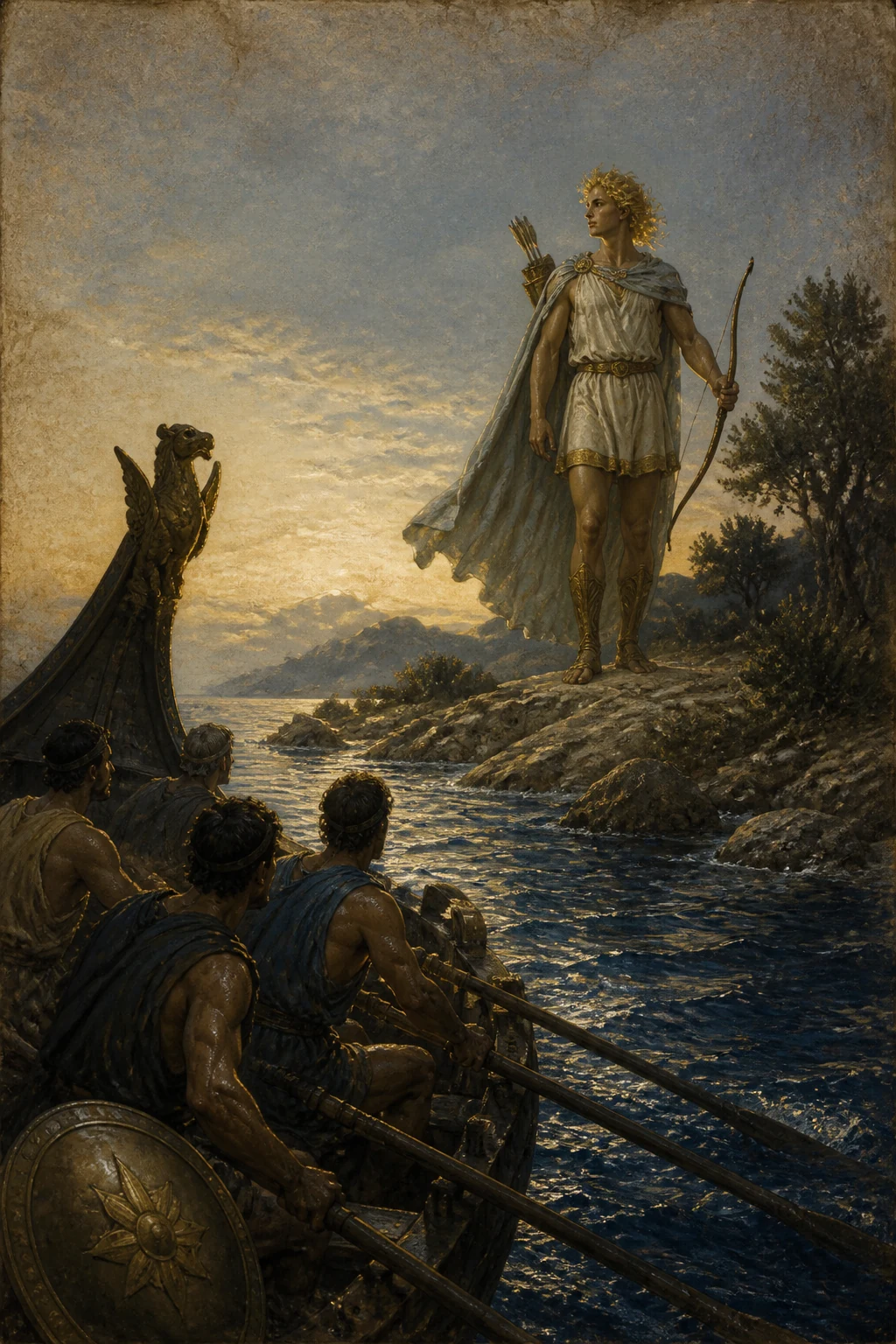
His vengeance taken, he left Tmolus and, borne through the clear air, came to rest, on this side of the narrow strait of Helle, Nephele’s daughter, in the fields of Laomedon—Apollo, the son of Latona. To the right of Sigeum, to the left of deep Rhoeteum, stands an ancient altar sacred to the Thunderer, source of every omen. From there he saw Laomedon beginning to raise the walls of new Troy, and the great undertaking growing through arduous toil and calling for no little wealth.
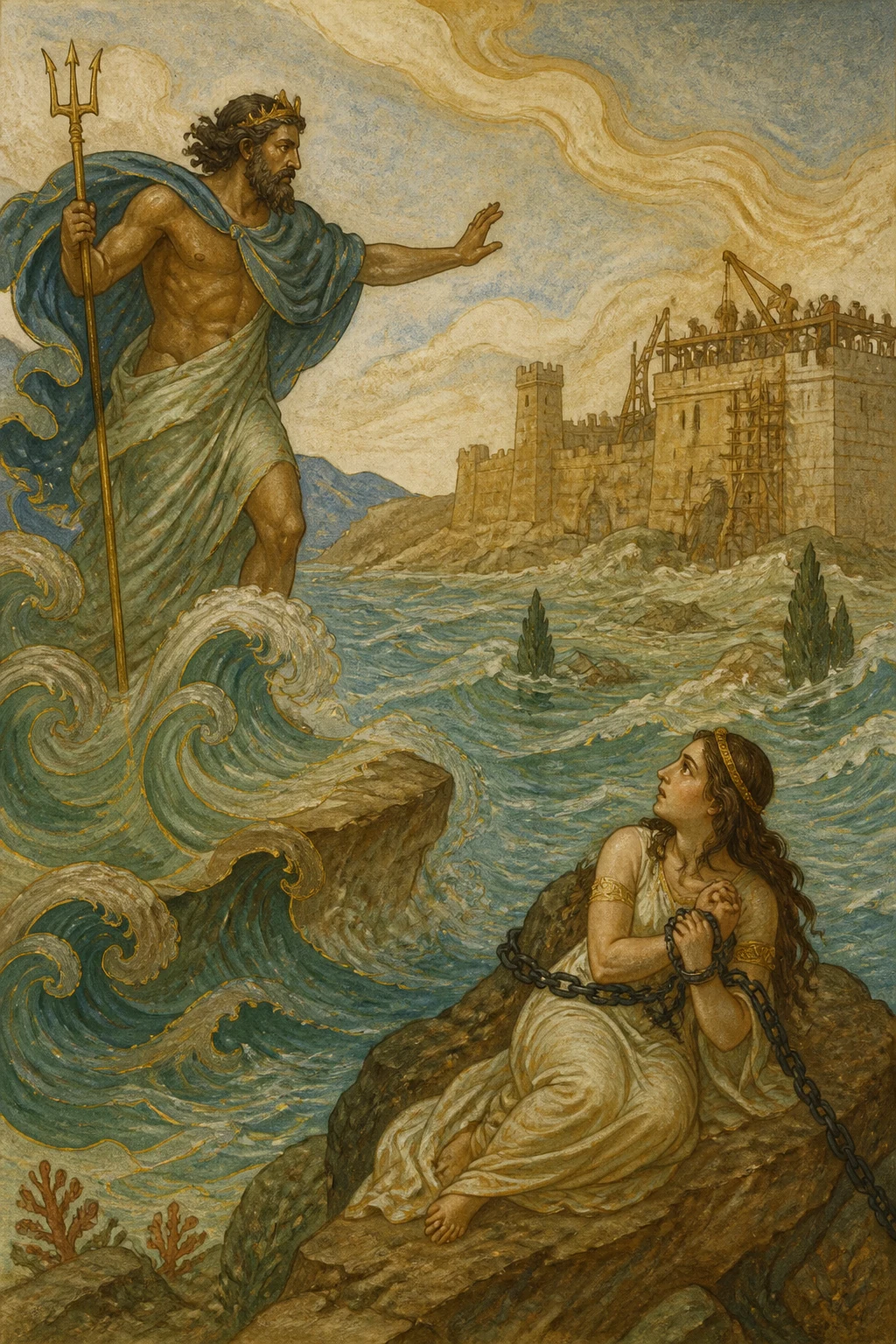
Together with the trident-bearing father of the swelling deep, he assumed a mortal shape and, for the ruler of Phrygia, built the walls, having agreed on gold as payment. The work stood finished: the king denied the debt and added, to crown his treachery, false oaths to his lying words. “You will not escape unpunished,” said the ruler of the sea, and drove all his waters against the shores of grasping Troy, flooding the land until it was a sea, stripping the farmers of their wealth and burying their fields beneath the waves.
Nor was this punishment enough: the king’s own daughter was demanded for a sea monster. Bound to the cruel rocks, she was rescued by Hercules, who claimed the promised reward, the horses pledged to him; and when payment for that great deed was refused, he captured the walls of twice-perjured Troy. Nor did Telamon, his comrade in arms, depart without honour: Hesione was given to him as his bride. For Peleus already was famed for his goddess-wife, and took no greater pride in his grandfather’s name than in his father-in-law’s: more than one man had been granted Jupiter as grandfather, but he alone a goddess as wife.
For old Proteus had said to Thetis, “Goddess of the waves, conceive a child: you will be mother to a youth who, in his prime, will surpass his father’s deeds and be called greater than he.” So, lest the world should hold anything greater than Jupiter, though he had felt no feeble flame of passion in his breast, Jupiter shunned marriage with Thetis of the sea and commanded his grandson, the son of Aeacus, to take his place in that desire and seek the sea-maiden’s embrace.
There is a bay in Thessaly, curved like a sickle’s blade: its arms reach out to form what, were the water deeper, would be a harbour; the sea barely covers the sand. Its beach is firm, neither retaining footprints nor hindering the traveller, nor yielding beneath a covering of weed. Nearby is a myrtle grove, laden with berries of two colours, and in its midst a cave—whether made by nature or art is doubtful, though it seems more likely art. There you often came, Thetis, naked, riding a dolphin with a bridle.
There Peleus seized you as you lay bound in sleep; and since you resisted when he tried to win you with entreaties, he resorted to force, locking both arms about your neck. Had you not turned to your accustomed arts, changing your shape again and again, he would have achieved his daring aim. But now you were a bird—yet he still held the bird; now a massive tree—yet Peleus clung to the tree; your third shape was a spotted tigress: terrified by that, the son of Aeacus loosened his arms from your body.
Then he worshipped the gods of the sea, pouring wine upon the waves, offering the entrails of sheep and the smoke of incense, until the prophet of Carpathus rose from the depths and said, “Son of Aeacus, you shall win the bride you seek! Only, when she lies asleep in the rocky cave, bind her unawares with cords and unyielding bonds. Do not let her deceive you by assuming a hundred shapes: hold fast, whatever she becomes, until she takes her own form again!”
So Proteus spoke and hid his face beneath the sea, letting his waves close over his final words. The Sun was sinking, and his sloping chariot-pole hung over the western sea, when the lovely Nereid returned, leaving the water to enter her familiar resting place in the rock. Scarcely had Peleus seized her maiden limbs when she changed shape, until she felt her body held fast and her arms stretched out to either side.
Then at last she groaned. “Not without a god’s help do you conquer,” she said, and revealed herself as Thetis. The hero embraced her, now acknowledged, fulfilled his desire, and made her pregnant with mighty Achilles. Happy in his son, happy in his wife was Peleus, a man who, were it not for the guilt of Phocus’s murder, had been granted everything. Guilty of shedding his brother’s blood and driven from his native home, he was received by the land of Trachis. There, without violence or bloodshed, Ceyx ruled, the son of Lucifer, the Morning Star, his father’s radiance shining in his face. At that time he was grieving, unlike his former self, mourning the loss of his brother.
When the son of Aeacus, weary with care and travel, arrived there and entered the city with a few companions, leaving the flocks and herds he had brought with him in a shady valley not far from the walls, he took the first chance offered to approach the king. Holding out a suppliant’s wool-wreathed branch, he told him who he was and from whom he sprang, concealing only his crime and inventing a reason for his exile. He asked for help, a home in town or country. The king of Trachis answered him with a kindly look: “Our resources are open even to ordinary people, Peleus; ours is no inhospitable kingdom.
Your coming strengthens that welcome—your power, your illustrious name, and Jupiter your grandfather. Waste no time in entreaties! You shall have all you ask. Regard as partly yours everything you see, such as it is. Would that you saw it happier!” And he wept. Peleus and his companions asked what cause had stirred such sorrow. He began: “Perhaps you think this bird, which lives by plunder and terrifies all other birds, has always worn feathers.
He was a man, and—so steadfast is the spirit—even then was fierce, savage in war and ready for violence: his name was Daedalion. We were born of that father who summons the dawn and is last to leave the heavens. My care was peace, the preservation of peace, and my marriage; my brother delighted in savage war. His valour subdued kings and nations— that valour which, transformed, now hunts the doves of Thisbe.
He had a daughter, Chione. Richly endowed with beauty, she had a thousand suitors, ripe for marriage at fourteen. By chance Phoebus and the son of Maia, returning, one from his Delphi, the other from Mount Cyllene, saw her at the same moment and burned with the same desire. Apollo deferred his hope of love until the night; the other could not bear delay, and with his sleep-bringing wand touched the maiden’s face. Beneath its potent touch she lay and suffered the god’s assault. Night had scattered stars across the sky when Phoebus assumed an old woman’s shape and took the pleasure another had forestalled.
When her womb had completed its appointed term, the wing-footed god’s cunning offspring was born: Autolycus, ingenious in every kind of theft, who could make white from black and black from white, no unworthy heir to his father’s arts. To Phoebus too a son was born—for she bore twins— Philammon, famed for his singing and his lyre. What use was it to have borne two sons, to have pleased two gods, to have a valiant father and the Thunderer for a grandfather?
Can glory itself do harm? It has harmed many; certainly it harmed her. She dared to set herself above Diana and disparaged the goddess’s beauty. Fierce anger rose in Diana. ‘Then I shall please you by my deeds,’ she said. At once she bent her bow, sent an arrow from its string, and pierced the tongue that had deserved the shaft. The tongue fell silent; no sound followed her efforts to speak, and, as she struggled for words, her life flowed out with her blood.
How I embraced her then, poor girl, and took her father’s grief into my own heart! What comfort I offered my loving brother! But the father heard it as a cliff hears the murmur of the sea, and bitterly lamented his lost daughter. When he saw her burning, four times he rushed to fling himself into the pyre; four times driven back, he gave his frenzied limbs to flight, and like a young bull with hornets’ stings embedded in its neck, he charged where there was no path. Even then he seemed to me to run faster than a man: you would have thought his feet had wings.
So he escaped us all and, swift in his longing for death, reached the summit of Parnassus. When Daedalion hurled himself from a lofty rock, Apollo pitied him, made him a bird and raised him, poised on sudden wings. He gave him a hooked beak and curved talons, his old courage and strength beyond his body’s size. And now, a hawk, showing mercy to none, he savages all birds, and in his grief gives others cause to grieve.”
While Lucifer’s son was telling this strange tale about his brother, a herdsman, Onetor of Phocis, came hurrying up, breathless from running. “Peleus, Peleus!” he cried. “I bring you news of a great disaster!” Peleus told him to report whatever it was; the king of Trachis too waited anxiously on his trembling lips. He said: “I had driven the weary cattle down to the curving shore when the Sun, at his highest in the middle of the sky, looked back on as much of his course as he saw still ahead.
Some of the cattle had bent their knees upon the golden sand and lay gazing over the wide fields of water; some wandered slowly here and there; others swam, their tall necks rising above the waves. A shrine stands near the sea, bright with neither marble nor gold, but shaded by close-set timbers and an ancient grove. Nereus and the Nereids dwell there: a fisherman told me these were the sea gods, as he dried his nets on the shore.
Beside it lies a marsh, hemmed in by thick willows, formed by seawater flooding in and lingering there. From it a heavy crashing terrified the country round: a monstrous beast—a wolf!—came out of the wet marshes, his jaws smeared with foam and spattered with blood, swift as lightning, his eyes suffused with crimson flame. Though he raged with hunger and with fury alike, his fury was the fiercer: he did not trouble to ease his ravenous hunger by slaughtering cattle, but wounded the whole herd and struck them all down like an enemy.
Some of us too, as we tried to defend them, were wounded by his deadly bite and killed. The shore and the water’s edge are red with blood, and the marshes ring with bellowing. But delay brings further loss; there is no time to hesitate. While anything remains, let us all unite and take up arms, arms, and together bring our weapons against him!” The herdsman finished. It was not the loss that troubled Peleus: remembering his crime, he understood that the bereaved Nereid was sending this destruction as an offering to the dead Phocus.
The king of Oeta ordered his men to put on armour and take up deadly weapons, and was preparing to go with them himself. But his wife Alcyone, roused by the uproar, rushed out and, though her hair was not yet fully dressed, tore it loose and threw her arms about her husband’s neck. With words and tears she begged him to send help without going himself, and save two lives in one.
The son of Aeacus said to her, “Queen, put aside those loving, loyal fears. My gratitude for your promise is complete. I have no wish to take up arms against this strange monster: we must pray to the divinity of the sea.” There was a lofty tower, a beacon on the citadel’s height, a welcome sight to weary ships. They climbed it and, groaning, looked down at the bulls strewn along the shore, and the savage destroyer, his jaws bloody, his long, shaggy coat stained with gore.
Then Peleus stretched his hands towards the shore of the open sea and prayed to sea-blue Psamathe to end her anger and bring help. She was not moved by the pleas of Aeacus’s son; but Thetis, pleading for her husband, won her forgiveness. Yet the wolf, though called back from his savage slaughter, persisted, maddened by the sweet taste of blood, until she turned him to marble as he clung to a mangled heifer’s neck. Except for its colour, his body kept every feature: only the stone’s colour showed that he was no longer a wolf, no longer to be feared.
Yet fate did not allow the fugitive Peleus to remain in that land. A wandering exile, he went to the Magnetes, and there received purification for his murder from Acastus of Thessaly.
Izvirnik
Peleus and Ceyx
Naslednje strani prikazujejo izvirno besedilo za primerjavo.
Source ID: ovid_metamorphoses_story_078 Citation: Ovid, Metamorphoses 11.194-11.409 Original language: Latin Source: PerseusDL canonical-latinLit Source URL: https://github.com/PerseusDL/canonical-latinLit/blob/master/data/phi0959/phi006/phi0959.phi006.perseus-lat2.xml Segmentation certainty: medium 194: Ultus abit Tmolo liquidumque per aera vectus 195: angustum citra pontum Nepheleidos Helles 196: Laomedonteis Latoius adstitit arvis.
197: Dextera Sigei, Rhoetei laeva profundi 198: ara Panomphaeo vetus est sacrata Tonanti. 199: Inde novae primum moliri moenia Troiae 200: Laomedonta videt susceptaque magna labore 201: crescere difficili nec opes exposcere parvas 202: cumque tridentigero tumidi genitore profundi 203: mortalem induitur formam Phrygiaeque tyranno 204: aedificat muros, pactus pro moenibus aurum.
205: Stabat opus: pretium rex infitiatur et addit, 206: perfidiae cumulum, falsis periuria verbis. 207: “Non impune feres” rector maris inquit et omnes 208: inclinavit aquas ad avarae litora Troiae, 209: inque freti formam terras complevit opesque 210: abstulit agricolis et fluctibus obruit agros. 211: Poena neque haec satis est: regis quoque filia monstro 212: poscitur aequoreo; quam dura ad saxa revinctam 213: vindicat Alcides promissaque munera, dictos 214: poscit equos, tantique operis mercede negata 215: bis periura capit superatae moenia Troiae.
216: Nec pars militiae, Telamon, sine honore recessit, 217: Hesioneque data potitur. Nam coniuge Peleus 218: clarus erat diva: nec avi magis ille superbus 219: nomine, quam soceri, siquidem Iovis esse nepoti 220: contigit haud uni, coniunx dea contigit uni. 221: Namque senex Thetidi Proteus “dea” dixerat “undae, 222: concipe: mater eris iuvenis, qui fortibus annis 223: acta patris vincet maiorque vocabitur illo.”
224: Ergo, ne quicquam mundus Iove maius haberet, 225: quamvis haud tepidos sub pectore senserat ignes, 226: Iuppiter aequoreae Thetidis conubia fugit 227: in suaque Aeaciden succedere vota nepotem 228: iussit et amplexus in virginis ire marinae. 229: Est sinus Haemoniae curvos falcatus in arcus: 230: bracchia procurrunt, ubi, si foret altior unda, 231: portus erat (summis inductum est aequor harenis); 232: litus habet solidum, quod nec vestigia servet 233: nec remoretur iter, nec opertum pendeat alga.
234: Myrtea silva subest bicoloribus obsita bacis 235: et specus in medio (natura factus an arte, 236: ambiguum, magis arte tamen), quo saepe venire 237: frenato delphine sedens, Theti, nuda solebas. 238: Illic te Peleus, ut somno vincta iacebas, 239: occupat: et quoniam precibus temptata repugnas, 240: vim parat, innectens ambobus colla lacertis. 241: Quod nisi venisses variatis saepe figuris 242: ad solitas artes, auso foret ille potitus.
243: Sed modo tu volucris (volucrem tamen ille tenebat), 244: nunc gravis arbor eras (haerebat in arbore Peleus), 245: tertia forma fuit maculosae tigridis: illa 246: territus Aeacides a corpore bracchia solvit. 247: Isque deos pelagi vino super aequora fuso 248: et pecoris fibris et fumo turis adorat, 249: donec Carpathius medio de gurgite vates 250: “Aeacide,” dixit, “thalamis potiere petitis!
251: Tu modo, cum rigido sopita quiescit in antro, 252: ignaram laqueis vincloque innecte tenaci. 253: Nec te decipiat centum mentita figuras, 254: sed preme, quidquid erit, dum, quod fuit ante, reformet!” 255: Dixerat haec Proteus et condidit aequore vultum 256: admisitque suos in verba novissima fluctus. 257: Pronus erat Titan inclinatoque tenebat 258: Hesperium temone fretum, cum pulchra relecto 259: Nereis ingreditur consueta cubilia saxo.
260: Vix bene virgineos Peleus invaserat artus, 261: illa novat formas, donec sua membra teneri 262: sentit et in partes diversas bracchia tendi. 263: Tum demum ingemuit, “neque” ait “sine numine vincis” 264: exhibita estque Thetis. Confessam amplectitur heros 265: et potitur votis ingentique implet Achille. 266: Felix et nato, felix et coniuge Peleus 267: et cui, si demas iugulati crimina Phoci, 268: omnia contigerant. Fraterno sanguine sontem 269: expulsumque domo patria Trachinia tellus 270: accipit. Hic regnum sine vi, sine caede regebat 271: Lucifero genitore satus patriumque nitorem
272: ore ferens Ceyx, illo qui tempore maestus 273: dissimilisque sui fratrem lugebat ademptum. 274: Quo postquam Aeacides fessus curaque viaque 275: venit et intravit paucis comitantibus urbem, 276: quosque greges pecorum, quae secum armenta trahebat, 277: haud procul a muris sub opaca valle reliquit, 278: copia cum facta est adeundi prima tyranni, 279: velamenta manu praetendens supplice, qui sit 280: se quoque satus, memorat, tantum sua crimina celat 281: mentiturque fugae causam: petit, urbe vel agro 282: se iuvet. Hunc contra placido Trachinius ore 283: talibus adloquitur: “Mediae quoque commoda plebi
284: nostra patent, Peleu, nec inhospita regna tenemus. 285: Adicis huic animo momento potentia, clarum 286: nomen avumque Iovem. Ne tempora perde precando! 287: Quod petis, omne feres tuaque haec pro parte vocato, 288: qualiacumque vides! Utinam meliora videres!' 289: Et flebat: moveat tantos quae causa dolores, 290: Peleusque comitesque rogant. Quibus ille profatur: 291: “Forsitan hanc volucrem, rapto quae vivit et omnes 292: terret aves, semper pennas habuisse putetis: 293: vir fuit et (tanta est animi constantia!) iam tum 294: acer erat belloque ferox ad vimque paratus, 295: nomine Daedalion. Illo genitore creatis,
296: qui vocat auroram caeloque novissimus exit, 297: (cura mihi pax est) pacis mihi cura tenendae 298: coniugiique fuit, fratri fera bella placebant: 299: illius virtus reges gentesque subegit, 300: quae nunc Thisbaeas agitat mutata columbas. 301: Nata erat huic Chione. Quae dotatissima forma 302: mille procos habuit, bis septem nubilis annis. 303: Forte revertentes Phoebus Maiaque creatus, 304: ille suis Delphis, hic vertice Cylleneo, 305: videre hanc pariter, pariter traxere calorem.
306: Spem veneris differt in tempora noctis Apollo, 307: non fert ille moras virgaque movente soporem 308: virginis os tangit: tactu iacet illa potenti 309: vimque dei patitur. Nox caelum sparserat astris: 310: Phoebus anum simulat praereptaque gaudia sumit. 311: Ut sua maturus complevit tempora venter, 312: alipedis de stirpe dei versuta propago 313: nascitur, Autolycus, furtum ingeniosus ad omne, 314: candida de nigris et de candentibus atra 315: qui facere adsuerat, patriae non degener artis; 316: nascitur e Phoebo (namque est enixa gemellos) 317: carmine vocali clarus citharaque Philammon.
318: Quid peperisse duos et dis placuisse duobus 319: et forti genitore et progenitore Tonanti 320: esse satam prodest? An obest quoque gloria? multis 321: Offuit, huic certe! Quae se praeferre Dianae 322: sustinuit faciemque deae culpavit. At illi 323: ira ferox mota est “factis” que “placebimus” inquit. 324: Nec mora, curvavit cornu nervoque sagittam 325: impulit et meritam traiecit harundine linguam.
326: Lingua tacet, nec vox temptataque verba sequuntur, 327: conantemque loqui cum sanguine vita reliquit. 328: Quo miser amplexus ego tum patriumque dolorem 329: corde tuli fratrique pio solacia dixi! 330: Quae pater haud aliter quam cautes murmura ponti 331: accipit et natam delamentatur ademptam. 332: Ut vero ardentem vidit, quater impetus illi 333: in medios fuit ire rogos; quater inde repulsus 334: concita membra fugae mandat similisque iuvenco 335: spicula crabronum pressa cervice gerenti, 336: qua via nulla, ruit. Iam tum mihi currere visus 337: plus homine est, alasque pedes sumpsisse putares.
338: Effugit ergo omnes veloxque cupidine leti 339: vertice Parnasi potitur. Miseratus Apollo, 340: cum se Daedalion saxo misisset ab alto, 341: fecit avem et subitis pendentem sustulit alis 342: oraque adunca dedit, curvos dedit unguibus hamos, 343: virtutem antiquam, maiores corpore vires. 344: Et nunc accipiter, nulli satis aequus, in omnes 345: saevit aves aliisque dolens fit causa dolendi.”
346: Quae dum Lucifero genitus miracula narrat 347: de consorte suo, cursu festinus anhelo 348: advolat armenti custos Phoceus Onetor 349: et “Peleu, Peleu! magnae tibi nuntius adsum 350: cladis” ait. Quodcumque ferat, iubet edere Peleus, 351: pendet et ipse metu trepidi Trachinius oris. 352: Ille refert: “Fessos ad litora curva iuvencos 353: adpuleram, medio cum Sol altissimus orbe 354: tantum respiceret, quantum superesse videret; 355: parsque boum fulvis genua inclinarat harenis 356: latarumque iacens campos spectabat aquarum, 357: pars gradibus tardis illuc errabat et illuc,
358: nant alii celsoque exstant super aequora collo. 359: Templa mari subsunt nec marmore clara neque auro, 360: sed trabibus densis lucoque umbrosa vetusto. 361: Nereides Nereusque tenent: hos navita ponti 362: edidit esse deos, dum retia litore siccat. 363: Iuncta palus huic est, densis obsessa salictis, 364: quam restagnantis fecit maris unda paludem. 365: Inde fragore gravi strepitus loca proxima terret 366: belua vasta, lupus! Udisque paludibus exit, 367: oblitus et spumis et sparsus sanguine rictus, 368: fulmineus, rubra suffusus lumina flamma.
369: Qui quamquam saevit pariter rabieque fameque, 370: acrior est rabie: neque enim ieiunia curat 371: caede boum diramque famem finire, sed omne 372: vulnerat armentum sternitque hostiliter omne. 373: Pars quoque de nobis funesto saucia morsu, 374: dum defensamus, leto est data. Sanguine litus 375: undaque prima rubet demugitaeque paludes. — 376: Sed mora damnosa est, nec res dubitare remittit: 377: dum superest aliquid, cuncti coeamus et arma, 378: arma capessamus coniunctaque tela feramus!”
379: Dixerat agrestis; nec Pelea damna movebant, 380: sed, memor admissi, Nereida conligit orbam 381: damna sua inferias exstincto mittere Phoco. 382: Induere arma viros violentaque sumere tela 383: rex iubet Oetaeus; cum quis simul ipse parabat 384: ire, sed Alcyone coniunx excita tumultu 385: prosilit et, nondum totos ornata capillos, 386: disicit hos ipsos, colloque infusa mariti, 387: mittat ut auxilium sine se, verbisque precatur 388: et lacrimis, animasque duas ut servet in una.
389: Aeacides illi: “Pulchros, regina, piosque 390: pone metus! Plena est promissi gratia vestri. 391: Non placet arma mihi contra nova monstra moveri: 392: numen adorandum pelagi est.” Erat ardua turris 393: arce focus summa, fessis loca grata carinis. 394: Adscendunt illuc stratosque in litore tauros 395: cum gemitu adspiciunt vastatoremque cruento 396: ore ferum, longos infectum sanguine villos.
397: Inde manus tendens in aperti litora ponti 398: caeruleam Peleus Psamathen, ut finiat iram, 399: orat, opemque ferat; nec vocibus illa rogantis 400: flectitur Aeacidae: Thetis hanc pro coniuge supplex 401: accepit veniam. Sed enim revocatus ab acri 402: caede lupus perstat, dulcedine sanguinis asper, 403: donec inhaerentem lacerae cervice iuvencae 404: marmore mutavit. Corpus praeterque colorem 405: omnia servavit: lapidis color indicat illum 406: iam non esse lupum, iam non debere timeri.
407: Nec tamen hac profugum consistere Pelea terra 408: fata sinunt: Magnetas adit vagus exul et illic 409: sumit ab Haemonio purgamina caedis Acasto.
Nadaljuj z branjem