Prevod
An old man watches them flying together across the broad sea and praises their love, faithful to the end. Someone nearby—or perhaps the same man—said, “This bird too, which you see skimming the sea with its legs drawn up” (pointing to a long-necked diver), “is of royal blood. If you wish to trace his descent through an unbroken line down to himself, his ancestors are Ilus and Assaracus, and Ganymede, carried off for Jupiter, and old Laomedon, and Priam, whose lot it was to witness Troy’s final days. This bird was Hector’s brother: had he not met so strange a fate in early youth, perhaps his fame would have been no less than Hector’s,
though Hector’s mother was the daughter of Dymas, while Aesacus, they say, was secretly born beneath shady Ida to Alexirhoe, daughter of the two-horned Granicus. He hated cities and, far from the glittering court, made his home in lonely mountains and the unpretentious countryside, seldom joining the gatherings at Troy. Yet his heart was neither uncouth nor proof against love.
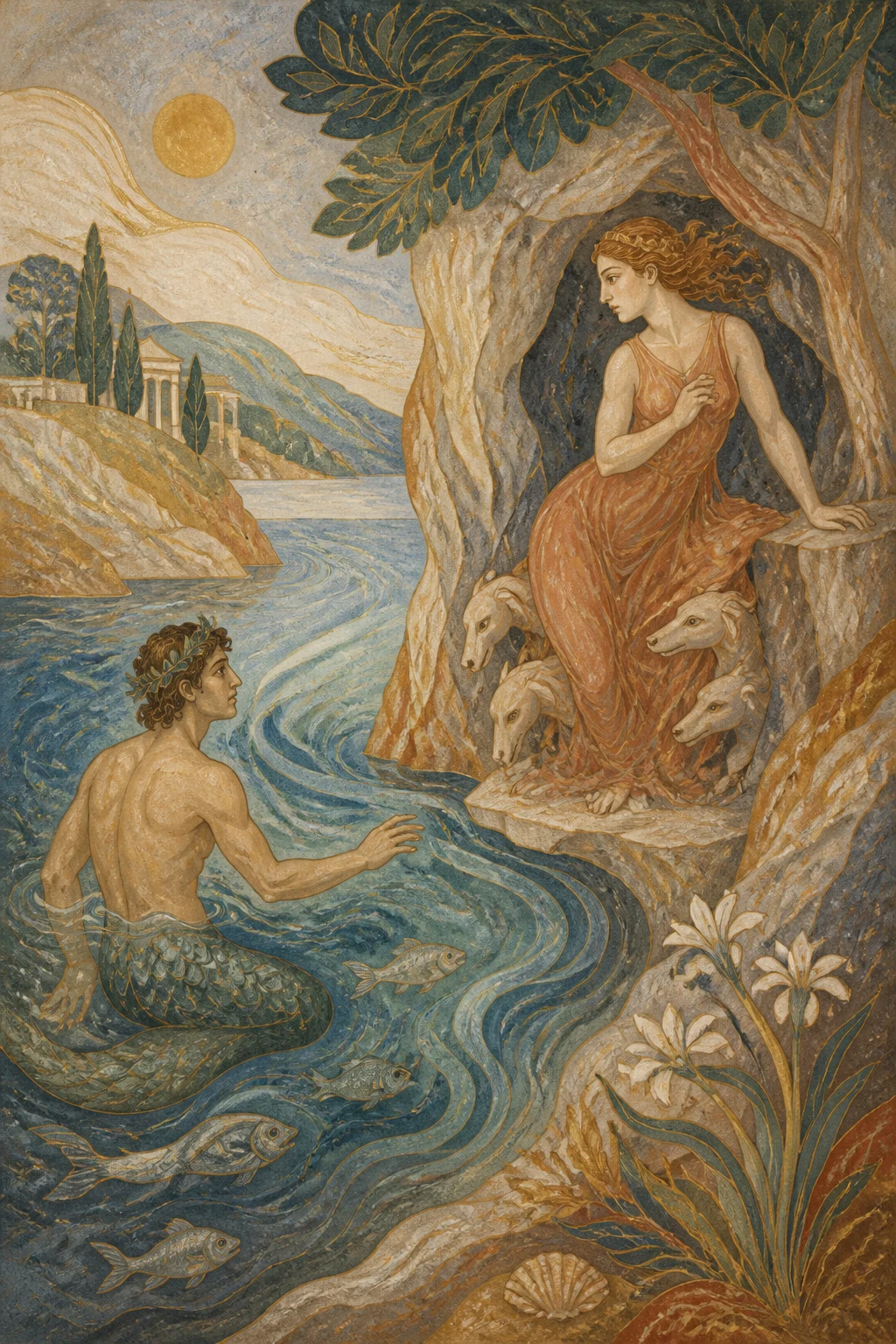
One day he saw Hesperie, whom he had often sought through all the woods, on the banks of her father Cebren, drying in the sun the hair that lay across her shoulders. The nymph caught sight of him and fled, like a frightened doe fleeing a tawny wolf, or a river duck surprised by a hawk far from the lake it has left behind. The Trojan hero pursued her, swift with love as she was swift with fear.
But a snake lurking in the grass grazed the fleeing girl’s foot with its curved fang and left its venom in her body. Her flight and life ended together. Distraught, he clasped her lifeless body and cried, ‘I wish, I wish I had not followed! This was not what I feared, nor was winning you worth such a price. We two have destroyed you, poor girl: the snake dealt the wound, but I supplied the cause. I am more guilty than he, and by my death I shall send you solace for your own.’ He spoke, and from a cliff undercut by the roaring waves flung himself into the sea. Tethys pitied him as he fell and caught him gently; as he floated on the water, she clothed him in feathers, denying him the death he longed for.
The lover raged at being forced to live against his will, his soul prevented from leaving the wretched dwelling it longed to escape. With the new wings his shoulders bore, he soared, then hurled his body down upon the sea once more. His feathers broke his fall. Aesacus raged and plunged headlong into the depths, endlessly seeking a way to die. Love made him lean: his legs grew long between the joints, his neck remained long, his head far from his body.
He loves the sea, and because he dives, he still bears the name ‘diver.’”