O besedilu
Eho in Narcis
- Vir
- Ovidove preobrazbe
- Avtor
- Ovid
- Jezik branja
- English
- Jezik izvirnika
- Latin
- Čas branja
- 10 min branja
- Obseg
- 8 strani
- Naslov izvirnika
- Echo and Narcissus
O izvirniku
Ovidove preobrazbe
Pesniški tok antičnih preobrazb, kjer bogovi, ljudje in narava stalno menjavajo obliko. Bralni jezik je English, izvirnik pa prihaja iz vira Ovidove preobrazbe v jeziku Latin.
Besedilo
Eho in Narcis
Famed throughout the cities of Aonia, he gave unfailing answers to the people who sought his counsel. The first to put his trustworthiness and prophetic words to the test was blue-watered Liriope. Once, in his winding stream, Cephisus had enfolded her, imprisoned her within his waters, and taken her by force. The lovely nymph, her womb now full, gave birth to a child whom even then the nymphs might well have loved, and named him Narcissus. Asked whether the boy would live to see the long years of ripe old age, the prophetic seer replied, “If he never knows himself.”
For a long time the prophet’s words seemed empty; but the outcome, the events, his manner of death, and his strange madness proved them true. For the son of Cephisus had added one year to three times five, and might have seemed either boy or young man. Many youths and many girls desired him. But in that tender beauty there was such hard pride that no youth, no girl, could touch his heart.
As he drove frightened deer into his nets, he caught the eye of the clear-voiced nymph who had never learned to keep silent when another spoke, nor to speak first herself: resounding Echo. Echo still had a body then, and was not merely a voice; yet, talkative as she was, her mouth had no more power than it has now: to repeat the last words of a longer speech. Juno had brought this about. For often, when she might have caught nymphs lying with her Jupiter upon the mountain, Echo would knowingly detain the goddess in long conversation while the nymphs escaped. When Saturn’s daughter understood, she said, “Of this tongue that has deceived me, you shall have little power, and of your voice the briefest use.”
She made good her threat. Yet Echo still repeats the sounds at the end of a speech, returning the words she hears. So when she saw Narcissus wandering through the lonely countryside and burned with love, she followed secretly in his footsteps; and the more she followed, the nearer the flame that warmed her, just as the quick-burning sulphur smeared around the tips of torches catches fire when a flame is brought close.
Oh, how often she longed to approach him with tender words and offer gentle pleas! Her nature thwarted her and would not let her begin. But she was ready to do what it allowed: to wait for sounds to which she could return her words. By chance the boy, separated from his faithful band of companions, had called, “Is anyone here?” and Echo had answered, “Here!” Astonished, he looked in every direction and shouted loudly, “Come!” She called to him as he called.
He looked behind him, and when no one came, he asked again, “Why do you run from me?” and received the very words he spoke. He persisted, deceived by the semblance of an answering voice: “Let us meet here!” he said. Never more gladly answering any sound, Echo returned, “Let us meet!” And, making good her own words, she came out of the wood to throw her arms around the neck she longed to clasp.
He fled, and as he fled he cried, “Keep your arms from embracing me! I would die before I let you have me.” She returned nothing but “I let you have me.” Rejected, she hid in the woods, concealing her shamed face among the leaves, and from that time lived in lonely caves. Yet her love endured, and grew with the pain of rejection. Sleepless sorrow wasted her wretched body; her skin shrivelled with thinness, and all her body’s moisture vanished into the air. Only her voice and bones remained: her voice lives on; her bones, they say, took the form of stone.
Ever since, she hides in the woods, unseen on any mountain, but heard by all: only sound lives on in her. So he had mocked her, and other nymphs born of waters or mountains; so, before them, he had mocked the company of men. Then one he had scorned raised his hands to heaven and cried, “May he too love, and never possess the one he loves!” The goddess of Rhamnus granted the just prayer.
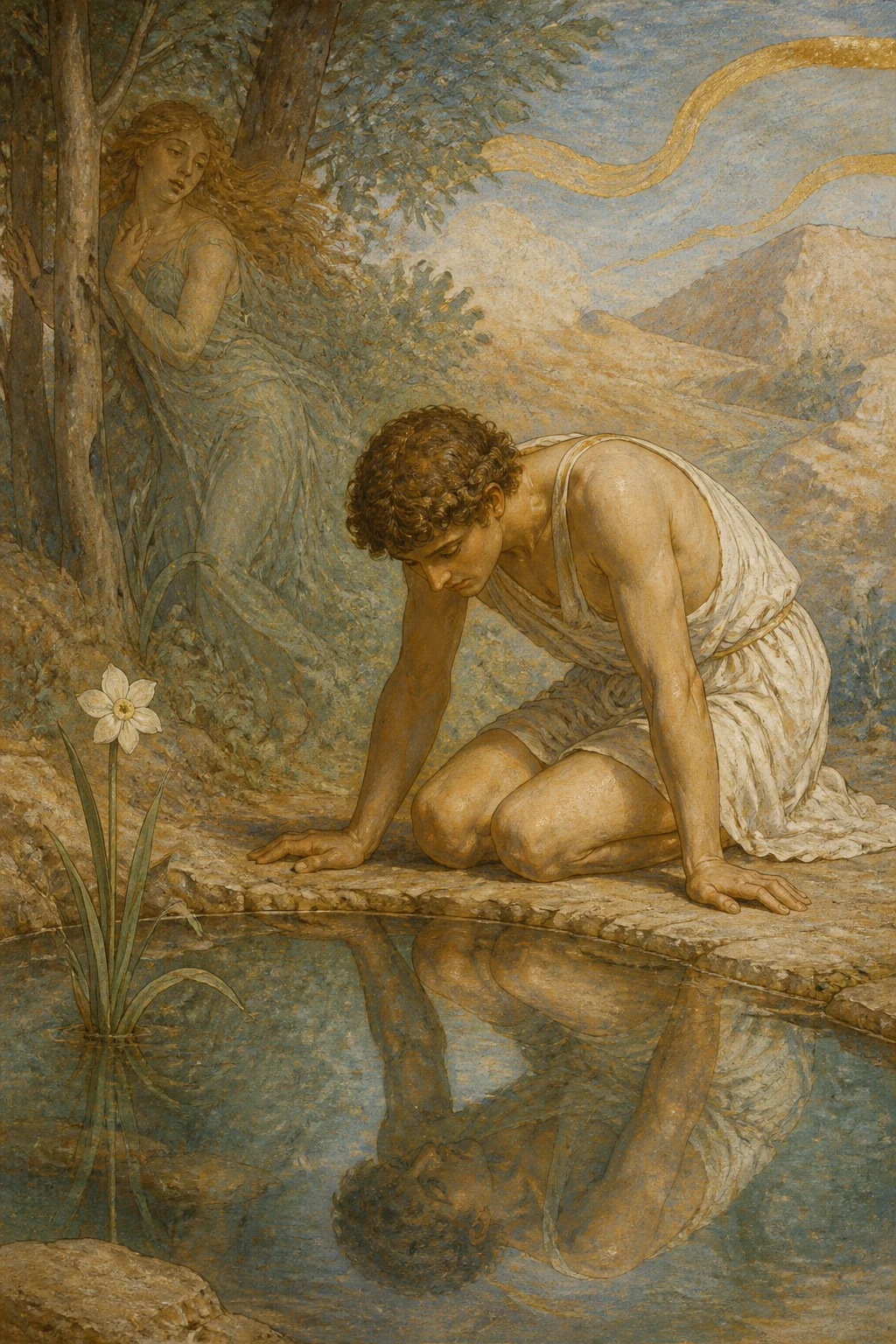
There was a clear spring, silver-bright with shining water, untouched by shepherds, by goats grazing on the mountain, or any other herd; no bird or beast had troubled it, nor any branch fallen from a tree. Grass grew around it, nourished by the water nearby, and a wood that would let no sunlight warm the place. Here the boy, weary from the hunt and the heat, lay down, drawn by the beauty of the place and by the spring.
And as he sought to quench his thirst, another thirst arose. As he drank, entranced by the beauty of the image he saw, he loved a bodiless hope, taking for a body what was only water. He gazed in wonder at himself, and lay motionless, his face unchanged, like a statue carved from Parian marble. Stretched upon the ground, he watched the twin stars of his own eyes, his hair worthy of Bacchus, worthy of Apollo, his beardless cheeks, his ivory neck, the beauty of his face, and the blush mingled with its snowy whiteness; he marvelled at all that made him marvellous.
Unknowing, he desired himself: the admirer was himself admired; he sought and was sought, kindling the fire that burned him. How often he planted futile kisses on the treacherous spring! How often he plunged his arms into the water, reaching for the neck he saw, yet never clasped himself within them! He did not know what he was seeing, but what he saw set him ablaze, and the same illusion that deceived his eyes urged them on.
Trusting boy, why vainly grasp at a fleeting image? What you seek is nowhere; turn away, and you will lose what you love. What you see is the shadow of a reflected image: it has nothing of its own; it comes and stays with you, and will leave with you, if you can leave. Neither the need for food nor the need for rest could draw him away. Stretched out upon the shaded grass, he watched that deceptive beauty with insatiable eyes, and through his own eyes perished. Raising himself a little and stretching his arms towards the woods around him, he said, “O woods, has anyone ever loved more cruelly?
You know, for you have offered many lovers a welcome hiding place. Through all the ages of your lives, do you remember anyone who wasted away like this? I see him, and he delights me; yet what I see and what delights me I cannot find: so deep is the delusion that possesses his lover. And to make my grief still greater, no vast sea divides us, no road, no mountains, no city walls with bolted gates: a little water keeps us apart. He too longs to be held: for whenever I offer kisses to the clear water, he strains towards me, lifting his face to mine.
You would think I could touch him: so little stands between us lovers. Whoever you are, come out here! Why deceive me, peerless boy, and where do you go when I reach for you? Surely neither my looks nor my age should make you flee; nymphs too have loved me. Your friendly face holds out some hope to me, and when I stretch my arms towards you, you stretch yours in return.
When I smile, you smile back; often I have seen your tears when I was weeping. You answer my nods with yours, and, as far as I can judge by the movement of your lovely lips, you return words that never reach my ears. I am he! I understand; my own image no longer deceives me. I burn with love for myself; I kindle the flames I suffer. What shall I do? Be wooed, or woo? And what then shall I ask?
What I desire is with me: abundance has made me poor. Oh, if only I could part from my own body! A strange wish for a lover: I wish what I love were far away!— And now grief drains my strength; little time remains of my life, and I am quenched in the first bloom of youth. Death is no burden to me, for in death I shall lay down my sorrows; but I wish the one I love might live on longer.
Now we two, united in one soul, shall die together.” He spoke, and in his madness returned to the same face; his tears troubled the waters, and the image grew dim in the ruffled pool. When he saw it vanishing, he cried, “Where are you fleeing? Stay! Do not cruelly desert the one who loves you! Let me look at what I cannot touch, and feed my wretched passion.” And in his grief he pulled his robe down from its upper edge and beat his naked breast with marble-white hands.
His breast, struck by the blows, took on a delicate blush, just as apples are white in one part and red in another, or as grapes in varied clusters take on a purple hue before they ripen. As soon as he saw this in the water, now clear again, he could bear no more. As yellow wax melts before a gentle fire, or morning frost in the warmth of the sun, so, wasted by love, he melted, slowly consumed by a hidden flame.
No longer did his colour mingle red with white; gone were his vigour, his strength, and all that had so lately pleased his eyes; nor did the body Echo once had loved remain. Yet when she saw him, though still angry and remembering, she grieved; and whenever the unhappy boy cried, “Alas!” she repeated, “Alas!” in her answering voice. And when he struck his arms with his own hands, she too returned the same sound of mourning.
His last words, gazing into the water as he always did, were these: “Alas, beloved boy, loved in vain!” The place returned the very words, and when he said, “Farewell,” Echo too said, “Farewell!” He laid his weary head upon the green grass; death closed the eyes that marvelled at their master’s beauty. Even then, after he had been received into the underworld, he gazed at himself in the waters of the Styx. His sisters, the Naiads, mourned and laid their shorn hair as an offering to their brother; the Dryads mourned, and Echo answered their lament.
Already they were preparing the pyre, the brandished torches, and the bier: his body was nowhere to be found. In its place they discovered a saffron-coloured flower, its heart encircled by white petals.
Izvirnik
Echo and Narcissus
Naslednje strani prikazujejo izvirno besedilo za primerjavo.
Source ID: ovid_metamorphoses_story_022 Citation: Ovid, Metamorphoses 3.339-3.510 Original language: Latin Source: PerseusDL canonical-latinLit Source URL: https://github.com/PerseusDL/canonical-latinLit/blob/master/data/phi0959/phi006/phi0959.phi006.perseus-lat2.xml Segmentation certainty: medium 339: Ille per Aonias fama celeberrimus urbes 340: inreprehensa dabat populo responsa petenti.
341: Prima fide vocisque ratae temptamina sumpsit 342: caerula Liriope. Quam quondam flumine curvo 343: implicuit clausaeque suis Cephisus in undis 344: vim tulit. Enixa est utero pulcherrima pleno 345: infantem, nymphis iam tunc qui posset amari, 346: Narcissumque vocat. De quo consultus, an esset 347: tempora maturae visurus longa senectae, 348: fatidicus vates “si se non noverit” inquit.
349: Vana diu visa est vox auguris: exitus illam 350: resque probat letique genus novitasque furoris. 351: Namque ter ad quinos unum Cephisius annum 352: addiderat poteratque puer iuvenisque videri: 353: multi illum iuvenes, multae cupiere puellae. 354: Sed fuit in tenera tam dura superbia forma: 355: nulli illum iuvenes, nullae tetigere puellae. 356: Adspicit hunc trepidos agitantem in retia cervos 357: vocalis nymphe, quae nec reticere loquenti, 358: nec prior ipsa loqui didicit, resonabilis Echo.
359: Corpus adhuc Echo, non vox erat; et tamen usum 360: garrula non alium, quam nunc habet, oris habebat, 361: reddere de multis ut verba novissima posset. 362: Fecerat hoc Iuno, quia, cum deprendere posset 363: cum Iove saepe suo nymphas in monte iacentes, 364: illa deam longo prudens sermone tenebat, 365: dum fugerent nymphae. Postquam Saturnia sensit 366: “huius” ait “linguae, qua sum delusa, potestas 367: parva tibi dabitur vocisque brevissimus usus”: 368: reque minas firmat. Tamen haec in fine loquendi 369: ingeminat voces auditaque verba reportat.
370: Ergo ubi Narcissum per devia rura vagantem 371: vidit et incaluit, sequitur vestigia furtim, 372: quoque magis sequitur, flamma propiore calescit, 373: non aliter, quam cum summis circumlita taedis 374: admotas rapiunt vivacia sulphura flammas. 375: O quotiens voluit blandis accedere dictis 376: et molles adhibere preces: natura repugnat 377: nec sinit incipiat. Sed, quod sinit, illa parata est 378: exspectare sonos, ad quos sua verba remittat.
379: Forte puer comitum seductus ab agmine fido, 380: dixerat “ecquis adest?” et “adest!” responderat Echo. 381: Hic stupet, utque aciem partes dimittit in omnes, 382: voce “veni!” magna clamat: vocat illa vocantem. 383: Respicit et rursus nullo veniente “quid” inquit 384: “me fugis?” et totidem, quot dixit, verba recepit. 385: Perstat et, alternae deceptus imagine vocis, 386: “huc coeamus!” ait: nullique libentius umquam 387: responsura sono “coeamus” rettulit Echo, 388: et verbis favet ipsa suis egressaque silva 389: ibat, ut iniceret sperato bracchia collo.
390: Ille fugit fugiensque “manus complexibus aufer: 391: ante” ait “emoriar, quam sit tibi copia nostri.” 392: Rettulit illa nihil nisi “sit tibi copia nostri.” 393: Spreta latet silvis pudibundaque frondibus ora 394: protegit et solis ex illo vivit in antris. 395: Sed tamen haeret amor crescitque dolore repulsae. 396: Extenuant vigiles corpus miserabile curae, 397: adducitque cutem macies et in aera sucus 398: corporis omnis abit. Vox tantum atque ossa supersunt: 399: vox manet; ossa ferunt lapidis traxisse figuram.
400: inde latet silvis nulloque in monte videtur; 401: omnibus auditur: sonus est, qui vivit in illa. 402: Sic hanc, sic alias undis aut montibus ortas 403: luserat hic nymphas, sic coetus ante viriles. 404: Inde manus aliquis despectus ad aethera tollens 405: “sic amet ipse licet sic non potiatur amato!” 406: dixerat. Adsensit precibus Rhamnusia iustis. 407: Fons erat inlimis, nitidis argenteus undis, 408: quem neque pastores neque pastae monte capellae 409: contigerant aliudve pecus, quem nulla volucris 410: nec fera turbarat nec lapsus ab arbore ramus.
411: Gramen erat circa, quod proximus umor alebat, 412: silvaque sole locum passura tepescere nullo. 413: Hic puer, et studio venandi lassus et aestu, 414: procubuit faciemque loci fontemque secutus. 415: dumque sitim sedare cupit, sitis altera crevit. 416: Dumque bibit, visae correptus imagine formae 417: spem sine corpore amat: corpus putat esse, quod unda est 418: adstupet ipse sibi, vultuque inmotus eodem 419: haeret, ut e Pario formatum marmore signum.
420: Spectat humi positus geminum, sua lumina, sidus 421: et dignos Baccho, dignos et Apolline crines 422: impubesque genas et eburnea colla decusque 423: oris et in niveo mixtum candore ruborem, 424: cunctaque miratur, quibus est mirabilis ipse. 425: Se cupit imprudens et qui probat, ipse probatur, 426: dumque petit, petitur, pariterque accendit et ardet. 427: Inrita fallaci quotiens dedit oscula fonti!
428: In mediis quotiens visum captantia collum 429: bracchia mersit aquis, nec se deprendit in illis! 430: Quid videat, nescit: sed quod videt, uritur illo, 431: atque oculos idem, qui decipit, incitat error. 432: Credule, quid frusta simulacra fugacia captas? 433: quod petis, est nusquam; quod amas, avertere, perdes. 434: Ista repercussae, quam cernis, imaginis umbra est: 435: nil habet ista sui; tecum venitque manetque, 436: tecum discedet, si tu discedere possis.
437: Non illum Cereris, non illum cura quietis 438: abstrahere inde potest, sed opaca fusus in herba 439: spectat inexpleto mendacem lumine formam, 440: perque oculos perit ipse suos; paulumque levatus 441: ad circumstantes tendens sua bracchia silvas 442: “ecquis, io silvae, crudelius” inquit “amavit? 443: Scitis enim, et multis latebra opportuna fuistis. 444: Ecquem, cum vestrae tot agantur saecula vitae, 445: qui sic tabuerit, longo meministis in aevo?
446: Et placet et video; sed quod videoque placetque, 447: non tamen invenio: tantus tenet error amantem. 448: Quoque magis doleam, nec nos mare separat ingens, 449: nec via nec montes nec clausis moenia portis: 450: exigua prohibemur aqua. Cupit ipse teneri: 451: nam quotiens liquidis porreximus oscula lymphis, 452: hic totiens ad me resupino nititur ore. 453: Posse putes tangi: minimum est, quod amantibus obstat.
454: Quisquis es, huc exi! quid me, puer unice, fallis, 455: quove petitus abis? certe nec forma nec aetas 456: est mea quam fugias, et amarunt me quoque nymphae. 457: Spem mihi nescio quam vultu promittis amico, 458: cumque ego porrexi tibi bracchia, porrigis ultro: 459: cum risi, adrides; lacrimas quoque saepe notavi 460: me lacrimante tuas, nutu quoque signa remittis, 461: et quantum motu formosi suspicor oris, 462: verba refers aures non pervenientia nostras.
463: Iste ego sum: sensi, nec me mea fallit imago. 464: Uror amore mei, flammas moveoque feroque. 465: Quid faciam? roger, anne rogem? quid deinde rogabo? 466: quod cupio mecum est: inopem me copia fecit. 467: O utinam a nostro secedere corpore possem! 468: Votum in amante novum: vellem quod amamus abesset! — 469: Iamque dolor vires adimit, nec tempora vitae 470: longa meae superant, primoque exstinguor in aevo.
471: Nec mihi mors gravis est posituro morte dolores: 472: hic, qui diligitur, vellem diuturnior esset. 473: Nunc duo concordes anima moriemur in una.” 474: Dixit et ad faciem rediit male sanus eandem 475: et lacrimis turbavit aquas, obscuraque moto 476: reddita forma lacu est. Quam cum vidisset abire, 477: “quo refugis? remane, nec me, crudelis, amantem 478: desere!” clamavit: “liceat, quod tangere non est, 479: adspicere et misero praebere alimenta furori.”
480: Dumque dolet, summa vestem deduxit ab ora 481: nudaque marmoreis percussit pectora palmis. 482: Pectora traxerunt tenuem percussa ruborem, 483: non aliter quam poma solent, quae candida parte, 484: parte rubent, aut ut variis solet uva racemis 485: ducere purpureum nondum matura colorem. 486: Quae simul adspexit liquefacta rursus in unda, 487: non tulit ulterius, sed ut intabescere flavae 488: igne levi cerae matutinaeque pruinae 489: sole tepente solent, sic attenuatus amore 490: liquitur et tecto paulatim carpitur igni.
491: Et neque iam color est mixto candore rubori, 492: nec vigor et vires et quae modo visa placebant, 493: nec corpus remanet, quondam quod amaverat Echo. 494: Quae tamen ut vidit, quamvis irata memorque, 495: indoluit, quotiensque puer miserabilis “eheu” 496: dixerat, haec resonis iterabat vocibus “eheu”; 497: cumque suos manibus percusserat ille lacertos, 498: haec quoque reddebat sonitum plangoris eundem.
499: Ultima vox solitam fuit haec spectantis in undam, 500: “heu frustra dilecte puer!” totidemque remisit 501: verba locus, dictoque vale “vale!” inquit et Echo. 502: Ille caput viridi fessum submisit in herba; 503: lumina mors clausit domini mirantia formam. 504: Tunc quoque se, postquam est inferna sede receptus, 505: in Stygia spectabat aqua. Planxere sorores 506: naides et sectos fratri posuere capillos, 507: planxerunt dryades: plangentibus adsonat Echo.
508: Iamque rogum quassasque faces feretrumque parabant: 509: nusquam corpus erat; croceum pro corpore florem 510: inveniunt, foliis medium cingentibus albis.
Nadaljuj z branjem