O besedilu
Glavk in Skila
- Vir
- Ovidove preobrazbe
- Avtor
- Ovid
- Jezik branja
- English
- Jezik izvirnika
- Latin
- Čas branja
- 4 min branja
- Obseg
- 3 strani
- Naslov izvirnika
- Glaucus and Scylla
O izvirniku
Ovidove preobrazbe
Pesniški tok antičnih preobrazb, kjer bogovi, ljudje in narava stalno menjavajo obliko. Bralni jezik je English, izvirnik pa prihaja iz vira Ovidove preobrazbe v jeziku Latin.
Besedilo
Glavk in Skila
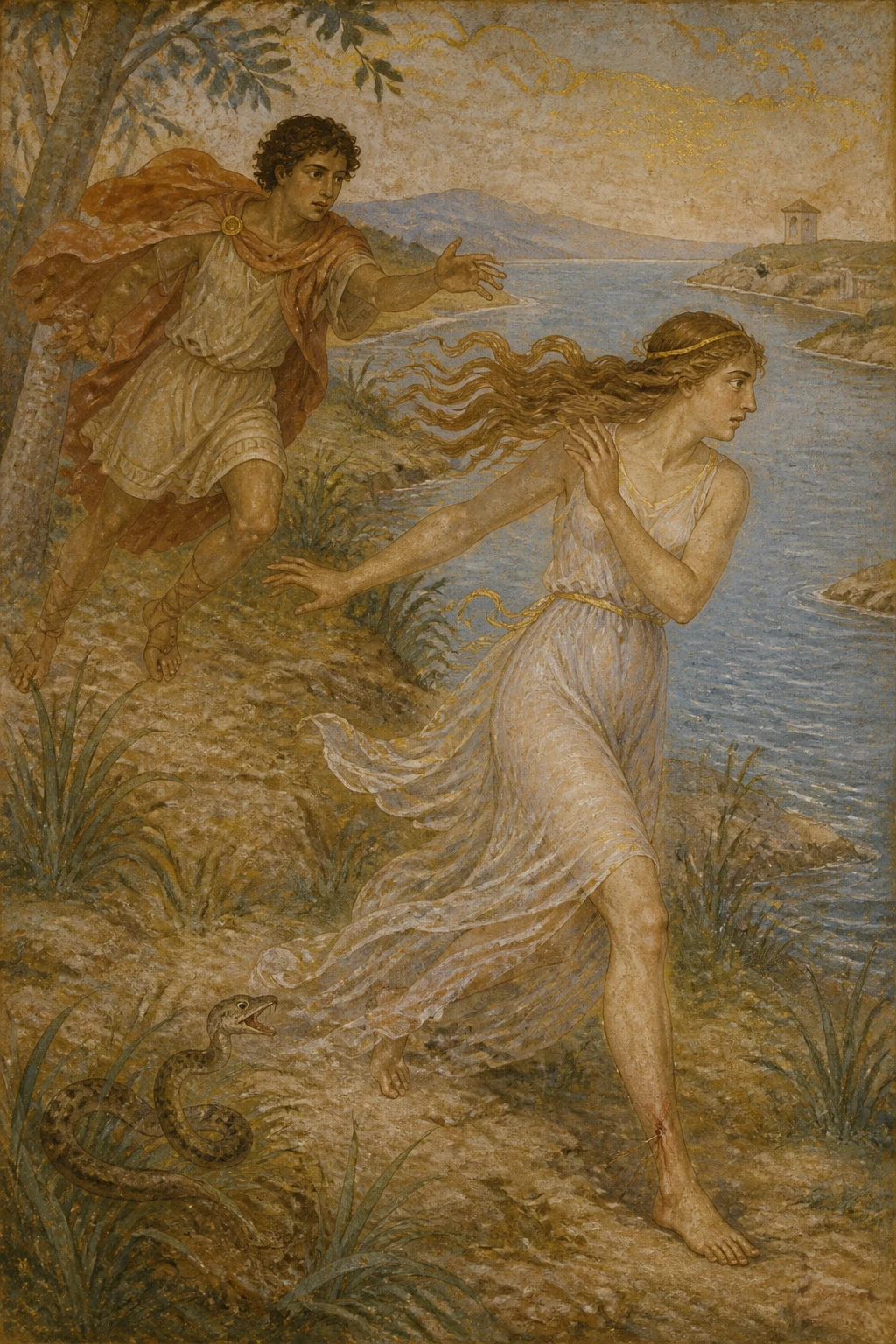
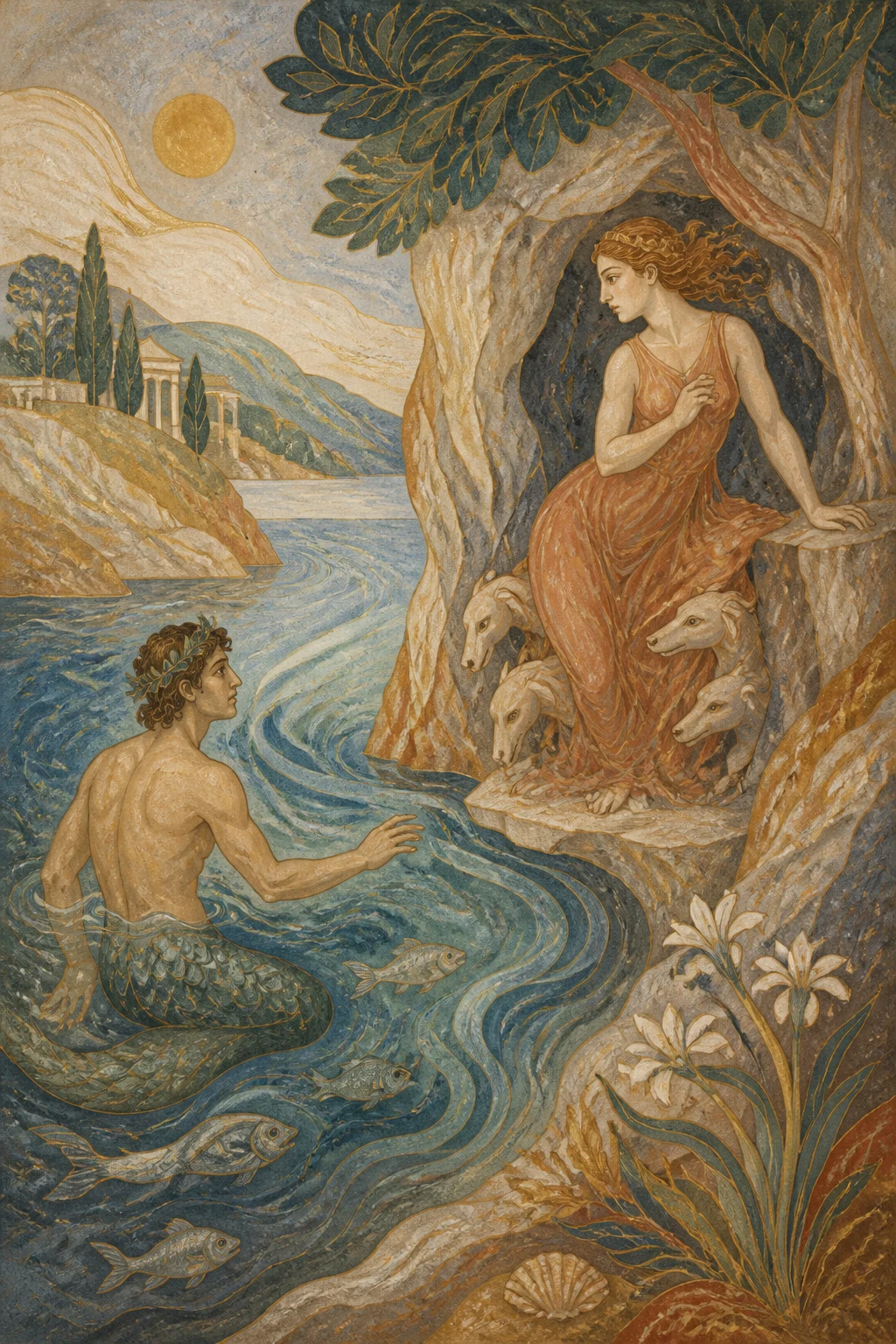
Galatea had finished speaking, and the gathering broke up; the Nereids departed, swimming through the tranquil waves. Scylla returned—for she dared not trust herself to the open sea—and either wandered naked over the thirsty sand or, when she grew weary, found some secluded inlet and cooled her limbs in its sheltered waters. And now, cleaving the waves, a new inhabitant of the deep, his body lately transformed at Anthedon in Euboea, Glaucus appeared. At the sight of the maiden, desire held him spellbound, and he called out whatever words he thought might stay her flight. But still she fled, and fear lent her speed until she reached the summit of a mountain near the shore.
It stood immense above the strait, narrowing to a single peak, its wooded crest curving far out over the sea. Here she stopped, safe in her lofty refuge, not knowing whether he was monster or god, and marvelled at his colour, his hair that covered his shoulders and the back beneath them, and the coiling fish’s tail that joined his body at the groin. He saw her wonder and, leaning against a nearby rock, said, “Maiden, I am no freak of nature, no savage beast, but a god of the waters. Neither Proteus nor Triton nor Palaemon, grandson of Athamas, has greater power over the sea.
Yet once I was mortal, though even then, devoted to the deep, I spent all my working hours upon it. Sometimes I hauled in nets heavy with fish; sometimes I sat upon a rock and plied my rod and line. There is a stretch of shore beside a green meadow, bordered on one side by water, on the other by grass that no horned heifer’s teeth had ever bruised, nor had you cropped it, gentle sheep or shaggy goats.
No bee had carried pollen gathered from its flowers; no festive garland had been woven there to crown a head, nor had any hand with a sickle ever cut it. I was the first to sit upon that turf, drying my dripping lines, and, to count my captive fish in order, I laid them out upon it—those that chance had driven into my nets or their own credulity onto my barbed hooks.
What followed sounds invented—but what would I gain by inventing it? At the touch of the grass, my catch began to move, turning from side to side and struggling on land as in the sea. While I lingered there in wonder, the whole shoal escaped into its native waters, leaving its new master and the shore behind. I stood astonished, wondering for a long time what had caused it: had some god done this, or the juice of the grass?
‘What grass can have such power?’ I asked, and with my hand I plucked a handful of the herbage and bit into it. Scarcely had my throat swallowed those unfamiliar juices when suddenly I felt my heart tremble within me, and my breast was seized with longing for another nature. I could not hold out long. ‘Earth, to which I shall never return, farewell!’ I cried, and plunged beneath the waves.
The sea gods welcomed me and deemed me worthy to share their honours; and, to strip away whatever mortality I still bore, they entreated Oceanus and Tethys. These two purified me, and, after a cleansing spell had been spoken over me nine times to purge all taint, commanded me to place my breast beneath a hundred rivers. At once the streams came rushing from every quarter, and all their waters poured over my head.
So far I can recount to you what happened, so far I remember; of the rest my mind knew nothing. When consciousness returned, I found myself changed throughout my body, and no longer the same in mind. Then for the first time I saw this beard, green with sea-dark rust, this hair that trails behind me through the wide waters, these massive shoulders and blue arms, and my legs transformed into a curving, finned fish’s tail.
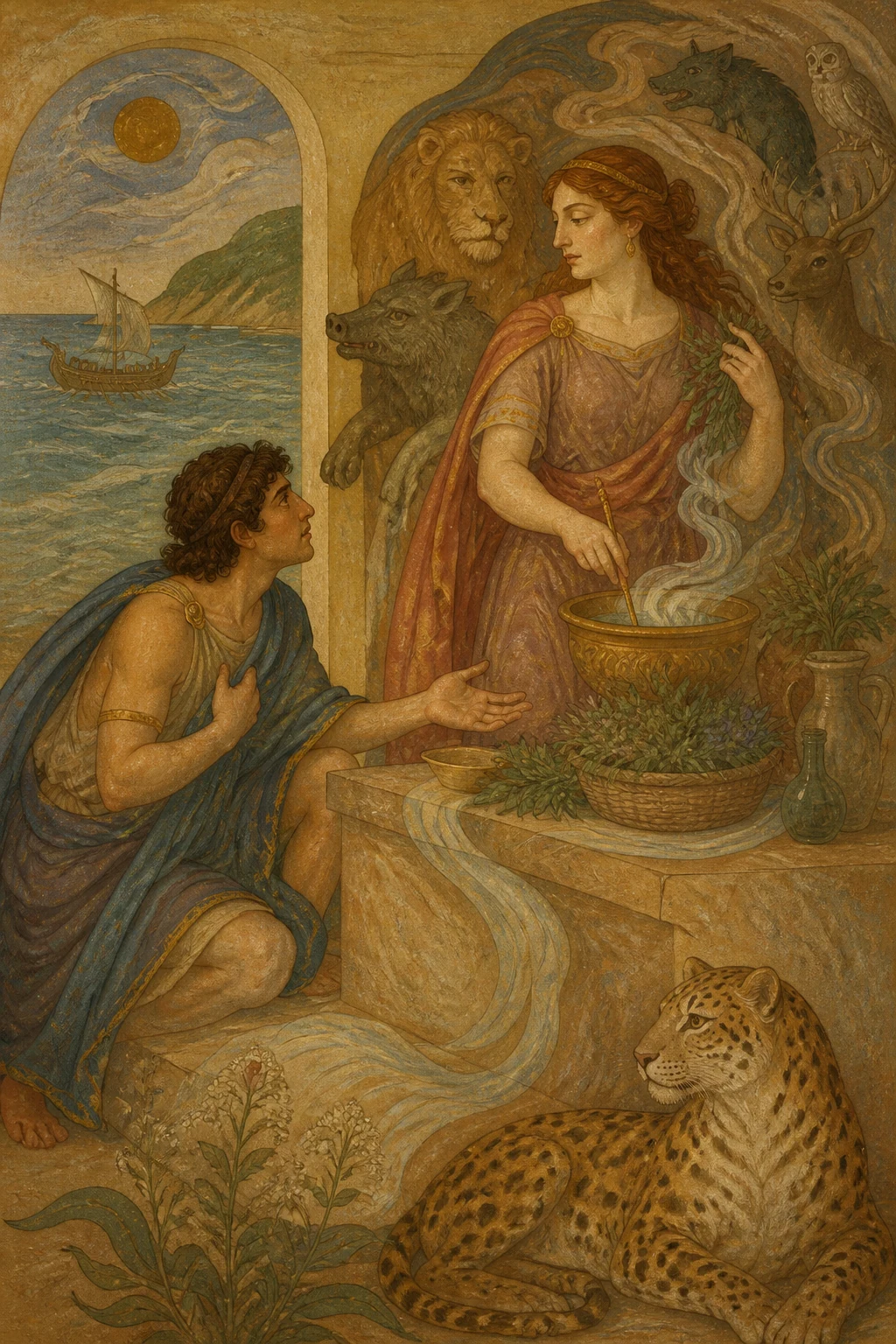
Yet what use is this form, or the favour of the sea gods? What good is being a god, if none of this can move you?” While he was speaking, and would have said still more, Scylla left the god. Furious, stung by her rejection, he sought the uncanny halls of Circe, daughter of the Sun.
Izvirnik
Glaucus and Scylla
Naslednje strani prikazujejo izvirno besedilo za primerjavo.
Source ID: ovid_metamorphoses_story_090 Citation: Ovid, Metamorphoses 13.898-13.968 Original language: Latin Source: PerseusDL canonical-latinLit Source URL: https://github.com/PerseusDL/canonical-latinLit/blob/master/data/phi0959/phi006/phi0959.phi006.perseus-lat2.xml Segmentation certainty: medium 898: Desierat Galatea loqui, coetuque soluto 899: discedunt placidisque natant Nereides undis.
900: Scylla redit (neque enim medio se credere ponto 901: audet) et aut bibula sine vestibus errat harena, 902: aut, ubi lassata est, seductos nacta recessus 903: gurgitis, inclusa sua membra refrigerat unda. 904: Ecce fretum scindens alti novus incola ponti, 905: nuper in Euboica versis Anthedone membris, 906: Glaucus adest visaeque cupidine virginis haeret 907: et quaecumque putat fugientem posse morari 908: verba refert; fugit illa tamen veloxque timore 909: pervenit in summum positi prope litora montis.
910: Ante fretum est ingens, apicem conlectus in unum, 911: longa sub arboribus convexus in aequora vertex: 912: constitit hic, et tuta loco, monstrumne deusne 913: ille sit, ignorans, admiraturque colorem 914: caesariemque umeros subiectaque terga tegentem, 915: ultimaque excipiat quod tortilis inguina piscis. 916: Sensit et innitens, quae stabat proxima, moli, 917: “non ego prodigium nec sum fera belua, virgo, 918: sed deus” inquit “aquae: nec maius in aequore Proteus 919: ius habet et Triton Athamantiadesque Palaemon.
920: Ante tamen mortalis eram, sed, scilicet altis 921: deditus aequoribus, tantum exercebar in illis. 922: Nam modo ducebam ducentia retia pisces, 923: nunc in mole sedens moderabar harundine linum. 924: Sunt viridi prato confinia litora, quorum 925: altera pars undis, pars altera cingitur herbis, 926: quas neque cornigerae morsu laesere iuvencae, 927: nec placidae carpsistis oves hirtaeve capellae; 928: non apis inde tulit conlectos semine flores, 929: non data sunt capiti genialia serta, neque umquam 930: falciferae secuere manus; ego primus in illo 931: caespite consedi, dum lina madentia sicco,
932: utque recenserem captivos ordine pisces, 933: insuper exposui, quos aut in retia casus 934: aut sua credulitas in aduncos egerat hamos. 935: Res similis fictae (sed quid mihi fingere prodest?): 936: gramine contacto coepit mea praeda moveri 937: et mutare latus terraque, ut in aequore, niti. 938: Dumque moror mirorque simul, fugit omnis in undas 939: turba suas dominumque novum litusque relinquunt.
940: Obstipui dubitoque diu causamque requiro, 941: num deus hoc aliquis, num sucus fecerit herbae. 942: “Quae” tamen “has” inquam “vires habet herba?”,manuque 943: pabula decerpsi decerptaque dente momordi. 944: Vix bene combiberant ignotos guttura sucos, 945: cum subito trepidare intus praecordia sensi 946: alteriusque rapi naturae pectus amore, 947: nec potui restare diu “repetenda” que “numquam 948: terra, vale!” dixi corpusque sub aequora mersi.
949: Di maris exceptum socio dignantur honore, 950: utque mihi quaecumque feram mortalia, demant, 951: Oceanum Tethynque rogant: ego lustror ab illis, 952: et purgante nefas noviens mihi carmine dicto 953: pectora fluminibus iubeor supponere centum; 954: nec mora, diversis lapsi de partibus amnes 955: totaque vertuntur supra caput aequora nostrum. 956: Hactenus acta tibi possum memoranda referre, 957: hactenus haec memini, nec mens mea cetera sensit.
958: Quae postquam rediit, alium me corpore toto 959: ac fueram nuper, neque eundem mente recepi. 960: Hanc ego tum primum viridem ferrugine barbam 961: caesariemque meam, quam longa per aequora verro, 962: ingentesque umeros et caerula bracchia vidi 963: cruraque pinnigero curvata novissima pisce. 964: Quid tamen haec species, quid dis placuisse marinis, 965: quid iuvat esse deum, si tu non tangeris istis?”
966: Talia dicentem, dicturum plura, reliquit 967: Scylla deum; furit ille inritatusque repulsa 968: prodigiosa petit Titanidos atria Circes.
Nadaljuj z branjem