Prevod
Meanwhile Ceyx, troubled by the portents that had attended his brother and followed his brother’s fate, his heart full of anxiety, prepared to consult the sacred oracles, those comforts of humankind, and visit the god at Claros; for the godless Phorbas, with his Phlegyans, made the way to Delphi’s temple unsafe. But first he told you of his plan, most faithful Alcyone; at once a chill sank into the marrow of your bones, a pallor like boxwood spread across your face, and your cheeks were drenched with streaming tears.
Three times she tried to speak, three times tears flooded her face, and, as sobs broke into her loving protests, she said, “What fault of mine, dearest, has changed your heart? Where is the care you used to feel for me? Can you now leave Alcyone behind without a thought? Does a long journey please you now? Am I dearer to you far away? But surely, I suppose, your journey is by land, and I shall only grieve, not fear as well, and my sorrow will be free from dread.
The waters terrify me, and the sea’s grim image: only lately I saw shattered timbers on the shore, and often I have read names on tombs that held no bodies. And do not let false confidence steal into your heart because the son of Hippotas is your father-in-law, who keeps the mighty winds imprisoned and calms the waters at his will! Once the winds are loosed and take possession of the sea, nothing is forbidden them; all the earth and all the ocean lie at their mercy. They harry even the clouds of heaven, and their savage collisions strike out fiery lightning.
The better I know them—for I do know them, and often saw them as a child in my father’s house—the more I think them to be feared. But if no prayers can bend your purpose, my dear husband, and you are all too firmly set on going, take me with you too. At least we shall be tossed together, and I shall fear only what I suffer; together we shall endure whatever comes, together be borne over the broad seas.”
These words and tears of Aeolus’s daughter moved her star-born husband, for the fire of love burned no less fiercely in him. Yet he would neither abandon his intended voyage nor let Alcyone share its dangers, and answered with many words to soothe her frightened heart. Still, he could not win her approval; to his words he added this further comfort, which alone prevailed upon his loving wife: “Every delay will seem long to us, but I swear to you by my father’s fires, if only fate allows me to return, I shall be back before the moon has twice filled out her circle.”
Once these promises had offered hope of his return, he immediately ordered the ship drawn from its sheds, launched upon the sea, and fitted with all its rigging. At the sight of it again, as though foreseeing what would come, Alcyone shuddered and let her rising tears flow, embraced him, and at last, utterly wretched, with sorrowful lips said, “Farewell,” and collapsed, her whole body giving way.
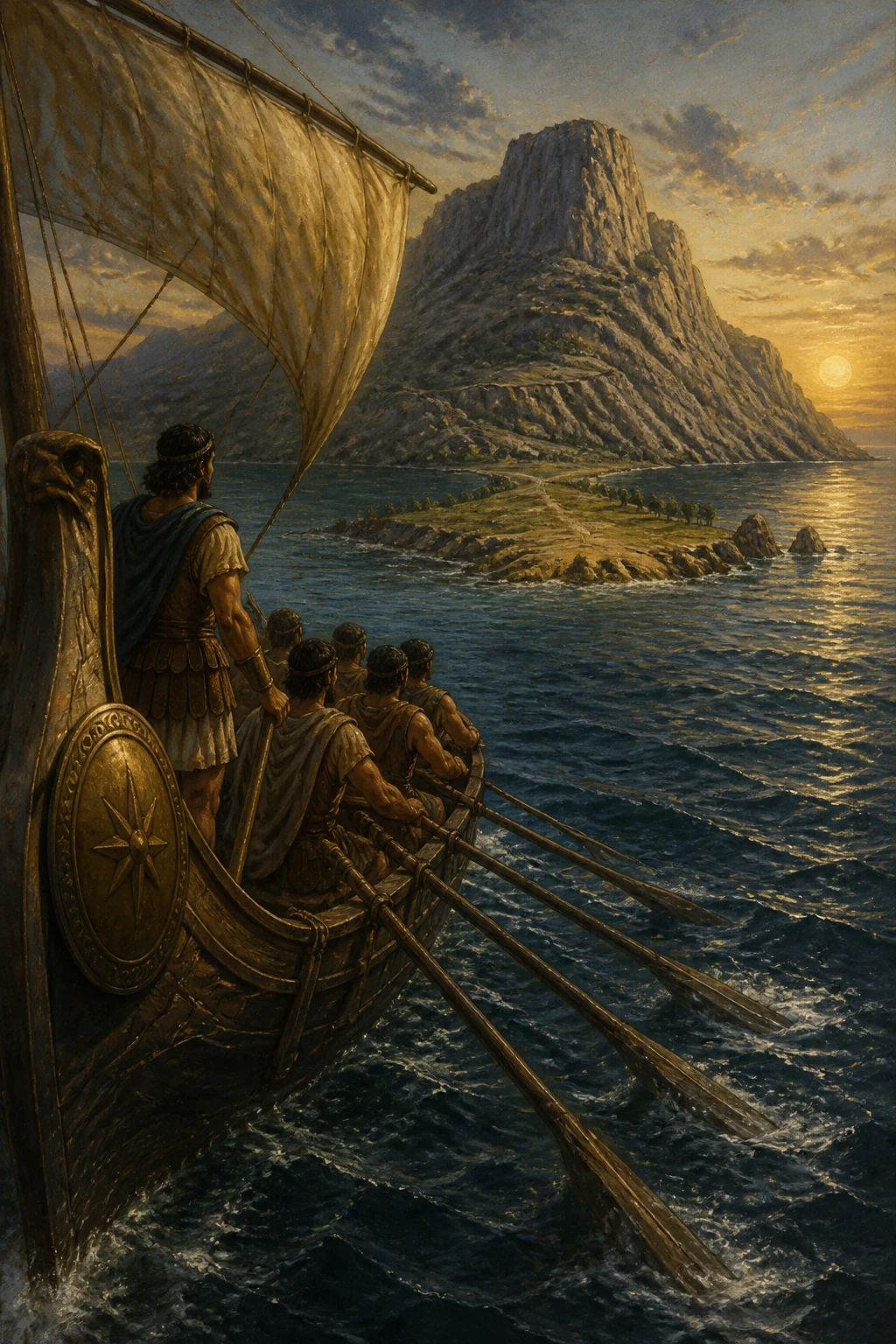
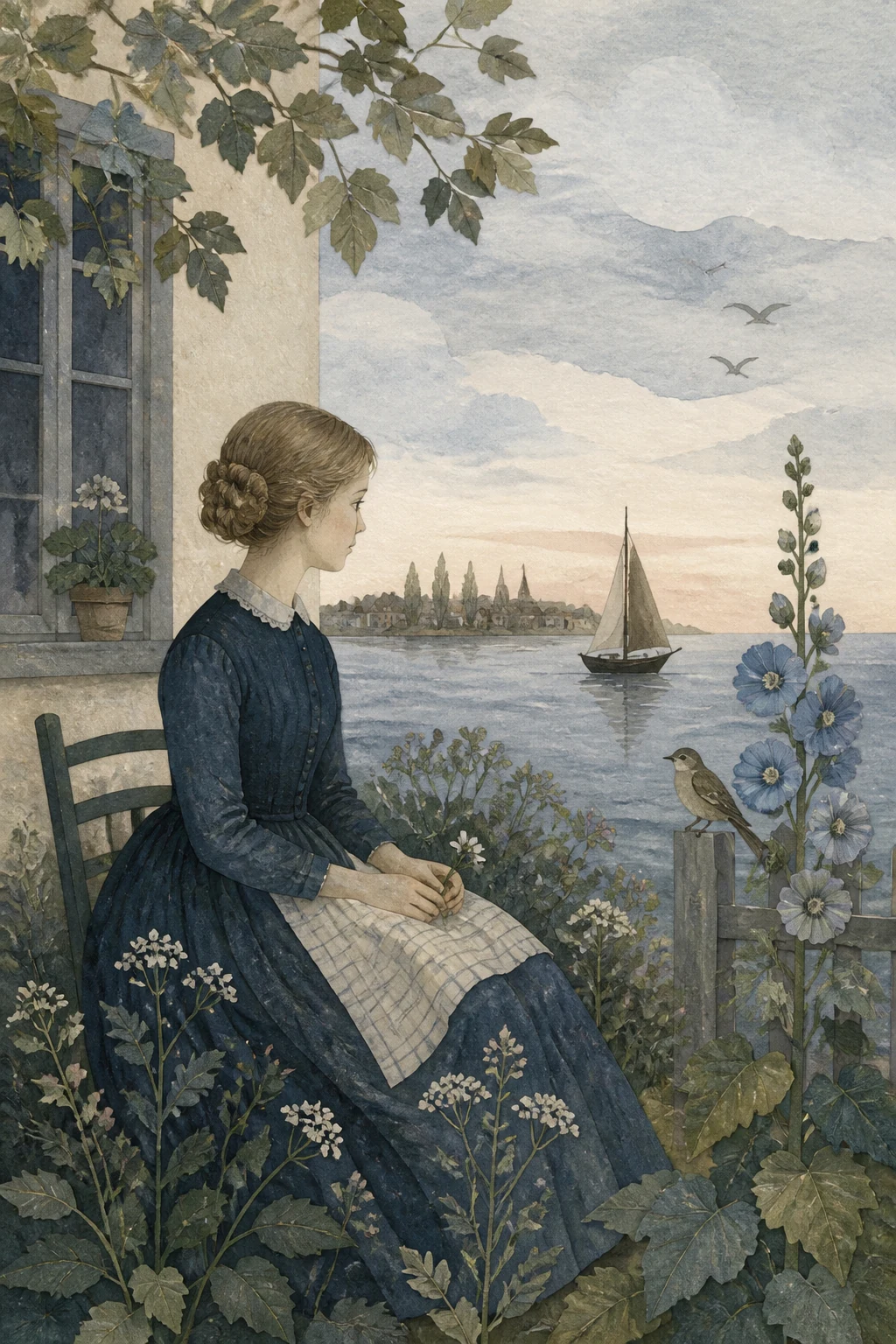
But while Ceyx sought excuses to delay, the young men drew the oars in double ranks towards their sturdy breasts and cleaved the sea with even strokes. She lifted her wet eyes, and at first saw her husband standing on the stern as it drew away, waving his hand to her, and returned his signals; when the land had fallen farther behind and her eyes could no longer distinguish his face, she followed the departing ship with her gaze as long as she could.
When distance hid even the ship from sight, she still watched the sails fluttering at the masthead; when she could no longer see the sails, she anxiously sought her empty bed and laid herself upon it; the bed and the place renewed Alcyone’s tears and reminded her what part of herself was missing. They had left the harbour, and a breeze stirred the ropes: the sailors turned the hanging oars against the ship’s side, raised the yard to the top of the mast, and spread the canvas down its whole length to catch the coming breeze.
The ship had covered less than half the sea, or certainly no more, and both shores were far away, when, towards nightfall, the sea began to whiten with swelling waves, and the headlong east wind blew more fiercely. “Lower the high yard, now!” the helmsman shouted. “Furl every inch of sail beneath it!” He gave the orders, but opposing gales thwarted them, and the roar of the sea let no voice be heard.
Yet of their own accord some hurried to draw in the oars, some to secure the ship’s sides, some to take the sails from the wind. One bailed out the waves, pouring the sea back into the sea; another hauled at the yard. While all this was done in confusion, the savage storm grew stronger, and from every quarter fierce winds waged war and churned the raging waters. The helmsman himself was afraid, and admitted that he did not know the ship’s condition, or what to order or what to choose: so great was the weight of disaster, so far beyond his skill.
For the men’s cries rang out, the rigging shrieked, heavy waves crashed against waves, and heaven thundered. The sea rose in billows and seemed to reach the sky, touching the shrouding clouds with spray; now, as it churned up tawny sand from the depths, it took on that same colour, now grew blacker than the waters of Styx, and sometimes flattened out, white with hissing foam.
The Trachinian ship itself was driven through these changes: now, lifted high, it seemed to look down from a mountain’s summit into valleys and the depths of Acheron; now, when it sank and the curving sea rose round it, it seemed to gaze from a hellish gulf towards the highest heaven. Often its side, struck by a wave, gave out a tremendous crash, and rang beneath the blows as loudly as when an iron battering ram or catapult shatters battered towers.
And as fierce lions, gathering strength in their charge, hurl their breasts against weapons and outstretched spears, so, when the wave had given itself to the rising winds, it rushed against the ship’s defences and towered far above them. Now the wedges loosened, and, stripped of their coating of wax, the seams gaped open, giving passage to the deadly waters. Then torrents of rain fell from the bursting clouds: you might have thought the whole sky was descending into the sea, and the swollen sea climbing into the regions of the sky.
The sails were soaked with rain, and the waters of heaven mingled with the waters of the sea; no stars lit the heavens, and blind night was crushed beneath its own darkness and the storm’s. Yet flashing thunderbolts tore that darkness apart and gave light: the lightning’s fires set the clouds ablaze. Now waves too leapt inside the hollow fabric of the hull; and as a soldier, braver than all his fellows, after many assaults upon a defended city’s walls, at last achieves his hope, and, fired by love of glory, alone among a thousand men gains possession of the rampart, so, after nine waves had battered the ship’s high sides, the tenth surged higher and rushed upon her;
nor did it cease its assault on the exhausted hull until it poured down into the ship as into a conquered city. Some of the sea was still attempting to invade the ship, and some was already inside. All were as frantic as a city whose walls are being undermined by enemies outside while others already hold those walls within. Skill failed, courage sank, and with every advancing wave another death seemed to rush upon them and break in.
One could not hold back his tears; another stood stunned; another called those blessed who had burial to await them; another worshipped the gods with prayers, vainly raising his arms to the sky he could not see and begging for help; one thought of his brother and father, another of his home and children and all that he had left behind. Alcyone filled Ceyx’s heart; on Ceyx’s lips was no name but Alcyone; and though he longed for her alone, he was glad that she was absent. He wished to look back towards his native shores and turn his last gaze homewards, but did not know where they lay: the sea seethed in such a whirl, and the shadow cast by pitch-black clouds hid all the sky, doubling the darkness of night.
The mast broke beneath the onslaught of the rain-laden whirlwind; the rudder broke too, and a triumphant wave, exulting over these spoils, reared its curving crest and looked down upon the other waves. Then, as heavily as if someone had torn all Athos or Pindus from its foundations and hurled it into the open sea, it plunged down, and with its weight and impact together drove the ship into the depths. With her, most of the men, borne down by the mass of water and never restored to the air, met their fate; others clung to pieces and broken limbs of the hull. Ceyx himself, with the hand that once held a sceptre, grasped a fragment of the ship and called upon his father-in-law and his father—alas, in vain! But most often on the swimmer’s lips
was Alcyone his wife: he remembered her and spoke her name, and wished that the waves might carry his body before her eyes, and that in death he might be buried by her loving hands. As he swam, whenever the waves allowed him to open his mouth, he called on absent Alcyone and murmured her name into the waves themselves. Then a black arch of water broke above the waves, and its crashing flood overwhelmed his submerged head.
Lucifer was dim that dawn, so changed you could not have known him; and since he was not allowed to leave the sky, he hid his face in thick clouds. Meanwhile the daughter of Aeolus, unaware of these great sorrows, counted the nights, and hurried to prepare the clothes that he would wear, and those she herself would put on when he returned, vainly promising herself his homecoming.
She devoutly offered incense to all the gods, but above all she worshipped at Juno’s temples, coming to the altars for a husband who no longer lived, and praying that he might be safe, that he might return, and that he might love no other woman more than her; but of all her prayers, this last alone could now be granted. But the goddess could no longer bear to be petitioned for one already dead; and to keep hands polluted by bereavement from her altars, she said, “Iris, most faithful messenger of my words, go swiftly to the drowsy halls of Sleep, and bid him send to Alcyone dreams in the likeness of dead Ceyx, telling her the truth of his fate.”
She spoke. Iris put on her robes of a thousand colours and, tracing her curving bow across the sky, sought the cloud-hidden dwelling of the king she had been told to visit. Near the Cimmerians lies a cave in a deep recess, a hollow mountain, the home and sanctuary of sluggish Sleep: there Phoebus can never enter with his rays, at rising, noon, or setting. Mists mingled with darkness breathe from the ground, and a twilight of uncertain light.
No watchful cock with its crested head calls forth the dawn with crowing there; no anxious dogs, nor geese more vigilant than dogs, break the silence with their cries. No wild beasts, no cattle, no branches stirred by the breeze, no clamour of human tongues makes any sound. Speechless stillness dwells there; yet from the foot of a rock a stream of Lethe’s water flows, its murmuring waves gliding over whispering pebbles and inviting sleep.
Before the cavern’s entrance bloom abundant poppies and countless herbs, from whose milky sap dewy Night gathers slumber and scatters it over the darkened earth. No door creaks upon its turning hinge: there is none anywhere in the house, no guardian at the threshold. But in the cavern’s midst stands a high couch of ebony, soft with feathers, covered in plain, dark cloth: there the god himself lies, his limbs relaxed in languor.
Around him everywhere lie empty dreams, mimicking countless shapes, as many as the ears of grain a harvest bears, the leaves a forest carries, or the grains of sand cast on a shore. As soon as the maiden entered and swept aside the dreams that blocked her path, the holy house shone with the brilliance of her robe; the god, scarcely raising his sunken eyes through the weight of sluggishness, sank back again and again, his nodding chin striking his breast, until at last he shook himself awake. Propped upon his elbow, he asked why she had come, for he knew her. She replied: “Sleep, rest of all things, Sleep, gentlest of the gods, peace of the mind, from whom care flees, who soothe bodies
wearied by hard service and restore them for their toil, command dreams whose mimicry matches the true forms of things to visit Alcyone in Hercules’ Trachin, in the likeness of her king, and fashion an image of his shipwreck. Juno commands it.” When she had delivered her message, Iris departed, for she could no longer endure the power of slumber; and as she felt sleep stealing through her limbs, she fled and returned along the rainbow by which she had come.
Then the father, from among his thousand sons, roused Morpheus, a master craftsman in the imitation of human forms: no other could reproduce more skilfully a person’s walk, expression, and manner of speaking. He added their clothes too, and the words most characteristic of each; but he imitated human beings alone. Another became a beast, a bird, or a long-bodied serpent: the gods call him Icelos, while mortal people name him Phobetor. A third, with a different art, is Phantasos: he assumes the deceptive shapes of earth, rocks, water, trees, and all things without life.
These show their forms by night to kings and rulers; others wander among the common people. The old god passed these by, and from all the brothers Sleep chose Morpheus alone to carry out the commands of Thaumas’s daughter; then, surrendering once more to gentle languor, he laid down his head and buried it in his deep couch. Morpheus flew through the darkness on wings that made no sound, and in a brief span of time reached the Thessalian city; laying aside his wings, he took on Ceyx’s appearance, and in that borrowed form, pallid as a corpse and naked, stood before his wretched wife’s bed. The man’s beard seemed wet,
and water dripped heavily from his sodden hair. Then, leaning over the bed, tears streaming down his face, he said, “Do you recognise Ceyx, most wretched wife? Or has my face changed? Look at me now! You will know me, and find your husband’s ghost in place of your husband. Your prayers brought me no help, Alcyone: I am dead! Do not deceive yourself with hopes of my return!
The cloud-laden south wind caught our ship on the Aegean and, tossing her in a mighty gale, broke her apart; and the waves filled my mouth as it called your name in vain. No doubtful witness brings you this news, nor do you hear it through wandering rumours: I myself, shipwrecked, stand before you and tell you my fate. Rise now, shed tears, put on mourning, and do not send me unlamented to the empty realms of Tartarus.”
To these words Morpheus added a voice that she would believe to be her husband’s; he seemed to shed real tears as well, and his hands moved with Ceyx’s gestures. Alcyone groaned, wept, and moved her arms in sleep; reaching for his body, she embraced the air and cried, “Stay! Where are you hurrying? We shall go together!” Disturbed by her own voice and the image of her husband, she shook off sleep and first looked round to see whether the man she had just seen was there; for the servants, roused by her cry, had brought a light. When she could find him nowhere, she struck her face, tore the clothes from her breast, and beat her breast itself; she did not trouble to loosen her hair,
but tore it, and when her nurse asked the cause of her grief, she said, “Alcyone is no more, no more! She has died with her Ceyx! Spare me your words of comfort! He has perished in a shipwreck! I saw him, knew him, and stretched my hands towards him as he left, longing to hold him back. He was a ghost—but still a clear and unmistakable ghost, the true image of my husband! He did not, if you ask, have his familiar features, nor did his face shine as it once did: to my sorrow I saw him pale and naked, his hair still wet. Here he stood, pitiful, on this very spot!” And she looked for any trace of his footprints.
“This was it, this was what my foreboding heart feared, when I begged you not to leave me and follow the winds. But surely, since you went away to die, I wish you had taken me too! How much better it would have been for me to go with you: then I should have spent no part of life apart from you, nor would our deaths have divided us. Now I have died far away, far away I too am tossed by the waves, and the sea possesses me without my being there. My heart would be crueller than the sea itself if I strove to prolong my life and struggled to survive such grief.
But I shall not struggle, nor shall I forsake you, poor husband; at least now I shall come to join you, and in the tomb, if not one urn, one inscription shall unite us: if I cannot touch your bones with mine, at least my name shall touch your name.” Grief would let her say no more; lamentation broke into every word, and groans were drawn from her stricken heart. Morning came. She left the house for the shore and sorrowfully returned to the place from which she had watched him depart.
As she lingered there, saying, “Here he loosed the mooring ropes; here on this shore he kissed me as he left,” recalling all that had happened there, with her eyes marking each spot, she looked out over the sea, and far off in the clear water saw something like a body. At first she could not tell what it was; but when the waves had brought it a little nearer, though it was still far away, it was plainly a body.
Not knowing whose it was, but moved by the omen of one drowned, she wept as though for a stranger and said, “Alas, poor soul, whoever you are—and your wife too, if you have one!” Driven by the waves, the body drew nearer; the more intently she watched it, the less and less was she mistress of herself. Now it had come close to the shore, now she could recognise what she saw: it was her husband. “It is he!” she cried, and at once tore her face, her hair, her clothes, and stretched trembling hands towards Ceyx. “Is this, dearest husband, is this how you return to me, poor love?” she said. Beside the water stood a man-made breakwater, which broke the sea’s first waves and weakened the force of the water’s onrush.
She leapt onto it—and it was a wonder that she could: she was flying, beating the light air with newly grown wings, a sorrowful bird skimming the surface of the waves. And as she flew, her mouth, clicking with its slender beak, gave out a mournful sound, full of lamentation. But when she touched the silent, bloodless body, she clasped the limbs she loved with her new wings and vainly gave him cold kisses with her hard beak.
Whether Ceyx felt this, or only seemed to raise his face with the movement of the waves, the onlookers were unsure; but he had felt it. At last the gods took pity, and both were changed to birds. Their love endured, subject to the same fate, nor was their marriage bond dissolved when they became birds: they mate and become parents, and for seven peaceful days in winter Alcyone broods on her nest afloat upon the sea.
Then the sea’s waves lie still: Aeolus keeps the winds confined, forbidding them to leave, and makes the sea safe for his grandchildren.