Prevod
Unaware that Aesacus lived on with wings newly won, his father Priam mourned him; and at an empty tomb that bore his name Hector and his brothers had offered gifts to the dead. Paris alone was absent from that sorrowful rite— Paris, who would soon bring home a stolen wife and with her a long war. A thousand ships followed, bound by an oath, and with them all the united strength of Greece.
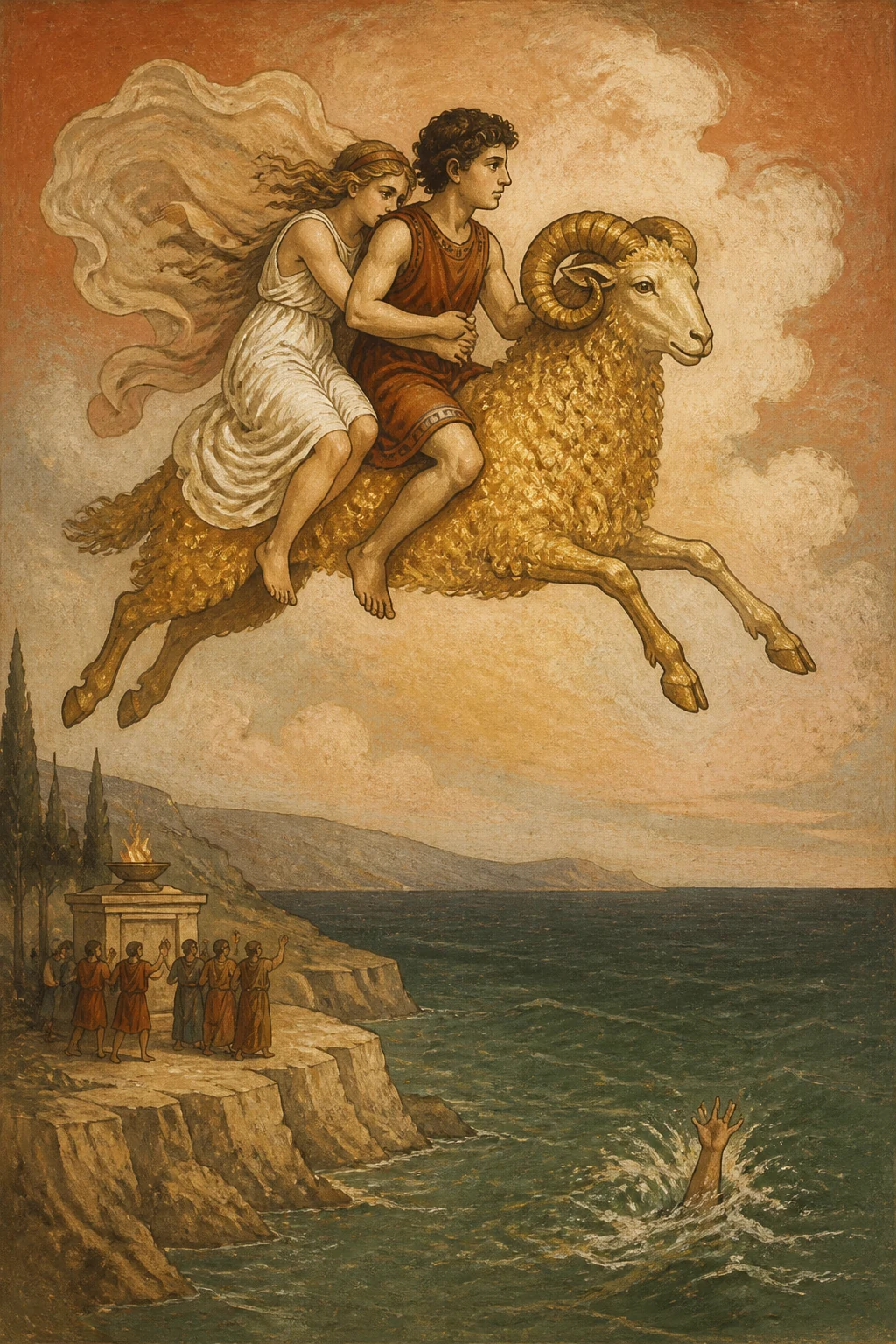
Vengeance would not have been delayed, had savage winds not made the seas impassable, and the Boeotian coast held the fleet at fish-rich Aulis as it tried to sail. Here, as they prepared a sacrifice to Jupiter in their fathers’ fashion, and the ancient altar glowed with kindled fires, the Greeks saw a dark-blue serpent crawl into a plane tree standing near the sacred rites.
High in the tree was a nest of eight young birds: these, together with their mother, who fluttered round her doomed brood, the serpent seized and swallowed in its greedy jaws. All stood aghast. But Thestor’s son, the seer who foresaw the truth, declared, “We shall conquer! Rejoice, men of Greece! Troy will fall, but our struggle will be long,” and he read in the nine birds as many years of war.
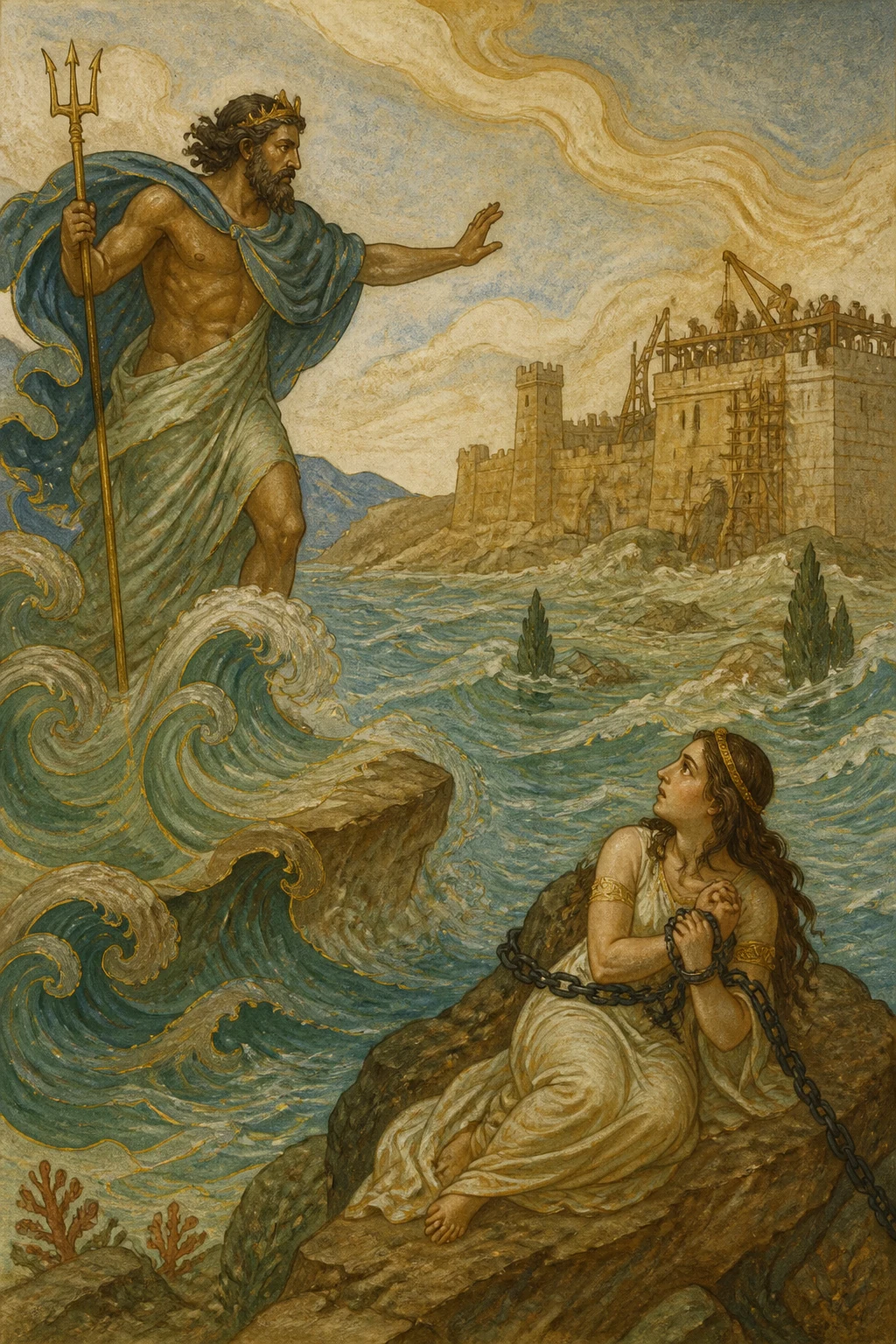
The serpent, still entwined about the tree’s green branches, turned to stone, and the stone preserved its serpent shape. Nereus raged on in the waters off Boeotia, refusing passage to the war; and some believed Neptune was sparing Troy because he had built its walls. But not Thestor’s son: he knew, and did not hide his knowledge, that a maiden’s blood must appease the anger of the maiden goddess. Once the common cause had conquered a father’s love, and the king had overcome the father, Iphigenia stood before the altar among weeping attendants, ready to shed her innocent blood.
Then the goddess relented, cast a cloud before their eyes, and amid the ritual, the throng of worshippers, and the voices raised in prayer, she is said to have stolen away the girl of Mycenae, leaving a hind in her place. Thus, when Diana was soothed by the blood of a fitting victim, and the anger of Phoebe and the sea alike had ebbed, a thousand ships received a following wind and, after many hardships, reached the Phrygian sands.
At the world’s heart there is a place between the land, the sea, and the regions of the sky, where the threefold universe meets. From there, whatever exists, however distant, can be seen, and every voice reaches its listening ears. Rumour dwells there, having chosen a home on the highest peak, with countless entrances and a thousand openings set in its walls, and no doors to close its thresholds: night and day it stands open. All is built of ringing bronze; the whole house hums, echoes voices, and repeats whatever it hears.
Within there is no rest, no silence anywhere, and yet no clamour, only a low murmuring, like the sound of ocean waves heard from far away, or like the dying rumble of thunder when Jupiter has clashed the dark clouds together. A crowd fills its halls, a fickle throng that comes and goes; inventions mingle everywhere with truths, and thousands of rumours wander, tossing out a jumble of words.
Some fill idle ears with talk, others carry elsewhere what they have heard; the measure of falsehood grows, and each new teller adds something to the tale. There dwell Credulity and reckless Error, groundless Joy and panic-stricken Fears, sudden Sedition and Whispers whose source no one knows. Rumour herself sees all that happens in the heavens, at sea, and on the earth, and searches out the whole wide world.
She had spread word that the Greek ships were approaching, laden with valiant soldiers, and so the armed enemy came as no surprise. The Trojans barred their landing and defended the shore; and you, Protesilaus, were the first to fall, as fate decreed, beneath Hector’s spear. The opening battles cost the Greeks dearly, and Hector’s slaughter of brave men made him known.
Nor did the Phrygians learn at little cost in blood what Greek hands could do. Already the shores of Sigeum ran red; already Cygnus, Neptune’s son, had sent a thousand men to death; already Achilles pressed on in his chariot, laying whole ranks low with strokes of his Pelian spear. Seeking either Cygnus or Hector through the battle lines, he encountered Cygnus—for his meeting with Hector was deferred until the tenth year. Urging on his horses, whose necks gleamed white beneath the yoke, he drove his chariot at the foe and, brandishing his quivering spear, cried, “Whoever you are, young man, take this consolation in death: that you were slain by Achilles of Thessaly.”
So spoke the grandson of Aeacus; his heavy spear followed his words. Yet though his aim was sure and the spear flew true, the iron point achieved nothing: it merely bruised the breast, as though its edge were blunt. “Son of a goddess—for your fame has reached us before you—” said Cygnus, “why marvel that I have no wound?” For Achilles was indeed amazed. “Neither this helmet you see, tawny with horsehair, nor the hollow shield that burdens my left arm protects me: I wear them only for adornment.
Mars, too, takes up his weapons for that reason. Strip away all this armour’s protection: I shall still leave unscathed. It counts for something to be born not of a Nereid, but of him who rules Nereus, his daughters, and the whole wide sea.” He spoke and hurled at Achilles a spear that would lodge in his rounded shield. It pierced the bronze and nine layers of oxhide beneath, but stopped in the tenth.
The hero shook it free and once more hurled his quivering spear with a mighty hand. Once more the body remained unharmed, without a wound. Nor could a third cast so much as graze Cygnus, though he stood exposed and offered himself. Achilles blazed with rage, like a bull in an open arena when it charges with its fearsome horns at the scarlet cloth that goads it, only to find its thrusts eluded.
He examined his spear to see whether the iron point had fallen off: it still clung to the shaft. “Then is my hand so weak,” he said, “and has all the strength it once possessed drained away against one man? Surely it had strength when I first brought down the walls of Lyrnesus, when I drenched Tenedos and Thebes, Eetion’s city, in their people’s blood; when the Caicus ran crimson with the slaughter of its folk, and Telephus twice felt the power of my spear.
Here, too, my right hand has been strong, and still is: witness all these dead, the heaps I made and now see lying along the shore.” He spoke and, as though mistrusting his past deeds, hurled his spear at Menoetes, a common Lycian facing him, and pierced both his breastplate and the breast beneath. As the dying man struck the hard earth with his chest, Achilles drew that same spear from the warm wound and said, “Here is my hand, here the spear with which I have just conquered.
I shall use them both against this man. Grant me, I pray, the same result!” With these words he attacked Cygnus again. The ashen spear flew true and struck his left shoulder with a clang, unavoided, then sprang back as though from a wall or solid cliff. Yet Achilles saw blood marking Cygnus where he had struck, and rejoiced in vain: there was no wound; the blood was Menoetes’.
Then, roaring with rage, he leapt headlong from his high chariot and attacked his untroubled foe at close quarters with his gleaming sword. He saw the blade dent shield and helmet, but on that hardened body even the iron lost its edge. He could endure no more. Drawing back his shield, he struck three times, four times at his enemy’s face, and battered his hollow temples with the hilt.
As Cygnus gave ground, Achilles pressed him, harried him, rushed him, and gave the stunned man no respite. Terror seized him; darkness swam before his eyes, and as he stepped backwards, a stone in the open field blocked his retreat. Over it Cygnus stumbled, falling backwards, and Achilles hurled him down with all his strength and dashed him to the ground. Then, pinning his breast beneath his shield and hard knees, he pulled the helmet’s straps. Drawn tight beneath the chin, they crushed his throat and closed both passages of his breath. Achilles was preparing to strip his conquered foe, but found only abandoned armour: the god of the sea had changed his body into the white bird whose name he had borne.