O besedilu
Io, Argos in Siringa
- Vir
- Ovidove preobrazbe
- Avtor
- Ovid
- Jezik branja
- English
- Jezik izvirnika
- Latin
- Čas branja
- 10 min branja
- Obseg
- 8 strani
- Naslov izvirnika
- Io, Argus, and Syrinx
O izvirniku
Ovidove preobrazbe
Pesniški tok antičnih preobrazb, kjer bogovi, ljudje in narava stalno menjavajo obliko. Bralni jezik je English, izvirnik pa prihaja iz vira Ovidove preobrazbe v jeziku Latin.
Besedilo
Io, Argos in Siringa
There is a grove in Haemonia, enclosed on every side by steep, wooded slopes: they call it Tempe. Through it Peneus, pouring from the foot of Pindus, rolls his foaming waters, and with his headlong fall gathers clouds that send up wisps of mist, showers the treetops with spray, and wearies more than the neighboring woods with his roar. This is the home, the dwelling, the innermost sanctuary of the mighty river; seated here in a cave of living rock, he ruled his waters and the nymphs who dwelt within them.
Here the rivers of his country first assemble, uncertain whether to congratulate or comfort their father: poplar-lined Sperchios and restless Enipeus, aged Apidanus, gentle Amphrysos, and Aeas, and soon the other rivers, which, wherever their current carries them, lead their waters, weary from wandering, down to the sea. Inachus alone is absent; hidden deep within his cave, he swells his waters with tears and, utterly wretched, mourns his daughter Io as lost. He does not know whether she lives or dwells among the dead; but since he finds her nowhere, he believes she is no more, and in his heart fears the worst.
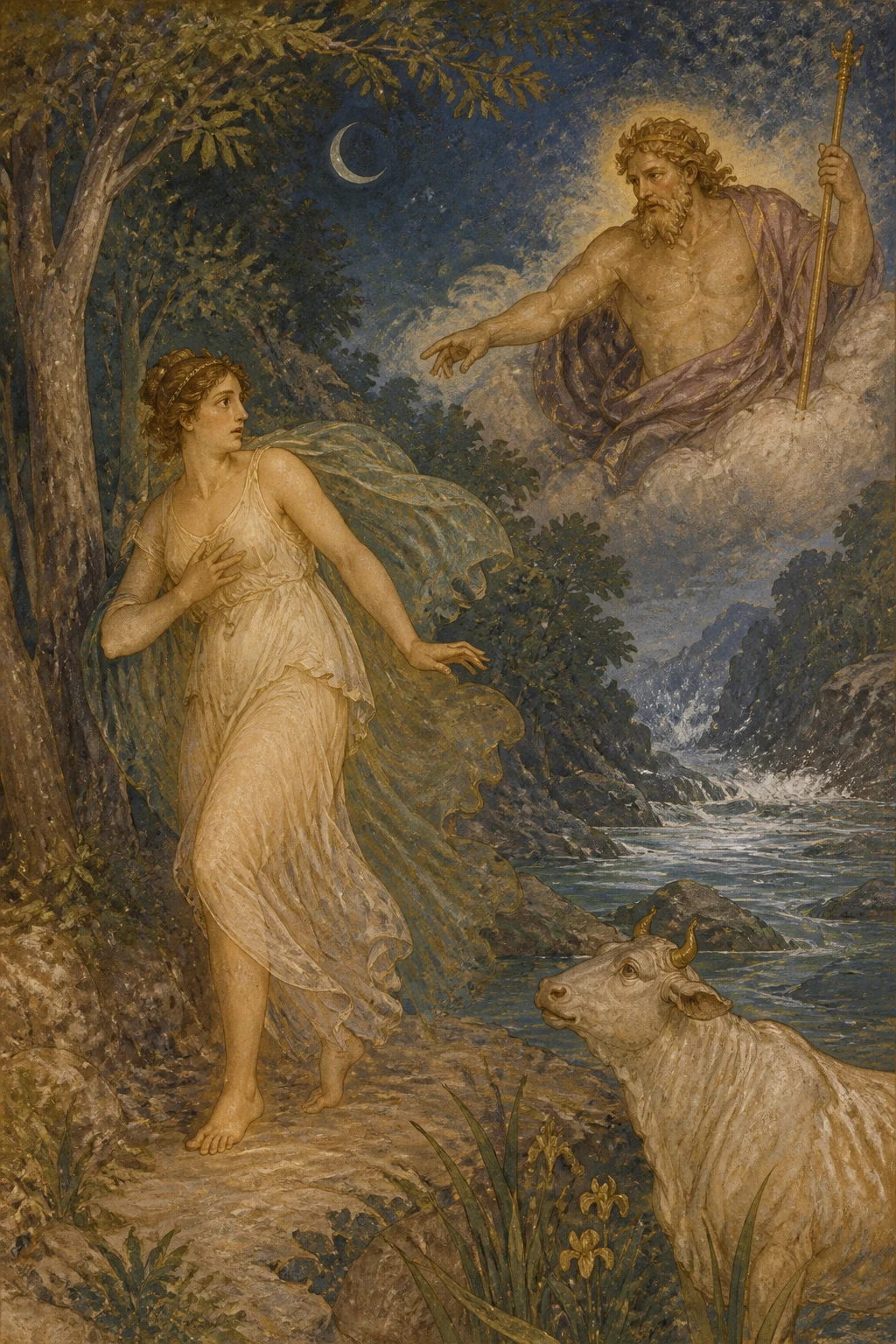
Jupiter had seen her returning from her father's river, and said, “O maiden worthy of Jupiter, destined to bless some man, whoever he may be, with your embrace, seek the shade of the deep woods”—and he pointed to their shade— “while the heat lasts and the sun stands highest in the sky. But if you fear to enter the haunts of wild beasts alone, you shall venture safely into the woodland's depths with a god to guard you: no common god, but I who hold heaven's mighty scepter in my hand, I who hurl the wandering thunderbolts.
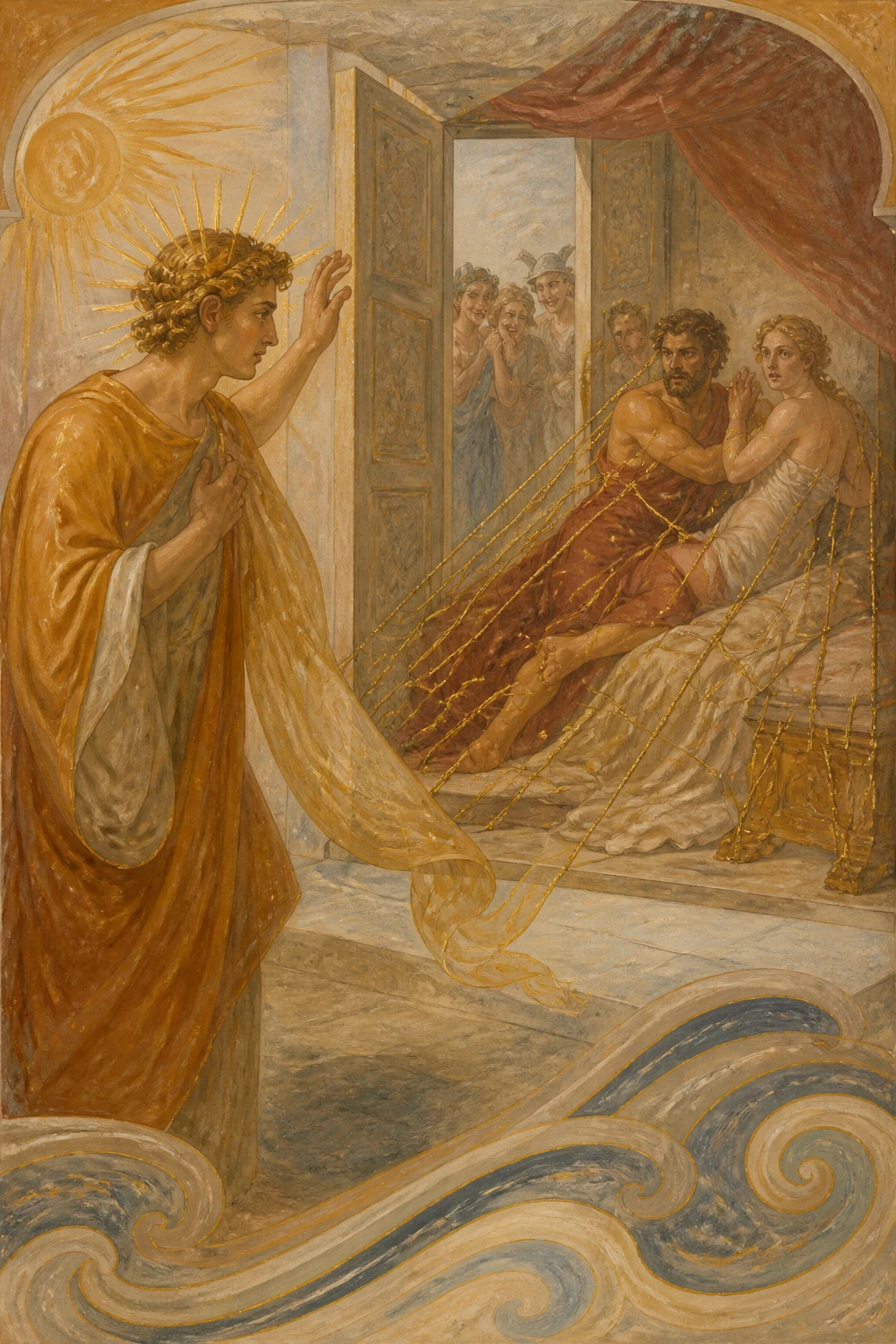
Do not flee from me!”—for she was fleeing. Already she had left the pastures of Lerna and the tree-planted fields of Lyrcea, when the god drew a veil of darkness over the broad earth, halted her flight, and robbed her of her chastity. Meanwhile Juno looked down upon the heart of the countryside and, wondering that drifting clouds had given it the look of night in the bright daylight, knew they had not risen from a river or been breathed out by the damp earth.
She looked about to see where her husband was, for she knew his secret affairs, having caught him so often before. When she could not find him in heaven, she said, “Either I am mistaken, or I am being wronged,” and, gliding down from the heights of heaven, stood upon the earth and ordered the clouds to withdraw. He had foreseen his wife's arrival and had changed the daughter of Inachus into a gleaming heifer.
Even as a cow she was lovely. Saturn's daughter, though unwillingly, praised her beauty, and asked whose she was, where she came from, and to what herd she belonged, as though she knew nothing. Jupiter lied that she had sprung from the earth, hoping to forestall further questions about her origin. Saturn's daughter asked for her as a gift. What could he do? To surrender his beloved was cruel; not to give her would arouse suspicion. Shame urged him one way, love held him back the other. Love would have conquered shame; but if he denied so small a gift as a cow to one who shared his lineage and his bed, she might seem no mere cow.
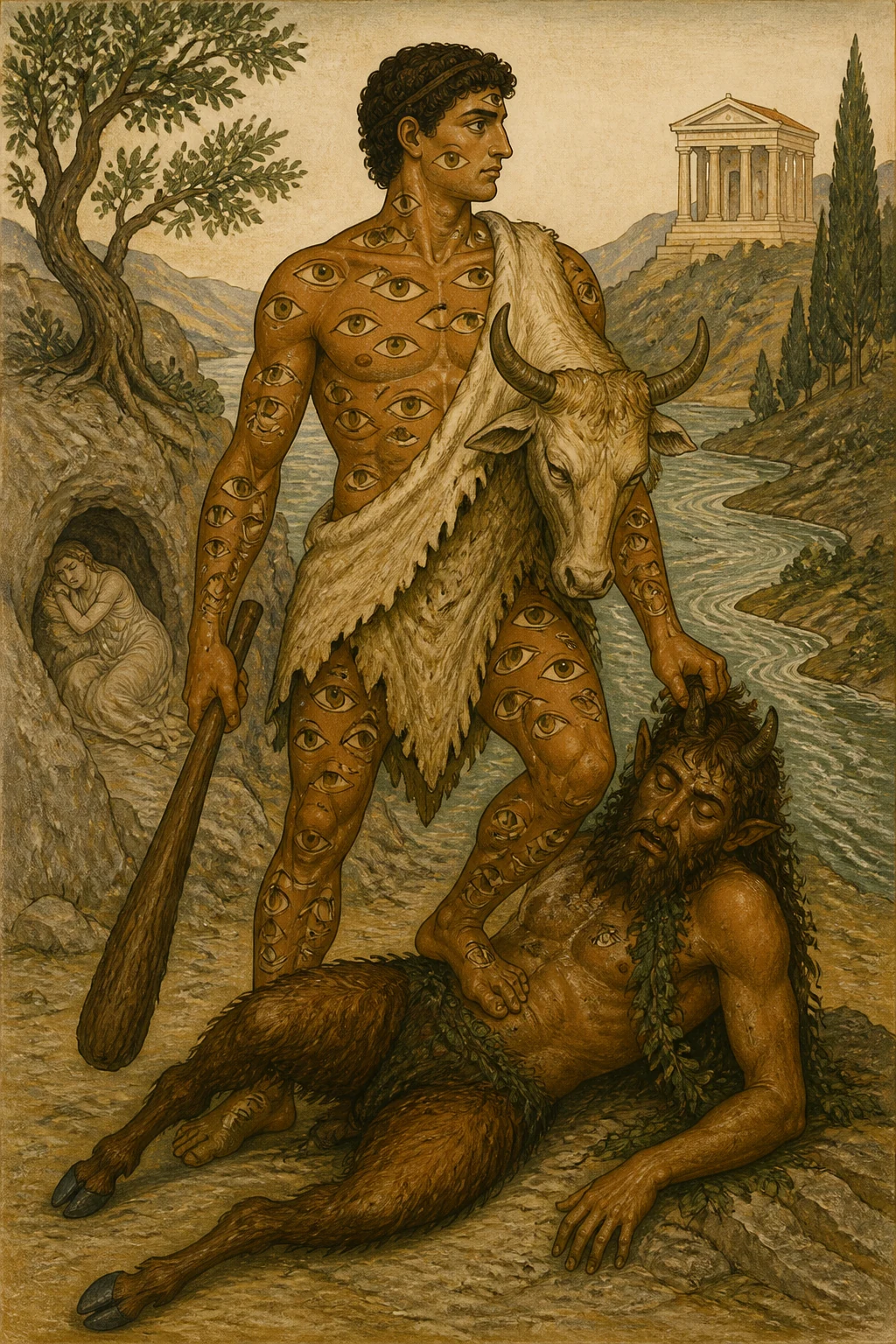
Even with her rival given to her, the goddess did not at once put aside all fear: she distrusted Jupiter and dreaded his deceit, until she entrusted the heifer to Argus, Arestor's son, to guard. Argus had a hundred eyes set all around his head: two at a time would take their turn at rest, while the others kept watch and remained at their posts. Whatever position he took, he could look at Io; even with his back turned, he kept Io in his sight.
By day he let her graze; when the sun sank beneath the earth, he shut her up and bound her neck with chains it did not deserve. She fed on the leaves of trees and bitter grass, and for her bed the unhappy creature lay upon the earth, not always grassy, and drank from muddy streams. Even when she wished to stretch her arms to Argus in supplication, she had no arms to stretch toward him; and when she tried to plead, a lowing came from her mouth.
She trembled at the sound, terrified by her own voice. She came, too, to the banks where she had often played, the banks of Inachus; and when she saw her unfamiliar horns reflected in the water, she recoiled in terror from herself. The Naiads did not know her, nor did Inachus himself know who she was; but she followed her father and her sisters, letting them touch her and offering herself to their admiring hands.
Old Inachus plucked some grass and held it out to her: she licked his hands and kissed her father's palms, unable to restrain her tears. If only words would come, she would beg for help and tell her name and her misfortune. Instead of speech, the letters her hoof traced in the dust revealed the sorrowful truth of her body's transformation. “Wretched man that I am!” her father Inachus cried, and, clinging to the horns and neck of the snow-white, moaning heifer, “Wretched man that I am!” he cried again. “Are you the daughter I sought through all the earth? When I could not find you, my grief was lighter than now that you are found. You are silent, and give no answering words to mine; you only draw deep sighs
from your breast and, all you can do, low in answer to my voice. Yet, knowing nothing, I was preparing your bridal chamber and wedding torches; my first hope was a son-in-law, my next, grandchildren. Now you must find a husband in the herd, and from the herd bear a son. Nor may I end such bitter sorrow through death: it is a curse to be a god; the door of death is barred, and stretches my grief through all eternity!”
As he mourned, star-eyed Argus thrust him aside, tore the daughter from her father, and dragged her away to distant pastures. He himself climbed a lofty mountain peak and sat there, keeping watch on every side. But heaven's ruler could no longer endure the sufferings of Phoroneus's descendant, and summoned the son whom the radiant Pleiad had borne him, commanding him to put Argus to death.
It took him little time to fasten wings to his feet, take his sleep-bringing wand in his powerful hand, and set his cap upon his hair. Once equipped, Jupiter's son leaped down from his father's citadel to earth. There he removed his cap and laid aside his wings, keeping only his wand. With it, like a shepherd, he drove goats through the lonely countryside, gathering them as he went, and played upon his pipe of reeds.
Charmed by the unfamiliar music, Juno's watchman said, “Whoever you are, you might sit here with me upon this rock. Nowhere is there richer grass for your flock, and you see how welcome the shade is for shepherds.” Atlas's grandson sat down and, talking of many things, held him in conversation as the day passed, and by playing his joined reeds tried to overcome those watchful eyes.
But Argus struggled to resist the soothing sleep, and though some of his eyes surrendered to slumber, others remained awake. He also asked how the pipe had been invented, for its invention was recent. Then the god said, “In the cold mountains of Arcadia, among the woodland nymphs of Nonacris, there was one Naiad more renowned than all the rest: the nymphs called her Syrinx.
More than once she had eluded pursuing satyrs and all the other gods who dwell in shady woods and fertile fields. She honored the goddess of Ortygia in her pursuits, and in her virginity itself. Dressed, too, like Diana, she might have deceived you and been taken for Latona's daughter, had her bow not been of horn, and the goddess's of gold. Even so, she deceived many. As she returned from Mount Lycaeus, Pan saw her, his head wreathed with sharp pine needles, and spoke these words”—it remained to tell what he said, and how the nymph, spurning his pleas, fled through the wilderness until she reached the quiet stream of sandy Ladon.
There, when the waters barred her flight, she begged her river-sisters to transform her; and Pan, just as he thought he had caught Syrinx, found marsh reeds in his arms instead of the nymph's body. As he sighed there, his breath stirring through the reeds made a thin sound, like a voice lamenting. Captivated by this new art and the sweetness of its music, the god said, “This, at least, shall remain my way of speaking with you!”
And so, joining reeds of unequal length with wax, he preserved the maiden's name. As he was about to tell all this, the Cyllenian saw that every eye had yielded, and all their lids were closed in sleep. At once he hushed his voice and deepened that slumber, stroking the drowsy eyes with his enchanted wand. Without delay he struck the nodding head with his curved blade where it joined the neck, hurled it bloodied from the rock, and stained the steep cliff with its blood.
Argus, you lie fallen; the light you held in all those eyes is quenched, and one night possesses all a hundred. Saturn's daughter gathered them and set them in the feathers of her own bird, filling its tail with starry jewels. At once she blazed with anger, allowing it no delay, and thrust a dreadful Fury before the eyes and into the mind of her Argive rival, buried unseen goads within her breast, and drove her fleeing in terror through the whole world.
You, Nile, remained the final stage of her boundless ordeal. As soon as she reached you, she sank to her knees at the river's edge and, arching her neck backward, raised her face, all she could raise, toward the stars. With groans and tears and mournful lowing, she seemed to plead with Jupiter and beg an end to her suffering. He clasped his arms about his wife's neck and begged her at last to end the punishment. “Put aside your fears for the future,” he said. “She will never again cause you grief.” And he called the Stygian waters to witness.
When the goddess was appeased, Io regained her former features and became what she had been: the hair fled from her body, her horns dwindled, her great round eyes grew smaller, her broad mouth narrowed, her shoulders and hands returned, and her hooves vanished, dividing into five nails apiece. Nothing of the heifer's form remained in her except its whiteness. Content now with the service of two feet, the nymph stood upright, yet feared to speak, lest she low like a heifer, and timidly tried the words so long unused.
Izvirnik
Io, Argus, and Syrinx
Naslednje strani prikazujejo izvirno besedilo za primerjavo.
Source ID: ovid_metamorphoses_story_008 Citation: Ovid, Metamorphoses 1.568-1.746 Original language: Latin Source: PerseusDL canonical-latinLit Source URL: https://github.com/PerseusDL/canonical-latinLit/blob/master/data/phi0959/phi006/phi0959.phi006.perseus-lat2.xml Segmentation certainty: medium 568: Est nemus Haemoniae, praerupta quod undique claudit 569: silva: vocant Tempe. Per quae Peneus ab imo 570: effusus Pindo spumosis volvitur undis, 571: deiectuque gravi tenues agitantia fumos 572: nubila conducit summisque adspergine silvis 573: inpluit et sonitu plus quam vicina fatigat.
574: Haec domus, haec sedes, haec sunt penetralia magni 575: amnis; in his residens facto de cautibus antro, 576: undis iura dabat nymphisque colentibus undas. 577: Conveniunt illuc popularia flumina primum, 578: nescia, gratentur consolenturne parentem, 579: populifer Sperchios et inrequietus Enipeus 580: Apidanusque senex lenisque Amphrysos et Aeas, 581: moxque amnes alii, qui, qua tulit impetus illos, 582: in mare deducunt fessas erroribus undas.
583: Inachus unus abest imoque reconditus antro 584: fletibus auget aquas natamque miserrimus Io 585: luget ut amissam. Nescit, vitane fruatur, 586: an sit apud manes; sed quam non invenit usquam. 587: esse putat nusquam atque animo peiora veretur. 588: Viderat a patrio redeuntem Iuppiter illam 589: flumine et “o virgo Iove digna tuoque beatum 590: nescio quem factura toro, pete” dixerat “umbras 591: altorum nemorum” (et nemorum monstraverat umbras), 592: “dum calet et medio sol est altissimus orbe.
593: Quodsi sola times latebras intrare ferarum, 594: praeside tuta deo nemorum secreta subibis, 595: nec de plebe deo, sed qui caelestia magna 596: sceptra manu teneo, sed qui vaga fulmina mitto. 597: Ne fuge me!”—fugiebat enim. Iam pascua Lernae 598: consitaque arboribus Lyrcea reliquerat arva, 599: cum deus inducta latas caligine terras 600: occuluit tenuitque fugam rapuitque pudorem.
601: Interea medios Iuno despexit in agros 602: et noctis faciem nebulas fecisse volucres 603: sub nitido mirata die, non fluminis illas 604: esse, nec umenti sensit tellure remitti; 605: atque suus coniunx ubi sit circumspicit, ut quae 606: deprensi totiens iam nosset furta mariti. 607: Quem postquam caelo non repperit, “aut ego fallor, 608: aut ego laedor” ait, delapsaque ab aethere summo 609: constitit in terris nebulasque recedere iussit.
610: Coniugis adventum praesenserat inque nitentem 611: Inachidos vultus mutaverat ille iuvencam. 612: Bos quoque formosa est. Speciem Saturnia vaccae, 613: quamquam invita, probat, nec non et cuius et unde 614: quove sit armento, veri quasi nescia quaerit. 615: Iuppiter e terra genitam mentitur, ut auctor 616: desinat inquiri. Petit hanc Saturnia munus. 617: Quid faciat? crudele suos addicere amores, 618: non dare suspectum est. Pudor est qui suadeat illinc, 619: hinc dissuadet amor. Victus pudor esset amore; 620: sed leve si munus sociae generisque torique 621: vacca negaretur, poterat non vacca videri.
622: Paelice donata non protinus exuit omnem 623: diva metum timuitque Iovem et fuit anxia furti, 624: donec Arestoridae servandam tradidit Argo. 625: Centum luminibus cinctum caput Argus habebat: 626: inde suis vicibus capiebant bina quietem, 627: cetera servabant atque in statione manebant. 628: Constiterat quocumque modo, spectabat ad Io: 629: ante oculos Io, quamvis aversus, habebat.
630: Luce sinit pasci; cum sol tellure sub alta est, 631: claudit et indigno circumdat vincula collo. 632: frondibus arboreis et amara pascitur herba, 633: proque toro terrae non semper gramen habenti 634: incubat infelix limosaque flumina potat. 635: Illa etiam supplex Argo cum bracchia vellet 636: tendere, non habuit, quae bracchia tenderet Argo, 637: et conata queri mugitus edidit ore 638: pertimuitque sonos propriaque exterrita voce est.
639: Venit et ad ripas, ubi ludere saepe solebat, 640: Inachidas ripas; novaque ut conspexit in unda 641: cornua, pertimuit seque exsternata refugit. 642: Naides ignorant, ignorat et Inachus ipse, 643: quae sit; at illa patrem sequitur sequiturque sorores 644: et patitur tangi seque admirantibus offert. 645: Decerptas senior porrexerat Inachus herbas: 646: illa manus lambit patriisque dat oscula palmis 647: nec retinet lacrimas et, si modo verba sequantur, 648: oret opem nomenque suum casusque loquatur.
649: Littera pro verbis, quam pes in pulvere duxit, 650: corporis indicium mutati triste peregit. 651: “Me miserum!” exclamat pater Inachus inque gementis 652: cornibus et niveae pendens cervice iuvencae 653: “me miserum!” ingeminat, “tune es quaesita per omnes 654: nata, mihi terras? tu non inventa reperta 655: luctus eras levior. Retices nec mutua nostris 656: dicta refers, alto tantum suspiria ducis 657: pectore, quodque unum potes, ad mea verba remugis.
658: At tibi ego ignarus thalamos taedasque parabam, 659: spesque fuit generi mihi prima, secunda nepotum. 660: De grege nunc tibi vir, nunc de grege natus habendus. 661: Nec finire licet tantos mihi morte dolores, 662: sed nocet esse deum, praeclusaque ianua leti 663: aeternum nostros luctus extendit in aevum?” 664: Talia maerentem stellatus submovet Argus 665: ereptamque patri diversa in pascua natam 666: abstrahit. Ipse procul montis sublime cacumen 667: occupat, unde sedens partes speculatur in omnes.
668: Nec superum rector mala tanta Phoronidos ultra 669: ferre potest natumque vocat, quem lucida partu 670: Pleias enixa est, letoque det imperat Argum. 671: Parva mora est alas pedibus virgamque potenti 672: somniferam sumpsisse manu tegimenque capillis. 673: Haec ubi disposuit, patria Iove natus ab arce 674: desilit in terras. Illic tegimenque removit 675: et posuit pennas, tantummodo virga retenta est.
676: Hac agit, ut pastor, per devia rura capellas, 677: dum venit, adductas et structis cantat avenis. 678: Voce nova captus custos Iunonius “at tu, 679: quisquis es, hoc poteras mecum considere saxo,” 680: Argus ait, “neque enim pecori fecundior ullo 681: herba loco est, aptamque vides pastoribus umbram.” 682: Sedit Atlantiades et euntem multa loquendo 683: detinuit sermone diem iunctisque canendo 684: vincere harundinibus servantia lumina temptat.
685: Ille tamen pugnat molles evincere somnos 686: et, quamvis sopor est oculorum parte receptus, 687: parte tamen vigilat. Quaerit quoque (namque reperta 688: fistula nuper erat), qua sit ratione reperta. 689: Tum deus “Arcadiae gelidis in montibus” inquit 690: “inter hamadryadas celeberrima Nonacrinas 691: naias una fuit; nymphae Syringa vocabant. 692: Non semel et satyros eluserat illa sequentes 693: et quoscumque deos umbrosaque silva feraxque 694: rus habet. Ortygiam studiis ipsaque colebat 695: virginitate deam. Ritu quoque cincta Dianae 696: falleret et posset credi Latonia, si non
697: corneus huic arcus, si non foret aureus illi. 698: Sic quoque fallebat. Redeuntem colle Lycaeo 699: Pan videt hanc pinuque caput praecinctus acuta 700: talia verba refert”—restabat verba referre 701: et precibus spretis fugisse per avia nympham, 702: donec harenosi placidum Ladonis ad amnem 703: venerit. Hic illam cursum inpedientibus undis, 704: ut se mutarent liquidas orasse sorores, 705: Panaque, cum prensam sibi iam Syringa putaret, 706: corpore pro nymphae calamos tenuisse palustres.
707: Dumque ibi suspirat, motos in harundine ventos 708: effecisse sonum tenuem similemque querenti. 709: Arte nova vocisque deum dulcedine captum 710: “hoc mihi concilium tecum” dixisse “manebit!“ 711: atque ita disparibus calamis conpagine cerae 712: inter se iunctis nomen tenuisse puellae. 713: Talia dicturus vidit Cyllenius omnes 714: succubuisse oculos adopertaque lumina somno.
715: Supprimit extemplo vocem firmatque soporem 716: languida permulcens medicata lumina virga. 717: Nec mora, falcato nutantem vulnerat ense 718: qua collo est confine caput, saxoque cruentum 719: deicit et maculat praeruptam sanguine rupem. 720: Arge, iaces, quodque in tot lumina lumen habebas, 721: exstinctum est, centumque oculos nox occupat una. 722: Excipit hos volucrisque suae Saturnia pennis 723: collocat et gemmis caudam stellantibus inplet.
724: Protinus exarsit nec tempora distulit irae 725: horriferamque oculis animoque obiecit Erinyn 726: paelicis Argolicae stimulosque in pectore caecos 727: condidit et profugam per totum terruit orbem. 728: Ultimus inmenso restabas, Nile, labori. 729: Quem simul ac tetigit, positis in margine ripae 730: procubuit genibus resupinoque ardua collo, 731: quos potuit solos, tollens ad sidera vultus 732: et gemitu et lacrimis et luctisono mugitu 733: cum Iove visa queri finemque orare malorum.
734: Coniugis ille suae conplexus colla lacertis, 735: finiat ut poenas tandem, rogat “in” que “futurum 736: pone metus” inquit; “numquam tibi causa doloris 737: haec erit:” et Stygias iubet hoc audire paludes. 738: Ut lenita dea est, vultus capit illa priores 739: fitque quod ante fuit: fugiunt e corpore saetae, 740: cornua decrescunt, fit luminis artior orbis, 741: contrahitur rictus, redeunt umerique manusque, 742: ungulaque in quinos dilapsa absumitur ungues: 743: de bove nil superest formae nisi candor in illa.
744: Officioque pedum nymphe contenta duorum 745: erigitur metuitque loqui, ne more iuvencae 746: mugiat, et timide verba intermissa retemptat.
Nadaljuj z branjem