Prevod
Nekoč je neki revež vzel sekiro in se odpravil v gozd sekat drva. Bil je lenuh, zato se je, brž ko je prišel v gozd, začel ozirati naokrog, katero drevo bi bilo najlaže posekati. Nazadnje je našel takšno, ki je bilo znotraj votlo; to je ugotovil tako, da je s sekiro potrkal po deblu. »Tega bom pa hitro posekal,« si je rekel. Dvignil je sekiro in tako močno udaril po drevesu, da so trske kar poletele.
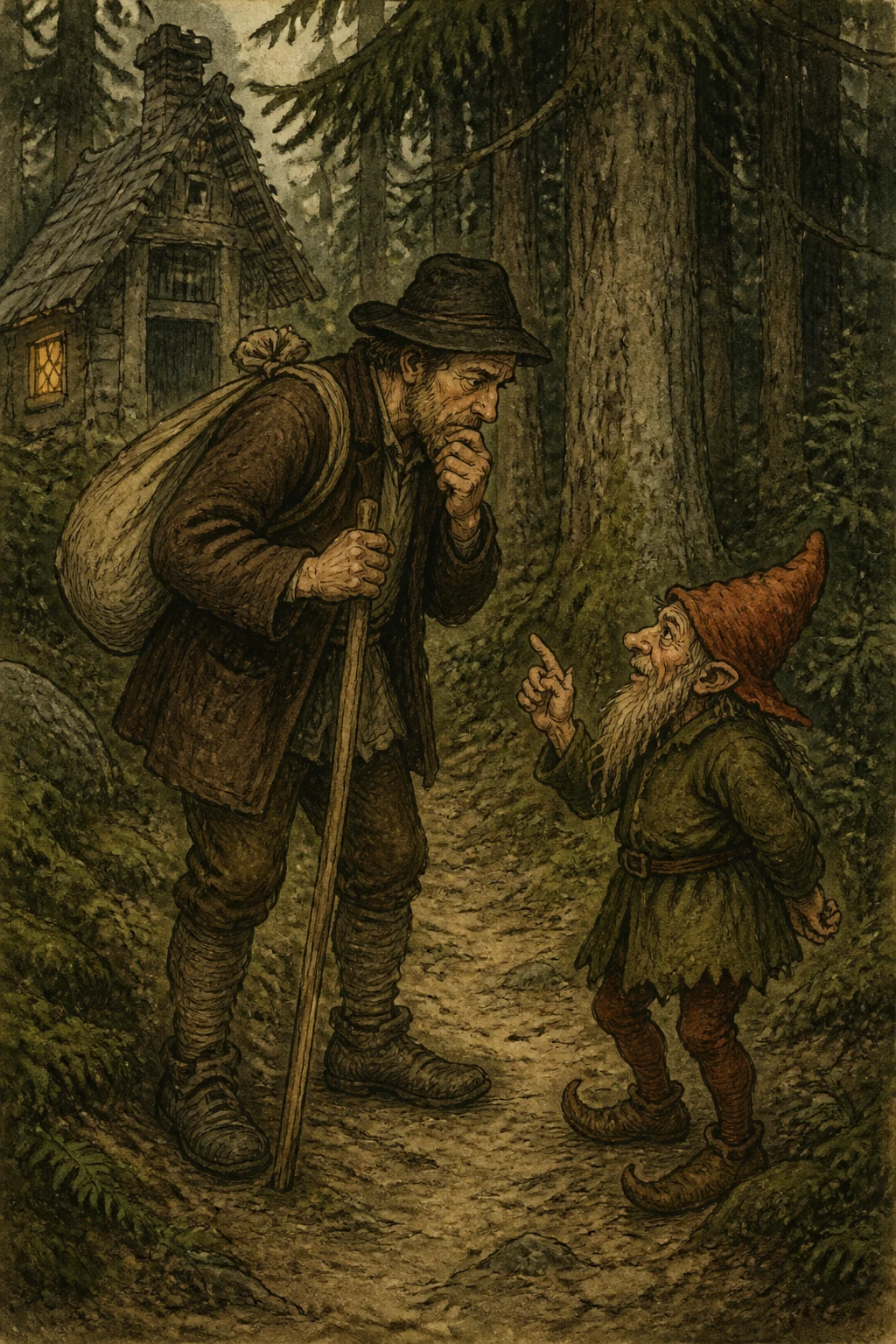
Tisti hip se je lubje razprlo in iz drevesa je pritekel droben star škrat z dolgo brado. »Kaj ti pride na misel, da sekaš po moji hiši?« je zavpil; tako je bil jezen, da so mu oči žarele kakor razbeljene iskre.
»Nisem vedel, da je to tvoja hiša,« je rekel mož. »Pa je moja hiša in prav lepo te prosim, da jo pustiš pri miru!« je zavpil škrat. »Že prav,« je rekel mož. »Prav tako rad posekam kakšno drugo drevo. Posekal bom tisto tamle.«
»Tako je prav,« je rekel škrat. »Vidim, da si vendarle ustrežljiv mož. Ker si prizanesel moji hiši, te nameravam nagraditi: naslednje tri želje, ki jih bosta izrekla ti in tvoja žena, se bodo izpolnile, kakršne koli že bodo. To bo tvoja nagrada.«
Nato se je škrat vrnil v drevo in za seboj stisnil lubje skupaj. Mož je stal, gledal drevo in se praskal po glavi. »To je pa čudna reč,« je rekel. Potem je sedel in začel premišljevati, kaj naj si zaželi. Tuhtal je in tuhtal, a se ni mogel za nič odločiti. »Kar domov bom šel in se pogovoril z ženo,« je rekel; oprtal si je torej sekiro na ramo in se odpravil domov. Brž ko je stopil skozi vrata, je začel na ves glas klicati ženo. Ta je prihitela, saj ni vedela, kaj se mu je zgodilo.
Povedal ji je svojo zgodbo in žena ga je poslušala. »Kako lepo, da se nama je to pripetilo,« je rekla. »Zdaj morava zelo paziti, kaj si bova zaželela.«
Sedla sta vsak na svojo stran ognjišča, da bi se posvetovala. Spomnila sta se nešteto reči, ki bi jih rada imela: vrečo zlata, kočijo s štirimi konji, lepo hišo, v kateri bi živela, in lepa oblačila, ki bi jih nosila, a nič se jima ni zdelo čisto prava izbira.
Tako dolgo sta se pogovarjala, da sta postala lačna. »No, takole sediva,« je rekel mož, »za kosilo pa ni nič skuhano. Ko bi le imela eno tistih slastnih krvavic, kakršne si včasih delala.«
Komaj je to izrekel, že je v dimniku močno zaropotalo in zabobnelo, na ognjišče pred njim pa je padla velika krvavica.
»Kaj je pa to?« je vzkliknil mož in strmel vanjo. »Oh, ti teslo! Ti bedak!« je zavreščala žena. »To je krvavica, ki si si jo zaželel. Pa je šla po zlu ena najinih želja. Ko bi se ti ta krvavica prilepila na konico nosu! Prav bi ti bilo!«
V hipu, ko je to izrekla, je krvavica poletela k možu in se mu prilepila na nos. Tam je obtičala in nikakor je ni mogel sneti. Mož je vlekel in cukal, žena je vlekla in cukala, a vse je bilo zaman.
»No, ni druge pomoči,« je rekel mož, »zaželeti si bova morala, da spet izgine z nosu.« Žena je začela jokati in tarnati. »Ne, ne!« je vpila. »Samo še eno željo imava in ne smeva je takole zapraviti. Zaželiva si, da bi bila najbogatejša človeka na svetu.«
Toda mož ni hotel niti slišati o tem. Hotel je spraviti krvavico z nosu, pa naj stane, kar hoče. Nazadnje je morala žena popustiti in obveljala je njegova. »Želim si, da krvavica spet izgine z mojega nosu,« je rekel mož, in to je bila njuna tretja želja. Tako od škratovega darila nista imela druge koristi kakor krvavico za kosilo; bila pa je najboljša krvavica, kar sta jih kdaj jedla. »Navsezadnje,« je rekel mož, »si na svetu težko zaželiš kaj boljšega od polnega želodca.«
Izvirnik
Once upon a time a poor man took his ax and went out into the forest to cut wood. He was a lazy fellow, so as soon as he was in the forest he began to look about to see which tree would be the easiest to cut down. At last he found one that was hollow inside, as he could tell by knocking upon it with his ax. “It ought not to take long to cut this down,” said he to himself. He raised his ax and struck the tree such a blow that the splinters flew.
At once the bark opened and a little old fairy with a long beard came running out of the tree.
“What do you mean by chopping into my house?” he cried; and his eyes shone like red hot sparks, he was so angry.
“I did not know it was your house,” said the man.
“Well, it is my house, and I’ll thank you to let it alone,” cried the fairy.
“Very well,” said the man. “I’d just as lieve cut down some other tree. I’ll chop down the one over yonder.”
“That is well,” said the fairy. “I see that you are an obliging fellow, after all. I have it in my mind to reward you for sparing my house, so the next three wishes you and your wife make shall come true, whatever they are; and that is your reward.”
Then the fairy went back into the tree again and pulled the bark together behind him.
The man stood looking at the tree and scratching his head. “Now that is a curious thing,” said he. Then he sat down and began to wonder what he should wish for. He thought and he thought, but he could decide on nothing. “I’ll just go home and talk it over with my wife,” said he; so he shouldered his ax, and set off for home. As soon as he came in at the door he began to bawl for his wife, and she came in a hurry, for she did not know what had happened to him.
He told his story and his wife listened. “This is a fine thing to have happen to us,” said she. “Now we must be very careful what we wish for.”
They sat down one on each side of the fire to talk it over. They thought of ever so many things they would like to have—a bag of gold, and a coach and four, and a fine house to live in, and fine clothes to wear, but nothing seemed just the right thing to choose.
They talked so long that they grew hungry. “Well, here we sit,” said the man, “and not a thing cooked for dinner. I wish we had one of those fine black puddings you used to make.”
No sooner had he spoken than there was a great thumping and bumping in the chimney and a great black pudding fell down on the hearth before him.
“What is this?” cried the man staring.
“Oh, you oaf! you stupid!” shrieked his wife. “It’s the pudding you wished for. There’s one of our wishes wasted. I wish the pudding were stuck on the end of your nose! It would serve you right!”
The moment she said this the pudding flew up and stuck to the man’s nose, and there it was and he couldn’t get it off; the man pulled and tugged, and his wife pulled and tugged, but it was all of no use.
“Well, there’s no help for it,” said the husband; “we’ll have to wish it off again.”
His wife begun to cry and bawl. “No, no,” she cried. “We only have one wish left, and we can’t waste it that way. Let’s wish ourselves the richest people in the world.”
But to this the man would not agree. He wanted the pudding off his nose whatever it cost. So at last the wife was obliged to let him have his own way. “I wish the pudding was off my nose again,” said the man, and that was the third of their wishes. So all the good they had of the fairy’s gift was a black pudding for dinner; but then it was the best black pudding they had ever eaten. “And after all,” said the man, “there’s nothing much better in the world to wish for than a full stomach.”