Waltey
Sultan resnice
Tunisische Märchen und Gedichte · Hans StummeO besedilu
Sultan resnice
- Vir
- Tunisische Märchen und Gedichte
- Avtor
- Hans Stumme
- Jezik branja
- English
- Jezik izvirnika
- Tunisian Arabic in Latin transcription
- Čas branja
- 23 min branja
- Obseg
- 18 strani
- Naslov izvirnika
- 006 Sultan elháqq
O izvirniku
Tunisische Märchen und Gedichte
Tunizijske pripovedi v zgodovinskem latiničnem zapisu govorjenega arabskega jezika. Bralni jezik je English, izvirnik pa prihaja iz vira Tunisische Märchen und Gedichte v jeziku Tunisian Arabic in Latin transcription.
Besedilo
Sultan resnice
There was once a fisherman who went out fishing every day. He would cast his line all day long and catch no more than a pair of fish. He would take them to market and sell them for a pittance, making a profit of four or five small coins, then carry the money home and spend it on his family.
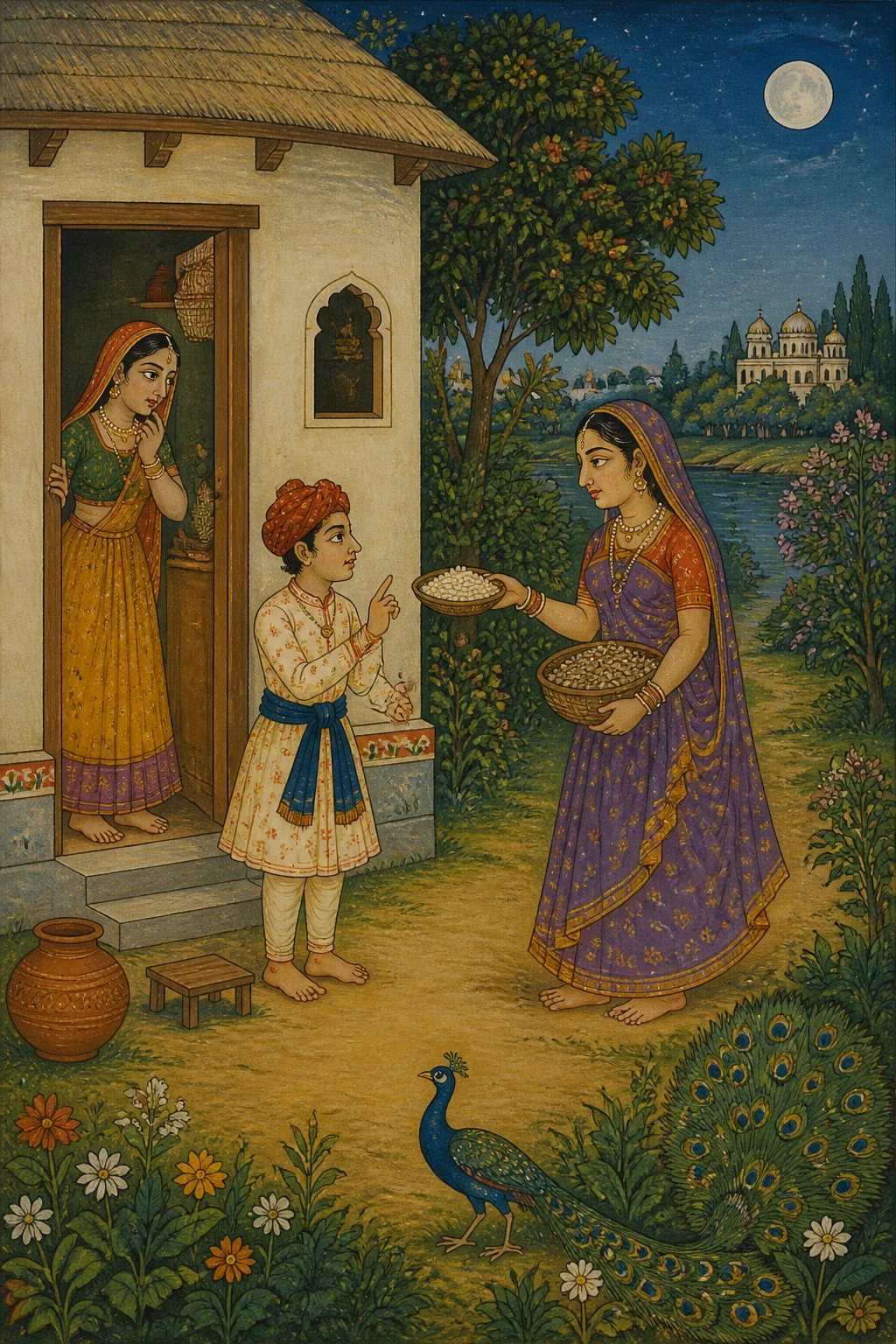
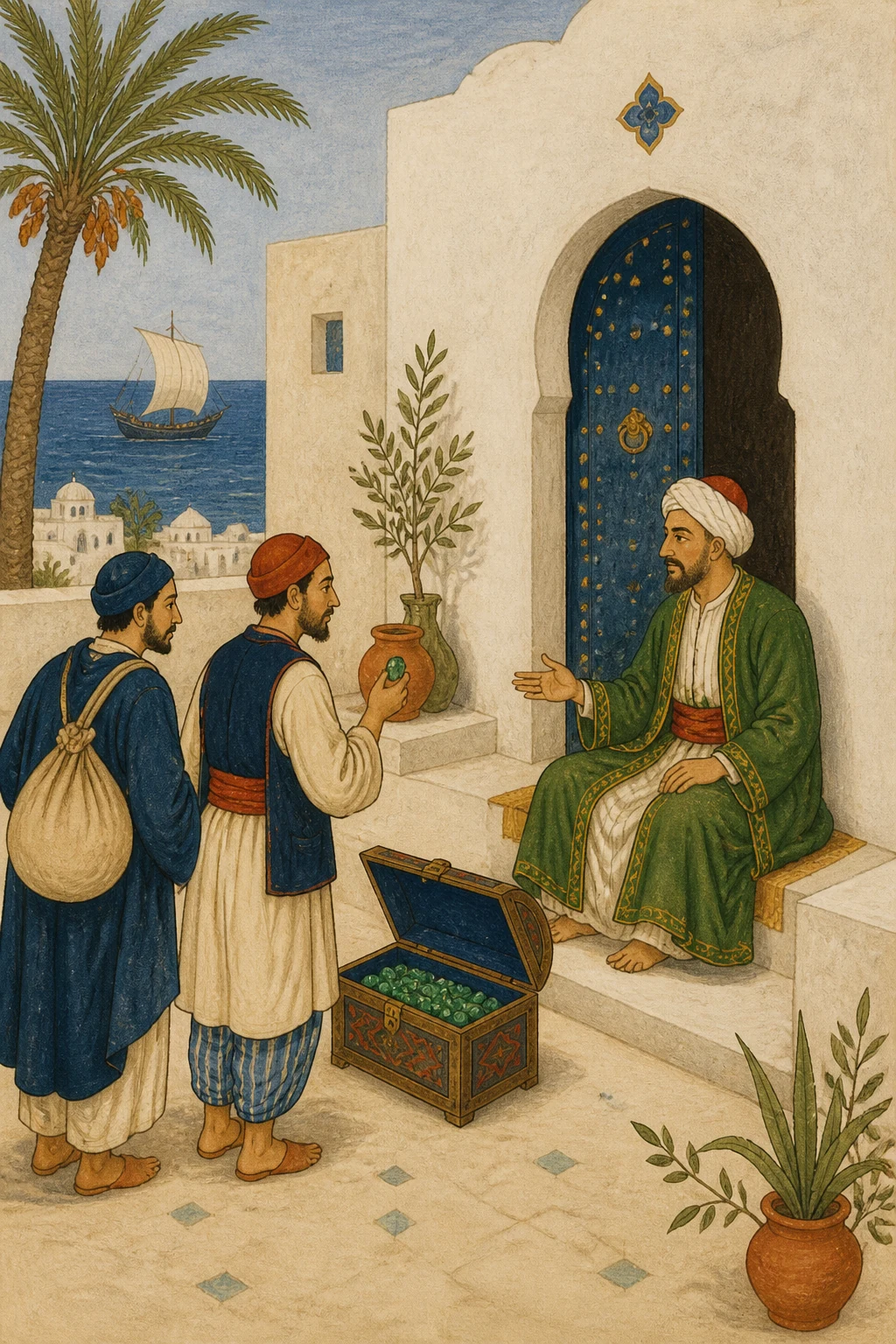
One day he caught his usual pair of fish and went to sell them. A boy came past with two birds. “My boy,” he asked, “are those birds for sale?” “Yes,” the boy replied. “How much?” “Give me those fish of yours in exchange.” “Very well,” said the fisherman. He took the birds and brought them home. He fetched a little cage and put them inside. Then he turned to his wife and said, “I haven’t brought you any money today. I exchanged the two fish for these little birds. They’re very pretty.” “Then we have nothing to live on!” she said. The poor woman went to her neighbours and borrowed some money so they could have supper. Next morning, he found that the female had laid an emerald egg. He took the egg and put it away in a chest, then went to the sea to fish. The following morning, he found another emerald egg beneath the female. In this way the poor man collected ten eggs. Now, one day, in that town by the sea, a merchant arrived from abroad, hoping to sell his goods. As he came into the harbour, he looked through his spyglass and saw a light. It came from the egg the bird had laid: even from a distance, the merchant could see it shining inside the house. He landed and followed the light and its radiance until he reached the house. The fisherman had been out fishing; when morning came, he opened his door and went outside, and there stood the merchant. “Peace be upon you,” said the merchant. “And upon you be peace.” “My son, is this your house, or does it belong to someone else?” “It is mine, sir.” “What have you in your house that gives off such a light, such a radiance?” “Nothing, sir.” “No, you must have something. Let me come inside with you.” “You are welcome.” He went in, looked around, saw the little bird, and found the egg beside her.
“Give me the egg so I can look at it,” he said. He examined it, then asked, “Have you any others?” “I have.” The fisherman opened the chest and handed him the ten eggs. “Sell them to me.” “You may buy them, sir.” “Take all the goods I brought aboard my ship, and give me the ten eggs.”
“That will be my payment.” He gave him everything in the ship: ambergris, aloeswood, musk, and cloth. The fisherman took the goods home and began to buy and sell. He became a merchant and no longer went fishing. Every morning when he rose, he found that the female had laid an emerald egg. He would take it to market and sell it for five hundred mahboubs. He became a very wealthy man. He had two sons, one called Mhammed and the other Ali, and he sent them to the Quran school. One day he told his wife, “I am going on the pilgrimage.” “May God make your way easy,” she replied. She prepared his provisions, and when he was about to set out, he entrusted the children to the maidservant. “Yes, master, God bless you,” she said. He set off on his journey. The maidservant stayed behind, taking the boys to school and bringing them home. Now there was a Jewish man who ran errands for the household, and the woman became his lover. One day he came into her house and saw the birds. “How did you come by those birds?” he asked. “My husband bought them,” she replied.
The Jewish man knew what those birds were. “I want you to slaughter them and make me some soup with them,” he said. “Very well.” He caught the birds and slaughtered them, then gave them to the maidservant. She plucked them and brought them back to him. He cut them up and returned them to her, setting aside the gizzards and hearts. “Put these in the cooking pot with the birds’ flesh and cook them,” he told her. The maidservant set about cooking while he and the mistress amused themselves and laughed together. The boys came back from school and said, “Give us something to eat. We’re hungry.” She took the hearts out of the pot and gave them to Mhammed, and gave the gizzards to Ali. They ate them and went back to school. The Jewish man came to eat the meat, but found neither the gizzards nor the hearts. “Maidservant, where are the gizzards and hearts?” he asked. “Sir, the little boys came home from school, and I gave them to them.”
He pushed the table away. “Adonai!” he cried. “If it hadn’t been for the gizzards and hearts, I would never have slaughtered them!” He turned to the boys’ mother. “Send for the children. I will slaughter them and take the gizzards and hearts out of their bellies.” Their mother called the maidservant and sent her to fetch the boys. The poor maid went into her room, took what she treasured, and made her way to the school. “Master Mhammed! Master Ali!” she called. As they came down the steps, Mhammed, who had eaten the hearts, turned to his brother and said, “The Jewish man has our mother under his power. He wants to slaughter us and take the gizzards and hearts out of our bellies.” “What shall we do?” Ali asked. “I think we had better run away.” They went down to the maidservant, who was weeping. “What is the matter, Dada?” they asked. “Your mother is under the Jewish man’s power. He wants to slaughter you.” “Then why should we go back to our mother?” Mhammed said. “God’s world is wide. Will you come with us, Dada?” “My young master, wherever you go, I will go with you.” She bought provisions, and they left the town. They walked on and on along the road, travelling for a month, until they came to a place where one road led right and another left. They looked at one another. “Brother,” they said, “we must part. Each of us must take a different road. And who will the maid go with?” Ali turned to Mhammed. “She shall go with you. God will look after me.” They said farewell, and one took one road and the other took the other. Let us leave Mhammed travelling with the maidservant.
Our tale returns to Ali, alone. He walked on until he reached a town and entered it. A poor stranger, he had no one there. He sat down outside the door of a house. The mistress of the house, an elderly woman, came out. “My son, what brings you here?” she asked. “I am a stranger,” he replied.
“Come, my son. Come into my house.” She led him into the entrance hall, brought out a bench and a rug for him, and gave him supper. He ate and went to sleep. In the morning he rose, put on his clothes, and left. Beneath the rug she found a purse containing five hundred mahboubs. She hurried after him.
“My son! My guest! Stranger!” she called. He heard her. “What do you want?” “Here is your purse. You left it behind.” “No, no, I have no purse!” “Yes, it is yours.” “If it is mine, then I give it to you.” “Praise be to God, we have enough. We do not want other people’s property.” “I give it to you. Only do me a kindness:
let me wander about the town all day, and come back to sleep at your house at night.” “My son, you are welcome!” she replied. So he went about his business, and every morning when he woke he found a purse of five hundred mahboubs beneath his head. He took out what he needed for the day and put it in his pocket, giving the rest to the woman. One day he went to the market and found an auctioneer offering a she-mule for sale. He began bidding for her and raised the price to five hundred mahboubs. The sale went to him. “The bridle is not for sale,” the mule’s owner told him. “Never mind,” he replied. He took off the bridle and returned it to the owner, made a halter for the mule, and led her home. He tied her up in the entrance hall and went inside. The old woman brought him his supper; he ate and went to sleep. In the morning, the mule was gone. He went out to the market where the animals were sold and found her with the auctioneer. He began bidding again, offering five hundred mahboubs. Before he paid, a man came up to him and said, “Come here, Ali. Let me tell you something.” He went with him. “When you buy this mule, say you want the bridle with her.” He returned, and the sale went to him. He asked the owner, “Does the sale include the mule’s bridle?” “Of course.” He took her, bridle and all, mounted her, and rode home. He tied her up and gave her feed. The man told him, “My son, do not feed her barley and straw like other animals.” “What does she eat, then?” “Feed her sesame and almond kernels.” Next morning he put the bridle on her, mounted, and went for a ride outside the town. In two hours she carried him a month’s journey. As he was returning and about to enter the town, he found a man sitting outside the gate. “Dismount,” the man said, “and sit down. Rest beside me a little.” Ali got down and sat beside him. “My son,” said the man, “why is your mule so tired?
Take the bridle out of her mouth and let her rest a little.” He removed the bridle. “Give it here. Let me see it,” said the man. As soon as the man held the bridle in his hand, the mule became a woman. “Seize him!” she cried. The man seized him, bound his arms, and carried him to her palace. She had him brought upstairs. “What shall I do with you now?” she asked. Her palace was full of monkeys, cats, beasts of burden, and pigeons. “Come, choose what you will become.” “I do not know,” he replied.
“I shall turn you into a peacock,” she said. She made him a peacock and brought him barley to eat. And what did she do when she wanted someone to mate with her? She went to the donkey when she wanted a large one, to the cat when she wanted a small one. She was depraved and lustful, with an insatiable appetite for coupling. She went from one creature in the courtyard to another, changing herself into their shapes.
At last his turn came. She came to him and turned herself into a peahen, but he would have none of her. She became a woman again and said, “Bring him here.” She changed him back into a man. “What is wrong with you? Do I not please you?” “God forbid!” he replied. “What you do is pleasing neither to God nor to man.” They bound him and gave him five hundred lashes. She turned him back into a peacock. “Bring him to me tomorrow,” she said. Next day they brought him, and she made him a man again. “Will you consent to me today?” she asked. “Away with you! May God curse you!”
“Stretch him out,” she ordered. “Give him another five hundred.” For seven days she gave him five hundred lashes each day. On the seventh day she had him brought before her. “Today, if you will not do it, if you will not lie with me, I shall wring your neck.” “What do you want?” he said.
“I shall pray to God to deliver me from your hands. Yes, wait while I pray to my Lord.” He said, “He is the bountiful, the all-seeing; He is the all-knowing, the almighty. He sees and is not seen; He knows what is in this world and the next! I beseech You, my Lord, deliver me from this unbelieving woman!”
As he prayed, he saw a bird, which came down beside him. “Come, climb onto my back,” it said. “I will take you out of here.” He climbed onto its back, and it rose into the air and carried him back to the town. It held out a bottle. “Drink from this.” He drank, and became a man again.
“At the town I found an old man sitting there. He greeted me, and I returned his greeting. ‘Dismount and rest beside me a little,’ he said. I got down beside him. He looked at me and said, ‘Take off the mule’s bridle and let her rest.’ I stood up and took it off. Then the man said, ‘Give me the bridle. Let me see it.’ I handed it to him, and she became a woman. ‘Seize him!’ she said. He overpowered me, and she had me taken to her palace and tortured me there.” The bird told him, “Tomorrow they will bring her to market. Go there, and you will see her with the auctioneer. Buy her as you did the first and second times, for five hundred mahboubs. They will not sell her for more or less. And take care not to let go of the bridle.
Do not forget my advice! Let what happened be as though it had never happened, and take heed!” He spent the night there, and in the morning went to the market. He found her with the auctioneer, bid for her, and won the sale. He bought her. “Does the sale include her bridle?” he asked. “Yes, indeed.”
He mounted her and rode back to the bird. By now the bird had become a man, a white-haired sage. He went up to the mule. “Ah, have you been caught, you whore?” He put a whip in Ali’s hand. “Mount her and lay into her with this whip. She will carry you wherever you wish.
As long as you hold this whip and her bridle, you need not fear her. Guard it carefully, even when you sleep: coil it up and put it in your pocket.” “Very well,” Ali replied. He mounted her and rode away, striking her hard on the flanks with the whip and tormenting her.
In three hours she carried him three months’ journey. “Give me a little relief, Master Ali!” she begged. “Have you forgotten what you did to me?” “I repent before God,” she said. He dismounted. “Give me your solemn pledge before God.” She gave him her pledge and submitted. The next morning he told her, “I cannot bring myself to turn you into a mule and ride you.” “It does not matter,” she said. “Ride me. We shall make our home in whichever town you choose.” He mounted and rode off. Before evening, he entered a town. He went to an inn and said, “I should like to rent a room for myself and my mule.” The innkeeper rented him a room. He brought the mule inside and tied her up, then went out to buy supper for himself and feed for her. Let us leave them at the inn and return to Mhammed, who had gone away with the maidservant. She had entered a town and rented a room, and placed him in a Quran school. Whenever the sultan of that town held court, three birds came down from the sky, a female and two males. They would quarrel before him in the language of birds, quarrel and flutter about, then fly away. The sultan turned to his council and said, “Tell me, what is the matter with these birds? What are they saying?” “We do not possess the tongue of our lord Solomon,” they answered, “to understand the speech of birds.” Word spread through the town that three birds came to the sultan every day and that he wanted someone to explain their dispute.
Mhammed turned to the other boys. “If the sultan would have me brought before him, I could explain their dispute.” Word reached the sultan. “There is a boy who says, ‘If I were brought before the sultan, I could explain the birds’ dispute.’” “Bring him to me,” he said. They brought him. The sultan looked at him and asked, “Can you judge the case of these birds?”
“Yes.” As he was talking to the sultan, the birds came down. “Come, my boy, here are the birds,” said the sultan. “Judge between them.” “I cannot judge between them,” Mhammed replied, “unless you seat me upon the royal throne, place your crown upon my head, and stand among the members of your council.” The birds came down, and he spoke to them in their own language. One of them came forward and said, “That is my wife. I was away for a year, and when I returned I found her married to another. Settle our dispute and judge justly between us.” Mhammed turned to the other male. “What have you to say?”
“I married her lawfully,” he replied. “I am not living with her in sin.” Mhammed said, “Let one bird sit here and the other there, one on the right and one on the left. Then let her go of her own free will to whichever one she chooses.” One sat on either side, and she went to the new husband. They flew away: she flew off with her new husband, and the former husband went his own way. Master Mhammed rose and turned to the sultan. “Here is your throne, and here is your crown.” The sultan looked at him. “No one but you shall sit upon it. You shall rule from this throne for the rest of your days. You are my son and I am your father, and I shall eat my bread under your protection.” The following morning, the man who climbed up to give the call to prayer found the town surrounded by wild beasts, birds, and animals: the leopard, the lion, the hyena, the wolf, and the hare. They had heard of the Sultan of Justice, and all had come to lay their complaints before him. The old sultan summoned him. “Mhammed, my son, they have heard that you are the Sultan of Justice and have gathered here. They all wish to bring their grievances to you. But we cannot let them all into the town. I shall build you a pavilion outside, and you can settle their disputes there.” He set up the throne of judgment there. A donkey came forward to complain of the hyena. “He has eaten my father and my children,” he said.
Then a ram came forward. “I complain of the wolf. He has eaten my wife and my brothers.” Mhammed turned to them. “If I question the hyena now, where can he find your father and your children to bring them back? They have been eaten; they are gone. But from this day I shall judge between you, and none shall wrong another.” All the beasts went away content. The sultan marvelled at him, kissed him between the eyes, and said, “God’s blessing upon you, my son!”
He returned to rule from the throne in the middle of the town. Now our tale returns to his brother, Master Ali, who was in his room at the inn in that very town. He went to buy their provisions and prepared a meal with everything from savouries to sweets. He lit the lamp and locked the door. She took off her mule’s skin and became a young woman of matchless beauty. The innkeeper came
and peered through a hole, gazing at the beautiful stranger. He left them there and went to the headman of the quarter. “Sir, a man has newly arrived and is staying at my inn. He has a beautiful young woman with him. He means to bring turmoil upon us and throw the town into confusion.” The headman sent four officers with him. “Bring her, and bring him too.”
They went. Master Ali was sitting up, unaware of anything, when they knocked at the door. “Who is it?” he asked. “Open!” He opened the room, and the officers entered. “Come. The governor summons you.” “Very well.” The woman wrapped herself in her veil and went with him. When she stood before the headman of the quarter, he saw how beautiful she was. “Take her into my house, and take him to prison,” he ordered. “How can she spend the night in your house while I spend it in prison?” Ali said. “Who can trust you? By God, I shall not go to prison unless I am dead or my wife is beside me.” “Take them both to prison,” he said. They remained there until morning. Then he brought their case before the king, Ali’s brother, telling him what had happened. “There is a man staying at an inn. He has an exceedingly beautiful wife and means to throw our town into turmoil.” “Bring him.” They went down and brought him up. As soon as Mhammed looked at him, he recognised his brother. “My son, what has happened to you?” he asked. “My wife and I have just arrived here, and I do not know how the authorities came down upon me.” Mhammed turned and said, “Take this woman into my house, and leave the man until I can attend to him.” Master Ali turned to him. “My wife shall not be taken away from beside me unless my head is taken off first! So you are the one they call the Sultan of Justice, whose fame has spread through every land! You want to take other men’s wives and unveil them in your house!” “Take them both,” he said, “and put them in the private chamber.”
They took them and put them in the private chamber. Then Sultan Mhammed came to him. “Did you not recognise me? I am your brother Mhammed. You and I ate the gizzards and hearts; I ate the hearts. If you do not believe me, I shall bring the Dada who raised us as proof.” He brought the maidservant, and when Ali saw the woman who had raised them, they rose and embraced one another. “Praise be to God, who has brought us together again!” In the end, Mhammed made his brother his vizier and announced to the people, “This is my brother, who has come to me.” Let us leave them ruling their country and return to their father, who had gone on the pilgrimage. He came back from the pilgrimage to his own town and found his house changed, with strangers living in it.
Their mother had taken up with the Jewish man and become Jewish herself. Her husband asked and asked, but no one could give him any news. He wandered through the town, poor man, like one bereft of his senses, crying, “My wealth! My home! My wife and children!” One day, as he wandered about, he saw a woman cleaning fish in the entrance hall of a Jewish house. He recognised her. “That is my wife—is it not?” He caught hold of her. “You are my wife!” “By Adonai, I am a Jewish woman!” she said.
He held her fast and shouted. A crowd gathered around them—Jews, Muslims, and Christians—and took them before the governor. “What is the matter, my son?” he asked. “This is my wife. I left her with her two children, the maidservant, my property, my money, and my house.” The governor questioned her. “What have you to say, my daughter?” “I am Jewish, the daughter of a Jew, on my honoured father’s life.” The governor turned to the man. “What do you say? You have heard what she says.”
“I will not let her go until she gives me my children. After that she may even become a Greek if she likes! Only let her give me my children!” At last the governor sent the case to the qadi. But the qadi, too, could not settle it; he suspended judgment because the case was so difficult.
“I shall go and complain to the Sultan of Justice,” the man said. “Go to the sultan,” the qadi told them. “He will judge between you.” Mhammed turned to his brother and said, “Keep quiet. Tomorrow our father and mother will come before us with a dispute.” They passed the night, and in the morning, before he had begun hearing cases, his mother and father entered with a group of Jews who were defending her claim. “Come forward, my son,” Mhammed said. “What have you to say?”
“I went on the pilgrimage and left this wife of mine at home with her two children and the maidservant. When I returned from the pilgrimage, I found neither home, wife, nor children. One day I was passing through the Jewish quarter and saw her in the entrance hall of a Jewish house.
I recognised her, but she denied knowing me. ‘I do not know you. I have never heard of you!’ she told me.” The Sultan of Justice turned to her. “What have you to say, my daughter?” “I am Jewish, the daughter of a Jew!” “That is the devil speaking!” said the Sultan of Justice. “No, sir. It is the truth.” The sultan sprang up. “You are my mother, and that is my father. There is Ali, your son, and I am Mhammed, your son.” She denied it. “No, I do not know any of you.” He sent to the house and had the maidservant brought. When she saw them, she rushed to her old master and began kissing him. “This is my master, and this is my mistress, and these are her children,” she declared before the council. Still the woman denied it. He summoned the qadis and muftis and asked, “What is the sentence upon someone who apostatises and changes religion?” “Such a person must be burned,” they replied. They burned her and the Jewish man with her, and their father remained with them in their country. Our tale has gone down to the river, while we remain here telling of noble folk!
Izvirnik
006 Sultan elháqq
Naslednje strani prikazujejo izvirno besedilo za primerjavo.
Fémma säijäd bût, júhruz kùlljûm istâd, ennbâr elkúll järmi elkîs, izî mâ ihássel illa zwájiz bût, jiddl 'bîbbum, ibîhhum bxásra brâreb willä bytläta rbâx, jiddîbum eldârû, jusrúfhum xála éhlü. nhâr minnharât búa sédd ezzwájiz hût kîf elxâda, msä ibîhhum, xñrdü îilid xándu zûz xasâfer. qâllù jâ wúldi halxasâfer lilbîax? qâllu éi náxám. qâllû bqaddää? qállü liât halhwltät Ii Jtándek, taxti- húmli fïxûdhum. qâl mlîb. hdä elxasâfer, râuwah bîhum ldârû. zâb qfëljiç. hátthum filqfájis. hzár elmártü, qâlliâ ma zibtléksi flus eljÛm, ezzwéjiz bût beddélthum bhebräslfrät, babîn jaser, qâlet mälla mâ xannâs élli núsurfü xalâ umfûsna. elbâsel msat elzlrânha, tséllëfet Ms bäs jitxassâu. qâru essbâb, jélqa taht lénta bâdtë zmúrda. häzz
elxádma, habbäha fisandûq iihráz, msä lilbhár istâd filhût. sed qâm essbâb, jílqa xadm' libra zmúrd taht lénta. elbâsel lämm xásra îo kaxbät, — jûm millâïjâm, ublädlmm xalbhár, fémma täzir zä min bläd libra, ihäbb ibîëx sélxatü fibalbläd. blát lilmársa säf bymrêït elliínd, säf däu. häkeddäu elxádma, élli bâdétba hîâ; §àfha ettäzir minbëxîd, táxmel búhra fiddâr. habát, kïf säf eddâu ulbúhra ubdä itébbax flhaddaíl, hátta zä quddäm eddâr. sarjad elhût, klf is qâm essbâb, ball bäb eddâr nzä häriz, jílqa bâk elmarkántl quddäm bäb eddâr. qâllû sëlâmu xalêkum. qâllû xalêkum essëlâm. qâllû jâ wuldij eddâr dârek wülä maSi dârek? qállü ja sîdi dârl. qâllû jandrâsnûa xándek fidârek jádwl, jáxmel búbra? qâllû jâ sîdi, mâ xandîs hâza. qâl lâ, läzim xándek. qâllû zaüúzni mxâk liddâr. qâllu
allâb ibärek. zäz, rmâ xäinü, säf elxasfûra, jélqa 'lxádma bdäha. qâllû míddli elxádma nsûfha. säflia, qâllû xandéksi xîrlia? qâl xàndï. háll essandûq umedhúmlu elxásra kaxbíit. qâllû byhbiimll. qâllû ja sîdi äsrl. qâllû essélxa II zíbtha lbûni hûdhà waxtîni elxásra kaxbflt. nidfáxlek. xatâh essélxa 'lkûll lï fissqâ'f, xámbar uqmärl umísk uqmSsat. habbáthá hakerrâzel uräuwah bîba ldârû, uqxád ibîx uísri ; wálla täzir, mâxâds istâd elhût, ukúlljüm kîf iqûm, jílqa lénta bâdtë zmúrda; jiddîba lissûq ibîhba bbamsumiét mâhbûb. wálla sâhb ëfîfis bizzêid. — xándü ülädu tnîn, wâhed ísmu mhámmed ulâbor ísmu xalî; hátthum filkuttäb. qâl lmártü râni mäsi lilhëzz. qátlü rábbl 'séhhel. hërkytlu filxawîn mtâxû; kîf zä mäs' jímsi msâfer,
wässa elhädem xallüläd. qátlü sîdi, allâb ibarek. sfár umsä. qáxdet elhädem tíddi luläd lilkuttäb uträuwah bîbum. — fémma wâhëd ihûdï jâqdîlhum, uhâkelmrâ hadîka sahëbt libûdl. zäz nhâr minnhârât ldârhâ, säf elxasâfer, qâl halxasâfer kîf sibbitbum? qátlü srähum râzli. ubaklaxsâfer lihûdi xâréfbum . qälilhä nbäbb tidbábbum utaljíbli xâlîhum sorba, qâlt allâb ibärek. sédbum lihûdi udbábbum. xatâ- hum lilhâdem, nahhëtilhum rîShum uzabethúmlü. qattáhhuni, rádlmni lilhâdem, náhha 'lgwânes* ulqttlûb, uqâlhâ hóthum mxallhám mtâx ettiûr fittâzîn utäxjibhum. qàxdët elhâdem etäijib uhîâ uhûa jilaxbu ujydahkü. zâu lüläd millkuttäb, qâlû hätt taxtîna mä nâkëlû, häna zóxna. nahhât mittazîn elqülñb waxtâthum limhámmed, idgwânes xâtâthuni lxalî. klaûhum uwallâu lilkuttäb. zä lihûdï, bda jâkul
ñllhám, ma lqâsi la elqwânes lâ 'lqulûb. qâljahâdem, wîn elqwânes ulqttlûb? qälitlü jä sîdi, zâu lulidät millkuttäb, râni xatithúmlhum. däzz essqâla, qâl 2 adûnâi, lükän elqwânes ulqttlûb, ma kúntsi rddbáhhum ! tläffet lúmmbum, qälilbä 'bxátll luHdät iáíu; nidbáhhum untállax miñkrüshum elqwânes ulqttlûb. úmm lüläd nâdât lilhâdem, báxtet elhâdem dzîb lüläd. elhâdem miskîna zäzt elbîtha uhäzzet mä ixëzz xâlîha umsät lilkuttäb. xâjëtet xâlîhum jä sîdi mhámmed, jä sîdi xalî. tläffet mhámmed, élli kla 'lqûlûb, klf hâbtu eddrûz, qâl elhûh úmme hkúm xâlîha lihûdï, ihäbb jidbáhna witállax min- is krusna elgwânes wulqtilûb. qâllu xâlî kïfâs náxmelü? qâllù hîr flbäli nóhorbü. hábtu lilhâdem, uhîâ tîbkl. qälülhä äs bîk, däda? qâlet
úmkum hkúm xâlîha libûdl ihäbb jidbáhkum. qälhä mhámmed malla las raimhu lúmna, dínjet rábbi wäsxa; wúnti timsisi mxâna jä däda? qälitlü jä sîdi, win timsi énti nímsi äna mxâkum. srät elxáwín uhárzu milbläd. bdâu idybbu mâsîn fittnîjâ, hátta säni fittnîjâ mútt shár. háltü, lqâu tnîjâ xallïmîn utnîjâ xallîsâr. tlâffëtû lbáxdhum, qâlû jä hûja, läzim nitfärqü, läzim nimsîu, kúll wâhetl jâbu tnîjâ. qâlû ulhâdem mxä '§kûn timsï? tläffet xâlî, qâl timsi mxak énti, wäna rábbi. twâdëxû minibxádhum, hâdâka hdä tnîjâ uhâdâka hdä tnîjâ. — hálli mhámmed mäsi hû' ulhâdeni.
jérzax elkläm lâxalî wàhëdû. tem säir hátta hlát libläd, zäz lilbläd. xrîb, miskîn, mä xándu hádd. zä quddäm bâbë dâr ugáxmez. harzytlu mülat eddâr, mrâ këbyra, qátlü jä wúldi, klf sibtek? qâl xrîb. qälitlü îza jä wúldi, ämsi mxâj' eldâri. zäuüzyttü lissqîfa utallëxetlû báñk uzärräjä uzäbitlu 'lxasâ; txássa urqád. qâm essbâh, Ibis hwâizu jáhbi télqa kîs bhamsumiét mabbüb táht ezzerräjä. bdät etébbax.
fîh, txâjet jä wûldï, jä dyf, jä xrîb! smáhha, qâl äs thäbb? qälitlü hâu elkîs mtâxak hallîtu. qälhä lälä, mâ xandîs kîs! qälitlü lä, mtâxak. qâl ilâkân mtâxi, hëbthûlek. qäMtlü áhna 'lhamdúlla fïhîr, mâ nhâbbûs mtâx ennâs. qâl âna hëbthûlek, tâxmel xâlîjâ mrûwa; finnhâr elkúll ndûr filbläd ufillîl nïîk mbät xàndëkum. qátlü ja ulîdï marhabâ bik! xäd jímsi, jímsi kulljûm ukidl sbâh, kîf iqûm, jilq.a taht râsû kîs bhamsumiét mahbûb, jahud mínnü wihótt fimek- tûbù ma jysruf xalanéfsu finnhâr, nlbâqï jáxti lilmrâ, hràz ënhâr, s msä lihnurkâd, jilqa dellàl idéllel xakibáxla. bdä izîd fîha, wâsçalhâ lhamsumiét mahbûb. tâh xalîh essûm. 1 mûl' elbáxla, qâllù ellzäin môs lilbîax. qâllû mâ isäls. nahhâlha 'llzam radhôlu, xaméllhâ ngûda, häzzha elbáxla urâùwah bîha liddâr. zabha fissqîfa urbátha,
uzäz hûa liddâr. tallëxëtlu 'lxazûza xäsäh, txássa urqád ; qâm essbâh, ni ma lqâsi elbáxla. hráz, msä lilmurkâd, wîn ibîxu ezzwâil. jilqâha fîd eddellâï. bdâ izîd fîha, qâllù hamsumiét mâhbûb. qbéllâ jédfax elflûs, zä wâhed râzel, qâllû îza xalî, ñqúllek. msä mxâh, qâllû kïf tísri helbàxla, qûllù 'llzäm mxâha. wálla, tâh xâlîh essûm. qâllû mûlaha elbîx ussrä filbáxla bilzäinhä? qâllû maxlûm. hdäha bilzämhä urkíh xalîha uräuwah liddâr. rbátha waxtâha xalfithä. qâllu errâzel jä wiildi, mâ txallefhäsi essxîr uttbin kîf ezzwâil. qâllû mall' äs täxlef? qâllû xalléfhâ zilzlän .uqálb ellûz. qâm essbâh, lâzzémhâ nrkib xalîha uhräz idûls elbárra milblad. sär bîha, säret bîli msîr shár fisâxatîn. hûa mräuwah, mäs' izûz lilbläd, jélqa râzel quddàm
elbäb mymbárra. qâllû àhabët, uqxod, ërtah bahdâja swÉjâ. nzil, qxád hdäh; kîf qxád hdäh, qâllû jä wúldi äs bîh' elbáxla taxëba? nahhîlha lzämha mimfümmhä, bäs tirtäh sweijä. nahhällia 'llzäm, qâl hat ellzäm, nsfifü. hûa sédd ellzäm fîdu, ulbáxla wallät ëmrâ; xâjëtet lirrâzel síddü. séddû, kéttfû uhäzzu lyqsárha. tallëxëttu lilxalî uqâlitlû âs naxmíllek täuwa? uhákelqsár mtáhha fîh elqrûda ulqtâtës ulbhàim nlhmäm. qâlitlû âja hâijer néfsek as twálli. qâlhâ äna mä náxref se.
qaíitlü nhäb rûddek tâus. raddíttu tâus, udzîblu fissëxîr jâkul. was táxmel hîâ, kîf thäbb wâhed izâmâhhâ? tímsi lilbehîm, thäb xëdda , timsi lilqattôs, thäbbha sxîra, ulûa mdauuda , närijä , thäbb enniûk 5 jäsir; dûr 6 xalazmîxët elhûs", titbéddel xála âûsâfhum. hâtta lähqu hûa 'ttrîq . zätu llh hûa, wallâtlu tâusa. ma häbbis hûa. wallät mrâ, qältilhum zïbûh. raddíttu bnadem, qâlitlû as bîk mâ xazibtéksi äna? qalílha hassá, élli táxmel fîha énti, lâ jërdâha la rábbi lâ elxàbëd. kettfûh, xataûh hamsumiét zihlä . raddíttu tâus kîfma käu, qriltílhuni muniúdwa zîbûh. munxúdwa zabûh, raddíttu bnâdem, qälitlu tërdâsi bîj' eljûm? qâl halbëxîda, lànxët alla xalîha.
qâltillium iniddûh , axtiûh hamsumiä uljiîn. qxád sébx' aijiun, kúll- jùm taxtîh hamsumiä. zäbittu ennhûr- essäbax, qälitlu âja, eljûm kîf ma taxmélsi, kïf mâ dzâmaxnîsi, eljûm núsuñqek. qälilhä âs thäbb? qâl nútlub rábbi ihallësni mnîdek. É, stennâni, m'itlub rábbi. qâl: hû' ennaxîni elbâsiru, hû' elxalîm elqâdiru, hûa lï 'râ ulä jura, jáxref mä fiddinjä ulâhira! nútlub mírmek, ja rábbi, hallësni min halkäfira!
búa jútlub häkkäka usäf fïtyr, nzíl xälili. qâllû âj' érkib xaladáhrl, nljárrezek minhûni. rkíb scaladáhrü usxëd bîli, rauwah bîhlilblàd. mädlu , qâl ësrob minhalgzäza. sráb mínlia, wálla bnädem. elblad, nilqa râzl ekbîr qâxad fémma. séllem xalîjâ, séllemt xalîh. qâlli àhabët ërtah hdâja swája. habátt ähdäh. hzárll, qâlll náhhi 12äm elbáxla, hálli tirtäh sweljä. qúmt, nahhît ellzäm. nahhïtilh i5 ellzâm urrâzel qâlll middli 'llzäm han-nsûfu. äna mâddlthôhi uhîâ wallät mfâ, qälitlu siddü. tmäkken bîjâ; wâsslétni lyqsarhä uxad- dëbytni fémma. qâllu ettyr xiidwa izlbûha lissûq; ëtlax lissûq, tsûfha lïjid delläl, ásriha kîfma srîtha elmárra lula uttàniâ bhamsumiét mahbûb, aqáll willä áktar mâ ibixuhäs. ullzäm bälek tfárrat fîh;
mâ tensa usait! : élli hsúl mâ hsúls, mahsûb xâfel! bat hakellîla hâdîka ussbâh tláx lilmurkâd, jilqâha fîd eddelläl. zäd filia hátta üqúf Xiilîh essûm. sräha. qâl elbîx ussrä bilzämha? qâl eí naxám. rkíb xäliba urâTïwah. räuwah littyr, täuwa ettyr wálla bnädem, râzel sêib, hkîm. za lilbáxla, qâlha âh, hsûlt ja xâhëra? xâtâh fîdu, qâl érkib xalîha udénden xalîha bissût, râk trâûwah bîk win thäbb ; râk mâdâm hassût ulzamha fîdek, ma thâfs minha; ustâhfâd xalîh hátta kîf túrqud, ëtwîh uhóttu fimektûbek. qâllû naxám. rkíb xalîha uhráz bîha, dénden xalîha xalaznäbha mlîh byddái*b, ixáddeb fîha.
säret bîh mslr tlfita shór fytläta säxat. qälitlu neffisni jä sîdi xâlî. so qâl mä rîtsi âs xämilt fija? qâlet äna täiba lilla, nzíl, qälilhä axtîni xáhed rábbi. xatâtu xáhed rábbi, silimet. muñxúdwa sbâh qählhä mâ ihûnsi xalîjâ rúddek báxla unírkib xalik. qalítlü mâ isälsi, érkib xalîjâ; elblad élli thabhä, náxndu fîha mháll. rkíb usâr bîha. mâ xassät elxasîjâ udhál libläd. za lukâla, qâl nhäb tikrîli bit âna ubáxeltl. krälu bît, zäh elbáxla fiwiist elbît urbátlui uhráS jísri fixäsäh uxasäha. — hâlli täuwa hûma filukâla, jérzax elkläm limhâm- med, élli msä mxalhâdem. dáhlet libläd ukrät bit; nahhät sweijä kuttäb. essultân mtah-halbläd, kîf jûnsub eddlwân, jahabtûlu tläta tiûr missëmâ, énta uzûz etjkûra; jibdâu itlâxâu quddämu bláxwut 2
ettiûr, itlâxâu wityrü, jímsiu. hzár liddîwân, qälilhum dàbbërû xalîjâ, hattiûr kltas? fis iqûlu hattiûr? qâlûlu áhna ma xannäsi 3 lsan sëïjidna sllmân, bäs nífliemu láxwut ettiûr. hráz elhbár filbläd, élli essultân iziûli tläta tiûr kulljûm ida mfessërilhum 4 hkûmythum. îo mhámmed bzár lilüläd, qâl lükän essultân izîbni quddämu, äna mfessërilhum hkûmythum. usúl lëhbàr lissultân, qâlûlû râu fémma ulid, qâl: lükän nûsël quddäm essultân, mfésser hkûmt ettiûr. qälil- lmm zlbûli. zâbûb. ljzárlu 'ssultân, qâllû tnäzzem táhkum xalahattiûr?
qâl naxám. hûa itkéllem mxassultân uttiûr liábtü. qâllû âja sîdi, hâum zâu ettiûr, áhkum xalîhum. hzár mhámmed, qâl mä náhkum jfâlîhum, illä mä thótnl kûrsï 'Imúlk uthótli ettäz mtâxak föq râsi utûqëf mxâzimlt eddlwân. hábtu ettiûr, itkellëmilhum hûa bláxwut ettiûr. tqaddémlu mynhum, qâllû hâdîka màrtî, xybt xalîha xâm, zît, lqîtha dzâlïuzet mxawâhed âhor. qâllu ûfsul mâ bînàtna, áhkum xalînâ bilháqq. hzár lilâhor, qâllu âsnûa klämek?
qâllû äna kläml wähüdhä filheläl, mânîsi mutlútty xalîha. mhámmed qâl jûqxod tyr hákka utyr hákka, wâhed xallîmîn uwâhed xallïsâr, uhîâ btybet hâtârha, élli thäbb, tímsi mxâh. qxad wâhed elxâdï uwâhed elxâdï, uhîâ msat lizzdîd. târû, msâu; hîâ târet mxâ râzihY ezzdîd uhûa 'lqdîm msä xalarûhû. qâm sîdi mhámmed, tläffet lis¬ sultân, qâllû hâu kursîk uhâu täzek. hzár essultân Hmhámmed, qâl mä tûqxod ill' énti xalatûl eddáhr énti hâkem xallkûrsï, wúnti wúldi wäna bûk, unâkul elhúbz tahtmínnek. — essbâh, élli tláx jídden, jílqa 'lbläd dâirâ bilhûs, ettiûr ulhïwanât, ennimr ussyd udclábax uddîb ulärneb, sémxu bsultân elháqq; zâu kûllhum ihäbbu iskîu quddämu. nädalu 'ssultân elkbîr, qâllû jä mhámmed, ja wúldi, sémxü bîk sultán elháqq, tlämmü, ihäbbu jiskîu 'Ilms elkúll. qâl
läkin mâ nâzzëmûs nzâïïûzûhum elkúll lilbläd, nibnîlek hilw' elbárra, ûfsël mâ bïnâthum fémma. nsâ'b elkúrsi mtâx elhúkm fémma. tqad- démlu bhîm, ihäb jíski byddábax. qâllû kläli baba ukläli ulâdï. wálla tqaddémlû kébs, qâllû niski biddîb, kläli márti uklali ähutl. tläftilhum mhámmed, qâl täuwa nínsid eddábax miún izíblek buk wulädek? hâdi hâza taklet, msät. qâl täuwa nûfsël bïnâtkum uhátta hád ma itxádda xalahádd. msät elliûs elkúll farhamn ussultAii stáxzeb fíli ubäsu mâbîn xalnîh uqâllû barkt alla t'îk, ja wùMï!
rzax jáhkum xallkúrsi ftwúst elbläd. — täuwa jérzax elkläm lïsî xalî, hûh, élli búa fîwûst elbläd fibîtu filùkàla. mââ jáqily ftmûnithum, qdâ waxmél súfra millmälah lilhlû, sáxxal elqandîl usákker elbît, nízxat qisrithä mtax báxla, wallät säbba, mä îlba nadyr. zä mûl' lükäla, táll minnûqba, bda júhzur fihassäbba 'lxrîba. hallâhum fem- mîka umsä lissîh mtâx elhûma, qâl jä sîdi, râh lemma râzel zíl zdîd, säkin fiukälti uhdäh säbba xrîba, râu ihäbb ibalwudënna , ihaljirínn' elbläd. bxát mxâb árbxa huddäm, qâlhum zîbûha uzibùh.
msâu. hûa, sï xalî, qâxad sâher , mâ fixëlmûs, dáqqu xalîh elbäb. qâl âskûn? qalûlu bell! haUilhum elbît, zäzu echlabtîjâ, qâlûlû âja elhâkem inâdîlek. qâl allâh ibärek. tláhft elnrrâ, msät mxâb. klf wùqfët quddäm sîh elhûma, lqâha zînâ bizzêid; qâl zâûuzûha lidâri idiûa ëddiûh lilhäbs. qâllu xalî klfäs hîâ tbât fïdârek wäna mbät h'lhäbs, âskûn jämmenek! qâllû wallâhi mä nímsi lilhäbs illä îïkûn mîjet willä marte hdâja. qâl ëddiûhum lilhäbs litnîn. bätü hátta lyssbâh utalláhhum lilmlék hûb. hâbbëru xalâ mä zrâ. qâl fémma râzel säkin fiukäla, xándu mrâ zînâ bizzäid, ihäbb ibalwudënna elbläd. qâllû zîbû. habát, tállexú. klf hzár, xaréf hûh. qâllu ja wúldi klf sibtek? qâllû zît ëzdîd äna umàrtï, ma náxref xalqdâ kïfâs sállate xalîjâ. tläffet mhámmed, qâl halmrâ ëddiûha lidârï uharrâzel
halliûb hattalîn nitïlhâ bïh. tläffet si xalî, qâllû márti mâ timsîsi mimbalujâja, illä mâ itnáhha râsy qbél; hâda énti, élli iqûlû sultan elháqq uhábrek 5 filaûtân, thäb tiddi hrîm ennäs titkéssef xalîh fïdârek! qâl hizzûhum, hûa wäljäha, hottûhuin fîmâqsôrt essirr. hâzzûbum , hattûhum fïmaqsôrt essirr. zä 'ssultân mhámmed, zä, qâllu énti mâ xareftnîsi? äna hûk mhámmed, élli klît äna wäijäk elqwânës wulqûlûb, wäna klît elqîilûb; wîlâ mâ âmmentnîsi, äna n/.îblek däda lî rabbâtn' amâra. zab elhâdem ulâhor säf elhâdem, iiinhum lî rabbâthum; qâmu iséllëmu xalabáxdhum, qâllû elham- dúlla élli zmáx rábbi semlnä! ulhâsel ráddü ûzîr mxâh uhâbbër ennäs, qâl hâda hûja zä. — hallîhum tâuwa fémma jàhkiïmû fiblädhum, jérzax elkläm elbûhum, élli lilhë'zz. rauwah millhëzl,
râuwah liblädü, jílqa dârû tbêddëlet, jilqâha sâknîii fiha näs hûrîn. úmmhum sàhbët lihûdî uwallät ilmdîjâ. bdä jinsid, jínsid, mä rádlü hád ahbár. qxad hämel filbläd, idûr miskîn kîf elmähäbül, ixâjet, ja mäll, jä hâlî, ja márti wauladï! nhâr niinnhârât idûr, isïif mrâ fîsqyf' 2 dâr ïhûd, tqàrqës filhût. xâréfha, qâl hädi márti, hîâ mö§ hîâ? séddha uqâlha énti márti. qälitlü bal adûnâi äna ilmdîjâ!
tmékken bîha usâh. tlämmet xâlîlmm ennas, ïhûd umislmîn unsâra, daûlmm lilhâkem. qâl as bîk jä wuldî? qâl hädi márti, hallîtha wulidätba tnîn ulhâdem mxâhum urizqï, flûsi udârï. n§idhâ 'lhâkem, qälilhä snûa qûlek, ja bíntl? qälitlü äna ilmdîjâ, bint ilmdîjâ elbû xazzédd. hzár elbâkem, tläffet, qâl 5§nûa qûlek, esmax bî' äs qâlet. qâllu äna mânîs nsëîjibha, taxtîni ulädi utímsi twálK hátta grîgîjâ kän thäbb! taxtîni ulädi bárk! elhâsel elbâkem bxát lilqâdl; hátt' elqâdy mâ nâzzémsi jufsûllmm, twâ'qqâf fähkümythum hâter sxîba.
qâl nímsi niski lïsultân elbáqq. qâlhum elqâdï barrâu 'msîu lys- sultân, jáhkum xâlîkum. tläffet mhámmed elhûh, qâllû sût, xúdwa baba wúmml 'zîu quddämna mithâsmîn. bätu lyssbâh; mäzäl mä bdäsi jáhkum, wúmmü ubûh dâhlîn, umxâhum zmâxa ihûd, élll 'ljâsmu xalîba. qâl mhámmed ëtqàddem, jä wúldi; qâllû snûa klâmek? qâllû msît lilhèzâ uhállit márti hädi, Ina "vvulldätha tnîn, umxâhum elhâdem, fïdâri. kîf râïïwàht millhëzz, la lqyt la dâr, lä mrâ, lâ uläd. nhâr minnhârât mitxëddi millhâra , nsuf fîha flsqyft ïhûd; xâréftha, nakritni, qâlitli mâ náxarfek ulâ nidrîk! tläftilhä sultán elháqq, qälilhä snûa qûlek, jä binti? qälitlü äna ilmdîjâ, bint ihùdt!
tläftilhä sultán elbáqq, qâl essltân! qälitlü lälä, jä sídi, hákka hûa. näggez essultân, qälilhä énti úmmi uhadâka bâba uhâdâka xalî wúldek wana mhámmed wúldek. nákret, qälitlü lä, mâ naxref- kúmsi. bxát liddâr, zâb elhâdem. zät; kîf saflmm, näggezet xal- sîdh' elkbîr, bdat etbûs fîh, qâlet hâda sîdi uhädi lilla uhäduma ulädhä, quddäm eddïwân, uhîâ bâqy nâkra. bxát lilqúdja ulilmfäti, qälillmm élli 'strádd wibéddel dínü, âs jílzmü filhúkm? qálü jilzmu elhárq. harqûha hîâ ulihûdi mxâha, uböihum qxád mxâlmm flblâd- hum. hurafitnä hásset lilwad, wáhna nhäddetü filazwäd!
Nadaljuj z branjem