Prevod
There was once a fisherman who went out fishing every day. He would cast his line all day long and catch no more than a pair of fish. He would take them to market and sell them for a pittance, making a profit of four or five small coins, then carry the money home and spend it on his family.
One day he caught his usual pair of fish and went to sell them. A boy came past with two birds. “My boy,” he asked, “are those birds for sale?” “Yes,” the boy replied. “How much?” “Give me those fish of yours in exchange.” “Very well,” said the fisherman. He took the birds and brought them home. He fetched a little cage and put them inside. Then he turned to his wife and said, “I haven’t brought you any money today. I exchanged the two fish for these little birds. They’re very pretty.” “Then we have nothing to live on!” she said. The poor woman went to her neighbours and borrowed some money so they could have supper. Next morning, he found that the female had laid an emerald egg. He took the egg and put it away in a chest, then went to the sea to fish. The following morning, he found another emerald egg beneath the female. In this way the poor man collected ten eggs. Now, one day, in that town by the sea, a merchant arrived from abroad, hoping to sell his goods. As he came into the harbour, he looked through his spyglass and saw a light. It came from the egg the bird had laid: even from a distance, the merchant could see it shining inside the house. He landed and followed the light and its radiance until he reached the house. The fisherman had been out fishing; when morning came, he opened his door and went outside, and there stood the merchant. “Peace be upon you,” said the merchant. “And upon you be peace.” “My son, is this your house, or does it belong to someone else?” “It is mine, sir.” “What have you in your house that gives off such a light, such a radiance?” “Nothing, sir.” “No, you must have something. Let me come inside with you.” “You are welcome.” He went in, looked around, saw the little bird, and found the egg beside her.
“Give me the egg so I can look at it,” he said. He examined it, then asked, “Have you any others?” “I have.” The fisherman opened the chest and handed him the ten eggs. “Sell them to me.” “You may buy them, sir.” “Take all the goods I brought aboard my ship, and give me the ten eggs.”
“That will be my payment.” He gave him everything in the ship: ambergris, aloeswood, musk, and cloth. The fisherman took the goods home and began to buy and sell. He became a merchant and no longer went fishing. Every morning when he rose, he found that the female had laid an emerald egg. He would take it to market and sell it for five hundred mahboubs. He became a very wealthy man. He had two sons, one called Mhammed and the other Ali, and he sent them to the Quran school. One day he told his wife, “I am going on the pilgrimage.” “May God make your way easy,” she replied. She prepared his provisions, and when he was about to set out, he entrusted the children to the maidservant. “Yes, master, God bless you,” she said. He set off on his journey. The maidservant stayed behind, taking the boys to school and bringing them home. Now there was a Jewish man who ran errands for the household, and the woman became his lover. One day he came into her house and saw the birds. “How did you come by those birds?” he asked. “My husband bought them,” she replied.
The Jewish man knew what those birds were. “I want you to slaughter them and make me some soup with them,” he said. “Very well.” He caught the birds and slaughtered them, then gave them to the maidservant. She plucked them and brought them back to him. He cut them up and returned them to her, setting aside the gizzards and hearts. “Put these in the cooking pot with the birds’ flesh and cook them,” he told her. The maidservant set about cooking while he and the mistress amused themselves and laughed together. The boys came back from school and said, “Give us something to eat. We’re hungry.” She took the hearts out of the pot and gave them to Mhammed, and gave the gizzards to Ali. They ate them and went back to school. The Jewish man came to eat the meat, but found neither the gizzards nor the hearts. “Maidservant, where are the gizzards and hearts?” he asked. “Sir, the little boys came home from school, and I gave them to them.”
He pushed the table away. “Adonai!” he cried. “If it hadn’t been for the gizzards and hearts, I would never have slaughtered them!” He turned to the boys’ mother. “Send for the children. I will slaughter them and take the gizzards and hearts out of their bellies.” Their mother called the maidservant and sent her to fetch the boys. The poor maid went into her room, took what she treasured, and made her way to the school. “Master Mhammed! Master Ali!” she called. As they came down the steps, Mhammed, who had eaten the hearts, turned to his brother and said, “The Jewish man has our mother under his power. He wants to slaughter us and take the gizzards and hearts out of our bellies.” “What shall we do?” Ali asked. “I think we had better run away.” They went down to the maidservant, who was weeping. “What is the matter, Dada?” they asked. “Your mother is under the Jewish man’s power. He wants to slaughter you.” “Then why should we go back to our mother?” Mhammed said. “God’s world is wide. Will you come with us, Dada?” “My young master, wherever you go, I will go with you.” She bought provisions, and they left the town. They walked on and on along the road, travelling for a month, until they came to a place where one road led right and another left. They looked at one another. “Brother,” they said, “we must part. Each of us must take a different road. And who will the maid go with?” Ali turned to Mhammed. “She shall go with you. God will look after me.” They said farewell, and one took one road and the other took the other. Let us leave Mhammed travelling with the maidservant.
Our tale returns to Ali, alone. He walked on until he reached a town and entered it. A poor stranger, he had no one there. He sat down outside the door of a house. The mistress of the house, an elderly woman, came out. “My son, what brings you here?” she asked. “I am a stranger,” he replied.
“Come, my son. Come into my house.” She led him into the entrance hall, brought out a bench and a rug for him, and gave him supper. He ate and went to sleep. In the morning he rose, put on his clothes, and left. Beneath the rug she found a purse containing five hundred mahboubs. She hurried after him.
“My son! My guest! Stranger!” she called. He heard her. “What do you want?” “Here is your purse. You left it behind.” “No, no, I have no purse!” “Yes, it is yours.” “If it is mine, then I give it to you.” “Praise be to God, we have enough. We do not want other people’s property.” “I give it to you. Only do me a kindness:
let me wander about the town all day, and come back to sleep at your house at night.” “My son, you are welcome!” she replied. So he went about his business, and every morning when he woke he found a purse of five hundred mahboubs beneath his head. He took out what he needed for the day and put it in his pocket, giving the rest to the woman. One day he went to the market and found an auctioneer offering a she-mule for sale. He began bidding for her and raised the price to five hundred mahboubs. The sale went to him. “The bridle is not for sale,” the mule’s owner told him. “Never mind,” he replied. He took off the bridle and returned it to the owner, made a halter for the mule, and led her home. He tied her up in the entrance hall and went inside. The old woman brought him his supper; he ate and went to sleep. In the morning, the mule was gone. He went out to the market where the animals were sold and found her with the auctioneer. He began bidding again, offering five hundred mahboubs. Before he paid, a man came up to him and said, “Come here, Ali. Let me tell you something.” He went with him. “When you buy this mule, say you want the bridle with her.” He returned, and the sale went to him. He asked the owner, “Does the sale include the mule’s bridle?” “Of course.” He took her, bridle and all, mounted her, and rode home. He tied her up and gave her feed. The man told him, “My son, do not feed her barley and straw like other animals.” “What does she eat, then?” “Feed her sesame and almond kernels.” Next morning he put the bridle on her, mounted, and went for a ride outside the town. In two hours she carried him a month’s journey. As he was returning and about to enter the town, he found a man sitting outside the gate. “Dismount,” the man said, “and sit down. Rest beside me a little.” Ali got down and sat beside him. “My son,” said the man, “why is your mule so tired?
Take the bridle out of her mouth and let her rest a little.” He removed the bridle. “Give it here. Let me see it,” said the man. As soon as the man held the bridle in his hand, the mule became a woman. “Seize him!” she cried. The man seized him, bound his arms, and carried him to her palace. She had him brought upstairs. “What shall I do with you now?” she asked. Her palace was full of monkeys, cats, beasts of burden, and pigeons. “Come, choose what you will become.” “I do not know,” he replied.
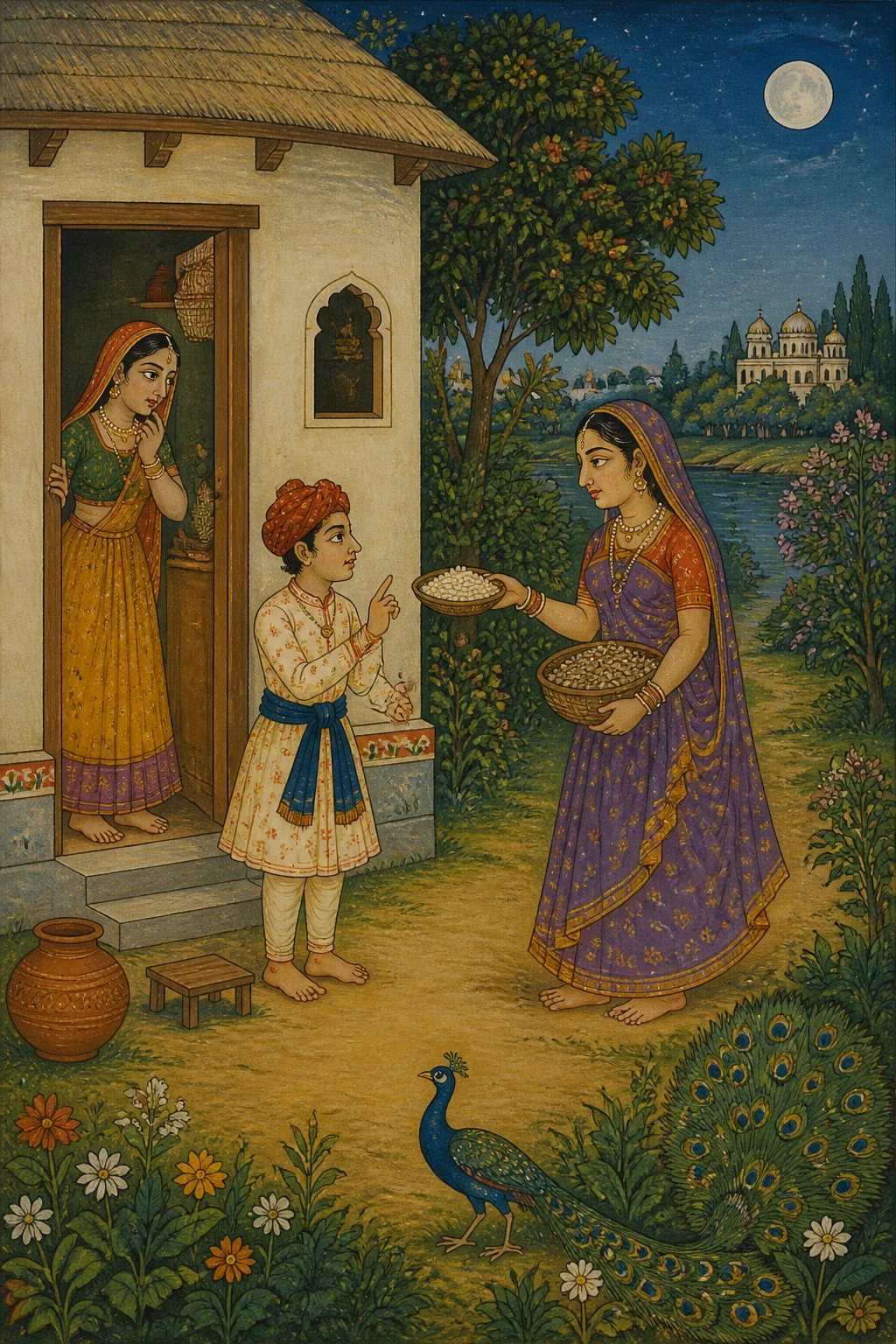
“I shall turn you into a peacock,” she said. She made him a peacock and brought him barley to eat. And what did she do when she wanted someone to mate with her? She went to the donkey when she wanted a large one, to the cat when she wanted a small one. She was depraved and lustful, with an insatiable appetite for coupling. She went from one creature in the courtyard to another, changing herself into their shapes.
At last his turn came. She came to him and turned herself into a peahen, but he would have none of her. She became a woman again and said, “Bring him here.” She changed him back into a man. “What is wrong with you? Do I not please you?” “God forbid!” he replied. “What you do is pleasing neither to God nor to man.” They bound him and gave him five hundred lashes. She turned him back into a peacock. “Bring him to me tomorrow,” she said. Next day they brought him, and she made him a man again. “Will you consent to me today?” she asked. “Away with you! May God curse you!”
“Stretch him out,” she ordered. “Give him another five hundred.” For seven days she gave him five hundred lashes each day. On the seventh day she had him brought before her. “Today, if you will not do it, if you will not lie with me, I shall wring your neck.” “What do you want?” he said.
“I shall pray to God to deliver me from your hands. Yes, wait while I pray to my Lord.” He said, “He is the bountiful, the all-seeing; He is the all-knowing, the almighty. He sees and is not seen; He knows what is in this world and the next! I beseech You, my Lord, deliver me from this unbelieving woman!”
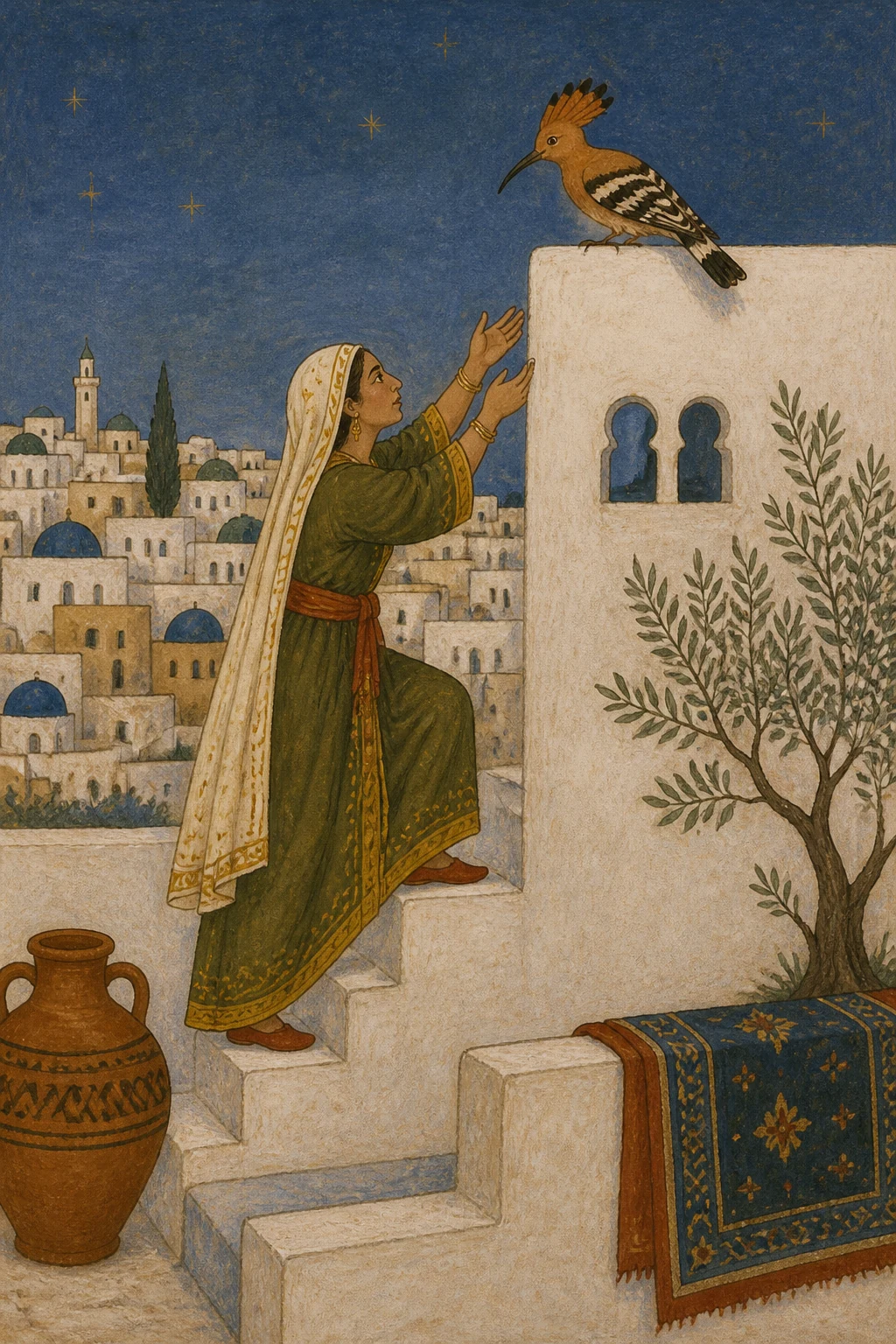
As he prayed, he saw a bird, which came down beside him. “Come, climb onto my back,” it said. “I will take you out of here.” He climbed onto its back, and it rose into the air and carried him back to the town. It held out a bottle. “Drink from this.” He drank, and became a man again.
“At the town I found an old man sitting there. He greeted me, and I returned his greeting. ‘Dismount and rest beside me a little,’ he said. I got down beside him. He looked at me and said, ‘Take off the mule’s bridle and let her rest.’ I stood up and took it off. Then the man said, ‘Give me the bridle. Let me see it.’ I handed it to him, and she became a woman. ‘Seize him!’ she said. He overpowered me, and she had me taken to her palace and tortured me there.” The bird told him, “Tomorrow they will bring her to market. Go there, and you will see her with the auctioneer. Buy her as you did the first and second times, for five hundred mahboubs. They will not sell her for more or less. And take care not to let go of the bridle.
Do not forget my advice! Let what happened be as though it had never happened, and take heed!” He spent the night there, and in the morning went to the market. He found her with the auctioneer, bid for her, and won the sale. He bought her. “Does the sale include her bridle?” he asked. “Yes, indeed.”
He mounted her and rode back to the bird. By now the bird had become a man, a white-haired sage. He went up to the mule. “Ah, have you been caught, you whore?” He put a whip in Ali’s hand. “Mount her and lay into her with this whip. She will carry you wherever you wish.
As long as you hold this whip and her bridle, you need not fear her. Guard it carefully, even when you sleep: coil it up and put it in your pocket.” “Very well,” Ali replied. He mounted her and rode away, striking her hard on the flanks with the whip and tormenting her.
In three hours she carried him three months’ journey. “Give me a little relief, Master Ali!” she begged. “Have you forgotten what you did to me?” “I repent before God,” she said. He dismounted. “Give me your solemn pledge before God.” She gave him her pledge and submitted. The next morning he told her, “I cannot bring myself to turn you into a mule and ride you.” “It does not matter,” she said. “Ride me. We shall make our home in whichever town you choose.” He mounted and rode off. Before evening, he entered a town. He went to an inn and said, “I should like to rent a room for myself and my mule.” The innkeeper rented him a room. He brought the mule inside and tied her up, then went out to buy supper for himself and feed for her. Let us leave them at the inn and return to Mhammed, who had gone away with the maidservant. She had entered a town and rented a room, and placed him in a Quran school. Whenever the sultan of that town held court, three birds came down from the sky, a female and two males. They would quarrel before him in the language of birds, quarrel and flutter about, then fly away. The sultan turned to his council and said, “Tell me, what is the matter with these birds? What are they saying?” “We do not possess the tongue of our lord Solomon,” they answered, “to understand the speech of birds.” Word spread through the town that three birds came to the sultan every day and that he wanted someone to explain their dispute.
Mhammed turned to the other boys. “If the sultan would have me brought before him, I could explain their dispute.” Word reached the sultan. “There is a boy who says, ‘If I were brought before the sultan, I could explain the birds’ dispute.’” “Bring him to me,” he said. They brought him. The sultan looked at him and asked, “Can you judge the case of these birds?”
“Yes.” As he was talking to the sultan, the birds came down. “Come, my boy, here are the birds,” said the sultan. “Judge between them.” “I cannot judge between them,” Mhammed replied, “unless you seat me upon the royal throne, place your crown upon my head, and stand among the members of your council.” The birds came down, and he spoke to them in their own language. One of them came forward and said, “That is my wife. I was away for a year, and when I returned I found her married to another. Settle our dispute and judge justly between us.” Mhammed turned to the other male. “What have you to say?”
“I married her lawfully,” he replied. “I am not living with her in sin.” Mhammed said, “Let one bird sit here and the other there, one on the right and one on the left. Then let her go of her own free will to whichever one she chooses.” One sat on either side, and she went to the new husband. They flew away: she flew off with her new husband, and the former husband went his own way. Master Mhammed rose and turned to the sultan. “Here is your throne, and here is your crown.” The sultan looked at him. “No one but you shall sit upon it. You shall rule from this throne for the rest of your days. You are my son and I am your father, and I shall eat my bread under your protection.” The following morning, the man who climbed up to give the call to prayer found the town surrounded by wild beasts, birds, and animals: the leopard, the lion, the hyena, the wolf, and the hare. They had heard of the Sultan of Justice, and all had come to lay their complaints before him. The old sultan summoned him. “Mhammed, my son, they have heard that you are the Sultan of Justice and have gathered here. They all wish to bring their grievances to you. But we cannot let them all into the town. I shall build you a pavilion outside, and you can settle their disputes there.” He set up the throne of judgment there. A donkey came forward to complain of the hyena. “He has eaten my father and my children,” he said.
Then a ram came forward. “I complain of the wolf. He has eaten my wife and my brothers.” Mhammed turned to them. “If I question the hyena now, where can he find your father and your children to bring them back? They have been eaten; they are gone. But from this day I shall judge between you, and none shall wrong another.” All the beasts went away content. The sultan marvelled at him, kissed him between the eyes, and said, “God’s blessing upon you, my son!”
He returned to rule from the throne in the middle of the town. Now our tale returns to his brother, Master Ali, who was in his room at the inn in that very town. He went to buy their provisions and prepared a meal with everything from savouries to sweets. He lit the lamp and locked the door. She took off her mule’s skin and became a young woman of matchless beauty. The innkeeper came
and peered through a hole, gazing at the beautiful stranger. He left them there and went to the headman of the quarter. “Sir, a man has newly arrived and is staying at my inn. He has a beautiful young woman with him. He means to bring turmoil upon us and throw the town into confusion.” The headman sent four officers with him. “Bring her, and bring him too.”
They went. Master Ali was sitting up, unaware of anything, when they knocked at the door. “Who is it?” he asked. “Open!” He opened the room, and the officers entered. “Come. The governor summons you.” “Very well.” The woman wrapped herself in her veil and went with him. When she stood before the headman of the quarter, he saw how beautiful she was. “Take her into my house, and take him to prison,” he ordered. “How can she spend the night in your house while I spend it in prison?” Ali said. “Who can trust you? By God, I shall not go to prison unless I am dead or my wife is beside me.” “Take them both to prison,” he said. They remained there until morning. Then he brought their case before the king, Ali’s brother, telling him what had happened. “There is a man staying at an inn. He has an exceedingly beautiful wife and means to throw our town into turmoil.” “Bring him.” They went down and brought him up. As soon as Mhammed looked at him, he recognised his brother. “My son, what has happened to you?” he asked. “My wife and I have just arrived here, and I do not know how the authorities came down upon me.” Mhammed turned and said, “Take this woman into my house, and leave the man until I can attend to him.” Master Ali turned to him. “My wife shall not be taken away from beside me unless my head is taken off first! So you are the one they call the Sultan of Justice, whose fame has spread through every land! You want to take other men’s wives and unveil them in your house!” “Take them both,” he said, “and put them in the private chamber.”
They took them and put them in the private chamber. Then Sultan Mhammed came to him. “Did you not recognise me? I am your brother Mhammed. You and I ate the gizzards and hearts; I ate the hearts. If you do not believe me, I shall bring the Dada who raised us as proof.” He brought the maidservant, and when Ali saw the woman who had raised them, they rose and embraced one another. “Praise be to God, who has brought us together again!” In the end, Mhammed made his brother his vizier and announced to the people, “This is my brother, who has come to me.” Let us leave them ruling their country and return to their father, who had gone on the pilgrimage. He came back from the pilgrimage to his own town and found his house changed, with strangers living in it.
Their mother had taken up with the Jewish man and become Jewish herself. Her husband asked and asked, but no one could give him any news. He wandered through the town, poor man, like one bereft of his senses, crying, “My wealth! My home! My wife and children!” One day, as he wandered about, he saw a woman cleaning fish in the entrance hall of a Jewish house. He recognised her. “That is my wife—is it not?” He caught hold of her. “You are my wife!” “By Adonai, I am a Jewish woman!” she said.
He held her fast and shouted. A crowd gathered around them—Jews, Muslims, and Christians—and took them before the governor. “What is the matter, my son?” he asked. “This is my wife. I left her with her two children, the maidservant, my property, my money, and my house.” The governor questioned her. “What have you to say, my daughter?” “I am Jewish, the daughter of a Jew, on my honoured father’s life.” The governor turned to the man. “What do you say? You have heard what she says.”
“I will not let her go until she gives me my children. After that she may even become a Greek if she likes! Only let her give me my children!” At last the governor sent the case to the qadi. But the qadi, too, could not settle it; he suspended judgment because the case was so difficult.
“I shall go and complain to the Sultan of Justice,” the man said. “Go to the sultan,” the qadi told them. “He will judge between you.” Mhammed turned to his brother and said, “Keep quiet. Tomorrow our father and mother will come before us with a dispute.” They passed the night, and in the morning, before he had begun hearing cases, his mother and father entered with a group of Jews who were defending her claim. “Come forward, my son,” Mhammed said. “What have you to say?”
“I went on the pilgrimage and left this wife of mine at home with her two children and the maidservant. When I returned from the pilgrimage, I found neither home, wife, nor children. One day I was passing through the Jewish quarter and saw her in the entrance hall of a Jewish house.
I recognised her, but she denied knowing me. ‘I do not know you. I have never heard of you!’ she told me.” The Sultan of Justice turned to her. “What have you to say, my daughter?” “I am Jewish, the daughter of a Jew!” “That is the devil speaking!” said the Sultan of Justice. “No, sir. It is the truth.” The sultan sprang up. “You are my mother, and that is my father. There is Ali, your son, and I am Mhammed, your son.” She denied it. “No, I do not know any of you.” He sent to the house and had the maidservant brought. When she saw them, she rushed to her old master and began kissing him. “This is my master, and this is my mistress, and these are her children,” she declared before the council. Still the woman denied it. He summoned the qadis and muftis and asked, “What is the sentence upon someone who apostatises and changes religion?” “Such a person must be burned,” they replied. They burned her and the Jewish man with her, and their father remained with them in their country. Our tale has gone down to the river, while we remain here telling of noble folk!