O besedilu
Peruonto
- Vir
- Pentameron
- Avtor
- Giambattista Basile
- Jezik branja
- English
- Jezik izvirnika
- Neapolitan
- Čas branja
- 15 min branja
- Obseg
- 12 strani
- Naslov izvirnika
- Jornata Primma III PERUONTO
O izvirniku
Pentameron
Baročna, divja starejša plast evropske pravljice, polna obratov in pretiravanj. Bralni jezik je English, izvirnik pa prihaja iz vira Pentameron v jeziku Neapolitan.
Besedilo
Peruonto
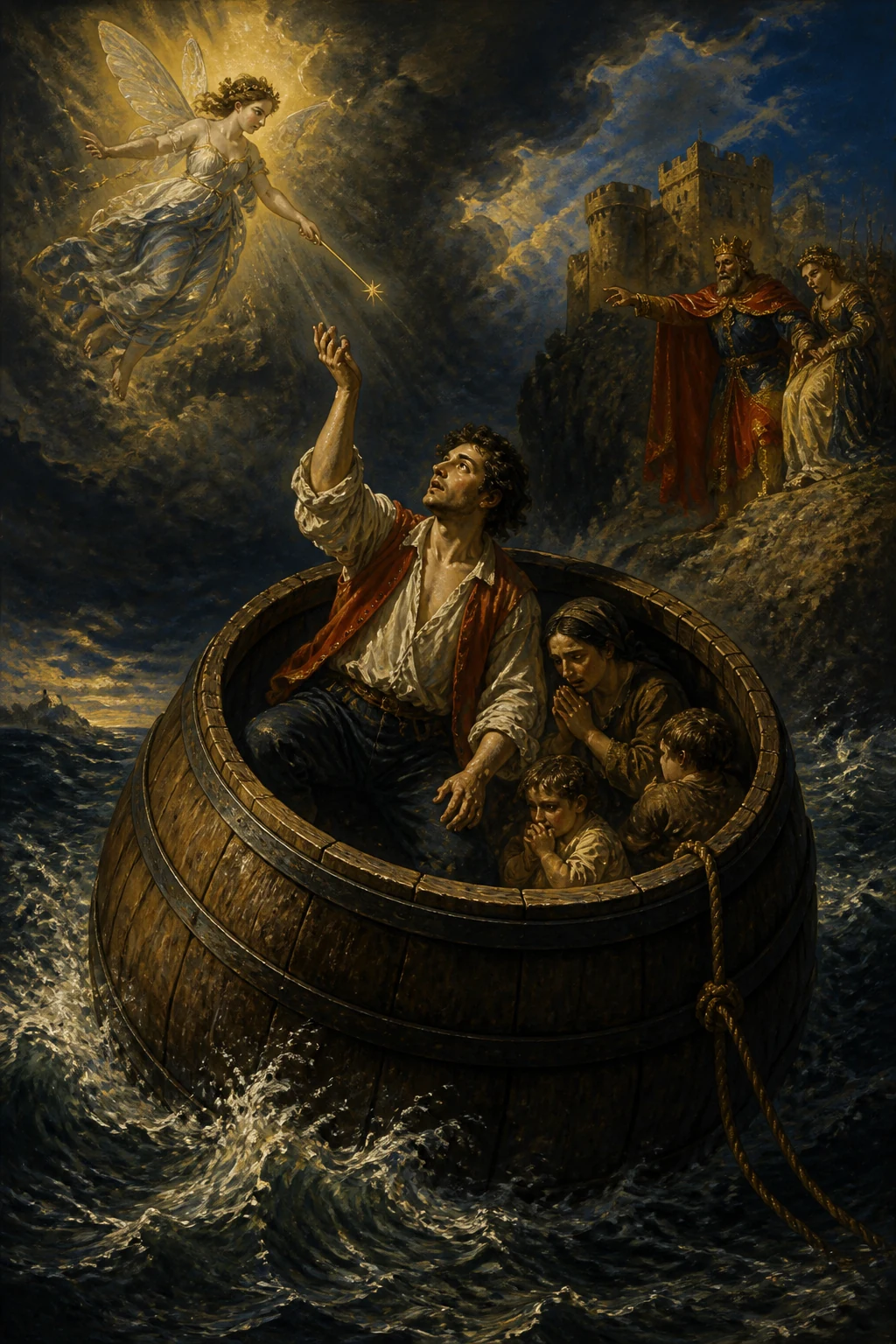
_Peruonto, a fool of the first water, goes into the woods to gather a bundle of firewood, shows kindness to three young men sleeping in the sun, and receives a magic gift in return. Mocked by the King’s daughter, he wishes her pregnant by him, and so she becomes. When the King discovers that Peruonto is the father of her children, he has him shut in a barrel with his wife and sons and thrown into the sea. But by virtue of his gift he escapes the danger, becomes a handsome young man, and is made King._ _All the women showed how delighted they were by the poor Prince’s happy deliverance and the punishment dealt to that wicked woman. But as it was now Meneca’s turn to speak, the others’ chatter came to an end, and she began to relate the following tale._ No good deed was ever wasted: whoever sows kindness reaps benefits, and whoever plants affection gathers love. A service done to a grateful soul was never barren, but breeds gratitude and gives birth to rewards. We see proof of this every day in the dealings of mankind, and you shall hear an example in the story now upon the tip of my tongue.
A good woman of Casoria, called Ceccarella, had a son named Peruonto, who was the most wretched creature, the greatest lout, and the most consummate blockhead that nature ever made. His poor mother’s heart was blacker than a kitchen rag on his account, and a thousand times a day she cursed the knee she had bent to open the door for this clod, who was not worth a dog’s breakfast. The unfortunate woman might shout herself hoarse and bellow till her throat split, but the sluggard would not stir from his squatting to do her one damned service. At last, after a thousand assaults upon his thick skull, a thousand fits of temper, and a thousand tellings and retellings, shouting today and screaming tomorrow, she persuaded him to go into the woods for a bundle of firewood. “It’s high time we stuffed something into our mouths,” she told him. “Run and fetch that wood, don’t forget yourself along the way, and come straight back, for we must cook a few stewed cabbage stalks to keep this life of ours stewing along.” Off went that lazy Peruonto, and he went like a man walking between the brethren of a funeral procession:
he set off and walked as though he were treading on eggs, at a magpie’s pace, counting every footstep, moving slowly, softly, gently, gingerly, dawdling along the woodland road as though he meant never to return. When he reached a certain meadow, through which a stream ran babbling and murmuring at the ill manners of the stones that blocked its path, he found three young men who had made themselves a mattress of the grass and a pillow of a flint. There, in the blazing midday sun, which beat straight down upon them, they slept like the slaughtered. Seeing these poor fellows turned into fountains of sweat in the midst of a fiery furnace, Peruonto felt sorry for them, and with the axe he carried he cut some oak branches and made them a fine leafy shelter.
Meanwhile the young men awoke. They were the sons of a fairy, and seeing Peruonto’s kindness and goodwill, they bestowed upon him the magic power to obtain whatever he might ask for.
Having done this good deed, Peruonto went on into the woods, where he made such an enormous bundle of firewood that it would have taken a sledge to drag it away. Seeing that he was quite unable to carry it on his back, he climbed astride it and said, “Oh, my goodness, if only this bundle would carry me along like a horse!” At once the bundle began to amble like a horse of Bisignano, and when it reached a King’s palace it wheeled and capered in the most astonishing fashion. The waiting-women at a window, seeing this marvel, ran to call Vastolla, the King’s daughter. She came to the window, and watching the bundle’s prancing and the firewood’s leaps, burst out laughing, though she was so melancholy by nature that no one could remember her ever having laughed before. Peruonto raised his head, saw that they were making fun of him, and said, “Oh, Vastolla! May you find yourself pregnant by this fine fellow!” With that, he dug his heels into the bundle and reached home at a firewood gallop, followed by a swarm of children who hooted and yelled after him. Had his mother not been quick to shut the door, they would have battered him to death with oranges and cabbage stalks. But Vastolla, after her monthly courses failed to come, and after certain fainting fits and flutterings of the heart, discovered that her dough was rising. She hid her pregnancy as long as she could, but when she could no longer conceal a belly swollen to the size of a bushel measure, the King noticed it. In a fury beyond anything ever seen, he summoned his Council and said, “You already know that the moon of my honour has sprouted horns. You already know that my daughter has supplied ink enough to write chronicles—or hornicles—of my disgrace. You already know that, to burden my brow, she has had her belly burdened. So tell me what to do; advise me.
“I am minded to make her bring forth her soul before she gives birth to an evil brood. I am inclined to let her feel the pangs of death before the pains of childbirth. I have a fancy to see her uprooted from this world before she puts out shoots and scatters seed.”
The councillors, who had burned more midnight oil than they had drunk wine, said, “She certainly deserves a great punishment, and the horn she has planted on your brow ought to furnish the handle of the knife that takes her life. Yet if we kill her now, while she is pregnant, that insolent fellow will slip through a hole in the net: the fellow who, to send you into battle with sorrow, has armed you with horns on the right and on the left; who, to teach you the statecraft of Tiberius, has set a Cornelius Tacitus before you; who, to make your dream of infamy come true, has sent you through the gate of horn. Let us wait, then, until she comes safely into harbour and we discover the root of this disgrace. Afterwards we may consider and decide, with a grain of sense, what is to be done with her.”
This advice pleased the King, for he saw that they spoke soundly and to the point. He therefore stayed his hand and said, “Let us await the outcome of the business.” And, as Heaven willed it, the hour of delivery arrived. With four little pains, at the first puff of the midwife’s breath, at her first word, at the very first push, Vastolla dropped into her lap two sturdy boys like two golden apples. The King, who was himself swollen with vexation, called his councillors together and said, “Well, my daughter has given birth, and now it is time to help out the afterbirth with a good cudgelling.” “No,” said those knowing old men, whose sole intention was to give time time. “Let us wait until the little fellows have grown, so that we may recognize their father’s features.” The King, who never drew a line without the ruling sheet of counsel beneath it for fear of writing crookedly, shrugged his shoulders, mastered his impatience, and waited until the boys were seven years old. Then he urged the councillors once again to strike at the root of the matter. One of them said, “Since you have been unable to worm the truth out of your daughter and discover who was the false coiner who debased the crown bearing your image, we shall now bring him to light. Order a great banquet to be prepared, to which every titled lord and gentleman in this city must come. We shall keep a sharp lookout, with our eyes upon the table, and see to whom the children turn most willingly, prompted by nature. That man will assuredly be their father, and we shall swoop upon him like a jackdaw upon a dropping.”
The King liked this proposal. He ordered the banquet and invited all the persons of standing and consequence. When they had eaten, he had them stand in a row and the children walk past them. But the boys paid them no more heed than Alexander’s hound paid to rabbits, so that the King stormed and bit his lips. Though he had no shortage of footwear, this shoe of sorrow pinched him so hard that he stamped his feet upon the ground. But the councillors said, “Gently, Your Majesty; let yourself be guided. Tomorrow we shall hold another banquet, not for persons of rank this time, but for those of humbler station. Perhaps, since women always fasten upon the worst, we shall find among cutlers, bead-makers, and comb-sellers the seed of your anger which we failed to discover among the knights.” This reasoning struck the right note with the King, and he commanded a second banquet. A proclamation was issued, and all the cripples, loafers, beggars, rogues, ragamuffins, idlers, scoundrels, dog-kickers, ruffians, gallows-strippers, and folk in aprons and clogs in the city came flocking in. Seated like fine counts at a very long table, they began to stuff themselves. Now Ceccarella, hearing the proclamation, began to prod Peruonto into going to the feast as well, and at last she got him on his way to the great guzzling. Scarcely had he arrived when those lovely little boys clustered round him, lavishing the wildest caresses and endearments upon him. Seeing this, the King tore at his beard, for the lucky bean in this cake, the winning name in this lottery, had fallen to a stunted wretch so hideous that the mere sight of him turned one’s stomach. Besides having a head like velvet, the eyes of an owl, a parrot’s nose, and a grouper’s mouth, he was barefoot and so ragged that, without reading the Fioravante, you could glimpse all his secrets. With a deep sigh, the King said, “What did that little sow of a daughter of mine see in this sea-monster to take such a fancy to him? What did she see in him, to go heels over head for this hairy-footed brute? Ah, infamous, blind, deceitful creature! What transformations are these? She turns cow for a pig, so that I may turn sheep! But what are we waiting for?
“What is there to think about? Let her have the punishment she deserves! Let her suffer whatever penalty you judge fit, and take her out of my sight, for I cannot stomach her.” The councillors therefore conferred and resolved that she, the culprit, and their children should all be shut inside a barrel and thrown into the sea, so that their lives might be brought to a full stop without anyone staining his hands with his own blood. No sooner had the sentence been pronounced than the barrel was brought and all four were crammed inside. Before it was sealed, however, some of Vastolla’s waiting-women, sobbing bitterly, put in a little keg of raisins and dried figs, so that she might keep herself alive for a while. Then the barrel was closed, carried away, and thrown into the sea, where it floated wherever the wind drove it. Meanwhile Vastolla, weeping two rivers from her eyes, said to Peruonto, “What terrible misfortune is ours, to have the cradle of Bacchus for our tomb! Oh, if only I knew who worked upon this body of mine to have me shut in such a prison!
“Alas, here I find myself unboned without knowing how! Tell me, tell me, cruel man, what spell did you cast, and with what wand, to imprison me within the hoops of this barrel? Tell me, tell me, what devil tempted you to put your invisible spigot into me, only to leave me no opening to look through but this wretched bunghole?” Peruonto, who for some time had turned a merchant’s deaf ear to her, answered at last, “If you want me to tell, give me raisins and figs as well.” Vastolla, to get something out of him, put a handful of each into him. Once he had filled his gullet, he told her exactly what had happened with the three young men, then with the bundle of firewood, and finally with her at the window: how, because she had treated him as a bellyful of laughter, he had given her a bellyful in return. Hearing this, the poor young lady took heart and said to Peruonto:
“My dear fellow, must we spill out our lives in this barrel? Why don’t you turn this vessel into a fine ship and carry us safely into harbour, out of danger?” Peruonto replied, “Give me raisins and figs as well, if you want me to tell.” Vastolla promptly filled his mouth to make him open it, and like a fisherwoman at Carnival, baited with raisins and dried figs, she fished fresh words out of his belly. The moment Peruonto spoke Vastolla’s wish, the barrel became a ship, with all the rigging needed for sailing and all the sailors required to serve her. There you might have seen one hauling on a sheet, another coiling ropes, another taking the helm, another setting sail, another climbing to the masthead, another shouting, “Luff!” another, “Bear away!” another blowing a trumpet, another firing the guns, and everyone busy at one thing or another. Thus Vastolla, aboard the ship, floated upon a sea of sweetness. By now the hour had come when the Moon wished to play with the Sun at “Here you come, and there you go, and now you’ve lost your place,” and Vastolla said to Peruonto, “My handsome young man, turn this ship into a fine palace, where we shall be safer. You know the saying: praise the sea, but keep to the land.” And Peruonto answered:
“If you want me to tell, give me raisins and figs as well.” She promptly paid him his due, and Peruonto, won over through his gullet, asked for the favour. At once the ship ran ashore and became a most beautiful palace, splendidly furnished and so full of comforts and magnificence that nothing remained to be desired. Vastolla, who before would have sold her life for three farthings, would now not have exchanged it with that of the greatest lady in the world, seeing herself cherished and served like a queen. To crown all her good fortune, she begged Peruonto to obtain the favour of becoming handsome and well-favoured, so that they might delight in one another;
for although the proverb says, “Better a husband who is a pig than a lover who is an emperor,” still, if he would only change his face, she would count herself the most fortunate woman in the world. Peruonto answered on the same terms as before, “Give me raisins and figs as well, if you want me to tell.” Vastolla at once cured the constipation of his speech with a dose of dried figs, and scarcely had he spoken when he changed from a clod into a goldfinch, from an ogre into a Narcissus, from a hideous mask into a pretty little darling;
and at the sight of him Vastolla nearly lost her senses for joy. Clasping him in her arms, she squeezed the very juice of happiness from him. At this same time the King, who since the day of his disgrace had been filled to the throat with leave-me-alone, was taken hunting by his courtiers to distract him. Night overtook them, and seeing a little lamp shining in a window of the palace, he sent a servant to ask whether they might lodge there. The answer came that they were welcome not merely to break a drinking glass, but to smash a whole chamber pot if they pleased. So the King came in, mounted the stairs, and passed through the rooms, but saw no living soul except the two little boys, who ran round him crying, “Grandfather! Grandfather! Grandfather!” Astonished, bewildered, and dumbfounded, the King stood as though enchanted. Being tired, he sat down beside a table, where he saw a cloth from Ioannina spread by invisible hands, and dishes arrive laden with every kind of good thing. He ate and drank like a king indeed, served by those beautiful children, while all through the meal the music of colasciones and tambourines never ceased, delighting him to the very marrow of his bones. When he had eaten, a bed appeared, all frothing with gold, and after having his boots pulled off he went to rest, as did his whole court, who had feasted heartily at a hundred other tables laid in the other rooms. Morning came, and when the King was ready to leave, he wished to take the two little boys with him. But Vastolla appeared with her husband, threw herself at his feet, and begged his forgiveness, telling him all her adventures. The King, finding that he had gained two grandchildren who were a pair of jewels, and a son-in-law who was a marvel, embraced them both and carried them straight back to the city. He ordered great festivities, which lasted many days, to celebrate his good fortune, confessing, much against his pride, _That man proposes, but God disposes._
Izvirnik
Jornata Primma III PERUONTO
Naslednje strani prikazujejo izvirno besedilo za primerjavo.
_Peruonto, sciaurato de coppella, và pe ffare na sarcena a lo vosco, usa no termene d’amorevolezza a ttre che ddormeno a lo Sole, nne receve na fatazione; e burlato da la figlia de lo Rrè, le manna la mmardezzione, che ssia prena d’isso, la quale cosa soccesse; e ssapenno essere isso lo patre de la creatura, lo Rrè lo mette dinto na votta co la mogliere e li figlie, jettannolo dinto mare: ma pe bertute de la fatazione soja se libera da lo pericolo, e ffatto no bello giovane, deventa Rrè._ _Mostraro tutte d’avere sentuto no gusto granne pe la consolazione avuta da lo povero Prencepe, e ppe lo castico recevuto da chella marvasa femmena: ma avenno da secotejare lo parlamiento Meneca, se deze fine a lo vesvesiamiento de ll’autre, e essa commenzaje a ccontare lo
socciesso, che ssecota._ Non se perdette maje lo ffare bene: chi semmena cortesie, mete beneficio; e cchi chianta amorevolezza, recoglie amorosanze: lo piacere che se fa ad anemo grato, non fu maje sterele, ma ’ncria gratetudene, e ffiglia premmie: se ne vedeno sprementate ne li continue fatte de ll’uommene, e nne vedarrite esempio nne lo cunto, ch’aggio ’mpizzo de fareve sentire.
Aveva na magna femmena de Casoria, chiammata Ceccarella, no figlio nommenato Peruonto, lo quale era lo cchiù scuro cuorpo, lo cchiù granne sarchiopio, e lo cchiù ssollenne sarchiapone ch’avesse crejato la natura. Pe la quale cosa la scura mamma nne steva co lo core cchiù nnigro de na mappina, e ghiastemmava mille vote lo juorno chillo denucchio, che spaparanzaje la porta a sto scellavattolo, che non era buono pe no quaglio de cane: pocca poteva gridare la sfortunata, aprire la canna, ca lo mantrone non se moveva da cacare pe ffarele no mmarditto servizio; a ll’utemo dapò mille ’ntronate de cellevriello, dapò mille ’nfroate de zuco, e ddapò mille dicote, e ddissete, e grida oje, e strilla craje, l’arredusse a ghire a lo vosco pe na sarcena,
decennole: ora maje è ora de strafocare co no muorzo, curre pe ste llegna, non te scordare pe bia, e biene subeto, ca volimmo cocenare quatto torze strascinate pe strascinare sta vita. Partette lo mantrone de Peruonto, e ppartette comme và chillo, che stà mmiezo a li Confrate: partette, e ccammenaje comme se jesse pe ccoppa a ll’ova co lo passo de la pica, e ccontanno le ppedate, abbiannose chiano chiano, adaso adaso, e ppalillo palillo, facenno sgamma a la via de lo vosco pe ffare la venuta de lo cuorno, e comme fu mmiezo a na certa campagna, pe ddove correva no sciummo vervesianno, e mormorejanno de la poca descrezzione de le pprete, che le ’mpedevano la strata, trovaje tre guagnune, che s’avevano fatto strappontino de ll’erva, e ccapezzale de na preta
selece; li quale a la calantrella de lo Sole, che le ccarfettejava a pperpennicolo, dormevano comme a scannate. Peruonto, che bidde ste poverielle, ch’erano fatte na Fontana d’acqua mmiezo na carcara de fuoco, avennone compassione co la medesima accetta, che portava, tagliaje certe ffrasche de cercola, e le fece na bella ’nfrascata. Fra chisto miezo scetatose chille giuvene, ch’erano figlie de na Fata, e bedenno la cortesia, e ammorosanza de lo Peruonto, le dezero na fatazione, che le venesse tutto chelle, che sapesse addemannare.
Peruonto avenno fatto sta cosa, pigliaje la strata verzo lo vosco, dove fece no sarcenone accossì spotestato, che ’nce voleva no straolo a strascinarelo, e bedenno, ch’era chiajeto scomputo a ppoterelo portare ’ncuollo, se le accravaccaje ’ncoppa, decenno; o bene mio, se sta fascina mme portasse camminanno a ccavallo; ecco la fascina commenzaje a ppigliare lo portante, comme a ccavallo de Besignano, e arrevato ’nnante a lo Palazzo de no Rrè fece rote, e ccrovette da stordire: le Ddammecelle, che stevano a na fenestra, vedendo sta maraveglia, corzero a chiammare Vastolla la figlia de lo Rrè, la quale affacciatese a la fenestra, e ppuosto mente a li repolune de la sarcena, a li saute de na fascina, sparaje a rridere; dove pe nnaturale malenconia non se
arrecordava maje, ch’avesse riso. Auzata la capo Peruonto, e bisto ca lo coffiavano, disse: O Vastolla; và, che puozze deventare prena de sto fusto; e accossì dditto, strenze na sbrigliata de scarpune a la sarcena, e de galoppo sarcenisco arrivaje subeto a la casa co ttanta peccerille appriesso, che le facevano l’allucco, lo illaio dereto, che se la mamma non era lesta a sserrare subeto la porta, l’averriano acciso a ccuorpe de cetrangolate, e de torza. Ma Vastolla dopo lo ’mpedemiento de l’ordenario, e dapò certe sfiole, e pipoliamiente de core, s’addonaje, ch’aveva pigliato la pasta, nascose quanto fu possibile sta prenezza, ma non potenno cchiù nasconnere la panza, c’era ’ntorzata quanto a no vero tummolo: lo Rrè se ne addonaje, e ffacenno
cose dell’autro Munno, chiammaje lo Consiglio, decenno: Già sapite ca la luna de lo nore mio ha fatto le ccorne: già sapite, ca pe ffare scrivere croneche, overo corneche de le bregogne meje, m’ha provisto figliama de materia de calamare. Già sapite, ca pe ccarrecareme la fronte, s’ha fatto carrecare lo ventre; perzò deciteme, consigliateme. Io sarria de pensiero de farela figliare l’arma primma de partorire na mala razza; io sarria d’omore de farele sentire primma le ddoglie de la morte, che li dolure de lo partoro. Io sarria de crapriccio, che primma sporchiasse da sto munno, che ffacesse sporchia, e ssemmenta.
Li Consigliere ch’avevano strutto cchiù uoglio, che bino, dissero: Veramente mereta no gran castigo, e dde lo cuorno, che v’ha puosto ’nfronte se deverria fare la maneca de lo cortiello, che le levasse la vita: Non però se l’accidimmo mò, ch’è pprena, se n’escerà per la maglia rotta chillo temmerario, che pe ve mettere dinto na vattaglia de desgusto, v’ave armato lo cuorno dritto, e lo manco; pe v’ammezzare la politeca de’ Tiberio, v’ha puosto ’nnante no Cornelio Taceto: pe rappresentareve no suonno vero d’infamia, v’ha fatto scire pe la porta de cuorno. Aspettammo addonca, ch’esca a ppuorto, e ssacciammo quale fu la radeca de sso vetuperio; e pò pensammo, e rresorvimmo co no grano de sale, che cosa n’averrimmo da fare.
Ncasciaje a lo Rrè sto conziglio, vedenno ca parlavano assestato, e a ssepara: e pperzò tenne la mano, e ddisse: aspettammo l’eseto de lo negozio. Ma comme voze lo Cielo, jonze ll’ora de lo partoro, e co quatto doglie legge legge a la primma sciosciata d’agliaro, a la primma voce de la mammana, a la primma premmuta pe cuorpo, jettaie ’n sino a la commare duje mascolune comme a duje pumme d’oro. Lo Rrè ch’era prieno isso puro de crepantiglia, chiammate li Conzigliere pe consegliare, loro disse: Ecco è ffigliata figliama, ma è tiempo d’asseconnare co na saglioccola. Nò, dissero chille Viecchie sapute (e tutto era pe ddare tiempo a lo tiempo) aspettammo, che se facciano granne li pacionielle pe ppotere venire ’ncognizione de la fesonomia
de lo Patre. Lo Rrè perchè non tirava vierzo senza la fauzarega de lo consiglio pe no scrivere stuorto, se strenze ne le spalle, appe freuma, aspettaje ’nfi a ttanto, che li figliule furono de sette anne, ne lo quale tiempo stimmolate de nuovo li Conzigliere a ddare a lo trunco, e a dove tene, uno de loro disse: pocca non avite potuto scauzare vostra figlia, e ppigliare lengua, chi sia stato lo monetario fauzo ch’a la mmagene vostra ave auterato la corona, mmo nne cacciarrimmo la macchia: ordenate addonca, che s’apparecchia no gran banchetto, dove aggia da venire ogne Ttetolato, e gentel’ommo de sta Cetate, e stammo all’erta, e co l’uocchie sopra lo tagliero, dove li piccerille ’ncrinano cchiù vollentiere vottate da la natura, ca chillo senz’autro
sarrà lo Patre, e nnuje subito ne l’auzammo comme cacazza de Ciavola. Piacquette a lo Rrè sto parere. Ordenaje lo banchetto; commetaje tutte le pperzone de ciappa, e de cunto, e mmagnato che s’appe, le ffece mettere ’nfilo, e passiare li peccerille: ma nne fecero chillo cunto, che faceva lo corzo d’Alisantro de li coniglie, tanto, che lo Rrè faceva fortuna, e sse mozzecava le llavra; e benchè no le mancassero cauzature, puro, perchè l’era stretta sta scarpa de doglia, sbatteva li piede ’nterra: ma li Consigliere le dissero, chiano vostra Majestà faciteve a ccorrejete, ca craje facimmo n’autro banchetto, no cchiù de gente de portata, ma de cchiù bascia mano, fuorze, perchè la femmena s’attacca sempre a lo ppeo, trovarrimo fra cortellare, paternostrare,
e mmercante de piettene la semmenta de la collera vostra, dove no l’avimmo asciata tra Cavaliere. Deze a lo vierzo sta ragione a lo Rrè, e ccommannaje, che se facesse lo secunno banchetto, addove pe banno jettato venettero tutte li chiaise, fiercole, guitte, guzze, ragazze, spolletrune, ciantelle, scauzacane, verrille, spoglia ’mpise, e gente de mantesino, e zuoccole, ch’erano a la Cetate: li quale sedute, comm’a belle Cuonte a na tavola longa longa, commenzaro a ccannariare: Ora mo Ceccarella, che ssentette sto banno, commenzaje a sporonare Peruonto, che ghiesse isso perzì a sta festa, e ttanto fece, che s’abbiaje a lo mazzecatorio, dove arrivato appena, chille belle ninnille se la azzecoliareno attuorno, e le facettero vierre, e cassesie fora de
li fora. Lo Rrè, che bedde ste ccose, se scippaje tutta la varva, vedenno ca la fava de sta copeta, lo nomme de sta beneficiata era toccato a no scirpio brutto brutto fatto, che te veneva stommaco, e ’nsavuorrio a bederelo schitto; lo quale otra che aveva la capo de veluto, l’uocchie de cefescola, lo naso de pappagallo, la vocca de cernia, era scauzo, vrenzoluso, che ssenza leggere lo Scioravante, potive pigliarete na vista de li secrete, e ddapò no cupo sospiro, disse: Che se n’ha bisto sta scrofella de figliema a ’ncapricciarese de st’uorco marino; che se n’ha bisto a ddaresella ’ntallune co sto pede peluso? ah ’nfamma cecata fauza, che mmetamorfose so ccheste? deventare vacca pe no puorco, azzò ch’io tornasse piecoro; Ma che s’aspetta?
che se penza? aggia lo castigo che mmereta; aggia la pena che sarrà jodecata da vuje, e llevatemella da nante, ca no la pozzo padejare. Fecero addonca conzierto li Consegliere, e concrusero, che tanto essa, quanto lo malefattore, e li figlie fossero schiaffate dinto na votte, e ghiettate a mmaro, azzò senza allordarese le mmano de lo sango propio, facessero punto finale a la vita. Non fu cossì priesto data la sentenzia, che venne la votte, dove ncaforchiarono tutte quatto, ma ’nnante, che ’ntompagnassero, certe dammecelle de Vastolla chiagnenno a selluzzo, nce mesero dinto no varrile de passe, e ffico secche, azzò se jesse mantenenno, pe quarche poco de tiempo; ma serrata la votta fu portata, e ghiettata a mmaro, pe dove jeva natanno secunno la vottava
lo viento. Tra chisto miezo Vastolla chiagnenno, e facenno doje lave de l’uocchie, disse a Pperonto: Che ddesgrazia granne è la nostra ad avere pe sebetura de morte la connola de Bacco? Oh sapesse a lo mmanco chi ha trasecato sto cuorpo pe schiaffareme dinto a sta carcere. Oimè, ch’io mme trovo spinolata, senza sapere lo comme. Dimme, dimme, o crodele, e che percanto faciste, e con quale verga, pe chiudereme dinto li chirchie de sta votte? dimme, dimme, chi diascance te tentaje a mmetteremme la cannella ’nvisibile pe n’avere autro spiracolo a la vista che no negrecato mafaro? Peruonto, ch’aveva fatto no piezzo aurecchia de mercante, all’utemo respose: Si vuoie che te lo ddico, tu damme passe, e ffico. Vastolla pe cacciarele da cuorpo quarche ccosa,
le mese ’ncuorpo na vrancata de l’uno, e de l’autro; lo quale comm’appe chiena la gorgia, le contaje puntualmente quanto le soccedette co li tre Giuvene, po co la sarcena, utemamente co essa a la fenestra, che pe ttrattarelo da panza chiena, le fece ’nchire la panza. La quale cosa sentuta la povera Signorella pigliaje core e disse a Pperuonto: Frate mio, e vorrimo sbottare la vita dinto sta votte? perchè non faie che de sto vasciello se faccia na bella Nave, e ghire pe scappare sto pericolo a buono puorto? e Pperuonto leprecaje. Tu damme passe, e ffico, si vuoje che te lo ddico. E Vastolla subeto lesta, le ’nchiette la canna, perchè apresse la canna; e comme pescatrice de Carnevale co li passe, e ffico secche le pescava le pparole fresche da cuorpo; ed
ecco che decenno Peruonto chello, che desiderava Vastolla, la votte tornaje Navilio, co ttutte li sarziamme necessarie a nnavecare, e co tutte li marinare, che besognavano pe lo servizio de lo vasciello: e lloco te vediste, chi tirare la scotta, chi arravogliare le ssarte, chi mettere mano a lo temmone, chi fare vela, chi saglire a la gaggia, chi gridare ad orza, chi appuggià, chi sonare na trommetta, chi dare fuoco a li piezze, e chi fare na cosa, e chi n’autra: tanto che Vastolla era dinto la Nave, e nnatava dinto no mare de docezza, essenno già l’ora che la Luna voleva jocare co lo Sole a ghiste, e beniste, e lo luoco te perdiste: disse Vastolla a Pperuonto: Bello Giovene mio, fa deventare sta Nave no bello Palazzo, ca starrimmo cchiù ssecure. Saie, che se
sole dicere; lauda lo maro, e ttienete a la terra: e Pperuonto respose: Si vuoje che te lo ddico, tu damme passe, e ffico, e essa subeto le refose lo fatto, e Pperuonto pigliato pe ccanna ademmannaje lo piacere; e ssubeto la Nave dette ’nterra, e ddeventaje no bellissimo Palazzo apparato de tutto punto, e cossì chino de mobele, e sfuorgie, che non c’era cchiù che desiderare; pe le quale cose Vastolla, ch’averria dato la vita pe ttre calle, non l’averria ’mpattato co la primma Segnora de sto munno, vedennose regalata, e sservuta comme na Regina; pe ssigillo de tutte le bone fortune soje, pregaje Pperuonto ad ottenere grazia de deventare bello, e ppolito, azzò s’avessero potuto ngaudiare ’nsiemme; che se be dice lo Proverbio: Meglio è mmarito porciello, ch’ammico
’mparatore, tutta vota si isso avesse cagnato ’nfaccia, l’averria tenuto per la cchiù gran fortuna de lo munno; e Pperuonto co lo medesemo appontamiento respose: Damme passe, e ffico, se vuoje che te lo ddico; e Vastolla subeto remmedejaje a la stitichezza de le pparole de Peruonto co le ffico jedettelle, ch’a ppena parlato tornaje da scellavattolo cardillo, da n’uorco Narciso, da no mascarone pipatiello; la quale cosa veduto Vastolla, se ne jette ’nsecoloro pe l’allegrezza, e strignennolo dinto le braccia, nne cacciaje zuco de contentezza. A sto medesemo tiempo lo Rrè, che da chillo juorno, che le soccese sto desastro, era stato sempre chino fi ’n canna de lassame stare, fu da li Cortisciane suoje portato pe rrecreazione a ccaccia; dove cogliennole
notte, e bedenno lucere na locernella a na fenestra de chillo palazzo, mannaje no servetore a bedere se lo volevano alloggiare; e le fu respuosto, ca ’nce poteva non sulo rompere no bicchiero, ma spezzare no cantaro: perzò lo Rrè nce venne, e sagliendo le grade, e scorrenno le ccammare, no vedde perzona vevente, sarvo, che li duie figliule, che le jevano ’ntuorno decenno, vavo, vavo, vavo. Lo Rrè stopafatto, strasecolato, attoneto steva comme ’ncantato, e ssedennose pe stracco vicino na tavola, lloco vedde ’nvisibelemente stennere mesale de Sciannena, e benire piatte chine de vaga, e de riesto, tanto che mmagnaje, e veppe veramente da Rrè, servuto da chille belle figliule, non cessanno maje, mentre steva a ttavola na museca da calasciune, e
ttammorielle, che le jeze pe fi a l’ossa pezzelle. Magnato ch’appe, comparse no lietto tutto scumma d’oro, dove fattose scauzare li stivale, se jette a ccorcare, comme fece ancora tutta la corte soja, dopo avere buono cannariato a cciento autre tavole pe ll’autre cammare apparecchiate. Venuta la matina, e bolenno partire lo Rrè, se voze portare co isso li duje peccerille, ma comparza Vastolla co lo marito, e ghiettatose a li piede suoje, le cercaje perdonanza, contannole tutte le ffortune soje. Lo Rrè che vedde guadagnate duje nepute ch’erano doje gioje, e no jennero, ch’era no fato, abbraccianno ll’uno, e ll’autro, se le pportaje de pesole a la Cetate, facenno fare feste granne, che dduraro mute juorne pe sto buono guadagno, confessanno asfastio de le
gargie soie, _Che se propone l’ommo, Dio despone._
Nadaljuj z branjem