Waltey
Vrana in golobji kralj
Pančatantra · indijska zbirka pripovediO besedilu
Vrana in golobji kralj
- Vir
- Pančatantra
- Avtor
- indijska zbirka pripovedi
- Jezik branja
- English
- Jezik izvirnika
- Sanskrit
- Čas branja
- 16 min branja
- Obseg
- 13 strani
- Naslov izvirnika
- Tantra 02 mitra-samprapti chunk 1
O izvirniku
Pančatantra
Indijske zgodbe o zvijači, prijateljstvu in modrosti v svetu živali in vladarjev. Bralni jezik je English, izvirnik pa prihaja iz vira Pančatantra v jeziku Sanskrit.
Besedilo
Vrana in golobji kralj
Now begins the second book, called “The Winning of Friends.” Its opening verse is:
Even without resources, the wise, intelligent, and widely learned
Swiftly accomplish their purposes, like the crow, the mouse, the deer, and the tortoise.
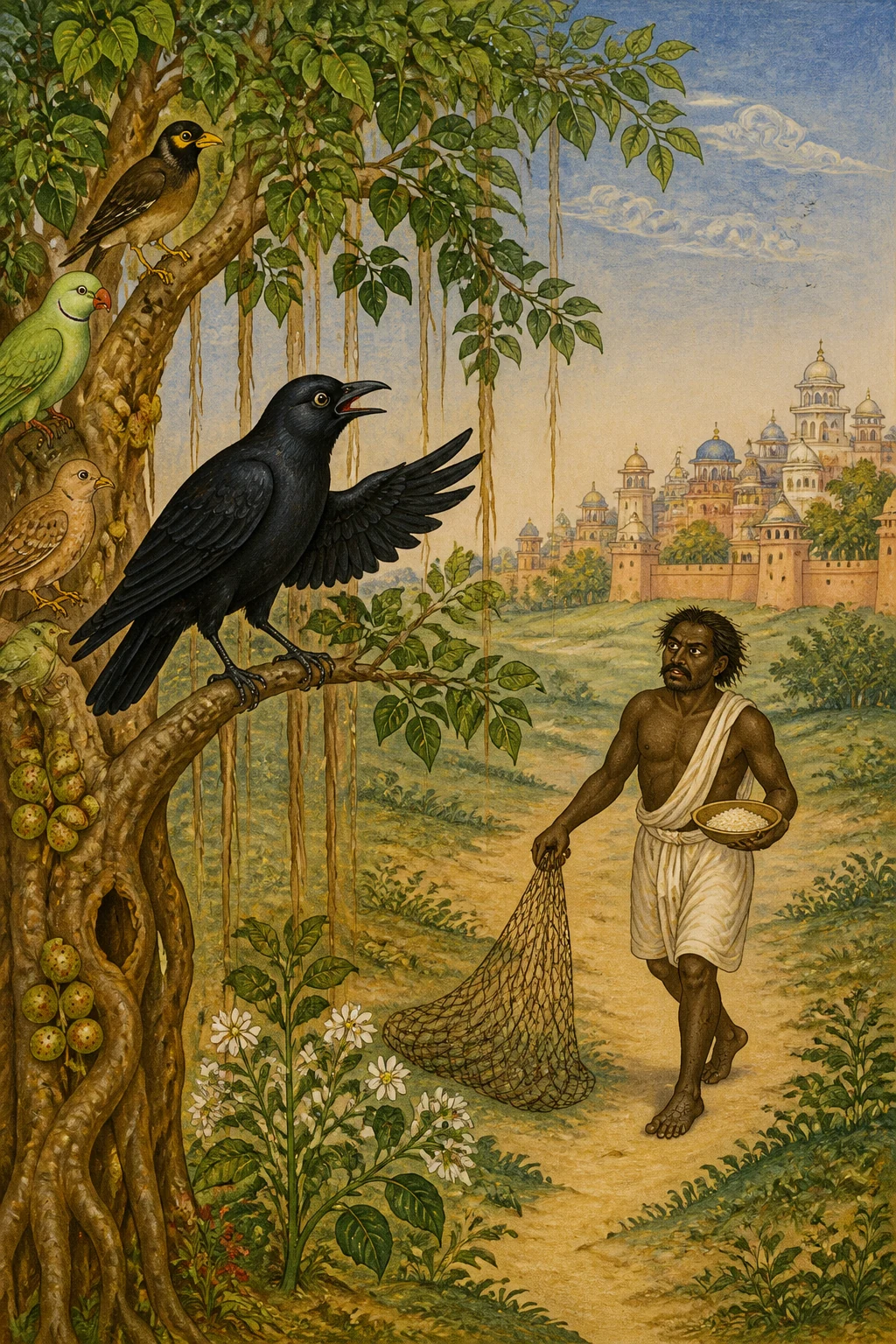
The story is told as follows. The introductory tale: the story of Laghupatanaka and Citragrīva. In the southern country there is a city called Mahilāropya. Not far from it stood an immense banyan tree, towering high, its fruit enjoyed by birds of many kinds, its hollows filled with insects, and its shade a comfort to crowds of weary travelers. Well indeed is it said: That tree is worthy of praise beneath whose shade deer sleep, whose leaves are plucked on every side by flocks of birds,
Whose hollows teem with insects, whose trunk shelters troops of monkeys,
And whose flowers the bees sip without fear—
A tree that, in every part, gives comfort to many living creatures. Any other is merely a burden to the earth.
In that tree lived a crow named Laghupatanaka. One day, as he was setting out toward the city in search of food, he saw a man approaching with a net in his hand. His body was very dark, his feet cracked, and his hair bristled upward; he looked like a servant of Yama, the god of death. Alarmed at the sight, the crow thought, “This wicked fellow is heading straight for the banyan where I live. Who knows whether the birds dwelling there will meet their end today?” Turning these fears over in his mind, he at once flew back to the banyan and warned all the birds: “Listen! A wicked hunter is coming with a net and rice in his hands. Whatever you do, do not trust him. He will spread his net and scatter the rice. Every one of you must regard those grains as deadly kālakūṭa poison.” While he was speaking, the hunter came to the foot of the banyan, spread his net, and scattered rice as white as sinduvāra blossoms. Then he went a little distance away and concealed himself. The birds in the tree, held back by the warning of Laghupatanaka as though by a bolt across a door, remained still, looking upon the grains as sprouts of deadly poison. Just then a king of pigeons named Citragrīva, roaming in search of food with a retinue of a thousand, caught sight of the rice from afar. Though Laghupatanaka warned him, his greedy appetite made him swoop down to eat, and he and all his followers were caught. Well indeed is it said:
Those foolish creatures enslaved by a greedy tongue
Meet an unforeseen death, like fish that dwell in water.
Or perhaps such things happen because fate has turned against one; the fault is not his. For it is said: How did Rāvaṇa, descendant of Pulastya, fail to see the wrong in carrying off another man’s wife?
How did even Rāma fail to recognize that a golden deer could not exist?
How did Yudhiṣṭhira suddenly bring ruin upon himself through dice?
When disaster draws near and clouds the mind, judgment generally fails.
And again:
Even the judgments of the great go astray
When they are caught in Death’s noose and fate has bewildered their minds.
Meanwhile, seeing that the pigeons were caught, the hunter joyfully raised his club and ran forward to kill them. Citragrīva, finding himself and his followers trapped and seeing the hunter approach, said to the pigeons, “Do not be afraid! For it is said:
One whose judgment does not fail in any calamity
Will surely overcome it through that very strength.
The great remain the same in prosperity and adversity:
The sun is red at its rising, and red again at its setting.
“Let us all rise into the air together, carrying the net and its cords. Once we are out of his sight, we can find our freedom. But if you lose your heads through fear and fail to rise together, you will meet your deaths. For it is said:
Even threads, stretched out side by side and joined in great numbers,
Withstand many strains through their multitude: so it is with good people united.
They did as he advised. As they flew through the sky carrying the net, the hunter ran after them along the ground. Looking upward, he recited this verse:
Even these birds can carry off a net when they act together;
But once they begin to quarrel, they will surely fall.
Laghupatanaka too abandoned his search for food and followed them, curious to see what would happen. At last, when the birds had passed beyond his sight, the hunter gave up hope, recited this verse, and turned back:
What is not destined will not happen; what is destined happens even without effort.
Even what lies in the palm of one’s hand is lost if it is not meant to be.
And again:
If wealth should somehow come when fate has turned its face away,
It gathers up one’s other possessions too and departs, like the treasure Śaṅkha.
“Never mind my hopes of feasting on birds—even the net that supported my family is lost!” Citragrīva, meanwhile, seeing that the hunter had disappeared, said to the others, “The wicked hunter has turned back. Now fly calmly, all of you, toward the northeastern side of Mahilāropya. My friend, a mouse named Hiraṇyaka, lives there. He will cut the bonds of every one of us. For it is said:
When misfortune overtakes a mortal,
No one but a friend offers help, even if only in words.
Thus encouraged by Citragrīva, the pigeons reached Hiraṇyaka’s fortified burrow in the city of Mahilāropya. Hiraṇyaka was resting comfortably within his stronghold, a burrow with a thousand entrances, afraid of nothing. Well indeed is it said:
Like a snake without fangs, or an elephant bereft of its rutting strength,
A king without a fortress falls into everyone’s power.
And again:
Neither a thousand elephants nor a hundred thousand horses
Can accomplish for kings in war what a single fortress can.
A single archer stationed on a rampart can hold off a hundred;
That is why those versed in statecraft praise a fortress.
Coming up to the burrow, Citragrīva called loudly, “My friend Hiraṇyaka! Come quickly! I am in terrible trouble!”
Hearing him, Hiraṇyaka called from within his fortified burrow, “Who are you? Why have you come? What has happened? What sort of trouble are you in? Tell me.”
Citragrīva replied, “It is I, your friend Citragrīva, king of the pigeons. Come quickly! I have urgent need of you.”
At these words, Hiraṇyaka’s fur bristled with delight. His heart rejoiced, his fears vanished, and he hurried out. Well indeed is it said:
Affectionate friends, whose sight delights the eyes,
Do not come every day even to the homes of noble householders.
The sunrise, my dear fellow, betel, a tale from the Bhārata,
A beloved wife, and a good friend seem fresh and new each day.
For one whose friends come to his house day after day,
No other happiness can equal the joy within his heart.
But when Hiraṇyaka saw Citragrīva and his followers caught in the net, he said sorrowfully, “My friend, what is this?” Citragrīva replied, “Why ask when you can see? For it is said: Whatever good or evil the fruits of one’s own deeds may be, from whatever source, through whatever agent,
At whatever time, in whatever manner, to whatever extent, and in whatever place they are due,
From that source, through that agent, at that time, in that manner, those very fruits
Come to one, in that measure and in that place, under the rule of fate.
“My greed for food has brought me into these bonds. Now please cut them quickly.” Hearing this, Hiraṇyaka said:
A bird can see food twenty-five yojanas away,
Yet, when fate so wills, it cannot see the snare beside it.
And again: When I behold the sun and moon afflicted by eclipse,
Elephants, snakes, and birds held captive,
And people of wisdom living in poverty,
I can only think: how powerful is fate!
And again: Even birds that roam the lonely reaches of the sky meet with disaster;
Skillful fishermen catch fish even from the ocean’s unfathomable waters.
What can bad conduct or good conduct do here? What advantage lies in finding a safe place?
Time stretches out its hand and seizes everyone, even from afar.
With these words, Hiraṇyaka was about to cut Citragrīva’s bonds when the pigeon king said, “My good friend, no, do not do that. First cut the bonds of my followers, and mine afterward.”
Hiraṇyaka was annoyed to hear this. “What you say is not right,” he replied. “Servants come after their master.”
“My good friend, do not say that,” said Citragrīva. “All these poor creatures depend on me. Besides, they have left their own families to follow me. How can I deny them even this much consideration? For it is said:
When a king always treats his servants with the highest honor,
They never forsake him, even when they see him penniless.
And again:
Trust is the root of prosperity; thus the elephant leads a herd.
The lion, though king of beasts, has no beasts gathered around him.
“Besides, while you are cutting my bonds, your teeth might break, or that wicked hunter might appear. Then I should surely fall into hell. For it is said:
A master who enjoys himself while his faithful servants suffer
Comes to grief in this world and goes to hell in the next.
Delighted by this, Hiraṇyaka said, “My friend, I know the duties of a king. I was only testing you. I shall cut everyone else’s bonds first. With such conduct, you will always have a great following of pigeons. For it is said:
Seeing your compassion toward your servants and your willingness to share with them,
One might well believe that a heart like yours deserves lordship over all three worlds.
Having said this, Hiraṇyaka cut all their bonds and said to Citragrīva, “My friend, return now to your home. If misfortune comes again, come back to me.”
After bidding them farewell, he went back into his fortress. Citragrīva too returned home with his followers. Well indeed is it said:
One who has friends accomplishes even things most difficult to achieve.
Therefore one should make friends who are one’s equals.
The crow Laghupatanaka had watched the whole rescue of Citragrīva and his companions. Filled with wonder, he thought, “What intelligence this Hiraṇyaka possesses! What ability, and what a well-equipped fortress! Here is the very means by which birds caught in snares may be set free. I trust no one, and my nature is fickle; even so, I shall make him my friend. For it is said:
Even those who lack nothing should wisely make friends.
The ocean, though full, still looks to the rising of the moon.
Having made up his mind, he flew down from the tree, settled at the entrance to the burrow, and called to Hiraṇyaka in a voice like Citragrīva’s: “Come out, Hiraṇyaka! Come, my friend, come!”
Hearing the voice, Hiraṇyaka thought, “Can there be another pigeon still caught in the net, calling to me?” He said, “Who are you?”
“I am a crow named Laghupatanaka,” came the reply.
At this, Hiraṇyaka withdrew still farther into his burrow and said, “Go away from here at once!”
The crow said, “I have come to you on important business. Why will you not let me see you?”
“I have no reason to associate with you,” Hiraṇyaka replied.
“My friend,” said the crow, “I saw you free Citragrīva from his bonds, and it filled me with affection for you. If I should ever be caught myself, perhaps you would set me free as well. So please become my friend.” Hiraṇyaka replied, “You are an eater, and I am your food. What friendship can there be between us? Go away. How can friendship exist between natural enemies? For it is said:
Friendship and marriage are fitting between those of equal wealth
And equal family standing, not between the prosperous and the destitute.
And again:
The fool who unwisely makes a friend unlike himself,
Whether lower or higher in station, becomes a laughingstock.
“So go away.”
The crow replied, “Hiraṇyaka, here I sit at the gate of your fortress. If you will not be my friend, I shall give up my life before your eyes. I shall sit here and fast to death.”
Hiraṇyaka said, “How can I make friends with you, an enemy? For it is said:
One should not make peace with an enemy, however firmly the treaty is bound:
Even water heated to boiling still puts out a fire.
The crow said, “We have never even met. How can there be enmity between us? Why say something so unreasonable?” Hiraṇyaka replied, “There are two kinds of enmity: natural and acquired. You are our natural enemy. For it is said:
Acquired enmity can soon be ended by deliberate acts of kindness;
Natural enmity ends only with the loss of life.
The crow said, “I should like to hear the distinction between these two kinds of enmity. Please explain it.”
Hiraṇyaka replied, “Acquired enmity arises from a particular cause. It disappears when a suitable kindness is done to remedy that cause. Natural enmity, however, never disappears. Such is the enmity between mongooses and snakes, grass-eating animals and beasts armed with claws, water and fire, gods and demons, dogs and cats, the rich and the poor, rival wives, lions and elephants, hunters and deer, learned Brahmins and those who have abandoned sacred observances, fools and scholars, faithful wives and adulteresses, good people and bad. Neither need have killed anyone belonging to the other, yet they torment one another’s lives.” The crow said, “That is no reason. Listen to what I have to say:
For a reason one becomes a friend; for a reason one becomes an enemy.
Therefore the wise should foster friendship here, not enmity.
“So meet with me, that we may fulfill the duties of friendship.”
Hiraṇyaka said, “Listen to the very essence of prudence:
One who tries to restore a cherished bond after it has once been betrayed
Embraces death, like a she-mule conceiving a foal.
“Nor should one think, ‘I am virtuous; no one will torment me with hostility.’ That too is an unsafe assumption. For it is said: A lion took the precious life of Pāṇini, the author of grammar;
An elephant suddenly crushed the sage Jaimini, author of the Mīmāṃsā;
A sea monster killed Piṅgala, a treasury of knowledge about meter, upon the shore.
What do furious beasts, their minds shrouded in ignorance, care for merit?
The crow replied, “That is true. Even so, listen:
People become friends through kindness, beasts and birds through some occasion,
Fools through fear or greed, but good people at the mere sight of one another.
A wicked person is like an earthen pot, easily broken and hard to mend;
A good person is like a golden vessel, hard to break and easy to repair.
As sugarcane grows sweeter joint by joint as one moves down from its tip,
So does friendship with the good; with their opposites, the reverse is true.
And again:
One begins large and gradually dwindles; the other is small at first and grows thereafter.
Like the shadows of morning and afternoon are the friendships of the wicked and the good.
“Now, I am a good creature. Besides, I shall put you at ease with oaths and whatever other assurances you wish.”
Hiraṇyaka replied, “Your oaths give me no confidence. For it is said:
Never trust an enemy, even when bound by oaths:
We hear that Śakra killed Vṛtra after swearing an oath.
Even the gods cannot overcome an enemy without first gaining trust.
It was through trust that the lord of the gods cut apart the child in Diti’s womb.
And further:
One who desires wisdom, long life, and happiness
Should not trust an enemy, even if that enemy is as wise as Bṛhaspati.
And again:
An enemy may enter through the tiniest opening
And then slowly destroy one, as a flood of water destroys a boat.
Do not trust the untrustworthy; do not trust even the trustworthy.
The danger born of trust cuts away one’s very roots.
The wary, though weak, are not slain even by the mighty;
The trusting, though strong, are soon slain even by the weak.
Viṣṇugupta’s sound action, Bhārgava’s winning of friends,
And Bṛhaspati’s distrust: thus policy rests on three foundations.
And again:
One who puts trust in enemies or in wives whose affection has utterly faded,
Even for the sake of great wealth, has reached the end of his life.
Hearing this, Laghupatanaka could find no answer. He thought, “How keen his understanding of prudence is! All the more reason to seek his friendship.” He said, “Hiraṇyaka, my friend!
The wise say that good people become friends after taking seven steps together.
So you have already become my friend. Now hear what I have to say.
“If you still do not trust me, stay within your fortress. Only talk with me regularly, and let us always enjoy conversations about virtues and faults and share wise and beautiful sayings.”
Izvirnik
Tantra 02 mitra-samprapti chunk 1
Naslednje strani prikazujejo izvirno besedilo za primerjavo.
Source ID: panchatantra_gretil_tantra_02_chunk_01 Source URL: https://gretil.sub.uni-goettingen.de/gretil/1_sanskr/5_poetry/4_narr/vispancu.htm athedam ārabhyate mitra-samprāptir nāma dvitīyaṃ tantram | yasyāyam ādyaḥ ślokaḥ- asādhanā api prājñā buddhimanot bahu-śrutāḥ | sādhayanty āśu kāryāṇi kākākhu-mṛga-kūrmavat tad yathānuśrūyate- prastāvanā-kathā laghupatanaka-citragrīva-vṛttāntaḥ asti dākṣiṇātye janapade mahilāropyaṃ nāma nagaram | tasya nātidūrastho mahocchrāyavān nānā-vihaṅgopabhukta-phalaḥ kīṭair āvṛta-koṭaraś chāyāśvāsita-pathika-jana-samūho nyagrodha-pādapo mahān | athavā yuktam- chāyā-supta-mṛgaḥ śakunta-nivahair viṣvag-vilupta-cchadaḥ kīṭair āvṛta-koṭaraḥ kapi-kulaiḥ skandhe kṛta-praśrayaḥ | viśrabdhaṃ madhupair nipīta-kusumaḥ ślāghyaḥ sa eva drumaḥ
sarvāṅgair bahu-sattva-saṅga-sukhado bhū-bhāra-bhūto 'paraḥ tatra ca laghupatanako nāma vāyasaḥ prativasati sma | sa kadācit prāṇa-yātrārthaṃ puram uddiśya pracalito yāvat paśyati, tāvaj jāla-hasto 'tikṛṣṇa-tanuḥ sphuṭita-caraṇa ūrdhva-keśo yama-kiṅkarākāro naraḥ saṃmukho babhūva | atha taṃ dṛṣṭvā śaṅkita-manā vyacintayat-yad ayaṃ durātmādya mamāśraya-vaṭa-pādapa-sammukho 'bhyeti | tan na jñāyate kim adya vaṭa-vāsināṃ vihaṅgamānāṃ saṅkṣayo bhaviṣyati na vā | evaṃ bahuvidhaṃ vicintya tat-kṣaṇān nivṛtya tam eva baṭa-pādapaṃ gatvā sarvān vihaṅgamān provāca-bhoḥ ! ayaṃ durātmā lubdhako jāla-taṇḍula-hastaḥ samabhyeti | tat sarvathā tasya na viśvasanīyam | eṣa jālaṃ prasārya taṇḍulān prakṣepsyati | te taṇḍulā bhavadbhiḥ sarvair api kālakūṭa-sadṛśā draṣṭavyāḥ |
evaṃ vadatas tasya sa lubdhakas tatra baṭa-tala āgatya jālaṃ prasārya sindu-vāra-sadṛśāṃs taṇḍulān prakṣipya nātidūraṃ gatvā nibhṛtaḥ sthitaḥ | atha ye pakṣiṇas tatra sthitās te laghu-patanaka-vākyārgalayā nivāritās tāṃs taṇḍulān hālāhālāṅkurān iva vīkṣamāṇā nibhṛtās tasthuḥ | atrāntare citragrīvo nāma kapotarājaḥ sahasra-parivāraḥ prāṇa-yātrārtha-paribhramaṃs tāṃs taṇḍulān dūrato 'pi paśyan laghupatanakena nivāryamāṇo 'pi jihvā-laulyād bhakṣaṇārtham apatat | sa-parivāro nibaddhaś ca | athavā sādhv idam ucyate- jihvā-laulya-prasaktānāṃ jala-madhya-nivāsinām | acintito vadho 'jñānāṃ mīnānām iva jāyate athavā daiva-pratipatikūlatayā bhavaty evam | na tasya doṣo 'sti | uktaṃ ca- paulastyaḥ katham anya-dāra-haraṇe doṣaṃ na vijñātavān
rāmeṇāpi kathaṃ na hema-hariṇasyāsambhavo lakṣitaḥ | akṣaiś cāpi yudhiṣṭhireṇa sahasā prāpto hy anarthaḥ kathaṃ pratyāsanna-vipatti-mūḍha-manasāṃ prāyo matiḥ kṣīyate tathā ca- kṛtānta-pāśa-baddhānāṃ daivopahata-cetasām | buddhayaḥ kubja-gāminyo bhavanti mahatām api atrāntare lubdhakas tān baddhān vijñāya prahṛṣṭa-manāḥ prodyata-yaṣṭis tad-vadhārthaṃ pradhāvitaḥ | citragrīvo 'py ātmānaṃ sa-parivāraṃ baddhaṃ matvā lubdhakam āyāntaṃ dṛṣṭvā tān kapotān ūce-aho, na bhetavyam | uktaṃ ca- vyasaneṣv eva sarveṣu yasya buddhir na hīyate | sa teṣāṃ pāram abhyeti tat-prabhāvād asaṃśayam sampattau ca vipattau ca mahatām eka-rūpatā | udaye savitā rakto raktaś cāsta-maye tathā tat sarve vayaṃ helayoḍḍīya sa-pāśa-jālā asyādarśanaṃ gatvā muktiṃ prāpnumaḥ | no ced bhaya-viklavāḥ santo helayā samutpātaṃ na kariṣyatha | tato mṛtyum avāpsyatha | uktaṃ ca-
tantavo 'py āyatā nityaṃ tantavo bahulāḥ samāḥ | bahūn bahutvād āyāsān sahantīty upamā satām tathānuṣṭhite lubdhako jālam ādāyākāśe gacchatāṃ teṣāṃ pṛṣṭhato bhūmistho 'pi paryadhāvat | tata ūrdhvānanḥ ślokam enam apaṭhat | jālam ādāya gacchanti saṃhatāḥ pakṣiṇo 'py amī | yāvac ca vivadiṣyante patiṣyanti na saṃśayaḥ laghupatanako 'pi prāṇa-yātrā-kriyāṃ tyaktvā kim atra bhaviṣyantīti kutūhalāt tat-pṛṣṭhato 'nusarati | atha dṛṣṭer agocaratāṃ gatān vijñāya lubdhako nirāśaḥ ślokam apaṭhan nivṛttaś ca- nahi bhavati yan na bhāvyaṃ bhavati ca bhāvyaṃ vināpi yatnena | karatala-gatam api naśyati yasya hi bhavitavyatā nāsti tathā ca- parāṅmukhe vidhau cet syāt kathañcid draviṇodayaḥ | tat so 'nyad api saṅgṛhya yāti śaṅkha-nidhir yathā
tad āstāṃ tāvad vihaṅgāmiṣa-lobho yāvat kuṭumba-vartanopāya-bhūtaṃ jālam api me naṣṭam | citragrīvo 'pi lubdhakam adarśanībhūtaṃ jñātvā tān uvāca-bhoḥ ! nivṛttaḥ sa durātmā lubdhakaḥ | tat sarvair api svasthair gamyatāṃ mahilāropyasya prāg-uttara-dig-bhāge | tatra mama suhṛd dhiraṇyako nāma mūṣakaḥ sarveṣāṃ pāśa-cchedaṃ kariṣyati | uktaṃ ca- sarveṣām eva martyānāṃ vyasane samupasthite | vāṅ-mātreṇāpi sāhāyyaṃ mitrād anyo na sandadhe evaṃ te kapotāś citragrīveṇa sambodhitā mahilāropye nagare hiraṇyaka-bila-durgaṃ prāpuḥ | hiraṇyako 'pi sahasra-mukha-bila-durgaṃ praviṣṭaḥ sann akutobhayaḥ sukhenāsta | athavā sādhv idam ucyate- daṃṣṭrā-virahitaḥ sarpo mada-hīno yathā gajaḥ | sarveṣāṃ jāyate vaśyo durga-hīnas tathā nṛpaḥ
tathā ca- na gajānāṃ sahasreṇa na ca lakṣeṇa vājinām | tat karma sidhyate rājñāṃ dureṇaikena yad raṇe śatam eko 'pi sandhatte prākārastho dhanurdharaḥ | tasmād durgaṃ praśaṃsanti nīti-śāstra-vido janāḥ atha citragrīvo bilam āsādya tāra-svareṇa provāca-bho bho mitra hiraṇyaka ! satvaram āgaccha | mahatī me vyasanāvasthā vartate | tac chrutvā hiraṇyako 'pi bila-durgāntargataḥ san provāca-bhoḥ ! ko bhavān ? kim artham āyātaḥ ? kiṃ kāraṇam ? kīdṛk te vyasanāvasthānām ? tat kathyatām iti | tac chrutvā citragrīva āha-bhoḥ ! citragrīvo nāma kapota-rājo 'haṃ te suhṛt | tat satvaram āgaccha | gurutaraṃ prayojanam asti | tad ākarṇya pulakita-tanuḥ prahṛṣṭātmā sthira-manās tvaramāṇo niṣkrāntaḥ | athavā sādhv idam ucyate- suhṛdaḥ sneha-sampannā locanānanda-dāyinaḥ |
gṛhe gṛhavatāṃ nityaṃ nāgacchanti mahātmanām ādityasyodayaṃ tāta tāmbūlaṃ bhāratī kathā | iṣṭā bhāryā sumitraṃ ca apūrvāṇi dine dine suhṛdo bhavane yasya samāgacchanti nityaśaḥ | citte ca tasya saukhyasya na kiñcit pratimaṃ sukham atha citraṃ grīvaṃ saparivāraṃ pāśa-baddham ālokya hiraṇyakaḥ sa-viṣādam idam āha-bhoḥ, kim etat ? sa āha-bhoḥ, jānann api kiṃ pṛcchasi ? uktaṃ ca yataḥ- yasmāc ca yena ca yadā ca yathā ca yac ca yāvac ca yatra ca śubhāśubham ātma-karma | tasmāc ca tena ca tadā ca tathā ca tac ca tāvac ca tatra ca kṛtānta-vaśād upaiti tat prāptaṃ mayaitad bandhanaṃ jihvā-laulyāt | sāmprāptaṃ tvaṃ satvaraṃ pāśa-vimokṣaṃ kuru | tad ākarṇya hiraṇyakaḥ prāha-
ardhārdhād yojana-śatād āmiṣaṃ vīkṣate khagaḥ | so 'pi pārśva-sthitaṃ daivād bandhanaṃ na ca paśyati tathā ca- ravi-niśākarayor graha-pīḍanaṃ gaja-bhujaṅga-vihaṅgama-bandhanam | matimatāṃ ca nirīkṣya daridratā vidhir aho balavān iti me matiḥ tathā ca- vyomaikānta-vicāriṇo 'pi vihagāḥ samprāpnuvanty āpadaṃ badhyante nipuṇair agādha-salilān mīnāḥ samudrād api | durnītaṃ kim ihāsti kiṃ ca sukṛtaṃ kaḥ sthāna-lābhe guṇaḥ kālaḥ sarva-janān prasārita-karo gṛhṇāti dūrād api
evam uktvā citragrīvasya pāśaṃ chettum udyataṃ sa tam āha-bhadra, mā maivaṃ kuru | prathamaṃ mama bhṛtyānāṃ pāśa-cchedaṃ kuru | tad anu mamāpi ca | tac chrutvā kupito hiraṇyakaḥ prāha-bhoḥ ! na yuktam uktaṃ bhavatā | yataḥ svāmino 'nantaraṃ bhṛtyāḥ | sa āha-bhadra, mā maivaṃ vada | mad-āśrayāḥ sarva ete varākāḥ | aparaṃ sva-kuṭumbaṃ parityajya samāgatāḥ | tat katham etāvan-mātram api saṃmānaṃ na karomi | uktaṃ ca- yaḥ saṃmānaṃ sadā dhatte bhṛtyānāṃ kṣitipo 'dhikam | vittābhāve'pi taṃ dṛṣṭvā te tyajanti na karhicit tathā ca- viśvāsaḥ sampadāṃ mūlaṃ tena yūthapatir gajaḥ | siṃho mṛgādhipatye'pi na mṛgaiḥ parivāryate aparaṃ mama kadācit pāśa-cchede kurvatas te danta-bhaṅgo bhavati | athavā durātmā lubdhakaḥ sambhyeti | tan nūnaṃ naraka-pāta eva | uktaṃ ca-
sadācāreṣu bhṛtyeṣu saṃsīdatsu ca yaḥ prabhuḥ | sukhī syān narakaṃ yāti paratreha ca sīdati tac chrutvā prahṛṣṭo hiraṇyakaḥ prāha-bhoḥ, vedmy ahaṃ rāja-dharmam | paraṃ mayā tava parīkṣā kṛtā | tat sarveṣāṃ pūrvaṃ pāśa-cchedaṃ kariṣyāmi | bhavān apy anena bahu-kapota-parivāreṇa bhaviṣyati | uktaṃ ca- kāruṇyaṃ saṃvibhāgaś ca yathā bhṛtyeṣu lakṣyate | cittenānena te śaṅkyā trailokyasyāpi nāthatā evam uktvā sarveṣāṃ pāśa-cchedaṃ kṛtvā hiraṇyakaś citragrīvam āha-mitra, gamyatām adhunā svāśrayaṃ prati | bhūyo 'pi vyasane prāpte samāgantavyam iti | tān sampreṣya punar api durgaṃ praviṣṭaḥ | citragrīvo 'pi saparivāraḥ svāśrayam agamat | athavā sādhv idam ucyate- mitravān sādhayaty arthān duḥsādhyān api vai yataḥ | tasmān mitrāṇi kurvīta samānāny eva cātmanaḥ
laghupatanako 'pi vāyasaḥ sarvaṃ taṃ citragrīva-bandhu-mokṣam avalokya vismitamanā vyacintayat-aho buddhir asya hiraṇyakasya śaktiś ca durga-sāmagrī ca | tad īdṛg eva vidhi-vihaṅgānāṃ bandhana-mokṣātmakaḥ | ahaṃ ca na kasyacid viśvasimi cala-prakṛtiś ca | tadāpy enaṃ mitraṃ karomi | uktaṃ ca- api sampūrṇatā-yuktaiḥ kartavyāḥ suhṛdo budhaiḥ | nadīśaḥ paripūrṇo 'pi candrodayam apekṣate evaṃ sampradhārya pādapād avatīrya bila-dvāram āśritya citragrīvavac chabdena hiraṇyakaṃ samāhūtavān-ehy ehi bho hiraṇyaka, ehi | tac chabdaṃ śrutvā hiraṇyako vyacintayat-kim anyo 'pi kaścit kapoto bandhana-śeṣas tiṣṭhati yena māṃ vyāharati | āha ca-bhoḥ ! ko bhavān ?
sa āha-ahaṃ laghupatanako nāma vāyasaḥ | tac chrutvā viśeṣād antarlīno hiraṇyaka āha-bhoḥ ! drutaṃ gamyatām asmāt sthānāt | vāyasa āha-ahaṃ tava pārśve guru-kāryeṇa samāgataḥ | tat kiṃ na kriyate mayā saha darśanam ? hiraṇyaka āha-na me'sti tvayā saha saṅgamena prayojanam iti | sa āha-bhoḥ ! citragrīvasya mayā tava sakāśāt pāśa-mokṣaṇaṃ dṛṣṭam | tena mama mahatī prītiḥ sañjātā | tat kadācin mamāpi bandhane jāte tava pārśvān muktair bhaviṣyati | tat kriyatāṃ mayā saha maitrī | hiraṇyaka āha-aho tvaṃ bhoktā | ahaṃ te bhojya-bhūtaḥ | tat kā tvayā saha mama maitrī ? tad gamyatām | maitrī virodha-bhāvāt katham ? uktaṃ ca- yayor eva samaṃ vittaṃ yayor eva samaṃ kulam | tayor maitrī vivāhaś ca na tu puṣṭa-vipuṣṭayoḥ tathā ca-
yo mitraṃ kurute mūḍha ātmano 'sadṛśaṃ kudhīḥ | hīnaṃ vāpy adhikaṃ vāpi hāsyatāṃ yāty asau janaḥ tad gamyatām iti | vāyasa āha-bho hiraṇyaka ! eṣo 'haṃ tava durga-dvāra upaviṣṭaḥ | yadi tvaṃ maitrī na karoṣi tato 'haṃ prāṇa-mokṣaṇaṃ tavāgre kariṣyāmi | athavā prāyopaveśanaṃ me syāt iti | hiraṇyaka āha-bhoḥ ! tvayā vairiṇā saha kathaṃ maitrīṃ karomi ? uktaṃ ca- vairiṇā na hi sandadhyāt suśliṣṭenāpi sandhinā | sutaptam api pānīyaṃ śamayaty eva pāvakam vāyasa āha-bhoḥ ! tvayā saha darśanam api nāsti | kuto vairam ? tat kim anucitaṃ vadasi ?
hiraṇyaka āha-dvividhaṃ vairaṃ bhavati | sahajaṃ kṛtrimaṃ ca | tat sahaja-vairī tvam asmākam | uktaṃ ca- kṛtrimaṃ nāśam abhyeti vairaṃ drāk kṛtrimair guṇaiḥ | prāṇa-dānaṃ vinā vairaṃ sahajaṃ yāti na kṣayam vāyasa āha-bhoḥ ! dvividhasya vairasya lakṣaṇaṃ śrotum icchāmi | tat kathyatām | hiraṇyaka āha-bhoḥ ! kāraṇena nirvṛtaṃ kṛtrimam | tat-tad-arhopakāra-karaṇād gacchati | svābhāvikaṃ punaḥ katham api na gacchati | tad yathā nakula-sarpāṇāṃ, śaṣpabhuṅ-nakhāyudhānāṃ, jala-vahnyoḥ, deva-daityānāṃ, sārameya-mārjarāṇāṃ, īśvara-daridrāṇāṃ, sapatnīnāṃ, siṃha-gajānāṃ, lubdhaka-hariṇānāṃ, śrotriya-bhraṣṭa-kriyāṇāṃ, mūrka-paṇḍitānāṃ, pativratā-kulaṭānāṃ, sajjana-durjanānām | na kaścit kenāpi vyāpāditaḥ, tathāpi prāṇān santāpayanti |
vāyasa āha-bhoḥ ! akāraṇam etat | śrūyatāṃ me vacanam- kāraṇān mitratām eti kāraṇād yāti śatrutām | tasmān mitratvam evātra yojyaṃ vairaṃ na dhīmatā tasmāt kuru mayā saha samāgamaṃ mitra-dharmārtham | hiraṇyaka āha-bhoḥ, śrūyatāṃ nīti-sarvasvam- sakṛd duṣṭam apīṣṭaṃ yaḥ punaḥ sandhātum icchati | sa mṛtyum upagṛhṇāti garbham aśvatarī yathā athavā guṇavān ahaṃ, na me kaścid vaira-yātanāṃ kariṣyati | etad api na sambhāvyam | uktaṃ ca- siṃho vyākaraṇasya kartur aharat prāṇān piryān pāṇiner mīmāṃsā-kṛtam unmamātha sahasā hastī muniṃ jaiminim | chando-jñāna-nidhiṃ jaghāna makaro velā-taṭe piṅgalam ajñānāvṛta-cetasām atiruṣā ko 'rthas tiraścāṃ guṇaiḥ
vāyasa āha-asty etat | yathāpi śrūyatām- upakārāc ca lokānāṃ nimittān mṛga-pakṣiṇām | bhayāl lobhāc ca mūrkhāṇāṃ maitrī syād darśanāt satām mṛd-ghaṭa iva sukha-bhedyo duḥsandhānaś ca durjano bhavati | sujanas tu kanaka-ghaṭa iva durbhedaḥ sukara-sandhiś ca ikṣor agrāt kramaśaḥ parvaṇi parvaṇi yathā rasa-viśeṣaḥ | tadvat sajjana-maitrī-viparītānāṃ tu viparītā tathā ca- ārambha-gurvī kṣayiṇī krameṇa laghvī purā vṛddhimatī ca paścāt | dinasya pūrvārdha-parārdha-bhinnā chāyeva maitrī khala-sajjanānām tat sādhur aham | aparaṃ tvāṃ śapathādibhir nirbhayaṃ kariṣyāmi | sa āha-na me'sti te śapathaiḥ pratyayaḥ | uktaṃ ca-
śapathaiḥ sandhitasyāpi na viśvāsaṃ vrajed ripoḥ | śrūyate śapathaṃ kṛtvā vṛtraḥ śakreṇa sūditaḥ na viśvāsaṃ vinā śatrur devānām api sidhyati | viśvāsāt tridaśendreṇa diter garbho vidāritaḥ anyac ca- bṛhaspater api prājñas tasmān naivātra viśvaset | ya icched ātmano buddhim āyuṣyaṃ ca sukhāni ca tathā ca- susūkṣmeṇāpi randhreṇa praviśyābhyantaraṃ ripuḥ | nāśayec ca śanaiḥ paścāt plavaṃ salila-pūravat na viśvased aviśvaste viśvaste'pi na viśvaset | viśvāsād bhayam utpannaṃ mūlāny api nikṛntati
na badhyate hy aviśvasto durbalo 'pi balotkaṭaiḥ | viśvastāś cāśu badhyante balavanto 'pi durbalaiḥ sukṛtyaṃ viṣṇu-guptasya mitrāptir bhārgavasya ca | bṛhaspater aviśvāso nītir-sandhis tridhā sthitaḥ tathā ca- mahatāpy artha-sāreṇa yo viśvasiti śatruṣu | bhāryāsu suviraktāsu tad-antaṃ tasya jīvitam tac chrutvā laghupatanako 'pi niruttaraś cintayāmāsa-aho, buddhi-prāgalbhyam asya nīti-viṣaye | athavā sa evāsyopari maitrī-pakṣapātaḥ | sa āha-bho hiraṇyaka !
satāṃ sāptapadaṃ maitram ity āhur vibudhā janāḥ | tasmāt tvaṃ mitratāṃ prāpto vacanaṃ mama tac chṛṇu durgasthenāpi tvayā mayā saha nityam evālāpo guṇa-doṣa-subhāṣita-goṣṭhī-kathāḥ sarvadā kartavyāḥ, yady evaṃ na viśvasiṣi |
Nadaljuj z branjem