Prevod
_Moscione is sent by his father to trade in Cairo, to wean him from the breast, where he has grown into a great lump of a fellow. Meeting people with extraordinary gifts along the road, he takes them into his service, and through their help returns home laden to the brim with silver and gold._ _There were plenty of courtiers around the prince who would have shown their anger at being stung to the quick, had not their very profession been the art of dissembling. They could not have said whether they were more nettled by having their trickery flung in their faces or by envy at hearing of Corvetto’s good fortune. But when Paola began to speak, she drew their spirits out of the well of their private resentment with the hook of these words._ An ignorant man who keeps company with gifted men has always earned far greater praise than a wise man who associates with worthless people;
for just as the former may bring him comfort and greatness, so the latter may cost him his property and his good name. And if a ham is known by testing it with a skewer, the story I am about to tell you will show whether what I have said is true.
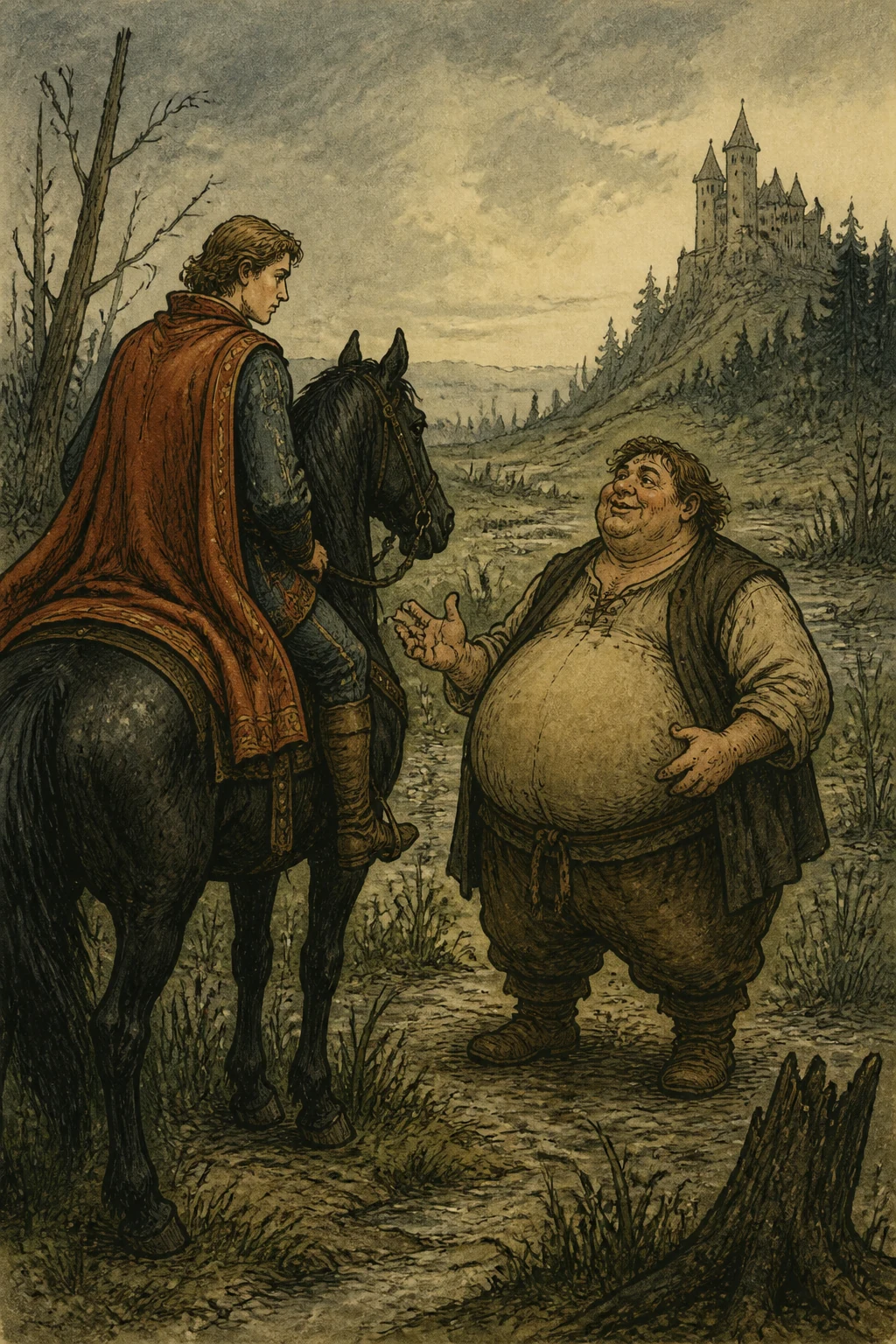
Once upon a time there was a father as rich as the sea; but since no one in this world can enjoy unmixed happiness, he had a son so witless and good-for-nothing that he could not tell carob pods from cucumbers. Unable to stomach his foolishness any longer, he gave him a good handful of crowns and sent him to trade in the Levant, knowing that seeing different countries and mixing with different people awakens the mind, sharpens the judgment, and makes a man quick-witted. Moscione, for that was the son’s name, mounted his horse and set off toward Venice, that arsenal of the wonders of the world, intending to embark on some vessel bound for Cairo. After a good day’s journey, he found a man standing at the foot of a poplar and said to him:
“What is your name, my young fellow? Where do you come from, and what is your trade?” The man answered, “My name is Furgolo; I come from Sajetta, and I can run like lightning.” “I should like to see proof of that,” replied Moscione. Furgolo said, “Wait a little, and you will soon see whether it is gunpowder or flour.” They waited a short while, and a doe appeared in the fields. Furgolo let her get well ahead, to give her the greater advantage, then began to run with such tremendous speed and so lightly that he could have crossed a field strewn with flour without leaving the print of his shoe. In four bounds he overtook her. Amazed at this, Moscione asked whether he would enter his service, promising to pay him handsomely. Furgolo agreed, and they set off together.
They had not gone another four miles when they met a second young man, whom Moscione asked, “What is your name, comrade? What country is yours, and what is your trade?” He answered, “My name is Aurecchia a lleparo; I come from Valle-curiosa. By putting my ear to the ground, without moving from the spot, I can hear everything that happens in the world: the monopolies and plots hatched by tradesmen to raise their prices, the dirty dealings of courtiers, the wicked counsels of procurers, lovers’ assignations, thieves’ conspiracies, servants’ complaints, spies’ reports, old women’s whisperings, and sailors’ curses. Neither Lucian’s cock nor Franco’s lamp ever saw as much as these ears of mine can see.” “If that is true,” replied Moscione,
“tell me what they are saying at my house.” The young man put his ear to the ground and said, “An old man is talking to his wife, saying, ‘Praise be to the blazing sun, I have got that Moscione out of my sight:
that old-fashioned yellow face, that nail driven into my heart! At least, by traveling about the world, he may make a man of himself and stop being such a brute of an ass, such a stunted fool and idler.’” “Enough, enough!” said Moscione. “You speak the truth, and I believe you. Come with me, then, for you have found your fortune.” “I will,” said the young man. So they went on together, and after traveling another ten miles they met another man. Moscione said to him, “What do they call you, my good fellow? Where were you born, and what can you do in this world?” He answered, “My name is Ceca-deritto; I come from Castiello Tira-justo, and I can shoot so precisely with a crossbow that I can hit a millet seed square in the middle.” “I should like to see proof of that,” replied Moscione. The man loaded his crossbow, took aim, and knocked a chickpea off a stone. At this, Moscione took him into his company like the others. After another day’s journey, he came upon some men building a handsome pier in the blazing sun. They might well have sung, “Parrella, put water in the wine, for my heart is burning!” He felt such pity for them that he said, “How, my good workmen, can you bear to stay in this limekiln? You could cook a buffalo’s afterbirth here!” One of them answered, “We are as cool as roses, for we have a young fellow blowing on our backs so that you would think the west wind was stirring.” Moscione said, “Let me see him, as you hope for God’s protection.” The mason called the young man, and Moscione said to him, “What do they call you, my fine fellow? What country do you come from, and what is your profession?” He answered, “My name is Sciosciariello; I come from Terra Ventosa, and with my mouth I can make every kind of wind. If you want zephyrs, I will send you into raptures; if you want squalls, I can knock down houses.”
“I will not believe it until I see it,” said Moscione. Sciosciariello first blew very gently, like the breeze that stirs at Posileco toward evening; then, turning suddenly toward some trees, he sent forth such a furious blast that he uprooted a whole row of oaks. Seeing this, Moscione took him for a companion. After traveling as far again, he met another young man and said, “What is your name, if you do not mind my asking? Where do you come from, if one may know? And what is your trade, if the question is permitted?” The man answered, “My name is Forte-schena; I come from Valentino, and I have such strength that I can sling a mountain on my back and find it light as a feather.” “If that is so,” said Moscione, “you deserve to be king of the customhouse, and they ought to choose you by public contest on the first of May. But I should like to see you put to the test.” Forte-schena began loading himself with blocks of stone, tree trunks, and so many other heavy things that a thousand great wagons could not have carried them. Seeing this, Moscione engaged him to join his company. Continuing their journey, they reached Bello-Sciore, where there was a king who had a daughter who ran like the wind and could have raced over flowering broccoli without bending the tops. He had issued a proclamation that whoever could overtake her in a race should have her for his wife, while whoever fell behind should have his head cut off.
When Moscione arrived in that country and heard this decree, he went to the king and offered to race his daughter. Having agreed to these pretty terms—either to make good use of his heels or leave his head behind—the next morning he sent word to the king that he had been seized by a catarrh and, being unable to run in person, would put another young man in his place. “Let whoever likes come,” answered Ciannetella, for that was the king’s daughter’s name. “I do not care a fig; there is enough for all of them.” The square was packed with people who had come to see the race: men swarmed like ants, and the windows and rooftops were full as eggs. Furgolo appeared and took his place at one end of the square, waiting for the show to begin. Then along came Ciannetella, her skirt tucked up to mid-calf, wearing dainty, close-fitting, single-soled shoes scarcely ten points long. They stood shoulder to shoulder, and at the tantara and toot-toot of the trumpet they began to run so fast that their heels struck their shoulders. You would have thought them hares pursued by greyhounds, horses broken loose from the stable, dogs with firecrackers tied to their tails, or asses with a goad behind them. But Furgolo, who lived up to his name, left her more than a hand’s breadth behind. When he reached the finish, what shouting and clamoring, what screeching and yelling and whistling, what clapping of hands and stamping of feet rose from the crowd! “Long live the stranger!” they cried. Ciannetella’s face turned as red as a schoolboy’s bottom after a birching, so ashamed and mortified was she to find herself beaten. But since the race had to be run twice, she resolved to avenge this affront. Going home, she immediately cast a spell upon a ring, so that anyone who wore it would find his legs giving way beneath him and be unable to walk, let alone run. She sent it as a gift to Furgolo, asking him to wear it for love of her. Aurecchia a lleparo, who heard this plot being hatched between the daughter and her father, kept quiet and waited to see how the affair would turn out. When, to the trumpeting of the birds, the sun drove Night away astride the ass of shadows, they returned to the field. At the customary signal they began to ply their heels; but while Ciannetella seemed another Atalanta, Furgolo had become a broken-down ass, a foundered horse, unable to move a step.
But Ceca-deritto saw his companion’s danger, and, having learned from Aurecchia a lleparo how the trick had been played, he seized his crossbow and shot a bolt straight at Furgolo’s finger, knocking out the stone in the ring where the power of the enchantment lay. At once his cramped legs loosened, and in four bounds like a roebuck’s he passed Ciannetella and won the prize. Seeing a ninny victorious, a dolt bearing the palm, and a flycatcher triumphant, the king gave much thought to whether he ought to give him his daughter. He consulted the wise men of his court, who answered that Ciannetella was no morsel for the teeth of a barefoot vagabond and idle bird, and that, without staining his honor as a breaker of promises, he could exchange the promised daughter for a gift of crowns, which would give this filthy beggar more satisfaction than all the women in the world. The king liked this advice and sent to ask Moscione how much money he would take instead of the wife he had been promised. Moscione consulted his companions and answered:
“I want as much gold and silver as one of my companions can carry on his back.” The king agreed, and Forte-schena was brought in. They began piling upon him chests full of great ducats, sacks of patacas, purses of crowns, barrels of copper coins, and cabinets of chains and rings. But the more they loaded him, the more firmly he stood, like a tower. At last the treasury, the banks, the bankrupts, and the money changers of the city could not supply enough. The king sent to all the gentlemen to borrow candlesticks, basins, pitchers, saucers, plates, trays, baskets, and even silver chamber pots. Still there was not enough to make up a proper load. At last, not so much weighed down as weary and sick of the business, they departed. But the counselors, seeing this boundless wealth being carried off by a handful of barefoot scoundrels, told the king it was great folly to let them take away all the sinews of his kingdom. He would do well to send men after them to lighten the burden of that Atlas who bore a whole heaven of treasure on his shoulders. The king yielded to this advice and immediately dispatched a band of armed men, on foot and on horseback, to overtake them. Aurecchia a lleparo heard this decision and warned his companions, while dust rose to the sky beneath the pounding heels of those who were coming to relieve them of their rich load. Seeing that matters were taking an ugly turn, Sciosciariello began to blow so hard that he not only flung all the enemy flat on their faces, but swept them more than a mile away, as the north winds do to travelers crossing those plains. And so, without further hindrance, Moscione reached his father’s house. There he divided the profits with his companions—for, as the saying goes, if someone helps you win a loaf, give him a slice—and sent them away happy and content. He remained with his father, rich beyond measure, an ass laden with gold, proving the truth of the saying, _God sends biscuits to those who have no teeth._
Izvirnik
_Moscione è mmannato da lo Patre a fare mercanzie a lo Cairo, pe smammarelo da lo Titto, dove era n’arcaseno, e ttrovanno pe la strata de passo ’n passo perzune vertolose, se le pporta cod’isso, pe mmiezo de li quale se ne torna a la casa carreco ’nfunno d’argiento, e d’oro._ _Non ce mancaro Cortesciane ’ntuorno a lo Prencepe, che averriano mostrato la collera de vederele toccato a lo bivo, si l’arte lloro non fosse stata a punto de semmolare: nè sapevano a dicere, se le dette cchiù a lo naso lo despietto de vederese jettato a facce la trafanaria lloro, o la ’nvidia de sentire la felicetate de Corvetto; ma ccommenzanno a pparlare Paola, tiraje fore da lo puzzo de la passione propria l’armo lloro co l’ancino de ste pparole._
Fu sempre laudato assaje cchiù no ’gnorante de la pratteca d’uommene vertoluse, che n’ommo sapio, pe la scommerzione de Gente da poco; perchè quanto pe ccausa de chisse pò guadagnare commodetate, e grannizze, tanto pe ccorpa de chille po scapetare de rrobba, ed onore, e si a la prova de lo spruoccolo se canosce lo presutto; a lo caso, che ve contarraggio, canosciarrite s’è bero chello, ch’io ve aggio propuosto.
Era na vota no Patre, ricco quanto a lo Maro; ma perchè non se pò avere felicetate sana a lo Munno, aveva no Figlio cossì sciaurato, e da poco, che non sapeva canoscere le scioscelle da le ccetrole: pe la quale cosa non potenno padiare cchiù le ’gnoranzie soje, datole na bona mano de scute, lo mannaje a fare mercanzie vierzo Levante, sapenno ca lo bedere varie paise, e lo ppratecare deverze gente, sceta lo ’ngiegno, affila lo jodizio, e fa l’ommo spierto. Moscione (che accossì se chiammava lo Figlio) puostose a ccavallo, commenzaje a cammenare a la vota de Venezia, Arzenale de le mmaraveglie de lo Munno, pe ’nvarcarese co quarche Vasciello, che ghiesse a lo Cairo, e cammenato na bona jornata, trovaje uno, che steva fitto a pede no chiuppo, a lo quale decette;
comme te chiamme, Giovene mio; de dove si? e che arte è la toja? e chillo respose; mme chiammo Furgolo; sò de Sajetta, e saccio correre comme a no lampo. Nne vorria vedere la prova, leprecaje Moscione; lo Furgolo disse: aspetta no poco, ca vide mo s’è pporvera, o farina. E stanno no pocorillo sospise, ecco na Cerva pe la campagna, e Furgolo lassannola passare no piezzo ’nnante, pe ddarele cchiù bantaggio, se mese a correre cossì spotestato, e ccossì llieggio de pede, che sarria juto pe coppa no semmenato de farina senza lassarence la forma de la scarpa; tanto che ’n quatto saute la jonze. Pe la quale cosa Moscione maravigliato le disse, si voleva stare cod’isso, ca l’averria pagato de musco; e Furgolo contentannose, s’abbiaro de compagnia:
ma non cammenaro quatt’autre miglia, che ttrovaro n’autro giovane, a lo quale Moscione disse: comme aje nomme, cammarata? che pajese è lo tujo? e che arte aje? e chillo respose; me chiammo Aurecchia a lleparo, so de Valle-curiosa, e mmettenno l’aurecchie ’n terra, senza partireme da no luoco, io sento quanto se fa pe lo munno, audenno li monepolie, e confarfe, che fanno l’artesciane pe auterare li priezze de le ccose, li male afficie de li Cortesciane, li triste consiglie de li roffiane, l’appontamiente de li ’nnammorate, li conzierte de li mariuole, e li lamiente de li serveture, li reportamiente de li spiune, li visse visse de le Becchie, le jastemme de li Marinare, che non tanto vedeva lo Gallo de Lociano, e la lucerna de lo Franco,
quanto vedono st’arecchie meje. S’è lo vero chesso, respose Moscione: dimme, che se dice a la casa mia; ed isso puosto l’arecchie ’n terra, decette: no viecchio parla co la mogliere, e dice: Sia laudato lo Sole lejone, ca m’aggio levato chillo Moscione da nanze a l’uocchie: chella facce de giarne a l’antica, chillo chiuovo de lo core mio, ch’a lo mmanco cammenanno sso munno, se farrà ommo, e non sarrà accossì aseno bestiale, vozzacchio, pierde jornata; no cchiù, no cchiù, disse Moscione, ca dice lo vero, e lo ccreo; perzò viene co mmico, ch’aje trovato la ventura toja. Vengo, disse lo Giovane, e cossì abbiannose ’nsiemme, cammenato diece autre miglie, trovaro n’autro a lo quale disse Moscione; comme te faje chiammare, ommo da bene mio? dove si
nnato? e che cosa saje fare a lo Munno? e chillo respose; mme chiammo Ceca-deritto, so de Castiello Tira-justo, e saccio ’nzertare accossì a ppilo co na valestra, che dò mmiezo a no milo sciuoccolo. Vorria vedere sta prova, leprecaje Moscione, e chillo carrecata la valestra, pigliato mira fece sautare no cecere da coppa na preta, pe la quale cosa Moscione se lo pigliaje comme l’autre pe ccompagnia soja; e ccammenato n’autra jornata, trovaje cierte che fravecavano no bello muolo a la calantrella de lo Sole, che potevano dire co rraggione, Parrella miette acqua a lo vino, ca m’arde lo core: de li quale appe tanta compassione, che le disse; e comme, o mastre mieje, avite capo de stare a sta carcara, dove se conciarria na seconna de Vufara; uno de li
quale respose; nuje stammo frische commo a na Rosa, perchè avimmo no Giovane, che ’nce scioscia da dereto de manera, che pare, che spirano li poniente; e Moscione disse, lassammelo vedere, se Dio te guarde; e lo fravecatore chiammato lo Giovane, Moscione le disse: comme te faje chiammare, previta de lo parente? de che tterra si? e che professione è la toja; e chillo respose: io mme chiammo Sciosciariello, so de Terra Ventosa, e ssaccio fare co la vocca tutte li viente; si vuoje Zefare, io te ne faccio ire nziecolo; si vuoje refole, io faccio cadere case; no lo ccreo si no lo beo, disse Moscione; e Sciosciariello sciosciaje ’mprimmo soave soave, che pareva lo viento, che spira a Posileco vierzo la sera, e botatose tutto a no tiempo a certe arvole, mannaje tanta
furia de viento, che sradecaje na fila de Cerze, la quale cosa vedenno Moscione, se lo pigliaje pe ccompagno; e cammenanno autro ttanto, trovaje n’autro Giovane, a lo quale disse; comme te chiamme, non te sia ’n commanno? de dove si, se pò sapere? e quale è l’arte toja, si è lleceta la dommanna? e chillo respose: mme chiammo Forte-schena, so de Valentino, ed aggio tale vertute, che mme schiaffo na Montagna ’n cuollo, e mme pare na penna. Si fosse chesto, disse Moscione, tu mmeritarisse essere lo Rrè de la doana, e sarrisse pigliato co lo palio lo primmo de Maggio; ma nne vorria vedere la sperienzia. E Forte-Schena commenzaje a carrecarese da scantune de prete, de trunche d’arvole, e de tante autre piseme, che no l’averriano portate mille
carrettune; lo che vedenno Moscione, l’accordaje a stare cod’isso; e cossì cammenanno arrivaro a Bello-Sciore, dov’era no Rrè, ch’aveva na Figlia la quale correva commo a lo viento, e averria curzeto pe ccoppa li vruoccole specate senza chiegare le cimme; ed aveva sprubecato no Banno, che chi l’avesse arrivata a correre ’nce l’averria data pe mmogliere; e chi fosse restato arreto, l’averria tagliato lo cuollo: arrivato Moscione a sta terra, e sentuto sto commannamiento, jette a lo Rrè, e s’offerze de correre co la Figlia; e fatto li belle patte, o de vattere le ccarcagna, o de ’nce lassare la catarozzola, la matina fece ’ntennere a lo Rrè, ca l’era schiaffato no descenzo, e non potenno correre mperzona, averria puosto a lluoco sujo n’autro Giovane. Venga
chi vole, respose Ciannetella (ch’era la Figlia de lo Rrè) ca non me se dà no lippolo, e pe tutte ’nce n’è. Accossì essenno la chiazza chiena de Gente, pe bedere la corzera, che l’uommene facevano comme a fformiche, e le ffenestre, e l’astreche erano chiene comme uovo, comparze Furgolo, lo quale se mese a lo capo de la chiazza, aspettanno le mmoppete, ed eccote venire Ciannetella co la gonnella accorciata pe ffi a mmeze gamme, e co na scarpetella a una sola, bella, ed attillata, che non passava diece punte, e puostose de spalla a spalla, e sentuto lo tarantara, e lo tù tù de la trommetta, se mesero a correre, che li tallune le toccavano le spalle; fa cunto, ca parevano liepare secutate da levriere, cavalle scapolate da la stalla, cane co le beffiche a la
coda, Asene co lo spruoccolo dereto, ma Furgolo, che n’aveva lo nomme, e li fatte, la lassaje cchiù de no parmo dereto, ed arrevanno nne lo termene, lloco te sentiste l’allucco, l’allajo, greciglio, le strille, li fische, lo sbattere de mano, e de piede de la Gente, dicenno: viva, viva lo forastiero; pe la quale cosa Ciannetella fece la facce comme a cculo de scolaro, ch’aggia avuta la spogliatura, restanno scornata, ed affrontata de vederese vinta. Ma perchè la corza s’aveva da provare doje vote, facette penziero de scontarese st’affrunto, e ghiutasenne a la casa, fece subeto no percanto a n’aniello, che chi lo teneva a lo dito se sconocchiasse le gamme, che non potesse cammenare, non solamente correre; e lo mannaje a donare a Furgolo, azzò lo portasse ’n
dito pe l’ammore sujo. Aurecchie a leparo, che sentette sta confarfa passata tra la Figlia, e lo Patre, stette zitto, e aspettaje l’eseto de lo negozio; e comme a lo ttrommettejare de l’Aucielle lo Sole frustaje la Notte ’ncoppa a l’Aseno de l’ombre, tornaro ’ncampo, e dato lo soleto signo, accommenzaro a ghiocare de tallune; ma non tanto Ciannetella pareva n’autra Attalanta, quanto Furgolo era deventato n’Aseno spallato, e no Cavallo repriso, che non poteva movere passo; ma Ceca-deritto, che bedde lo pericolo de lo compagno, e sentuto da Aurecchia a lleparo comme passava lo mbruoglio, dato de mano a la valestra, tiraje na parretta, coglienno justo a lo dito de Furgolo, facenno zompare la preta da l’aniello addove era la vertute de lo
’ncanto; pe la quale cosa se le sciouzero le ggamme ncordate, e ’n quatto saute de Crapio passaje Ciannetella, e benze lo Palio: lo Rrè vedenno la vettoria de no Paposcia, la Parma de no Vozzacchio, lo triunfo de no caccialappascere, fece gran penziere si dovevale dare, o no la Figlia; e ffatto conziglio co li sapute de la Corte soja, le fu respuosto, che Ciannetella non era voccone pe li diente de no Scauza Cane, e de n’Auciello pierde jornata; e che senza macchia de mancatore poteva commutare la prommessa de la Figlia a no donativo de Scute, che sarria stato cchiù sfazione de sto brutto Pezzentone, che ttutte le femmene de lo munno; piacquette a lo Rrè sto parere, e fece ntennere a Moscione, che denare volesse ’n cagno de la mogliere, che
l’era stata prommessa; ed isso conzegliatose co l’autre, responnette: Io voglio tanto oro, ed argiento, quanto nne pò portare ’ncuollo no compagno mio; e ccontentatose lo Rrè, fecero venire Forte-Schena, sopra lo quale accommenzaje a carrecare forza de bauglie de docatune, sacche de Patacche, vorzune de scute, varrile de monete de ramma, scrittorie de catene, ed anelle; ma quanto cchiù carrecavano, steva cchiù saudo comme na torre, tanto che non bastanno la tresoreria, li banche, li bancarotte, e li mercante de cammio de la Cetate, mannnaje pe ttutte li Cavaliere a cercare ’n priesto canneliere, vacile, voccale, sotta-coppe, piatte, guantere, canestre, pe fi a li cantarielle d’argiento; e mmanco vastattero pe ffare lo piso justo,
all’utemo non carreche, ma sazie, e sfastidiate, se partettero; ma li Conzigliere, che beddero sto sfonnerio, che se nne portavano quatto Scauza-cane, dissero a lo Rrè, che era na granne asenetate a ffarene carrejare tutto lo niervo de lo Regno sujo, e perzò farria bene a mmannarele Gente dereto ad allegerire tanto carreco de chillo Atlante, che portava ’ncoppa a le spalle no Cielo de tresore. Lo Rrè chiegatose a sto conziglio, spedette subbeto na mano de gente armate a pede, ed a cavallo, che l’arrivassero. Aurecchia a lleparo, che sentette sto conziglio, nne avisaje li compagne, mentre la polvere s’auzava a lo Cielo pe lo sbattere de le ccarcagna de chi veneva a scarrecare sta ricca sarma; Sciosciariello, che bedde la cosa male parata, commenzaje
a sciosciare de manera, che fece non sulo schiaffare de facce ’n terra tutte le gente nnemmiche, ma le mmannaje comme fanno li viente Settentrionale a chi vace pe chella campagna, cchiù de no miglio lontano; pe la quale cosa senza avere autro ’mpedemiento, arrivato a la Casa de lo patre, dove facenno parte a li compagne de lo guadagno (perchè se sole dicere: a chi te fa guadagnare lo tortano, e tu dalle l’asca) nne le mmannaje conzolate, e contiente; ed isso restaje co lo Patre ricco ’nfunno, e se vedde n’aseno carreco d’oro, non facenno bosciardo lo mutto, _Dio manna li vescotte a chi n’ha diente._