Prevod
_Moscione is sent by his father to trade in Cairo, to wean him from the breast, where he has grown into a great lump of a fellow. Meeting people with extraordinary gifts along the road, he takes them into his service, and through their help returns home laden to the brim with silver and gold._ _There were plenty of courtiers around the prince who would have shown their anger at being stung to the quick, had not their very profession been the art of dissembling. They could not have said whether they were more nettled by having their trickery flung in their faces or by envy at hearing of Corvetto’s good fortune. But when Paola began to speak, she drew their spirits out of the well of their private resentment with the hook of these words._ An ignorant man who keeps company with gifted men has always earned far greater praise than a wise man who associates with worthless people;
for just as the former may bring him comfort and greatness, so the latter may cost him his property and his good name. And if a ham is known by testing it with a skewer, the story I am about to tell you will show whether what I have said is true.
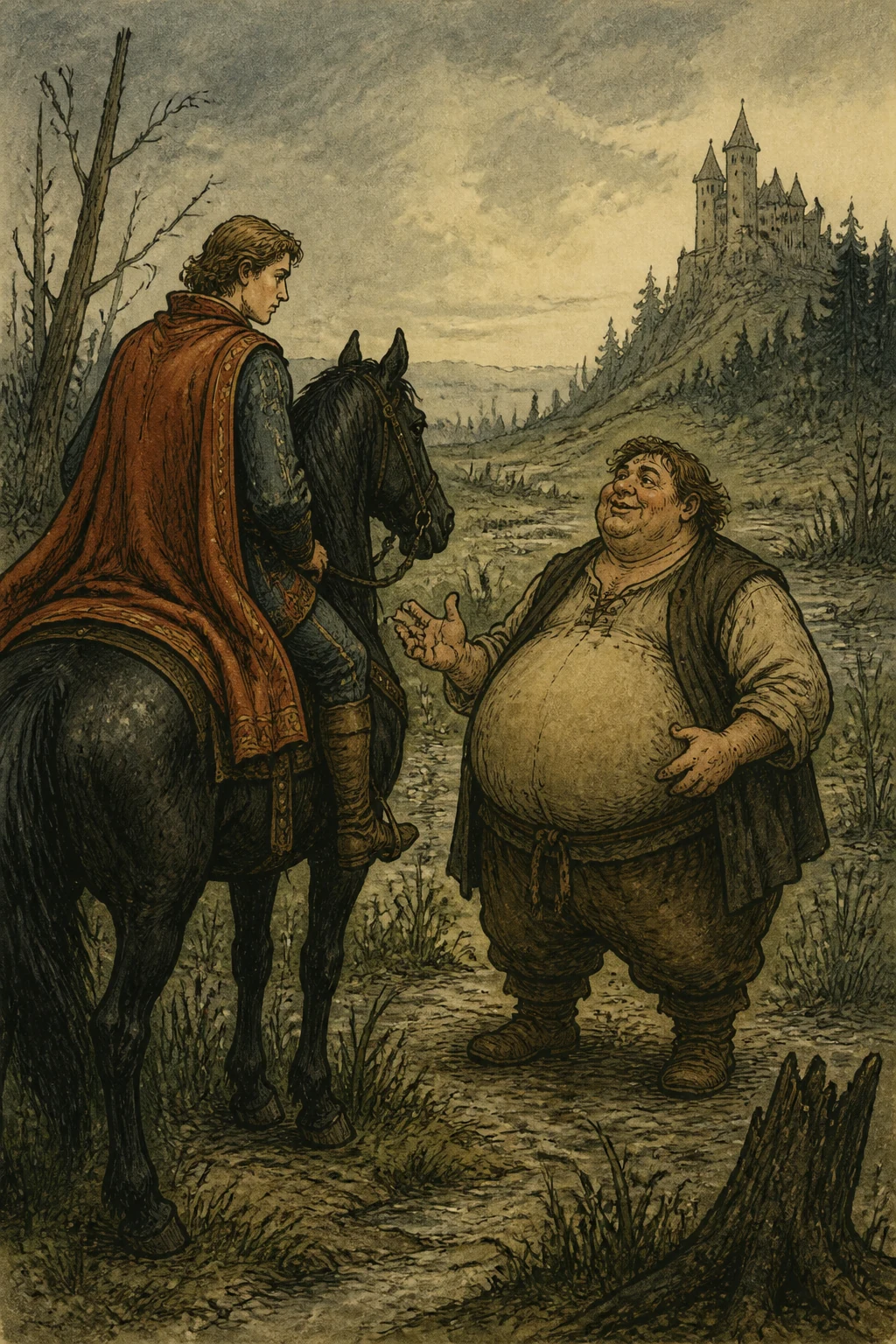
Once upon a time there was a father as rich as the sea; but since no one in this world can enjoy unmixed happiness, he had a son so witless and good-for-nothing that he could not tell carob pods from cucumbers. Unable to stomach his foolishness any longer, he gave him a good handful of crowns and sent him to trade in the Levant, knowing that seeing different countries and mixing with different people awakens the mind, sharpens the judgment, and makes a man quick-witted. Moscione, for that was the son’s name, mounted his horse and set off toward Venice, that arsenal of the wonders of the world, intending to embark on some vessel bound for Cairo. After a good day’s journey, he found a man standing at the foot of a poplar and said to him:
“What is your name, my young fellow? Where do you come from, and what is your trade?” The man answered, “My name is Furgolo; I come from Sajetta, and I can run like lightning.” “I should like to see proof of that,” replied Moscione. Furgolo said, “Wait a little, and you will soon see whether it is gunpowder or flour.” They waited a short while, and a doe appeared in the fields. Furgolo let her get well ahead, to give her the greater advantage, then began to run with such tremendous speed and so lightly that he could have crossed a field strewn with flour without leaving the print of his shoe. In four bounds he overtook her. Amazed at this, Moscione asked whether he would enter his service, promising to pay him handsomely. Furgolo agreed, and they set off together.
They had not gone another four miles when they met a second young man, whom Moscione asked, “What is your name, comrade? What country is yours, and what is your trade?” He answered, “My name is Aurecchia a lleparo; I come from Valle-curiosa. By putting my ear to the ground, without moving from the spot, I can hear everything that happens in the world: the monopolies and plots hatched by tradesmen to raise their prices, the dirty dealings of courtiers, the wicked counsels of procurers, lovers’ assignations, thieves’ conspiracies, servants’ complaints, spies’ reports, old women’s whisperings, and sailors’ curses. Neither Lucian’s cock nor Franco’s lamp ever saw as much as these ears of mine can see.” “If that is true,” replied Moscione,
“tell me what they are saying at my house.” The young man put his ear to the ground and said, “An old man is talking to his wife, saying, ‘Praise be to the blazing sun, I have got that Moscione out of my sight:
that old-fashioned yellow face, that nail driven into my heart! At least, by traveling about the world, he may make a man of himself and stop being such a brute of an ass, such a stunted fool and idler.’” “Enough, enough!” said Moscione. “You speak the truth, and I believe you. Come with me, then, for you have found your fortune.” “I will,” said the young man. So they went on together, and after traveling another ten miles they met another man. Moscione said to him, “What do they call you, my good fellow? Where were you born, and what can you do in this world?” He answered, “My name is Ceca-deritto; I come from Castiello Tira-justo, and I can shoot so precisely with a crossbow that I can hit a millet seed square in the middle.” “I should like to see proof of that,” replied Moscione. The man loaded his crossbow, took aim, and knocked a chickpea off a stone. At this, Moscione took him into his company like the others. After another day’s journey, he came upon some men building a handsome pier in the blazing sun. They might well have sung, “Parrella, put water in the wine, for my heart is burning!” He felt such pity for them that he said, “How, my good workmen, can you bear to stay in this limekiln? You could cook a buffalo’s afterbirth here!” One of them answered, “We are as cool as roses, for we have a young fellow blowing on our backs so that you would think the west wind was stirring.” Moscione said, “Let me see him, as you hope for God’s protection.” The mason called the young man, and Moscione said to him, “What do they call you, my fine fellow? What country do you come from, and what is your profession?” He answered, “My name is Sciosciariello; I come from Terra Ventosa, and with my mouth I can make every kind of wind. If you want zephyrs, I will send you into raptures; if you want squalls, I can knock down houses.”
“I will not believe it until I see it,” said Moscione. Sciosciariello first blew very gently, like the breeze that stirs at Posileco toward evening; then, turning suddenly toward some trees, he sent forth such a furious blast that he uprooted a whole row of oaks. Seeing this, Moscione took him for a companion. After traveling as far again, he met another young man and said, “What is your name, if you do not mind my asking? Where do you come from, if one may know? And what is your trade, if the question is permitted?” The man answered, “My name is Forte-schena; I come from Valentino, and I have such strength that I can sling a mountain on my back and find it light as a feather.” “If that is so,” said Moscione, “you deserve to be king of the customhouse, and they ought to choose you by public contest on the first of May. But I should like to see you put to the test.” Forte-schena began loading himself with blocks of stone, tree trunks, and so many other heavy things that a thousand great wagons could not have carried them. Seeing this, Moscione engaged him to join his company. Continuing their journey, they reached Bello-Sciore, where there was a king who had a daughter who ran like the wind and could have raced over flowering broccoli without bending the tops. He had issued a proclamation that whoever could overtake her in a race should have her for his wife, while whoever fell behind should have his head cut off.
When Moscione arrived in that country and heard this decree, he went to the king and offered to race his daughter. Having agreed to these pretty terms—either to make good use of his heels or leave his head behind—the next morning he sent word to the king that he had been seized by a catarrh and, being unable to run in person, would put another young man in his place. “Let whoever likes come,” answered Ciannetella, for that was the king’s daughter’s name. “I do not care a fig; there is enough for all of them.” The square was packed with people who had come to see the race: men swarmed like ants, and the windows and rooftops were full as eggs. Furgolo appeared and took his place at one end of the square, waiting for the show to begin. Then along came Ciannetella, her skirt tucked up to mid-calf, wearing dainty, close-fitting, single-soled shoes scarcely ten points long. They stood shoulder to shoulder, and at the tantara and toot-toot of the trumpet they began to run so fast that their heels struck their shoulders. You would have thought them hares pursued by greyhounds, horses broken loose from the stable, dogs with firecrackers tied to their tails, or asses with a goad behind them. But Furgolo, who lived up to his name, left her more than a hand’s breadth behind. When he reached the finish, what shouting and clamoring, what screeching and yelling and whistling, what clapping of hands and stamping of feet rose from the crowd! “Long live the stranger!” they cried. Ciannetella’s face turned as red as a schoolboy’s bottom after a birching, so ashamed and mortified was she to find herself beaten. But since the race had to be run twice, she resolved to avenge this affront. Going home, she immediately cast a spell upon a ring, so that anyone who wore it would find his legs giving way beneath him and be unable to walk, let alone run. She sent it as a gift to Furgolo, asking him to wear it for love of her. Aurecchia a lleparo, who heard this plot being hatched between the daughter and her father, kept quiet and waited to see how the affair would turn out. When, to the trumpeting of the birds, the sun drove Night away astride the ass of shadows, they returned to the field. At the customary signal they began to ply their heels; but while Ciannetella seemed another Atalanta, Furgolo had become a broken-down ass, a foundered horse, unable to move a step.
But Ceca-deritto saw his companion’s danger, and, having learned from Aurecchia a lleparo how the trick had been played, he seized his crossbow and shot a bolt straight at Furgolo’s finger, knocking out the stone in the ring where the power of the enchantment lay. At once his cramped legs loosened, and in four bounds like a roebuck’s he passed Ciannetella and won the prize. Seeing a ninny victorious, a dolt bearing the palm, and a flycatcher triumphant, the king gave much thought to whether he ought to give him his daughter. He consulted the wise men of his court, who answered that Ciannetella was no morsel for the teeth of a barefoot vagabond and idle bird, and that, without staining his honor as a breaker of promises, he could exchange the promised daughter for a gift of crowns, which would give this filthy beggar more satisfaction than all the women in the world. The king liked this advice and sent to ask Moscione how much money he would take instead of the wife he had been promised. Moscione consulted his companions and answered:
“I want as much gold and silver as one of my companions can carry on his back.” The king agreed, and Forte-schena was brought in. They began piling upon him chests full of great ducats, sacks of patacas, purses of crowns, barrels of copper coins, and cabinets of chains and rings. But the more they loaded him, the more firmly he stood, like a tower. At last the treasury, the banks, the bankrupts, and the money changers of the city could not supply enough. The king sent to all the gentlemen to borrow candlesticks, basins, pitchers, saucers, plates, trays, baskets, and even silver chamber pots. Still there was not enough to make up a proper load. At last, not so much weighed down as weary and sick of the business, they departed. But the counselors, seeing this boundless wealth being carried off by a handful of barefoot scoundrels, told the king it was great folly to let them take away all the sinews of his kingdom. He would do well to send men after them to lighten the burden of that Atlas who bore a whole heaven of treasure on his shoulders. The king yielded to this advice and immediately dispatched a band of armed men, on foot and on horseback, to overtake them. Aurecchia a lleparo heard this decision and warned his companions, while dust rose to the sky beneath the pounding heels of those who were coming to relieve them of their rich load. Seeing that matters were taking an ugly turn, Sciosciariello began to blow so hard that he not only flung all the enemy flat on their faces, but swept them more than a mile away, as the north winds do to travelers crossing those plains. And so, without further hindrance, Moscione reached his father’s house. There he divided the profits with his companions—for, as the saying goes, if someone helps you win a loaf, give him a slice—and sent them away happy and content. He remained with his father, rich beyond measure, an ass laden with gold, proving the truth of the saying, _God sends biscuits to those who have no teeth._