Waltey
Kraljeva otroka
Grimmove pravljice · Jacob in Wilhelm GrimmO besedilu
Kraljeva otroka
- Vir
- Grimmove pravljice
- Avtor
- Jacob in Wilhelm Grimm
- Jezik branja
- English
- Jezik izvirnika
- Deutsch
- Čas branja
- 15 min branja
- Obseg
- 12 strani
- Naslov izvirnika
- Die beiden Königskinder
O izvirniku
Grimmove pravljice
Gozdovi, čarobni predmeti in ljudska logika evropske pripovedne tradicije. Bralni jezik je English, izvirnik pa prihaja iz vira Grimmove pravljice v jeziku Deutsch.
Besedilo
Kraljeva otroka
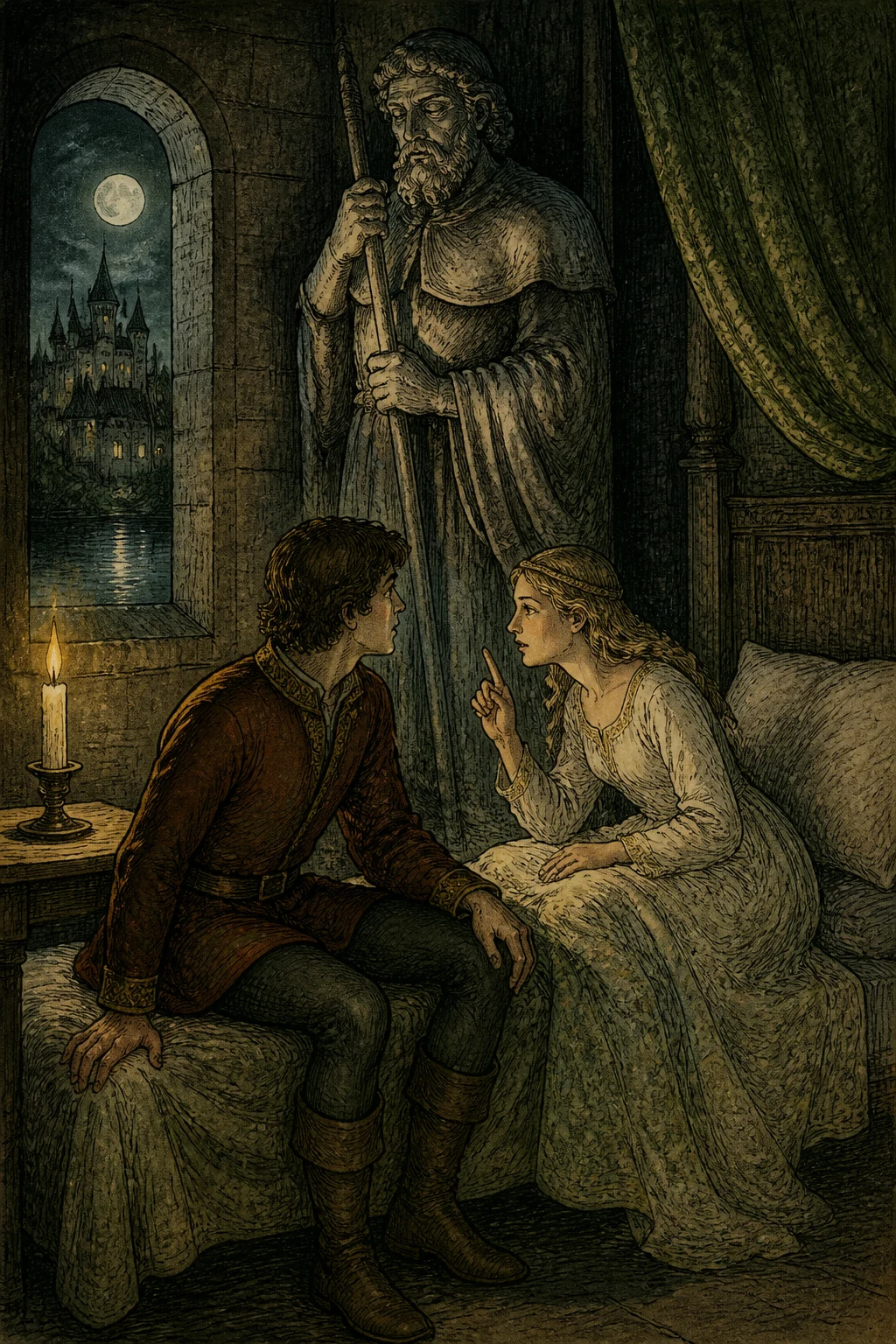
Once upon a time there was a king who had a little son, and it had been foretold in the stars that the boy would be killed by a stag when he was sixteen years old. When he had grown to that age, the huntsmen took him out hunting one day. But in the forest the prince became separated from the others, and suddenly he saw a great stag. He tried to shoot it, but could not hit it. At last the stag had led him on so far that he came right out of the forest. Suddenly, instead of the stag, a great tall man stood before him and said, "Well, I'm glad I've got you at last! I've worn out six pairs of glass skates chasing after you, and never managed to catch you." He took the prince with him and dragged him through a great stretch of water to a magnificent royal castle. There the prince had to sit down at the table and eat something. When they had eaten together, the king said, "I have three daughters. You must keep watch for one night beside the eldest, from nine in the evening until six in the morning. Whenever the clock strikes, I shall come myself and call out, and if you give me no answer, you will be put to death tomorrow. But if you do answer me, you shall have her for your wife." When the young people entered the bedchamber, they found a stone statue of Saint Christopher standing there. The princess said to it, "My father will come at nine, and every hour after that until the clock strikes three. When he calls, answer him in the prince's place." The stone Saint Christopher nodded his head very quickly, then more and more slowly, until at last he stood still again. The next morning the king said to the prince, "You have done well, but I cannot give up my daughter. You must keep watch beside my second daughter for another night, and then I will consider once more whether you may have my eldest daughter for your wife. But I shall come myself every hour, and when I call you, answer me. If I call and you do not answer, your blood shall be shed at my command." Then the two went to the bedchamber, where an even larger stone Saint Christopher stood. The princess said to it, "When my father calls, you must answer." The great stone Saint Christopher nodded his head quickly, then more and more slowly, until at last he stood still again. And the prince lay down on the threshold, put his hand beneath his head, and fell asleep. The next morning the king said to him, "You have done well, but I still cannot give you my daughter. You must keep watch beside the youngest princess for one more night. Then I will consider whether you may have my second daughter for your wife. But I shall come myself every hour, and if I call and you do not answer, your blood shall be shed at my command." Then they went together to her bedchamber. Inside stood a still bigger and taller Saint Christopher. The princess said to it, "When my father calls, you must answer!" The great tall stone Saint Christopher nodded his head for a good half hour before he stood still again. Then the prince lay down on the threshold and fell asleep.
The next morning the king said, "You have kept watch well, but I still cannot give you my daughter. I have a great forest, and you must cut it down for me between six this morning and six this evening. Then I will consider the matter." For this task he gave him a glass axe, a glass wedge, and a glass woodman's mallet. When the prince reached the wood, he struck once with the axe, and it broke in two. Then he took the wedge and struck it once with the mallet, and it was shattered into little pieces like pebbles. This distressed him greatly, for he thought he would now have to die, and he sat down and wept. At noon the king said, "One of you girls must take him something to eat." "No," said the two eldest, "we shan't take him anything. The one he kept watch beside last night can take him something." So the youngest had to go and bring him some food. When she came to the forest, she asked how he was faring. Very badly, he said. Then she told him to come and eat a little. No, he said, he could not, for he would have to die all the same, and so he no longer wished to eat. She coaxed him kindly to try a little, and at last he came and ate some. When he had eaten a little, she said, "To take your mind off your troubles, I'll stroke your head for a while." She stroked his head, and he grew drowsy and fell asleep. Then she took her handkerchief, tied a knot in it, struck it three times upon the ground, and said, "Workers, come out!" At once a great many little earth-men appeared and asked for the princess's orders.
She said, "Within three hours the great forest must be felled and the wood piled in stacks!" The little earth-men went about summoning all their kin to help them with the work. They began at once, and when the three hours were up, they had finished. Then they came back to the princess and told her so. The girl took her white handkerchief and said, "Workers, go home!" And at once they all vanished again.
When the prince awoke, he was glad at heart, but she said to him, "When the clock has struck six, come back home!" He did as she said, and the king asked, "Have you cut down the forest?" "Yes," said the prince. And as they sat at table, the king said, "I still cannot give you my daughter for your wife. You must do something more for her." The prince asked what it was. "I have a great pond," said the king. "Tomorrow you must go and clear out the mud until it is as bright as a mirror, and there must be all kinds of fish in it as well." The next morning the king gave him a glass spade and said, "The pond must be finished by six o'clock." So he went away, and when he reached the pond, he thrust the spade into the mire, and it snapped. He struck into it with the mattock, and that shattered too. Once more he was deeply distressed. At noon the princess brought him his food and asked how he was faring. The prince said he was faring very badly indeed, and would surely lose his head. Oh, she said, he need only come and eat something to take his mind off his troubles. No, he said, he could not eat; he was far too sad. But once more she coaxed him kindly until he came to her and ate a little. Then she stroked his head again, and he fell asleep. She took her handkerchief, tied a knot in it, tapped the ground three times with it, and said, "Workers, come out!" At once a great many little earth-men appeared, and all asked what she wished. She told them. Then the little earth-men went and summoned their kin to help them, and within two hours everything was finished. They returned to the princess and said, "We have done as you commanded." Then the princess took the handkerchief, struck the ground three times again, and said, "Workers, go home!" And they all went away again.
When the prince awoke, the pond was finished. Now the princess went away too, telling him to come home at six. When he returned, the king asked him, "Have you finished the pond?" "Yes," said the prince. As they sat at table, the king remarked, "You have indeed finished the pond, but I still cannot give you my daughter, for you must first do one more thing." "What is that?" asked the prince. The king said he also had a great mountain covered in thorn bushes, which must all be cut down. And on its summit the prince must build a great castle, as beautiful as anyone could possibly imagine, with all its furnishings and everything else that belonged in a castle.
When he rose the next morning, the king gave him a glass axe and a glass auger to take with him. He must be finished by six o'clock, the king said. When he struck the first thorn bush with the axe, it shattered into pieces that flew all around him; the auger broke in two as well. Once more he was deeply distressed, and waited for his beloved, hoping she would come and help him out of his plight. Towards noon she did come, bringing him something to eat. He went to meet her, told her everything, and ate a little; then he let her stroke his head and fell asleep again.
Then she took the knotted handkerchief once more, struck it upon the ground, and said, "Workers, come out!" Again a great many little earth-men appeared and asked what she wished. She said, "Within three hours you must cut down all the thorn bushes, and on top of the mountain there must stand a castle more beautiful than any other in the world." The little earth-men went and summoned their kin to help them. When the time was up, everything was finished. Then they came to the princess and told her so. The princess took her handkerchief, struck the ground three times with it, and said, "Workers, go home!" At once they all vanished again, and when the prince awoke and saw everything, he was as happy as a bird in the air.
When the clock had struck six, they went home together, and the king asked, "Is the castle finished too?" "Yes," said the prince. As they sat at table, the king said, "I cannot give up my youngest daughter until the two elder ones are married." The prince and the princess were very unhappy at this, and the prince no longer knew what to do. So when night came, he ran away with the princess. They had been gone for some time when the princess looked back and saw her father behind them. "Oh," she said, "what shall we do? My father is following us and means to catch us. I will turn you into a thorn bush and myself into a rose. I shall surely be safe in the middle of the bush." When her father reached the spot, there stood a thorn bush with a rose in its midst. He tried to pluck the rose, but the thorns pricked his fingers, so that he had to go home again. His wife asked why he had not brought them back. He said he had seen only a thorn bush and a rose. Then the queen said, "If only you had plucked the rose, the bush would have come along too." So the king set out again to fetch the rose. But the two were already far away across the fields, and the king kept running after them. Then the daughter looked back again and caught sight of her father. She said, "Oh, what shall we do now? I will turn you into a church and myself into a pastor. I shall stand in the pulpit and preach." When the king reached the spot, there stood a church, with a pastor in the pulpit preaching. The king listened to the sermon, then went home and told his wife everything. "You should have brought the pastor," his wife said. "The church would have followed of its own accord. What is the use of sending you! I suppose I shall have to go myself."
When she had been on her way for a while and could see the two in the distance, the princess looked back, saw her mother coming, and said, "Oh dear, now my mother herself is coming. I will turn you into a pond and myself into a fish." When the mother reached the spot, there was a great pond, and in the middle a fish was leaping about, poking its head out of the water and making merry. This made her so angry that she drank up the whole pond, hoping to catch the fish after all. But it made her so ill that she had to spew all the water out again. And she said, "I can see there is nothing more to be done here!" Then the queen gave her daughter three walnuts and said, "These will bring you help in your hour of greatest need." With that the young people went on their way together. They had been walking for some ten hours when they reached the castle where the prince came from, with a village nearby. When they arrived there, the prince said, "Stay here, my beloved. I will go to the castle first, then come back with a carriage and servants to fetch you." When he entered the castle, everyone was overjoyed to have the prince home again. He told them that he had a bride who was waiting in the village, and that they must drive there in the carriage and fetch her. They harnessed the horses at once, and many servants climbed into the carriage. But just as the prince was about to get in, his mother gave him a kiss that made him forget everything that had happened, and everything he had intended to do. Then his mother ordered the horses to be unharnessed, and they all went back into the castle. Meanwhile the girl sat in the village, waiting and waiting, thinking he would come to fetch her, but no one came. So the princess took service at the mill, which belonged to the castle. Every afternoon she had to sit beside the water and scrub vessels. One day the queen came down from the castle to walk by the water. She saw the lovely girl sitting there and said, "What a lovely girl! I like her very much!" Then they all looked at her, but not a soul recognized her.
A long time passed, and the girl served the miller faithfully and well. Meanwhile the queen had sought out a wife for her son, a lady who came from very far away. When the bride arrived, they were to be married at once. So many people flocked to see it all that the girl too asked the miller for leave to go to church. "Go along," said the miller. But before she left, she opened one of the three walnuts, and inside lay a beautiful dress. She put it on and went to church, standing very near the altar. Presently the bride and bridegroom arrived and took their places before the altar. But just as the pastor was about to bless them, the bride glanced aside and saw the girl. She stood up at once and said she would not return to be married until she had a dress as beautiful as the lady's. So they went home again and sent to ask the lady whether she would sell her dress. No, she would not sell it, but the bride could certainly earn it. They asked the girl what she meant by that. She said that if she were allowed to sleep outside the prince's door that night, the bride was welcome to the dress. And the bride agreed! So the servants had to prepare a sleeping draught for the prince, and the girl lay down outside his door and wept, telling him all night long how she had had the whole forest felled for him, the pond cleared of mud, and the castle built. Then she had turned him into a thorn bush, next into a church, and last into a pond; yet he had forgotten her so quickly. But the prince heard none of it. Only the servants had been woken by her cries and heard everything, though they did not know what it meant.
The next morning, when they had risen, the bride put on the dress and drove to church with the bridegroom. Meanwhile the girl opened the second walnut, and inside lay an even more beautiful dress. She put it on, went to church, and sat close to the altar. Everything happened just as it had before: the girl lay down outside the door of the prince's chamber, and his servants were again supposed to give him a sleeping draught. This time, however, there was no sleeping potion in the prince's drink, and he lay awake in bed. The miller's maid wept again and told him all she had done. The prince heard everything and was deeply grieved, and suddenly all that had happened in the past came back to him. He wanted to go to her, but his mother had locked the door. The next morning, however, he went straight to his beloved and told her all that had befallen him, begging her not to be angry that he had forgotten her for so long. Then the princess opened the third walnut, and inside was the most beautiful dress anyone could possibly imagine. She put it on and drove to church with the bridegroom. Many children came and gave them flowers and laid bright ribbons at their feet, and they received the marriage blessing and celebrated a merry wedding. But the false-hearted mother and the other bride had to go away. And whoever told this tale last still has a warm mouth.
Izvirnik
Die beiden Königskinder
Naslednje strani prikazujejo izvirno besedilo za primerjavo.
Ein Märchen der Brüder Grimm
Es war einmal ein König, der hatte einen kleinen Jungen bekommen, in dessen Sternbild hatte gestanden, er würde von einem Hirsch umgebracht werden, wenn er sechzehn Jahre alt wäre. Als er nun so herangewachsen war, da gingen die Jäger einmal mit ihm auf die Jagd. Doch im Wald kam der Königssohn von den anderen weg, und sah auf einmal einen großen Hirsch, den wollte er schießen, konnte ihn aber nicht treffen. Zuletzt war der Hirsch so lange vor ihm hergelaufen, bis er ganz aus dem Wald hinausgekommen war. Auf einmal stand vor ihm ein großer langer Mann statt des Hirsches, der sagte zu ihm: "Nun, das ist gut, daß ich dich habe; ich habe schon sechs Paar gläserne Schlittschuhe hinter dir kaputtgejagt und habe dich nicht kriegen können." Er nahm ihn mit sich und schleppte ihn durch ein großes Wasser vor ein großes Königsschloß. Da mußte er sich mit an den Tisch setzen und etwas essen. Als sie zusammen gegessen hatten, sagte der König: "Ich habe drei Töchter, bei der ältesten mußt du eine Nacht wachen, von des abends neun Uhr bis morgens um sechs, und ich komme jedesmal, wenn die Glocke schlägt, selber und rufe, und wenn du mir dann keine Antwort gibst, so wirst du morgen umgebracht; wenn du mir aber eine Antwort gibst, so sollst du sie zur Frau haben." Als die jungen Leute in die Schlafkammer kamen, da stand dort ein steinerner Christoph. Da sagte die Königstochter zu ihm: "Um neun Uhr kommt mein Vater, alle Stunden, bis es drei schlägt; wenn er fragt, so gebt ihr ihm Antwort statt des Königssohnes." Da nickte der steinerne Christoph mit dem Kopf ganz geschwind, dann immer langsamer, bis er zuletzt wieder stillstand. Am andern Morgen, da sagte der König zu ihm: "Du hast deine Sache gut gemacht, aber meine Tochter kann ich nicht hergeben, du müßtest noch eine Nacht bei der zweiten Tochter wachen, dann will ich noch einmal darüber nachdenken, ob du meine älteste Tochter zur Frau haben kannst. Aber ich komme alle Stunde selber, und wenn ich dich rufe, so antworte mir, und wenn ich dich rufe und du antwortest nicht, so soll dein Blut für mich fließen." Und dann gingen beide zur Schlafkammer, da stand noch ein größerer steinerner Christoph, zu dem die Königstochter sagte: "Wenn mein Vater fragt, so antworte du." Da nickte der große steinerne Christoph geschwind mit dem Kopf, dann immer langsamer, bis er zuletzt wieder stillstand. Und der Königssohn legte sich auf die Türschwelle, legte die Hand unter den Kopf und schlief ein. Am andern Morgen sagte der König zu ihm: "Du hast deine Sache gut gemacht, aber meine Tochter kann ich dir immer noch nicht geben. Du mußt auch bei der jüngsten Königstochter noch eine Nacht wachen. Und ich werde bedenken, ob du meine zweite Tochter zur Frau haben kannst, ich komme aber alle Stunden selbst; und wenn ich dich rufe, und du antwortest nicht, soll dein Blut für mich fließen." Dann gingen sie zusammen auf ihre Schlafkammer. Da war ein noch größerer und längerer Christoph darin. Die Königstochter sagte zu ihm: "Wenn mein Vater ruft, so antworte du!" Der große, lange, steinerne Christoph nickte wohl eine halbe Stunde lang mit dem Kopf, bis er dann wieder stillstand. Der Königssohn legte sich darauf auf die Türschwelle und schlief ein.
Am andern Morgen sagte der König: "Du hast gut gewacht, aber meine Tochter kann ich dir noch nicht geben. Ich habe da einen großen Wald, den du mir von heute morgen sechs bis abends sechs abholzen mußt; dann werde ich mir die Sache bedenken." Und er gab ihm eine gläserne Axt, einen gläsernen Keil und eine gläserne Holzhacke dafür. Wie er nun ins Holz gekommen war, hackte er einmal mit der Axt, da war sie entzwei; dann nahm er den Keil und schlug einmal mit der Holzhacke darauf, da war dieser so kurz und so klein wie ein Stein. Das betrübte ihn sehr, weil er glaubte, nun sterben zu müssen, und er setzte sich hin und weinte. Als es Mittag geworden war, da sagte der König: "Eine von euch Mädchen muß ihm etwas zu essen bringen." - "Nein," sagten die beiden älstesten, "wir wollen ihm nichts bringen. Die, bei der er die letzte Nacht gewacht hat, die kann ihm auch etwas bringen." Nun mußte die jüngste weg, und ihm etwas zu essen bringen. Wie sie in den Wald kam, fragte sie ihn, wie es ihm gehe? Es gehe ihm schlecht, sagte er. Da sagte sie, er solle herkommen und ein wenig essen. Nein, sagte er, das könne er nicht, denn er müsse ja doch sterben, und wolle deshalb nicht mehr essen. Sie gab ihm viele gute Worte, er möge doch einmal versuchen. Endlich kam er und aß davon. Als er ein wenig gegessen hatte, sagte sie: "Damit du auf andere Gedanken kommst, will ich dich erst ein bißchen kraulen." Sie kraulte ihn, und dabei wurde er müde und schlief ein. Da nahm sie ihr Tuch, band einen Knoten hinein, schlug es dreimal auf die Erde und sagte: "Arbeiter, heraus!" Da kamen sogleich viele, viele Erdmännchen hervor und fragten nach den Befehlen der Königstochter.
Sie sagte: "In der Zeit von drei Stunden muß der große Wald abgehauen und das Holz in Stapeln aufgesetzt sein!" Und da gingen die Erdmännchen herum und boten ihre ganze Verwandschaft auf, daß sie ihnen bei der Arbeit helfen sollten. Sie fingen gleich an, und als die drei Stunden um waren, hatten sie die Arbeit erledigt. Da kamen sie wieder zur Königstochter und sagten es ihr. Das Mädchen nahm ihr weißes Tuch und sagte: "Arbeiter, nach Hause!" Und da sind alle gleich wieder weggewesen.
Als der Königssohn aufwachte, da war er von Herzen froh; sie aber sagte zu ihm: "Wenn es nach sechs geschlagen hat, dann komm zurück nach Haus!" Das befolgte er, und der König fragte: "Hast du den Wald ab?" -"Ja," sagte der Königssohn. Und als sie bei Tisch saßen, sagte der König: "Noch kann ich dir meine Tochter nicht zur Frau geben, du mußt noch etwas für sie tun." Der Königssohn fragte, was es denn sei. "Ich habe einen großen Teich," sagte der König, "da mußt du morgen hin und mußt ihn ausschlämmen, daß er so blank ist wie ein Spiegel, und es müssen noch allerhand Fische darin sein." Am anderen Morgen gab ihm der König eine gläserne Schippe und sagte: "Um sechs Uhr muß der Teich fertig sein." Da ging er fort, und als er zu dem Teich gekommen war, da steckte er die Schippe in den Sumpf, und sie brach ab. Er stach mit der Hacke hinein, und sie zersprang. Da wurde er wieder ganz betrübt. Am Mittag brachte ihm die Tochter das Essen, und fragte ihn, wie es ihm gehe. Da sagte der Königssohn, es gehe ihm ganz schlecht, und er würde wohl seinen Kopf verlieren. Oh, sagte sie, er solle nur kommen und etwas essen, um wieder auf andere Gedanken zu kommen. Nein, sagte er, essen könne er nicht, dazu sei er viel zu traurig. Aber sie redete ihm wieder gut zu, bis er zu ihr kam und etwas aß. Da kraulte sie ihn wieder, und er schlief ein. Dann nahm sie ihr Tuch, knüpfte einen Knoten hinein und klopfte damit dreimal auf die Erde und sagte: "Arbeiter, heraus!" Da kamen gleich so viele, viele Erdmännchen und alle fragten nach ihrem Begehren. Sie sagte es ihnen. Da gingen die Erdmännchen hin und boten ihre Verwandtschaft auf, daß sie ihnen helfen sollte. Und in zwei Stunden war alles fertig. Sie kehrten zur Königstochter zurück und sagten: "Wir taten, was du uns befohlen hast." Da nahm die Königstochter das Tuch und schlug wieder dreimal auf die Erde und sagte: "Arbeiter, nach Hause!" Da gingen alle wieder weg.
Wie nun der Königssohn wieder aufwachte, war der Teich fertig. Jetzt ging auch die Königstochter weg und sagte, wenn es sechs wäre, sollte er nach Hause kommen. Als er nach Hause kam, da fragte ihn der König: "Hast du den Teich fertig?" - "Ja," sagte der Königssohn. Als sie bei Tische saßen, meinte der König: "Du hast den Teich zwar fertig, aber meine Tochter kann ich dir noch nicht geben, denn du mußt erst noch etwas tun." - "Was denn?" fragte der Königssohn. Er hätte noch einen großen Berg, sagte der König, da wären viele Dornbüsche drauf, die alle abgehauen werden müßten. Und oben auf dem Gipfel müßte er ein großes Schloß bauen, das so schön sein müßte, als es sich nur ein Mensch denken könnte, und alles Hausgerät und was sonst noch in ein Schloß gehört, sollte drinnen sein.
Als er am andern Morgen aufstand, gab ihm der König eine gläserne Axt und einen Bohrer aus Glas mit. Um sechs Uhr, sagte der König, müßte er damit fertig sein. Als er den ersten Dornbusch mit der Axt anhieb, ging sie kurz und klein, daß die Stücke um ihn herumflogen; auch der Bohrer ging entzwei. Da war er wieder ganz betrübt und wartete auf seine Liebste, ob sie nicht käme und ihm aus der Not helfen würde. Gegen Mittag kam sie auch und brachte ihm etwas zu essen. Da ging er ihr entgegen und erzählte ihr alles und aß etwas; dann ließ er sich von ihr kraulen und schlief wieder ein.
Da nahm sie wieder den Knoten, schlug damit auf die Erde und sagte: "Arbeiter, heraus!" Und wieder kamen viele Erdmännchen und fragten, was sie begehre? Sie sagte: "In der Zeit von drei Stunden müßt ihr alle Dornbüsche abholzen, und oben auf dem Berge, da muß ein Schloß stehen, das muß so schön sein, wie es kein anderes mehr gibt." Die Erdmännchen gingen nun hin und boten ihre Verwandtschaft auf, daß sie helfen sollte. Als die Zeit um war, da war auch alles fertig. Da kamen sie zur Königstochter und sagten es ihr. Und die Königstochter nahm das Tuch, schlug damit dreimal auf die Erde und sagte: "Arbeiter, nach Hause!" Da sind alle gleich wieder weggewesen, und als der Königssohn aufwachte und alles sah, war er so froh wie ein Vogel in der Luft.
Als es nun sechs geschlagen hatte, da gingen sie zusammen nach Hause, und der König fragte: "Ist das Schloß auch fertig?" - "Ja," sagte der Königssohn. Als sie nun bei Tische saßen, sagte der König: "Meine jüngste Tochter kann ich nicht eher hergeben, als bis die beiden älteren gefreit haben." Da waren der Königssohn und die Königstochter sehr betrübt, und der Königssohn wußte sich nicht mehr zu helfen. Und als die Nacht gekommen war, lief er mit der Königstochter davon. Als sie schon eine Weile fort waren, da schaute sich die Königstochter einmal um und sah ihren Vater hinter sich. "Oh," sagte sie, "was sollen wir machen? Mein Vater ist hinter uns und will uns einholen. Ich werde dich in einen Dornbusch verwandeln und mich in eine Rose. Und mitten im Busch werde ich wohl sicher sein." Als der Vater an die Stelle kam, stand dort ein Dornbusch und mittendrin eine Rose. Er wollte die Rose abbrechen, doch kam der Dorn und stach ihm in die Finger, daß er wieder nach Hause gehen mußte. Da fragte seine Frau, warum er sie nicht mitgebracht hatte? Da sagte er, er habe nur einen Dornbusch und eine Rose gesehen. Da sagte die Königin: "Hättest du nur die Rose abgebrochen, dann wäre der Busch schon mitgekommen." Da ging der König wieder fort und wollte die Rose holen. Aber die beiden waren schon weit über Feld, und der König lief immer hinter ihnen her. Da sah sich die Tochter wieder um und erblickte den Vater. Da sagte sie: "Oh, wie wollen wir es jetzt machen? Ich werde dich in eine Kirche verwandeln und mich in einen Pastor. Da will ich auf der Kanzel stehen und predigen." Und als der König an die Stelle kam, stand dort eine Kirche, und ein Pastor stand auf der Kanzel und predigte. Der König hörte sich die Predigt an, ging dann nach Hause und erzählte alles seiner Frau. "Du hättest den Pastor mitbringen sollen," sagte die Frau, "die Kirche wäre dann schon von selber gekommen. Wenn man dich schon schickt. Ich glaube doch, ich muß selber gehen."
Als sie eine Weile unterwegs war und die beiden von ferne sah, da guckte sich die Königstochter um und sah ihre Mutter kommen und sagte: "O weh, nun kommt meine Mutter selbst. Ich will dich in einen Teich verwandeln und mich in einen Fisch." Als die Mutter an die Stelle kam, war da ein großer Teich und in der Mitte sprang ein Fisch herum und sah mit dem Kopf aus dem Wasser und war ganz lustig. Da war sie ganz böse und trank den ganzen Teich aus, damit sie den Fisch doch noch fangen konnte. Doch wurde ihr davon so übel, daß sie das ganze Wasser wieder ausspeien mußte. Und sie sagte: "Ich sehe wohl, daß hier nichts mehr helfen kann!" Und die Königin gab ihrer Tochter drei Walnüsse und sagte: "Mit diesen kannst du Hilfe in höchster Not erhalten." Und damit gingen die jungen Leute wieder zusammen fort. Sie waren nun schon an die zehn Stunden gegangen, da kamen sie zu dem Schloß, aus dem der Königssohn war, und in dessen Nähe sich ein Dorf befand. Als sie da angekommen waren, da sagte der Königssohn: "Bleib hier, meine Liebste, ich will zuerste zum Schloß gehen, und dann mit Wagen und Bedienten kommen und dich abholen." Als er in das Schloß kam, da waren alle so froh, daß sie den Königssohn wiederhatten, und er erzählte, daß er eine Braut hätte, und die wäre jetzt im Dorf; sie sollten mit dem Wagen hinfahren und sie holen. Da spannten sie auch gleich an, und viele Bediente setzten sich auf den Wagen. Als nun der Königssohn einsteigen wollte, da gab ihm seine Mutter einen Kuß, der ihn alles vergessen ließ, was geschehen war und auch, was er hatte tun wollen. Da befahl die Mutter, sie sollten wieder ausspannen, und alle kehrten ins Haus zurück. Das Mädchen aber sitzt im Dorf und lauert und lauert und meint, er komme, sie abzuholen, es kommt aber keiner. Da vermietet sich die Königstochter in die Mühle, die gehört aber zum Schloß. Da mußte sie alle Nachmittage am Wasser sitzen und Gefäße reinigen. Einmal kam die Königin vom Schlosse her, um am Wasser spazierenzugehen. Sie sah das wackere Mädchen da sitzen und sagte: "Was ist das für ein wackeres Mädchen! Das gefällt mir gut!" Da guckten sie alle an, aber kein Mensch erkannte sie.
Es verging nun eine lange Zeit, und das Mädchen diente dem Müller treu und brav. Unterdessen hatte die Königin eine Frau für ihren Sohn gesucht, die von ganz weit herkam. Als die Braut ankam, sollten sie gleich einander verbunden werden. Es liefen so viele Leute zusammen, die das alles sehen wollten, daß auch das Mädchen den Müller bat, zur Kirche gehen zu dürfen. "Geh nur hin," sagte der Müller. Doch bevor sie wegging, öffnete sie eine der drei Walnüsse; darin lag ein schönes Kleid. Das zog sie an und ging in die Kirche, ganz nahe an den Altar. Auf einmal kommt die Braut und der Bräutigam, und sie setzten sich vor den Altar; und als der Pastor sie einsegnen will, sieht die Braut zur Seite und sieht das Mädchen. Sie steht sofort wieder auf und sagt, sie würde nicht eher wieder zur Trauung erscheinen, als bis sie so ein schönes Kleid wie die Dame hätte. Da gingen sie wieder nach Hause und ließen die Dame fragen, ob sie das Kleid wohl verkaufte. Nein, verkaufen würde sie es nicht, aber verdienen, das könnte es die Braut schon. Da fragten sie das Mädchen, was es damit wohl meine. Dieses sagte, wenn sie nachts vor der Tür des Königssohnes schlafen dürfte, dann könnte die Braut das Kleid gern haben. Und die Braut sagte ja! So mußten die Bedienten dem Königssohn einen Schlaftrunk herrichten, und das Mädchen legte sich vor die Tür und weinte und erzählte die ganze Nacht: sie hätte für ihn den ganzen Wald abholzen, den Teich ausschlämmen und das Schloß für ihn bauen lassen. Dann hätte sie ihn in einen Dornbusch verwandelt, als zweites in eine Kirche und zuletzt in einen Teich; aber er hätte sie so rasch vergessen. Davon hörte der Königssohn jedoch nichts, und nur die Diener waren dadurch aufgewacht und hatten alles gehört, wußten aber nicht, was es bedeuten sollte.
Am andern Morgen, als sie aufgestanden waren, zog die Braut das Kleid an und fuhr mit dem Bräutigam zur Kirche. Unterdessen öffnete das Mädchen die zweite Walnuß, und darin lag ein noch schöneres Kleid. Das zog sie an, ging damit in die Kirche und setzte sich dicht an den Altar; und alles ging genauso wie beim letzten Mal: Das Mädchen legte sich vor die Tür der Stube des Königssohnes, dessen Bedienten ihm wieder einen Schlaftrunk geben sollten. Doch enthielt der Trunk des Königssohnes kein Schlafmittel, und er legte sich wach zu Bett. Die Müllersmagd weinte wieder und erzählte, was sie alles getan hätte. Das alles hörte der Königssohn, und war davon ganz betrübt, und plötzlich fiel ihm alles wieder ein, was in der Vergangenheit geschehen war. Da wollte er zu ihr gehen, aber seine Mutter hatte die Türe zugeschlossen. Am andern Morgen aber ging er gleich zu seiner Liebsten und erzählte ihr alles, wie es ihm ergangen wäre, und sie möchte doch nicht böse sein, daß er sie so lange vergessen hätte. Da machte die Königstochter die dritte Walnuß auf, und es war das allerschönste Kleid darin, das man sich nur denken konnte. Das zog sie an und fuhr mit dem Bräutigam zur Kirche; da kamen viele Kinder, die gaben ihnen Blumen und legten ihnen bunte Bänder zu Füßen, und sie ließen sich einsegnen und hielten eine lustige Hochzeit; aber die falsche Mutter und die Braut mußten weg. Und wer das zuletzt erzählt hat, dem ist der Mund noch warm.
Nadaljuj z branjem