Prevod
_The Grand Turk, wishing to bathe in noble blood, has a prince taken captive. His daughter falls in love with the prisoner, and they flee together. Her mother overtakes them, but the prince cuts off her hands, and the Grand Turk dies of grief. The mother’s curse makes the prince forget her daughter; but after various stratagems, the girl restores herself to her husband’s memory, and they live happily together._ _Paola’s tale was heard with great delight, and all the women agreed that the father had been right to want his daughters to acquire useful skills, though the cuckoo had sung on his account, and if they had kneaded the dough, he had certainly swallowed the macaroni. But when Ciommetella’s turn came to tell her story, she began in this fashion._ Whoever lives badly cannot die well; and if anyone escapes this sentence, he is a white crow. For whoever sows darnel cannot reap wheat, and whoever plants spurge cannot gather flowering broccoli. The tale I am about to tell will not prove me a liar. Pray reward me with ears spread wide and mouths agape, while I do my best to give you pleasure.
Once upon a time there was a Grand Turk who suffered from leprosy and could find no remedy for it. His physicians, not knowing what course to take, proposed something impossible, hoping thereby to rid themselves of this troublesome patient: they told him that he must bathe in the blood of a prince of high rank. Hearing this savage prescription, and longing to recover his health, the Grand Turk immediately sent a mighty fleet to sea, ordering its commanders to scour every quarter and, by means of spies and lavish promises, contrive to get some prince into their hands. As they sailed along the coast of Fonte-chiaro, they encountered a little pleasure boat carrying Pauluccio, the son of that country’s king. They seized him and whisked him off bodily to Constantinople. Seeing this, the physicians were less moved by pity for the poor prince than by concern for their own skins, for if the bath did no good, they would be left to shit out the penance. Wishing to let time take its course and drag the business out, they persuaded the Grand Turk that the prince was full of choler over the liberty he had lost as though at a game of cards, and that his troubled blood would do more harm than good. The remedy must therefore be postponed until the prince’s melancholy had passed; meanwhile, he must be kept cheerful and given nourishing food to make good blood. On hearing this, the Grand Turk decided to keep him in good spirits by shutting him in a lovely garden which Spring had taken on a perpetual lease, where the fountains vied with the birds and the cool breezes to see which could warble and murmur best. He put his daughter Rosella there with him, leading the prince to believe that he meant to give her to him in marriage. As soon as Rosella saw the prince’s beauty, she was bound fast with a hawser of love; and, making a fine stew of her desires and Pauluccio’s, the two were set like jewels in the ring of a single longing. But when the season came in which cats go courting and the sun takes pleasure in butting heads with the celestial Ram, Rosella discovered that, since it was spring, when the blood is in its best condition, the physicians had decided to cut Pauluccio’s throat and prepare the Grand Turk’s bath. Though her father had kept the matter hidden from her, the fairy powers she had inherited from her mother revealed the treachery being woven against her beloved. Giving him a fine sword, she said, “My sweet lips, if you wish to save your liberty, which is so precious, and your life, which is so sweet, lose no time. Put a hare’s feet beneath you and hurry to the shore. There you will find a boat: go aboard and wait for me. By virtue of this enchanted sword, the sailors will receive you with all the honour you deserve, as though you were the emperor himself.”
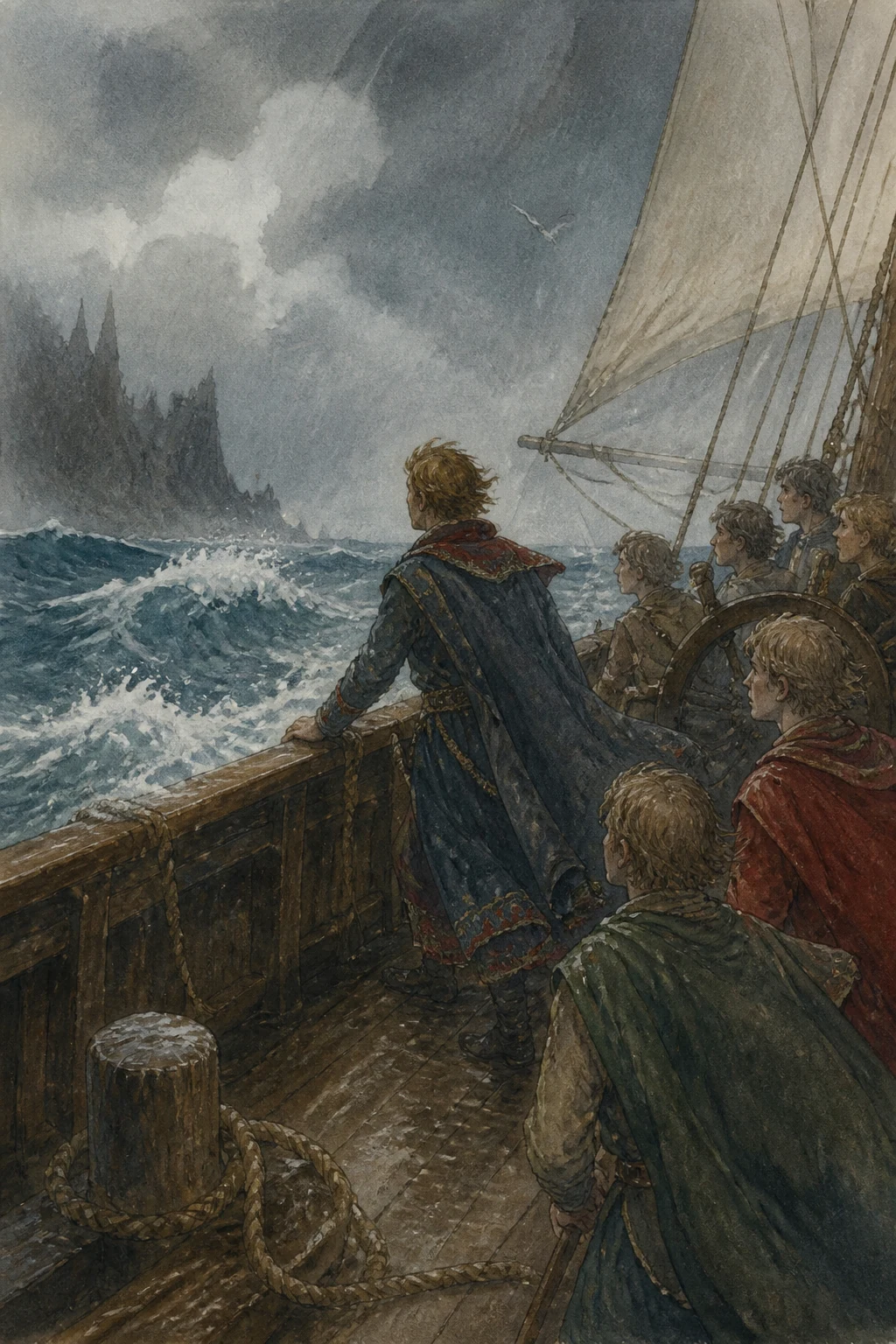
Pauluccio, seeing so fair a road opened to his deliverance, took the sword and made for the shore, where he found the boat and was welcomed with great reverence by those who sailed her.
Meanwhile, Rosella wrote a certain spell upon a piece of paper and, unseen and unheard, slipped it into her mother’s pocket. The woman at once fell so soundly asleep that she could feel nothing from head to foot. This done, Rosella took a bundle of jewels, ran to the boat, and they set sail. Just then the Grand Turk came into the garden, and finding neither his daughter nor the prince, he raised an uproar fit to shake the world and ran to find his wife. Unable to wake her either by shouting or by pulling her nose, he supposed that some seizure had robbed her of her senses, and called her ladies to undress her:
but as soon as they removed her skirt, the spell was broken, and she awoke crying, “Alas! That traitress of a daughter has tricked us and run away with the prince! But never mind: I shall soon put a stop to your journey and shorten your strides!” With these words she rushed to the shore, where she cast a leaf into the sea and brought forth a swift felucca, in which she began pursuing the young fugitives. Though her mother approached unseen, Rosella’s magical sight showed her the ruin bearing down upon them, and she said to Pauluccio:
“Quick, my heart! Draw that blade and plant yourself at the stern. The moment you hear chains and grappling hooks coming to seize this boat, slash away blindly, hit whom you may, and the devil take whoever gets in the way! Otherwise we are lost, and our escape has stuck in our throats.” Since his own hide was at stake, the prince kept a sharp lookout; and as soon as the Grand Turk’s wife drew alongside and threw her chains and grappling hooks, he struck a mighty backhand blow which, by good fortune, cut off both the sultana’s hands at a stroke. Screaming like a damned soul, she cursed her daughter: the moment the prince set foot in his own country, he would forget her. Then she hurried back to Turkey, her stumps streaming blood, appeared before her husband, and, showing him that pitiful sight, said:
“See, husband, what we have gambled away at Fortune’s table: you your health, and I my life.” With these words her spirit and her breath departed, and she went to pay her dues to the master who had taught her the art. At this, the Grand Turk plunged after her like a waterbird into the sea of despair, followed in his wife’s footsteps, and went, cold as snow, to the house of heat. But when Pauluccio reached Fonte-chiaro, he told Rosella to wait aboard the boat while he went to fetch attendants and carriages to bring her in triumph to his palace. Scarcely had he set foot ashore, however, when Rosella slipped from his mind. On reaching the royal palace, he was welcomed by his father and mother with such affection as no one could imagine, and there were celebrations and illuminations enough to astonish the world. But Rosella, after waiting three days for Pauluccio in vain, remembered the curse and bit her lips for not having thought to guard against it. In despair she went ashore and rented a palace opposite the king’s, hoping to find some way of reminding the prince of what he owed her. The gentlemen of the court, who must poke their noses into everything, spotted this new bird that had flown into the house. Gazing upon a beauty that overstepped every bound, exceeded every measure, surpassed all limits, struck the highest note of wonder, dealt staggering blows of amazement, and carried astonishment beyond itself, they began buzzing about her like gnats. Not a day passed without their parading around her dwelling and prancing before her door. Sonnets came thick and fast, messages poured in torrents, music split the ears, and hand-kissing wore out the bung of courtesy. Each unknown to the others, they all aimed at one target, and all, drunk with love, sought to tap this lovely cask. Rosella, who knew where to moor her boat, showed them all a smiling face, entertained them all, and kept them all in hope. At last, wishing to draw the purse strings tight, she secretly agreed with a gentleman of high standing that, if he gave her a thousand ducats and a complete new gown, he might come that night, when she would release the treasure of her affections to him. The poor window-haunter, whom passion had blindfolded, immediately borrowed the money at interest and obtained on credit from a merchant a rich length of brocade, loop piled upon loop. He could hardly wait for the sun to change places with the moon so that he might gather the fruit of his desires. When night came, he went secretly to Rosella’s house and found her lying in a splendid bed, like Venus in a field of flowers. Looking quite downcast, she told him not to get into bed until he had shut the door. The gentleman, thinking this a small enough service to render so lovely a jewel, went to close it; but no sooner was it shut than it flew wide open again. He pushed, and it opened, so that he kept up this to-and-fro, this push-and-pull, all night long, until the sun sowed golden light upon the fields that dawn had ploughed. He had struggled a whole long night with a cursed door, without ever getting to use his key; and, as a bonus for his labours, Rosella gave him a fine tongue-lashing, calling him a useless lump who could not even shut a door yet presumed to open the cabinet of Love’s delights. Thus the wretched dupe went away to mind his own affairs, bewildered and ashamed, hot about the head and cold about the tail. The second evening she made an appointment with another baron, asking him for another thousand ducats and another gown. He sent all the gold and silver he possessed to the pawnbrokers, to satisfy a desire that carries repentance at the tip of pleasure. When night, like a bashful beggar, drew her cloak over her face to ask an alms of silence, he presented himself at Rosella’s house. She was already in bed, and told him to put out the candle and then come to her;
and the gentleman, taking off his cloak and sword, began blowing at the candle. But the harder he puffed, the brighter it burned, for the blasts from his mouth had the same effect as bellows on a blacksmith’s fire. He spent the whole night blowing, and in trying to consume the candle, consumed himself like one. But when night hid herself away to avoid seeing the manifold follies of mankind, the poor mocked fellow went off with another dose of insults, just like the first. On the third night the third lover appeared, with another thousand ducats borrowed at usury and a gown procured by swindling. Having crept stealthily up to Rosella’s room, he heard her say, “I will not go to bed until my hair has been combed.”
“Leave that to me,” replied the gentleman; and seating her with her head in his lap, believing he was about to steal himself some fine French cloth, he began drawing an ivory comb through her hair. But the harder he tried to untangle those dishevelled locks, the more tangled the whole business became;
so that he laboured the entire night without accomplishing anything properly; and in trying to put one head in order, he threw his own into such confusion that he was ready to dash it against a wall. When the sun came out to hear the birds recite their lesson, and with the flat of his rays swatted the crickets that had infested the schoolroom of the fields, the gentleman received another double-soled thrashing of insults and came down from the house cold and frozen. Later, as they fell into conversation in the king’s antechamber, where reputations are cut and sewn, where woe betide the mother whose daughter is mentioned, where the bellows of flattery are worked, the webs of deceit are woven, the keys of slander are played, and melons are cut open to put ignorance to the test, this last gentleman told the whole story, explaining the trick that had been played on him. The second answered, “Say no more! If Africa wept, Italy did not laugh, for I too have been through that needle’s eye. Still, shared sorrow is half a joy.” At this the third said, “Why, we are all tarred with the same brush, and may shake hands without envying one another, for that traitress has fleeced us all down to the skin. But we ought not to swallow this pill without showing some resentment. We are not men to be mocked and stuffed into a sack. Let us make this barbarous child-strangler repent of it!” So, having agreed among themselves, they went to the king and told him the whole affair. He immediately sent for Rosella and said, “Where did you learn this habit of swindling my courtiers? Do you not think I shall have you entered in the register, you harlot, you strumpet, you little slut?” Without changing colour in the least, Rosella replied, “What I have done was to avenge a wrong done me by someone at your court, though nothing I could do in this world would be enough to repay the injury I have suffered.” The king ordered her to tell him what offence had been committed against her; and, speaking in the third person, she related all she had done for the prince: how she had rescued him from bondage, delivered him from death, saved him from the danger of a sorceress, and brought him safe and sound to his own country, only to be repaid with a turned back and left hanging like a cheese. Such treatment ill befitted her station, for she was a woman of noble blood and the daughter of one who ruled over kingdoms. On hearing this, the king at once had her seated with great honour, begging her to reveal who this witless, ungrateful fellow was who had played so cruel a trick upon her. Taking a ring from her finger, she said, “Whomever this ring goes to find is the faithless traitor who has made a fool of me.” She tossed the ring, and it slipped straight onto the finger of the prince, who was standing there like a post. At once its power passed into his head, and his lost memory returned; his eyes were opened, his blood stirred, and his spirits awoke. Running to embrace Rosella, he could not clasp the chain of his soul enough, nor tire of kissing the vessel of his joys. He begged her forgiveness for the sorrow he had caused her, and she replied:
“There is no need to seek forgiveness for faults that were not begotten by the will. I know why you forgot your Rosella, for I have not forgotten the curse that lost soul, my mother, laid upon you. So I excuse you and pity you.” And thus they exchanged a thousand tender words. The king, learning of Rosella’s lineage and of the debt he owed her for what she had done for his son, was glad to see them united; and, having had Rosella made a Christian, he gave her to the prince in marriage. They lived more contentedly than any couple who ever bore the yoke of matrimony, and found in the end, _That always, given time and straw,_ _The medlars ripen after all._