Prevod
_Corvetto, envied by the King’s courtiers for his excellent qualities, is sent into various dangers and emerges from them with great honor, to the still greater mortification of his enemies; he is given the Princess in marriage._ _The listeners had so lost themselves in Belluccia’s adventures that, when they saw her married, they became as merry and jubilant as if she had sprung from their own loins. But their eagerness to hear Ciulla brought the applause to a halt, and they hung upon the movement of her lips as she began to speak._ I once heard it said that Juno went to Cannia in search of Deceit. But if anyone were to ask me where dissimulation and fraud might truly be found, I could direct them nowhere but to court, where masquerades are forever being staged: backbiting plays Trastullo, slander plays Graziano, treachery plays Zanne, and knavery plays Pulcinella. There, at one and the same time, they cut and stitch, prick and anoint, break and glue together. Of all these things I shall show you just one little scrap in the tale you are about to hear.
Once upon a time, in the service of the King of Sciummo Largo, there was a very worthy young man named Corvetto. His good conduct had won him a place in his master’s heart, and for this very reason all the courtiers hated him and could not stomach him. Being bats of ignorance, they could not bear the brightness of Corvetto’s virtue, which bought his master’s favor with the ready coin of good manners. But the breezes of favor with which the King refreshed him were scorching siroccos upon the swollen groins of those bursting with envy. At every hour, in every corner of the palace, they did nothing but grumble, chatter, whisper, mutter, and snip away at the poor fellow, saying, “What spell has this good-for-nothing cast upon the King, that he loves him so dearly? What luck is his, that not a day passes without some fresh helping of favors? And we keep going backward like ropemakers, losing ground all the time, though we serve like dogs, sweat like ditchdiggers, and run like deer to suit the King’s taste to a hair. Truly, a man must be born lucky in this world, and whoever has no luck might as well throw himself into the sea. In the end, we can only look on and burst.” These and other words flew from the bows of their mouths, poisoned arrows aimed at the target of Corvetto’s ruin. Oh, wretched is the man condemned to that hell of a court, where flatteries are sold four to the penny, malice and evil offices are measured by the bushel, and deception and treachery weighed by the hundredweight! But who could tell of all the melon rinds of intrigue they slipped beneath his feet to bring him down? Who could describe all the soap of falsehood they smeared upon the stairway to the King’s ears, to make Corvetto tumble headlong and break his neck? Who could recount the pits of deceit they dug in his master’s mind, covering them with the twigs of zealous devotion so that he might fall into them? But Corvetto, who seemed to lead a charmed life, saw their snares and uncovered their traps, knew their tangled skeins, and perceived his adversaries’ plots, ambushes, gins, schemes, and intrigues. He always kept his ears pricked and his eyes open, lest he lose the thread, knowing that a courtier’s fortune is made of glass. Yet the higher this young man continued to rise, the more plainly the others sank and fell. At last, not knowing how to get him out of their way, since their slanders went unbelieved, they decided to send him over a precipice by way of praise—an art invented in the house of fire and perfected at court. And this is how they tried it.
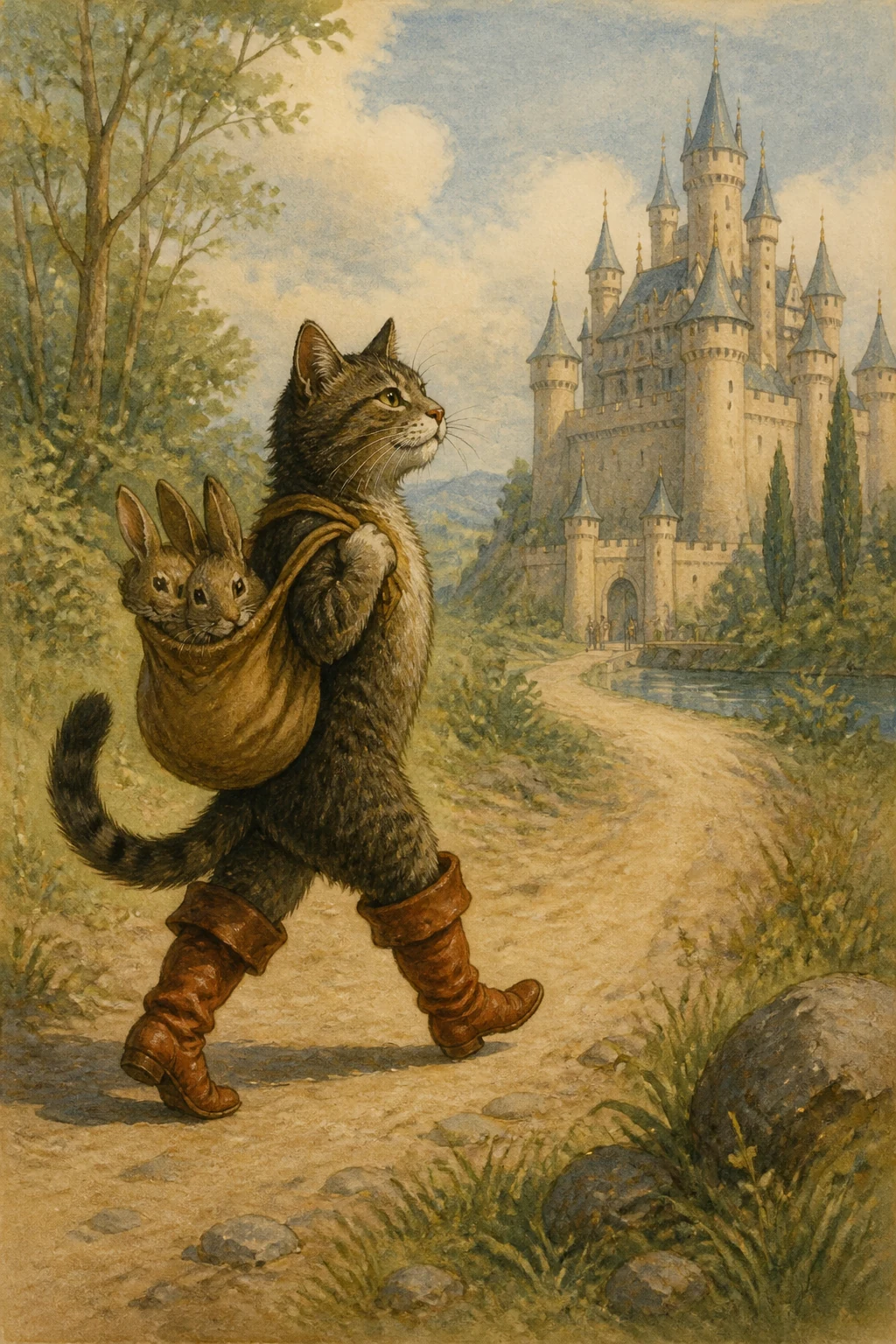
Ten miles from Scozia, where this King held his court, there lived an ogre, the most savage and brutal creature ever seen in all Ogreland. Hounded by the King, he had fortified himself in a deserted forest upon a mountain where even the birds would not fly, a forest so tangled that sunlight could never find its way inside. This ogre possessed a most beautiful horse, which seemed to have been painted with a brush; and among its other perfections it did not even lack speech, for through enchantment it could talk just as we do. Now the courtiers, knowing how wicked the ogre was, how rough the forest, how high the mountain, and how difficult it would be to obtain this horse, went to the King and described the animal’s perfections in minute detail. They said it was a creature worthy of a king, and that he ought therefore to find some means, by hook or by crook, of taking it out of the ogre’s claws. Corvetto, they added, would be just the man to lay hands on it, being a spirited young fellow who could get himself out of the fire. The King, unaware of the snake hidden beneath the flowers of these words, immediately summoned Corvetto and said, “If you love me, see that you get the horse belonging to my enemy the ogre, whatever it takes. You will have cause to count yourself happy and fortunate for having done me this service.” Corvetto knew very well that this drum had been beaten by those who wished him ill; nevertheless, to obey the King, he set off toward the mountain. Then, stealing quietly into the ogre’s stable, he saddled the horse, mounted, set his feet firmly in the stirrups, and took the homeward road. But when the horse felt itself being spurred out of the palace, it cried, “Help! Corvetto is carrying me off!” At this cry the ogre rushed out with all the animals that served him, so that here you saw a great baboon, there a prince of a bear, on this side a lion, on that a werewolf, all bent on making dried meat of him. But the young man gave the horse its head and put the mountain behind him, galloping all the way toward the city until he reached court. There he presented the horse to the King, who embraced him more fondly than a son and, reaching into a purse, filled his hands with great silver coins. This added a good gusset to the courtiers’ garment of spite: whereas before they had been puffed up through a pipe, now they were bursting under the blast of bellows, seeing that the pickaxes with which they had hoped to demolish Corvetto’s good fortune served instead to level the road to his advancement. Nevertheless, knowing that a wall does not fall at the first blow of a siege engine, they resolved to try their luck a second time. “May your splendid horse bring you joy,” they told the King, “for he will indeed be the glory of the royal stable. If only you also possessed the ogre’s hangings! They are beyond all description, and your fame would spread to every fair. No one could add such riches to your treasury except Corvetto, who has a wonderfully lucky hand at services of this kind.” The King, who danced to every tune and tasted only the sugared rind of these bitter fruits, summoned Corvetto and asked him to procure the ogre’s hangings. Without a word of protest, Corvetto was off to the ogre’s mountain in a twinkling. Entering unseen into the bedroom, he hid beneath the bed and crouched there until night, to make the stars laugh, turned the face of heaven into a carnival songbook. Then, when the ogre and his wife had gone to bed, he silently stripped the chamber of its hangings. Wishing to carry off the bedspread as well, he began pulling it very gently; but the ogre woke at once and told his wife not to tug so hard, for she was uncovering him altogether and would give him a pain in his belly. “You’re the one uncovering me,” answered the ogress. “I haven’t a stitch left over me.” “Where the devil is the blanket?” replied the ogre, and, lowering his hand to the floor, he touched Corvetto’s face. At this he began to shout, “The Monaciello! The Monaciello! Servants! Candles! Come quickly!” His cries threw the whole household into an uproar. But Corvetto, who had tossed the things out of the window, dropped down upon them, made them into a fine bundle, and set off toward the city. There is no describing the affection the King showed him, or the burning mortification of the courtiers, who were bursting at the seams.
For all that, they intended to bring the rearguard of their knavery to bear upon Corvetto. They found the King in high spirits over his pleasure in the hangings, which were not only of silk embroidered with gold but were also adorned with countless emblems expressing all manner of fancies and conceits. Among them, if I remember rightly, was a cock about to crow at the sight of the rising dawn, with a motto in Tuscan: “If only I may gaze upon you.” There was also a drooping heliotrope, with another Tuscan motto: “At the setting of the sun.”
And there were so many, many more that one would need a better memory and more time to tell of them all. Finding the King, as I say, so delighted and jubilant, they told him, “Since Corvetto has done so very much in your service, it would be no great matter for him to do you one signal favor more and secure you the ogre’s palace, which is fit to house an emperor.
“Indeed, it has so many chambers within and outlying buildings beyond that it could hold an army. You would never believe the courtyards, porticoes, little loggias, balconies, spiral privies, and pipe-shaped chimneys it contains, all fashioned with such architecture that art is stung with envy, nature blushes, and wonder wallows in delight.” The King, whose fertile brain conceived a notion at once, summoned Corvetto and told him of his newfound longing for the ogre’s palace. After all the pleasures Corvetto had given him, he begged him to add this extra helping, promising to write it with the charcoal of obligation upon the tavern wall of memory. Corvetto, who was quick as a match and could cover a hundred miles an hour, immediately took to his heels. When he reached the ogre’s palace, he found that the ogress had given birth to a fine little ogre. Her husband had gone to invite their relations, while the new mother, having risen from her bed, was busily preparing the feast. Corvetto walked in as bold as brass and said, “Well met, great lady, fine mistress of the house! Why do you wear yourself out so? You gave birth only yesterday, and now you work so hard, without a thought for your poor flesh.” “What would you have me do?” answered the ogress. “There’s no one to help me.” “Here I am,” replied Corvetto, “to help you tooth and nail.” “Then welcome,” said the ogress, “and since you have offered yourself so kindly, help me split four pieces of wood.”
“Gladly,” answered Corvetto. “And if four are not enough, let us make it five.” Taking a freshly sharpened axe, instead of striking the wood he struck the ogress on the nape of the neck and brought her down like a pear to the ground;
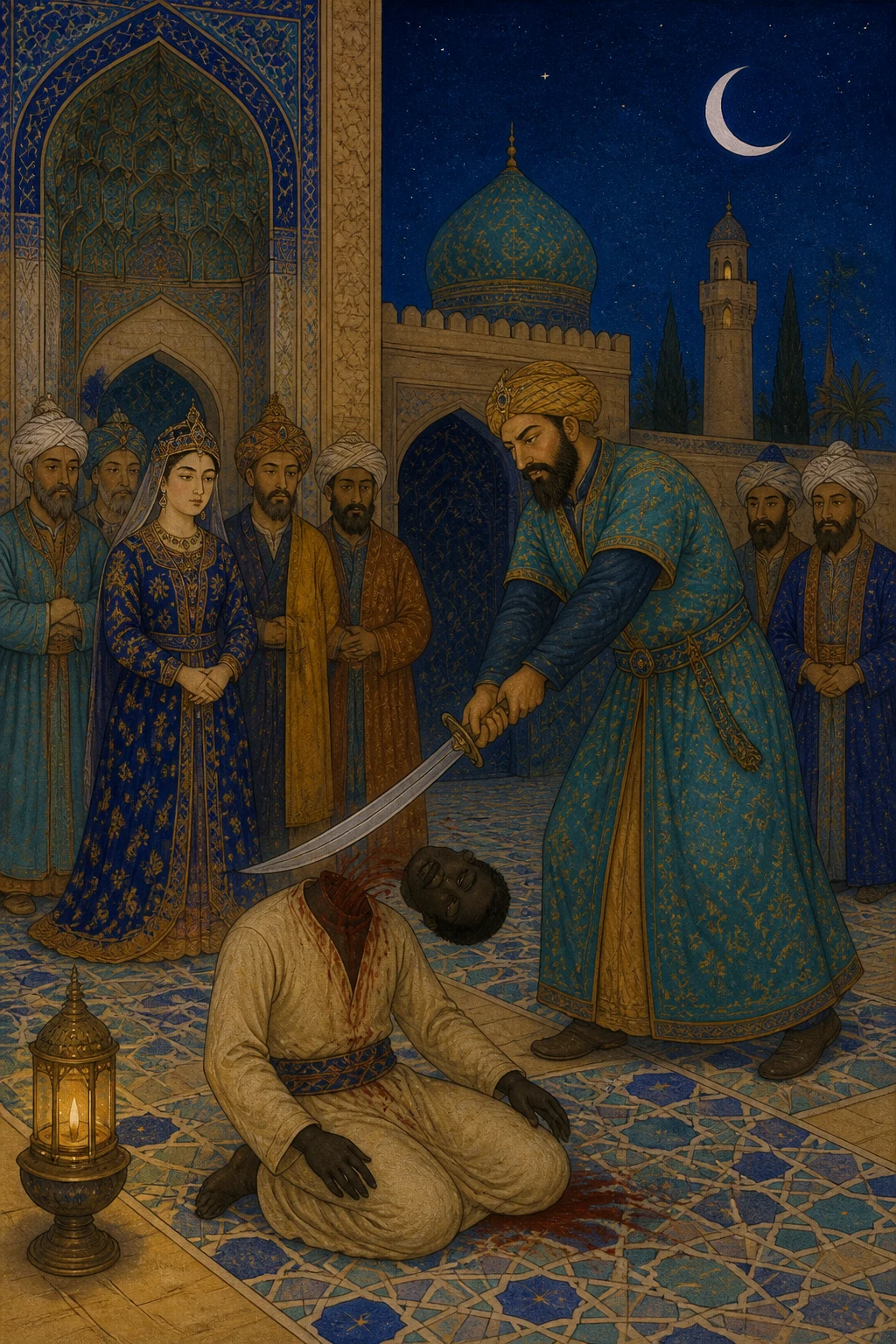
then, hurrying straight to the entrance, he dug a very deep pit, covered it with branches and earth, and hid behind the door to keep watch. When he saw the ogre coming with his relations, he stepped into the courtyard and shouted, “Bear witness, all of you: a turd in your midst, and long live the King of Sciummo Largo!” Hearing this insolent challenge, the ogre rushed like a thunderbolt toward Corvetto, meaning to make sauce of him. But as he and his relations charged into the portico, they all set foot upon the pit together and tumbled to the bottom, where Corvetto battered them to a pulp with stones. Then he locked the door and carried the keys to the King, who, seeing the young man’s courage and ingenuity, gave him his daughter in marriage, in the teeth of fortune, in defiance of envy, and to the vexation of the courtiers. Thus the obstacles envy had set in his path became the rollers that launched the ship of his life upon the sea of greatness; while his enemies, confounded and bursting with spite, went to bed without a candle, _For punishment, however long delayed,_ _Will find the wicked, and will not be stayed._