Prevod
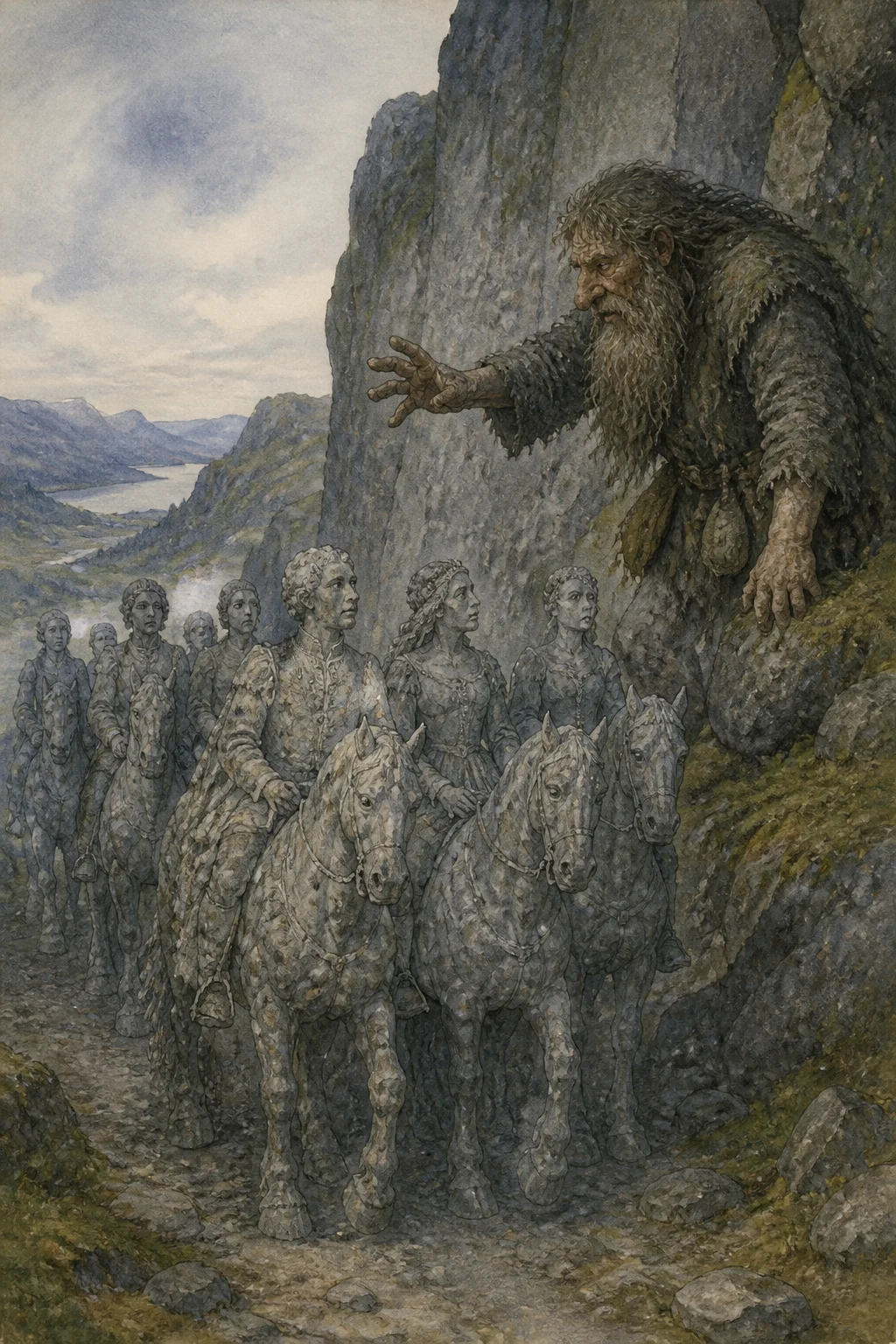
Once upon a time there was a king who had several sons. I do not rightly know how many there were, but the youngest could find no peace at home: he was bent on going out into the world to try his fortune, and at last the king had to let him go. When he had travelled for a few days, he came to a giant’s farm, and there he took service with the giant.
In the morning the giant was going out to tend his goats, and just as he was leaving the farm, he told the prince to muck out the stable. “When you have done that, you need do no more today, for you must know you have come to a kindly master,” he said.
“But whatever work you are given, you must do it properly and well. And you must on no account go into any of the rooms beyond the one where you slept last night;
if you do, I shall take your life.” “A kindly master indeed!” the prince said to himself. He walked up and down the room, humming and singing, for he thought there was plenty of time to muck out the stable. “Still, it would be amusing to peep into those other rooms of his. There must be something he is afraid of, since I am not allowed in,” he thought, and so he went into the first room.
There a cauldron hung on the wall, boiling away, but the prince could see no fire beneath it. What can there be in that? he wondered, and dipped his forelock into it; at once every hair looked as though it were made of copper. “That is a curious soup! Anyone who tasted it would have a fine mouthful,” said the lad, and with that he went into the next room. There, too, a cauldron hung on the wall, bubbling and boiling, but there was no fire beneath that one either.
“I must try this one too,” said the prince, and dipped his forelock in again; this time it was silvered over. “They have no soup as costly as this at my father’s court,” said the prince, “though it all depends on how it tastes.” With that he went into the third room. There, too, a cauldron hung on the wall, boiling just like those in the other two rooms, and the prince felt he must try this one as well. So he dipped his forelock into it, and it came out so brightly gilded that it shone.
“‘Worse and worse!’ said the old woman, when she meant to say, ‘Glory be!’” said the prince. “But if he boils gold in here, I wonder what he boils in there?” He meant to find out, so he went through the door into the fourth room. There was no cauldron to be seen, but someone was sitting on the bench. She must surely have been a princess; but whoever her father was, the prince had never in all his life seen her equal, she was so beautiful. “Oh, in Jesus’ name, what are you doing here?” said the girl on the bench. “I took service here yesterday,” said the prince. “God help you, what a place you have come to serve in!” she said. “Oh, I think I have found a kindly master,” said the prince. “He has given me no hard work today: once I have mucked out the stable, I am done.” “Yes, and how do you mean to do that?” she asked. “If you muck it out as people usually do, ten shovelfuls will come in for every one you throw out. But I shall teach you how to set about it: turn the shovel upside down and use the handle, and it will all fly out of its own accord.” Yes, the prince said, he would be sure to remember that. Then he stayed sitting in there all day, for before long he and the princess had agreed that they would have one another—and so his first day in the giant’s service did not drag, as you may well imagine. But towards evening she said he had better get the stable cleaned before the giant came home. When he reached the stable, he wanted to try whether what she had said was true, so he began mucking it out as he had seen the stablemen do at his father’s palace. But you may be sure he soon had to stop, for after he had been at it a little while, he scarcely had room to stand. Then he did as the princess had taught him: he turned the shovel round and mucked out with the handle, and in less than a moment the stable was as clean as though it had been scrubbed. When he had finished, he went back into the room where the giant had given him leave to stay, and there he walked up and down, humming and singing. Then the giant came home with the goats. “Have you mucked out the stable?” asked the giant. “Yes, it is neat and clean now, master,” said the prince. “I shall see about that!” said the giant, and strode out to the stable; but it was just as the prince had said.
“You must have been talking to my Mastermaid, for you never thought that up out of your own head,” said the giant. “Mastermaid? What sort of thing is that, master?” said the prince, pretending to be as stupid as a block of wood. “I should dearly like to see it.” “Oh, you will see her soon enough,” said the giant.
The next morning the giant was going out with his goats again. He told the prince that his task that day was to fetch home his horse, which was up on the moor, and when he had done that, he could rest for the remainder of the day. “For you must know you have come to a kindly master,” said the giant once more. “But if you go into any of those rooms I spoke of yesterday, I shall wring your head off,” he said, and then he went away with his flock of goats. “A kindly master you are indeed,” said the prince. “But I shall go in and talk to Mastermaid all the same. Perhaps she may be mine as soon as yours.” And so he went in to her. She asked him what he had to do that day. “Oh, I do not suppose it is any very dangerous work,” said the prince. “I have only to go up on the moor and fetch his horse.” “Yes, and how do you mean to do that?” asked Mastermaid. “Oh, riding a horse home is no great feat,” said the prince. “I dare say I have ridden as lively a horse before.” “Well, riding that horse home is not quite so easy as you think,” said Mastermaid;
“but I shall teach you what to do. When you catch sight of him, he will come at you with fire and flame streaming from his nostrils like a blazing pine torch. Watch carefully, then take the bridle hanging over there by the door and throw it straight into his mouth. He will become so gentle that you can do whatever you please with him.” Yes, he would be sure to remember that. Then he sat in there with Mastermaid all day again, and the two of them talked of this and that, but first and last they talked of how happy and splendid their life would be if only they could marry and escape safely from the giant. The prince would surely have forgotten both the moor and the horse if Mastermaid had not reminded him towards evening, telling him he had better go and fetch the horse before the giant came home.
So he did: he took the bridle hanging in the corner and ran up on the moor, and before long the horse came to meet him, with fire and red flames shooting from its nostrils. But the lad watched for his chance, and just as it came at him with its jaws wide open, he threw the bit straight into its mouth. Then the horse stood as meekly as a little lamb, and after that it was no great trouble to bring it home to the stable, I should think.
Then he went back indoors and began humming and singing. In the evening the giant came home with the goats. “Have you fetched the horse home from the moor?” asked the giant. “Yes, I have, master. He was a merry horse to ride, but I rode straight home and put him in the stable all the same,” said the prince. “I shall see about that!” said the giant, and out he went to the stable; but there stood the horse, just as the prince had said. “You must have been talking to my Mastermaid, for you never thought that up out of your own head,” said the giant again. “Yesterday master was talking about this Mastermaid, and today it is the same story. Oh, God bless you, master!
You would not show me this thing, I suppose? I should dearly like to see it,” said the prince, pretending to be just as stupid and witless as before. “Oh, you will see her soon enough,” said the giant.
On the morning of the third day, the giant was going into the forest with his goats again. “Today you are to go to Hell and fetch the tribute,” he told the prince. “When you have done that, you may rest for the remainder of the day, for you must know you have come to a kindly master.” And then he went away. “Well, however kindly a master you may be, you give me some nasty tasks all the same,” said the prince. “But I had better see if I can find this Mastermaid of yours. You say she is yours, but perhaps she may still tell me how to set about it.” And so he went in to her.
When Mastermaid asked him what the giant had set him to do that day, he told her he had to go to Hell and fetch the tribute. “How do you mean to do that?” said Mastermaid. “Well, you will have to tell me,” said the prince, “for I have never been to Hell before, and even if I knew the way, I should not know how much to ask for.” “Oh, I shall tell you that readily enough. You must go to the rock face over there below the moor, take the club lying there, and knock on the rock,” said Mastermaid. “Then someone will come out with sparks flying from him. Tell him your errand, and when he asks how much you are to have, say, ‘As much as I can carry.’” Yes, he said, he would be sure to remember. Then he sat in there with Mastermaid all day, right up until evening, and he would gladly have been sitting there still if Mastermaid had not reminded him that he had better set off to Hell for the tribute before the giant came home. So he had to be on his way, and he did exactly as Mastermaid had told him: he went to the rock face, took the club, and knocked. Then someone came out with sparks flying from both his eyes and his nose. “What do you want?” he said. “I was to come here on the giant’s behalf and claim his tribute,” said the prince.
“How much are you to have, then?” asked the other. “I never ask for more than I can carry away,” said the prince. “A good thing you did not want a whole horse-load!” said the fellow who had come out of the rock.
“But come inside with me now!” The prince did so, and there he saw gold and silver, you may be sure: it lay inside the mountain like heaps of stones on a scree slope. He was given as heavy a load as he could carry, and off he went with it. When the giant came home with the goats that evening, the prince was walking about indoors, humming and singing just as he had the two evenings before. “Have you been to Hell for the tribute?” said the giant. “Yes, indeed I have, master,” said the prince. “Where have you put it, then?” asked the giant. “The sack of gold is over there on the bench,” said the prince. “I shall see about that!” said the giant, and strode over to the bench. But there stood the sack, so full that gold and silver spilled out as soon as the giant loosened the cord.
“You must have been talking to my Mastermaid,” said the giant. “If you have, I shall wring your head off.” “Mastermaid?” said the prince. “Yesterday master was talking about this Mastermaid, and today he is talking about her again, and the day before yesterday it was the same story. I do wish I could see this thing.” “Very well, wait until tomorrow, and I shall take you in to her myself,” said the giant. “Oh, thank you, master, though I dare say you are only teasing me,” said the prince.
The next day the giant took him in to Mastermaid. “Now you are to slaughter him and boil him in that great big cauldron—you know the one. When the soup is ready, you can call me,” said the giant. Then he lay down on the bench to sleep, and in no time he was snoring so loudly that the mountain rumbled.
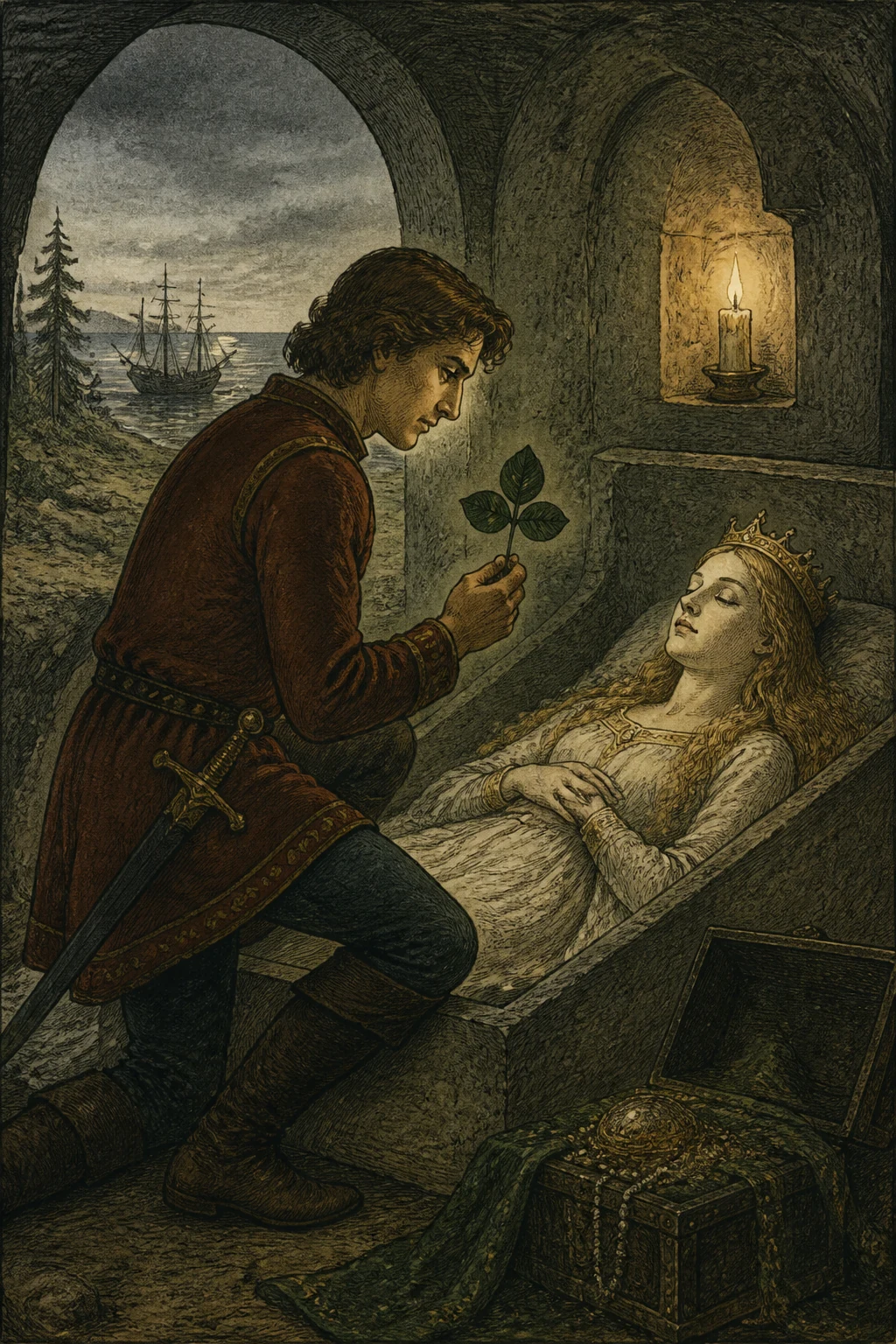
Then Mastermaid took a knife and cut the lad’s little finger, letting three drops of blood fall onto the stool. After that she took all the old rags and shoe soles and every scrap of rubbish she could lay hands on and put them into the cauldron. Then she took a whole chestful of ground gold, a lump of salt, a flask of water hanging by the door, a golden apple, and two golden hens, and with these she and the prince fled from the giant’s farm as fast as they could. When they had gone some way, they came to the sea, and after that they sailed; but where they got the ship from, I have never rightly learned.
When the giant had slept for a good while, he began to stretch himself where he lay on the bench. “Is it nearly cooked?” he said. “Only just begun!” said the first drop of blood on the stool. So the giant settled down to sleep again, and slept for a long, long while. Then he began to stir a little once more. “Is it nearly cooked now?” he said, but he did not look up—nor had he the first time—for he was still half asleep. “Half cooked!” said the second drop of blood, and once again the giant thought it was Mastermaid;
he turned over on the stool and went back to sleep. When he had slept for many more hours, he began to stir and stretch. “Is it not cooked yet?” he said.
“Quite cooked!” said the third drop of blood. Then the giant began to sit up and rub his eyes, but he could not see who had spoken, so he asked for Mastermaid and called out to her. No, there was no answer. “Oh well, she must have slipped out for a moment,” thought the giant. He took a ladle and went over to the cauldron to taste the soup. But there was nothing in it except shoe soles and rags and such rubbish, all boiled together until he could not tell whether it was porridge or gruel. When he saw that, he understood what had happened, and he grew so furious that he did not know which foot to stand on. Off he rushed after the prince and Mastermaid, at a terrific pace; but before long he stood at the water’s edge, and he could not get across. “Well, well, I know how to deal with this. I need only call my River-sucker,” said the giant, and so he did. His River-sucker came and lay down and drank two or three great gulps, and the water in the sea sank so far that the giant could see Mastermaid and the prince out on the ship.
“Now you must throw out the lump of salt,” said Mastermaid. The prince did so, and it became a mountain stretching right across the sea, so great and high that the giant could not get over it, nor could the River-sucker drink any more. “Well, well, I know how to deal with this,” said the giant. He fetched his Rock-borer and set about boring through the mountain so that the River-sucker could drink again;
but the moment there was a hole and the River-sucker began to drink, Mastermaid told the prince to pour a drop or two out of the flask. At once the sea was just as full as before, and before the River-sucker could take another gulp, they had reached land and were safe.
Now they were to go home to the prince’s father, but he would not hear of Mastermaid going on foot, for he thought it unbecoming to both her and himself. “Wait here just a little while, while I go home and fetch the seven horses in my father’s stable,” said the prince. “It is not far, and I shall not be long. But I will not have my sweetheart come walking into the courtyard.” “Oh no, do not do that, for once you get home to the palace, you will simply forget me. I know it already,” said Mastermaid. “How could I forget you, when we have suffered so much together and love each other so dearly?” said the prince;
he was determined to go home for the carriage drawn by the seven horses, and she was to wait by the shore meanwhile. In the end Mastermaid had to give in, since he was so set upon it. “But when you get there, you must not even stop to greet anyone. Go straight into the stable, take the horses, harness them, and drive off as fast as you can.
They will all crowd round you, but you must pretend not to see them, and you must not taste a thing. If you do, it will bring misfortune on us both,” she said, and he promised.
But when he reached the palace, one of his brothers was just about to be married, and the bride and all those who had escorted her were already there. They all crowded round him, asking him about this and that and wanting him to come inside with them. But he pretended not to see them, went straight into the stable, brought out the horses, and began harnessing them. When they could not get him to come indoors by any means, they came out to him with food and drink and all the best things they had prepared for the wedding;
but the prince would not taste anything; he only hurried on with the harnessing. At last the bride’s sister rolled an apple across the courtyard to him. “Since you will not taste anything else, you might at least take a bite of that, for you may well be both thirsty and hungry after your long journey,” she said. And he did: he picked up the apple and bit into it. But no sooner was the mouthful between his lips than he forgot both Mastermaid and that he was to drive out to fetch her. “I must be mad! What do I want with the horses and carriage?” he said. So he put the horses back in the stable and went into the palace with the others, and it was soon arranged that he should marry the bride’s sister, the one who had rolled the apple to him.
Mastermaid sat by the shore and waited for ages and ages, but no prince came. At last she went away, and when she had walked some distance, she came to a little cottage standing by itself in a wooded enclosure close to the palace;
she went inside and asked whether she might stay there. The cottage belonged to an old woman, a fierce and ill-tempered old troll she was too. At first she would not let Mastermaid stay at all, but after a great deal of coaxing and the promise of payment, she gave her leave at last.
But inside it was as filthy and black as a pigsty, so Mastermaid said she would like to tidy it up a little, so that it might look like other people’s homes. The old woman did not like that either; she snarled and flew into a temper;
but Mastermaid took no notice. She brought out her chest of gold and threw a few quarts or so onto the fire, so that the gold hissed and sprayed all over the cottage, gilding it both inside and out. But the moment the gold began to hiss, the old woman took such fright that she rushed out as though the Evil One himself were after her. She forgot to duck in the doorway, struck the frame, and broke her head clean off.
The next morning the constable came riding past. He was quite astonished at the golden cottage glittering and gleaming over in the wooded enclosure, as you may well imagine, and still more astonished when he went inside and saw the beautiful maiden sitting there. He fell so deeply in love with her that he proposed on the spot, begging her most sweetly and earnestly to become his wife. “Well, have you plenty of money?” said Mastermaid. Oh yes, the constable thought he had quite a tidy sum. He would go home and fetch it, and that evening he returned with a whole half-barrel sack, which he set down on the bench. Yes, since he had so much money, Mastermaid would have him, and they lay down together. But no sooner had they lain down than Mastermaid wanted to get up again. “I have forgotten to bank the fire,” she said. “Good heavens, should you get up for that?” said the constable. “I shall do it.” And he sprang out onto the floor and over to the hearth in a single bound. “Tell me when you have hold of the poker,” said Mastermaid. “I have hold of the poker now,” said the constable. “Then God grant that you may hold the poker and the poker hold you, and that you may shovel fire and embers over yourself until daybreak!” said Mastermaid. So the constable stood there all night, shovelling fire and embers over himself, and for all his weeping, pleading, and begging, the embers grew no cooler. But when day broke and he was able to let go of the poker, he did not stay long, you may be sure. He dashed away as though the bailiff or the Devil were at his heels. Everyone he met gaped and stared after the constable, for he flew along like a madman, and he could not have looked worse if he had been both flayed and tanned. They all wondered where he had been, but he was too ashamed to say a word about it.
The next day the magistrate came riding past the place where Mastermaid lived. He saw the cottage glittering and shining over in the wooded enclosure, and he too felt he must go in and see who lived there. When he entered and saw the beautiful maiden, he fell even more deeply in love than the constable and began proposing that very instant. Mastermaid gave him the same answer she had given the constable: if he had plenty of money, then perhaps—. As for money, the magistrate thought he had quite a tidy sum, and he would go straight home and fetch it. That evening he returned with a great bulging sack of money—I believe it was a whole barrel-sized sack—and set it on the bench in Mastermaid’s cottage.
So it was settled that he should have her, and they lay down together. But Mastermaid had forgotten to shut the porch door that evening, and she said she must get up and fasten it. “Good heavens, should you do that?” said the magistrate. “No, you lie still. I shall do it.” And out of bed he sprang, as lightly as a pea off a piece of birch bark, and went into the porch. “Tell me when you have hold of the door latch!” called Mastermaid. “I am holding the door now!” the magistrate shouted from the porch. “Then God grant that you may hold the door and the door hold you, and that you may fly from wall to wall until daybreak!” said Mastermaid. And you may be sure the magistrate had to dance that night. He had never waltzed such a waltz before, nor was he likely to want to dance it again afterwards. Now he was in front and now the door, and away they went from one corner of the porch to the other, until the magistrate was almost battered to death. First he began to curse, then to weep and plead, but the door paid no attention and went on with its work until day began to break. When the door let go, the magistrate ran off as though he were being paid for it. He forgot both his sack of money and his courtship, and was only thankful the cottage door did not come dancing after him. Everyone he met gaped and stared after the magistrate, for he flew along like a madman, and besides, he looked worse than if he had been butting heads with the rams all night.
On the third day the bailiff came riding by, and he too caught sight of the golden cottage in the wooded enclosure. Yes, he too had to go in and see who lived there. When he saw Mastermaid, he fell so deeply in love with her that he proposed almost before he had said good day. Mastermaid answered him as she had the other two: if he had plenty of money, she would gladly have him. And the bailiff said he had quite a tidy sum; he would go straight home and fetch it, and so he did. When he returned that evening, he had an even bigger sack of money than the magistrate’s—it must have held a barrel and a half—and he set it down on the bench. So now it was settled that he should have Mastermaid. But no sooner had they lain down than Mastermaid said she had forgotten to let the calf in; she must get up again and put it in its pen.
No, goodness gracious, she must do no such thing; the bailiff would do it, he said. And fat and stout as he was, he sprang out of bed and out of doors as nimbly as a young man. “Tell me when you have hold of the calf’s tail,” said Mastermaid, and so he did. “I have hold of the calf’s tail now!” shouted the bailiff. “Then God grant that you may hold the calf’s tail and the calf’s tail hold you, and that you may race all over the world until daybreak!” said Mastermaid. And you may be sure the bailiff had to put his legs to work;
Away they went, uphill and down, over mountains and through valleys, and the more the bailiff cursed and shouted, the faster the calf ran. By the time dawn began to break, the bailiff was almost done for, and he was so glad to let go of the calf’s tail that he forgot the moneybag and everything else. He made his way home rather more slowly than the sheriff and the clerk had done, but the more slowly he went, the more time everyone had to gape and stare at him; and you may be sure they made the most of it, so worn out and ragged did he look after his dance with the calf.
The next day the wedding was to be held at the royal palace, and both the eldest brother and his bride, and the brother who had been with the giant and her sister, were to go to church. But when they had climbed into the carriage and were about to set off, one of the harness pins snapped. They made another, and a second, and a third to replace it, but every one of them broke, no matter what sort of wood they used. This went on and on, and still they could not get away, until they all began to lose heart. Then the sheriff spoke up—for he too had been invited to the wedding at the palace, you must know—and said that a maiden lived over in Skovhagen. “If you could only borrow the poker she uses to rake her fire together, I know for certain it would hold,” said the sheriff. So they sent word to Skovhagen and asked very politely whether they might borrow the poker the sheriff had spoken of. There was no question of refusing, and now, you may be sure, they had a harness pin that would not snap.
But just as they were about to drive off, the bottom of the carriage broke. They set to work making a new one as quickly and as well as they could, but however they nailed it together, and whatever wood they used, it was no use. No sooner had they fitted the bottom and made ready to leave than it broke apart again, and now they were even worse off than they had been with the harness pin. Then the clerk spoke up—for if the sheriff was there, you may be sure the clerk was at the palace wedding too. “There is a maiden living over in Skovhagen,” he said. “If you could only borrow one half of the door to her gallery, I know for certain it would hold.” So they sent word to Skovhagen again and asked very politely whether they might borrow the gilded gallery door the clerk had spoken of, and they were given it at once. Once more they were ready to set off, but now the horses could not pull the carriage. They already had six horses harnessed to it; then they tried eight, then ten, then twelve, but however many they harnessed, and however hard the coachmen used their whips, it did no good: the carriage would not stir from the spot. By now it was getting well on in the day, and to church they must and would go, so everyone at the palace was quite in despair. But then the bailiff said that a maiden lived over in the gilded crofter’s cottage in Skovhagen, and if only they could borrow her calf—“For I know for certain it will pull the carriage, even if it is as heavy as a mountain!” said the bailiff. They thought it a sorry thing to drive to church behind a calf, but there was nothing else for it. They had to send word again and ask very politely on the king’s behalf whether he might borrow the calf the bailiff had spoken of. Mestermø let them have it at once; she did not refuse them this time either. Once they had harnessed it, you may be sure the carriage began to move. Away it went, uphill and down, over sticks and stones, so fast they could scarcely draw breath, sometimes on the ground and sometimes in the air. When they reached the church, it began whirling round and round it like a reel, and only with the greatest difficulty did they manage to get out of the carriage and into the church.
On the way back they went faster still, so that they scarcely knew where they were by the time they reached the palace again. When they had sat down at table, the prince who had served in the giant’s house said that he thought they ought to invite up to the palace the maiden down in Skovhagen who had lent them the poker, the gallery door, and the calf. “For if we had not had those three things, we should not have got away yet,” he said. The king agreed that this was only right and proper, and sent five of his best men down to the gilded crofter’s cottage. They said that the king sent his warmest greetings and begged her to be so good as to come up to the palace and dine. “Give the king my greetings and tell him that if he is too good to come to me, then I am too good to go to him,” answered Mestermø. So the king had to go himself, and then Mestermø came along at once. The king evidently thought she was rather more than she seemed, for he seated her in the place of honour beside the younger bridegroom. When they had been at table a little while, Mestermø brought out the cock, the hen, and the golden apple she had taken with her from the giant’s house, and set them on the table before her. At once the cock and the hen began squabbling over the golden apple. “Just look at those two fighting over the golden apple!” said the prince. “Yes, that was how the two of us struggled to get out when we were inside the mountain,” said Mestermø. Then the prince knew her again, and you may be sure he was overjoyed. He had the wicked witch who had rolled the apple to him torn apart between twenty-four horses, until not a scrap of her remained, and only then did the wedding festivities begin in earnest. And battered and bruised though they were, the sheriff, the clerk, and the bailiff held out to the end as well.