Prevod
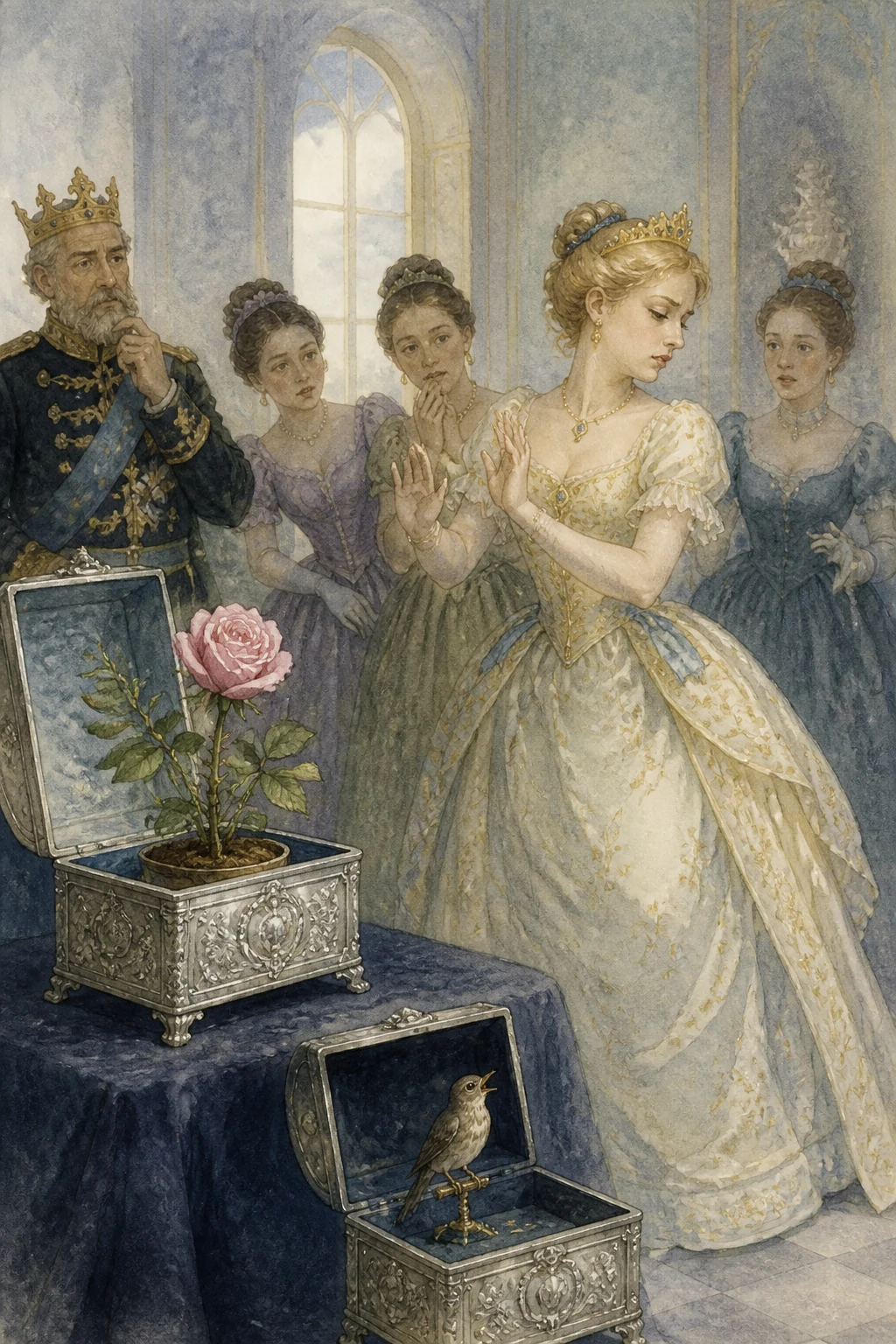
Once upon a time there was a king’s daughter who was so proud and haughty that no suitor was good enough for her. She made fools of them all and sent them packing one after another. Yet proud as she was, suitors kept coming to the palace, for she was beautiful, the wicked little troll. Now one day a prince came to woo her in his turn, and his name was Haaken Borkenskjæg.
But on the very first night he was there, she told the court jester to cut the ears off one of his horses and slit the other’s mouth right back to its ears. When the prince was about to drive away the next day, the princess stood on the gallery, watching. “Well, I never saw the like!” she said. “The sharp north wind that blows here has carried off one horse’s ears, and the other has stood grinning at it till its mouth has split right back to its own ears.” With that she burst out laughing, flew indoors, and left him to drive away. He went home, but he thought to himself that he would pay her back yet. He put on a great beard of lichen, pulled on a loose leather coat, and disguised himself as an ordinary beggar. But from a goldsmith he bought a golden spinning wheel, and off he went. One morning he sat down beneath the princess’s window and began filing and working away at the golden wheel, for it was not quite finished, and it had no uprights either. When the princess came to her window that morning, she opened it, called down to him, and asked whether he would sell his golden spinning wheel. “No, it is not for sale,” said Haaken Borkenskjæg. “But all the same, if you let me sleep outside your chamber door tonight, you shall have it.” The princess thought that a fine bargain; surely there could be no harm in it. She took the wheel, and that evening Haaken Borkenskjæg lay down outside her chamber door. But as the night wore on, he began to feel terribly cold. “Brr-r-r-r, it’s so dreadfully cold that—let me in!” he said. “I do believe you’ve lost your wits,” said the princess. “Oh, brr-r-r-r, it’s so cold! Only let me in!” said Haaken Borkenskjæg.
“Hush, hush! Be quiet!” said the princess. “If Father hears there’s a man here, I shall be utterly ruined!” “Oh, brr-r-r-r, I’m freezing to death! Only let me come in and lie on the floor!” said Haaken Borkenskjæg. Well, there was nothing else for it: she had to let him in, and once inside he lay down on the floor and slept soundly enough.
Some time later Haaken came back with the uprights for the spinning wheel, and once again he sat down beneath the princess’s window and began filing them, for they were not quite finished.
When she heard him filing, she opened the window, spoke to him, and asked what he had there. “Oh, these are the uprights for the spinning wheel the princess bought. I thought to myself that, since she wanted a wheel, she might need the uprights too.” “And what do you want for them?” asked the princess.
They were not for sale either; but if he might sleep on the floor in the princess’s chamber that night, she could have them. Yes, he might do that, but she begged him to keep quiet and not start shivering and saying brr-r-r.
Haaken Borkenskjæg promised readily enough, but as the night wore on he began to shudder and shiver and make such a fuss, and then he asked whether he might lie on the floor beside the princess’s bed. There was nothing else for it: she had to let him, unless she wanted the king to hear. So Haaken Borkenskjæg lay down on the floor beside the princess’s bed and slept very well indeed.
A good while passed before Haaken Borkenskjæg came again, but this time he brought a golden yarn winder, and sat down beneath the princess’s windows one morning to file it. Things went just as before. When the princess heard him, she came to the window, greeted him, and asked what he wanted for the yarn winder. “It is not for sale for money, but if I may lie in your chamber tonight with my head resting on your bedstead, you shall have it,” said Haaken Borkenskjæg. Yes, he might do that, said the princess, so long as he would only keep quiet and make no noise. He promised to do his best; but as the night wore on he began shuddering and shivering till his teeth chattered. “Brr-r-r-r, it’s so cold! Oh, let me get into bed and warm myself a little!” said Haaken Borkenskjæg. “I do believe you’re mad,” said the princess. “Brr-r-r-r!” said Haaken Borkenskjæg. “Oh, let me get into bed! Brr-r-r-r!” “Hush, hush! For God’s sake, be quiet!” said the princess. “If Father hears there’s a man here, I shall be utterly ruined. I’m sure he’ll kill me on the spot.” “Brr-r-r-r, let me into bed!” said Haaken Borkenskjæg, shivering so hard that the whole room shook. There was nothing else for it: she had to let him into bed, and then he slept very well indeed. But some time afterwards the princess had a child, and the king grew so angry and furious that he very nearly put an end to both her and the baby. A little while later Haaken Borkenskjæg came wandering by, seemingly by chance, and sat out in the kitchen like any other poor man.
When the king’s daughter came out and saw him, she said, “Oh, heaven help me, what misery you have brought upon me! My father is beside himself, he’s so furious. Let me go home with you!” “You’re surely too used to fine living to come with me,” said Haaken. “I have nothing but a hut of branches to live in, and how I’m to find food for you I do not know, for I have trouble enough feeding myself.” “I don’t care how you live,” she said. “Only let me come with you, for if I stay here any longer, Father will surely kill me.” So she was allowed to go with the tramp, as she called him, and they walked a long, long way, and she had a hard time of it on the road. When they left that country and entered another kingdom, the princess asked whose it was.
“Oh, it belongs to Haaken Borkenskjæg,” he said. “Does it indeed?” said the princess. “Well, I could have married him, and then I should not have had to go wandering here like a ragged beggar.” And whenever they came to the finest castles and woods and farms, she asked who owned them. “Oh, they belong to Haaken Borkenskjæg,” said the tramp. And the princess walked on, lamenting that she had not married the man who owned so much.
At long last they came to a royal palace. He said he was known there, and thought he could find her work so they would have something to live on. Then he built a hut of branches at the edge of the woods, where he meant to stay.
He himself went to the palace to chop wood and carry water for the cook, or so he said, and when he came home he brought a few scraps of food, but they did not go far.
One day he came home from the palace. “Tomorrow I shall stay at home and mind the child, but you must get ready to go to the palace,” he said, “for the prince said you were to come and help with the baking.” “Me, bake?” said the king’s daughter. “I cannot bake. I’ve never done it.” “Well, you’ll have to go,” said Haaken Borkenskjæg, “since he has said so. If you cannot bake, you can learn. Watch how the others do it, and when you leave, you must steal a few loaves for me.” “I cannot steal,” said the king’s daughter. “You can learn,” said Haaken Borkenskjæg. “You know how short of food we are.
But take good care around the prince, for he has eyes everywhere.” As soon as she had gone, Haaken ran by a shortcut and reached the palace long before her, threw off his rags and his lichen beard, and put on his princely clothes.
The king’s daughter helped with the baking and did as Haaken had told her, stealing enough loaves to fill all her pockets. When she was about to go home that evening, the prince said:
“We know nothing about this wife of Haaken Borkenskjæg’s. We had better see whether she has taken anything with her.” Then he plunged his hands into all her pockets, rummaging and searching, and when he found the loaves he grew angry and made a dreadful scene.
She wept and wailed and said, “The tramp told me to do it, so I had to.” “Well, you deserve to be punished,” said the prince, “but never mind. For the tramp’s sake, you shall be forgiven.” As soon as she had gone, he threw off his princely clothes, pulled on his leather coat, put on his lichen beard, and reached the hut before her. When she arrived, he was busy tending the child.
“Well, you have made me do something I am sorry for,” she said. “That was the first time I ever stole, and it shall certainly be the last.” Then she told him what had happened and what the prince had said.
A few days later Haaken came home to the hut one evening. “Tomorrow I must stay at home and mind the little one,” he said, “for you are to help with the slaughtering and make sausages.” “Me, make sausages?” said the king’s daughter. “I cannot do that.
I have eaten sausages, to be sure, but I have never made them.” Well, Haaken said she must go, since the prince had said so. She must do as she saw the others doing, and then he asked her to steal a few sausages to bring home to him.
“No, I cannot steal,” she said, “for you surely remember what happened last time.” “You can learn to steal,” said Haaken. “There’s no saying it will go wrong every time.” As soon as she had gone, Haaken Borkenskjæg ran along the shortcut, reached the palace long before her, threw off his leather coat and lichen beard, and was standing in the kitchen in his princely clothes when she arrived. The king’s daughter helped with the slaughtering and made sausages, and she did as Haaken had said and stuffed her pockets full. When she was about to go home that evening, the prince said:
“This tramp’s wife was light-fingered last time. We had better see whether she has taken anything with her.” And he began rummaging and searching through all her pockets. When he found the sausages, he grew angry again, made a terrible scene, and threatened to hand her over to the sheriff.
“Oh, God bless you, let me go! The tramp told me to do it,” she said, weeping and wailing. “Well, you deserve to be punished, but for the tramp’s sake you shall be forgiven,” said Haaken Borkenskjæg.
When she had gone, he threw off his princely clothes, pulled on his leather coat, put on his lichen beard, and ran along the shortcut. By the time she came home, he was already there.
She told him what had happened and swore solemnly that this was the last time he would make her do such a thing. Some time later the man had been to the palace again. “Now our prince is to be married,” he said when he came home that evening. “But the bride has fallen ill, so the tailor cannot take her measurements for the wedding dress. The prince wants you to come up to the palace and be measured in her place, for he says you are just her height and build. But once you have been measured, you must not leave. Stay there and watch while the tailor cuts out the dress, then scoop up the largest scraps and bring them home to make me a pointed cap.” “No, I cannot steal,” she said, “and you surely remember what happened last time.” “You can learn,” said Haaken. “There’s no saying it will go wrong this time.” She thought it wrong, but she went and did as he asked. She stood watching while the tailor cut out the dress, scooped up the largest scraps, and put them in her pocket. When she was about to leave, the prince said, “We had better see whether the woman has been light-fingered this time too.” And he began searching all her pockets. When he found the stolen things, he grew angry and began scolding and shouting beyond all measure. She wept and wailed and said:
“Oh, the tramp told me to do it, so I had to.” “Well, you deserve to be punished, but for the tramp’s sake I suppose you must be forgiven,” said Haaken Borkenskjæg. Then things went as they had before: when she came home to the hut, Haaken was there too. “Oh, God help me,” she said. “You will surely be the ruin of me in the end, for you never ask me to do anything but what is wrong. The prince was so angry and furious that he threatened me with both the sheriff and the house of correction.” Some time later Haaken came home to the hut one evening.
“Now the prince wants you to come to the palace and stand in for the bride,” he said, “for his bride is still ill in bed. But he means to hold the wedding, and you are so like her that no one can tell you apart. Tomorrow you must get ready to go to the palace.” “I believe you and the prince have both lost your wits,” she said. “Do you think I look fit to be a bride? No tramp’s wife could look worse than I do.” “Well, the prince has said so, and so you must do it,” said Haaken Borkenskjæg. There was nothing else for it: she had to go. When she reached the palace, they dressed and adorned her so splendidly that no princess could have looked finer. They went to church, and she stood as the bride, and when they came home again there was dancing and merriment at the palace. But just as she was in the midst of a dance with the prince, she caught sight of a glow through the window, and saw that the hut of branches was blazing.
“Oh no, the tramp and the child and the hut!” she cried, nearly fainting. “Here is the tramp, and there is the child, so let the hut go up in smoke!” said Haaken Borkenskjæg. And then she knew him again. Only then did the true merriment and rejoicing begin; but since that day I have neither heard from them nor asked after them.