Prevod
Then all alike, women and men, feared the manifest wrath of heaven, and with still greater devotion revered the mighty power of the goddess who bore the twins, and, as happens, this recent deed brought older tales to mind. One among them said: “In the fields of fertile Lycia, too, the country folk of old did not scorn the goddess unpunished. The story is little known, for its people were obscure, yet it is marvellous. I myself have seen the pool and the place made famous by the wonder. For my father, then advanced in years and no longer able to endure the journey, had ordered me to bring home some chosen cattle from that country, and as I set out had given me a man of that people as my guide. As I roamed the pastures with him,
there in the middle of a lake stood an ancient altar, black with sacrificial ashes, surrounded by trembling reeds. My guide stopped and murmured fearfully, ‘Be gracious to me’; and in just such a murmur I too said, ‘Be gracious.’ Yet I asked whether the altar belonged to the Naiads, to Faunus, or to some native god, and my companion answered: ‘Young man, no mountain deity dwells at this altar: she claims it as her own whom heaven’s royal consort once barred from all the earth, whom wandering Delos scarcely dared receive despite her prayers, when that light island still floated on the sea.
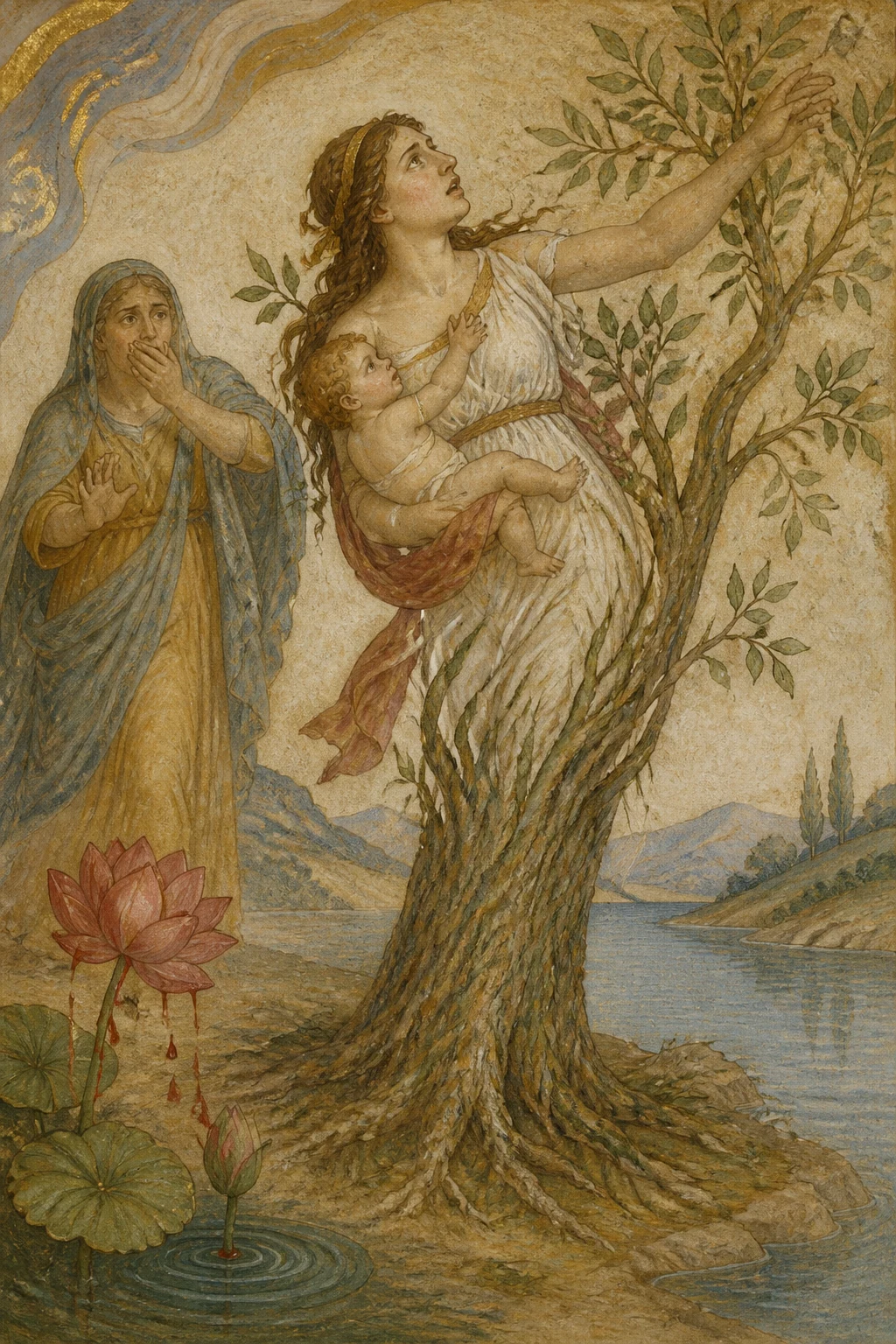
There, leaning against a palm and the tree of Pallas, Latona bore her twins, against their stepmother’s will. From there too, they say, the new-made mother fled from Juno, carrying in her arms her children, both divine. And now, in the land of Lycia, home of the Chimaera, as the fierce sun scorched the fields, the goddess, weary from her long ordeal, grew thirsty, parched by the blazing heat from heaven, and her hungry children had drained her milk-filled breasts.
By chance she caught sight of a pool of modest size deep in a valley; country folk were gathering bushy willow shoots there, along with rushes and the sedge that thrives in marshes. The Titan’s daughter approached and knelt upon the earth, meaning to scoop up the cool water and drink. The rustic crowd forbade her. The goddess addressed those who denied her: “Why do you keep me from the water? Water is for everyone to use.
Nature has made neither sunlight nor air the property of anyone, nor the flowing waters: I have come for a gift that belongs to all. Yet I beg you humbly to grant it. I did not intend to bathe my body here, or wash my weary limbs, but to relieve my thirst. My mouth is dry as I speak, my throat is parched, and scarcely lets my voice pass through. A draught of water will be nectar to me, and I shall acknowledge that with it I have received life: in giving water, you will have given life.
Let these children move you too, who stretch their little arms from my embrace”—and by chance the children were stretching out their arms. Who could have failed to be moved by the goddess’s gentle words? Yet they persisted in denying her pleas, adding threats unless she went far away, and insults besides. Nor was that enough: with their hands and feet they even stirred up the pool itself, and with spiteful leaps churned the soft mud this way and that from the bottom of the water.
Anger made her forget her thirst: the daughter of Coeus no longer begged favours of the unworthy, nor could she bear to speak words beneath a goddess any longer. Raising her hands to the stars, she said, “May you live for ever in that pool!” The goddess’s wish came true: they delight in being beneath the water, now plunging their whole bodies into the depths of the marsh, now putting out their heads, now swimming on the surface, often resting on the bank of the pool, often leaping back into the cold water. Yet even now they ply their ugly tongues in quarrels, and, casting off all shame, though they are beneath the water, beneath the water they still try to curse.
Their voices too are hoarse now, their puffed-up throats swell, and their very insults stretch their gaping mouths wide. Their heads touch their backs, their necks seem to have vanished, their backs are green, their bellies—the largest part of their bodies—white, and they leap about the muddy pool, newly fashioned frogs.’”