O besedilu
Driopa
- Vir
- Ovidove preobrazbe
- Avtor
- Ovid
- Jezik branja
- English
- Jezik izvirnika
- Latin
- Čas branja
- 4 min branja
- Obseg
- 3 strani
- Naslov izvirnika
- Dryope
O izvirniku
Ovidove preobrazbe
Pesniški tok antičnih preobrazb, kjer bogovi, ljudje in narava stalno menjavajo obliko. Bralni jezik je English, izvirnik pa prihaja iz vira Ovidove preobrazbe v jeziku Latin.
Besedilo
Driopa
She spoke, and, stirred by the memory of her old servant, groaned. Her daughter-in-law addressed her in her sorrow: “Yet you, mother, are moved by the loss of human form in one not of your blood. What if I told you the strange fate of my sister? Though tears and grief hinder me and will not let me speak. Her mother’s only child (my father had me by another woman), Dryope was famed for beauty among the women of Oechalia.
After she had lost her maidenhood, overcome by force by the god who rules Delphi and Delos, Andraemon took her as his wife and was thought fortunate in his bride. There is a lake whose sloping banks form a shelving shore, with groves of myrtle crowning their heights. Here Dryope had come, unaware of her fate—and, to make you feel the wrong more keenly, bearing garlands for the nymphs.
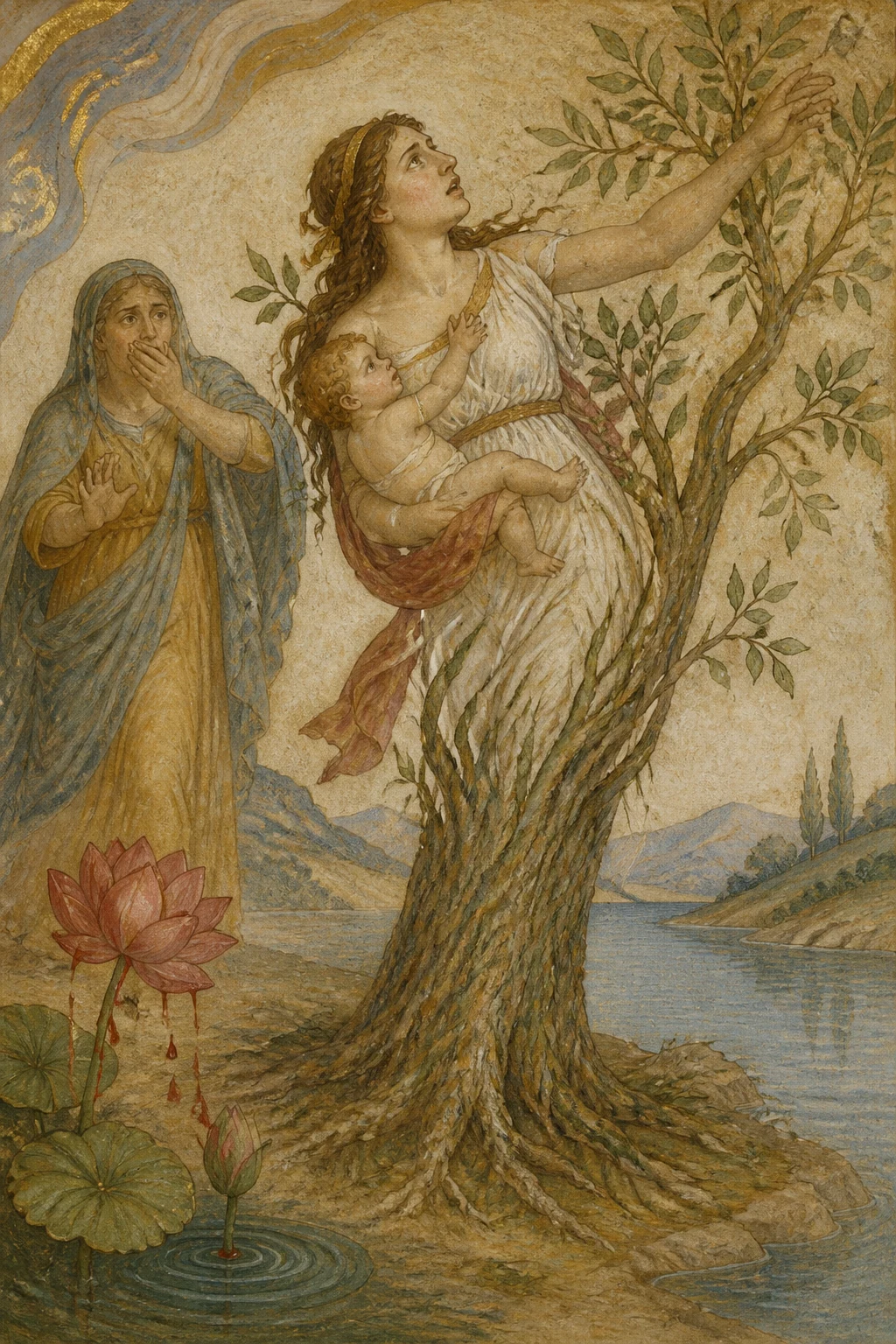
In her arms she carried her little boy, not yet a year old, a sweet burden, and nourished him with her warm milk. Not far from the pool a water-loving lotus tree, rivaling Tyrian purple, was in flower, promising berries. Dryope had picked some blossoms from it to offer her child for his delight, and I was about to do the same (for I was there), when I saw drops of blood fall from the flowers, and the branches shake with shuddering dread.
For, as the countryfolk now tell us, slow to speak at last, the nymph Lotis, fleeing Priapus’s lust, had changed her form into this tree, keeping her name. My sister did not know this. When, terrified, she wished to turn back and leave, after praying to the nymphs, her feet held fast as roots. She struggled to tear them free, but could move only her upper body. From below, pliant bark crept upward, slowly enclosing all her groin.
Seeing this, she tried to tear her hair with her hand, but filled her hand with leaves: leaves covered her whole head. But the child Amphissos—for his grandfather Eurytus had given him that name—felt his mother’s breasts grow hard, and no milk flowed when he suckled. I stood there watching that cruel event, unable to help you, sister; with all my strength I clasped the growing trunk and branches, holding them back, and, I confess, I longed to be enclosed within the same bark.
Then her husband Andraemon and her wretched father arrived, asking for Dryope. As they searched for Dryope, I showed them the lotus tree. They kissed the still-warm wood and, flinging themselves down, clung to the roots of their beloved tree. Nothing but her face remained that was not wood, my dear sister’s face. Her tears bedewed the leaves formed from her suffering body, and, while she still could, while her mouth still gave her voice a passage, she poured these laments into the air: “If the wretched can be believed, I swear by the gods I have not deserved this dreadful fate: I suffer punishment without a crime.
I have lived innocently. If I lie, may I wither and lose these leaves of mine, and be felled by axes and burned. But take this baby from his mother’s branches and give him to a nurse; often, beneath my tree, let him drink his milk, and beneath my tree let him play! When he can speak, teach him to greet his mother and say in sorrow, ‘My mother is hidden in this trunk.’ But let him beware of pools, and pluck no flowers from trees, and let him think that every bush may be a god’s body!
Farewell, dear husband, and you, my sister, and my father! If you have any love for me, protect my leaves from the wound of the sharp pruning hook and the bite of grazing beasts. And since I am no longer allowed to lean toward you, raise yourselves up here and come to kiss me, while my lips can still be touched, and lift my little son. I can say no more. Already the soft inner bark creeps over my white neck, and I am hidden in the treetop.
Take your hands away from my eyes: without your kindness, let the bark that closes over them cover my dying eyes!” Her mouth ceased speaking and ceased to be in the same moment; and long after her body changed, the new branches still were warm.”
Izvirnik
Dryope
Naslednje strani prikazujejo izvirno besedilo za primerjavo.
Source ID: ovid_metamorphoses_story_063 Citation: Ovid, Metamorphoses 9.324-9.393 Original language: Latin Source: PerseusDL canonical-latinLit Source URL: https://github.com/PerseusDL/canonical-latinLit/blob/master/data/phi0959/phi006/phi0959.phi006.perseus-lat2.xml Segmentation certainty: medium 324: Dixit, et admonitu veteris commota ministrae 325: ingemuit. Quam sic nurus est adfata dolentem: 326: “Te tamen, o genetrix, alienae sanguine vestro 327: rapta movet facies. Quid si tibi mira sororis 328: fata meae referam? quamquam lacrimaeque dolorque 329: impediunt prohibentque loqui. Fuit unica matri
330: (me pater ex alia genuit) notissima forma 331: Oechalidum Dryope. Quam virginitate carentem 332: vimque dei passam Delphos Delumque tenentis 333: excipit Andraemon, et habetur coniuge felix. 334: Est lacus adclivis devexo margine formam 335: litoris efficiens: summum myrteta coronant. 336: Venerat huc Dryope fatorum nescia, quoque 337: indignere magis, nymphis latura coronas; 338: inque sinu puerum, qui nondum impleverat annum, 339: dulce ferebat onus tepidique ope lactis alebat.
340: Haud procul a stagno Tyrios imitata colores 341: in spem bacarum florebat aquatica lotos. 342: Carpserat hinc Dryope, quos oblectamina nato 343: porrigeret, flores, et idem factura videbar 344: (namque aderam): vidi guttas e flore cruentas 345: decidere et tremulo ramos horrore moveri. 346: Scilicet, ut referunt tardi nunc denique agrestes, 347: Lotis in hanc nymphe, fugiens obscena Priapi, 348: contulerat versos servato nomine, vultus.
349: Nescierat soror hoc. Quae cum perterrita retro 350: ire et adoratis vellet discedere nymphis, 351: haeserunt radice pedes. Convellere pugnat, 352: nec quicquam nisi summa movet. Subcrescit ab imo 353: totaque paulatim lentus premit inguina cortex. 354: Ut vidit, conata manu laniare capillos, 355: fronde manum implevit: frondes caput omne tenebant. 356: At puer Amphissos (namque hoc avus Eurytus illi 357: addiderat nomen) materna rigescere sentit 358: ubera, nec sequitur ducentem lacteus umor.
359: Spectatrix aderam facti crudelis opemque 360: non poteram tibi ferre, soror; quantumque valebam, 361: crescentem truncum ramosque amplexa morabar 362: et, fateor, volui sub eodem cortice condi. 363: Ecce vir Andraemon genitorque miserrimus adsunt 364: et quaerunt Dryopen: Dryopen quaerentibus illis 365: ostendi loton. Tepido dant oscula ligno 366: adfusique suae radicibus arboris haerent.
367: Nil nisi iam faciem, quod non foret arbor, habebat 368: cara soror: lacrimae misero de corpore factis 369: inrorant foliis, et, dum licet oraque praestant 370: vocis iter, tales effundit in aera questus: 371: “Siqua fides miseris, hoc me per numina iuro 372: non meruisse nefas: patior sine crimine poenam. 373: Viximus innocuae: si mentior, arida perdam 374: quas habeo, frondes et caesa securibus urar.
375: Hunc tamen infantem maternis demite ramis 376: et date nutrici; nostraque sub arbore saepe 377: lac facitote bibat nostraque sub arbore ludat! 378: Cumque loqui poterit, matrem facitote salutet, 379: et tristis dicat “latet hoc in stipite mater.” 380: Stagna tamen timeat nec carpat ab arbore flores, 381: et frutices omnes corpus putet esse deorum! 382: Care vale coniunx, et tu, germana, paterque!
383: Qui, siqua est pietas, ab acutae vulnere falcis, 384: a pecoris morsu frondes defendite nostras. 385: Et quoniam mihi fas ad vos incumbere non est, 386: erigite huc artus et ad oscula nostra venite, 387: dum tangi possunt, parvumque attollite natum. 388: Plura loqui nequeo. Nam iam per candida mollis 389: colla liber serpit, summoque cacumine condor. 390: Ex oculis removete manus: sine munere vestro 391: contegat inductus morientia lumina cortex!”
392: Desierant simul ora loqui, simul esse, diuque 393: corpore mutato rami caluere recentes.”
Nadaljuj z branjem