Prevod
All Lydia seethes, and through the towns of Phrygia the tale of what had happened spreads, filling the wide world with talk. Niobe had known her before her own marriage, when, still a maiden, she lived in Maeonia, near Sipylus; yet the punishment of Arachne, her countrywoman, did not teach her to yield to the gods or speak with greater humility. Much encouraged her pride; yet neither her husband's art, nor their noble birth, nor the power of their mighty kingdom delighted her so much, though all these things delighted her, as her own children. Niobe might have been called the happiest of mothers, had she not thought herself so.
For Manto, Tiresias's daughter, who foresaw the future, had passed through the streets, stirred by divine inspiration, prophesying: “Women of Thebes, come in throngs and offer incense with devout prayers to Latona and her two children, and bind your hair with laurel. Latona commands you through my lips.” They obey, and all the women of Thebes adorn their temples with leaves as ordered and offer incense and words of prayer to the sacred flames.
Now Niobe comes, surrounded by a great crowd of attendants, splendid in Phrygian robes interwoven with gold, and beautiful, so far as anger allows. Shaking her lovely head, her hair streaming down over both shoulders, she halts; then, standing tall, she casts her proud eyes around. “What madness,” she says, “to prefer gods you have only heard of to those you see! Why is Latona worshipped at the altars, while my divinity still receives no incense? Tantalus is my father, the only mortal permitted to share the tables of the gods; my mother is the sister of the Pleiades; mighty Atlas is my grandfather, who bears the vault of heaven on his shoulders.
Jupiter is my other grandfather; I glory in him as my father-in-law too. The peoples of Phrygia fear me; the royal house of Cadmus is under my rule, and the walls raised by my husband's lyre, with all their people, are governed by him and me. Wherever I turn my eyes within my house, boundless wealth meets my gaze. Add to this a beauty worthy of a goddess. Add seven daughters and as many sons, and soon sons-in-law and daughters-in-law.
Ask now what grounds I have for pride, and dare to prefer to me the Titaness Latona, daughter of some Coeus or other, to whom the vast earth once denied even a little place in which to give birth. Neither heaven nor earth nor sea would receive your goddess: she was an exile from the world, until Delos pitied her wanderings and said, ‘You wander a stranger on land, and I upon the waves,’ and gave her an unsteady refuge. She became the mother of two: a mere seventh of the children my womb has borne.
I am happy—who could deny it?—and happy I shall remain: who could doubt that either? My abundance has made me secure. I am too great for Fortune to harm; though she take much away, she will leave me far more. My blessings have put me beyond fear. Suppose some of this multitude of children could be taken from me: even so, I should not be stripped down to a mere two, Latona's brood. How far is she from childlessness?
Go! Enough of this worship! Go quickly, and take the laurel from your hair.” They remove it and leave the rites unfinished, yet worship the goddess in hushed murmurs, as they still may. The goddess was outraged, and on the highest peak of Cynthus she addressed her twin children in these words: “See how I, your mother, proud to have borne you, who would yield to none among goddesses except Juno, am questioned whether I am a goddess at all, and barred from altars worshipped through the ages, unless you help me, my children.
Nor is this my only grievance: the daughter of Tantalus has added insults to her dreadful deed, and dared to rank you below her children, calling me childless—may that word recoil upon her!—and wickedly displaying her father's tongue.” Latona was about to add entreaties to her tale, but Phoebus said, “Enough! Long complaints only delay her punishment.” Phoebe said the same; and gliding swiftly through the air, hidden by clouds, they reached the citadel of Cadmus.
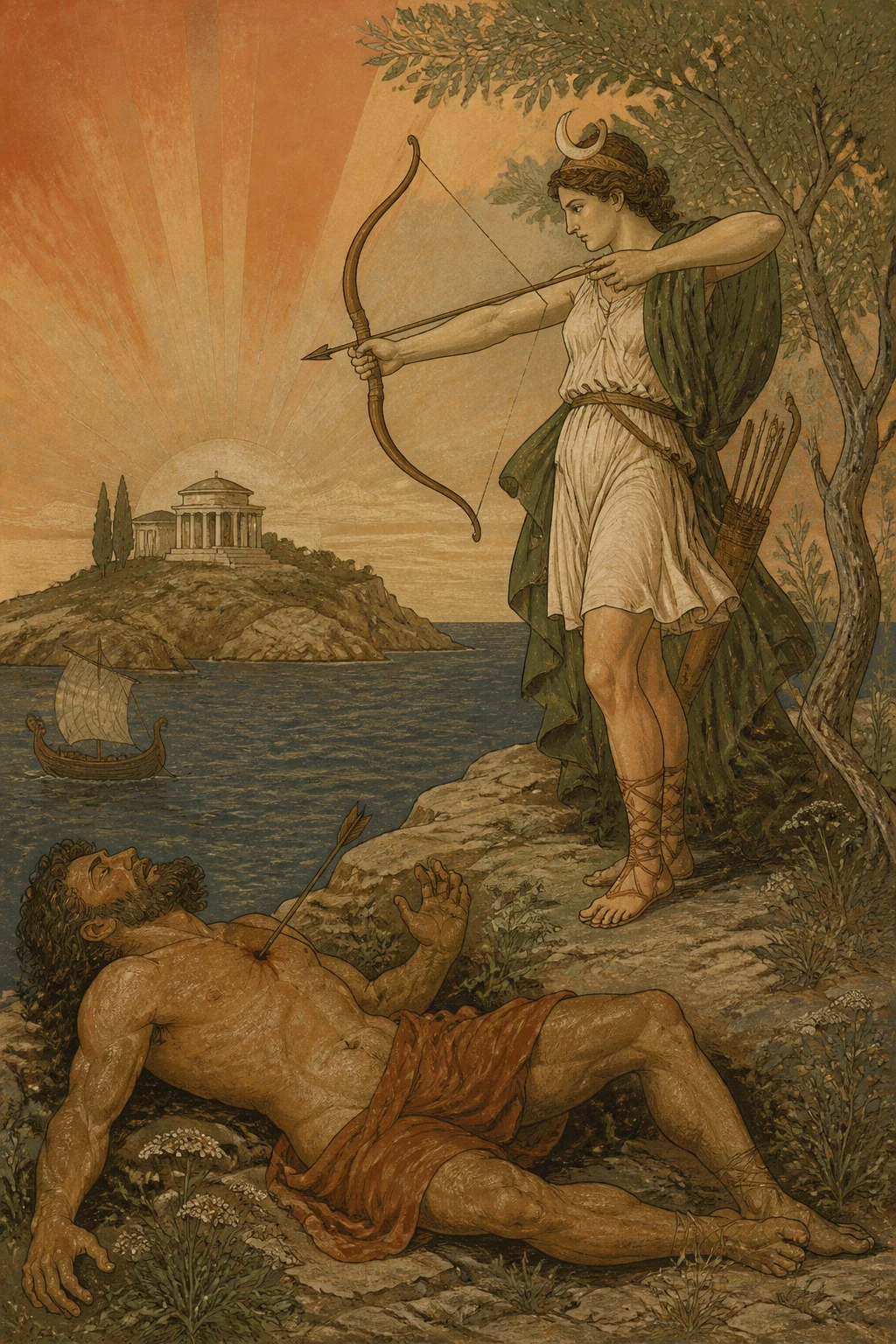
Near the walls lay a broad, level plain, continually pounded by horses, where countless wheels and hard hooves had softened the clods beneath them. There some of Amphion's seven sons were mounting their spirited horses, sitting on saddlecloths crimson with Tyrian dye, and handling reins heavy with gold. Among them was Ismenus, once the first burden his mother bore. As he guided his horse's course in a steady circle, checking its foaming mouth, he cried, “Ah, me!” An arrow stood fixed in the middle of his chest; his dying hand released the reins, and slowly he slipped sideways over the horse's right shoulder.
Next Sipylus, hearing the rattle of a quiver in the empty air, gave his horse the reins, as a sailor, foreseeing rain, flees at the sight of a cloud and unfurls all his hanging sails, lest the faintest breeze escape him. Yet as he gave rein, an inescapable arrow overtook him: it lodged quivering high in his neck, and its naked iron point protruded from his throat.
Pitched forward as he was, he rolled down over the flying legs and mane, and stained the earth with his warm blood. Unhappy Phaedimus and Tantalus, who bore his grandfather's name, had finished their usual exercises and turned to the young men's sport of the oil-slick wrestling ground. Already they had locked themselves in a close embrace, struggling chest to chest, when an arrow loosed from the taut string pierced them both, just as they stood entwined.
Together they groaned, together their limbs twisted in pain and sank to earth, together as they lay their eyes rolled for the last time, together they breathed their last. Alphenor saw them and, tearing and beating his breast, flew to lift their cold limbs in his arms, and fell in that act of brotherly devotion: for the Delian god pierced his inmost heart with deadly iron.
When he pulled it out, part of his lung came away on the barbs, and his blood poured into the air with his breath. But long-haired Damasichthon was struck by more than one wound. He was hit where the lower leg begins, where the sinewy knee makes a supple joint. And while he tried to draw out the deadly shaft with his hand, another arrow drove through his throat up to its feathers.
His blood forced it out, then shot high into the air and spurted far, piercing the empty space. Last, Ilioneus raised his arms in prayer, though prayer would do no good. “O gods, all of you together,” he cried, not knowing that not all should be implored, “spare me!” The archer was moved, but by then the arrow could not be recalled. Yet the boy died of the slightest wound: the shaft had barely pierced his heart.
News of the disaster, the people's grief, and her household's tears told the mother of this sudden ruin. She marvelled that the gods had had the power, and raged that they had dared such a deed, that their authority was so great. For the father, Amphion, had driven a sword through his breast and in dying ended both his grief and his life. Ah, how different this Niobe was from the Niobe who had just driven the people from Latona's altars and walked through the city with her head held high, the envy of her people, but now pitied even by an enemy.
She flung herself upon the cold bodies, bestowing last kisses at random on all her sons. Then, lifting her bruised arms from them toward heaven, she said, “Feed, cruel Latona, on my anguish, feed, and glut your heart upon my grief! Glut your savage heart,” she said, “with seven funerals! I myself am borne to burial. Exult, my enemy, and triumph in your victory! But why call it victory? In my misery I still have more than you in your happiness: even after so many deaths, I win.”
She had spoken, and the string rang out from the bended bow. The sound terrified everyone except Niobe alone: her misery made her bold. In black robes, their hair unbound, the sisters stood before their brothers' biers. One of them, pulling at the arrow lodged in her flesh, sank dying, her face resting on her brother. Another, trying to comfort her wretched mother, fell suddenly silent and doubled over at the wound.
Only as her breath was leaving her did she close her lips. One collapsed in fruitless flight; another died upon her sister; one hid; another could be seen trembling. When six had been given to death, suffering different wounds, the last remained. Her mother covered her with her whole body, with all her robes, and cried, “Leave me one, the youngest! Of so many I ask only the youngest—only one!”
And as she pleaded, the child she pleaded for fell dead. Bereft, she sat among her lifeless sons and daughters and her husband, and hardened in her grief. No breeze stirred her hair; the colour in her face was bloodless; her eyes stood fixed in her sorrowful face; nothing in her form remained alive. Within, her very tongue froze against her hard palate, and her veins could no longer move; her neck could not bend, her arms could make no movement, her feet could not walk; even her inward organs were stone.
Yet still she weeps. Enfolded in a mighty whirlwind, she was swept back to her native land. There, fixed upon a mountain peak, she melts in tears, and even now the marble streams with them.