O besedilu
Salmakida in Hermafrodit
- Vir
- Ovidove preobrazbe
- Avtor
- Ovid
- Jezik branja
- English
- Jezik izvirnika
- Latin
- Čas branja
- 7 min branja
- Obseg
- 5 strani
- Naslov izvirnika
- Salmacis and Hermaphroditus
O izvirniku
Ovidove preobrazbe
Pesniški tok antičnih preobrazb, kjer bogovi, ljudje in narava stalno menjavajo obliko. Bralni jezik je English, izvirnik pa prihaja iz vira Ovidove preobrazbe v jeziku Latin.
Besedilo
Salmakida in Hermafrodit
She had finished, and the wondrous tale had held them spellbound. Some denied that it could have happened; others declared that true gods could do anything—but they did not count Bacchus among them. When her sisters fell silent, Alcithoe was called upon. Passing her shuttle through the warp of the upright loom, she said, “I shall leave untold the well-known love of the shepherd Daphnis of Ida, whom a nymph, enraged by a rival, turned to stone—so fierce a pain burns in lovers’ hearts.
Nor shall I tell how Sithon, the laws of nature strangely altered, once shifted between the sexes, now a man, now a woman. You too I pass over, Celmis, now adamant, once the most faithful friend of infant Jupiter; the Curetes, born from a mighty downpour; and Crocus, changed with Smilax into tiny flowers. Instead, I shall hold your hearts with the charm of something new.
Learn why Salmacis is infamous, why its enfeebling waters sap the strength and soften the limbs they touch. The cause lies hidden; the spring’s power is known far and wide. A boy born to Mercury and the goddess of Cythera was reared by naiads in the caves of Ida. In his face both mother and father could be recognized, and from them both he took his name. As soon as he had reached his fifteenth year, he left his native mountains and Ida, where he had been nursed, delighting in wandering through unknown lands and seeing unfamiliar rivers, his eagerness lightening the toil.
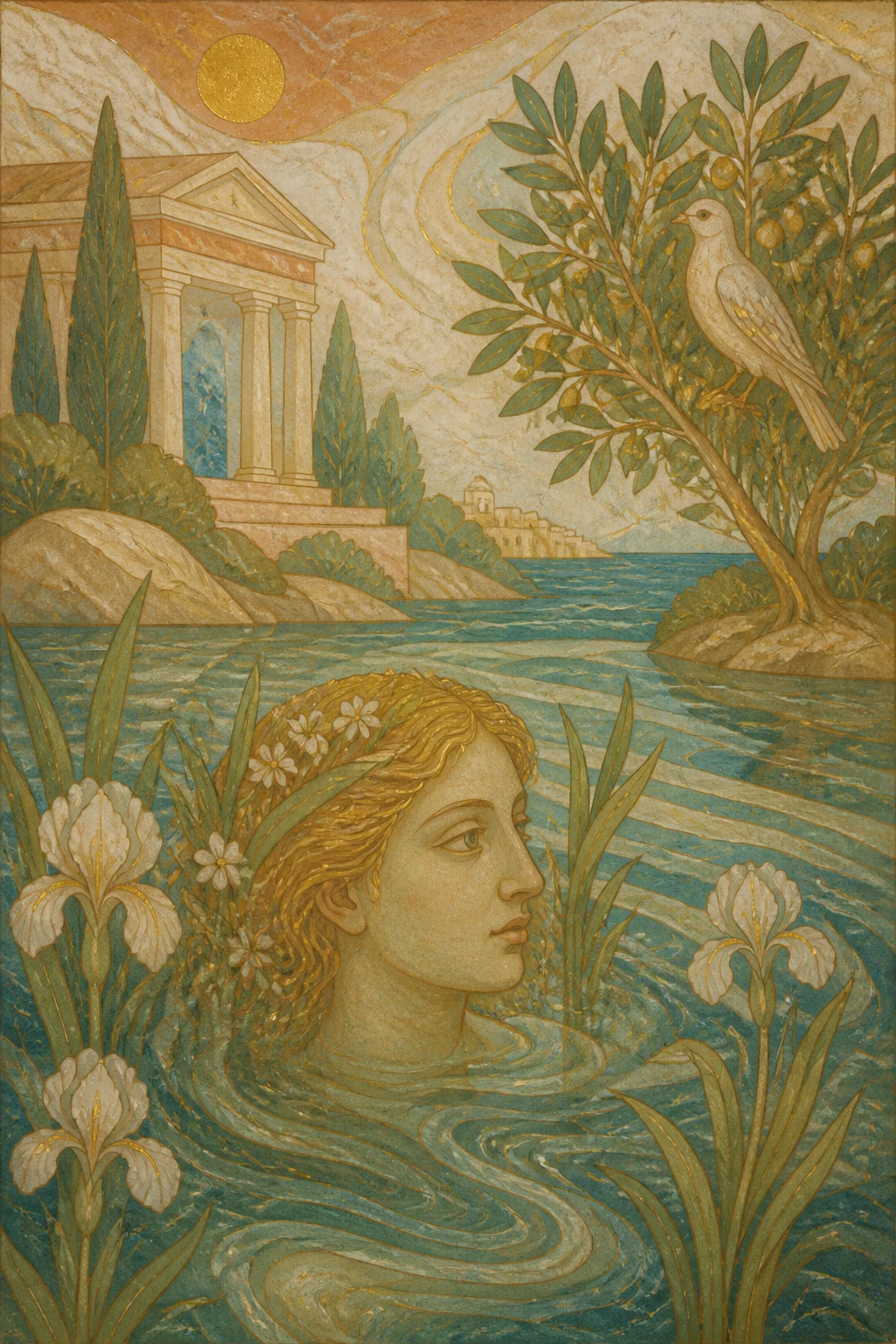
He visited the cities of Lycia and the Carians who dwell nearby. Here he saw a pool whose water shone clear to the very bottom. No marsh reeds grew there, no barren sedge, no rushes with their pointed tips. The water was transparent, but the pool’s edges were ringed with living turf and grasses always green. A nymph dwelt there, but she had no taste for hunting, nor was she accustomed to bending the bow or racing on foot: alone among the naiads, she was unknown to swift Diana.
Often, they say, her sisters told her: “Salmacis, take up a javelin or a painted quiver, and temper your idleness with the rigors of the hunt.” But she took up neither javelin nor painted quiver, nor tempered her idleness with the rigors of the hunt. Instead, she would bathe her lovely limbs in her own spring, often drawing a comb of Cytorian boxwood through her hair, and consulting her reflection in the water to see what suited her.
Or, with her body wrapped in a translucent robe, she would recline on soft leaves or soft grass. Often she gathered flowers, and she happened to be gathering them when she saw the boy—and, seeing him, longed to have him. Yet, eager though she was to approach him, she did not go until she had composed herself, inspected her robe, arranged her expression, and made sure she deserved to seem beautiful.
Then she began: “Boy, most worthy to be thought a god, if you are a god, you must be Cupid; if mortal, blessed are those who brought you into the world, happy your brother, and fortunate indeed any sister you may have, and the nurse who gave you her breast. But far, far happier than all of them is she, if you have a bride, if you deem anyone worthy of marriage. If there is such a woman, let mine be a secret pleasure; if there is none, let me be yours, and let us share one marriage bed.”
With this the naiad fell silent. A blush marked the boy’s cheeks, for he did not know what love was; yet even blushing became him. Such is the color of apples hanging on a sunlit tree, or of tinted ivory, or of the moon when a reddish hue flushes her pale face and bronze clashes vainly to her aid. The nymph kept begging for at least a sister’s kisses, and was already reaching for his ivory neck, when he said, “Will you stop? Or I shall run away and leave you to all this.”
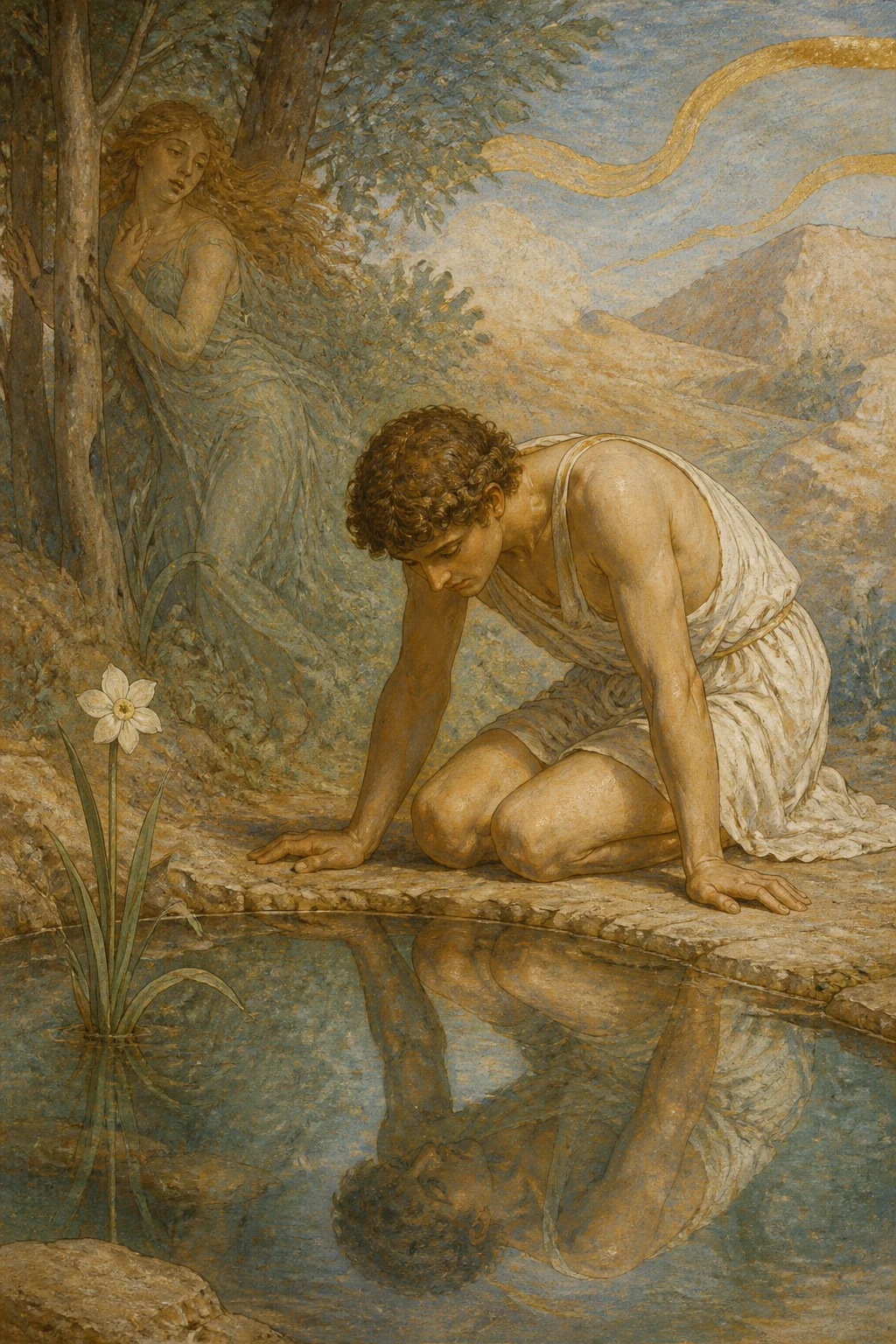
Salmacis grew frightened. “I surrender this place to you, stranger,” she said, and turned as though to leave, still looking back. Then, hidden in a thicket of shrubs, she crouched down on bended knees. But he, believing himself alone and unobserved on the deserted grass, wandered here and there, and in the rippling water dipped his toes and then his feet up to the ankles.
Soon, charmed by the soothing warmth of the water, he stripped the soft garments from his youthful body. Then indeed he pleased her, and desire for his naked beauty set Salmacis ablaze. The nymph’s eyes too shone with fire, just as when the sun, dazzling in a cloudless sky, flashes back from a mirror held to catch its image. She could scarcely bear to wait, scarcely postpone her pleasure; already she longed to embrace him, scarcely restraining her frenzy.
He slapped his body briskly with cupped palms and plunged into the pool. As he drew his arms in alternating strokes, his body gleamed through the clear water, like ivory statues or white lilies enclosed in transparent glass. “I have won! He is mine!” cried the naiad, and, flinging all her clothes aside, she plunged into the heart of the pool. She held him as he fought, snatching kisses as he struggled, slipping her hands beneath him and touching his unwilling breast, twining herself about the boy, now on this side, now on that.
At last, as he resisted and tried to slip away, she entwined him like a serpent that the royal eagle has caught and carried high: hanging in the air, it binds the bird’s head and feet and coils its tail around the outspread wings; or like ivy winding itself around tall trunks, or an octopus beneath the waves, holding its captured prey with tentacles reaching out on every side.
The descendant of Atlas held firm, denying the nymph the pleasure she hoped for. She pressed against him, clinging with her whole body, and said, “Struggle as you may, cruel boy, you shall not escape. Grant this, you gods: let no day ever part him from me, or me from him!” Her prayers found gods to hear them: their two bodies, mingling, fused together, and one form enfolded them both.
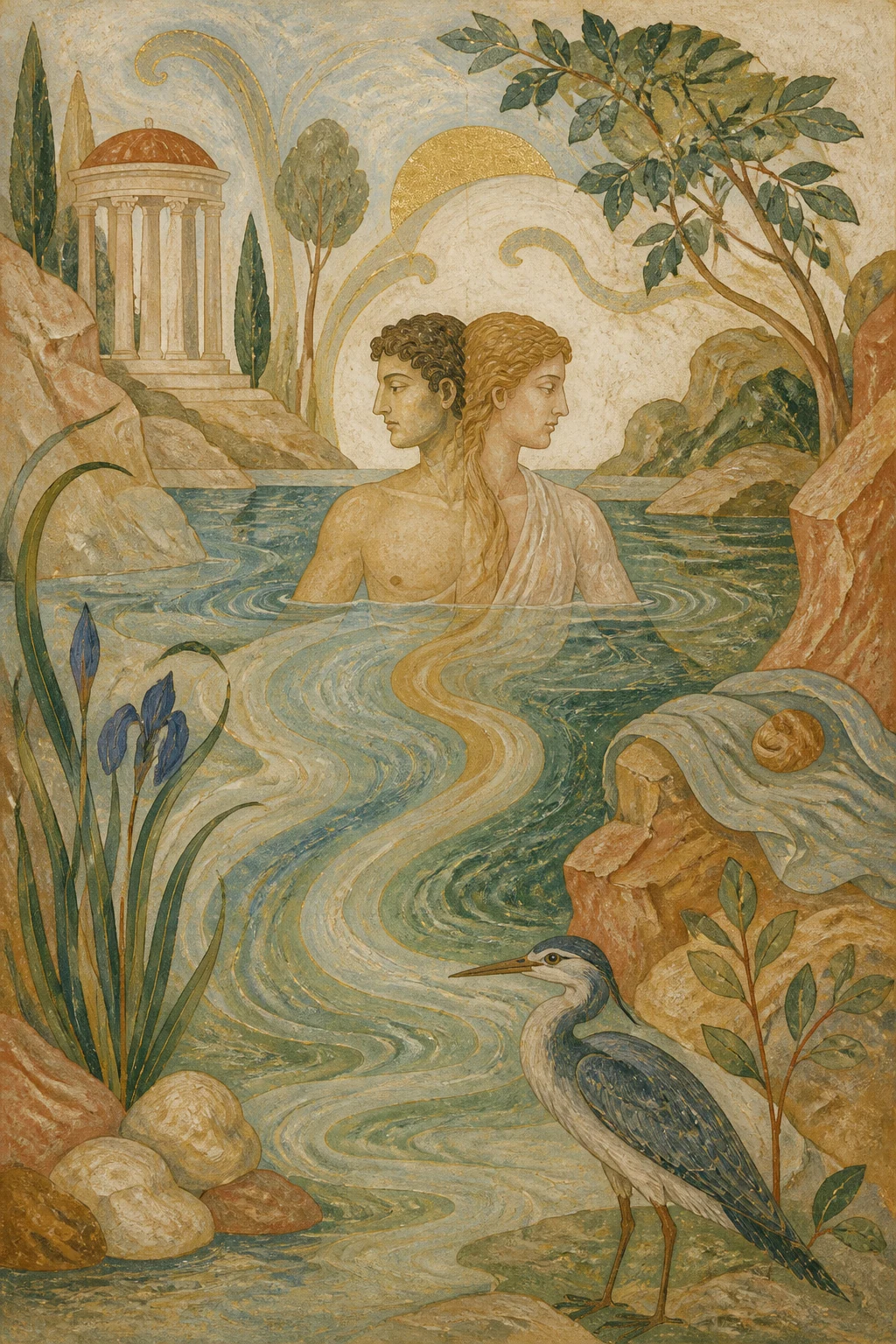
Just as someone grafting branches beneath a single bark sees them join as they grow and mature together, so, when their limbs united in that clinging embrace, they were no longer two, but a twofold form, which could be called neither woman nor boy: they seemed neither and both. When he saw that the clear waters he had entered as a man had left him only half a man, and that his limbs had softened there, Hermaphroditus stretched out his hands and spoke, though no longer in a man’s voice: “Father and mother, grant this gift to your son, who bears the names of both of you: whatever man comes into this spring, let him leave it half a man, suddenly softened by the touch of its waters.”
Both parents, moved, made their two-formed son’s words come true, and tainted the spring with a corrupting power.”
Izvirnik
Salmacis and Hermaphroditus
Naslednje strani prikazujejo izvirno besedilo za primerjavo.
Source ID: ovid_metamorphoses_story_027 Citation: Ovid, Metamorphoses 4.271-4.388 Original language: Latin Source: PerseusDL canonical-latinLit Source URL: https://github.com/PerseusDL/canonical-latinLit/blob/master/data/phi0959/phi006/phi0959.phi006.perseus-lat2.xml Segmentation certainty: medium 271: Dixerat, et factum mirabile ceperat aures. 272: Pars fieri potuisse negant, pars omnia veros 273: posse deos memorant: sed non et Bacchus in illis.
274: Poscitur Alcithoe, postquam siluere sorores. 275: Quae radio stantis percurrens stamina telae 276: “vulgatos taceo” dixit “pastoris amores 277: Daphnidis Idaei, quem nymphe paelicis ira 278: contulit in saxum (tantus dolor urit amantes). 279: Nec loquor, ut quondam naturae iure novato 280: ambiguus fuerit modo vir, modo femina Sithon. 281: Te quoque, nunc adamas, quondam fidissime parvo, 282: Celmi, Iovi, largoque satos Curetas ab imbri 283: et Crocon in parvos versum cum Smilace flores 284: praetereo, dulcique animos novitate tenebo.
285: Unde sit infamis, quare male fortibus undis 286: Salmacis enervet tactosque remolliat artus, 287: discite. Causa latet, vis est notissima fontis. 288: Mercurio puerum diva Cythereide natum 289: naides Idaeis enutrivere sub antris; 290: cuius erat facies, in qua materque paterque 291: cognosci possent; nomen quoque traxit ab illis. 292: Is tria cum primum fecit quinquennia, montes 293: deseruit patrios, Idaque altrice relicta 294: ignotis errare locis, ignota videre 295: flumina gaudebat, studio minuente laborem.
296: Ille etiam Lycias urbes Lyciaeque propinquos 297: Caras adit. Videt hic stagnum lucentis ad imum 298: usque solum lymphae. Non illic canna palustris 299: nec steriles ulvae nec acuta cuspide iunci: 300: perspicuus liquor est; stagni tamen ultima vivo 301: caespite cinguntur semperque virentibus herbis. 302: Nympha colit, sed nec venatibus apta, nec arcus 303: flectere quae soleat nec quae contendere cursu, 304: solaque naiadum celeri non nota Dianae.
305: Saepe suas illi fama est dixisse sorores: 306: “Salmaci, vel iaculum vel pictas sume pharetras, 307: et tua cum duris venatibus otia misce.” 308: Nec iaculum sumit nec pictas illa pharetras, 309: nec sua cum duris venatibus otia miscet, 310: sed modo fonte suo formosos perluit artus, 311: saepe Cytoriaco deducit pectine crines 312: et, quid se deceat, spectatas consulit undas; 313: nunc perlucenti circumdata corpus amictu 314: mollibus aut foliis aut mollibus incubat herbis; 315: saepe legit flores. Et tunc quoque forte legebat, 316: cum puerum vidit visumque optavit habere.
317: Nec tamen ante adiit, etsi properabat adire, 318: quam se conposuit, quam circumspexit amictus, 319: et finxit vultum et meruit formosa videri. 320: Tum sic orsa loqui: “Puer o dignissime credi 321: esse deus, seu tu deus es, potes esse Cupido, 322: sive es mortalis, qui te genuere, beati, 323: et frater felix, et fortunata profecto, 324: siqua tibi soror est, et quae dedit ubera nutrix: 325: sed longe cunctis longeque beatior illa, 326: siqua tibi sponsa est, siquam dignabere taeda.
327: Haec tibi sive aliqua est, mea sit furtiva voluptas, 328: seu nulla est, ego sim, thalamumque ineamus eundem.” 329: Nais ab his tacuit. Pueri rubor ora notavit 330: (nescit enim, quid amor), sed et erubuisse decebat. 331: Hic color aprica pendentibus arbore pomis 332: aut ebori tincto est, aut sub candore rubenti, 333: cum frustra resonant aera auxiliaria, lunae.
334: Poscenti nymphae sine fine sororia saltem 335: oscula iamque manus ad eburnea colla ferenti 336: “desinis? aut fugio, tecumque” ait “ista relinquo.” 337: Salmacis extimuit “loca” que “haec tibi libera trado, 338: hospes” ait, simulatque gradu discedere verso, 339: tunc quoque respiciens, fruticumque recondita silva 340: delituit, flexuque genu submisit. At ille, 341: scilicet ut vacuis et inobservatus in herbis, 342: huc it et hinc illuc, et in adludentibus undis 343: summa pedum taloque tenus vestigia tingit; 344: nec mora, temperie blandarum captus aquarum 345: mollia de tenero velamina corpore ponit.
346: Tum vero placuit, nudaeque cupidine formae 347: Salmacis exarsit: flagrant quoque lumina nymphae, 348: non aliter quam cum puro nitidissimus orbe 349: opposita speculi referitur imagine Phoebus. 350: Vixque moram patitur, vix iam sua gaudia differt, 351: iam cupit amplecti, iam se male continet amens. 352: Ille cavis velox adplauso corpore palmis 353: desilit in latices, alternaque bracchia ducens 354: in liquidis translucet aquis, ut eburnea siquis 355: signa tegat claro vel candida lilia vitro.
356: “Vicimus et meus est!” exclamat nais et omni 357: veste procul iacta mediis inmittitur undis, 358: pugnantemque tenet luctantiaque oscula carpit, 359: subiectatque manus invitaque pectora tangit, 360: et nunc hac iuveni, nunc circumfunditur illac; 361: denique nitentem contra elabique volentem 362: inplicat, ut serpens, quam regia sustinet ales 363: sublimemque rapit: pendens caput illa pedesque 364: adligat et cauda spatiantes inplicat alas: 365: utve solent hederae longos intexere truncos, 366: utque sub aequoribus deprensum polypus hostem 367: continet, ex omni dimissis parte flagellis.
368: Perstat Atlantiades, sperataque gaudia nymphae 369: denegat. Illa premit, commissaque corpore toto 370: sicut inhaerebat, “pugnes licet, inprobe” dixit, 371: “non tamen effugies. Ita di iubeatis! et istum 372: nulla dies a me nec me diducat ab isto.” 373: Vota suos habuere deos: nam mixta duorum 374: corpora iunguntur, faciesque inducitur illis 375: una, velut, siquis conducat cortice ramos, 376: crescendo iungi pariterque adolescere cernit.
377: Sic ubi conplexu coierunt membra tenaci, 378: nec duo sunt et forma duplex, nec femina dici 379: nec puer ut possit: neutrumque et utrumque videntur. 380: Ergo ubi se liquidas, quo vir descenderat, undas 381: semimarem fecisse videt, mollitaque in illis 382: membra, manus tendens, sed non iam voce virili, 383: Hermaphroditus ait: “Nato date munera vestro, 384: et pater et genetrix, amborum nomen habenti: 385: quisquis in hos fontes vir venerit, exeat inde 386: semivir et tactis subito mollescat in undis.”
387: Motus uterque parens nati rata verba biformis 388: fecit et incesto fontem medicamine tinxit.”
Nadaljuj z branjem