Prevod
Nekoč je živel mož, ki je bil tak bahač, da je bilo komaj kaj od tega, kar je povedal, res. Nekega dne se je pogovarjal z nekaj znanci in dejal: »Ni mi treba delati ali si s čim beliti glave. Če bi hotel, bi bil lahko bogatejši od samega kralja, saj imam hčer, ki zna iz slame presti zlato.«
Plemič, ki je šel mimo, je to slišal, odšel h kralju in mu povedal, kaj je mož govoril. Kralj tiste dežele pa je imel zlato silno rad; nikoli se ga ni mogel nasititi. Takoj je poslal po bahača in njegovo hčer ter ju dal privesti v palačo. Pripeljali so ju pred kralja, ki je sedel na prestolu, in ta je rekel: »Slišal sem, da si se bahal, da zna tvoja hči iz slame presti zlato. Je to res?«
Mož se je ob teh besedah silno prestrašil, vendar si ni upal zanikati tega, kar je že povedal. »Da, vaše veličanstvo, tako sem rekel,« je odgovoril.
»Prav,« je rekel kralj. »Kmalu bomo izvedeli, ali si govoril resnico ali ne. Za tvojo hčer sem dal pripraviti veliko sobo. Polna je slame. Ukazal bom, naj jo odpeljejo tja, in če bo iz slame napredla zlato, boš bogato nagrajen, če pa ji ne uspe, bosta oba strogo kaznovana.«
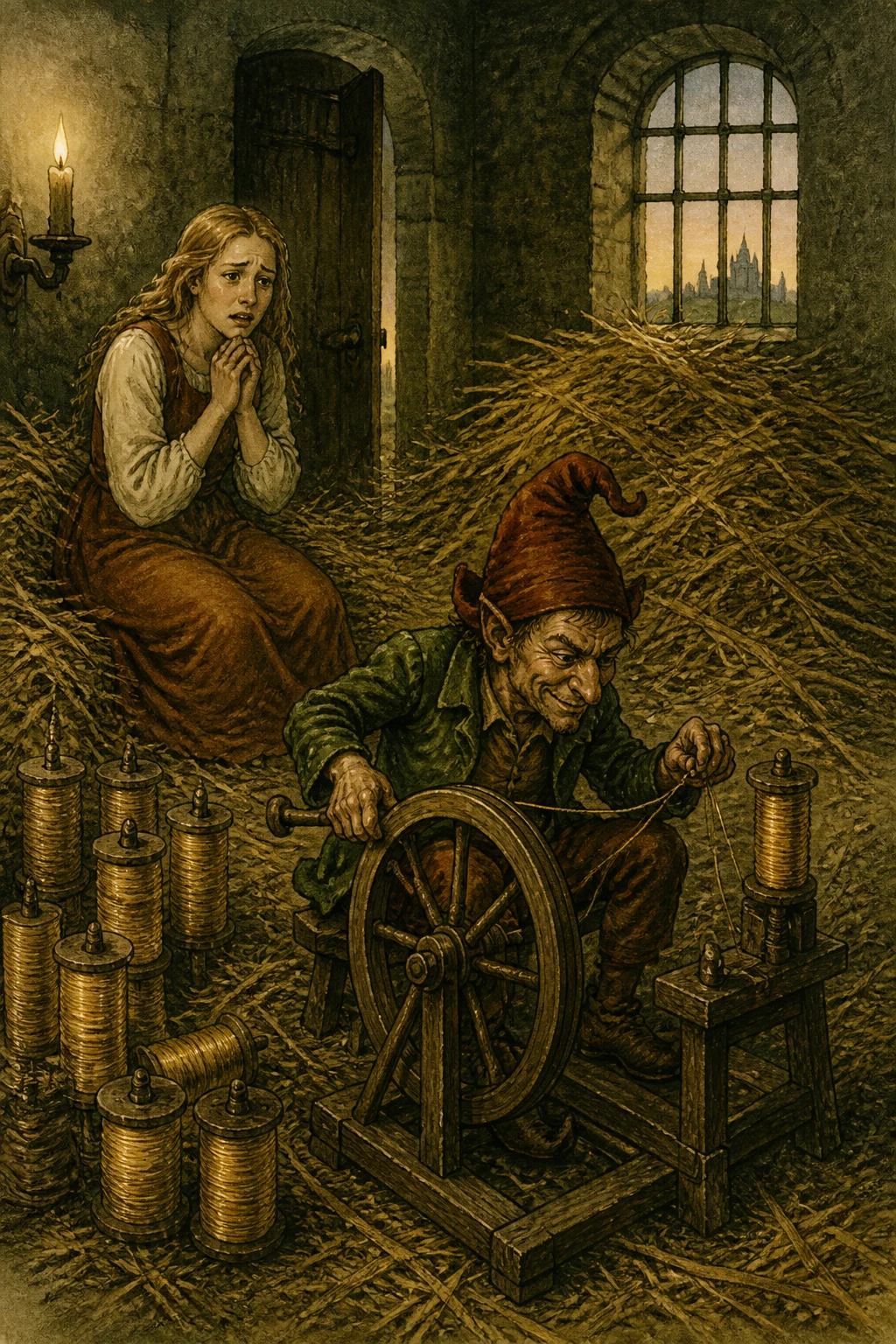
Oče in hči sta se ob teh besedah zgrozila. Nista vedela, kaj bo z njima. Bahaču so dovolili oditi domov, dekle pa so odpeljali v veliko sobo, polno slame, in jo pustili tam. Sedela je in jokala in jokala.
Kmalu so se vrata odprla in v sobo je stopil majhen, sključen škrat rjave polti. »No, no, kakšen hrup,« je rekel. »Zakaj tako bridko jokaš?«
»Jokam, ker me je kralj zaprl sem, da bi iz te slame napredla zlato, jaz pa še tega ne vem, kako naj se dela lotim.« »Saj to ne bi smelo biti tako težko. Kaj mi daš, če to opravim namesto tebe?«
»Tole ogrlico, ki jo imam okoli vratu,« je reklo dekle. »Prav, daj mi jo.« Škrat je vzel ogrlico in sedel h kolovratu. Ni trajalo dolgo, pa je vso slamo spredel v zlato — cele kupe zlata. Nato je odskakljal proč in razen dekleta ga nihče ni videl ne priti ne oditi.
Zgodaj naslednje jutro je kralj prišel pogledat, kako gre dekletu delo od rok. Ko je namesto slame zagledal sobo, polno bleščečega zlata, ga je prevzelo veselje in začudenje. A kljub temu še ni bil zadovoljen. Odpeljal je dekle v še večjo sobo in tudi ta je bila polna slame.
»Zelo dobro si opravila,« je rekel, »vendar pričakujem, da se boš odrezala še bolje. Spredi mi to slamo v zlato in nagrada ti ne uide.« Potem je odšel in dekle pustil samo.
Sedela je in jokala in jokala. Kmalu so se vrata odprla in isti mali škrat je priskakljal v sobo. »Kaj mi daš,« je rekel, »če ti to slamo spredem v zlato?«
»Dam ti zlati prstan s svojega prsta,« je odgovorilo dekle. Škrat je sedel h kolovratu in kmalu je bila vsa slama spredena v zlato. Nato je dekletu snel prstan s prsta in odšel.
Ko je kralj naslednji dan prišel in zagledal vse tisto zlato, se je razveselil še bolj kakor prej. Zdaj je bil bogat kot sam cesar, a še vedno ni bil zadovoljen. Odpeljal je dekle v še večjo sobo in tudi ta je bila, kakor prejšnji, polna slame.
»Če boš tudi to spredla v zlato, boš postala moja nevesta,« je rekel. Komaj je kralj odšel, je v sobo že priskakljal škrat. »No,« je rekel, »kaj mi daš tokrat, če ti slamo spredem v zlato?«
»Ojoj, ojoj!« je zajokalo dekle. »Ničesar več nimam, kar bi ti lahko dala.« »Obljubi mi, da mi boš dala svojega prvega otroka, če se kralj poroči s teboj, pa ti bom pomagal,« je rekel škrat.
Dekle tega sprva ni hotelo obljubiti, potem pa je pomislilo, da je navsezadnje zelo malo verjetno, da bi se kralj res poročil z njo, in tudi če bi se, morda nikoli ne bi imela otroka. »Prav,« je rekla, »obljubim.«
Škrat se je glasno zasmejal in od veselja tlesknil s prsti. Nato je sedel h kolovratu in predel, da je kolo kar brnelo. Tako hitro se je vrtelo, da ga je bilo komaj mogoče videti. Kmalu je bila vsa slama spredena. »Tako,« je rekel, »zdaj me ne boš več potrebovala. A ne pozabi svoje obljube, kajti ob pravem času bom zagotovo prišel po otroka.« Nato je odskakljal proč in se med potjo smejal.
Nedolgo zatem je v sobo prišel kralj. Ni mogel več čakati, da bi videl, ali je dekle opravilo svojo nalogo. Ko je zagledal kupe zlata, večje kot kdaj prej, od sreče skoraj ni vedel, kaj bi sam s seboj.
»Zdaj sem zadovoljen,« je rekel. »Postala boš moja žena, kakor sem obljubil, tvojega očeta pa bodo pripeljali na dvor in postal bo mogočen plemič.« Kakor je kralj rekel, tako se je zgodilo. Z dekletom sta se poročila, po njenega očeta pa so poslali, da bi prišel živet na dvor.
Dekle je bilo zdaj zelo srečno. Ljubila je kralja in povsem pozabila na obljubo, ki jo je dala škratu. Čez leto dni se je kraljici rodil lep otročiček. Vse kraljestvo se je veselilo. Kralj pa je bil od radosti skoraj ves iz sebe.
Nekega dne, ko je kraljica sedela ob otrokovi zibelki, so se vrata odprla in v sobo je priskakljal mali sključeni škrat. Ko ga je kraljica zagledala, je pobledela kot papir.
»No,« je rekel škrat, »si pripravljena izpolniti obljubo, ki si mi jo dala, ko sem ti slamo spredel v zlato?« Kraljica ga je začela prositi in rotiti, naj ji pusti otroka in ga ne odpelje. Ponujala mu je zlato in dragulje, celo zlato krono s svoje glave, samo da bi ji pustil otroka. Toda ne in ne — škrat je imel zlata in draguljev več, kot si jih je želel. Hotel je mladega princa.
Naposled je rekel: »Poslušaj, dal ti bom eno priložnost. Če v treh dneh uganeš, kako mi je ime, smeš obdržati otroka, če pa ti ne uspe, mi ga moraš dati in o tem ne bova več razpravljala.«
Kraljica je rada privolila, saj ni niti malo dvomila, da bo uganila škratovo ime. Takoj ko je odšel, je poslala k vsem sosedom naokrog, da bi izvedela imena vseh moških, ki so jih poznali, in ko je škrat naslednji dan prišel, ga je pričakala pripravljena.
»Ti je ime John?« »Ne, ni.« »Je Henry?« »Ne.« »Je James ali Conrad ali Phillip ali Habbakuk?« »Ne, ne, ne; nobeno od teh ni.« Kraljica je naštela vsa imena, za katera je izvedela, a niti eno ni bilo pravo, in škrat je ves vesel odšel.
Naslednji dan je spet prišel in kraljica je imela pripravljen nov seznam imen, saj je razposlala sle na vse strani in ti so ji prinesli vsako ime, za katero so slišali. Toda škrat je pri vseh rekel ne. Niti eno ni bilo pravo. Kraljici je tedaj upadlo srce, vendar je zbrala pogum in takoj, ko je škrat odšel, poslala še druge sle. Ti pa niso prinesli niti enega imena, ki ga ne bi že poznala. Kraljica je obupala. Sedela je ob oknu in z otrokom v naročju čakala, da pride škrat.
Tedaj je zaslišala kraljevega gozdarja, ki se je na dvorišču pod oknom pogovarjal s svojo ljubico. Ničesar ni vedel o tem, da je kraljica razposlala sle na vse strani, da bi zbrali imena, saj je bil tri dni v gozdu. Svoji ljubici je pripovedoval, kako je prejšnjo noč zašel v gozdu. Nato je prišel do kotanje, polne skal, med katerimi je gorel rdeč ogenj. Okoli ognja je plesal majhen, sključen škrat in med plesom pel:
»Danes varim, nocoj pečem, jutri princa s sabo vlečem, saj nihče ne ve, če mu ne povedo, da Krhkonog je moje ime.«
Ko je kraljica to slišala, se je glasno zasmejala. Nato je vstala, položila otroka v zibelko in gozdarju poslala sporočilo, naj nikomur drugemu ne pove, kaj je videl v gozdu.
Nedolgo zatem je škrat prišel kakor po navadi. »No, si uganila moje ime?« je vprašal. »Če ga nisi, mi moraš dati otroka.« Kraljica se je pretvarjala, da je v hudi stiski. »Ti je — ti je ime Kratkonog?« je vprašala.
»Ne!« je vzkliknil škrat in oči so se mu zaiskrile. »Ti je ime Dolgoroki?« »Ne!« je zavpil škrat in od veselja poskakoval. »Ti je — ti je morda ime Krhkonog?«
Ko je kraljica to izrekla, je škrat od besa zakričal. Obraz mu je najprej potemnel kot nevihtni oblak, nato pa pordečel kot ogenj. »Nekdo ti je povedal! Nekdo ti je povedal!« je vreščal in tako močno udaril z nogo ob tla, da se mu je stopalo pogreznilo vanje in ga ni mogel izvleči. Zato je tako silovito stresal nogo, da se mu je odtrgala, in odskakljal proč ter jo pustil za seboj. Kaj se je potem zgodilo z njim, ni nikoli nihče izvedel. Kraljica pa je odtlej živela srečno in brez skrbi.
Izvirnik
There was once a man who was such a boaster that scarcely a word he said was true. One day he was talking with some companions and he said, “I have no need to work or worry over anything. I could be richer than the King himself if I chose, for I have a daughter who can spin straw into gold.”
A nobleman who was passing by overheard this, and he went to the King and repeated to him what the man had said.
Now the King of that country was very fond of gold; he never could have enough of it. He at once sent to the boaster’s house and had him and his daughter brought to the palace. They were brought to where the King sat, and the King said, “I hear that you have boasted that your daughter can spin straw into gold. Is that true?”
The man was very much frightened when he heard this, but he was afraid to deny what he had already said.
“Yes, your majesty, that is what I said,” he answered.
“Very well,” said the King. “We shall soon know whether you have spoken the truth or not. I have had a large room made ready for your daughter. It is filled with straw. I will have her taken to it, and if she spins it into gold you shall be well rewarded, but if she fails you shall both be punished severely.”
Both the father and daughter were terrified at these words. They did not know what would become of them. The boaster was allowed to go home, but the girl was taken to a large room filled with straw, and was left there. She sat and cried and cried.
Presently the door opened and a crooked little brown dwarf came into the room.
“Tut, tut, what a noise,” said he. “Why are you crying so bitterly.”
“I am crying because the King has put me here to spin this straw into gold, and I do not know how to set about it.”
“That should not be such a hard matter. What will you give me if I do it for you?”
“This necklace around my neck,” said the girl.
“Very well, give it to me.” The dwarf took the necklace and sat down to the spinning wheel, and it did not take him long to spin all the straw into gold—heaps and heaps of it. Then he hopped away, and no one saw him come or go but the girl.
Early the next morning the King came to see how the girl was getting on. When he saw the room full of glittering gold instead of straw he was filled with joy and wonder. But for all that he was not satisfied. He led the girl into a still larger room, and it, too, was full of straw.
“You have done very well,” said he, “but I expect you to do still better. Spin this straw into gold for me and the reward shall not be lacking.” Then he went away, leaving the girl alone.
She sat and cried and cried.
Presently the door opened, and the same little dwarf came hopping into the room.
“What will you give me,” said he, “if I spin this straw into gold for you?”
“I will give you the gold ring from my finger,” answered the girl.
The dwarf sat down at the spinning wheel, and soon all the straw was spun into gold. Then the dwarf took the ring from the girl’s finger and went away.
The next day, when the King came and saw all the gold he was even more delighted than before. He was now as rich as any emperor, but even yet he was not content. He took the girl into a still larger room, and it, like the others, was full of straw.
“If you will spin this, too, into gold, then you shall be my bride,” said he.
The King had scarcely left her before the dwarf came hopping into the room. “Well,” said he, “what will you give me this time if I spin the straw into gold for you?”
“Alas, alas!” cried the girl, “I have nothing more to give.”
“Promise me that if the King marries you, you will give me your first child, and I will help you,” said the dwarf.
At first the girl did not want to promise this, but then she thought that after all it was very unlikely the King would marry her, and even if he did she might never have a child. “Very well,” said she, “I promise.”
The dwarf laughed aloud and snapped his fingers with joy. Then he sat down at the spinning wheel and spun till the wheel whirred. You could scarcely see it, it flew so fast. Soon all the straw was spun. “There,” said he, “now you will not need me again. But do not forget your promise, for at the right time I shall certainly come to claim the child.” Then he hopped away, laughing as he went.
Not long afterward the King came into the room. He could wait no longer to see whether the girl had finished her task. When he saw the heaps of gold, more than ever before, he hardly knew what to do with himself, he was so happy.
“Now I am satisfied,” said he. “You shall be my wife, as I promised, and your father shall be brought to court and become a great nobleman.”
As the King said, so it was done. He and the girl were married, and her father was sent for to come and live at the court.
And now the girl was very happy. She loved the King, and she had forgotten all about the promise she had made to the dwarf.
At the end of a year a fine little child was born to the Queen. The whole kingdom was filled with rejoicings. As to the King he was almost beside himself with joy.
One day, as the Queen was sitting by the baby’s cradle, the door opened, and the crooked little dwarf hopped into the room. When the Queen saw him she turned as white as paper.
“Well,” said the dwarf, “and are you ready to keep the promise you made when I spun the straw into gold for you?”
Then the Queen began to beg and entreat that the dwarf would leave the baby with her, and not take it away. She offered him gold and jewels, and even the golden crown from her head, if he would only leave her the child. But no—no—the dwarf had gold and jewels, more than he cared for. It was the young Prince he wanted.
At last he said, “Listen, I will give you one chance. If within three days you can guess what my name is you shall keep the child, but if you fail in this then you must give him to me, and no more words about it.”
To this the Queen agreed willingly, for she had no fear but what she could guess the dwarf’s name.
As soon as he had gone she sent out to all the neighbors round to learn what were the names of all the men they knew, and when the dwarf came the next day she was ready for him.
“Was his name John?” “No, it was not.” “Was it Henry?” “No.” “Was it James or Conrad or Phillip or Habbakuk?” “No, no, no; it was none of them.” The Queen went over all the names she had learned, but not one of them was the right one, and the dwarf went away rejoicing.
The next day he came again and the Queen had a fresh list of names ready, for she had sent out messengers far and wide, and they had brought back every name they could hear of. But the dwarf said no to all of them. Not one of them was right. Then the Queen’s heart sank within her, but she plucked up courage, and as soon as the dwarf had gone, sent out other messengers, but these brought back not a single name but those she knew already. The Queen was in despair. She sat at the window and waited for the dwarf to come, and she held the baby in her arms.
Then she heard the King’s forester talking to his sweetheart in the courtyard below. He had heard nothing of how the Queen had sent far and wide to gather names, for he had been off in the forest for three days. The forester told his sweetheart how he had lost his way in the forest the night before. Then he had come to a hollow, and it was full of rocks, and a red fire was burning among them. Around this fire a crooked little dwarf was dancing and as he danced he sang:
“To-day I brew, to-night I bake, To-morrow I the young prince take, For none could guess, unless they were told That Brittle-Legs is the name I hold.”
When the Queen heard that, she laughed aloud. Then she arose and put the baby down, and sent word to the forester that he should tell no one else of what he had seen in the forest.
Not long afterward the dwarf came as usual.
“Well, and have you guessed my name?” he asked; “for if you have not I must have the child.”
The Queen pretended to be in great trouble. “Is it—is it Short-Shanks?” she asked.
“No,” cried the dwarf and his eyes shone like sparks.
“Is it Long-Arms?”
“No,” shouted the dwarf, and he hopped up and down with joy.
“Is it—is it by any chance Brittle-Legs?”
When the Queen said that the dwarf gave a scream of rage. His face grew first as black as thunder, and then as red as fire.
“Someone has told you! Someone has told you!” he shrieked and he stamped so hard that his foot sank down into the floor and he could not pull it out, so he shook it off and hopped away, leaving one leg behind him, and what became of him after that nobody ever knew. But the Queen lived happy and untroubled forever after.