Prevod
It is night. The temperature is twenty below zero. Outside, not the slightest sound can be heard: the snow, falling in fine, exquisitely delicate flakes that cushion the air, helps sustain the absolute, muffled silence weighing on the gardens in their fantastic whiteness. The snow has traced with exquisite care the outlines of the tree-lined avenues, the flower beds, the groves, the icebound ponds whose smooth surfaces were scored by skates at the last skating party, which so amused the court because the Prince of Circassia took several resounding tumbles. The statues seem to shiver, decked in ornaments of icicles. The conifers are embroidered, sculpted masses of ice. On the palace, the cornices, the balconies, the turrets, the monumental ornamentation of the façade, the clock supported by Spirits representing the destinies of the imperial house triumphing over Time, are gradually disappearing beneath the soft white padding. Shivering in their sentry boxes, feeling their breath first freeze and then melt inside the high collars of their military greatcoats, the sentries stamp their feet on the ground and think of the guardroom, where the stove is burning and a man can take a swig of something fermented; from time to time they send their guttural cry of “All’s well!” through the snow. The ornamental clock strikes twelve, slowly, as though the hour it tells were more solemn than any other. The clock outside is answered by those within, on their console tables; they have the piping, well-modulated little voices of courtiers.
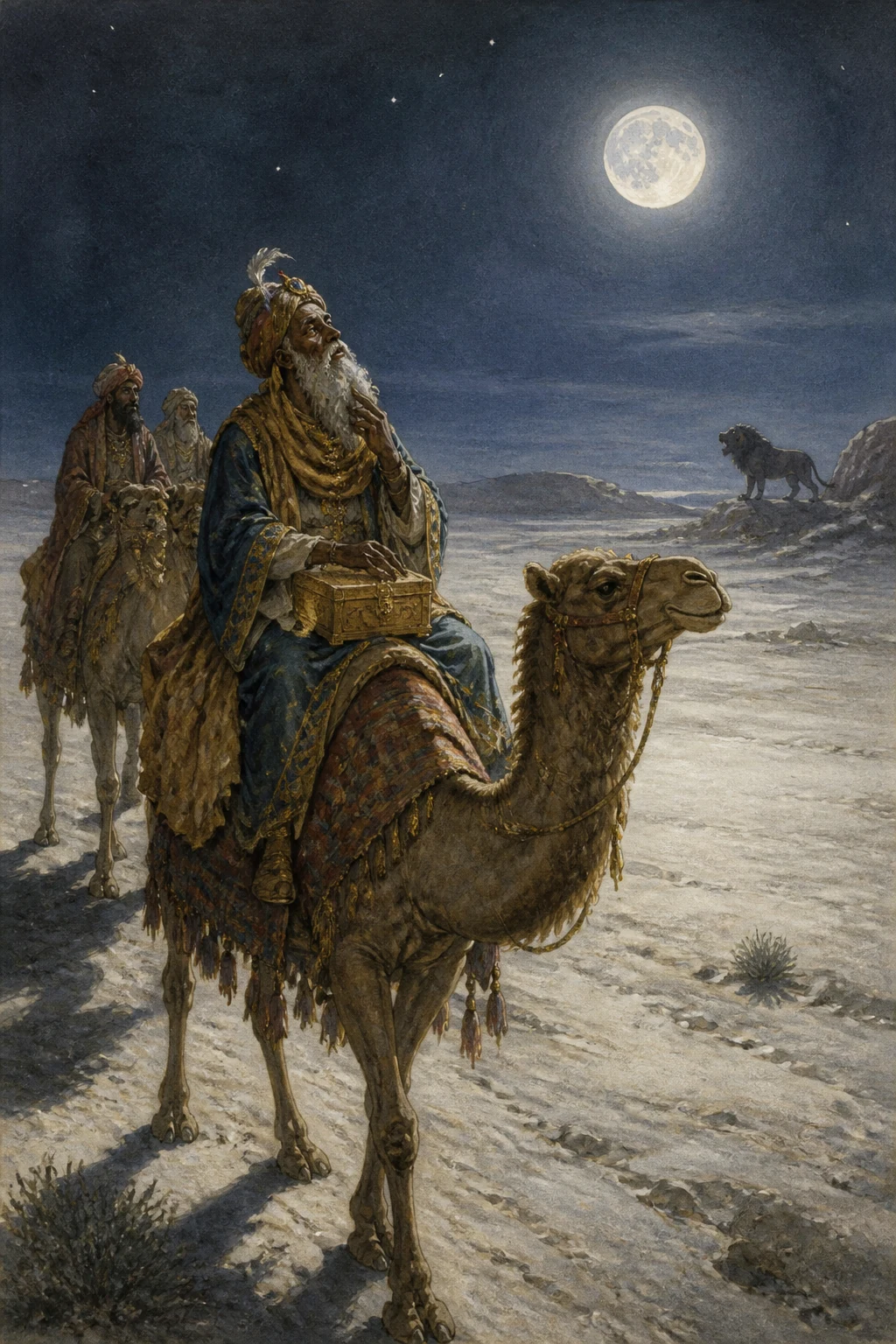
The emperor shudders and sits up in the great ivory-inlaid bed, amid the rarest of furs that cushion it. He has the impression that a hand has just been laid on his shoulder; and indeed, by the light of the lace-veiled alabaster lamp, he sees a venerable figure, an old man haloed by an immensely long beard and flowing hair in which the snow seems to have tangled its fleece. The old man’s garments dazzle: a tunic of gold brocade, a mantle of violet velvet edged with ermine. A kind of mitre, with pearls clustered over its filigree, encircles his temples, compressing his great snowy mane and making it billow out in abundant waves over his shoulders. In his hand he carries an open, finely chased casket filled with impalpable gold dust.
“What do you want of me, and who are you?” the emperor asks the old man. “One of the family. Baltasar, king of the lands of the East,” the patriarch replies in a tremulous voice.
“Welcome, my royal cousin! Why does Your Majesty travel on so bitter a night? Crowned heads should never expose themselves to the discomforts suffered by other mortals. May Your Majesty deign to rest beneath my hospitable roof.”
“I can accept only for a few moments, though I am exhausted from crossing Your Majesty’s dominions, which seem to have no end: they must cover a good part of the planet’s surface.”
“Ah!” says the emperor, pleased. “Has Your Majesty travelled through them? Have you acquainted yourself with their extent and wealth? Every climate, every kind of produce, every race acknowledges my sovereignty. When I review my army, I see white-skinned, fair-haired soldiers with blue eyes; soldiers of dusky complexion; soldiers with yellow skin and flattened noses; Oriental garments and wrappings that ward off the harshness of the seasons in the hyperborean lands. My empire yields wheat and sapphires, minerals, furs, and fragrant woods; it is a giant whose head, like Your Majesty’s, is bathed in Arctic snows, and whose hands stretch towards the South to embrace it. And in this Empire I am God. At my voice, heads bow, multitudes prostrate themselves, prayers for me set the iconostases trembling. While the hurricane’s breath makes playthings of the Western monarchs, our foolish cousins, I, like a divinity, remain hidden in an inaccessible sanctuary.”
“I know Your Majesty’s might. That is why I suspect the task entrusted to me may prove fruitless; but in obedience, I carry it out.”
“What task is that, my royal cousin?” “The one the Child commanded me to perform. I am returning from Palestine, going home after my interminable yearly journey... It is a wonder how lovely the Child is, and how sweet and pure his Mother! Their immortal beauty has lost nothing in the nineteen hundred and two years since I first adored them. As always, I brought them my offering: gold dust from Ophir. And the Child, after holding out his little hands, which I kissed, and blessing the gold, told me to sprinkle it on the ground wherever I see man assailing the freedom of man.”
“So those are the tricks the Child is learning?” stammered the emperor. “His Mother and the carpenter are certainly bringing him up very badly—lowborn people, after all, though he is descended from the line of our august cousins, the kings of Judah! Your Majesty, with the experience your years afford you, must have understood that this whim of the Child’s ought not to be indulged.”
“It is impossible to disobey him, my royal cousin,” the Magus declared gravely. “I have sprinkled the vast expanse of land over which Your Majesty reigns, though I confess I doubt I shall see anything germinate upon the hard crust of ice that covers it. Without hope I go on scattering gold dust; and yet, a moment ago, in the gardens of this palace, as the golden dust fell, I thought the ground stirred and the layer of snow cracked. The earth trembled; I fancied a cavernous rumbling sounded deep within it. Is Your Majesty certain there are no mines beneath your palace?”
“Your Majesty is the one undermining it, and that must be stopped,” the emperor answers forcefully, striking a bell. The guard appears. The old man takes a pinch of dust, flings it into the soldiers’ eyes, and passes freely and majestically through their midst.
Another scene of snow upon gardens and a royal palace, but snow now packed hard and beginning to melt into filthy, blackish mud. Lights can still be seen in the palace: there has been a splendid family supper in the private dining room, with merry, affectionate toasts, and the emperor, worn out by receiving congratulations all afternoon, after blessing his children, who have respectfully kissed his hand one by one, and fondly embracing the prolific empress, stretches out on his narrow, hard camp bed, the only one on which habit allows him to fall asleep.
He has scarcely begun to doze when someone calls to him with a very soft “Psst!” and by the glow of the night-light he makes out a man in the prime of life, wrapped in a purple robe beneath which armour of admirable workmanship can be seen. A pointed crown encircles his temples; in his right hand he holds aloft a precious flask of myrrh, with a pungent, heady fragrance.
“What does Your Majesty desire, King Gaspar?” asks the emperor, who, recognising the traveller, leaps from his bed and gives a military salute. “To wish Your Majesty a happy Christmas and entrust you with a secret. The fact is that the Child—you know, Your Majesty, the Child whom I visit every year in his stable, to drink wisdom from his violet eyes!—after playing with this myrrh I offered him and breathing his heavenly breath upon it, commands me to scatter it, drop by drop, over the soil of the countries where man thirsts for the blood of man. And as the drops of this myrrh fall, my royal cousin, I see the sodden, clinging earth grow loose and open, and olive trees, roses, myrtles, rye, hops, and vines laden with grapes spring up and grow. Ah! This myrrh is a great marvel. And as for me, my royal cousin, my armour stifles me; my heart can no longer fit within it. Allow me to sprinkle Your Majesty’s august head with myrrh.”
“What the devil! Childish nonsense!” the emperor growled. “When the Child grows up and leaves his mother’s skirts and lap behind, his fancies will be different. Nothing is holier than war. God himself guides armies and instils in their commanders the courage and judgement to secure victory. Above the battlefield hovers the Archangel, his wings spattered with rubies, his sword aflame. The divine breath swells my breast the moment the gleaming cuirass covers it. Such things are beyond the understanding of children and women; granted. We, the shepherds of peoples, the leaders of races, smile at certain charming outbursts of weakness.”
“I must do as I am commanded,” Gaspar insists. And taking a few drops of myrrh, he flicks them onto the emperor’s forehead. The emperor gives a sigh, sinks onto his camp bed, and sees in a dream a towering pyramid of human bones, white and polished. On its summit a raven croaks plaintively, hungry, its feathers ruffled; and at its foot, in the branches of a young olive tree, two doves kiss, touching beaks.
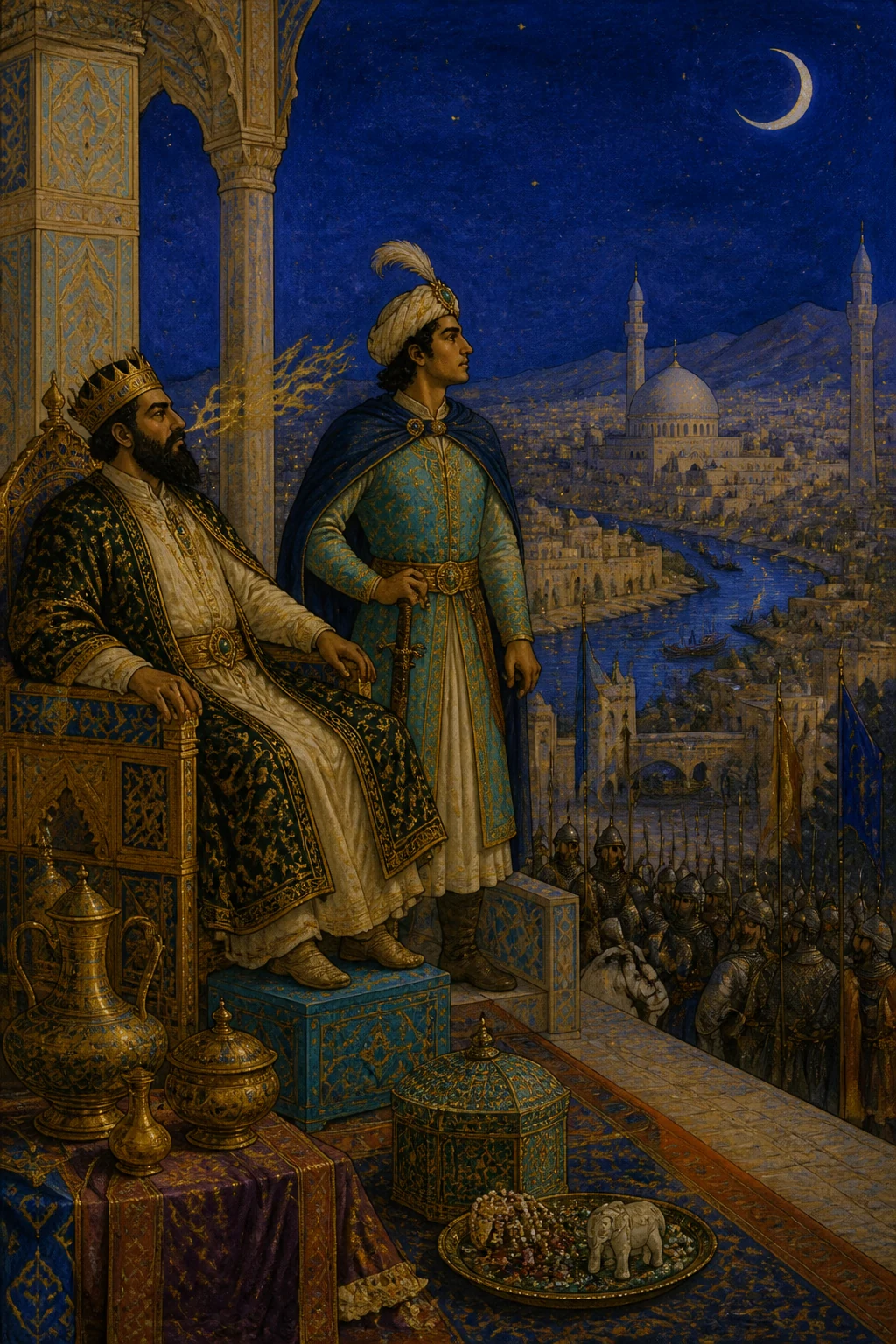
In the palace courtyard, water falls back into the great porphyry basin supported by lions, melodious in its gentle persistence. The moon lights the filigreed arcades, plays upon the glossy leaves of the orange trees, reveals the pale gleam of their golden fruit. Two slaves watch over the sleep of the emir, who lies fully dressed on a divan, covered with a blanket of fine ostrich feathers—for the night is rather cold, and frost has hardened the desert roads—with his foot resting on the throat of a naked woman, who serves as a cushion and provides a more pleasing warmth than the blanket.
An elegant figure slips unseen between the slaves. He is a young black man, slender, with strong, steely muscles and sinewy legs encased in tight hose spangled with sequins like those worn by the youths in Carpaccio’s paintings; a surcoat of silver tissue outlines his figure; a jewelled belt holds a magnificent dagger against his lean belly; a crimson velvet cap sits jauntily upon his tightly curled hair, and beneath its brim gleams a diamond diadem. The handsome black man bends over the emir and bathes his face in a waft of incense smoking in a pierced censer suspended from little chains of pearls. With a start, the emir wakes and reaches for his curved dagger.
“Do not be afraid. I am Melchor, who, like you, rules over tribes of the desert and possesses mysterious palaces that seem to have been wrought by the spirits of the air. I come to carry out the commands of the Child Yesuá, son of Leila Mariem.”
“And what does that infidel prophet command you to do?” the emir exclaims scornfully. “To swing this censer in every country where man treats woman as a slave rather than a companion.”
The emir laughs, showing his white jackal’s teeth amid his black, silky beard. “Then go back to the land of the Rumis, Melchor. They too need the fragrance of your censer. But first, rest. You are my guest; I shall order two beautiful captives to prepare you a bath of rosewater.”
And the Emir sits up, kicking the woman on whose throat his foot had been resting.