Prevod
On their journey, guided day and night by the Star’s trail of light, the Magi wished to stop and rest at the foot of the walls of Samaria, which rose upon a hill among olive groves and hedges of thorny cactus. But an indefinable instinct moved them to change their minds: the city of Samaria was the most dangerous place they could have chosen to halt. Herod had just rebuilt it upon the ruins heaped up centuries before by the soldiers of Alexander the Macedonian, and it was inhabited by Roman settlers who had lately exchanged the short sword for the plow and winnowing fork: men wholly devoted to the bloodthirsty Tetrarch, and ready to suspect any foreigner or traveler, if not to rob him of his jewels and provisions.
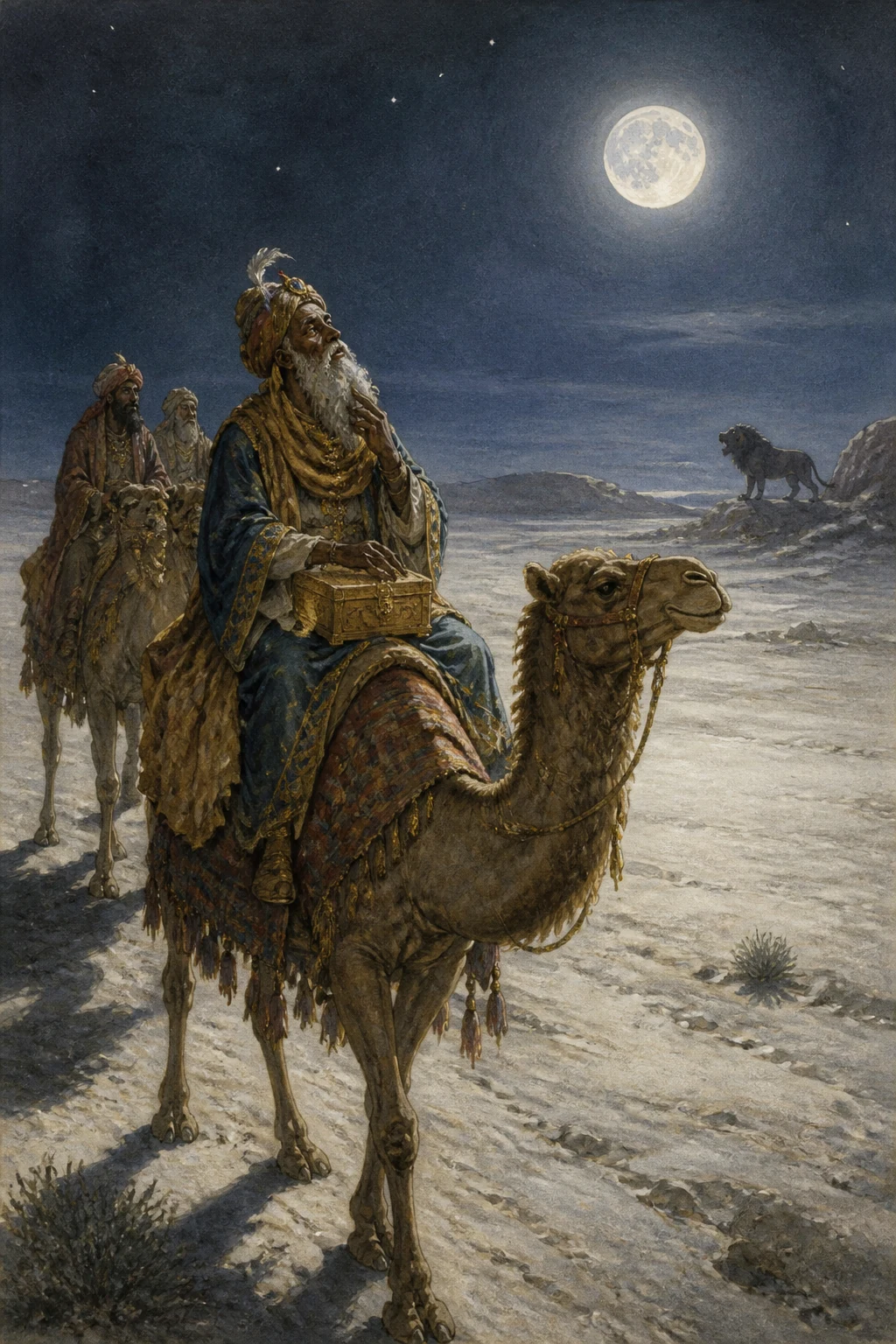
They continued on their way, then, crossing fields sown with wheat, avoiding the double row of lofty columns that marked the triumphal entrance to the city, and seeking the shade of olive and fig trees, the oasis of some silvery spring. The sun was scorching, and near the little town of Bethulia the bareness of the landscape and the whiteness of the rocks seared their eyes. “We shall find nothing there but wells and cisterns, and I long to drink water that I can see welling up before me,” murmured the aged King Baltasar, rolling his dry tongue against his palate, his eyes thirstier even than his throat. He remembered the broad rivers of his beloved Iran, the immense expanse of the Indus, the cool and mysterious Lake Bakhtegan, along whose shaded shores gazelles gambol. The plain, uniform and monotonous, stretched as far as the eye could see: hayfields and expanses covered with thorns and weeds were all the horizon offered; in the ultramarine sky, the blood-red clouds of the west devoured the Star’s radiance, hiding it from sight. Then Melchor, the Black king, dismounts and, folding his arms across his breast, kneels without a thought of soiling his rich robe of silver brocade, fringed with emeralds and peacock feathers. He takes up a handful of sand and brings it to his lips, imploring:
“Heavenly power, give my mouth no other drink, but do not hide your light from me. Let the Star shine again!” Like a lamp replenished with oil, the Star blazed and sparkled. At the same moment the other two Magi cried out with joy: they had caught sight of the white dwellings and clusters of age-old palms of En-Ganim. In Palestine, to see palm trees is to see a spring. Joyfully the company made for the oasis, and when they discovered the water and heard its refreshing murmur, they all dismounted from their camels and dromedaries and prostrated themselves in thanksgiving, while the animals stretched out their necks and muzzles, scenting the moist breath of the stream. Once they had drunk, filled their waterskins, and washed their feet and faces, they made camp and slept peacefully there beneath the palms, in the light of the Star, which shone serenely high in the heavens.
At dawn they prepared to set out once more in search of the Child. The morning was clear and radiant. The flocks of En-Ganim were going out to pasture, and the countless white sheep moving across the plain resembled phantom armies. They could tell they were nearing the region where Jerusalem stood by the greater richness of the soil, the green of the thick moss, the abundance of grass and little wildflowers that winter had failed to wither. Baltasar and Gaspar pondered, swaying to the vigorous rhythm of their mounts’ long strides. They thought of that Child, king of kings, whom a decree of the stars commanded them to revere and worship and lavish with gifts and homage. In that Child, surely, the irresistible might of the monarchs of Judah and Israel would blossom anew: lions in battle, supremely fortunate rulers in peace; and the vast kingdom, with its memories of glory, filled the minds of the two Magi. What wisdom, what divinely imparted knowledge Solomon had possessed, he who had subdued all his neighbors, from the Egyptian Pharaohs to the trading emporiums of Tyre and Sidon; he who had built the gigantic Temple, with its seas of bronze, its golden lampstands, its awe-inspiring, veiled tabernacle, its forests of columns of marble, jasper, and serpentine, its coral inlays and ivory overlays! What magnificence in the king whose welcome had dazzled the Queen of Sheba, Balkis of the perfumes, who brought with her the treasures of the East and rarities from the three parts of the world, gathered for her alone, which she cast, wrapped in purple cloths, at the foot of the king’s throne! Closing their eyes, Baltasar and Gaspar saw the scene: strings of pearls spilling loose, elephant tusks displaying their intricate carvings, censers smoking and releasing fragrant clouds, little monkeys playing, pheasants and peacocks spreading their tails, zither players and harpists plucking their strings, and Balkis, wrapped in her long robe embroidered with turquoise and topaz, sheltered from the sun by immense feather fans, advancing with open arms to receive Solomon in her embrace... They could not doubt it: the Child they were going to worship would in time be another Solomon, greater, stronger, wealthier, more learned than the king of old. He would subdue all nations; he would wear the crown of the Universe, and beneath his diamond-studded throne the oppressive city of Latium would prostrate itself; yes, the ravenous Roman she-wolf, tamed at last, would lick the feet of that wondrous Child...
While they turned these thoughts over in their minds, the Star faded and vanished. They found themselves lost, without a guide, in the vast plain. They looked about them and, to their surprise, discovered that Melchor had become separated from them. A thick, gloomy mist rising from the swamps and marshes must surely have deceived them and led them astray. Troubled and sorrowful, they tried to find their bearings; but their habit of following the Star and their utter ignorance of the country through which they traveled were insurmountable obstacles. It occurred to them to seek a guide, and they called out into the wilderness, for they could see no one, nor any trace of human habitation. At last a very young shepherd appeared, clad in blue wool, his garment secured at the brow with a roll of white linen. And when he heard that the travelers were seeking the Child king, the country boy smiled joyfully and offered to lead them.
“I worshipped him on the night he was born...” he said in rapture. “Then take us to his palace, and we shall reward you.” “To his palace! The Child is in a little cave where we often shelter the livestock in bad weather.”
“What, has he no palace? No guards?” “A mule and an ox warm him with their breath...” replied the shepherd. “His mother and his father, Joseph the carpenter of Nazareth, tend him and watch over him lovingly...”
Gaspar and Baltasar exchanged a glance that betrayed confusion, astonishment, and suspicion. The shepherd must be mistaken; it was impossible that so great a king should have been born like this, in poverty and neglect. What were they to do? Should they ask Melchor’s advice? But Melchor, enveloped in mist, walked steadily on; the Star had not dimmed for him. He was already far away when at last he heard his companions calling and shouting: “Ho there, Melchor! Wait for us!” The dark-skinned Magus stopped and called back: “I am here, I am here...”
When the caravan was at last reunited, Melchor saw the young shepherd and heard his news of the Child king. “This poor lad is deceiving us, or is himself deceived,” Gaspar exclaimed angrily. “He says he will lead us to a ruined stable, and that there we shall see the son of a carpenter from Nazareth. What do you think, Melchor? The most learned Baltasar fears we are in grave danger here, for we do not know the country, and if we venture to ask questions we shall arouse suspicion, be taken prisoner, and perhaps be shut away by Herod in his underground dungeons. The Star no longer shines, and our hearts are failing us.”
Melchor remained silent. For him the Star had not been hidden for a single second. On the contrary, its light grew more brilliant as they advanced, as they drew nearer the stable. And in his imagination Melchor saw it: a cave hollowed out of the limestone, a manger softly bedded with straw and hay, a young and heavenly-beautiful woman cherishing a tiny infant who trembles with cold; a humble Child, rosy, fair, who blesses and does not weep. The strange thing is that the cave, instead of being dark, is flooded with light, and that an ineffable music, barely perceptible, exquisitely delicate and melodious, resounds within it. The whole cave seems made of radiance and harmony. Melchor listens in ecstasy; he bathes, immerses himself in the delicious music and the golden splendor that fill the cavern and surround the Child.
“Do you not hear us, Melchor? We are asking whether we should continue our journey... or return to our own land, lest we be imprisoned and oppressed here.” “And do you not hear the music?” Melchor repeats, sweet tears slipping down his ebony cheeks.
“We hear nothing, we see nothing...” reply the two Magi, distressed. “Pray, and you shall see... Pray, and you shall hear... Pray, and God will reveal himself to you.” The Magi and their retinue dismount, spread their carpets, and, standing upon them with their faces turned toward the East, raise their prayer. And little by little the Star, like the gaze of a dying man that revives when a loved one approaches his bedside, begins to kindle and sparkle, until it fully lights the path that stretches away into the hills toward Bethlehem. The mist disperses; the landscape is cheerful, pastoral, fresh, and flowery despite the season; clear little streams thread the earth, and, as in May, birdsong rings out, accompanying the tinkle of sheep bells and the singing of shepherds reclining beneath the evergreen terebinths and cedars. Their prayer ended, the Magi set out, full of hope and confidence. A cohort of mounted soldiers meets the caravan: a Roman detachment, haughty and warlike; the sun strikes sparks from their breastplates and helmets; manes toss, pennants flutter, the horses’ hooves strike the ground with defiant fury. The Magi halt in fear. But the detachment passes beside them without showing any sign of noticing their presence. Not an eyelid flickers, not a head turns; they perceive nothing.
“They are blind,” Melchor exclaims; and the Magi quicken their pace as the cohort draws away.