Prevod
(The Magi return to their homeland by a different road from the one they came by, to elude the bloodthirsty Herod. It is night: the star no longer guides them; but the moon, shining with an intense and silvery light, splendidly illuminates the desert plain. The shadows of the dromedaries loom enormous on the smooth white ground, and far away a lion’s cavernous roar resounds.)
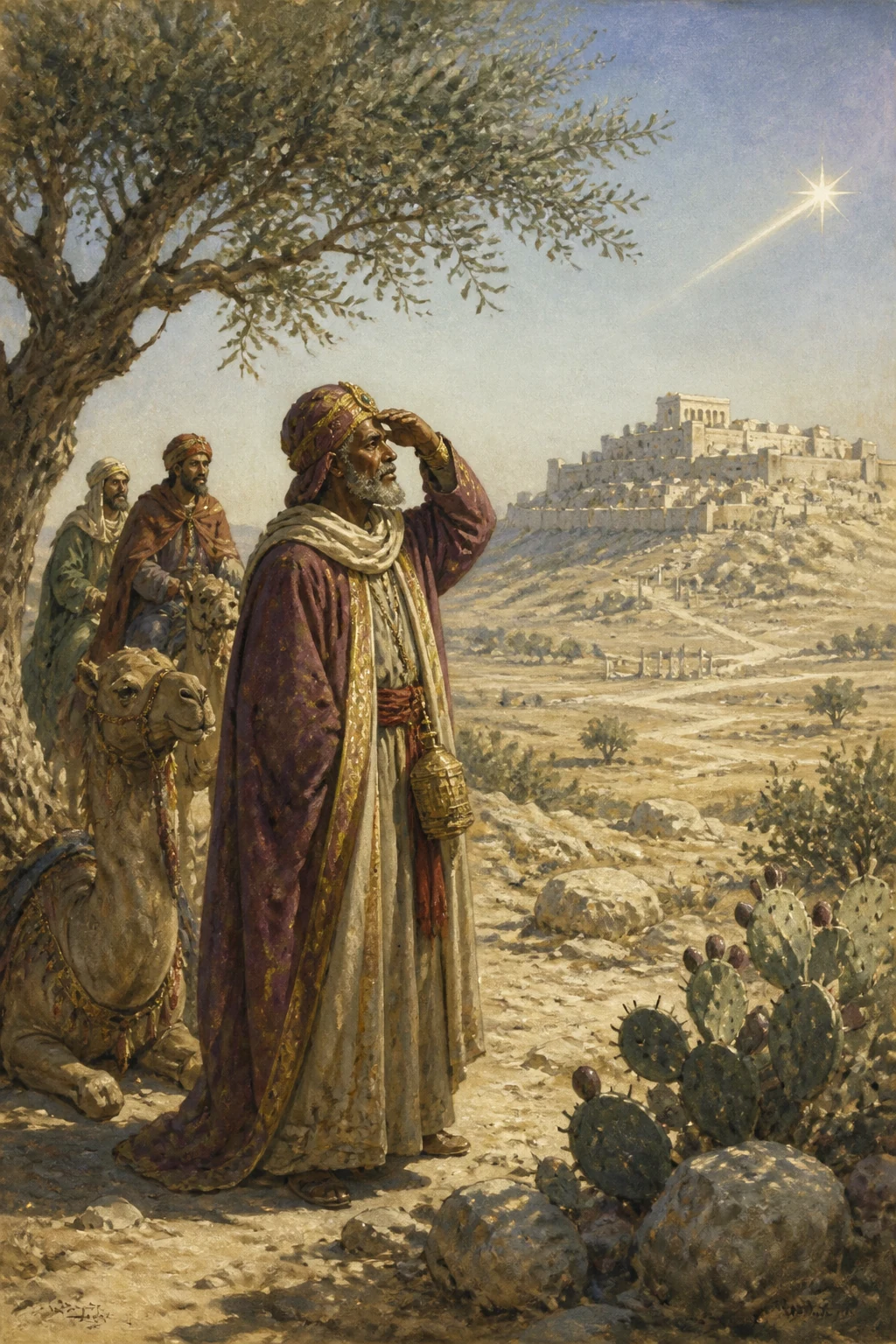
BALTASAR (stroking his long, snow-white beard and moving his aged head like one who prophesies).—I do not know what has come over me since I knelt in the stable at Bethlehem and hailed the Maiden’s Son: a prophetic spirit stirs within me, and I feel the veil that shrouds the ages to come being drawn aside. This tribute of gold I offered the Child in acknowledgment of his kingship—how many, how many generations shall render it to him! He shall receive tribute, not as we do, for days, months, and years, but for centuries, tens of centuries, generation after generation; and he shall receive it from the whole universe, from every race and tongue, from new lands that shall be discovered to acclaim his name. The gold I presented to him was little enough; it scarcely filled the cedar chest in which I brought it. And now it seems to me that it has become a sea of gold, and I see temples of gold raised to the Child, altars of wrought and graven gold, golden thrones about which sway white feather fans with golden handles; and upon his head rests a triple crown, likewise of solid gold, studded with diamonds and precious gems. Waves of gold, flowing from the veins of the earth, pour at the Child’s feet; and the strangest thing is that the Child gazes upon them with a saddened face, and at last hides his face against his Mother’s breast. Have I done wrong, O wise men, in presenting him with gold? Can the symbol of royal authority displease the heavenly infant? I fear my gifts have not found favor, and my offering may have seemed sacrilegious.
GASPAR (drawing himself upright in the saddle, reaching for his sword, knitting his brows, his eyes flashing).—Patriarch of the Magi, I foretold as much. He who was born King of the Jews is no base merchant who wishes to hoard untold riches in the vaults beneath his dwelling. Greed debases the soul and makes it sticky and coarse as the clay we tread upon with contempt. My gift alone could have pleased the Virgin’s firstborn. You brought him gold as a monarch; I brought him myrrh as a man. He chose to be born a man, and to be called a man shall be his greatest title. Myrrh, bitter as life and, like life, wholesome and fortifying: that is what befits one who must accomplish a manly work, a work of vigor and health. Do you think one can be great and noble and strong without tasting the bitter cup? Look at me, O wise men! I have fought, I have suffered, I have vanquished monsters, I have wrestled with dreadful temptations, I have found myself a thousand times in my enemies’ hands, and the breath of martyrdom has brushed my brow. Yet on only one day have I wept, and a drop of my tears, falling into the myrrh jar, lent it its bracing, savory bitterness, and perhaps its balsamic fragrance. I too see the Child, Baltasar, but I see him fighting, sweeping all before him, conquering, crushing dragons, bringing humanity beneath his yoke, suffering and watering a palm branch with blood. I did well to bring him myrrh.
MELCHOR (timidly, with profound humility).—I do not know whether I chose rightly; and yet, from the joy that floods my heart, I fancy the Child does not reject my gift. You, venerable and most learned Baltasar, presented him with gold, regarding him as a King. You, indomitable and valiant Gaspar, brought him myrrh, believing him a man. I, the least among you, the most ignorant, the black-skinned Ethiopian, offered him a few grains of frankincense, for my heart sensed that he was God.
BALTASAR and GASPAR, astonished.—God! MELCHOR (with faith and ardent conviction).—Yes, God. This very moment, amid this tranquil night, against the clear blue of heaven, I have seen his divinity shine forth. There are the nations prostrate at his feet and redeemed by him, and through him all men made equal. My people, the dark race of Ham, are no longer set apart from the white sons of Japheth. The Child’s sacred finger has erased the ancient curses. You do not recognize him at once, for he is a God unlike the Gods who are about to die: he neither condemns nor hates nor destroys; he loves, reconciles, forgives, and merely by drawing near him I feel an inexplicable freshness in my heart and a peace in my spirit that fills it with glory. As soon as I reach my kingdom, I shall open the prisons, disband the armies, remit the tributes, set my concubines free, and stand unarmed in the middle of the public square to confess my wrongs and let my enemies, if they wish, take their revenge upon me.
BALTASAR.—You bewilder me, Melchor. Your belief borders on madness. GASPAR.—I do not quite understand you, Melchor. Your belief seems effeminate to me, unworthy of a King.
MELCHOR.—I do not know how to defend it with arguments. I do what I feel. BALTASAR.—My gift was precious. GASPAR.—Mine was worthy and noble. MELCHOR.—Mine expresses my littleness and signifies only adoration.
BALTASAR.—By joining all three in one, perhaps we might obtain something that would bring a smile to the wondrous Child. GASPAR.—It cannot be. Where could there be a gift befitting King, Man, and God alike?
(The moon shines with a softer light, more mysteriously sweet and dreamlike. The desert seems a lake of silver. Against the horizon stands the figure of a woman, splendidly adorned and richly dressed, beautiful, weeping, with long golden hair falling to the hem of her gown. In her hands she carries a murrhine vessel filled with ointment of spikenard, whose fragrance spreads and permeates the Magi’s garments, rising to their heads in delicate, penetrating wafts. And the three Kings, dismounting and prostrating themselves in the desert dust, envy, with a holy envy, the gift of the sinner Magdalene.)