Waltey
Videnje svetih treh kraljev
Cuentos de Navidad y Reyes
Cuentos de Navidad, de la patria y antiguos · Emilia Pardo BazánO besedilu
Videnje svetih treh kraljev
- Vir
- Cuentos de Navidad, de la patria y antiguos
- Avtor
- Emilia Pardo Bazán
- Jezik branja
- English
- Jezik izvirnika
- Español
- Čas branja
- 6 min branja
- Obseg
- 5 strani
- Naslov izvirnika
- 015 La visión de los Reyes Magos
O izvirniku
Cuentos de Navidad, de la patria y antiguos
Sedemintrideset avtorskih zgodb v treh zgodovinskih knjižnih skupinah. Bralni jezik je English, izvirnik pa prihaja iz vira Cuentos de Navidad, de la patria y antiguos v jeziku Español.
Besedilo
Videnje svetih treh kraljev
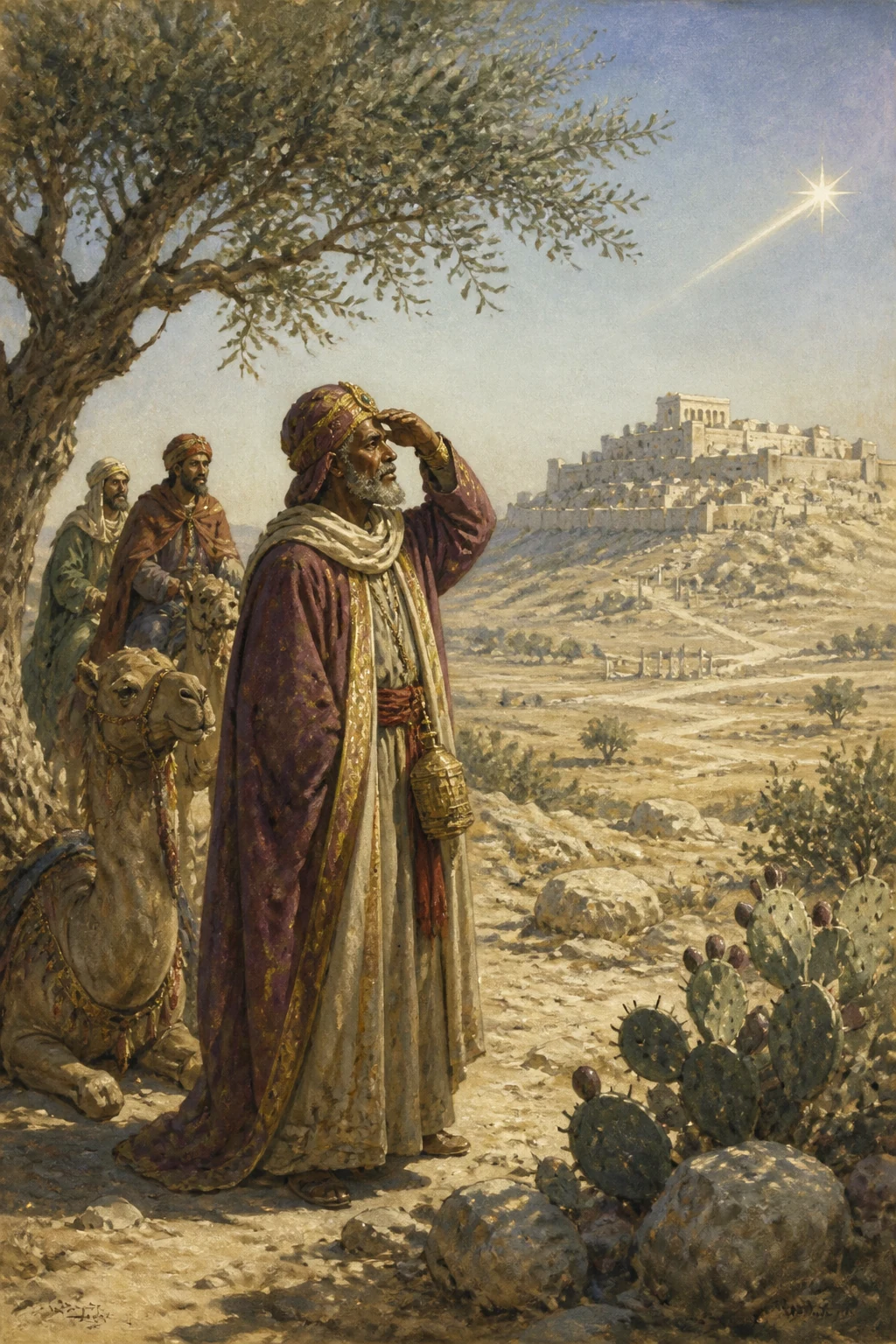
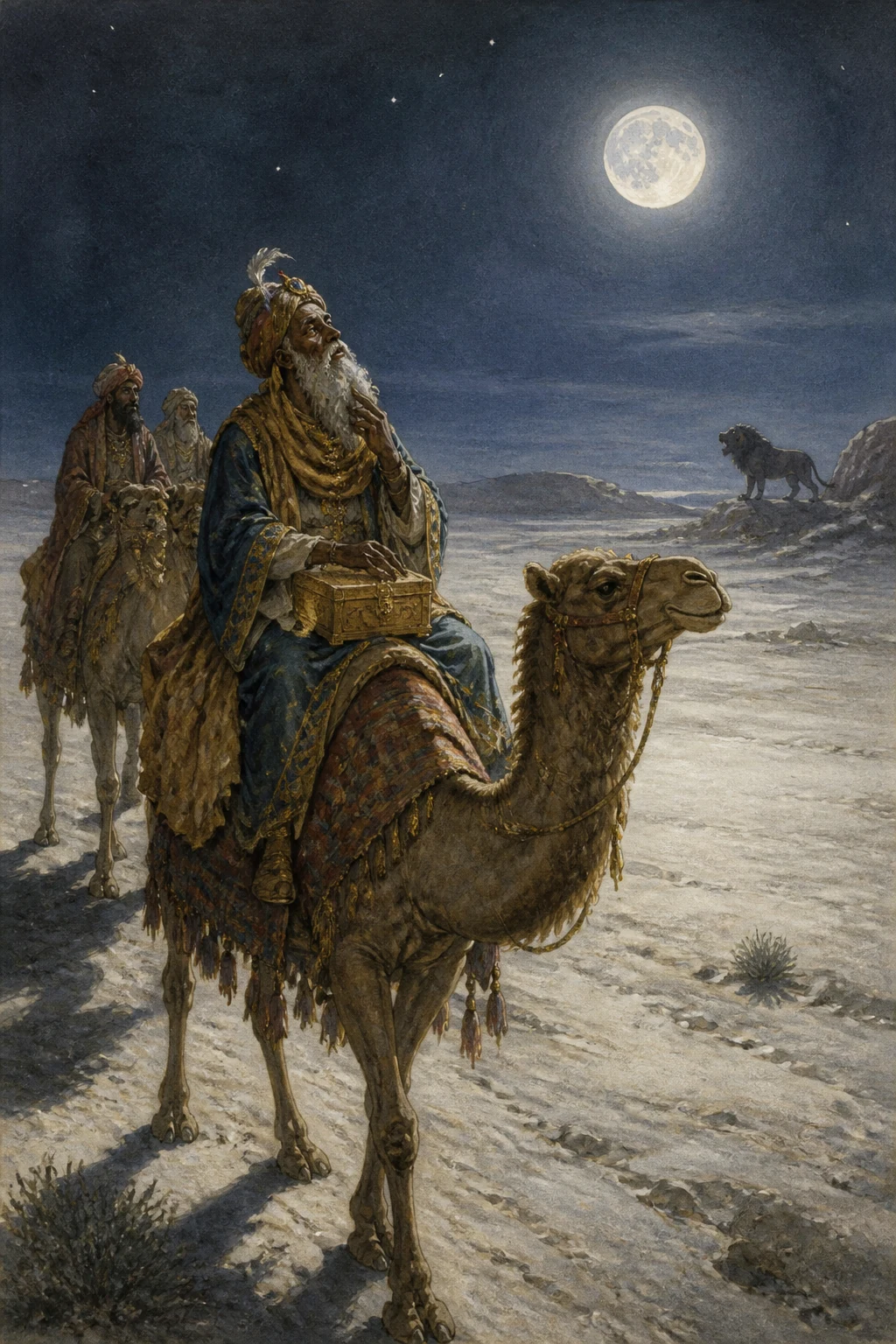
(The Magi return to their homeland by a different road from the one they came by, to elude the bloodthirsty Herod. It is night: the star no longer guides them; but the moon, shining with an intense and silvery light, splendidly illuminates the desert plain. The shadows of the dromedaries loom enormous on the smooth white ground, and far away a lion’s cavernous roar resounds.)
BALTASAR (stroking his long, snow-white beard and moving his aged head like one who prophesies).—I do not know what has come over me since I knelt in the stable at Bethlehem and hailed the Maiden’s Son: a prophetic spirit stirs within me, and I feel the veil that shrouds the ages to come being drawn aside. This tribute of gold I offered the Child in acknowledgment of his kingship—how many, how many generations shall render it to him! He shall receive tribute, not as we do, for days, months, and years, but for centuries, tens of centuries, generation after generation; and he shall receive it from the whole universe, from every race and tongue, from new lands that shall be discovered to acclaim his name. The gold I presented to him was little enough; it scarcely filled the cedar chest in which I brought it. And now it seems to me that it has become a sea of gold, and I see temples of gold raised to the Child, altars of wrought and graven gold, golden thrones about which sway white feather fans with golden handles; and upon his head rests a triple crown, likewise of solid gold, studded with diamonds and precious gems. Waves of gold, flowing from the veins of the earth, pour at the Child’s feet; and the strangest thing is that the Child gazes upon them with a saddened face, and at last hides his face against his Mother’s breast. Have I done wrong, O wise men, in presenting him with gold? Can the symbol of royal authority displease the heavenly infant? I fear my gifts have not found favor, and my offering may have seemed sacrilegious.
GASPAR (drawing himself upright in the saddle, reaching for his sword, knitting his brows, his eyes flashing).—Patriarch of the Magi, I foretold as much. He who was born King of the Jews is no base merchant who wishes to hoard untold riches in the vaults beneath his dwelling. Greed debases the soul and makes it sticky and coarse as the clay we tread upon with contempt. My gift alone could have pleased the Virgin’s firstborn. You brought him gold as a monarch; I brought him myrrh as a man. He chose to be born a man, and to be called a man shall be his greatest title. Myrrh, bitter as life and, like life, wholesome and fortifying: that is what befits one who must accomplish a manly work, a work of vigor and health. Do you think one can be great and noble and strong without tasting the bitter cup? Look at me, O wise men! I have fought, I have suffered, I have vanquished monsters, I have wrestled with dreadful temptations, I have found myself a thousand times in my enemies’ hands, and the breath of martyrdom has brushed my brow. Yet on only one day have I wept, and a drop of my tears, falling into the myrrh jar, lent it its bracing, savory bitterness, and perhaps its balsamic fragrance. I too see the Child, Baltasar, but I see him fighting, sweeping all before him, conquering, crushing dragons, bringing humanity beneath his yoke, suffering and watering a palm branch with blood. I did well to bring him myrrh.
MELCHOR (timidly, with profound humility).—I do not know whether I chose rightly; and yet, from the joy that floods my heart, I fancy the Child does not reject my gift. You, venerable and most learned Baltasar, presented him with gold, regarding him as a King. You, indomitable and valiant Gaspar, brought him myrrh, believing him a man. I, the least among you, the most ignorant, the black-skinned Ethiopian, offered him a few grains of frankincense, for my heart sensed that he was God.
BALTASAR and GASPAR, astonished.—God! MELCHOR (with faith and ardent conviction).—Yes, God. This very moment, amid this tranquil night, against the clear blue of heaven, I have seen his divinity shine forth. There are the nations prostrate at his feet and redeemed by him, and through him all men made equal. My people, the dark race of Ham, are no longer set apart from the white sons of Japheth. The Child’s sacred finger has erased the ancient curses. You do not recognize him at once, for he is a God unlike the Gods who are about to die: he neither condemns nor hates nor destroys; he loves, reconciles, forgives, and merely by drawing near him I feel an inexplicable freshness in my heart and a peace in my spirit that fills it with glory. As soon as I reach my kingdom, I shall open the prisons, disband the armies, remit the tributes, set my concubines free, and stand unarmed in the middle of the public square to confess my wrongs and let my enemies, if they wish, take their revenge upon me.
BALTASAR.—You bewilder me, Melchor. Your belief borders on madness. GASPAR.—I do not quite understand you, Melchor. Your belief seems effeminate to me, unworthy of a King.
MELCHOR.—I do not know how to defend it with arguments. I do what I feel. BALTASAR.—My gift was precious. GASPAR.—Mine was worthy and noble. MELCHOR.—Mine expresses my littleness and signifies only adoration.
BALTASAR.—By joining all three in one, perhaps we might obtain something that would bring a smile to the wondrous Child. GASPAR.—It cannot be. Where could there be a gift befitting King, Man, and God alike?
(The moon shines with a softer light, more mysteriously sweet and dreamlike. The desert seems a lake of silver. Against the horizon stands the figure of a woman, splendidly adorned and richly dressed, beautiful, weeping, with long golden hair falling to the hem of her gown. In her hands she carries a murrhine vessel filled with ointment of spikenard, whose fragrance spreads and permeates the Magi’s garments, rising to their heads in delicate, penetrating wafts. And the three Kings, dismounting and prostrating themselves in the desert dust, envy, with a holy envy, the gift of the sinner Magdalene.)
Izvirnik
015 La visión de los Reyes Magos
Naslednje strani prikazujejo izvirno besedilo za primerjavo.
(Los Reyes Magos regresan á su patria por distinto camino del que vinieron, á fin de burlar al sanguinario Herodes. Es de noche: la estrella no les guía ya; pero la luna, brillando con intensa y argentada luz, alumbra espléndidamente la planicie del desierto. La sombra de los dromedarios se agiganta sobre el suelo blanco y liso, y á lo lejos resuena el cavernoso rugir de un león.)
BALTASAR (acariciándose la nevada y luenga barba y moviendo la anciana cabeza á estilo del que vaticina).--No sé lo que me sucede desde que me puse de rodillas en el establo de Belén y saludé al Hijo de la Doncella, que me agita un espíritu profético, y siento descorrerse el velo que cubre los tiempos futuros. Este tributo de oro que ofrecí al Niño para reconocerle Rey, ¡cuántas y cuántas generaciones se lo han de rendir! Tributos percibirá, no como nosotros, días, meses y años, sino siglos, decenas de siglos, generación tras generación, y los percibirá de todo el universo, de toda raza y lengua, de nuevas tierras que se descubrirán para aclamar su nombre. El oro que le he presentado era poco; apenas llenaba el cofre de cedro en que lo traje; y ahora se me figura que se ha convertido en un mar de oro, y veo que al Niño se le erigen templos de oro, altares de oro labrado y cincelado, tronos de oro en torno de los cuales oscilan blancos flábulos de plumas con mango de oro, y que ciñe su cabeza una triple corona de oro macizo también, incrustada de diamantes y gemas preciosas. Olas de oro, fluyendo de los veneros de la tierra, corren á los pies del Niño: y lo más extraño es que el Niño los contempla con entristecida cara, y al fin esconde el rostro en el seno de su Madre. ¿Habré obrado mal, ¡oh sabios!, en presentarle oro? ¿No le agradará á la criatura celeste el símbolo de la autoridad real? Temo que mis dones no hayan sido aceptos y mi obsequio pareciese sacrílego.
GASPAR (enderezándose sobre su montura, requiriendo la espada, frunciendo las cejas y echando chispas por los ojos).--Patriarca de los Magos, bien te lo pronostiqué. El nacido Rey de los judíos no es vil mercader que quiere atesorar riquezas sin cuento en los subterráneos de su morada. La codicia rebaja el alma y la hace pegajosa y grosera como la arcilla que, despreciándola, pisamos. Mi don es el único que pudo complacer al primogénito de la Virgen. Tú le trajiste oro, por monarca; yo mirra, por hombre. Hombre ha querido nacer, y el llamarse hombre será su mejor título. La mirra, amarga como el vivir y como el vivir sana y fortificante; he ahí lo que conviene á quien ha de realizar obra viril, obra de vigor y salud. ¿Creéis que se puede ser grande y noble y fuerte sin gustar el cáliz amargo? Aquí me tenéis á mí, ¡oh, sabios!: he combatido, he sufrido, he vencido monstruos, he lidiado con tentaciones horribles, me he visto mil veces en manos de mis enemigos y el soplo del martirio ha rozado mi sien. Pues sólo un día he llorado, y una gota de mi llanto, cayendo en el ánfora de la mirra, le prestó su tónica y sabrosa amargura y quizás su balsámico perfume. Yo también veo al Niño, Baltasar, pero le veo combatiendo, arrollando, venciendo, aplastando dragones, sometiendo á su yugo á la humanidad, sufriendo y regando con sangre una palma. Bien hice en traerle mirra.
MELCHOR (tímidamente, con humildad profunda).--Yo no sé si habré acertado, y, sin embargo, por la alegría que me inunda, presumo que el Niño no rechaza mi don. Tú, venerable y doctísimo Baltasar, le obsequiaste con oro, considerándole Rey. Tú, indomable y valeroso Gaspar, le trajiste mirra, teniéndole por hombre. Yo, el último de vosotros, el más ignorante, el etiope de negra tez, le ofrecí unos granos de incienso, pues mi corazón le presentía Dios.
BALTASAR y GASPAR, atónitos.--¡Dios!
MELCHOR (con fe y persuasión ardiente).--Sí, Dios. Ahora mismo, en medio de esta serena noche, sobre el limpio azul del cielo, he visto resplandecer su divinidad. Ahí están las naciones postradas á sus pies y redimidas por Él, y por Él igualados todos los hombres. Mi progenie, la obscura raza de Cam, ya no se diferencia de los blancos hijos de Jafet. Las antiguas maldiciones las ha borrado el sacro dedo del Niño. No le reconocéis así al pronto, porque es un Dios diferente de los Dioses que van á morir: no condena, ni odia, ni extermina; ama, reconcilia, perdona, y sólo con acercarme á Él noto en mi corazón una frescura inexplicable y en mi espíritu una paz que glorifica. Así que llegue á mi reino abriré las prisiones, licenciaré los ejércitos, condonaré los tributos, daré libertad á mis concubinas y me pondré desarmado en medio de la plaza pública á confesar mis yerros y á que mis enemigos, si lo desean, tomen venganza de mí.
BALTASAR.--Me dejas confuso, Melchor. Tu creencia se asemeja á la locura.
GASPAR.--No te entiendo bien, Melchor. Tu creencia me parece afeminada, impropia de un Rey.
MELCHOR.--No sé defenderla con razones. Hago lo que siento.
BALTASAR.--Mi dádiva era preciosa.
GASPAR.--La mía era digna y noble.
MELCHOR.--La mía expresa mi pequeñez y sólo significa adoración.
BALTASAR.--Reuniendo las tres en una, quizas obtendríamos algo que hiciese sonreir al prodigioso Niño.
GASPAR.--No puede ser. ¿Dónde habrá un don que convenga al Rey, al Hombre y al Dios juntamente?
(La luna brilla con claridad más suave, más misteriosamente dulce y soñadora. El desierto parece un lago de plata. Sobre el horizonte se destaca una figura de mujer bizarramente engalanada y ricamente vestida, hermosa, llorosa, con larga cabellera rubia que baja hasta la orla del traje. Lleva en las manos un vaso mirrino lleno de ungüento de nardo, cuya fragancia se esparce é impregna la ropa de los Magos y sube hasta su cerebro en delicados y penetrantes efluvios. Y los tres Reyes, apeándose y prosternados sobre el polvo del desierto, envidian, con envidia santa, el don de la pecadora Magdalena.)
Nadaljuj z branjem