Waltey
Hilas in Heraklej ostaneta na kopnem
Argonavtika · Apolonij RodoškiO besedilu
Hilas in Heraklej ostaneta na kopnem
- Vir
- Argonavtika
- Avtor
- Apolonij Rodoški
- Jezik branja
- English
- Jezik izvirnika
- Ancient Greek
- Čas branja
- 22 min branja
- Obseg
- 18 strani
- Naslov izvirnika
- Hylas and Heracles Are Left Behind
O izvirniku
Argonavtika
Morska odprava za zlatim runom, med junaštvom, čarovnijo in Medejino odločitvijo. Bralni jezik je English, izvirnik pa prihaja iz vira Argonavtika v jeziku Ancient Greek.
Besedilo
Hilas in Heraklej ostaneta na kopnem
So he spoke, and was the first to board the ship; the other heroes followed, and, sitting in their places one after another, took the oars in their hands. Argus untied the stern cables from the sea-washed rock, and they struck the water mightily with their long fir oars.
At evening, on Orpheus’ advice, they put in at the island of Electra, daughter of Atlas, so that, instructed through gentle rites of initiation in mysteries that must not be spoken, they might sail more safely over the chilling sea.
Of these I shall tell no more. May the island itself look kindly on me, and likewise the divine inhabitants to whose keeping those mysteries belong, which it is not lawful for us to sing.
From there they pressed onward with their oars through the depths of the Gulf of Melas, with the land of the Thracians on one side and Imbros opposite, above them, on the other. Just as the sun was setting, they reached the projecting Chersonese.
There a swift south wind blew for them. They set their sails to the following breeze and entered the headlong waters named for Athamas’ daughter. By morning they had left the open sea behind; through the night they measured their course inside the headland of Rhoeteum, keeping the land of Ida on their right.
Leaving Dardania, they drew on toward Abydos, and after it passed Percote, the sandy shore of Abarnis, and sacred Pityeia. That night, as the ship sped onward, they crossed the Hellespont, dark and seething with eddies.
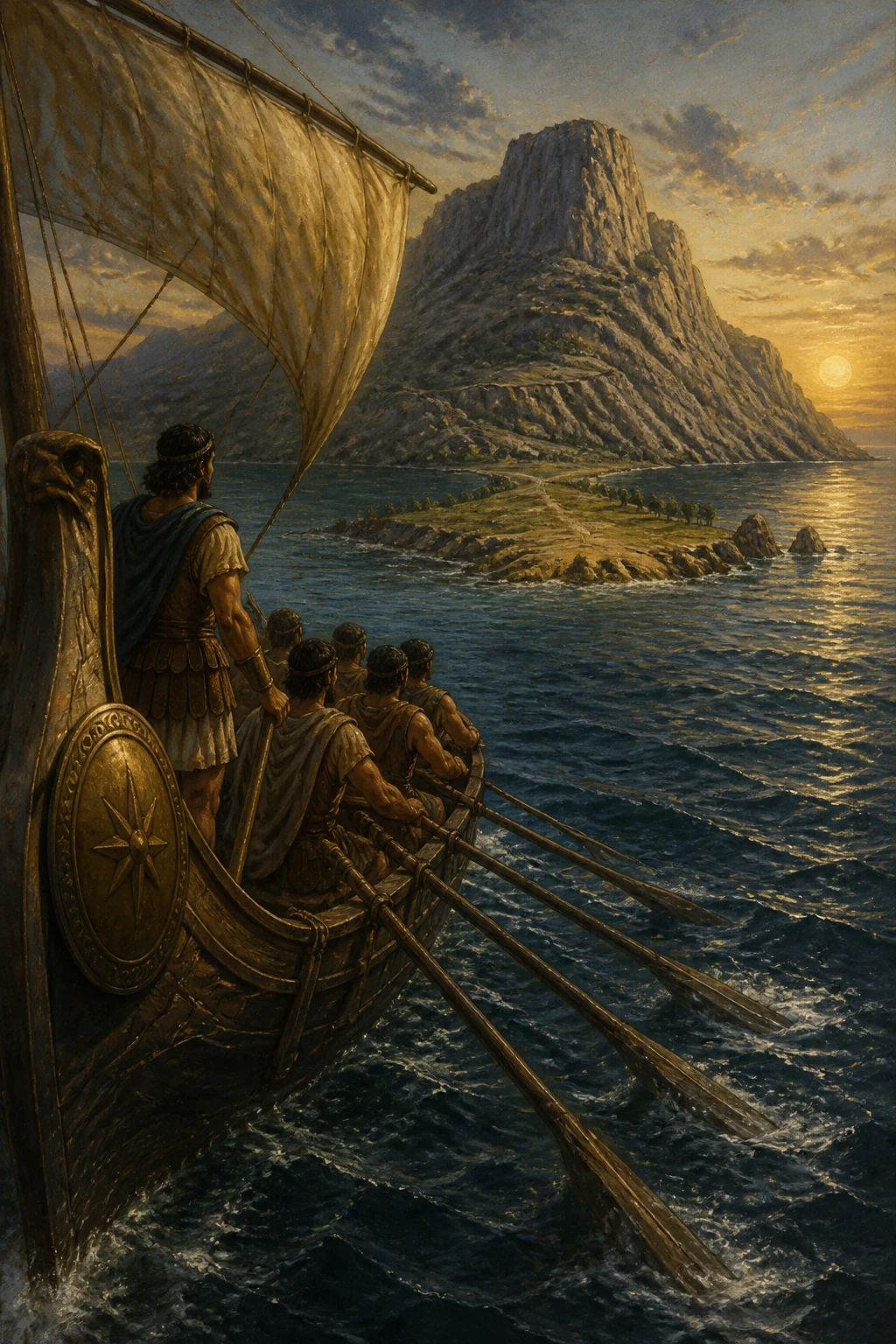
Within the Propontis lies a steep island, extending into the sea a little way from the grain-rich mainland of Phrygia. A low-lying isthmus, washed by the waves, slopes down to join it to the mainland. It has two shores, and lies beyond the waters of the Aesepus.
The neighboring people call it the Mountain of Bears. Savage, violent Earthborn men dwell there, a great marvel for those who live around them to behold. Each has six mighty arms: two spring from his sturdy shoulders, and four more are fixed below along his monstrous sides.
The Doliones inhabited the isthmus and the plain. Their king was the hero Cyzicus, son of Aeneus, whom Aenete, daughter of noble Eusorus, had borne. Terrible though they were, the Earthborn did the Doliones no harm, for Poseidon protected them: from him the Doliones traced their earliest descent.
There the Argo put in, driven onward by Thracian winds, and Fair Harbor received her as she sped along. On Tiphys’ advice they unfastened their small anchor stone and left it beneath a spring, the spring of Artace, choosing another, heavier stone that suited their purpose. In later years, at the command of the Far-shooter’s oracle, the Ionian descendants of Neleus dedicated that first stone, as sacred custom required, in the sanctuary of Jasonian Athena.
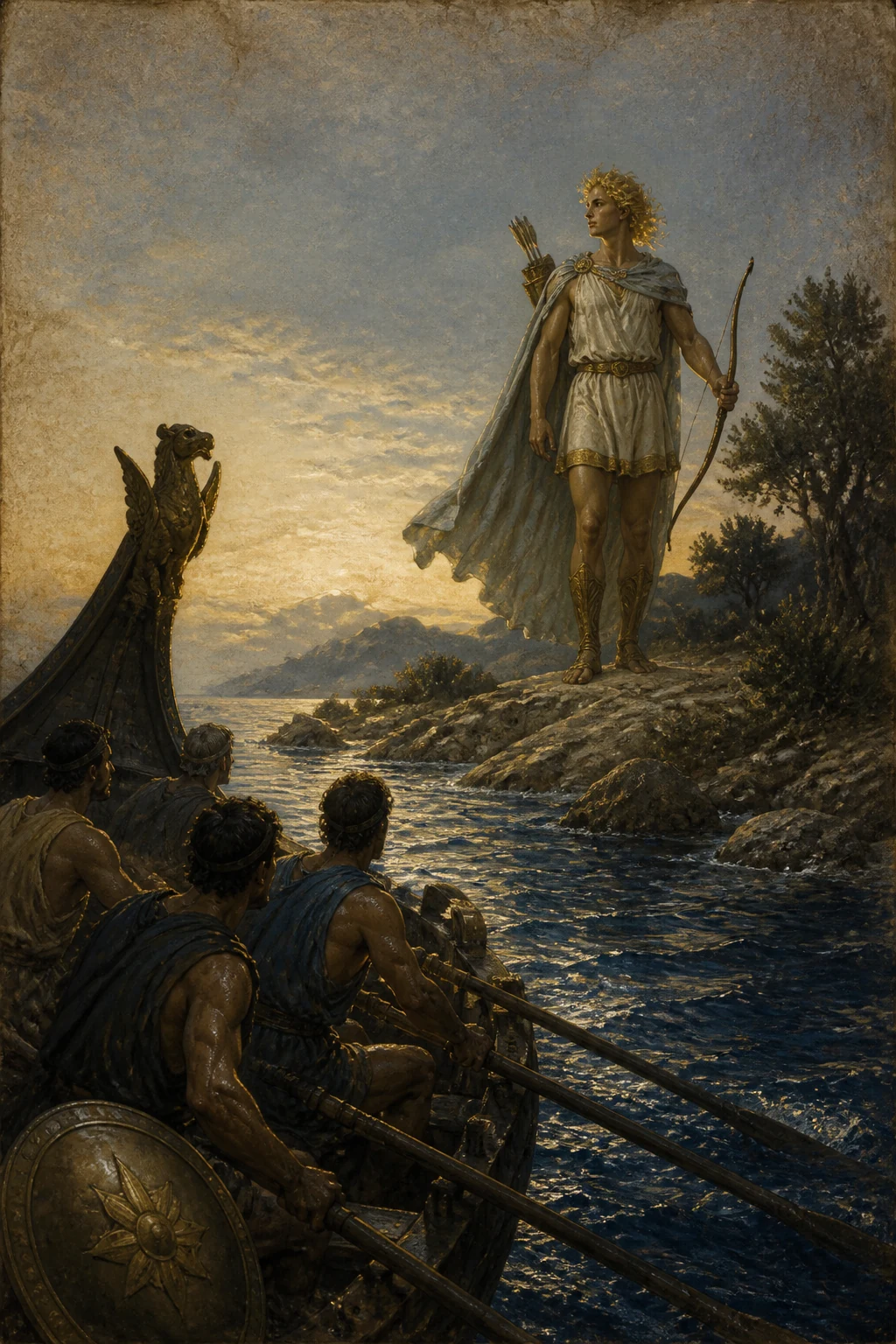
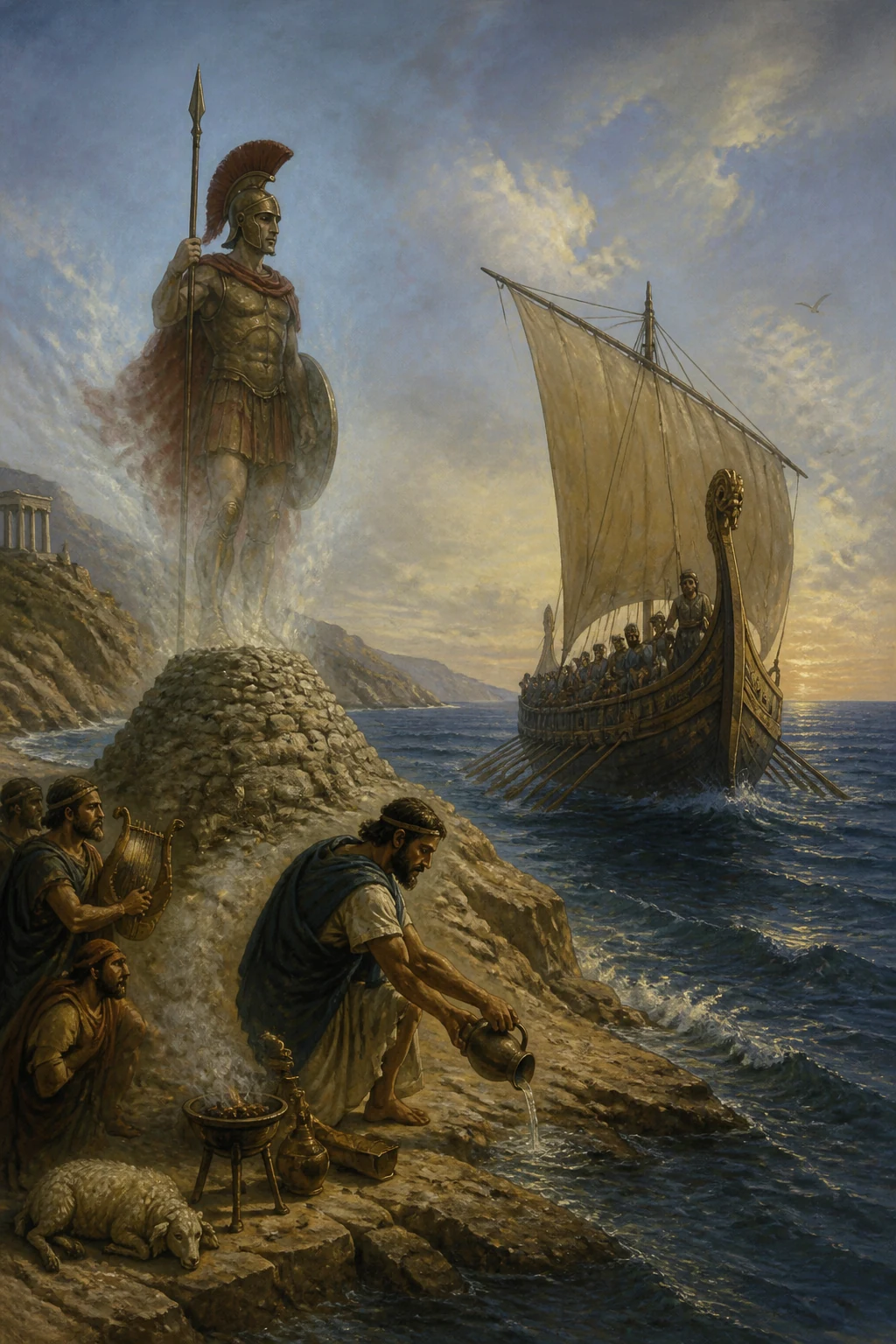
The Doliones and Cyzicus himself came together to meet them in friendship. When they had heard the purpose of their voyage and learned who they were and from what families they came, they welcomed them warmly. They persuaded them to row farther on and fasten their ship’s stern cables in the city’s harbor. There, beside the shore, the heroes built an altar to Apollo, Protector of Landings, and attended to the sacrifice.
The king himself gave them sweet wine and sheep to supply their needs. For he had been warned that, whenever a divine company of heroes arrived, he must at once receive them graciously and have no thought of war.
Like Jason, he was only just growing his first beard, and had not yet been granted the joy of children. His wife still lived in his house untouched by the pains of childbirth: lovely-haired Cleite, daughter of Merops of Percote, whom he had only lately brought from her father’s home across the water, after giving a splendid bride-price.
Yet even so he left his bridal chamber and his young wife’s bed to oversee their feast, putting his fears from his heart. They questioned one another in turn. He asked about the goal of their voyage and the commands of Pelias; they asked about the cities of the neighboring peoples and the whole broad gulf of the Propontis. But of the regions farther on, which they longed to learn about, he could tell them nothing.
At dawn they climbed lofty Dindymum to see for themselves the passages through that sea. They had brought the ship out from her former anchorage into the harbor of Chytus; and the path they climbed is known as Jason’s Way.
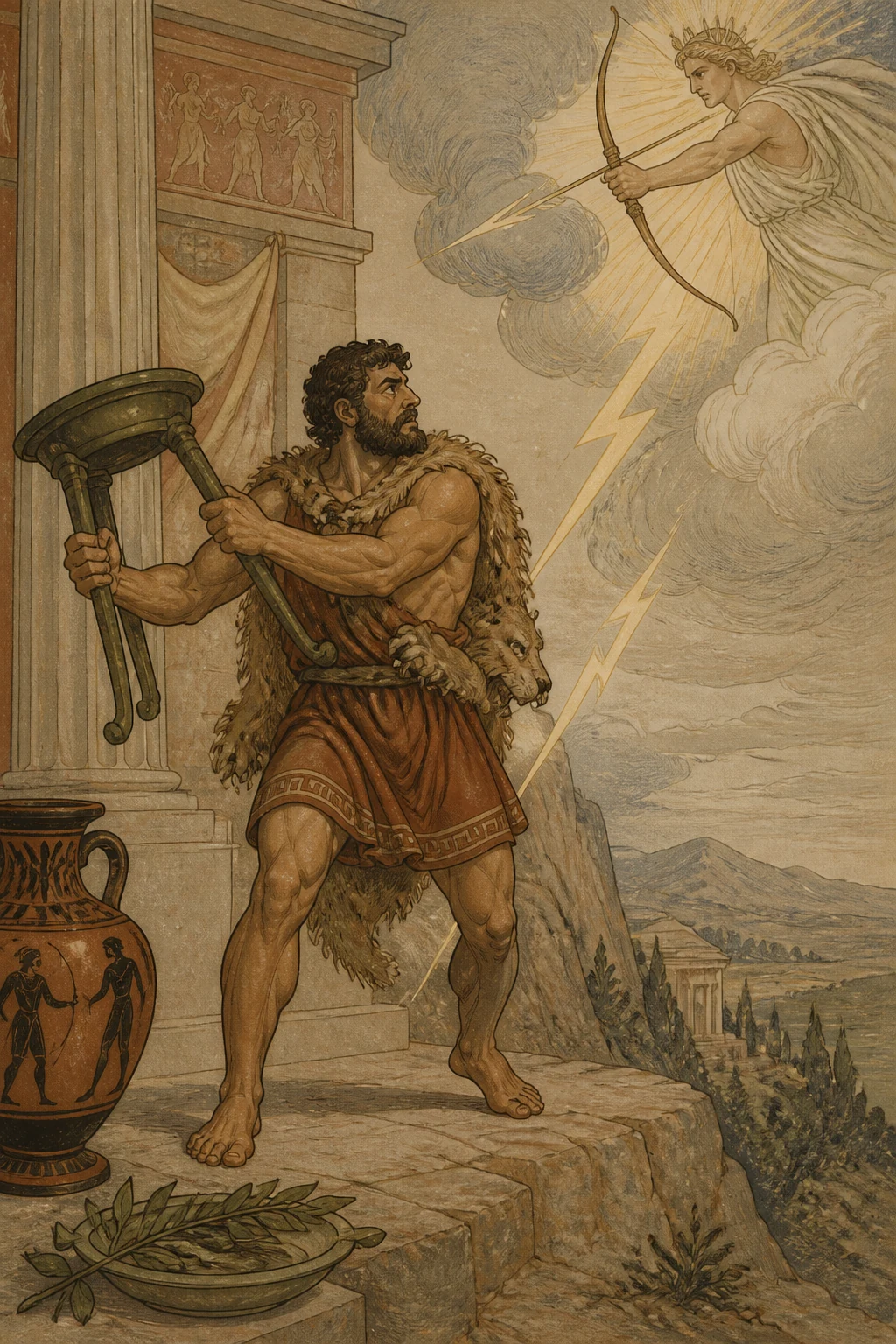
But the Earthborn rushed down from the other side of the mountain and blocked the seaward mouth of spacious Chytus with boulders, as though trapping a wild beast within. Heracles, however, had been left there with the younger men. Quickly bending his recurved bow, he brought them to the ground one after another, while they in turn lifted jagged rocks and hurled them at him.
For Hera, the wife of Zeus, had surely reared those dreadful monsters too as a trial for Heracles. Meanwhile the other warrior heroes turned back and came to face them before they reached the lookout. They joined in slaughtering the Earthborn, meeting their attack with arrows and spears, until they had killed them all, despite their fierce and furious resistance.
As when woodcutters lay long timbers, freshly hewn with axes, in rows along the surf, so that, soaked through, they may hold the stout fastening pegs, so the bodies lay stretched in rows at the entrance to the gray harbor. Some had plunged their heads and chests together into the salt water, while their limbs lay stretched upon the land; others lay the opposite way, their heads upon the sandy beach and their feet reaching into the depths. Thus they were to become the prey of birds and fish alike.
When the heroes had finished their task without further fear, they loosed the ship’s cables to the blowing wind and sailed onward across the swelling sea. All day she sped under sail. But when night came, the breeze no longer held steady: contrary squalls seized her and swept her backward, until they brought her once more among the hospitable Doliones. They went ashore that same night; and the rock around which they hastily cast the ship’s cables is still called the Sacred Rock.
None of them recognized the island as the same one. Nor in the darkness did the Doliones clearly perceive that the returning men were the heroes. They supposed that a Pelasgian war band from the Macrians had landed.
So they armed themselves and raised their hands against them. Ashen spears and shields clashed together, like a fierce rush of fire that falls upon dry brushwood and mounts into flame. A dreadful, furious tumult descended on the people of the Doliones.
Nor was their king destined to escape the battle and return home to his bridal chamber and marriage bed. As he charged straight at Jason, the son of Aeson leapt forward and struck him in the middle of the chest; the bone shattered around the spear. He sank into the sand and fulfilled his fate. For no mortal may ever escape it: on every side its great net is spread.
So that very night fate ensnared him as he fought against the heroes, though he had thought himself beyond the reach of bitter destruction. Many others who came to his aid were slain. Heracles killed Telecles and Megabrontes; Acastus slew Sphodris; Peleus brought down Zelys and Gephyrus, swift in battle.
Telamon, skilled with the spear, killed Basileus. Idas slew Promeus, and Clytius Hyacinthus; the two sons of Tyndareus killed Megalossaces and Phlogius. The son of Oeneus also slew bold Itymoneus and Artaceus, a leader among men. All these the inhabitants still honor with the worship due to heroes.
The rest gave way and fled, as doves in a flock flee before swift-winged hawks. With a great clamor they crowded through the gates, and the city was soon filled with cries of grief as the battle recoiled upon it.
At dawn both sides understood their fatal, irreparable mistake. Bitter sorrow seized the Minyan heroes when they saw before them Cyzicus, the son of Aeneus, lying in the dust and blood.
For three whole days they mourned and tore their hair, the heroes and the Dolionian people alike. Then, after circling his tomb three times in bronze armor, they buried him with due honors and held funeral games, as custom required, on the meadow plain. There his burial mound still stands for later generations to behold.
Nor did Cleite survive her dead husband. She added another, crueler grief to their misfortune by fastening a noose around her neck. Even the woodland nymphs lamented her death, and all the tears the goddesses shed from their eyes upon the ground they made into a spring. They call it Cleite, preserving the renowned name of the unhappy bride.
That was the most dreadful day Zeus ever brought upon the women and men of the Doliones. Not one of them could bring himself to taste food; and for a long time, in their grief, they gave no thought to the labor of grinding grain. Instead, they kept themselves alive on food just as it was, uncooked.
And even now, whenever the Ionians who dwell in Cyzicus pour their yearly libations for the dead, they always grind the meal for their sacrificial cakes at the public mill. After this, fierce storms arose for twelve days and nights together, keeping the heroes there and preventing them from sailing. On the following night, the other heroes lay overcome by sleep during the last watch, while Acastus and Mopsus, son of Ampycus, kept guard over the soundly sleeping men.
Then a halcyon fluttered above the fair head of Aeson’s son, foretelling in its clear cry the end of the raging winds. Mopsus heard and understood the shorebird’s prophetic voice.
A god turned the bird away again, and it darted upward to perch upon the ship’s high stern ornament. Mopsus went to Jason, who lay wrapped in soft sheepskins, shook him awake, and said: “Son of Aeson, you must climb this holy height of rugged Dindymum and win the favor of the Mother of all the blessed gods, seated upon her fair throne. Then these violent storms will cease. Such is the message I have just heard from the sea-halcyon, which fluttered above you as you slept and made all this known to me.
“For on her depend the winds and the sea, and all the earth below, and the snowy seat of Olympus. When she rises from the mountains into the great heavens, Zeus himself, the son of Cronus, gives way before her. So too the other blessed immortals pay reverence to the dread goddess.”
So he spoke, and Jason welcomed his words. Gladly he rose from his bed and roused all his companions in haste. When they were awake, he told them the prophecy of Mopsus, son of Ampycus.
At once the younger men drove cattle from the stalls and led them to the mountain’s steep summit. The others untied the cables from the Sacred Rock and rowed into the Thracian harbor. Then they too climbed the mountain, leaving only a few of their companions aboard.
Before their eyes the Macrian heights and all the opposite coast of Thrace lay as clear as though within their hands. They could see the misty mouth of the Bosporus and the hills of Mysia; on the other side lay the course of the Aesepus, the city of Adrasteia, and its Nepeian plain.
There was a sturdy, ancient vine stock growing in the woods. They cut it down to make a sacred image of the mountain goddess. Argus carved it with skill, and they set it upon a rugged hill, sheltered by the tallest oaks, which grew higher than all the rest.
They piled up an altar of small stones, and, crowning themselves with oak leaves, attended to the sacrifice. They invoked the all-powerful Mother of Dindymum, who dwells in Phrygia, and with her Titias and Cyllenus. Of all the Cretan Idaean Dactyls, these alone are called dispensers of destiny and attendants of the Idaean Mother. The nymph Anchiale once brought them forth in the Dictaean cave, clutching the earth of Oaxus with both her hands.
The son of Aeson poured libations upon the burning offerings and earnestly entreated the goddess to turn the storms away. At Orpheus’ bidding, the young men leapt and danced an armed dance, beating their shields with their swords, so that the ill-omened sound of the people’s lamentation, still rising in grief for their king, might be scattered through the air. Ever since then the Phrygians have propitiated Rhea with the whirring wheel and drum.
The goddess turned a gracious heart toward their holy sacrifices, and fitting signs appeared. The trees shed fruit in abundance, and around their feet the earth of itself put forth flowers among the tender grass.
Wild beasts left their lairs and woodland thickets and came up to them, fawning with their tails. And she worked another wonder. Until then no water had flowed on Dindymum; but now, from its thirsty summit, a stream gushed forth for them without ceasing. In later times the people who live around it called that spring Jason’s Fountain.
Then they held a feast in honor of the goddess on the Mountain of Bears, singing the praises of all-powerful Rhea. At dawn, when the winds had fallen, they left the island under oars. A spirit of rivalry stirred each hero to strive to be the last to tire. For the windless air had smoothed the eddies all around and lulled the sea to sleep.
Trusting in the calm, they drove the ship forcefully onward. Not even Poseidon’s storm-footed horses could have caught her as she darted across the sea. But when the swell rose beneath the strong breezes that begin to blow from the rivers toward evening, the men grew weary and rested from their labor. Heracles, however, dragged them all onward by the strength of his arms, toiling with all his might, and made the ship’s fitted timbers tremble.
But as they pressed eagerly toward the Mysian mainland, passing within sight of the mouths of the Rhyndacus and the great burial mound of Aegaeon a little beyond Phrygia, he bore down against the surging waves and snapped his oar in the middle. Holding one piece in both hands, he fell sideways; the sea carried the other away on its backward wash. He sat up in silence, staring about him, for his hands were unaccustomed to lying idle.
At the hour when a gardener or a plowman gladly comes home from the fields, longing for his supper, and bends his weary knees upon the threshold, caked with dust, then looks at his chafed hands and curses his belly bitterly—at that hour they reached the lands of Cius, around Mount Arganthonium and the mouths of the river Cius.
The Mysians who inhabited that country welcomed them with friendly hospitality, giving them provisions, sheep, and wine in abundance to supply their needs. Some of the heroes then brought dry wood, while others cut and carried great heaps of meadow herbage to spread for bedding. Some worked the fire sticks; others mixed wine in bowls and prepared the feast, after sacrificing at dusk to Apollo, Protector of Landings.
But the son of Zeus, after bidding his companions enjoy their meal, set off into the forest, intending first to fashion an oar to fit his hand. As he wandered, he found a fir, neither burdened with many branches nor grown too large, but like a shoot of slender poplar: such it seemed in height and girth alike.
Quickly he laid his quiver of arrows on the ground, together with his bow, and stripped off his lion skin. First he shook the tree loose at its base with his bronze-weighted club, then clasped both hands around its trunk, trusting in his strength. Planting his feet firmly, he braced his broad shoulder against it, and, deep-rooted though it was, wrested it from the ground, bringing up with it the very clods in which it held fast.
As when a sudden, swift gust strikes a ship’s mast from above, especially at the stormy setting of deadly Orion, and tears it, wedges and all, free of its stays, so he lifted the tree. Then, gathering up his bow and arrows, his skin and club, he set off on his way back.
Meanwhile Hylas, carrying a bronze pitcher, had gone apart from the company to seek the sacred water of a spring. He wished to draw water in time for Heracles’ supper and have everything else promptly set in order for his return.
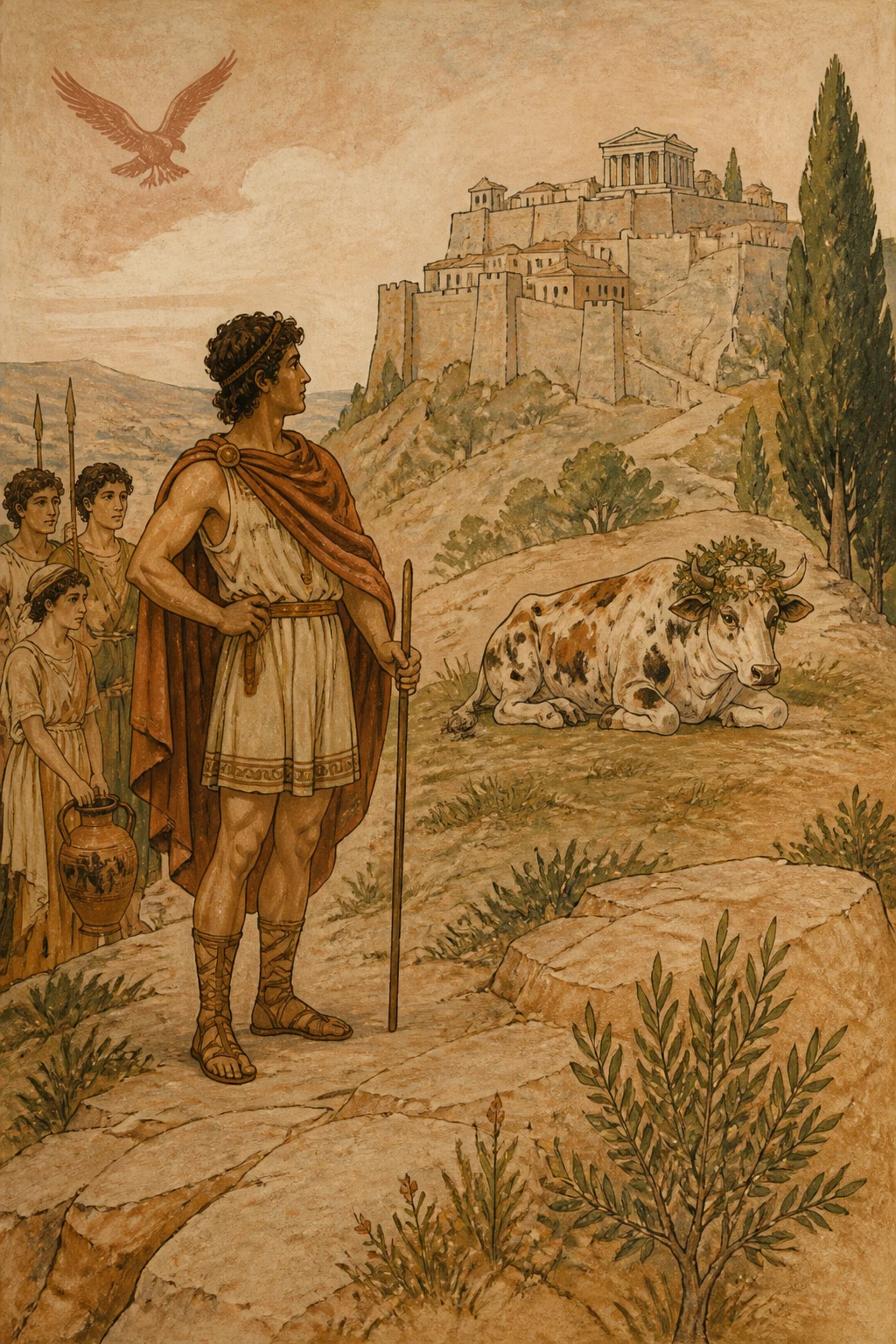
For Heracles himself had reared him to such habits, ever since he took him as a little child from the house of his father, noble Theiodamas. Him he had pitilessly killed among the Dryopians when they quarreled over a plowing ox.
Theiodamas was painfully laboring to cut the furrows of a fallow field with his plow, and Heracles ordered him to surrender a plowing ox against his will. For he wished to find a grievous pretext for war against the Dryopians, who lived without any regard for justice.
But that would lead me far astray from my song. Hylas soon reached the spring which the neighboring people call Pegae. The nymphs’ dances were just beginning, for all the nymphs who dwelt about that lovely height were wont to celebrate Artemis with nightly songs.
Those whose province was the mountain peaks or the glens, the woodland nymphs, were coming in from far away. But the water nymph was just rising from the fair-flowing spring, and close at hand she saw him, radiant with beauty and sweet grace.
For the full moon, shining from the sky, cast its light upon him. Cypris set the nymph’s heart aflutter, and in her bewilderment she could scarcely gather her wits. But as soon as he leaned sideways and dipped the pitcher into the stream, and the water roared loudly as it poured into the ringing bronze, she threw her left arm around his neck, eager to kiss his tender mouth. With her right hand she caught his elbow and dragged him down into the midst of the swirling water.
Of all his companions, only the hero Polyphemus, son of Eilatus, heard his cry. He had gone farther along the path, waiting for mighty Heracles to return. He rushed toward Pegae like a wild beast that has heard the bleating of sheep far away and, burning with hunger, follows the sound, yet cannot find the flock, for the shepherds have already shut it in the folds. It groans and roars without ceasing until it is exhausted. So the son of Eilatus groaned aloud and roamed about the place calling out; but his voice was of no avail.
Quickly drawing his great sword, he hurried in pursuit, fearing that Hylas had fallen prey to wild beasts, or that men had ambushed him alone and were carrying him off as easy plunder. Then, as he rushed along the path with his naked sword in hand, he met Heracles. Through the gloom he clearly recognized him hurrying toward the ship. At once, his chest laboring for breath, he told him of the dreadful misfortune: “My poor friend, I shall be the first to bring you bitter news.
“Hylas went to the spring and has not come safely back. Either robbers have fallen upon him and are carrying him away, or wild beasts are tearing him. I heard him cry out.” So he spoke. As Heracles listened, sweat streamed from his temples, and the dark blood boiled beneath his heart.
In fury he flung the fir tree to the ground and raced along whatever path his feet carried him in his headlong rush. As when a bull, stung by a gadfly, leaves the meadows and marshland behind and charges off, heeding neither herdsmen nor herd, now running without pause, now halting and lifting his broad neck to bellow, tormented by the maddening sting—so Heracles in his frenzy sometimes sped on with tireless strides, and sometimes ceased from running to send a mighty, piercing shout far into the distance.
Soon the morning star rose over the highest ridges, and breezes swept down. Tiphys quickly urged them to embark and take advantage of the wind. Eagerly they went aboard, hoisted the ship’s anchors, and hauled back the cables.
The wind bellied the sail in the middle, and joyfully they were borne far from shore past Cape Poseidon. But when bright dawn began to shine from the far horizon, and the paths grew clear and the dewy plains gleamed in the radiant light, they realized that they had left the others behind without knowing it.
A fierce quarrel broke out among them, and an immense uproar, because they had sailed away leaving the best of their companions behind. The son of Aeson, overwhelmed by helplessness, said neither this nor that, but sat consuming his heart in the depth of his grief. Anger seized Telamon, and he said: “Yes, sit there at your ease! It suited you well to leave Heracles behind. This scheme came from you, so that his glory should not overshadow yours throughout Greece, if the gods grant us a safe return home.
“But what pleasure is there in words? I shall go, even without those companions of yours who helped contrive this treachery.” So he spoke, and sprang at Tiphys, son of Hagnias. His eyes flashed like sparks of blazing fire.
And they would have returned to the land of the Mysians, forcing their way over the sea against the wind’s ceaseless roar, had not the two sons of Thracian Boreas restrained the son of Aeacus with harsh words. Reckless men! In later days they paid a bitter price at the hands of Heracles, because they had prevented the others from searching for him.
For as they returned from the funeral games of the dead Pelias, he killed them on sea-girt Tenos, heaped earth over their bodies, and set two pillars above them. One of these, a great wonder for men to see, sways beneath the blast of the roaring north wind.
These things were to come to pass in later time. But now Glaucus appeared to them from the depths of the sea, the wise interpreter of divine Nereus. Lifting his shaggy head and chest high out of the water, he reached up from below with his strong hand and seized the ship’s keel. Then he called to the hurrying men: “Why do you strive, against the will of mighty Zeus, to bring bold Heracles to the city of Aeetes?
“It is his fate to toil for reckless Eurystheus in Argos and fulfill all twelve labors, and then to dwell at the same hearth with the immortals, when he has accomplished the few that still remain. Therefore let there be no yearning for him.
“Likewise it is ordained that Polyphemus shall build a renowned city for the Mysians at the mouths of the Cius, and then fulfill his fate in the boundless land of the Chalybes. As for Hylas, a divine nymph has taken him in love to be her husband; and it was on his account that those two strayed away and were left behind.”
He spoke, then sank beneath the water and wrapped himself in the restless waves. Around him the dark water foamed and swirled in eddies, washing over the hollow ship as it rolled across the sea. The heroes rejoiced, and Telamon, son of Aeacus, hastened to Jason. Clasping his hand, he embraced him and said: “Son of Aeson, do not be angry with me if I wronged you in my folly. Grief overwhelmed me and made me speak with an arrogance I could not restrain. Let us give my fault to the winds and be friends as before.”
The son of Aeson answered him thoughtfully: “My friend, you did indeed revile me with bitter words, declaring before them all that I had betrayed a good man. Yet I shall bear you no lasting anger, though I was hurt at first. For it was not over flocks of sheep or possessions that your wrath flared up, but over a companion. I trust that you would quarrel with another on my behalf as well, should such a thing ever happen.”
So he spoke, and, reconciled, they sat down as before. By the will of Zeus, the two who had been left behind were destined for different paths. Polyphemus, son of Eilatus, was to found a city among the Mysians and name it after the river; Heracles was to return and labor once more at the tasks of Eurystheus. He threatened to lay waste the Mysian land on the spot unless they found Hylas for him, dead or alive.
They chose the noblest sons of their people and gave them to him as pledges, swearing never to cease from the labor of searching. That is why, even now, the people of Cius seek Hylas, son of Theiodamas, and maintain their ties with well-built Trachis. For there Heracles settled the boys whom they had sent with him as hostages.
All day and all night a strong wind blew and carried the ship onward. But when dawn rose, not the faintest breeze was stirring. Seeing a headland that stretched out from the gulf, very broad to the eye, they put in under oars as the sun rose.
Izvirnik
Hylas and Heracles Are Left Behind
Naslednje strani prikazujejo izvirno besedilo za primerjavo.
ἦ, καὶ ἔβαινʼ ἐπὶ νῆα παροίτατος· ὧς δὲ καὶ ἄλλοι βαῖνον ἀριστῆες· λάζοντο δὲ χερσὶν ἐρετμὰ ἐνσχερὼ ἑζόμενοι· πρυμνήσια δέ σφισιν Ἄργος λῦσεν ὑπὲκ πέτρης ἁλιμυρέος. ἔνθʼ ἄρα τοίγε κόπτον ὕδωρ δολιχῇσιν ἐπικρατέως ἐλάτῃσιν. ἑσπέριοι δʼ Ὀρφῆος ἐφημοσύνῃσιν ἔκελσαν νῆσον ἐς Ἠλέκτρης Ἀτλαντίδος, ὄφρα δαέντες ἀρρήτους ἀγανῇσι τελεσφορίῃσι θέμιστας σωότεροι κρυόεσσαν ὑπεὶρ ἅλα ναυτίλλοιντο.
τῶν μὲν ἔτʼ οὐ προτέρω μυθήσομαι· ἀλλὰ καὶ αὐτὴ νῆσος ὁμῶς κεχάροιτο καὶ οἳ λάχον ὄργια κεῖνα δαίμονες ἐνναέται, τὰ μὲν οὐ θέμις ἄμμιν ἀείδειν. κεῖθεν δʼ εἰρεσίῃ Μέλανος διὰ βένθεα πόντου ἱέμενοι τῇ μὲν Θρῃκῶν χθόνα, τῇ δὲ περαίην Ἴμβρον ἔχον καθύπερθε· νέον γε μὲν ἠελίοιο δυομένου Χερόνησον ἐπὶ προύχουσαν ἵκοντο. ἔνθα σφιν λαιψηρὸς ἄη νότος, ἱστία δʼ οὔρῳ στησάμενοι κούρης Ἀθαμαντίδος αἰπὰ ῥέεθρα εἰσέβαλον· πέλαγος δὲ τὸ μὲν καθύπερθε λέλειπτο ἦρι, τὸ δʼ ἐννύχιοι Ῥοιτειάδος ἔνδοθεν ἀκτῆς μέτρεον, Ἰδαίην ἐπὶ δεξιὰ γαῖαν ἔχοντες.
Δαρδανίην δὲ λιπόντες ἐπιπροσέβαλλον Ἀβύδῳ, Περκώτην δʼ ἐπὶ τῇ καὶ Ἀβαρνίδος ἠμαθόεσσαν ἠιόνα ζαθέην τε παρήμειβον Πιτύειαν. καὶ δὴ τοίγʼ ἐπὶ νυκτὶ διάνδιχα νηὸς ἰούσης δίνῃ πορφύροντα διήνυσαν Ἑλλήσποντον. ἔστι δέ τις αἰπεῖα Προποντίδος ἔνδοθι νῆσος τυτθὸν ἀπὸ Φρυγίης πολυληίου ἠπείροιο εἰς ἅλα κεκλιμένη, ὅσσον τʼ ἐπιμύρεται ἰσθμὸς χέρσῳ ἐπιπρηνὴς καταειμένος· ἐν δέ οἱ ἀκταὶ ἀμφίδυμοι, κεῖνται δʼ ὑπὲρ ὕδατος Αἰσήποιο.
Ἄρκτων μιν καλέουσιν ὄρος περιναιετάοντες· καὶ τὸ μὲν ὑβρισταί τε καὶ ἄγριοι ἐνναίουσιν Γηγενέες, μέγα θαῦμα περικτιόνεσσιν ἰδέσθαι. ἓξ γὰρ ἑκάστῳ χεῖρες ὑπέρβιοι ἠερέθονται, αἱ μὲν ἀπὸ στιβαρῶν ὤμων δύο, ταὶ δʼ ὑπένερθεν τέσσαρες αἰνοτάτῃσιν ἐπὶ πλευρῇς ἀραρυῖαι. ἰσθμὸν δʼ αὖ πεδίον τε Δολίονες ἀμφενέμοντο ἀνέρες· ἐν δʼ ἥρως Αἰνήιος υἱὸς ἄνασσεν Κύζικος, ὃν κούρη δίου τέκεν Εὐσώροιο Αἰνήτη. τοὺς δʼ οὔτι καὶ ἔκπαγλοί περ ἐόντες Γηγενέες σίνοντο, Ποσειδάωνος ἀρωγῇ· τοῦ γὰρ ἔσαν τὰ πρῶτα Δολίονες ἐκγεγαῶτες.
ἔνθʼ Ἀργὼ προύτυψεν ἐπειγομένη ἀνέμοισιν Θρηικίοις, Καλὸς δὲ λιμὴν ὑπέδεκτο θέουσαν. κεῖσε καὶ εὐναίης ὀλίγον λίθον ἐκλύσαντες Τίφυος ἐννεσίῃσιν ὑπὸ κρήνῃ ἐλίποντο, κρήνῃ ὑπʼ Ἀρτακίῃ· ἕτερον δʼ ἕλον, ὅστις ἀρήρει, βριθύν· ἀτὰρ κεῖνόν γε θεοπροπίαις Ἑκάτοιο Νηλεΐδαι μετόπισθεν Ἰάονες ἱδρύσαντο ἱερόν, ἣ θέμις ἦεν, Ἰησονίης ἐν Ἀθήνης. τοὺς δʼ ἄμυδις φιλότητι Δολίονες ἠδὲ καὶ αὐτὸς Κύζικος ἀντήσαντες ὅτε στόλον ἠδὲ γενέθλην ἔκλυον, οἵτινες εἶεν, ἐυξείνως ἀρέσαντο, καί σφεας εἰρεσίῃ πέπιθον προτέρωσε κιόντας
ἄστεος ἐν λιμένι πρυμνήσια νηὸς ἀνάψαι, ἔνθʼ οἵγʼ Ἐκβασίῳ βωμὸν θέσαν Ἀπόλλωνι εἱσάμενοι παρὰ θῖνα, θυηπολίης τʼ ἐμέλοντο ἐμελοντο .corrected diacritic error (ἐμελοντο) in the source text. δῶκεν δʼ αὐτὸς ἄναξ λαρὸν μέθυ δευομένοισιν μῆλά θʼ ὁμοῦ· δὴ γάρ οἱ ἔην φάτις, εὖτʼ ἂν ἵκωνται ἀνδρῶν ἡρώων θεῖος στόλος, αὐτίκα τόνγε μείλιχον ἀντιάαν, μηδὲ πτολέμοιο μέλεσθαι.
ἶσόν που κἀκείνῳ ἐπισταχύεσκον ἴουλοι, οὐδέ νύ πω παίδεσσιν ἀγαλλόμενος μεμόρητο· ἀλλʼ ἔτι οἱ κατὰ δώματʼ ἀκήρατος ἦεν ἄκοιτις ὠδίνων, Μέροπος Περκωσίου ἐκγεγαυῖα, Κλείτη ἐυπλόκαμος, τὴν μὲν νέον ἐξέτι πατρὸς θεσπεσίοις ἕδνοισιν ἀνήγαγεν ἀντιπέρηθεν. ἀλλὰ καὶ ὧς θάλαμόν τε λιπὼν καὶ δέμνια νύμφης τοῖς μέτα δαῖτʼ ἀλέγυνε, βάλεν δʼ ἀπὸ δείματα θυμοῦ. ἀλλήλους δʼ ἐρέεινον ἀμοιβαδίς· ἤτοι ὁ μέν σφεων πεύθετο ναυτιλίης ἄνυσιν, Πελίαό τʼ ἐφετμάς· οἱ δὲ περικτιόνων πόλιας καὶ κόλπον ἅπαντα εὐρείης πεύθοντο Προποντίδος· οὐ μὲν ἐπιπρὸ
ἠείδει καταλέξαι ἐελδομένοισι δαῆναι. ἠοῖ δʼ εἰσανέβαν μέγα Δίνδυμον, ὄφρα καὶ αὐτοὶ θηήσαιντο πόρους κείνης ἁλός· ἐκ δʼ ἄρα τοίγε νῆα Χυτοῦ λιμένος προτέρω ἐξήλασαν ὅρμον· ἥδε δʼ Ἰησονίη πέφαται ὁδός, ἥνπερ ἔβησαν. Γηγενέες δʼ ἑτέρωθεν ἀπʼ οὔρεος ἀίξαντες φράξαν ἀπειρεσίοιο Χυτοῦ στόμα νειόθι πέτρῃς πόντιον, οἷά τε θῆρα λοχώμενοι ἔνδον ἐόντα. ἀλλὰ γὰρ αὖθι λέλειπτο σὺν ἀνδράσιν ὁπλοτέροισιν Ἡρακλέης, ὃς δή σφι παλίντονον αἶψα τανύσσας τόξον ἐπασσυτέρους πέλασε χθονί· τοὶ δὲ καὶ αὐτοὶ πέτρας ἀμφιρρῶγας ἀερτάζοντες ἔβαλλον.
δὴ γάρ που κἀκεῖνα θεὰ τρέφεν αἰνὰ πέλωρα Ἥρη, Ζηνὸς ἄκοιτις, ἀέθλιον Ἡρακλῆι. σὺν δὲ καὶ ὧλλοι δῆθεν ὑπότροποι ἀντιόωντες, πρίν περ ἀνελθέμεναι σκοπιήν, ἥπτοντο φόνοιο γηγενέων ἥρωες ἀρήιοι, ἠμὲν ὀιστοῖς ἠδὲ καὶ ἐγχείῃσι δεδεγμένοι, εἰσόκε πάντας ἀντιβίην ἀσπερχὲς ὀρινομένους ἐδάιξαν. ὡς δʼ ὅτε δούρατα μακρὰ νέον πελέκεσσι τυπέντα ὑλοτόμοι στοιχηδὸν ἐπὶ ῥηγμῖνι βάλωσιν, ὄφρα νοτισθέντα κρατεροὺς ἀνεχοίατο γόμφους· ὧς οἱ ἐνὶ ξυνοχῇ λιμένος πολιοῖο τέταντο ἑξείης, ἄλλοι μὲν ἐς ἁλμυρὸν ἀθρόοι ὕδωρ
δύπτοντες κεφαλὰς καὶ στήθεα, γυῖα δʼ ὕπερθεν χέρσῳ τεινάμενοι· τοὶ δʼ ἔμπαλιν, αἰγιαλοῖο κράατα μὲν ψαμάθοισι, πόδας δʼ εἰς βένθος ἔρειδον, ἄμφω ἅμʼ οἰωνοῖσι καὶ ἰχθύσι κύρμα γενέσθαι. ἥρωες δʼ, ὅτε δή σφιν ἀταρβὴς ἔπλετʼ ἄεθλος, δὴ τότε πείσματα νηὸς ἐπὶ πνοιῇς ἀνέμοιο λυσάμενοι προτέρωσε διὲξ ἁλὸς οἶδμα νέοντο. ἡ δʼ ἔθεεν λαίφεσσι πανήμερος· οὐ μὲν ἰούσης νυκτὸς ἔτι ῥιπὴ μένεν ἔμπεδον, ἀλλὰ θύελλαι ἀντίαι ἁρπάγδην ὀπίσω φέρον, ὄφρʼ ἐπέλασσαν αὖτις ἐυξείνοισι Δολίοσιν ἐκ δʼ ἄρʼ ἔβησαν αὐτονυχί· ἱερὴ δὲ φατίζεται ἥδʼ ἔτι πέτρη,
ᾗ πέρι πείσματα νηὸς ἐπεσσύμενοι ἐβάλοντο. οὐδέ τις αὐτὴν νῆσον ἐπιφραδέως ἐνόησεν ἔμμεναι· οὐδʼ ὑπὸ νυκτὶ Δολίονες ἂψ ἀνιόντας ἥρωας νημερτὲς ἐπήισαν· ἀλλά που ἀνδρῶν Μακριέων εἴσαντο Πελασγικὸν ἄρεα κέλσαι. τῶ καὶ τεύχεα δύντες ἐπὶ σφίσι χεῖρας ἄειραν. σὺν δʼ ἔλασαν μελίας τε καὶ ἀσπίδας ἀλλήλοισιν ὀξείῃ ἴκελοι ῥιπῇ πυρός, ἥ τʼ ἐνὶ θάμνοις αὐαλέοισι πεσοῦσα κορύσσεται· ἐν δὲ κυδοιμὸς δεινός τε ζαμενής τε Δολιονίῳ πέσε δήμῳ.
οὐδʼ ὅγε δηιοτῆτος ὑπὲρ μόρον αὖτις ἔμελλεν οἴκαδε νυμφιδίους θαλάμους καὶ λέκτρον ἱκέσθαι. ἀλλά μιν Αἰσονίδης τετραμμένον ἰθὺς ἑοῖο πλῆξεν ἐπαΐξας στῆθος μέσον, ἀμφὶ δὲ δουρὶ ὀστέον ἐρραίσθη· ὁ δʼ ἐνὶ ψαμάθοισιν ἐλυσθεὶς μοῖραν ἀνέπλησεν. τὴν γὰρ θέμις οὔποτʼ ἀλύξαι θνητοῖσιν· πάντῃ δὲ περὶ μέγα πέπταται ἕρκος. ὧς τὸν ὀιόμενόν που ἀδευκέος ἔκτοθεν ἄτης εἶναι ἀριστήων αὐτῇ ὑπὸ νυκτὶ πέδησεν μαρνάμενον κείνοισι· πολεῖς δʼ ἐπαρηγόνες ἄλλοι ἔκταθεν· Ἡρακλέης μὲν ἐνήρατο Τηλεκλῆα ἠδὲ Μεγαβρόντην· Σφόδριν δʼ ἐνάριξεν Ἄκαστος·
Πηλεὺς δὲ Ζέλυν εἷλεν ἀρηίθοόν τε Γέφυρον. αὐτὰρ ἐυμμελίης Τελαμὼν Βασιλῆα κατέκτα. Ἴδας δʼ αὖ Προμέα, Κλυτίος δʼ Ὑάκινθον ἔπεφνεν, Τυνδαρίδαι δʼ ἄμφω Μεγαλοσσάκεα Φλογίον τε. Οἰνεΐδης δʼ ἐπὶ τοῖσιν ἕλεν θρασὺν Ἰτυμονῆα ἠδὲ καὶ Ἀρτακέα, πρόμον ἀνδρῶν· οὓς ἔτι πάντας ἐνναέται τιμαῖς ἡρωίσι κυδαίνουσιν. οἱ δʼ ἄλλοι εἴξαντες ὑπέτρεσαν, ἠύτε κίρκους ὠκυπέτας ἀγεληδὸν ὑποτρέσσωσι πέλειαι.
ἐς δὲ πύλας ὁμάδῳ πέσον ἀθρόοι· αἶψα δʼ ἀυτῆς πλῆτο πόλις στονόεντος ὑποτροπίῃ πολέμοιο. ἠῶθεν δʼ ὀλοὴν καὶ ἀμήχανον εἰσενόησαν ἀμπλακίην ἄμφω· στυγερὸν δʼ ἄχος εἷλεν ἰδόντας ἥρωας Μινύας Αἰνήιον υἷα πάροιθεν Κύζικον ἐν κονίῃσι καὶ αἵματι πεπτηῶτα. ἤματα δὲ τρία πάντα γόων, τίλλοντό τε χαίτας αὐτοὶ ὁμῶς λαοί τε Δολίονες. αὐτὰρ ἔπειτα τρὶς περὶ χαλκείοις σὺν τεύχεσι δινηθέντες τύμβῳ ἐνεκτερέιξαν, ἐπειρήσαντό τʼ ἀέθλων, ἣ θέμις, ἂμ πεδίον λειμώνιον, ἔνθʼ ἔτι νῦν περ ἀγκέχυται τόδε σῆμα καὶ ὀψιγόνοισιν ἰδέσθαι.
οὐδὲ μὲν οὐδʼ ἄλοχος Κλείτη φθιμένοιο λέλειπτο οὗ πόσιος μετόπισθε· κακῷ δʼ ἐπὶ κύντερον ἄλλο ἤνυσεν, ἁψαμένη βρόχον αὐχένι. τὴν δὲ καὶ αὐταὶ νύμφαι ἀποφθιμένην ἀλσηίδες ὠδύραντο· καί οἱ ἀπὸ βλεφάρων ὅσα δάκρυα χεῦαν ἔραζε, πάντα τάγε κρήνην τεῦξαν θεαί, ἣν καλέουσιν Κλείτην, δυστήνοιο περικλεὲς οὔνομα νύμφης. αἰνότατον δὴ κεῖνο Δολιονίῃσι γυναιξὶν ἀνδράσι τʼ ἐκ Διὸς ἦμαρ ἐπήλυθεν· οὐδὲ γὰρ αὐτῶν ἔτλη τις πάσσασθαι ἐδητύος, οὐδʼ ἐπὶ δηρὸν ἐξ ἀχέων ἔργοιο μυληφάτου ἐμνώοντο· ἀλλʼ αὔτως ἄφλεκτα διαζώεσκον ἔδοντες.
ἔνθʼ ἔτι νῦν, εὖτʼ ἄν σφιν ἐτήσια χύτλα χέωνται Κύζικον ἐνναίοντες Ἰάονες, ἔμπεδον αἰεὶ πανδήμοιο μύλης πελάνους ἐπαλετρεύουσιν. ἐκ δὲ τόθεν τρηχεῖαι ἀνηέρθησαν ἄελλαι ἤμαθʼ ὁμοῦ νύκτας τε δυώδεκα, τοὺς δὲ καταῦθι ναυτίλλεσθαι ἔρυκον. ἐπιπλομένῃ δʼ ἐνὶ νυκτὶ ὧλλοι μέν ῥα πάρος δεδμημένοι εὐνάζοντο ὕπνῳ ἀριστῆες πύματον λάχος· αὐτὰρ Ἄκαστος Μόψος τʼ Ἀμπυκίδης ἀδινὰ κνώσσοντας ἔρυντο.
ἡ δʼ ἄρʼ ὑπὲρ ξανθοῖο καρήατος Αἰσονίδαο πωτᾶτʼ ἀλκυονὶς λιγυρῇ ὀπὶ θεσπίζουσα λῆξιν ὀρινομένων ἀνέμων· συνέηκε δὲ Μόψος ἀκταίης ὄρνιθος ἐναίσιμον ὄσσαν ἀκούσας. καὶ τὴν μὲν θεὸς αὖτις ἀπέτραπεν, ἷζε δʼ ὕπερθεν νηίου ἀφλάστοιο μετήορος ἀίξασα. τὸν δʼ ὅγε κεκλιμένον μαλακοῖς ἐνὶ κώεσιν οἰῶν. κινήσας ἀνέγειρε παρασχεδόν, ὧδέ τʼ ἔειπεν· Αἰσονίδη, χρειώ σε τόδʼ ἱερὸν εἰσανιόντα Δινδύμου ὀκριόεντος ἐύθρονον ἱλάξασθαι μητέρα συμπάντων μακάρων· λήξουσι δʼ ἄελλαι ζαχρηεῖς· τοίην γὰρ ἐγὼ νέον ὄσσαν ἄκουσα
ἀλκυόνος ἁλίης, ἥ τε κνώσσοντος ὕπερθεν σεῖο πέριξ τὰ ἕκαστα πιφαυσκομένη πεπότηται. ἐκ γὰρ τῆς ἄνεμοί τε θάλασσά τε νειόθι τε χθὼν πᾶσα πεπείρανται νιφόεν θʼ ἕδος Οὐλύμποιο· καί οἱ, ὅτʼ ἐξ ὀρέων μέγαν οὐρανὸν εἰσαναβαίνῃ, Ζεὺς αὐτὸς Κρονίδης ὑποχάζεται. ὧς δὲ καὶ ὧλλοι ἀθάνατοι μάκαρες δεινὴν θεὸν ἀμφιέπουσιν. ὧς φάτο· τῷ δʼ ἀσπαστὸν ἔπος γένετʼ εἰσαΐοντι. ὤρνυτο δʼ ἐξ εὐνῆς κεχαρημένος· ὦρσε δʼ ἑταίρους πάντας ἐπισπέρχων, καί τέ σφισιν ἐγρομένοισιν Ἀμπυκίδεω Μόψοιο θεοπροπίας ἀγόρευεν.
αἶψα δὲ κουρότεροι μὲν ἀπὸ σταθμῶν ἐλάσαντες ἔνθεν ἐς αἰπεινὴν ἄναγον βόας οὔρεος ἄκρην. οἱ δʼ ἄρα λυσάμενοι Ἱερῆς ἐκ πείσματα πέτρης ἤρεσαν ἐς λιμένα Θρηίκιον· ἂν δὲ καὶ αὐτοὶ βαῖνον, παυροτέρους ἑτάρων ἐν νηὶ λιπόντες. τοῖσι δὲ Μακριάδες σκοπιαὶ καὶ πᾶσα περαίη Θρηικίης ἐνὶ χερσὶν ἑαῖς προυφαίνετʼ ἰδέσθαι· φαίνετο δʼ ἠερόεν στόμα Βοσπόρου ἠδὲ κολῶναι Μυσίαι· ἐκ δʼ ἑτέρης ποταμοῦ ῥόος Αἰσήποιο ἄστυ τε καὶ πεδίον Νηπήιον Ἀδρηστείης.
ἔσκε δέ τι στιβαρὸν στύπος ἀμπέλου ἔντροφον ὕλῃ, πρόχνυ γεράνδρυον· τὸ μὲν ἔκταμον, ὄφρα πέλοιτο δαίμονος οὐρείης ἱερὸν βρέτας· ἔξεσε δʼ Ἄργος εὐκόσμως, καὶ δή μιν ἐπʼ ὀκριόεντι κολωνῷ ἵδρυσαν φηγοῖσιν ἐπηρεφὲς ἀκροτάτῃσιν, αἵ ῥά τε πασάων πανυπέρταται ἐρρίζωνται. βωμὸν δʼ αὖ χέραδος παρενήνεον· ἀμφὶ δὲ φύλλοις στεψάμενοι δρυΐνοισι θυηπολίης ἐμέλοντο Μητέρα Δινδυμίην πολυπότνιαν ἀγκαλέοντες, ἐνναέτιν Φρυγίης, Τιτίην θʼ ἅμα Κύλληνόν τε, οἳ μοῦνοι πολέων μοιρηγέται ἠδὲ πάρεδροι Μητέρος Ἰδαίης κεκλήαται, ὅσσοι ἔασιν
δάκτυλοι Ἰδαῖοι Κρηταιέες, οὕς ποτε νύμφη Ἀγχιάλη Δικταῖον ἀνὰ σπέος ἀμφοτέρῃσιν δραξαμένη γαίης Οἰαξίδος ἐβλάστησεν. πολλὰ δὲ τήνγε λιτῇσιν ἀποστρέψαι ἐριώλας Αἰσονίδης γουνάζετʼ ἐπιλλείβων ἱεροῖσιν αἰθομένοις· ἄμυδις δὲ νέοι Ὀρφῆος ἀνωγῇ σκαίροντες βηταρμὸν ἐνόπλιον ὠρχήσαντο, καὶ σάκεα ξιφέεσσιν ἐπέκτυπον, ὥς κεν ἰωὴ δύσφημος πλάζοιτο διʼ ἠέρος, ἣν ἔτι λαοὶ κηδείῃ βασιλῆος ἀνέστενον. ἔνθεν ἐσαιεὶ ῥόμβῳ καὶ τυπάνῳ Ῥείην Φρύγες ἱλάσκονται.
ἡ δέ που εὐαγέεσσιν ἐπὶ φρένα θῆκε θυηλαῖς ἀνταίη δαίμων· τὰ δʼ ἐοικότα σήματʼ ἔγεντο. δένδρεα μὲν καρπὸν χέον ἄσπετον, ἀμφὶ δὲ ποσσὶν αὐτομάτη φύε γαῖα τερείνης ἄνθεα ποίης. θῆρες δʼ εἰλυούς τε κατὰ ξυλόχους τε λιπόντες οὐρῇσιν σαίνοντες ἐπήλυθον. ἡ δὲ καὶ ἄλλο θῆκε τέρας· ἐπεὶ οὔτι παροίτερον ὕδατι νᾶεν Δίνδυμον· ἀλλά σφιν τότʼ ἀνέβραχε διψάδος αὔτως ἐκ κορυφῆς ἄλληκτον· Ἰησονίην δʼ ἐνέπουσιν κεῖνο ποτὸν κρήνην περιναιέται ἄνδρες ὀπίσσω.
καὶ τότε μὲν δαῖτʼ ἀμφὶ θεᾶς θέσαν οὔρεσιν Ἄρκτων, μέλποντες Ῥείην πολυπότνιαν· αὐτὰρ ἐς ἠὼ ληξάντων ἀνέμων νῆσον λίπον εἰρεσίῃσιν. ἔνθʼ ἔρις ἄνδρα ἕκαστον ἀριστήων ὀρόθυνεν, ὅστις ἀπολλήξειε πανύστατος. ἀμφὶ γὰρ αἰθὴρ νήνεμος ἐστόρεσεν δίνας, κατὰ δʼ εὔνασε πόντον. οἱ δὲ γαληναίῃ πίσυνοι ἐλάασκον ἐπιπρὸ νῆα βίῃ· τὴν δʼ οὔ κε διὲξ ἁλὸς ἀίσσουσαν οὐδὲ Ποσειδάωνος ἀελλόποδες κίχον ἵπποι.
ἔμπης δʼ ἐγρομένοιο σάλου ζαχρηέσιν ζαχρηεσι corrected diacritic error (ζαχρηεσιν) in the source text. αὔραις, αἳ νέον ἐκ ποταμῶν ὑπὸ δείελον ἠερέθονται, τειρόμενοι καὶ δὴ μετελώφεον· αὐτὰρ ὁ τούσγε πασσυδίῃ μογέοντας ἐφέλκετο κάρτεϊ χειρῶν Ἡρακλέης, ἐτίνασσε δʼ ἀρηρότα δούρατα νηός. ἀλλʼ ὅτε δὴ Μυσῶν λελιημένοι ἠπείροιο Ῥυνδακίδας προχοὰς μέγα τʼ ἠρίον Αἰγαίωνος τυτθὸν ὑπὲκ Φρυγίης παρεμέτρεον εἰσορόωντες, δὴ τότʼ ἀνοχλίζων τετρηχότος οἴδματος ὁλκοὺς μεσσόθεν ἆξεν ἐρετμόν. ἀτὰρ τρύφος ἄλλο μὲν αὐτὸς ἄμφω χερσὶν ἔχων πέσε δόχμιος, ἄλλο δὲ πόντος κλύζε παλιρροθίοισι φέρων. ἀνὰ δʼ ἕζετο σιγῇ
παπταίνων· χεῖρες γὰρ ἀήθεον ἠρεμέουσαι. ἦμος δʼ ἀγρόθεν εἶσι φυτοσκάφος ἤ τις ἀροτρεὺς ἀσπασίως εἰς αὖλιν ἑήν, δόρποιο χατίζων, αὐτοῦ δʼ ἐν προμολῇ τετρυμένα γούνατʼ ἔκαμψεν αὐσταλέος κονίῃσι, περιτριβέας δέ τε χεῖρας εἰσορόων κακὰ πολλὰ ἑῇ ἠρήσατο γαστρί· τῆμος ἄρʼ οἵγʼ ἀφίκοντο Κιανίδος ἤθεα γαίης ἀμφʼ Ἀργανθώνειον ὄρος προχοάς τε Κίοιο. τοὺς μὲν ἐυξείνως Μυσοὶ φιλότητι κιόντας δειδέχατʼ, ἐνναέται κείνης χθονός, ἤιά τέ σφιν μῆλά τε δευομένοις μέθυ τʼ ἄσπετον ἐγγυάλιξαν.
ἔνθα δʼ ἔπειθʼ οἱ μὲν ξύλα κάγκανα, τοὶ δὲ λεχαίην φυλλάδα λειμώνων φέρον ἄσπετον ἀμήσαντες, στόρνυσθαι· τοὶ δʼ ἀμφὶ πυρήια δινεύεσκον· οἱ δʼ οἶνον κρητῆρσι κέρων, πονέοντό τε δαῖτα, Ἐκβασίῳ ῥέξαντες ὑπὸ κνέφας Ἀπόλλωνι. αὐτὰρ ὁ δαίνυσθαι ἑτάροις οἷς εὖ ἐπιτείλας βῆ ῥʼ ἴμεν εἰς ὕλην υἱὸς Διός, ὥς κεν ἐρετμὸν οἷ αὐτῷ φθαίη καταχείριον ἐντύνασθαι. εὗρεν ἔπειτʼ ἐλάτην ἀλαλήμενος, οὔτε τι πολλοῖς ἀχθομένην ὄζοις, οὐδὲ μέγα τηλεθόωσαν, ἀλλʼ οἷον ταναῆς ἔρνος πέλει αἰγείροιο· τόσση ὁμῶς μῆκός τε καὶ ἐς πάχος ἦεν ἰδέσθαι.
ῥίμφα δʼ ὀιστοδόκην μὲν ἐπὶ χθονὶ θῆκε φαρέτρην αὐτοῖσιν τόξοισιν, ἔδυ δʼ ἀπὸ δέρμα λέοντος. τὴν δʼ ὅγε χαλκοβαρεῖ ῥοπάλῳ δαπέδοιο τινάξας νειόθεν ἀμφοτέρῃσι περὶ στύπος ἔλλαβε χερσίν, ἠνορέῃ πίσυνος· ἐν δὲ πλατὺν ὦμον ἔρεισεν εὖ διαβάς· πεδόθεν δὲ βαθύρριζόν περ ἐοῦσαν προσφὺς ἐξήειρε σὺν αὐτοῖς ἔχμασι γαίης. ὡς δʼ ὅταν ἀπροφάτως ἱστὸν ἱστόν corrected diacritic error (ἱστόν) in the source text. νεός, εὖτε μάλιστα χειμερίη ὀλοοῖο δύσις πέλει Ὠρίωνος, ὑψόθεν ἐμπλήξασα θοὴ ἀνέμοιο κατάιξ αὐτοῖσι σφήνεσσιν ὑπὲκ προτόνων ἐρύσηται· ὧς ὅγε τὴν ἤειρεν. ὁμοῦ δʼ ἀνὰ τόξα καὶ ἰοὺς
δέρμα θʼ ἑλὼν ῥόπαλόν τε παλίσσυτος ὦρτο νέεσθαι. τόφρα δʼ Ὕλας χαλκέῃ σὺν κάλπιδι νόσφιν ὁμίλου δίζητο κρήνης ἱερὸν ῥόον, ὥς κέ οἱ ὕδωρ φθαίη ἀφυσσάμενος ποτιδόρπιον, ἄλλα τε πάντα ὀτραλέως κατὰ κόσμον ἐπαρτίσσειεν ἰόντι. δὴ γάρ μιν τοίοισιν ἐν ἤθεσιν αὐτὸς ἔφερβεν, νηπίαχον τὰ πρῶτα δόμων ἐκ πατρὸς ἀπούρας, δίου Θειοδάμαντος, ὃν ἐν Δρυόπεσσιν ἔπεφνεν νηλειῶς, βοὸς ἀμφὶ γεωμόρου ἀντιόωντα.
ἤτοι ὁ μὲν νειοῖο γύας τέμνεσκεν ἀρότρῳ Θειοδάμας ἀνίῃ βεβολημένος· αὐτὰρ ὁ τόνγε βοῦν ἀρότην ἤνωγε παρασχέμεν οὐκ ἐθέλοντα. ἵετο γὰρ πρόφασιν πολέμου Δρυόπεσσι βαλέσθαι λευγαλέην, ἐπεὶ οὔτι δίκης ἀλέγοντες ἔναιον. ἀλλὰ τὰ μὲν τηλοῦ κεν ἀποπλάγξειεν ἀοιδῆς. αἶψα δʼ ὅγε κρήνην μετεκίαθεν, ἣν καλέουσιν Πηγὰς ἀγχίγυοι περιναιέται. οἱ δέ που ἄρτι νυμφάων ἵσταντο χοροί· μέλε γάρ σφισι πάσαις, ὅσσαι κεῖσʼ ἐρατὸν νύμφαι ῥίον ἀμφενέμοντο, Ἄρτεμιν ἐννυχίῃσιν ἀεὶ μέλπεσθαι ἀοιδαῖς.
αἱ μέν, ὅσαι σκοπιὰς ὀρέων λάχον ἢ καὶ ἐναύλους, αἵγε μὲν ὑλήωροι ἀπόπροθεν ἐστιχόωντο, ἡ δὲ νέον κρήνης ἀνεδύετο καλλινάοιο νύμφη ἐφυδατίη· τὸν δὲ σχεδὸν εἰσενόησεν κάλλεϊ καὶ γλυκερῇσιν ἐρευθόμενον χαρίτεσσιν. πρὸς γάρ οἱ διχόμηνις ἀπʼ αἰθέρος αὐγάζουσα βάλλε σεληναίη. τὴν δὲ φρένας ἐπτοίησεν Κύπρις, ἀμηχανίῃ δὲ μόλις συναγείρατο θυμόν. αὐτὰρ ὅγʼ ὡς τὰ πρῶτα ῥόῳ ἔνι κάλπιν ἔρεισεν λέχρις ἐπιχριμφθείς, περὶ δʼ ἄσπετον ἔβραχεν ὕδωρ χαλκὸν ἐς ἠχήεντα φορεύμενον, αὐτίκα δʼ ἥγε λαιὸν μὲν καθύπερθεν ἐπʼ αὐχένος ἄνθετο πῆχυν
κύσσαι ἐπιθύουσα τέρεν στόμα· δεξιτερῇ δὲ ἀγκῶνʼ ἔσπασε χειρί, μέσῃ δʼ ἐνικάββαλε δίνῃ. τοῦ δʼ ἥρως ἰάχοντος ἐπέκλυεν οἶος ἑταίρων Εἰλατίδης Πολύφημος, ἰὼν προτέρωσε κελεύθου, δέκτο γὰρ Ἡρακλῆα πελώριον, ὁππόθʼ ἵκοιτο. βῆ δὲ μεταΐξας Πηγέων σχεδόν, ἠύτε τις θὴρ ἄγριος, ὅν ῥά τε γῆρυς ἀπόπροθεν ἵκετο μήλων, λιμῷ δʼ αἰθόμενος μετανίσσεται, οὐδʼ ἐπέκυρσεν ποίμνῃσιν· πρὸ γὰρ αὐτοὶ ἐνὶ σταθμοῖσι νομῆες ἔλσαν· ὁ δὲ στενάχων βρέμει ἄσπετον, ὄφρα κάμῃσιν· ὧς τότʼ ἄρʼ Εἰλατίδης μεγάλʼ ἔστενεν, ἀμφὶ δὲ χῶρον φοίτα κεκληγώς· μελέη δέ οἱ ἔπλετο φωνή.
αἶψα δʼ ἐρυσσάμενος μέγα φάσγανον ὦρτο δίεσθαι, μήπως ἢ θήρεσσιν ἕλωρ πέλοι, ἠέ μιν ἄνδρες μοῦνον ἐόντʼ ἐλόχησαν, ἄγουσι δὲ ληίδʼ ἑτοίμην. ἔνθʼ αὐτῷ ξύμβλητο κατὰ στίβον Ἡρακλῆι γυμνὸν ἐπαΐσσων παλάμῃ ξίφος· εὖ δέ μιν ἔγνω σπερχόμενον μετὰ νῆα διὰ κνέφας. αὐτίκα δʼ ἄτην ἔκφατο λευγαλέην, βεβαρημένος ἄσθματι θυμόν· δαιμόνιε, στυγερόν τοι ἄχος πάμπρωτος ἐνίψω. οὐ γὰρ Ὕλας κρήνηνδε κιὼν σόος αὖτις ἱκάνει.
ἀλλά ἑ ληιστῆρες ἐνιχρίμψαντες ἄγουσιν, ἢ θῆρες σίνονται· ἐγὼ δʼ ἰάχοντος ἄκουσα. ὧς φάτο· τῷ δʼ ἀίοντι κατὰ κροτάφων ἅλις ἱδρὼς κήκιεν, ἐν δὲ κελαινὸν ὑπὸ σπλάγχνοις ζέεν αἷμα. χωόμενος δʼ ἐλάτην χαμάδις βάλεν, ἐς δὲ κέλευθον τὴν θέεν, ᾗ πόδες αὐτὸν ὑπέκφερον ἀίσσοντα. ὡς δʼ ὅτε τίς τε μύωπι τετυμμένος ἔσσυτο ταῦρος πίσεά τε προλιπὼν καὶ ἑλεσπίδας, οὐδὲ νομήων οὐδʼ ἀγέλης ὄθεται, πρήσσει δʼ ὁδόν, ἄλλοτʼ ἄπαυστος, ἄλλοτε δʼ ἱστάμενος, καὶ ἀνὰ πλατὺν αὐχένʼ ἀείρων ἵησιν μύκημα, κακῷ βεβολημένος οἴστρῳ· ὧς ὅγε μαιμώων ὁτὲ μὲν θοὰ γούνατʼ ἔπαλλεν
συνεχέως, ὁτὲ δʼ αὖτε μεταλλήγων καμάτοιο τῆλε διαπρύσιον μεγάλῃ βοάασκεν ἀυτῇ. αὐτίκα δʼ ἀκροτάτας ὑπερέσχεθεν ἄκριας ἀστὴρ ἠῷος, πνοιαὶ δὲ κατήλυθον· ὦκα δὲ Τῖφυς ἐσβαίνειν ὀρόθυνεν, ἐπαύρεσθαί τʼ ἀνέμοιο. οἱ δʼ εἴσβαινον ἄφαρ λελιημένοι· ὕψι δὲ νηὸς εὐναίας ἐρύσαντες ἀνεκρούσαντο κάλωας. κυρτώθη δʼ ἀνέμῳ λίνα μεσσόθι, τῆλε δʼ ἀπʼ ἀκτῆς γηθόσυνοι φορέοντο παραὶ Ποσιδήιον ἄκρην.
ἦμος δʼ οὐρανόθεν χαροπὴ ὑπολάμπεται ἠὼς ἐκ περάτης ἀνιοῦσα, διαγλαύσσουσι δʼ ἀταρποί, καὶ πεδία δροσόεντα φαεινῇ λάμπεται αἴγλῃ, τῆμος τούσγʼ ἐνόησαν ἀιδρείῃσι λιπόντες. ἐν δέ σφιν κρατερὸν νεῖκος πέσεν, ἐν δὲ κολῳὸς ἄσπετος, εἰ τὸν ἄριστον ἀποπρολιπόντες ἔβησαν σφωιτέρων ἑτάρων. ὁ δʼ ἀμηχανίῃσιν ἀτυχθεὶς οὔτε τι τοῖον ἔπος μετεφώνεεν, οὔτε τι τοῖον Αἰσονίδης· ἀλλʼ ἧστο βαρείῃ νειόθεν ἄτῃ θυμὸν ἔδων· Τελαμῶνα δʼ ἕλεν χόλος, ὧδέ τʼ ἔειπεν· ἧσʼ αὔτως εὔκηλος, ἐπεί νύ τοι ἄρμενον ἦεν Ἡρακλῆα λιπεῖν· σέο δʼ ἔκτοθι μῆτις ὄρωρεν,
ὄφρα τὸ κείνου κῦδος ἀνʼ Ἑλλάδα μή σε καλύψῃ, αἴ κε θεοὶ δώωσιν ὑπότροπον οἴκαδε νόστον. ἀλλὰ τί μύθων ἦδος; ἐπεὶ καὶ νόσφιν ἑταίρων εἶμι τεῶν, οἳ τόνγε δόλον συνετεκτήναντο. ἦ, καὶ ἐς Ἁγνιάδην Τῖφυν θόρε· τὼ δέ οἱ ὄσσε ὄστλιγγες μαλεροῖο πυρὸς ὣς ἰνδάλλοντο. καί νύ κεν ἂψ ὀπίσω Μυσῶν ἐπὶ γαῖαν ἵκοντο λαῖτμα βιησάμενοι ἀνέμου τʼ ἄλληκτον ἰωήν, εἰ μὴ Θρηικίοιο δύω υἷες Βορέαο Αἰακίδην χαλεποῖσιν ἐρητύεσκον ἔπεσσιν, σχέτλιοι· ἦ τέ σφιν στυγερὴ τίσις ἔπλετʼ ὀπίσσω χερσὶν ὑφʼ Ἡρακλῆος, ὅ μιν δίζεσθαι ἔρυκον.
ἄθλων γὰρ Πελίαο δεδουπότος ἂψ ἀνιόντας τήνῳ ἐν ἀμφιρύτῃ πέφνεν, καὶ ἀμήσατο γαῖαν ἀμφʼ αὐτοῖς, στήλας τε δύω καθύπερθεν ἔτευξεν, ὧν ἑτέρη, θάμβος περιώσιον ἀνδράσι λεύσσειν, κίνυται ἠχήεντος ὑπὸ πνοιῇ βορέαο. καὶ τὰ μὲν ὧς ἤμελλε μετὰ χρόνον ἐκτελέεσθαι. τοῖσιν δὲ Γλαῦκος βρυχίης ἁλὸς ἐξεφαάνθη, Νηρῆος θείοιο πολυφράδμων ὑποφήτης· ὕψι δὲ λαχνῆέν τε κάρη καὶ στήθεʼ ἀείρας νειόθεν ἐκ λαγόνων στιβαρῇ ἐπορέξατο χειρὶ νηίου ὁλκαίοιο, καὶ ἴαχεν ἐσσυμένοισιν· τίπτε παρὲκ μεγάλοιο Διὸς μενεαίνετε βουλὴν
Αἰήτεω πτολίεθρον ἄγειν θρασὺν Ἡρακλῆα; Ἄργεΐ οἱ μοῖρʼ ἐστὶν ἀτασθάλῳ Εὐρυσθῆι ἐκπλῆσαι μογέοντα δυώδεκα πάντας ἀέθλους, ναίειν δʼ ἀθανάτοισι συνέστιον, εἴ κʼ ἔτι παύρους ἐξανύσῃ· τῶ μή τι ποθὴ κείνοιο πελέσθω. αὔτως δʼ αὖ Πολύφημον ἐπὶ προχοῇσι Κίοιο πέπρωται Μυσοῖσι περικλεὲς ἄστυ καμόντα μοῖραν ἀναπλήσειν Χαλύβων ἐν ἀπείρονι γαίῃ. αὐτὰρ Ὕλαν φιλότητι θεὰ ποιήσατο νύμφη ὃν πόσιν, οἷό περ οὕνεκʼ ἀποπλαγχθέντες ἔλειφθεν.
ἦ, καὶ κῦμʼ ἀλίαστον ἐφέσσατο νειόθι δύψας· ἀμφὶ δέ οἱ δίνῃσι κυκώμενον ἄφρεεν ὕδωρ πορφύρεον, κοίλην δὲ διὲξ ἁλὸς ἔκλυσε νῆα. γήθησαν δʼ ἥρωες· ὁ δʼ ἐσσυμένως ἐβεβήκει Αἰακίδης Τελαμὼν ἐς Ἰήσονα, χεῖρα δὲ χειρὶ ἄκρην ἀμφιβαλὼν προσπτύξατο, φώνησέν τε· Αἰσονίδη, μή μοί τι χολώσεαι, ἀφραδίῃσιν εἴ τί περ ἀασάμην· πέρι γάρ μʼ ἄχος εἷλεν ἐνισπεῖν μῦθον ὑπερφίαλόν τε καὶ ἄσχετον, ἀλλʼ ἀνέμοισιν δώομεν ἀμπλακίην, ὡς καὶ πάρος εὐμενέοντες.
τὸν δʼ αὖτʼ Αἴσονος υἱὸς ἐπιφραδέως προσέειπεν· ὦ πέπον, ἦ μάλα δή με κακῷ ἐκυδάσσαο μύθῳ, φὰς ἐνὶ τοῖσιν ἅπασιν ἐνηέος ἀνδρὸς ἀλείτην ἔμμεναι. ἀλλʼ οὐ θήν τοι ἀδευκέα μῆνιν ἀέξω, πρίν περ ἀνιηθείς· ἐπεὶ οὐ περὶ πώεσι μήλων, οὐδὲ περὶ κτεάτεσσι χαλεψάμενος μενέηνας, ἀλλʼ ἑτάρου περὶ φωτός. ἔολπα δέ τοι σὲ καὶ ἄλλῳ ἀμφʼ ἐμεῦ, εἰ τοιόνδε πέλοι ποτέ, δηρίσασθαι. ἦ ῥα, καὶ ἀρθμηθέντες, ὅπῃ πάρος, ἑδριόωντο.
τὼ δὲ Διὸς βουλῇσιν, ὁ μὲν Μυσοῖσι βαλέσθαι μέλλεν ἐπώνυμον ἄστυ πολισσάμενος ποταμοῖο Εἰλατίδης Πολύφημος· ὁ δʼ Εὐρυσθῆος ἀέθλους αὖτις ἰὼν πονέεσθαι. ἐπηπείλησε δὲ γαῖαν Μυσίδʼ ἀναστήσειν αὐτοσχεδόν, ὁππότε μή οἱ ἢ ζωοῦ εὕροιεν Ὕλα μόρον, ἠὲ θανόντος. τοῖο δὲ ῥύσιʼ ὄπασσαν ἀποκρίναντες ἀρίστους υἱέας ἐκ δήμοιο, καὶ ὅρκια ποιήσαντο, μήποτε μαστεύοντες ἀπολλήξειν καμάτοιο.
τούνεκεν εἰσέτι νῦν περ Ὕλαν ἐρέουσι Κιανοί, κοῦρον Θειοδάμαντος, ἐυκτιμένης τε μέλονται Τρηχῖνος. δὴ γάρ ῥα κατʼ αὐτόθι νάσσατο παῖδας, οὕς οἱ ῥύσια κεῖθεν ἐπιπροέηκαν ἄγεσθαι. Νηῦν δὲ πανημερίην ἄνεμος φέρε νυκτί τε πάσῃ λάβρος ἐπιπνείων· ἀτὰρ οὐδʼ ἐπὶ τυτθὸν ἄητο ἠοῦς τελλομένης, οἱ δὲ χθονὸς εἰσανέχουσαν ἀκτὴν ἐκ κόλποιο μάλʼ εὐρεῖαν ἐσιδέσθαι φρασσάμενοι, κώπῃσιν ἅμʼ ἠελίῳ ἐπέκελσαν
Nadaljuj z branjem