Prevod
_The King of Starza-longa marries his daughter to a Serpent and, discovering that he is a handsome young man, burns his skin. Trying to break through a window to escape, the young man wounds his head. When no remedy can be found, the King’s daughter leaves her father’s house and learns from a Fox the secret of curing her beloved. She cunningly kills the Fox and, anointing the wounded young man, who is a prince, with her fat and that of various birds, wins him as her husband._ _Everyone felt boundless pity for the poor Cat, to see her so ill rewarded, though someone remarked that she might console herself with what she had gained and gathered, since she was not alone in her plight. Nowadays ingratitude has become as common a household complaint as the French disease or a hernia. Others have toiled and struggled, squandered their property, and ruined their lives in the service of this ungrateful breed; and just when they thought they held golden cages in their hands, they find themselves destined for a pauper’s grave at the hospital. Meanwhile, seeing Popa ready to speak, they fell silent, and she began._ Whoever pries too curiously into other people’s affairs always brings the axe down on his own foot, as the King of Starza-longa can testify: by poking his nose into the business, he tangled his daughter’s thread and ruined his poor son-in-law, who, having come to make a great stir, ended with his own head smashed.
Now it is told that once there was a countrywoman who longed for a child more than a litigant longs for a favorable judgment, a sick man for cool water, or an innkeeper for the passing coach. But however diligently her husband dug away, she never saw the fruitfulness she desired. One day the poor man went to the mountain to gather a bundle of firewood, and when he untied it at home, he found a pretty little serpent among the branches. Seeing it, Sapatella—for that was the countrywoman’s name—heaved a great sigh and said, “Why, even serpents have their little serpents, while I was born unlucky into this world, with a ruptured husband who, gardener though he is, cannot manage a single graft!” At these words the Serpent replied, “Since you cannot have children, take me instead. You will have made a good bargain, and I shall love you more dearly than a mother.” When Sapatella heard a serpent speak, she nearly gave up the ghost;
but taking courage, she said, “If for no other reason than this affection of yours, I am happy to take you as though you had come from my own womb.” So she gave him a hole in the house for a cradle and fed him on whatever she had, with the greatest tenderness in the world. He grew day by day, and when he was fairly big, he said to Cola-Matteo, the countryman whom he regarded as his father, “Daddy, I want to marry.” “Certainly,” said Cola-Matteo. “We shall find another serpent like you and set up this little partnership.” “What is this?” replied the little Serpent. “Must we all be lumped together with vipers and grass snakes? You certainly are a simpleton, making one bundle of every kind of herb! I want the King’s daughter. So go this very instant and ask the King for his daughter, and tell him that a serpent wants her.” Cola-Matteo, who was an innocent soul and understood little of such twists and turns, went straight to the King and delivered his message. “An ambassador should suffer no harm,” he said, “or else I shall earn as many blows as there are grains of sand. Now you must know that a serpent wants your daughter for his wife, so I have come to you as a gardener to see whether we might graft a serpent onto a little dove.” The King, who could tell at a glance that he was a blockhead, said, merely to get him off his back, “Go and tell this Serpent that if he turns all the fruit in my park to gold, I shall give him my daughter.” Then, bursting into laughter, he dismissed him.
But when Cola-Matteo brought the answer to the Serpent, he said, “Go tomorrow morning and gather all the fruit stones you can find in the city, and sow them in the park. You will see pearls strung upon rushes!” Cola-Matteo, who was used to being driven and knew neither how to argue nor how to object, waited until the Sun, with his golden broom, swept the rubbish of shadows from the fields watered by dawn. Then he slipped a basket over his arm and went from square to square, gathering every stone he could find from peaches, apricots, plums, and cherries, and all the seeds and pips lying in the streets. Going to the park, he sowed them as the Serpent had told him, and instantly they sprouted, sending up trunks, leaves, flowers, and fruit, all of gleaming gold. At the sight, the King went into an ecstasy of wonder and swelled with delight. But when the Serpent sent Cola-Matteo to claim the King’s promise, the King said, “Not so fast! If he wants my daughter, there is something else I require: he must make all the walls and the ground of the park into precious stones.” When the farmer reported this to the Serpent, he replied, “Go tomorrow morning and gather all the broken crockery you find on the ground, and scatter it over the paths and walls of the park. We shall catch this limping fellow yet!” So Cola-Matteo, when Night, outlawed for aiding thieves, began gathering her bundles of twilight from the sky, tucked a hamper beneath his arm and went about collecting shards of pitchers, pieces of flowerpots and lids, bottoms of cooking pots and pans, rims of washbasins, handles of water jugs, and lips of chamber pots. He rounded up every broken lamp, shattered vessel, cracked jar, and scrap of earthenware he could find in the street. When he had done as the Serpent instructed, the park appeared heaped with emeralds and chalcedonies and plastered with rubies and carbuncles, whose brilliance imprisoned sight within the storehouses of the eyes and planted wonder in the territories of the heart. At this spectacle the King stood stock-still, not knowing what had come over him. But when the Serpent sent word once more that he should keep his promise, the King replied, “All that has been done is nothing unless he turns this entire palace into gold.” Cola-Matteo reported this further whim of the King’s to the Serpent, who said:
“Go and gather a bundle of different herbs, and rub them over the foundations of the palace. We shall see if we can satisfy this royal fancy.” Cola-Matteo immediately gathered a great bundle of mallow, wild turnip greens, sorrel, purslane, rocket, and chervil, and when he had rubbed them around the foot of the palace, he saw the whole building instantly shine like a gilded pine nut, enough to purge poverty from a hundred households left constipated by fortune. The countryman returned in the Serpent’s name to press his suit for a wife, and the King, seeing every escape cut off, summoned his daughter and said, “My Grannonia, to make a fool of a suitor who wanted you, I demanded terms that I thought impossible to fulfill. But now I find myself caught and bound, I scarcely know how. If you are a good daughter, I beg you to let me keep my word and accept what Heaven wills and I am obliged to do.” “Do as you please, my lord and father,” Grannonia answered, “for I shall not stray one jot from your wishes.” Hearing this, the King told Cola-Matteo to bring the Serpent, who, on receiving the summons, came to court in a chariot of solid gold drawn by four golden elephants. Wherever he passed, people fled in terror at the sight of so huge and fearsome a serpent parading through the city. When he reached the palace, all the courtiers trembled like reeds and made themselves scarce; not even the kitchen scullions remained. The King and Queen hid themselves in a room out of sheer fright. Grannonia alone stood firm. Though her father and mother cried, “Run! Be off, Grannonia! Save your skin!” she would not budge an inch, saying, “Why should I run away from the husband you have given me?” The Serpent entered the room, caught Grannonia round the waist with his tail, and gave her a shower of kisses. At this the King writhed as though full of worms, and if you had pricked him, not a drop of blood would have come out. Then the Serpent carried her into another room and had the door shut. Shaking his skin off onto the floor, he became a most handsome young man, with a head of golden curls and eyes that could bewitch you. Embracing his bride, he gathered the first fruits of her love.
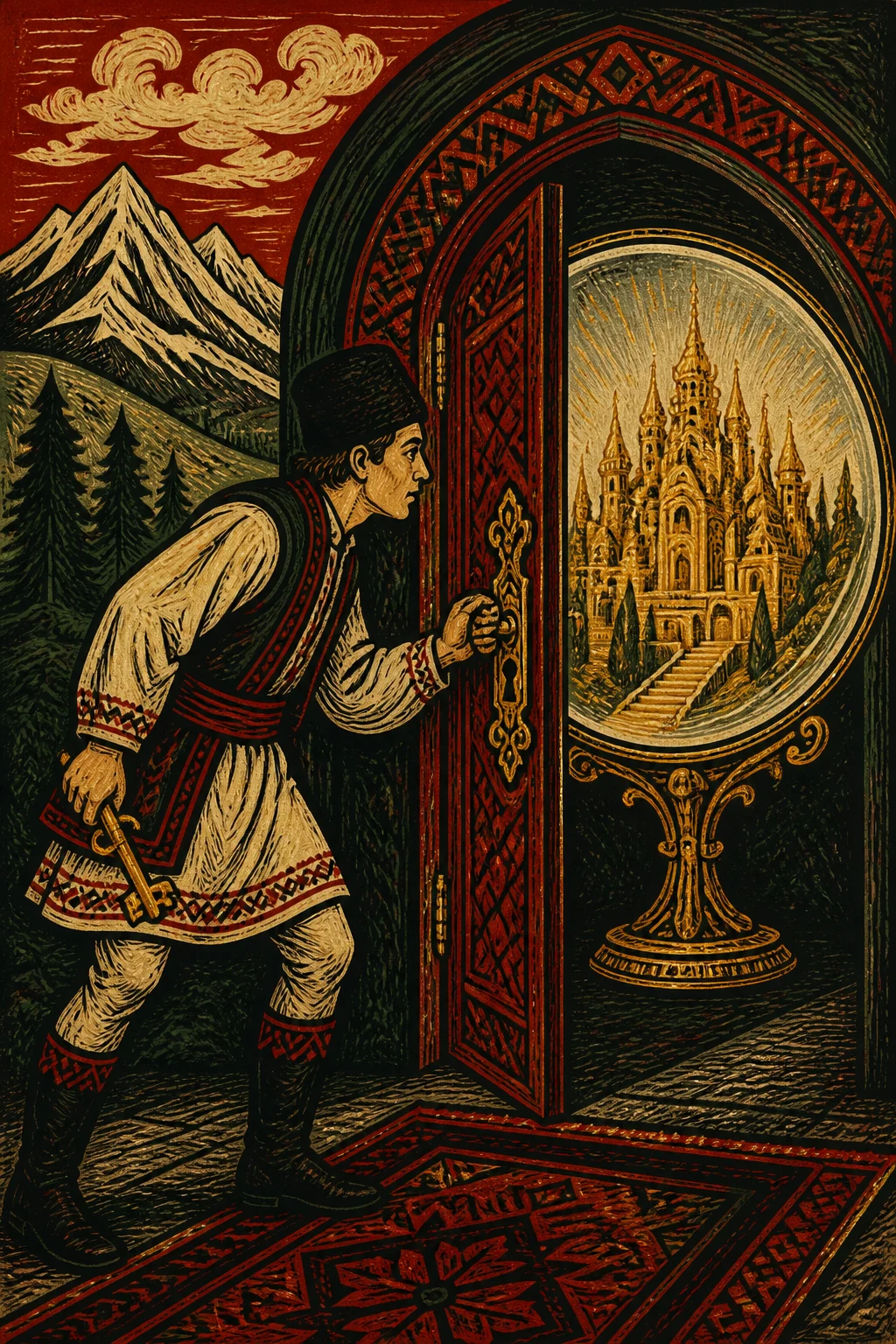
The King, who had seen the Serpent shut himself away with his daughter and close the door, said to his wife, “May Heaven grant peace to our good daughter’s soul, for she is certainly gone by now, and that accursed Serpent must have swallowed her like the yolk of an egg.” Putting his eye to the keyhole, he tried to see what had become of her. But when he beheld the extraordinary beauty of the young man and the serpent’s skin lying on the floor, he kicked open the door, and they rushed inside, seized the skin, and threw it into the fire to burn;
at the sight, the young man cried, “Ah, you accursed dogs! You have ruined me!” Turning into a dove, he tried to escape, but found glass in the windows. He battered it with his head until he broke through, yet emerged so badly hurt that not a single part of his skull remained sound. Grannonia, finding herself in the same instant joyful and wretched, happy and unfortunate, rich and beggared, clawed at her face and reproached her father and mother for this clouding of her happiness, this poisoning of her sweetness, this wrecking of her good fortune. They excused themselves, saying that they had meant no harm. But she went on lamenting until Night came out to light the catafalque of Heaven for the Sun’s funeral rites. When she saw everyone asleep, she gathered all the jewels she kept in a cabinet and slipped out through a back door, determined to search until she found the happiness she had lost;
and once outside the city, guided by the moonlight, she met a Fox, who asked whether she would like some company. Grannonia replied, “You would be doing me a kindness, my good gossip, for I do not know this country very well.”
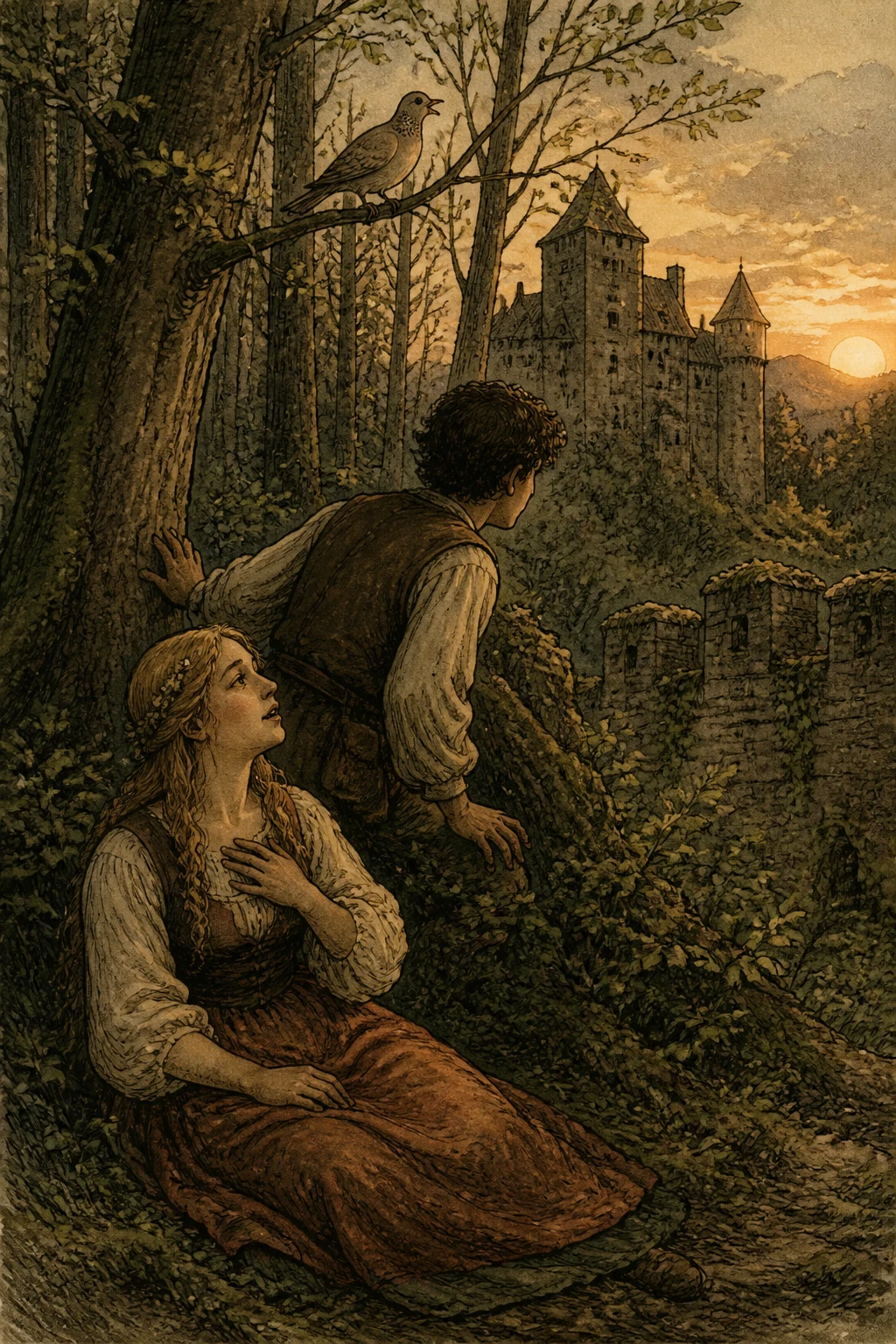
Walking on together, they reached a wood where the trees, playing like little children, made little houses for the shadows to nest in. By now weary from their journey and wishing to rest, they withdrew beneath the sheltering leaves, where a fountain played carnival games with the fresh grass, dousing it with jugfuls of water. Lying down upon a mattress of tender grass, they paid Nature the toll of rest they owed her for the merchandise of life. They did not wake until the Sun gave his customary fiery signal to sailors and couriers that they might continue on their way. Once awake, they lingered a good while to listen to the singing of the various birds, and Grannonia showed great pleasure in their warbling. Seeing this, the Fox said, “You would take twice as much pleasure if you understood what they were saying, as I do.” At these words Grannonia—for curiosity comes as naturally to women as chatter—begged the Fox to tell her what she had heard in the birds’ language. After allowing herself to be begged for a good while, to arouse still greater curiosity about what she had to tell, the Fox said that the birds were discussing a misfortune that had befallen a king’s son. He was as handsome as a fairy prince, but because he had refused to satisfy the unbridled desires of an accursed ogress, she had laid a curse upon him, transforming him into a serpent for seven years. The term was almost over when he fell in love with a king’s daughter. He was with his bride in a room and had left his skin upon the floor, but the bride’s father and mother, prying too closely, had burned it. Fleeing in the form of a dove, he had smashed through a glass window to escape and injured himself so badly that the physicians had given him up for lost. Grannonia, hearing her own affairs discussed, first asked whose son this prince was and whether there was any hope of a remedy for his injuries. The Fox replied that the birds had said his father was the King of Vallone-gruosso, and that there was no other secret for stopping the holes in his head, to keep his soul from slipping out, than to anoint his wounds with the blood of the very birds who had told the story.
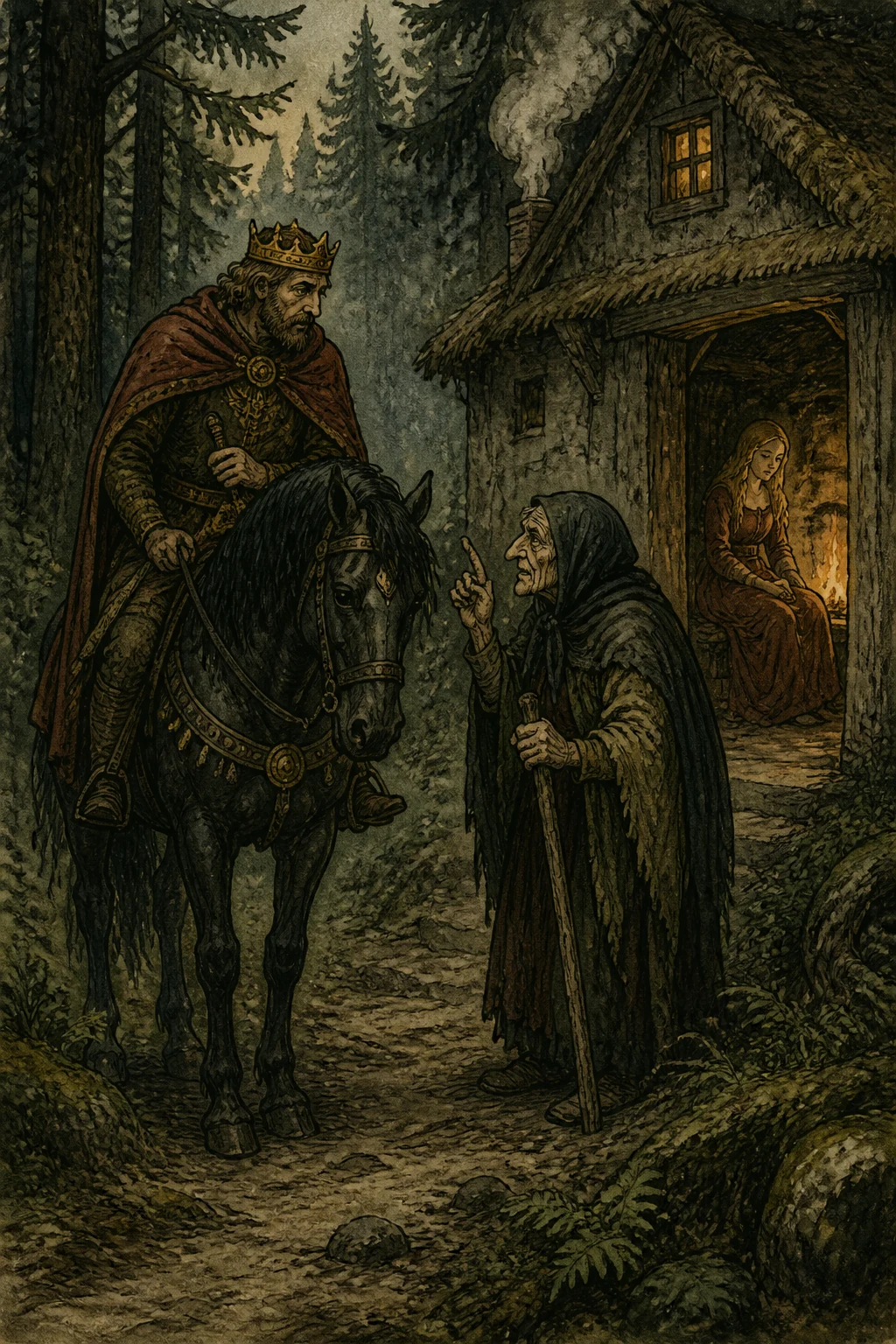
At these words Grannonia knelt before the Fox and begged her to do her the kindness of catching those birds so that she could draw their blood, promising that they would share the reward like good companions. “Softly,” said the Fox. “Let us wait until night, and when the birds roost, leave it to your old mother: I shall climb the tree and wring their necks one by one.” So they spent the whole day talking, now of the young man’s beauty, now of the bride’s father’s mistake, now of the misfortune that had followed. Talking and talking, they let the day slip by, until Earth spread out a great black sheet to catch the wax from the torches of Night. When the Fox saw the birds asleep upon the branches, she crept up and, one by one, caught all the golden orioles, goldfinches, wrens, chaffinches, woodhens, woodcocks, owls, hoopoes, thrushes, greenfinches, kestrels, and flycatchers in the trees. Having killed them, they poured their blood into a little flask the Fox carried to refresh herself on the road. Grannonia was so delighted that her feet scarcely touched the ground, but the Fox said, “Ah, my child, this is happiness in a dream! You have achieved nothing unless you also have my blood to make a stew with that of the birds.” With that, she took to her heels. Grannonia, seeing her hopes dashed, resorted to women’s arts—cunning and flattery—and said, “Gossip Fox, you would have good reason to save your skin if I were not so deeply in your debt, and if there were no other foxes in the world. But since you know how much I owe you, and know too that there are plenty of your kind in these fields, you may trust my good faith. Do not be like the cow who kicks over the pail just when she has filled it with milk! You have done so much, only to undo it all and abandon me at the best moment. Stop, trust me, and come with me to this king’s city, and I shall be your slave.” The Fox, who had never believed that a finer essence of foxhood than herself could exist, found herself outfoxed by a woman. For she agreed to walk with Grannonia, and they had not gone fifty paces before Grannonia aimed a blow at her with the stick she carried and struck her on the skull so hard that she instantly stretched out her legs. Slitting her throat at once, Grannonia drew her blood and poured it into the flask. Then she set off at a brisk pace and reached Vallone-gruosso, where she made her way to the royal palace and sent word to the King that she had come to cure the Prince. The King had her brought before him and marveled to see a young girl promise what the finest physicians in his kingdom had been unable to accomplish. Still, since there was no harm in trying, he said he would be very glad to see her make the attempt.
But Grannonia replied, “If I bring about the result you desire, I want you to promise to give him to me as my husband.” The King, who already considered his son dead, answered, “When you give him back to me safe and sound, I shall give him to you sound and free. It is no great thing to give a husband to someone who gives me a son.” So they went to the Prince’s room, and scarcely had she anointed him with the blood when he was as well as though he had never been ill. Seeing the Prince strong and vigorous, Grannonia asked the King to keep his word. Turning to his son, the King said, “My son, you have already looked death in the face, and now I see you alive and can scarcely believe it. But I promised this young woman that, if she cured you, you would become her husband. Since Heaven has granted you this mercy, let me fulfill my promise, for the love you bear me, for gratitude obliges us to pay this debt.” The Prince answered, “My lord, I wish my heart were as free to give you satisfaction as it is full of love for you. But I have pledged my word to another woman, and neither would you consent to my breaking faith, nor would this young woman advise me to wrong the one I love, nor can I change my mind.” Hearing this, Grannonia felt an inward joy beyond all telling, to find herself still alive in the Prince’s memory. Her face flushed crimson, and she said, “If I persuaded this young woman you love to yield her claim to me, would you not bend to my wishes?” “Never,” replied the Prince, “shall I erase the lovely image of my beloved from this breast. Whether she gives me the sweet preserves of her love or doses me with bitter physic, I shall always hold to the same desire and the same resolve. Even if I were in danger of losing my place at the table of life, I would never play such a trick or practice such deceit.” Unable to remain any longer in the shackles of pretense, Grannonia revealed who she was. For the room had been kept dark because of his wounded head, and her altered dress had prevented him from recognizing her. Once he knew her, the Prince embraced her at once with a joy that left everyone astonished, telling his father who she was and what he had suffered and done for her sake. They sent for the King and Queen of Starza-longa, and in good fellowship celebrated the wedding, taking particular delight in the trick played upon the Fox, and concluding, in the end, _That to the joys of love_ _Pain has always lent its savor._