O besedilu
Pik in Kanens
- Vir
- Ovidove preobrazbe
- Avtor
- Ovid
- Jezik branja
- English
- Jezik izvirnika
- Latin
- Čas branja
- 7 min branja
- Obseg
- 6 strani
- Naslov izvirnika
- Picus and Canens
O izvirniku
Ovidove preobrazbe
Pesniški tok antičnih preobrazb, kjer bogovi, ljudje in narava stalno menjavajo obliko. Bralni jezik je English, izvirnik pa prihaja iz vira Ovidove preobrazbe v jeziku Latin.
Besedilo
Pik in Kanens
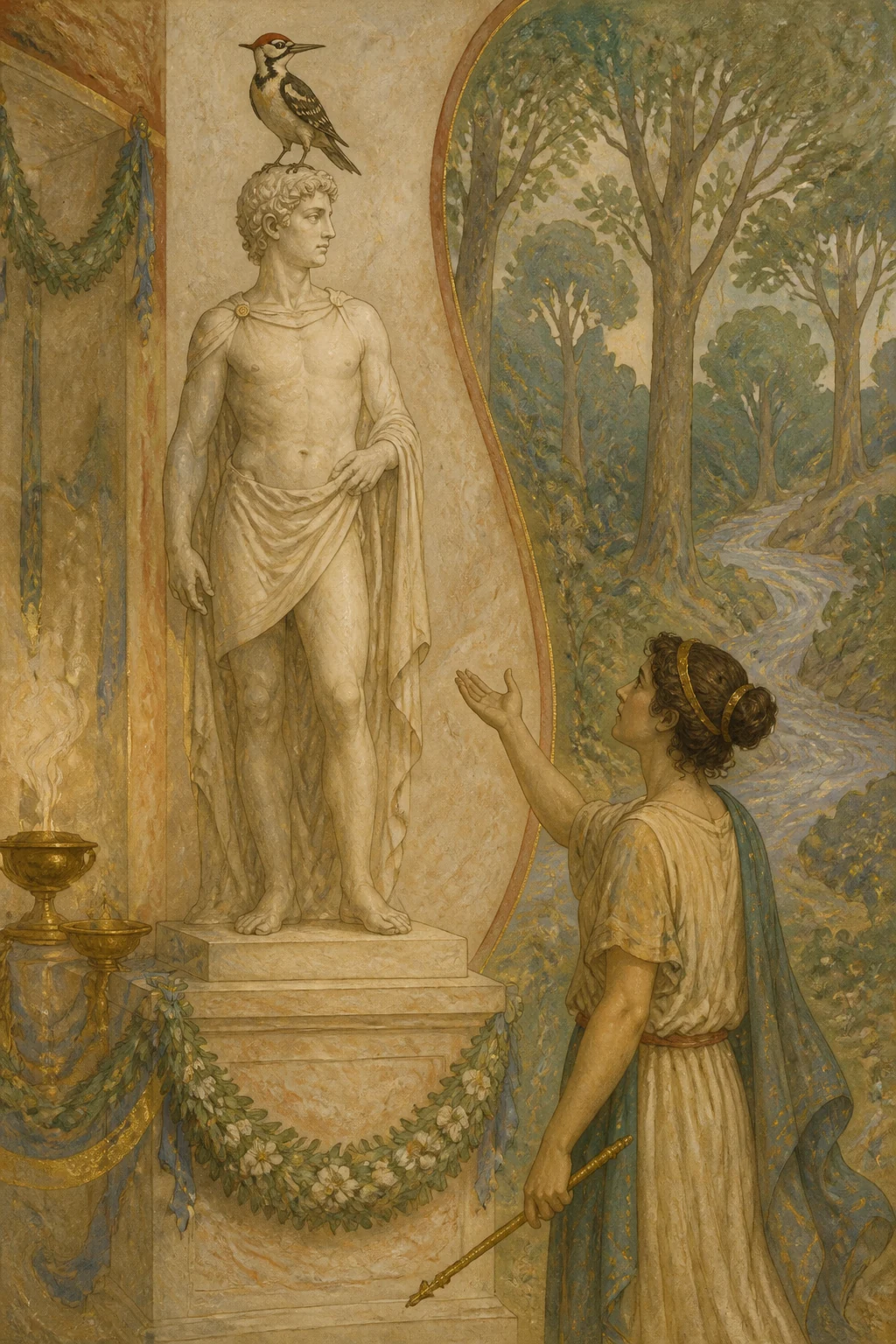
A full year’s delay kept us there, and much I saw myself in that long time, and much I heard, including, among many other things, a tale told me in secret by one of the four attendants appointed to those rites. For while Circe was alone with my leader, the girl showed me a statue made of snowy marble, a young man bearing a woodpecker on his head, set in a sacred shrine and adorned with many wreaths.
When I asked who he was, why he was honored in a shrine, and why he bore that bird, eager to learn, “Listen, Macareus,” she said, “and learn from this as well how great my mistress’s power is. Attend to what I tell you! Picus, a son of Saturn, was king in the Ausonian lands, devoted to horses useful in war. His looks were as you see them here: you may judge his true beauty for yourself from this sculpted likeness.
His spirit matched his beauty; he was not yet old enough to have seen four of the five-yearly contests at Greek Elis. He had drawn the eyes of the dryads born in Latium’s mountains; the deities of the springs pursued him, the naiads borne by Albula, by the waters of Numicius and Anio, by Almo with its briefest course, by rushing Nar and Farfarus with its deep shade, and those who haunt the woodland pool of Scythian Diana and the neighboring lakes. Yet, spurning them all, he loved one nymph alone, whom Venilia is said to have borne to Ionian Janus on the Palatine hill.
As soon as she reached marriageable age, she was given to Picus of Laurentum, preferred above all others. Rare was her beauty, but rarer still her gift of song, which earned her the name Canens. With her voice she could move woods and rocks, soothe wild beasts, hold back long rivers, and halt the wandering birds in flight. While she was singing in her womanly voice, Picus had left his home for the fields of Laurentum to spear the native boars. He rode a spirited horse, carrying two hunting spears in his left hand, his scarlet cloak fastened with yellow gold.
The daughter of the Sun had come to those same woods; to gather fresh herbs on the fertile hills, she had left the Circaean fields that bore her name. Hidden among the bushes, she caught sight of the young man and stood spellbound. The herbs she had gathered fell from her hand, and fire seemed to course through the marrow of her bones. As soon as she recovered her senses from that fierce heat, she was ready to confess her desire. But she could not approach him: his galloping horse and the attendants around him prevented her.
“You shall not escape,” she said, “though the wind itself carry you, if I know myself, if the herbs have not lost all their power, and my spells do not fail me.” She spoke and fashioned a phantom boar, a likeness without a body, and commanded it to run before the king’s eyes and seem to plunge into a dense grove, where the trees grew thickest and no horse could pass.
At once, unsuspecting, Picus pursued the shadow of his quarry, swiftly leaped from his horse’s foaming back, and followed his empty hope on foot into the deep woods. She composed her prayers and spoke the words of invocation, worshiping unknown gods with an unknown chant, the spell with which she would obscure the face of the snowy Moon and weave moisture-laden clouds before her father’s head.
Now too, as she sang her spell, the heavens thickened, the earth breathed out mist, and his companions wandered along darkened paths, leaving their king unguarded. Seizing her time and place, she said, “By those eyes of yours that have captivated mine, by this beauty, fairest of men, which makes a goddess kneel before you, take pity on my burning love. Accept the all-seeing Sun as your father-in-law, and do not cruelly scorn Circe, the Titan’s daughter!”
She finished. But he proudly turned from her and her entreaties. “Whoever you are,” he said, “I am not yours. Another holds my heart, and may she hold it, I pray, for many years! No alien love shall make me violate our marriage bond while fate preserves Canens, Janus’s daughter, for me!” After the Titan’s daughter had vainly renewed her pleas again and again, “You shall not go unpunished,” she said, “nor return to Canens.
You shall learn what a woman can do when wounded, when in love.” So spoke Circe, a woman both wounded and in love. Then twice she turned to the west and twice to the east, touched the young man three times with her wand, and spoke three spells. He fled, but wondered to find himself moving more swiftly than before. He saw feathers on his body, and, outraged to find himself suddenly a strange new bird in the woods of Latium, he stabbed the rugged oaks with his hard beak and angrily wounded their long branches.
His feathers took on the purple color of his cloak; the gold that had been a clasp, fastening his garment, became plumage, and a band of yellow gold encircled his neck. Nothing of the old Picus remained except his name. Meanwhile his companions, after calling repeatedly through the fields for Picus in vain and finding him nowhere, came upon Circe—for she had now thinned the air and let the winds and sun disperse the mists.
They pressed her with well-founded accusations, demanded their king, and threatened violence, preparing to attack her with their deadly weapons. She scattered harmful venom and poisonous juices, summoned Night and the gods of Night from Erebus and Chaos, and called on Hecate with long, howling cries. The woods leaped from their places—marvelous to tell— the earth groaned, the neighboring trees grew pale, and the grass grew wet with scattered drops of blood.
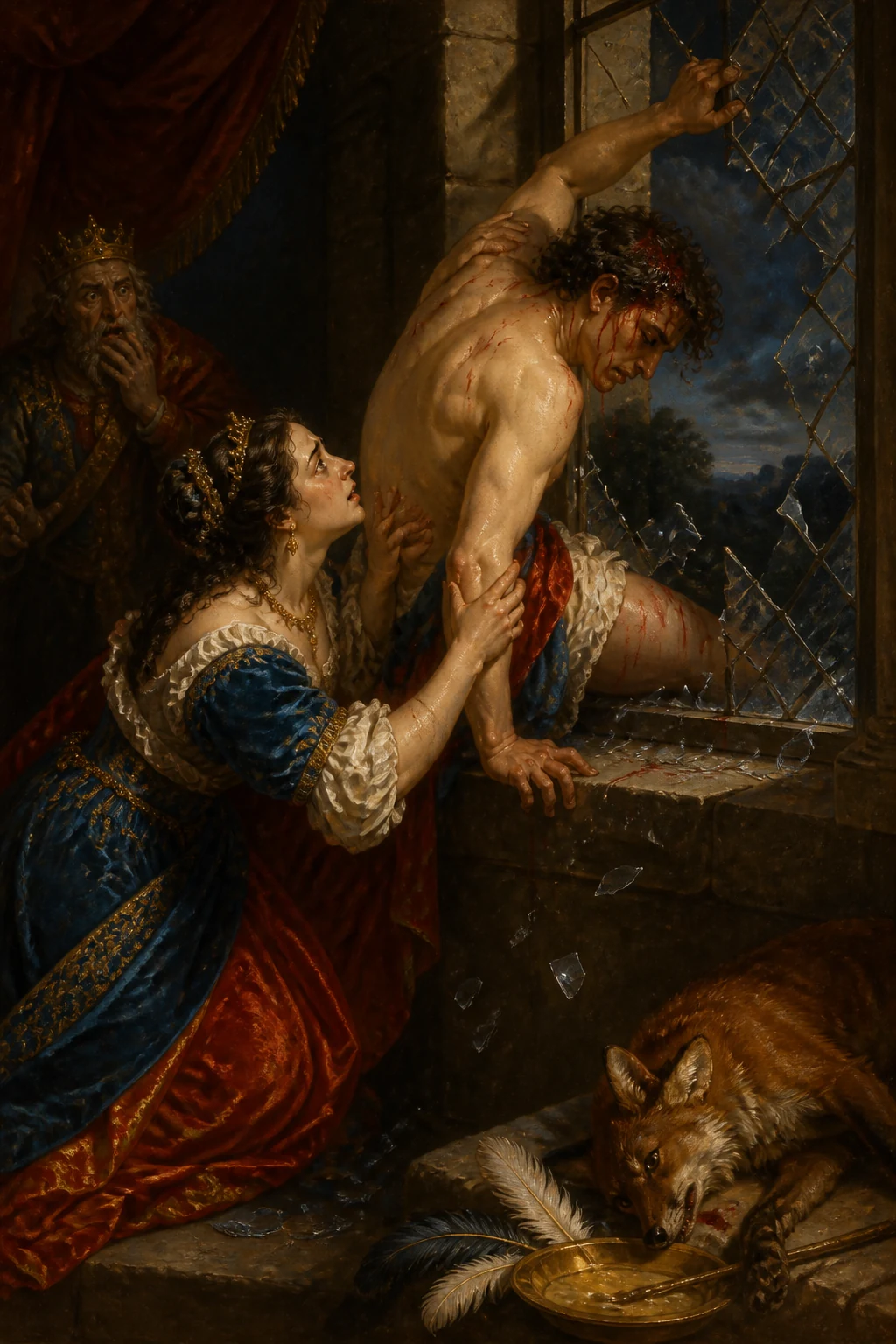
The stones seemed to give out hoarse bellowing; dogs seemed to bark, the ground to swarm with black snakes, and insubstantial spirits to flit through the air. Stunned by these marvels, the men trembled. As they stood in terrified wonder, she touched their faces with her poisoned wand. At its touch the shapes of various monstrous beasts came over the young men; not one retained his own form.
The setting sun had bathed the shores of Tartessus in light, and Canens had watched and longed for her husband in vain. Servants and people ran through every wood, carrying torches to meet him on his way. For the nymph, weeping and tearing her hair and beating her breast were not enough—though she did all these. She rushed out and wandered wildly through the fields of Latium.
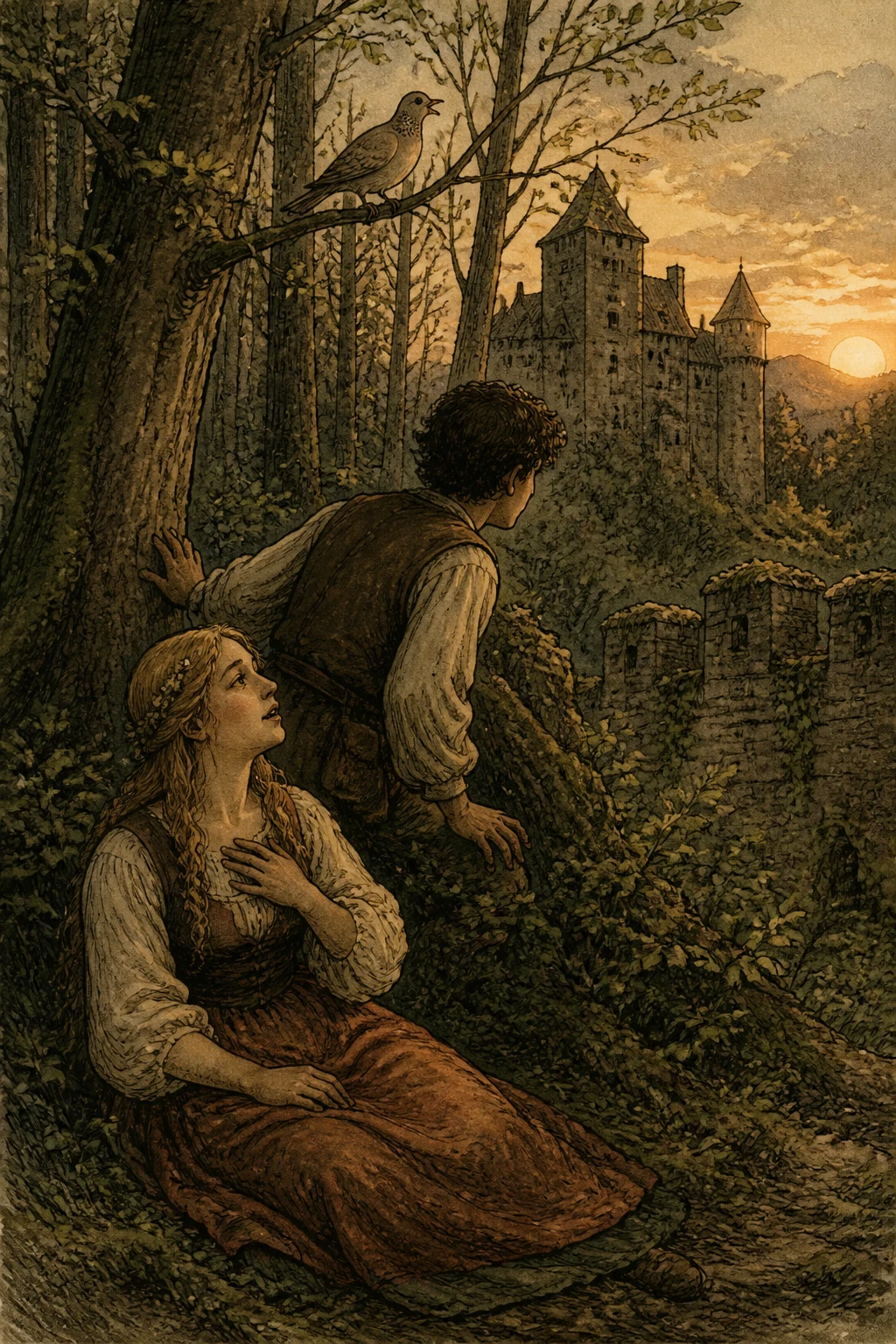
Six nights and as many returning dawns saw her without sleep or food, roaming over hills and through valleys wherever chance led her. Last of all, the Tiber saw her, worn out with grief and wandering, laying herself down upon its long bank. There, through her tears, she poured out sorrowful words in a faint voice, her grief itself shaping the melody, as a swan, at the point of death, sings its own funeral song.
Her tender marrow melted in the extremity of sorrow; she wasted away and slowly vanished into the insubstantial air. Yet the place preserved her memory: the ancient Camenae fittingly named it Canens after the nymph.” Many such stories were told me during that long year, and many such things I saw. Idle and slow from disuse, we were ordered to take to the sea again, to set sail once more.
The Titan’s daughter had told us of uncertain paths, a vast journey, and the dangers of the savage sea that still lay ahead. I was afraid, I confess, and, reaching this shore, I stayed.”
Izvirnik
Picus and Canens
Naslednje strani prikazujejo izvirno besedilo za primerjavo.
Source ID: ovid_metamorphoses_story_094 Citation: Ovid, Metamorphoses 14.308-14.440 Original language: Latin Source: PerseusDL canonical-latinLit Source URL: https://github.com/PerseusDL/canonical-latinLit/blob/master/data/phi0959/phi006/phi0959.phi006.perseus-lat2.xml Segmentation certainty: medium 308: Annua nos illic tenuit mora, multaque praesens 309: tempore tam longo vidi, multa auribus hausi, 310: hoc quoque cum multis, quod clam mihi rettulit una 311: quattuor e famulis ad talia sacra paratis.
312: Cum duce namque meo Circe dum sola moratur, 313: illa mihi niveo factum de marmore signum 314: ostendit iuvenale, gerens in vertice picum, 315: aede sacra positum multisque insigne coronis. 316: Quis foret et quare sacra coleretur in aede, 317: cur hanc ferret avem, quaerenti et scire volenti 318: “accipe” ait “Macareu, dominaeque potentia quae sit 319: hinc quoque disce meae: tu dictis adice mentem!
320: Picus in Ausoniis, proles Saturnia terris 321: rex fuit, utilium bello studiosus equorum; 322: forma viro, quam cernis, erat: licet ipse decorem 323: adspicias fictaque probes ab imagine veram. 324: Par animus formae; nec adhuc spectasse per annos 325: quinquennem poterat Graia quater Elide pugnam. 326: Ille suos dryadas Latiis in montibus ortas 327: verterat in vultus, illum fontana petebant 328: numina, naiades, quas Albula, quasque Numici, 329: quas Anienis aquae cursuque brevissimus Almo 330: Narve tulit praeceps et opacae Farfarus umbrae, 331: quaeque colunt Scythicae stagnum nemorale Dianae
332: finitimosque lacus; spretis tamen omnibus unam 333: ille colit nymphen, quam quondam in colle Palati 334: dicitur Ionio peperisse Venilia Iano. 335: Haec ubi nubilibus primum maturuit annis, 336: praeposito cunctis Laurenti tradita Pico est, 337: rara quidem facie, sed rarior arte canendi, 338: unde Canens dicta est: silvas et saxa movere 339: et mulcere feras et flumina longa morari 340: ore suo volucresque vagas retinere solebat.
341: Quae dum feminea modulatur carmina voce, 342: exierat tecto Laurentes Picus in agros, 343: indigenas fixurus apros, tergumque premebat 344: acris equi, laevaque hastilia bina ferebat, 345: poeniceam fulvo chlamydem contractus ab auro. 346: Venerat in silvas et filia Solis easdem, 347: utque novas legeret fecundis collibus herbas, 348: nomine dicta suo Circaea reliquerat arva.
349: Quae simul ac iuvenem, virgultis abdita, vidit, 350: obstipuit: cecidere manu, quas legerat, herbae, 351: flammaque per totas visa est errare medullas. 352: Ut primum valido mentem conlegit ab aestu, 353: quid cuperet, fassura fuit: ne posset adire, 354: cursus equi fecit circumfususque satelles. 355: “Non” ait “effugies, vento rapiare licebit, 356: si modo me novi, si non evanuit omnis 357: herbarum virtus et non mea carmina fallunt.”
358: Dixit et effigiem, nullo cum corpore, falsi 359: finxit apri praeterque oculos transcurrere regis 360: iussit et in densum trabibus nemus ire videri, 361: plurima qua silva est et equo loca pervia non sunt. 362: Haud mora: continuo praedae petit inscius umbram 363: Picus equique celer spumantia terga relinquit 364: spemque sequens vanam silva pedes errat in alta.
365: Concipit illa preces et verba precantia dicit 366: ignotosque deos ignoto carmine adorat, 367: quo solet et niveae vultum confundere Lunae 368: et patrio capiti bibulas subtexere nubes. 369: Tum quoque cantato densetur carmine caelum, 370: et nebulas exhalat humus, caecisque vagantur 371: limitibus comites, et abest custodia regis. 372: Nacta locum tempusque “per, o, tua lumina” dixit, 373: “quae mea ceperunt, perque hanc, pulcherrime, formam, 374: quae facit, ut supplex tibi sim dea, consule nostris 375: ignibus et socerum, qui pervidet omnia, Solem 376: accipe, nec durus Titanida despice Circen!”
377: Dixerat. Ille ferox ipsamque precesque relinquit 378: et “quaecumque es” ait, “non sum tuus: altera captum 379: me tenet et teneat per longum, comprecor, aevum! 380: Nec venere externa socialia foedera laedam, 381: dum mihi Ianigenam servabunt fata Canentem!” 382: Saepe retemptatis precibus Titania frustra 383: “non impune feres, neque” ait “reddere Canenti, 384: laesaque quid faciat, quid amans, quid femina disces.”
385: rebus, ait, sed amans et laesa et femina Circe. 386: Tum bis ad occasum, bis se convertit ad ortus, 387: ter iuvenem baculo tetigit, tria carmina dixit. 388: Ille fugit, sed se solito velocius ipse 389: currere miratur: pennas in corpore vidit, 390: seque novam subito Latiis accedere silvis 391: indignatus avem duro fera robora rostro 392: figit et iratus longis dat vulnera ramis.
393: Purpureum chlamydis pennae traxere colorem, 394: fibula quod fuerat vestemque momorderat aurum, 395: pluma fit, et fulvo cervix praecingitur auro, 396: nec quicquam antiquum Pico nisi nomina restat. 397: Interea comites, clamato saepe per agros 398: nequiquam Pico nullaque in parte reperto, 399: inveniunt Circen (nam iam tenuaverat auras 400: passaque erat nebulas ventis ac sole recludi) 401: criminibusque premunt veris regemque reposcunt 402: vimque ferunt saevisque parant incessere telis.
403: Illa nocens spargit virus sucosque veneni 404: et Noctem noctisque deos Ereboque chaoque 405: convocat et longis Hecaten ululatibus orat: 406: exsiluere loco (dictu mirabile) silvae, 407: ingemuitque solum, vicinaque palluit arbor, 408: sparsaque sanguineis maduerunt pabula guttis, 409: et lapides visi mugitus edere raucos, 410: et latrare canes et humus serpentibus atris 411: squalere et tenues animae volitare videntur.
412: Attonitum monstris vulgus pavet: illa paventis 413: ora venenata tetigit mirantia virga, 414: cuius ab attactu variarum monstra ferarum 415: in iuvenes veniunt: nulli sua mansit imago. 416: Sparserat occiduus Tartessia litora Phoebus, 417: et frustra coniunx oculis animoque Canentis 418: exspectatus erat: famuli populusque per omnes 419: discurrunt silvas atque obvia lumina portant; 420: nec satis est nymphae flere et lacerare capillos 421: et dare plangorem (facit et tamen omnia) seque 422: proripit ac Latios errat vesana per agros.
423: Sex illam noctes, tetidem redeuntia solis 424: lumina viderunt inopem somnique cibique 425: per iuga, per valles, qua fors ducebat, euntem. 426: Ultimus adspexit Thybris luctuque viaque 427: fessam et iam longa ponentem corpora ripa. 428: Illic cum lacrimis ipso modulata dolore 429: verba sono tenui maerens fundebat, ut olim 430: carmina iam moriens canit exequialia cygnus.
431: Luctibus extremis teneras liquefacta medullas 432: tabuit inque leves paulatim evanuit auras; 433: fama tamen signata loco est, quem rite Canentem 434: nomine de nymphae veteres dixere Camenae.” 435: Talia multa mihi longum narrata per annum 436: visaque sunt. Resides et desuetudine tardi 437: rursus inire fretum, rursus dare vela iubemur. 438: Ancipitesque vias et iter Titania vastum 439: dixerat et saevi restare pericula ponti.
440: Pertimui, fateor, nactusque hoc litus adhaesi.”
Nadaljuj z branjem