Prevod
_Through the ingenuity of a Cat left him by his father, Gagliuso becomes a great lord; but when he proves ungrateful, she reproaches him for his ingratitude._ _There is no telling how delighted everyone was at Viola’s good fortune: by her own wits she had fashioned herself so happy a destiny, to the spite and vexation of her sisters, who, enemies to their own flesh and blood, had laid so many snares to break her neck. But now it was time for Paola to pay the tribute she owed, pouring gold coins of fair words from her mouth; and thus she discharged her debt._ Ingratitude, my ladies, is a rusty nail which, driven into the tree of kindness, makes it wither; a broken sewer that undermines the foundations of affection; and soot which, falling into the cooking pot of friendship, robs it of its fragrance and flavor, as we see and experience every day, and as you shall hear in the tale I am about to tell.
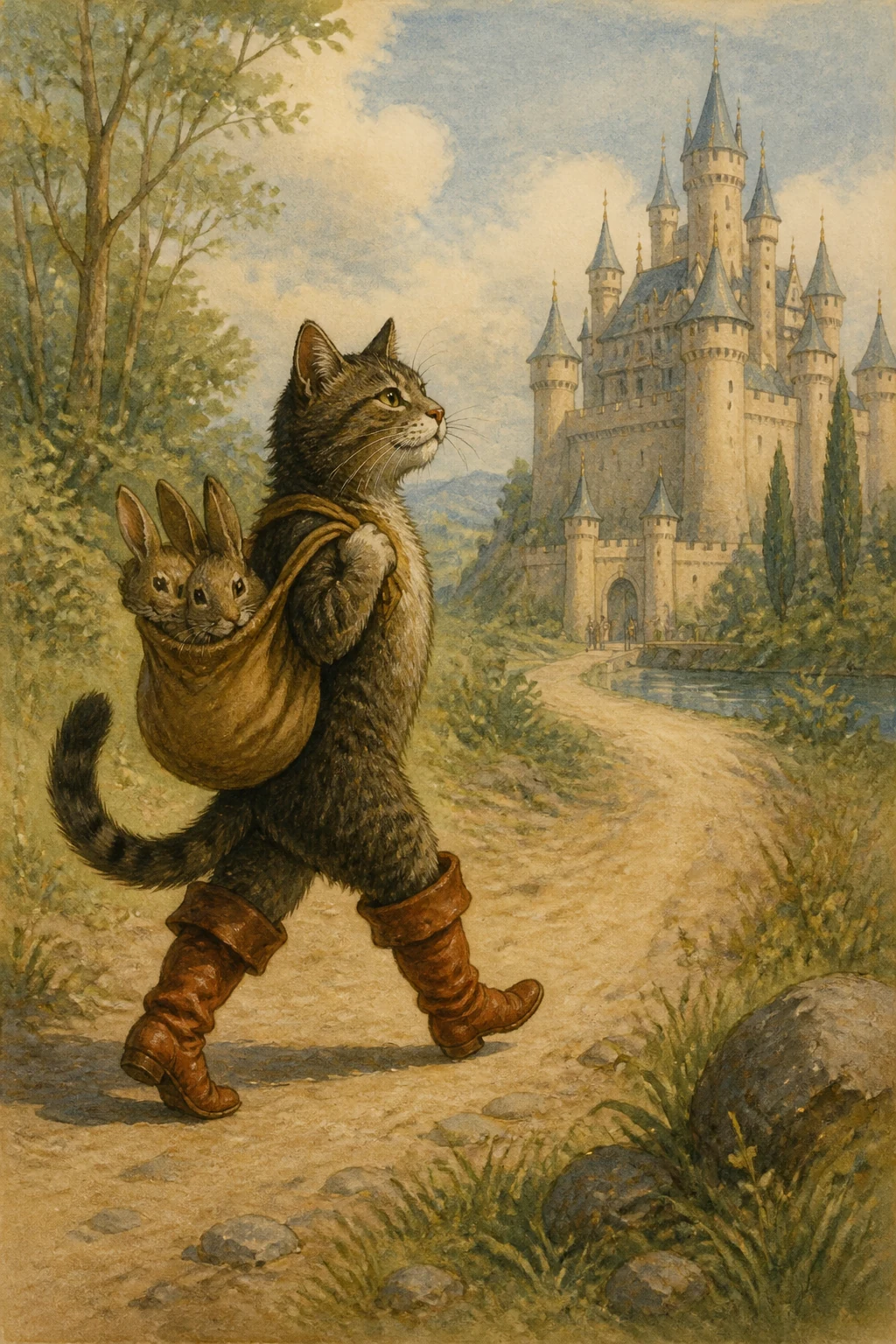
Once upon a time, in my own city of Naples, there lived an old man, a beggar through and through, so destitute, penniless, gaunt, lank, and lean, without a scrap of clothing to cover him, that he went about naked as a louse. When he had come to shake the last crumbs from the sack of life, he called his sons Oratiello and Pippo and said to them, “I have already been served with a summons, according to the terms of the bond, for the debt I owe to Nature; and believe me, if you are Christians, I should be heartily glad to leave this hodgepodge of sorrows and this jumble of troubles, were it not that I leave you stranded, as tall as Santa Chiara, at the five roads of Melito, without a penny: as clean as a barber’s basin, as trim as a sergeant, as dry as a plum stone. You have not so much as a fly carries on its foot, and if you ran a hundred miles, not a farthing would fall from you. For my ill fortune has brought me to where the three dogs do their business; I have nothing but my life, and what you see is all there is. As you know, I have always gone hungry, crossed myself, and crept into bed without a candle. For all that, at my death I still wish to leave you some token of my love. So you, Oratiello, who are my firstborn, take that sieve hanging on the wall: with it you can earn your bread. And you, the youngest, take the cat, and remember your daddy.” At these words he burst into tears, and shortly afterward said, “Farewell, for night has come.” Oratiello had his father buried out of charity, then took the sieve and went sifting here and there to earn his living; and the more he sifted, the more he earned. Pippo, taking the Cat, said, “Now look what a miserable inheritance my father has left me! I have nothing to keep myself alive, and now I shall have to provide for two. What good is this wretched bequest? He would have done better to keep it.” But the Cat, hearing these lamentations, said to him, “You complain without cause, and you have more luck than sense. You do not know your own good fortune, for I can make you rich, if I set my mind to it.” When Pippo heard this, he thanked her feline ladyship, and, stroking her back three or four times, earnestly entrusted himself to her care. So the Cat, taking pity on poor Gagliuso, went every morning, when the Sun fishes up the shadows of night with the bait of light on his golden hook, to try her luck either on the shore at Chiaia or at the fish market. Whenever she spied a fat mullet or a fine gilt-head bream, she would whisk it away and carry it to the King, saying, “Lord Gagliuso, Your
Highness’s servant to the very rooftops, sends you this fish with his respects, saying, ‘A small gift for a great lord.’” The King, with the cheerful face people always put on for those who bring them presents, replied to the Cat, “Tell this lord, whom I have not the pleasure of knowing, that I thank him most heartily.” At other times the Cat would run to the marshes or the Astroni, where men were hunting; and whenever the hunters brought down a woodcock, a snipe, or a blackcap, she would snatch it up and present it to the King with the same message. She carried on this trick until one morning the King said to her, “I feel so indebted to this Lord Gagliuso that I long to meet him, so I may repay the kindness he has shown me.” To this the Cat replied, “Lord Gagliuso’s greatest desire is to devote his life and blood to your crown; and tomorrow morning without fail, when the Sun has set fire to the stubble in the fields of the sky, he will come to pay you his respects.” But when morning came, the Cat went to the King and said, “My lord, Lord Gagliuso sends his apologies for not coming: last night some of his servants ran away and left him without so much as a shirt.” Hearing this, the King at once ordered an assortment of clothes and linen to be taken from his wardrobe and sent to Gagliuso. Not two hours later, Gagliuso arrived at the palace, guided by the Cat. The King greeted him with a thousand courtesies, seated him before him, and treated him to an astonishing banquet. But as they ate, Gagliuso kept turning to the Cat and saying, “My pussy, mind those few rags of mine, so they do not go astray.” And the Cat answered, “Be quiet, shut your mouth! Do not talk of such beggarly things.” When the King asked what he wanted, the Cat answered that he had taken a fancy to a little lemon; and the King immediately sent to the garden for a small basketful. Gagliuso began the same old tune again about his tatters and rags, and the Cat once more told him to seal his mouth. The King again asked what he needed, and the Cat had another excuse ready to cover Gagliuso’s meanness. At last, when they had eaten and chatted a while about this and that, Gagliuso asked leave to go. The Cat remained with the King, describing Gagliuso’s courage, wit, and judgment, and above all the immense wealth he possessed in the countryside around Rome and in Lombardy, which made him worthy of marrying into the family of a crowned king. When the King asked how much he might be worth, the Cat replied that there was no reckoning this rich man’s goods, estates, and furnishings: he himself did not know all he owned. If the King wished to inquire into it, he need only send men with her beyond the kingdom, and she would furnish proof that no wealth in the world equaled his. The King summoned some trusted servants and ordered them to investigate the matter thoroughly. They followed the Cat, who, on the pretext of arranging refreshments for them at each stage of the journey, ran on ahead as soon as they had crossed the borders of the kingdom. Whenever she came upon flocks of sheep, herds of cattle, droves of horses, or bands of pigs, she said to the shepherds and herdsmen, “Listen! Keep your wits about you: a band of outlaws is coming to plunder everything in this countryside. If you want to escape their fury, say these things belong to Lord Gagliuso, and not a hair of your heads will be touched.” She said the same at every farm she passed along the road. Thus, wherever the King’s men arrived, they found everyone singing the same tune: everything they saw, they were told, belonged to Lord Gagliuso. At last, tired of asking further questions, they returned to the King and told him mountains and oceans of tales about Lord Gagliuso’s riches. Hearing this, the King promised the Cat a handsome reward if she would arrange the marriage;
and the Cat, shuttling back and forth, finally concluded the match. Gagliuso came, and the King gave him his daughter and a great dowry. After a month of festivities, Gagliuso said that he wished to take his bride to his own estates. The King accompanied them as far as the border, and they went on to Lombardy, where, on the Cat’s advice, Gagliuso bought a number of estates and domains and became a baron. Now that Gagliuso found himself rich beyond measure, he thanked the Cat more fervently than words can tell, saying that he owed her his very life, and all his greatness to her good offices; that a Cat’s ingenuity had done more for him than his father’s wits. She could therefore do as she pleased with his possessions and his life, making and unmaking everything at her pleasure. He gave her his word that when she died, a hundred years hence, he would have her embalmed and placed in a golden cage in his own room, so that her memory might always be before his eyes. The Cat, hearing this boast, let less than three days pass before pretending to be dead and stretching herself out at full length in the garden. When Gagliuso’s wife saw her, she cried, “Oh, my husband, what a terrible misfortune! The Cat is dead!” “May every misfortune go with her,” Gagliuso replied. “Better her than us.” “What shall we do with her?” his wife asked. “Take her by a leg,” he said, “and throw her out of the window.” When the Cat heard this fine reward, at the moment she least expected it,
she began to say, “Is this your great gratitude for the lice I took off your back? Is this your thousand thanks for making you throw away those rags of yours, with their loose ends enough to hang spindles on? Is this my reward for setting you up like a lord and filling the belly that was always howling with hunger, you beggar, you tattered breeches! You were a ragged, bedraggled, patched, lousy wretch, fit to strip clothes off a hanged man. This is what comes of washing an ass’s head! Away with you, and may all I have done for you turn to a curse, for you do not deserve so much as a spit in your throat! What a fine golden cage you had ready for me! What a splendid burial you had arranged! Go on, then: serve, struggle, toil, and sweat, to earn such a handsome reward! Oh, wretched is the man who puts his pot on the fire in hopes that someone else will fill it! That philosopher spoke well who said, ‘He who lies down an ass wakes up an ass.’ In short, the more you do, the less you may expect.
“But fine words and foul deeds deceive wise men and fools alike.” With these words, shaking her head, she took the road out. And however Gagliuso, with all the breath of humility in his lungs, tried to coax her back, nothing could persuade her to return. She ran on without once turning her head, saying:
God save you from a rich man fallen poor_, _And a beggar grown rich once more_.