Prevod
Once upon a time, as never before, there lived an emperor and an empress. For ten years they had lived together in marriage, yet they had not managed to bring even the tiniest scrap of a child into the world. At last the emperor told his wife that if, within a year from that day, she had not borne him a child, she should know that she would no longer eat bread and salt from the same platter as he. When the empress heard this, her heart grew heavy, for they had lived happily together. She began seeking advice from physicians and sorcerers, from midwives and women who whispered charms. She took every sort of remedy. Then one night she dreamed a dream that terrified her. It seemed she was walking through a lovely green meadow. Every blade of grass there had a mate, and, two by two, they bent toward one another as though exchanging kisses. Even the butterflies flew in pairs. Though she was dreaming, she believed everything she saw was real. She had scarcely begun to delight in the lovely sight when a dragon, a devilish monster, came hurtling toward her like a whirlwind. It was chasing a little dove. Trembling like a reed, the dove darted up and down, and, seeing no escape from the savage beast, flew into the empress’s bosom and hid there. At this the dragon hurled itself at the empress too. She gave a scream and awoke. Her heart was pounding with fear, every limb was trembling, and she came within a hair’s breadth of fainting. She told the emperor of her dreadful dream, and he too was struck dumb with horror. The next day she felt that she was with child, and nine months later she gave birth to the sweetest, loveliest little boy.
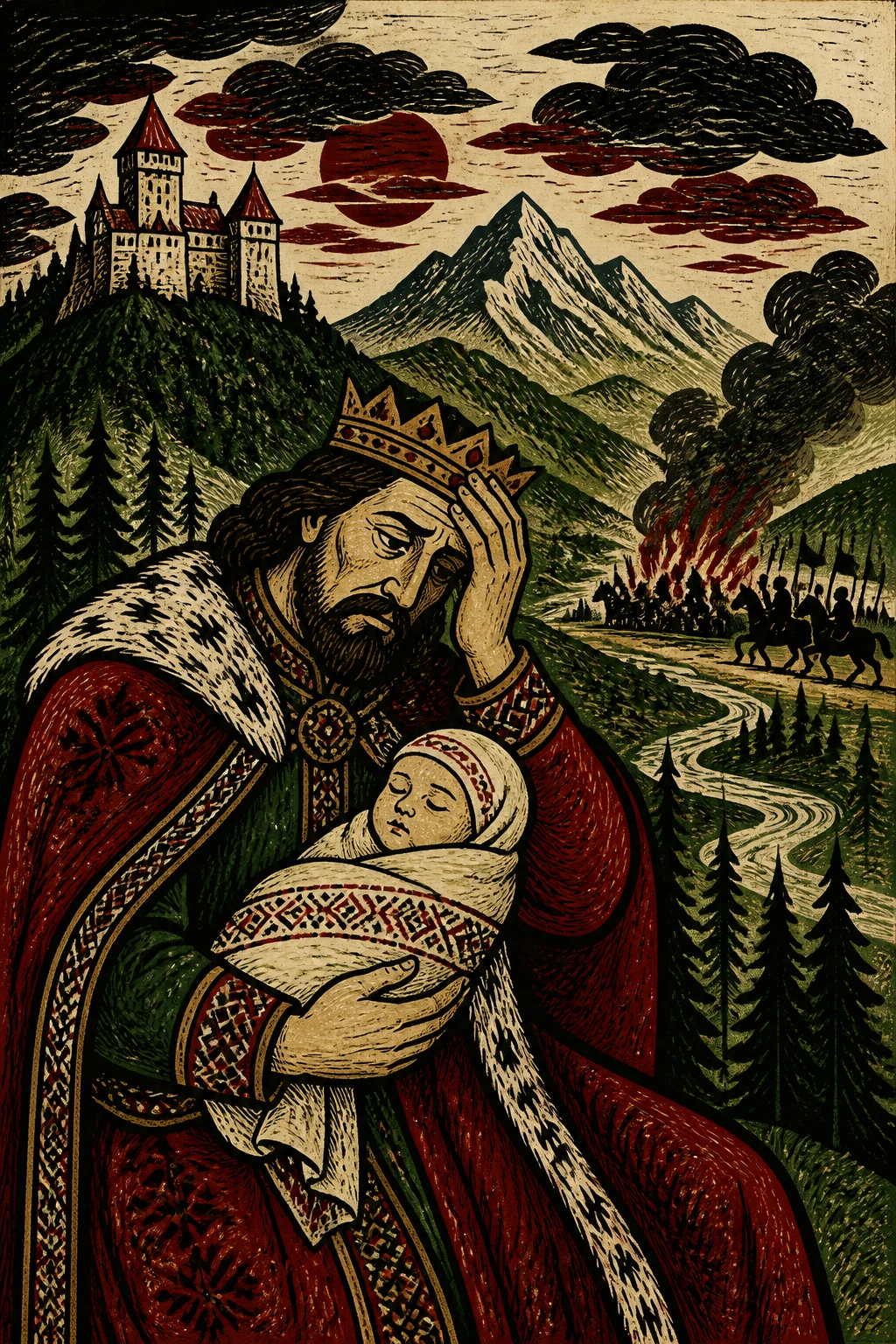
The rejoicing at the emperor’s court was beyond telling. They decided to have the infant baptized. In those days children were baptized at a spring beneath a mountain. Now, some time before, a band of robbers had appeared on that mountain, lying in wait for those who came to baptize their children and murdering them. So the emperor gave strict orders that soldiers should surround the spring, to guard and defend the child should the robbers appear. Nor was he satisfied with that. He also ordered a letter to be engraved on each of several precious stones; then the stones were strung together to spell the child’s name. This string of jewels he hung about the little boy’s neck. With these preparations made, the emperor and empress set out to baptize their child, taking many armed horsemen with them. When they reached the foot of the mountain, the robbers came out to meet them and, without a word, fell fiercely upon them. The emperor sent the empress on to have the infant baptized, saying that he would hold off the robbers until her return. The empress obeyed and went on her way. As she was coming back from the baptism, she reached a place where she stopped to listen. Hearing neither the clash of weapons nor the din of battle, she felt a chill strike through her heart. No longer daring to go forward, she turned back and hid the child behind the spring, in a thick clump of flowers. For the robbers had overcome the imperial troops and cut them down. The empress then set out alone to find her husband. When she reached the battlefield, she saw a pool of blood and, beside it, a great pit where the emperor’s men lay buried. She shut her eyes against the dreadful sight and hurried on, only to find herself suddenly seized by two robbers. Once she had told them who she was, they took her to their captain. No sooner did he hear her name than, without trial or further ado, he ordered her shut up in a deserted cave and given a quarter of a loaf of bread and a jug of water each day until she perished there. Meanwhile, the child lay among the flowers. But God watched over him and allowed no evil thing that might harm him to come near. Not far from that place, a hermit lived in a hollow in the mountainside. He owned a goat, a creature dear to his heart. She always came to drink the cold water of the spring. One day, grazing here and there, she wandered toward the clump of flowers. When she found the child, she lay down beside him, began licking him, and brought her udder close to his little mouth. Feeling it there, he began to suck and went on sucking until he had drunk his fill. The goat grew so fond of the child that for a whole month she would not leave his side. When the monk saw that his goat no longer came home, he set out to look for her. He searched high and low, but the goat was nowhere to be found. He had almost given up hope of her when one day she appeared before him. The hermit began coaxing her: “Little goat, my little goat!” He tried to lay a hand on her. But not a bit of it! Off she skipped to the right, off she skipped to the left, always keeping out of reach, with the monk following after her. When he saw that he could not catch her, he went back to his little cell, filled a bowl with bran, and tried winning her over with kindness, calling and petting her: “Little goat, my little goat!” But this did no good either. The goat would not even look at his bowl of bran; she kept straining to be off. Curious to see where she was going, the hermit followed her. Without a moment’s hesitation, the goat went straight to the clump of flowers where the child lay, settled down beside him, and let him suckle. The monk stepped in after her, but when he saw what was there he stood stock-still, afraid it might be some apparition. He crossed himself and said a prayer, asking God to protect him from evil and make the phantom vanish. But how could it vanish? What he saw was real: a child as lovely as a little angel. Once he had made certain that there was nothing unholy about it, and that the infant had even been baptized, compassion moved him to take the little boy back to his cell and lay him in his own small bed. The goat jumped up too and settled beside the child. Seeing this marvel, the monk let her feed him until he was satisfied; then he took him up, unwound his swaddling clothes, washed him, and wrapped him in some pieces torn from his own garments. He read the jewels about the child’s neck and learned that his name was George and that he was an emperor’s son. As the boy grew older, the monk taught him to read and write. When the goat died, both George and the monk wept so bitterly that their tears would not dry for a long time. They buried her as they would a human being. George mourned her most deeply of all. He knew very well that the goat had not brought him into the world, but he honored her as a mother, for she had fed and raised him. Before long the monk died too, and George buried him with all due reverence. After weeping and mourning for another month, he resolved to go out into the world. He no longer cared to stay in the place where his mother and his spiritual father had died. First he pieced together a shaggy suit, rather like a bear’s hide, from some fox skins he found in the loft of the little cell where he had lived with the hermit. Then he took the nearest path and let it lead him wherever it would. He walked and walked until the trees began to thin, and then he came down into fields full of all manner of plants. A little farther on, he entered a town. The crowds surrounding him made him dizzy and bewildered, and the noise all about him deafened him. He walked on without knowing where he was going. Once he had recovered his wits, he steadied himself, plucked up his courage, and began looking into all the shops, marveling at everything he saw. People followed him as though he were a performing bear, for he was dressed like no one they had ever seen. After wandering through a good part of the town, he came to a smithy. Seeing swords and maces there, he went in and asked to be given a sword and a mace. “Choose whichever you please,” the shopkeeper answered. George chose an enormous sword that other men could scarcely hold, and a tremendous mace, and was about to leave. “Pay first, my lad, and then you may go.” “What does ‘pay’ mean?” he asked. “Why, we must bargain, and then you must give me as much money as we agree upon.” “What is money?” he asked again. Seeing that he was dealing with a creature straight out of the forest, the shopkeeper set about enlightening him and explaining how things were done in towns. At first George marveled at all the strange things the man told him. Then, seeing that there was no other way, he offered to work for the smith in exchange for the sword and mace. They agreed that he should serve a year for them, and so he became an apprentice. George’s skill soon became the talk of the town. Where others could not master certain kinds of ironwork in three years, he worked like a seasoned journeyman within six months. He played with the great sledgehammer that three men together could not lift, and everyone stood in awe of him. When his year was up, he hired himself out for another year in exchange for enough iron and charcoal to forge a sword and mace to his own liking. At the end of that year, the master ordered that he be given the iron and charcoal. But the senior journeyman, fearing that George would take his place, bore him a grudge and looked for a way to be rid of him. He told George that there was iron enough, but not enough charcoal, and that he must go and make some in the Black Forest, which was where they themselves got theirs. This was not true. A monstrous scorpia had appeared in the Black Forest and killed anyone who entered it; the journeyman was sending him there to his death. George knew nothing of such things. His heart was pure and free of guile. He chose from his master’s shop an old sword handed down from the mighty Novaci, which was kept there as a treasured relic. He took some great charcoal sacks made from two buffalo hides and set off for the Black Forest. After walking some distance, he reached a village and asked which way the Black Forest lay. At his words, the villagers began crossing themselves and spitting into their shirts against ill luck. Then they told him the whole tale of the scorpia. George cut them short. “If you do not mean to tell me, spare me this nonsense, such as no one ever heard before!” Seeing how determined he was, the people showed him the way and left him to go wherever his fate might lead him. When he reached the forest, he cut down a great many trees with his sword, piled them into a heap so vast that no one could have measured it, and set it alight. As he stood beside the fire, he felt something drawing him in, a kind of sucking force that nearly pulled him from his place. He turned—and what should he see? There came the raging scorpia, my good fellow, sucking in the air for all she was worth, meaning to draw poor George into her maw as well. Seeing what was in store for him, he drove his sword into the ground and braced himself against it. There he stood, watching and waiting to see what would happen. The scorpia came up, lashed out with her tail and scattered the fire, then hurled herself at George to swallow him. But the brave young man wrenched his sword from the earth and, quicker than thought, swung it round and slashed the monster in two. Then he pursued her as she fled toward the hollow where she lived, caught up with her, and cut off her head. So much dark blood poured from the foul creature that it formed a pool. He was about to return to his work when suddenly he heard a sweet voice calling him by name. He looked up, and what should he see? A pretty little bird perched on a branch, saying: “Brave little George, in gratitude for saving my family from this unholy scorpia, who swallowed my young every year, I advise you to bathe in the blood of this accursed beast. Then nothing will be able to harm you for the rest of your life, and you need fear no one but God.” Brave George did as the little bird advised. When he came out of the pool, the bird saw a leaf stuck to his back and said: “George, one small place on your body is still open to harm. But if you guard it well, you need not trouble yourself.” Then the young man put the monster’s head into one sack and the charcoal he had made into the other, and returned to his master’s shop. He took the iron for which he had labored a year and set about forging a sword and a mace. When they were finished, he tested the sword by striking an iron bar, and it broke in two. He threw it away. Then he tossed the mace high into the heavens, but when it fell to earth it flattened, so he threw that away too. What was he to do now? He stood there, whistling over his misfortune. After thinking and thinking, he remembered seeing a thick piece of iron sticking out of the ground in the forest where he had grown up. He went all the way back there. When he took hold of it, what should he discover? The iron was not merely driven into the ground: it was a vein running through the mountain. He pulled and tugged and twisted until he broke the vein and tore it loose. Then, like the mighty fellow he was, he hoisted it onto his shoulder, returned to the smithy, and at last succeeded in making a sword and a mace that could be his inseparable companions. Afterward he took them to the baptismal spring and baptized them, naming the sword Balmut, My Helper, and the mace Slayer of My Enemies. Then he returned once more to the smithy to say farewell, for he meant to go in search of his parents. But when he reached the shop, he found everyone there stone dead. During his absence they had searched his sack and come upon the scorpia’s head. The moment they saw it, they all died. George was deeply sorry, but there was nothing he could do. He went out through the gate and set off. On the road he met an apprentice who had not been there when the journeymen rummaged in his sack. As soon as the boy saw him, he came over to say goodbye. “Where are you going, brother George?”
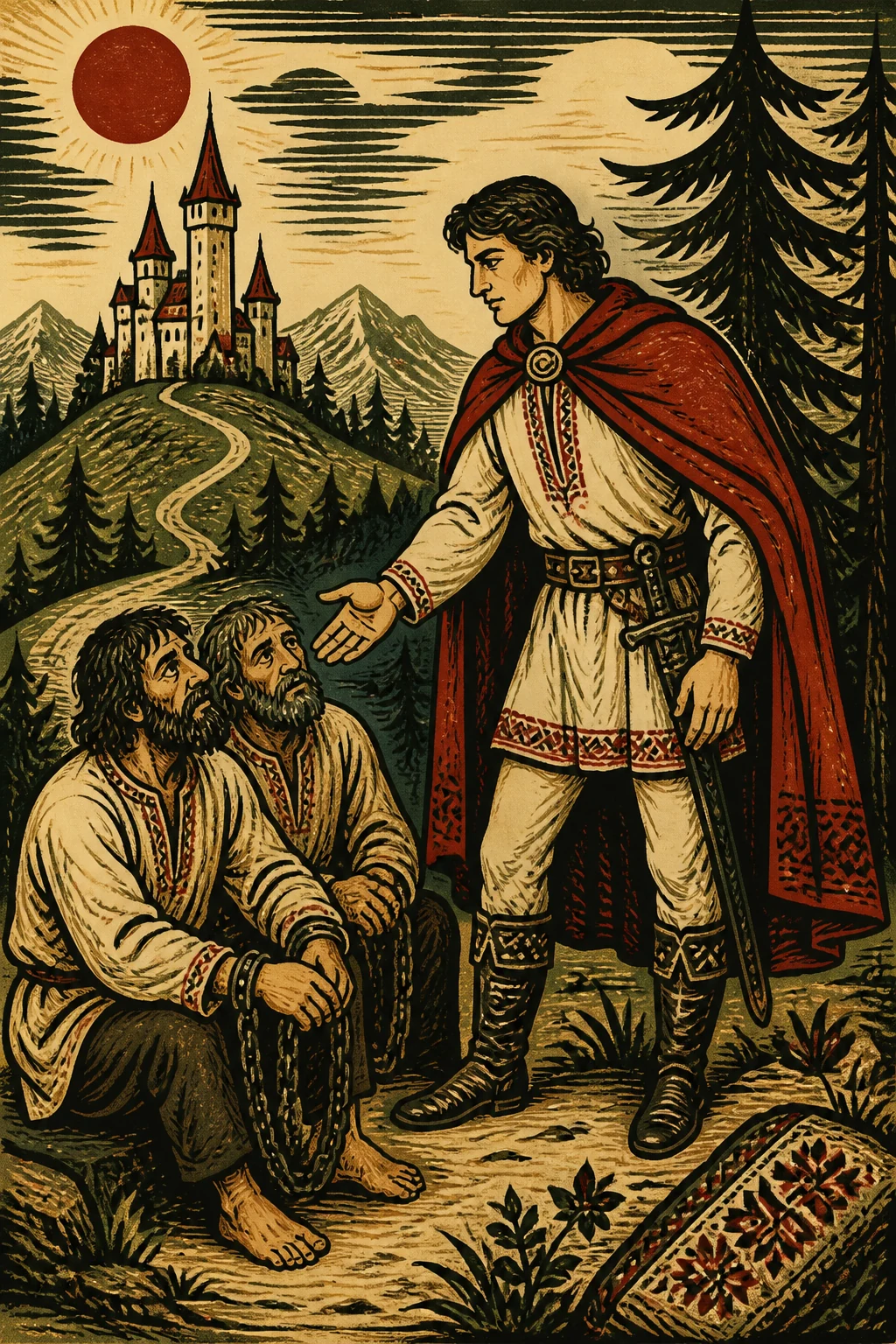
“Wherever my eyes lead me and God lights the way.” “Take me with you, brother George,” the apprentice begged. “Leave me in peace! I have nowhere to lay my own head, let alone drag a little scamp like you after me!” George went on alone, all by himself, and turned aside into a clearing to rest. And there was the boy who had been his fellow apprentice, coming to sit beside him. He had followed George, keeping out of sight, until he caught up with him. “What is this?” George asked. “Here I am too,” the apprentice answered. “What? Just because you would not take me, did you think I could not follow the road?” George laughed a little, and, touched by the boy’s devotion, consented to take him along. “If that is how it is, then you shall be my companion.” Then they lengthened their stride and went on and on, traveling three days and three nights until they reached a great forest. There they stopped to rest and eat a bite. While they were sitting there, they heard a pig squealing and saw a great wild boar running past, with a mounted huntsman in pursuit. Behind the huntsman came another boar, fiercer still. The huntsman drew his bow, and as the arrow flew, the first wild beast tumbled over, blood gushing from its mouth as from a water barrel. Then the boar behind charged with a mighty grunt and reached the huntsman’s horse, ripping open its belly with its dreadful tusks and spilling its entrails. The huntsman fell in a heap from the saddle. As the wild boar made to tear him to pieces, brave George sprang from where he sat and, quicker than thought, stood beside the unfortunate man with his naked sword in his hand. With one stroke he cut the foul beast in two. In less than the blink of an eye, the huntsman’s companions arrived and stood aghast at what had almost happened. These men came from George’s father’s empire. They all thanked him for saving their lord. Then they sat down to eat and celebrated so heartily that the feast was long remembered. As it was hot, they took off their outer garments to be more at ease. One of the company noticed the jewels about George’s neck. He edged quietly closer, read the name, and recognized him. When he told the others of the divine marvel by which their emperor had been revealed to them, the huntsman came to George and said: “Long life to you, our lord and sovereign! Know that the emperor of this land has fallen asleep in the Lord, and I, an unworthy servant of my master, have governed in his place until his heir, lost at his baptism, should be found. The council of elders entrusted me with this charge. Now I thank the Lord for what has happened to me: God sent you to save me from death, and I have recognized in you the son of that good emperor who ruled us so kindly for so many years.” George, who had listened to the huntsman with his mouth hanging open and his eyes wide, said: “But how do you know, good people, that I am the son of this emperor you speak of?” “The jewels about your neck have told us. Praised be the name of the Lord that we have found you! From this day forward, you shall rule over us.” Everyone at the feast rose and bowed before him as before an emperor. George went with them to the imperial palace, taking his fellow apprentice along. Word of this happy event spread throughout the land, and the people came flocking from every quarter, young and old, to see the one who had been dead and was alive again, who had been lost and was found, praising the name of the Lord. Once George had taken his father’s throne, he began setting everything in order so that the affairs of the empire should prosper. The boy who had been his fellow apprentice became his right-hand man, and in a short time grew polished and discerning. The new emperor made inquiries far and wide into how he had been lost, and learned the whole story from beginning to end: how his father had fought the robbers; how they had defeated his army; how the emperor and his surviving men had fled and heard nothing more of either him or his mother; how grief and sorrow had weighed upon the emperor until his death; and how he had died unconsoled, never learning what had become of them. Then George gathered a band of picked men, every one a match for any other, and prepared to set out for the baptismal spring to rid the forest of those robbers. First, however, lest any harm should come to his mother, he thought it wiser to send the robbers’ captain a letter requesting the empress’s release. He wrote the letter, and when he saw that his soldiers were reluctant to take it, he accepted his former fellow apprentice’s offer and sent him instead. The young man set off, but when he reached the forest where the baptismal spring lay, he found himself surrounded by twelve outlaws, who seized him. They were considering how best to kill him when he told them he was carrying a letter to their captain. Then they took him to their leader and waited to hear his orders. The captain laughed after reading the letter. He wrote back to the emperor that, if he wished to remain alive, he had better stay where he was; but if he had grown weary of living, he could come and fight, for the captain was waiting for him. As for his mother, he would not release her: she would remain in prison until she wasted away entirely. This punishment, he said, was only what she deserved for the insult she had offered him in his youth, when she refused to take him as her husband after he asked her parents for her hand. That was why he had become a robber. Before sending the reply, the outlaw captain had a turkey killed and roasted, and sent it to the empress, telling her to eat her last good meal. He was about to fight her son the emperor, for whom she pined, and might well kill him. This, he said, was the offering he was making for her son’s soul, since after the young man’s death there would be no one left to make such an offering. When the empress heard that her son was alive and ruled his father’s empire, she did not so much as touch the turkey. She sent word to the outlaw captain that, just as she had lived for twenty-four years on bread and water alone, so she would continue to live until God, who knew every secret of the heart and knew her innocence, delivered her from these torments she had done nothing to deserve. George was black with anger when he read the outlaw’s insolent reply and his mocking challenge. He set out with his picked band, resolved that nothing on earth would make him return home without his mother, whom he rejoiced to learn was still alive. Meanwhile, the outlaw captain gathered his band in a fortified tower beneath some ruined walls on the mountain, where they had made their home, and sat down to supper. As they drank and made merry, talking of this and that and mocking the emperor’s letter and the empress’s reply, the wall suddenly split open and a shadow appeared. It set two burning stone candles, a letter, and a key upon the table. Then the shadow vanished. The robbers froze as though they had been painted on the wall and fell utterly silent. You could have heard a fly buzzing, so deep was the hush that followed. The captain took the letter, broke its seal, opened it, and read: “The thread of your wicked deeds has run out. The cries of the wretched people you have mercilessly slaughtered have reached heaven. The innocent blood you have shed for so many years demands vengeance. You are accursed. In the corner to your right is a hiding place of which you have known nothing. There is a little door there, which you will find by searching with one of these candles. Take the key that has been set upon the table and open it. Within this hiding place you will find an empress’s robes and jewels. Give them to the unhappy empress, George’s mother, so that she may dress herself in them. She will forgive you for the suffering and torment you have inflicted upon her for twenty-four years. In the other little chest you will find a bearskin and a chain. Put on the skin, for a bear you shall remain until you have atoned for your sins. The empress will lead you by the chain and deliver you into the emperor’s hands. Do not dare act otherwise, for the wrath of heaven will fall upon you more terribly still.” As he read this letter, the captain stood as though thunderstruck. Having no choice, he brought out all the wealth he had amassed during his years of robbery, divided it into twelve equal shares, and gave them to his twelve companions. They took their leave of their captain and scattered like young partridges, each in a different direction. The captain opened the chests and found everything exactly as the letter had said. He took the empress’s robes and jewels and gave them to George’s mother to put on. She gladly accepted, for the clothes she wore had become ragged and moldy and rotted away, leaving her almost naked. Then he begged forgiveness for the wrongs he had done her, and she forgave him, for the empress had a very kind heart. When the robber captain put on the bearskin, it clung to his body as though it had always grown there. The empress took him by the chain and set off toward her son’s throne. On the road she met George, coming like a whirlwind on a fiery, untamed steed that seemed to eat fire, his naked sword in his hand. The moment his mother saw him, she knew him, for he was the very image of his father, and she bowed before him as before an emperor. Once he learned who she was, George dismounted and embraced the empress as his mother. She told him how God, knowing her innocence, had vindicated her by turning her persecutor into a bear. Then she placed the bear’s chain in the emperor’s hand. Moved to pity by the creature’s punishment, George set him free, saying: “God’s wrath is punishment enough for you. Go and see to the atonement of your sins.” In the blink of an eye the bear vanished into the forest. The emperor, with his mother, his faithful companion, and his soldiers, returned to the imperial capital, giving thanks to God for all His mercies. They ruled in peace and quiet until God willed to take them from this world. But their adventures have lived on in story and will live on forever and ever.