Prevod
Once upon a time, as never before, there lived an emperor and an empress. They had but one daughter, and they cherished her as the light of their eyes. She was not allowed even into the garden without her nurse. The nurse watched her closely and never let her out of sight, not even for the time it takes to strike a spark from a flint. As the girl sat by the window, she would see a young good-for-nothing wandering to and fro. One day, while she was looking at him, he caught sight of her too and fixed his eyes on hers. A shiver ran through her, and then something like a spark of fire burned her heart. She drew back from the window and told her nurse what had happened. “Get away from that window, will you!” the nurse said. “Why must you keep staring and gaping at every idle fellow who passes?” Before long, the girl began to feel unwell. It seemed she had conceived, by some means beyond all understanding. She told her nurse, who was beside herself with dismay that such a thing could happen when the girl had never known a man. The fear that seized them both was beyond telling. “What will your father say when he finds out?” the nurse lamented. “What am I to answer when he questions me?” “How am I to stand before him with my belly swelling,” said the girl, “when God alone knows how innocent I am?” And indeed her father was a stern man. He would never in his life have forgiven them. So they went and told the empress all that had happened, begging her to plead with the emperor for forgiveness. The girl would not dare show herself before her father for anything in the world.
When the empress heard what had happened, she tore at her hair. She said it was impossible for anyone to become pregnant from a glance. You see, she knew how things went in the world, and such a miracle was the last thing she had expected. The matter could not remain hidden for long. Much as she dreaded it, the empress was obliged to tell the emperor the whole story. When he heard of this disgrace, he blazed with anger. He roared like a lion: “Who is the villain who has dishonoured the white hairs of my old age? Let him be put to death! Let him hang from the gallows! Let him be ground to dust and ashes!” The empress spoke gently to him and calmed him a little. You see, he did not believe what his daughter and her nurse had told him. He knew that such a thing had never been heard of before. After giving the nurse an imperial scolding, he turned his wrath upon his daughter. He ordered a little boat to be built, put the girl inside it with five loaves of bread and a small jug of water, and set it adrift, to carry her wherever God’s mercy might lead. As the boat floated along, she prayed to God from the depths of her soul to bring her safely to shore, for He knew her innocence, and she knew of no stain upon her soul. For several days she was tossed about upon the waves. On the third day her time came, and she gave birth to a plump little boy, as lovely as an angel. Poor woman! In her hour of trouble she had no human help, nothing but her suffering and God to comfort her. Yet she found some consolation in knowing herself undefiled. And by God’s will, one night the little boat came to a halt. She felt that it was no longer moving, but lying still. Until daybreak her heart beat with fear, for she did not know what shore she had reached. When it grew light, she saw that the boat had come to rest beside a forest. She went ashore with her baby in her arms and wandered here and there among the trees. At last she settled in the hollow of a great tree, thick as a barrel. There she lived for many years, feeding on herbs and roots and the fruit of certain trees. She brought up her little boy with loving care. From branches she made a cradle in which she laid him by day; at night she never let him leave her breast. To bathe him, she went down to the shallow bed of a brook that flowed nearby. The starry sky was their roof; the flowers of the field, the birds of the air, the butterflies and the insects were the child’s playmates. When he grew a little older, his mother taught him to hunt, and with tears in her eyes she told him how she had been brought up and how she was now obliged to bring him up. He listened and remembered everything she said. As he grew older still, he began to hunt farther from their dwelling. One day he spied a palace in the distance. He remembered what his mother had told him about her father’s palaces, and thought it looked rather like them. He ran back and told her what he had discovered. The next day he took his mother by the hand and led her there. When they reached the palace, she told him that it was not her father’s, though the palaces of the emperors of the world were much like it. More time passed, and the boy grew taller. One day, while hunting again, he somehow found himself once more before that palace. With his club over his shoulder, he took heart and entered the courtyard. Now, this palace belonged to some ogres. Our brave young fellow, who knew nothing of fear, went inside as well. He was almost beside himself with wonder, so astonished was he at all the things he had never seen in his life. And then, what should happen? All at once three ogres appeared before him. These were the masters of the palace. They rushed at him as though to tear him to pieces, and in harsh voices demanded, “How dare you, filthy wretch, set foot in our house?” The young hero did not utter a sound. He swung his club faster than lightning, striking one on the right and another on the left before either knew where the thunderbolt had come from, and laid them both stretched out upon the ground. Neither stirred again, for he had struck them good and hard. Seeing how matters stood, the third ogre vanished from before him like a ghost and hid in the cellar. He saw that he could not stand against such a hero, and resolved to bring about his ruin by other means. In the heat of battle, our brave young Romanian had not noticed what had become of the third ogre. He waited a while, and when he saw that no one else was coming, he went back for his mother, brought her to the palace and settled there. Wandering from room to room, he came upon the ogres’ weapons and marvelled at them. His mother told him that she had seen such weapons in her father’s house, and showed him how to use them. They served him well, for he found hunting much easier. Now he began to shoot deer and does, whereas until then he had caught only little birds in snares, and that with difficulty. He had become the mightiest hunter in the forest. There was no one who could stand against him. Often he stayed away from home for days at a time. One day the ogre came out of the cellar and went begging to the hero’s mother, asking her to take pity on him and let him stay at her household. He said he had been wandering for he knew not how long, groping his way through that wilderness. He told her he was an unfortunate man who had lost his way while hunting, and thanked the Lord for granting him the sight of human beings once more. The poor woman, who knew what hardship and want meant, lent an ear to the ogre’s deceitful pleas. Taking pity on his misfortunes, she promised to speak to her son about him. As soon as her son returned, she told him the whole sad story of the man who sought their mercy, and begged him to take pity on his wretchedness. “For we cannot know,” she said, “what God may yet have in store for us.” The young hero was pleased by this turn of events, thinking that at least there would be a servant in the house to keep his mother company while he was away and help her with the work. When he saw the fellow, he did not recognize him as an ogre, so well had the villain disguised himself. He told him what his duties would be and allowed him to stay. The many privations, the many troubles, the deep sorrow the hero’s mother had suffered, and her great longing for her country—but above all the thought of the shame that still lay upon her name in her parents’ house, though she was innocent—made her languish and waste away upon her feet. Seeing her so pale and always downcast, the ogre ventured one day, while the young man was hunting, to question her, pretending to speak with great diffidence. “Mistress, if I am not mistaken, you are not at all well.” “I am not well, my boy, for I long for my father and mother and my own country. You see, I am an emperor’s daughter, and because of a misfortune that befell me, I have been wandering through the world all these many years.” “I know a remedy for your illness, mistress, but there is no one to go and fetch it.” And he told her of all the wonders wrought by the remedy he claimed would do her good. When her son returned from hunting, she told him she had heard from their servant that she would recover if she ate apples from the Red Apple Tree. He was overjoyed to hear of a remedy that might make his mother well, and resolved to go and fetch it, however far away it might be. He bade her farewell and set out. But which way should he go? Until then he had never even heard of such a thing. Trusting to his luck, he headed east. As he made his way through the thick forest, he caught sight of a palace more beautiful than the one in which they lived. He went straight towards it. A wondrous fairy dwelt there. The moment he saw her, his heart went out to her. The fairy came to meet him, welcomed him as was fitting, led him into her palace and entertained him as a guest. As they talked of one thing and another, they soon came to understand each other. You see, this was a great turn of fortune ordained for him. Until then he had never seen any woman’s face but his mother’s. And the fairy was as beautiful and as delicate as a flower.
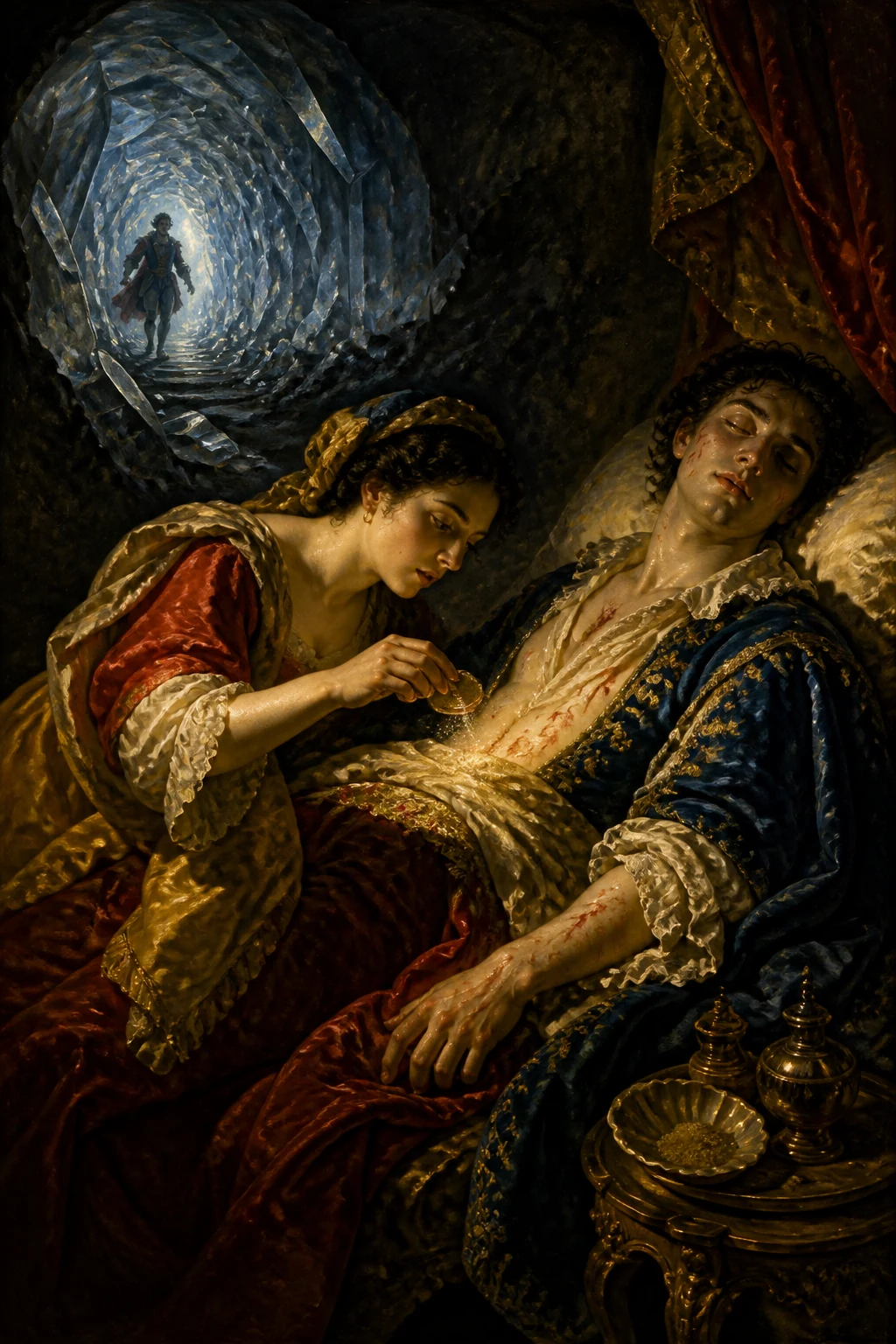
She, too, had plenty to admire in him, for he was a fine young Romanian, tall and straight as a fir tree. He lingered there, gazing at her. Then he remembered that he had set out to fetch his mother apples from the Red Apple Tree, and made to hurry away. But the wondrous fairy stopped him and asked where he was going. The young hero told her the whole story, from beginning to end. The fairy understood the ogre’s trickery, but said nothing. Instead, she directed him to the place where the Red Apple Tree grew and taught him how to gather its fruit. He bade the fairy farewell, promising to return by way of her palace, and set out. On and on he went, over a long road and a longer one still, until, after crossing lands and seas, he reached a garden enclosed entirely by roses. He went inside and found the Red Apple Tree planted in its very midst. He tried to approach it, but the tree said, “Come no nearer, brave youth, for you will lose your life, and that would be a pity.” The lad, who knew no fear, answered as the fairy had taught him: “Do not be afraid, poor afflicted tree. I shall rid you of your caterpillars and dead branches.” After cutting away the dead wood and removing the caterpillars, he picked three little apples, as lovely as those of paradise, and turned back. When he reached the forest, he called on the fairy. She welcomed him joyfully and put him in a room to rest. While he slept, she exchanged his apples for others. On waking, the young hero was eager to return to his mother with his errand accomplished. He took the apples and set off. Meanwhile, the accursed ogre was fawning upon the boy’s mother, trying with temptations and sly tricks to beguile her into yielding to him. The poor woman did not know what the devilish creature was about. In her heart she knew nothing of the temptations and snares of love, and so she gave the foul wretch no encouragement to grow bold. She knew only one thing: she was wasting away with longing for her parents and the country where she had been born. Whenever she sought a little comfort, her son was the one who gave it to her. At any other time you would find her with her eyes bathed in tears. When she saw her son, she came to life with joy. It seemed to revive her a little. She ate the apples he had brought, and thought them good. After a while, however, she sank back into her former languor. Seeing his mother’s health decline, the young hero did not know what else he could do to cheer her. As for that devil of an ogre, he showed himself so eager in his service that scarcely had his master opened his mouth before he guessed his wish; then he moved heaven and earth to fulfil it. The young hero noticed the servant’s zeal and faithfulness, and far from regretting having taken him into his household, began to look on him with favour. One day, when the hero was in good spirits, the ogre approached him and said in a pleading voice, “Master, I know how dearly you love your mother. I do not like the look of this wasting sickness of hers. If you will listen to me, you will not go wrong.” “Do you know of some remedy? Tell me, and I shall listen.” “In the country I come from, when people suffer from such an illness, they do everything they can to obtain the water of life and the water of death from the mountains that clash together. That water is the best remedy of all. I see that you are a great hero, and I believe in my heart that it would be easier for you than for others to bring it back.” Before he had finished speaking, the young hero went to his mother. “Mother,” he said when he reached her, “I see you always pale and wasting away upon your feet. I am going to fetch you a remedy. At the mountains that clash together there is the water of life and the water of death. I shall go all the way there to bring you some.” “Do not go, my darling boy. The Lord’s mercy is with us. If it is His will that I should be ill, then whatever water you bring me will be in vain. Do not leave me alone again. Loneliness has gnawed at my heart enough already. You are my comfort now, my child; if I am deprived of that too, I shall perish.” “Be brave, Mother, and keep your spirits up until I return. Once you have drunk the water of life, you will be cheerful and sound as a rock.” There was no holding him back. He made ready and set off. On his way he called on the wondrous fairy. As they talked, he mentioned that he was going on a journey, and told her where. The fairy smiled when she heard this and saw the little jugs the ogre had given him. She said nothing to arouse his suspicions, but gave him two wide-mouthed jars with which he could scoop up the water more quickly, and taught him what to do. At the very stroke of noon, when the sun stood high overhead, he was to raise a pole with a red kerchief tied to its tip. The mountains would stare at it, wide-eyed, and before they recovered from their bewilderment, he must rush in and fill the jars from the two springs. The young hero was most grateful for her advice. He bade her farewell and set out. He travelled on and on, until after a long journey he reached the place in question. He did as the fairy had taught him, then, still on horseback, darted between the mountains and filled his jars. As he turned to leave, the mountains realized that someone had taken water from the springs, and began clashing together again. The young hero was just riding back between them. Had he not hurried out, he would have perished on the spot. But he escaped unharmed. Only his horse’s tail was caught, and half of it remained behind. Ever since then, a horse’s tail has been half flesh and half hair. On his way home he stopped again at the fairy’s palace. As before, she urged him to rest a little, and while he slept she exchanged his water for other water. When he woke, he took the jars and went home. His mother needed nothing more than the sight of him. She did not know what to do for joy, and kissed him on one cheek and then the other. After drinking the water he had brought, she thought she felt a little stronger. So she said, at least! You see, she did not realize that it was the joy of seeing her son that made her feel somewhat livelier. The ogre was beside himself when he saw the young man return safe and sound, with his errand accomplished. In the son’s absence, he had tried every means he could think of to beguile the emperor’s daughter, but all his snares had come to nothing, for she had not fallen into the trap the foul creature was laying for her. She could not understand why he kept hovering about her with his blandishments and lures. She never dreamed what the accursed ogre had in mind. The truth was that he feared to meet the hero in open combat. He meant to destroy him by treachery, and then dishonour his mother too, to avenge his brothers’ deaths. But fortune did not favour him. From time to time the young hero went hunting and paid a visit to the fairy. Before long he noticed that his mother was not recovering, but growing ever more weary and wasting away. His heart was heavy to see that nothing did her any good and that he could give her no help. The wretched ogre saw how troubled the young man was about his mother’s health. One day he approached him and let fall another hint, for the villain was afraid to urge him too strongly. He feared the hero might grow suspicious and guess his wicked intentions. “When I was a child, master, I heard that grown people who suffer from a wasting sickness, and children who suffer from the dog’s sickness, can be cured by eating a piglet from the sow beneath the earth. It breaks my heart to see the life ebbing out of my good mistress. But I would not urge even you to go, for terrible danger awaits anyone who tries to steal a piglet and fails.” “Say no more,” the hero answered. “I know nothing of danger or fear.” And at once he set about preparing for a longer journey. He told his mother he was going hunting. Then he set out and called on the fairy, telling her what he intended to do. He knew, you see, how well her advice had served him. After teaching him how to succeed, she gave him a cake of soap, a comb and a brush to help him. The young hero thanked the fairy, bade her Godspeed, and departed. He travelled on and on until he reached a forest so dense and dark that he could scarcely force his way through. He groped about until he found the sow’s lair. But how was he to approach it? The lair was surrounded by logs and upturned roots, so thickly tangled that not even a magic bird could get through. The young hero did as the fairy had taught him. He dug a tunnel until he came beneath the sow’s bed, crawled inside and waited for her to come and lie down. The piglets were all clustered at her udder, suckling. Before the Swineherd’s Star rose, when all pigs wake, the piglets lay asleep with the teats still in their mouths. The young hero slipped his hand forward and took hold of one, so gently and so lightly that the teat slid out of its mouth without its feeling a thing. At once he clamped its snout shut so that it could not squeal, and away he went. That devil of a sow felt her teat growing cold. She woke and saw that one of her piglets was missing. She set off after the hero. Although his steed was a marvel of a horse, the sow caught up with him. When he saw that she was about to seize him in her tusks, the young hero threw down the soap. At once a stretch of sticky, foul-smelling mire appeared, so loathsome that it made your flesh crawl. The horse flew on with its belly close to the ground. The sow struggled and wallowed through the mire until you could no longer tell whether she was a sow or some devilish thing. She escaped from the mud and set off after the hero again. In an instant she had caught him up. Seeing his danger, the young man threw down the comb. A tall wall rose across her path, too high for her to leap. The sow set to work with her tusks and broke through it, making a hole just large enough to squeeze through. Then she was after him again! When the hero saw that she was drawing near once more, he threw down the brush. All at once there sprang up a forest so tall and thick that not even a fledgling could slip through it. The sow began gnawing at the trees, gnawing and gnawing until she had made herself a path. She followed him until, just as she was about to catch him, he rode into the fairy’s courtyard. The fairy came out at once, stretched out her hand and cried, “Back, shameless sow, and fear my father’s wrath!” At the sound of her voice, the sow stood rooted to the spot. Then, overcome with shame, she turned away. As she went she kept looking back, as though she could scarcely believe what she had seen and heard. Once again the young hero lay down to rest, and meanwhile the fairy exchanged his piglet for another. When he woke, he set off home in high spirits at what he had accomplished. There he came, my friend, his cap cocked to one side, the piglet in his arms, playing a tune on a leaf. Presently he met three travellers. They were the Wind, the Heat and the Frost. He took off his cap and bowed deeply. “God grant you good fortune, Uncle Wind!” “A good journey to you, my dear boy,” the Wind replied. “What’s this, lad? Is it only to the Wind that you bow?” asked the Heat. “Don’t you know I can send such sweltering weather and such scorching heat that your very guts will boil?” “I care for nothing,” the young hero answered, “so long as the Wind blows on me.” “And have you never heard of me, lad?” said the Frost. “I have the power to send such cold and bitter frost that your very guts will freeze.” “It troubles me not at all,” he answered, “so long as the Wind does not blow on me.” Little by little he made his way home. When his mother saw him and heard what perils he had passed through, she nearly died and came to life again with joy at seeing him once more in flesh and blood. He gave her the piglet to eat, but she confessed that she felt no relief. The ogre could have gone mad with rage! He saw that there was no way to destroy the hero except by treachery. So he waited for a suitable moment to carry out his wicked plan. One day the young hero returned from hunting utterly exhausted, and lay down in the garden in the shade of some rose bushes. The ogre found him there and hacked him to pieces with the sword he always kept hidden about him. So that the young man’s mother would not notice, he packed all the pieces into the saddlebags and laid them across the horse. Then he struck the horse a few times and drove it out through the gate. The horse had belonged to the fairy. She had given it to the young hero when he set out for the Red Apple Tree. Finding itself driven away, it ran straight to its mistress. When she saw it coming without its rider, she knew that some devilry must be afoot. She went down to it, and what she saw filled her with horror. She took the saddlebags into her house and laid out the body, piece by piece and bone by bone, each in its proper place. Then she poured the water of death over them. The pieces knit together, joining one to another; the flesh set like jelly and became whole. She sprinkled him with the water of life, and he revived, but he was deaf and dumb. Then she gave him one of the apples he had brought, and his speech returned. She took the piglet from the sow beneath the earth and made it squeal in his ears, and his hearing returned as well. “What a heavy sleep I have had, dear sister!” he said. “Heavy indeed, dear brother! And you would have slept as long as the world endures, had it not been for the wondrous things you brought for your mother. I kept them and put others in their place.” Then she told him who the enemy was that had sought his death. So that he might be certain she spoke the truth, she gave him the power to turn into a dove and go to see how the ogre was tormenting his mother. The young hero became a dove and flew in a single breath to the house where she lived. And what did he see there? He rubbed his eyes, wondering whether what lay before him was real or a vision. The ogre, who had failed with all his coaxing and lures to persuade the hero’s mother to yield to him, had now taken to torture. He had bound her with a red silk rope, kept her without food and left her staring into the sun. He was about to kill her just as the young hero arrived in the shape of a dove. The hero turned three somersaults, as the fairy had taught him, and became a man again, with his naked sword in his hand. In less time than it takes to say a word, he hacked that foul ogre, that devil’s creature, into little pieces. He freed his mother from her torment and gave her a little water of life to drink. As soon as she drank it, she revived and felt as cheerful and strong as a person in perfect health. Then the young hero married the fairy, and the three of them lived in happiness and harmony to a ripe old age. And I mounted a saddle, and so my tale is told.