Waltey
Dekle, ki prinaša nesrečo
Legende sau basmele românilor · Petre IspirescuO besedilu
Dekle, ki prinaša nesrečo
- Vir
- Legende sau basmele românilor
- Avtor
- Petre Ispirescu
- Jezik branja
- English
- Jezik izvirnika
- Română
- Čas branja
- 17 min branja
- Obseg
- 13 strani
- Naslov izvirnika
- 037 Fata cu pieze rele
O izvirniku
Legende sau basmele românilor
Romunske ljudske pravljice o začaranih kraljestvih, preizkušnjah in junakih, zapisane iz ustnega izročila. Bralni jezik je English, izvirnik pa prihaja iz vira Legende sau basmele românilor v jeziku Română.
Besedilo
Dekle, ki prinaša nesrečo
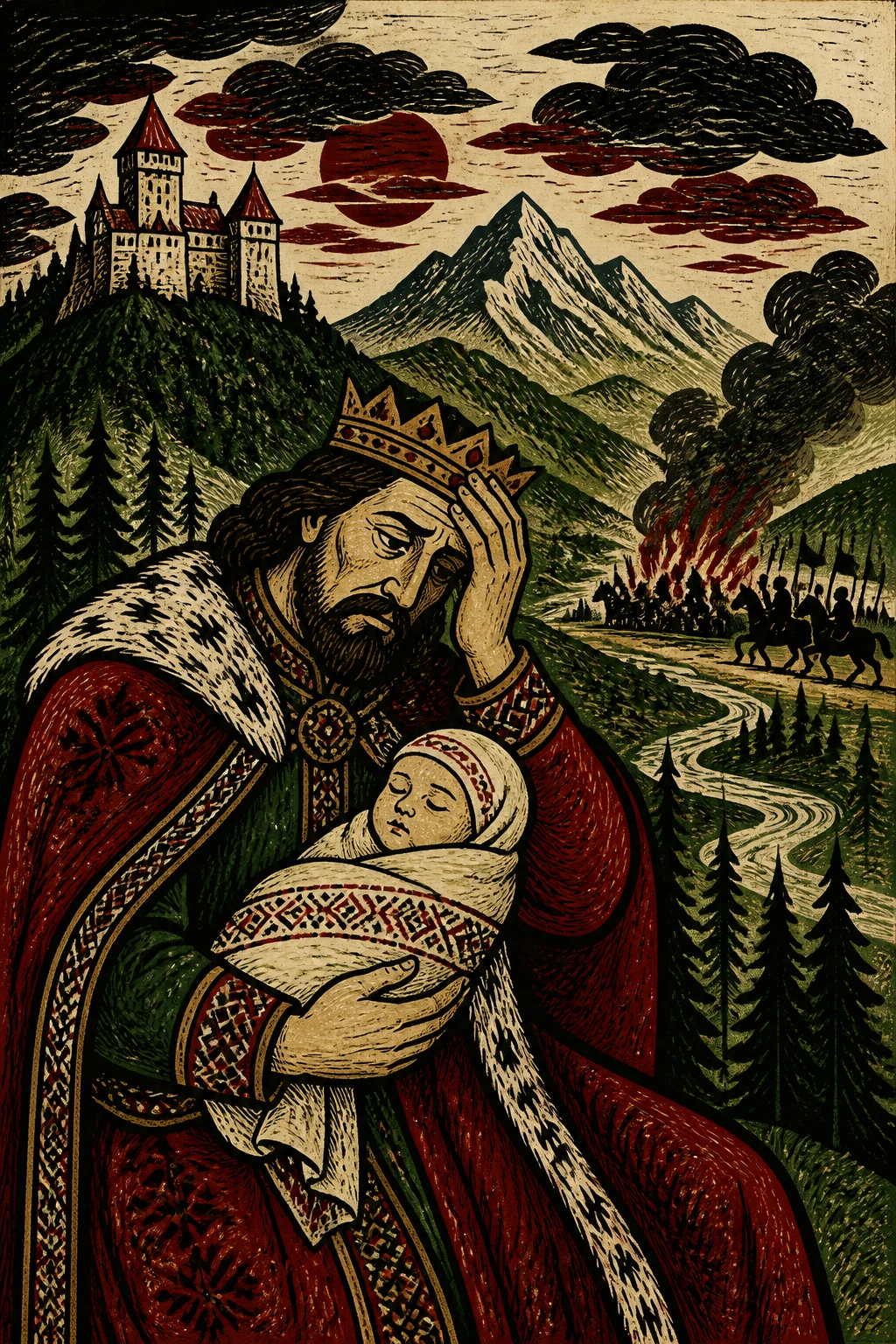
Once upon a time, as never before, there lived an emperor who had twelve sons. Whenever he sat down to table, his children formed a perfect wreath around him. He was always in good spirits, for everything prospered in his hands. The neighboring emperors envied his peaceful life. You see, he was kindhearted too: he did not burden his people, nor did he oppress the widow or the poor. Yet no one knew what secret sorrow gnawed at his heart. For all his sons, good people, he longed to have at least one daughter. And after many hopes and prayers, God at last granted this wish as well: his wife, the empress, conceived, and nine months later gave birth to a girl so beautiful that she had no equal in the world. Now the emperor expected to be perfectly happy—but not a bit of it! In his case, as in that of everyone in this sinful world, the old song proved true: Of all who on this earth were born, None ever lived from care untorn, Nor ever knew, from first to last, A happiness no shadow cast. The affairs of his empire began to languish. In short, his fortunes took a turn for the worse. One emperor threatened to make war on him unless he did a certain thing; another demanded something else; his subjects began talking of rebellion; cattle from his estates strayed across the border into another empire and were impounded; then a plague struck his herds. Misfortunes followed one another in an unbroken chain, until the poor emperor was all but ruined. He and all his twelve sons did their utmost to make peace, to foster goodwill among men, and to put a stop to the evils besetting them, but it was no use: the losses kept mounting. At last he summoned a reader of the stars to tell him why everything was going wrong and why he could make no headway. When the wise man came, he consulted the stars, and then told the emperor to observe for three nights running how his children slept. After the three nights had passed, the wise man returned. The emperor told him that some slept with their hands above their heads, some on their sides, some with their hands upon their chests, and others on their backs with their arms beside them; but the girl slept on her stomach, or lay curled up, or with her hands between her knees. “She is the ill omen in your empire,” the wise man replied. “Unless you send her away from your house, not a trace will remain of you or your children.” The emperor himself had noticed that the wise man’s words seemed to be borne out, for his fortunes had begun to decline from the very time his daughter was born. Yet he did not know what to do, or how to save his twelve sons from destruction. To the poor emperor, she too was his child. He would not willingly have lost a single one of them. In the end, however, he yielded to the counsel of the wise men. They said it was better to lose one and save twelve than for them all to be brought to misery and become the laughingstock of the world. Both the emperor and the empress shrank from committing such a deed; but, hard pressed by all the troubles assailing them on every side, they gave way to the advice of those closest to them and finally resolved to sacrifice one rather than all thirteen. So the emperor spoke with his trusted servant about how it should be done. The servant was to say that he was going hunting and would take the girl along, together with his dogs, especially since she was always saying how much she liked watching people hunt. Then he was to leave her there in the forest, without her knowing his intention. The emperor’s heart was torn with grief at the thought of losing his daughter, and the empress was sorrowful to the very depths of her soul as she packed food into a basket for her, placing a change of clothes and a few of her own jewels beneath it. When the carriage was ready, they put in the basket of food and a pitcher of water, and the girl and the emperor’s trusted servant climbed aboard. They set off and came to a great forest. Back at home, the emperor, the empress, and the girl’s brothers wept so bitterly that it would have made you want to flee the world. When they reached the forest, they left the carriage a little way off beside the path, took the basket and pitcher, and went into the woods to hunt. Coming to a clearing, the girl began picking little flowers to make herself a posy, while the emperor’s servant wandered through the trees after birds. Little by little he drew farther away, until he reached the carriage, climbed in, and was off before you could blink. When the emperor’s daughter looked about her, the servant was gone. She called out, shouted, and screamed, but no one answered. What was she to do? At last, seeing that evening was drawing on, she climbed a tree and looked first one way and then another, hoping to catch sight of some little hut. There was nothing. She turned and searched in other directions, and there, far away, she saw a light twinkling like a tiny star. Then she climbed down and, dragging the basket in one hand and the pitcher of water in the other, made straight for the light she had glimpsed. When she reached it, she found a hut with a little oil lamp burning in a shard of pottery. She knocked, and the door was opened. An old beggar woman lived there. The girl begged her for shelter. The poor woman took her in, but said she had nothing to give her to eat, for all she possessed was a hen, a little dog, and a cat. The girl took food from her basket and shared it with the old woman. The next morning, when they rose, the old woman began lamenting that her hen had died overnight. Now, she cried, she would have to take to the road and starve, for she had lived on the little egg the hen laid every day. The poor emperor’s daughter gave her one of her jewels to buy another hen and so provide herself with food. With a good deal of grumbling, half willingly and half because she had no choice, the old woman accepted the girl’s gift and fell silent. On the second night, her little dog died. Then she said, “My girl, gather your few belongings and leave my house, for ever since you came, one loss has followed another. I would not have parted with that dog for anything in the world: he guarded my hut, and I had had him for so many years.” “There, dear mother, do not be upset. I will give you enough to buy another, and you will have something left over besides.” And she took out another jewel and gave it to her. On the third day, they found the cat dead too. “Leave my house, girl,” said the old woman, “and never come back. I can see you come of good people, and I can see you have precious things, but I want none of such riches. Better to be poor and live in peace. Ever since you arrived, troubles have come crowding upon me. Go, my dear, and take with you everything you brought into my house, both good and bad.” The girl had no choice but to leave the old woman’s hut. Before going, however, she took off her fine clothes and asked the old woman for some of her rags. Eager to be rid of her, the old woman searched behind the pillows, under the bed, and along the clothes rail, and found a few scraps for her to put on, if only she would leave the house. The fine clothes the girl left behind, the old woman carried outside and put in the storeroom beside her hut. And so the girl, dressed like a beggar, left the old woman’s house and began feeling her way through the dense forest, hoping to find a path that would lead her back to other people. As she wandered on, she came upon a sheepfold. There was no one there, for its owners were three companions who all went out together with their sheep. Once she arrived, the emperor’s daughter swept out the hut, put everything in its proper place, lit the fire, and hung the little pot for maize porridge from its hook. While seeing to one thing and another, she also washed the vessels, the pails and wooden tubs in which the shepherds collected their milk. Then she hid. When the shepherds returned and saw all this, they were astonished. They looked here and there, but could see no one. Then they said, “Whoever has done us this kindness, if it is a lad, he shall be our brother; and if it is a girl, she shall be our sister.” At that, the emperor’s daughter came out of hiding. She begged them to let her live with them, for she was an unfortunate girl with nowhere to find shelter or lay her head. The shepherds took her in and told her what she was to do. When they came back that evening, they again found everything ready: supper was cooked, the tubs in which they made cheese were clean, and all was in good order at the sheepfold. But one of the companions complained that he did not know what was wrong with his sheep, which had been ailing since morning. Some sickness must have struck them; they had the staggers, or he could not tell what had happened to them. The next day, another complained that sheep-pox had broken out in his flock, and he did not know how many would survive. On the third day, the other shepherd came home with only a pitiful handful of sheep. He said that, as he was about to cross a little bridge over which he drove his flock every day, one of the sheep had somehow taken it into its head to leap into the river; another followed it, and another after that, until the whole flock rushed forward and nearly all of them jumped into the water. The poor shepherd had struggled to stop them, but you might as well try stopping the devil! Once sheep take fright, all your efforts are in vain. He had barely managed to save the few he brought home. The poor shepherds began to wonder how they had come to suffer such losses in the three days since that girl had arrived at their sheepfold. They saw that their new sister must be a bringer of bad luck, and that she had descended upon them like a curse. So they agreed to send her away, and said to her, “Sister, as you came, so you must leave us, and go wherever the Lord in His mercy may guide you. We can keep you no longer. You entered our hut with poverty at your heels. The losses we have suffered in these three days since you came to us we shall not make good in ten years.” The girl could say nothing. She too could see that it was so. She rose, gathered her things, and begged their pardon for the harm she had unwittingly done them. Then she wandered away across the fields, wherever her eyes might lead her. As she walked with her heart full of sorrow and tears streaming down her face, she saw a palace far in the distance. She quickened her pace and made for it, so that night would not overtake her on the road. A wealthy Moorish woman lived there. The girl begged the palace servants to take her in. The Moorish woman, who had seen her from above as she came through the gate, ordered them to bring her before her. As soon as she saw the girl, she knew who she was, and had her bathed, dressed in clean clothes, and taken into her own service. One day, the Moorish woman set her to searching her hair for lice, for they say that, however clean the Moors may be, little creatures are still to be found in their hair, so tangled, matted, and exceedingly thick is it. When the emperor’s daughter saw things on the Moorish woman’s head such as she had never seen since her mother bore her, she was filled with disgust and felt the need to spit. She looked to the right and to the left, but everywhere her eyes fell on costly things that she could not bear to spoil. She could not move farther away, either, for the Moorish woman had fallen asleep with her head in the girl’s lap. So she spat in the Moorish woman’s face. The woman, sharp as the devil, felt it and sprang up at once. She looked at the girl with pity and said, “If I did not know who you were, you would see what you would suffer at my hands. As it is, I forgive you. Make yourself ready; we are going somewhere.” She ordered the horses to be harnessed to the carriage. By the time they were ready, it had drawn up at the steps. They went downstairs and got in. The Moorish woman told the coachman where to drive. Along the way, she also instructed the girl in what to do when they reached their destination. She had scarcely finished speaking when they arrived in the courtyard of a palace with thousands upon thousands of chambers. As soon as they stepped out of the carriage, the Moorish woman went to a room where there were two men. One, young and fat, lay back on a golden bed, playing with two balls of silk; the other, an old man, hurried to and fro, unable to rest for a moment. He had grown bent with toil, and was so ragged, thin, and shriveled that you would have taken him for some strange creature rather than a human being. As it happened, the young man was the girl’s Fortune, and the old man was the Moorish woman’s Fortune. The moment the girl saw the young man playing with the balls of silk, she rushed at him, just as the Moorish woman had taught her, snatched them from his hands, and away she went! She ran out, jumped into the carriage, and the coachman whipped up the horses and did not stop until they were home. The fellow, slow and clumsy as he was, took so long to get up, come outside, and set off after her that he was left looking foolish: he could no longer catch her. Then the carriage went back, picked up the Moorish woman, and brought her home as well. Now, just at that time, the emperor of that country, who was a bachelor, had decided to marry. His betrothed had asked him to have a gown made for her from a very costly silk. By one means or another, the emperor found just such a fabric and sent it to the tailor. But here was the trouble: there was not enough silk, and one more piece was needed. The emperor had a search made for it, but no more silk of that kind could be found anywhere in the empire. Well then, what was to become of the bride’s gown? Unless it was made exactly to her liking, his betrothed would not accept it; and unless the missing piece could be found, the gown would remain unfinished. Surely the wedding could not be abandoned over such a trifle! So the emperor sent more men to make inquiries, and they learned that a certain Moorish woman had a piece of silk exactly like the one he was seeking, and just as much as he needed. It so happened that this piece of silk was in the balls the emperor’s daughter had taken from her idle Fortune. The emperor sent men to buy it. The Moorish woman told them she would give the piece to whoever paid her its weight in gold coins. So she placed the piece of silk in one pan of a balance, and at once that end sank down. They put gold coins in the other pan, but it remained aloft. They added more, and more, and still more, yet the balance would not come down. The emperor’s men put in all the money they had with them, but the pan still stayed up. Then they went and told the emperor. He was astonished beyond measure at this strange occurrence. He sent several sacks of gold, but his messengers returned and said that the devilish balance would not come down in the slightest. Then the emperor took several more sacks of gold and went to see this marvel with his own eyes, for he could scarcely believe it. When he reached the Moorish woman’s house and went inside, he saw the emperor’s daughter—the very girl her father had driven away as a bringer of bad luck—and lost his heart to her. You see, she was far from ugly: she had charm, she had that come-hither grace, as the saying goes, and she was well brought up—after all, she was an emperor’s daughter. It was only luck she had lacked. The emperor looked at the balance too. The pan with the money in it was still high in the air! He put in one of the sacks of gold he had brought, but as for the pan coming down—not a chance. He added another, and then another, but the balance took no notice. He put in every sack; the pan seemed fastened where it stood. Then, in a fit of vexation, the emperor took it into his head to climb on top of the money himself, and at once that end of the balance sank and came to rest exactly level with the pan holding the piece of silk. The scales were balanced at last. “So this piece of silk can be bought only with me,” said the emperor, who, being an emperor, had understood what the balance meant. “Something like that, Your Majesty,” replied the Moorish woman. “Well, if that is so, I should gladly break my engagement to that fussy girl I have promised to marry, if I knew the owner of this silk would have me.” “How can you suppose she would not?” the Moorish woman answered. “You can see for yourself that even her little piece of silk wants you.” And so the matter was settled, and before long the wedding was celebrated with great rejoicing and love. But when the girl’s father, mother, and brothers heard of it, can you imagine their joy? They all came together again, and held one of those imperial weddings whose fame spreads far and wide. And I mounted my saddle, and so on.
Izvirnik
037 Fata cu pieze rele
Naslednje strani prikazujejo izvirno besedilo za primerjavo.
fosta °data ca nici cdata, etc. A fostii °data unit imperata. Elu avea doi-spre-clece feclorI. Gaud se punea la masa, copiiI stair imprejuref cununa deplina. Ela era totil-d'auna cu voe bunk find -ca vedea ca trebile ii merga strung. imparata, vecinil lui, rivnea la traiula lui cela ticnitu. Ve;II ca si ela era bung la inima, si nu aupera intru nimica pe poporii, si nu asuprea pe veduva nici pe sirmana. Adeca, de nimeni nu scia ce verme ila rodea la inima si pe densula. Ara fi dorita, boeri d-vostra, sa alba si 0 fats barim, la atafia feclorI. Si maI una, si mal alta, dete Dumneclea in cele din urma de I se jmplini si acesta pofta a inimei ; nevasta luI, imp6rat4sa, remase grey si peste nog luni facu o fatk frumosa, frumosa, de semana pe lume n'avea. De and e se astepta acum imperatula ca sä fie pe deplina fericita, as1 ! uncle? eca se adeveri si la densulit, ca la tots lumea asta pacatosa, povestea cantecului: In lume nascuta, Nimeni n'a statutil A fi fericita Cu desaversita. Incepu a-I tanji trebile imperatieL Incepu adeca a da indarata. Ba cutare imperata flu amerinta ca voesce sa se stole cu resboia asupra lui, data nu o face cutare lucru ; ba, cutare imperata cere cutare lucru ; ha, Supugii lui vor sä faca. ras- I
mirira ; ba, vitele de pe m*le lul a calcatii botarele altel imperafii si suntii luate de pripasd; ba, ca mortea a dAtil in ele, cAte neajunsuel tote se linead lantd, de ajumese bietula imperatd in sapA de lemnil. Se silea, bietuld Imperatd, cu top cel dol-spre-clece fii aT se!, sA facA pace, sä fie Intre omenlbuna-invoire, sa opresca relele bantuia, dar geba, pagubele curgead In cele mai de pe urma chema unit cetitord de stele sA-I spue ce e pricina de-1 mergii lucrurile anapoda, si nu Ole sa dea inainte. Daca veni filosofuld, it pus3 in stele, si ad)a Si ii ctise sa -bap de soma in trel Bile d'a rinduld cum 11 dormil copiii. Trecendd cele treI clue filosofuld veni din nod. imperatuld ii spuse ca dormeau care cu mainile d'asupra capulu!, care Intro parte, tare cu mainile pe pepttit, care pe spate si cu maInile pe langA de4I ; iar feta dOrme pe brand, or! starts& facuta ghemil, sat en mainile iutre genuchi Acosta este piazareaoa a imperAtiei tale, respunse filosofuld ; de nu o veT del:arta din casa, nu se va alege nicl prafuld de D-ta §i de copiii dumitale. Imperatulti bagase §i eld de sema ca se cam adevereatt clisele filosefului, ca de cand, adecA, debandise feta, d'atuncl §i elf) dA. Indaratil. Dail nu scia ce sA fad., cum sä scape de prapAdd pe ,cel doI-spre-clece copii. Bietului Imperatd,§i acesta Hera copilu. N'ar fi vrutu, veg., sa piara nicI unulii. In cele de pe urm5. se las& dupA povata filosofilord. El clicead ca mai bine este sä piard unuId §i sä scape cloi-spre- clece, de cafe tots sA ajunga ca vas de eI §i risuld lumi!. Se indoia Imperatuld, .se indoia imperatesa sA -Neal o asa fapta , dara intetiti de tote relele ce-1 nApadea din tote patine, se induplecara la sfaturile celord muT aprope de cl6n§ii, §i se botarirA in cele din unna sä faca o jertfa de catu treispre-clece. Vorbi deci imperatuld cu credinciosuld sett cum s'a. fac.A. SA 4ica adecA ca vrea sa merga la vinatil, sä is §i pe fats §i ce -lit g&rla. baetii gi
cu densulu, mai cu sema ca totii (.Iicea ea ca-1 place sa vacla cum mergii omenii la vinatii, si sa o lase acolo in padure.. Acesta ins& fara sa scie ea. I se rupea rArunchii imperatului de mahnire pentru repunerea flicii sale, se mahni imperatesa pica in funduld sufletului ei, cand ii apda merinde in co0i, sub care puse primeneli, qi cate-va giuvaericale d'ale el. Cand fu cart* gata, puse cosulu cu merinde, unit' urcloril cu apa, 0 se urcarA §i ei, adeca fata qi cu credinceruld imperatului Pornira si ajuosera intr'o padure mare. in urma loru acasa se bocea imperatulii, imperatesa §i fratil fetei, de-ti venea sa-ti el lumea in capii. Daca ajunsera in padure, stete caruta mai d'o parte la opoteca, luara cu dan0I cosulu si urciorulii, plecara prin pAdure dupa vinatit. &Audit la unit colnicii, fata se dete sA culega nisce floricele, sä$ faca unit manuchiii ; era credinterulii imp6ratului umbla rasna prin pidure dupa paserele, incetii se departs o bucata bung, ajunse la caruta, se pima intr'ensa si pe ici ti-e Cand baga de sema fata imperatului, credinceruill nu e. Dada chiotu, striga, tips, darn nimeni nu-i respunse. Ce sa faca ea? Earl data veciu ca da in desera, fata se urea inteund copaciil, se eta intro parte, se uita intr'alta, nu care cum-v a vede vr'o coliba ce-va. Nu e. Se mai intorse de se mai uita si in alte pArti si clad, tocmg ce 1 intro departare licarindu o lumina ca o steluta. Atunci se dete josii, §i cu cosulu trite() mans, iar cu urciorulil de apA intr'alta, tire$ dui:4 (Musa, merse dreptil la lumina ce ()Arise. Aci d tea ajunse, dete peste v coliba, in care ardea unit opaitii in ciobil. 13atu la use qi-I deschise. Acolo qedea o betrana ceretore. Fata se rug-a sa o adapostesca si pe dense. Saraca o priimi ; dara ii spuse ca n'are ce sA-I dea de mancareflind-ca tutu avutula el este o gala, tutu cAtelii si o pisick Fata see-se din co0 si dete si betraneI. A doa cli card se sculara, betrana incepu sA se vaete ca i-a muritit gaina pe eighth Ea se plangea acum ca are ss incetd, drumulit. gi 9i,
mara de fame, de Ore-ce cu ousorula ce lua de la gaina pe fie-care- di se brdnea ea. Biata fata de 1mperatil II dete o giuvarieca d'ale el, ca sail cumpere o alts gaina cu care sA se hranesca. Baba, cam cu maraiala, cam de voe, cam de novoe priimi clarula fete!, si tacu. A doa nopte 11 muri catelusula. Atunci ea dise: Fata mea, sa-ti el ale trel fuiOre si sä te dud din casa mea, ea de cand aI venita tu, pagubele se tina lentil. Catelulu asta nu l'asT fi data nu will pe ce, flind-ca ImI pazea coliba, si-la arnii de atatea marl de ani. Lasa mamusora, nu te supara, (ha eu cu ce sa-II cumperI altulu, ba Inca ,sa-ff ma! si ramae. Si scose de-I mai dete o giuvaerica. Atreia di gasira si pisica morta. Sa te duel, fetico, din casa mea, dise baba, si indarata sa nu te ma! Word. Te ved a fi fatd de Omen!, te \recta ea a! scule, dard lipsa de asa bogatiI. MaI bine ea Cu saracia mea si sa traescil in, fiend. De cand al venita tu, belelele inima. Duke, dragula mamel, si is 1mpreund ell tine tutu ce a! adusa In casa mea si bur& si Tea. Fata n'avu incotro, si catd BA piece din coliba babe!. mnainte Msa d'a pleca, se desbraca de hainele sale cele bune Si ceru de h baba nisce sdrente d'ale ei. Baba, ea sa scape de dense, cauta dupa perne, pe sub pata, pe culme, dete nisce tale de puse pe densa, numaI sa se duca din casa Hainele ce le lass fate, baba le scose din casa si le dete in celarulti ce avea langa coliba. er, Si asa fata, imbracata cu haine de cersetOre, plea din casa babel si incepu a orbacai grin bungetulit cela de padure, ea der' d'o gasi vr'o poteca care sa o scold la lume. Si totil mergenda asa, dete peste o stand de °I. Acolo nu gasi pe nimen! ; edel stapanil erail trel tovarosI, earl se duceati cate tree Cu oile. Aci data ajunse, fata imperatulta se puse de matura coliba, rindui fi -care lueru la Toesorula lu!, lacu focula si atarna calddrusa de manaaliga in cram°. Pand ml-ail taiatu eI. III
una. alta, mai spala vasele, precum vedrele §i bardaele fn care adunati clobanil laptele. A.poi se ascunse. Venindil clobartiI Si vedendd tote astea, se mirara. Se uitara incoce §i incoloj darA nu vedura pe nimeni. Atunci clisera Cine ne-a facptil astii bine, de va fi baiatti, frate sa ne fie era de va fi fata, sora sa ne fie. Fata imperatului atund so areta. Ea se rugs sa o primesca a locui eu densii cael era o mnorocita si P'avea uncle sa se adapostesca, nici piece capuld. Clobanii o primira §i ii spusera ce are sa faca. Sera cand venira gasira erMi tote gata, si demancaricd §i hardaelel in care facead branda, curate, ci tote bune la stand. Lisa unuld din tovarmi se planse ea nu scie ce au oile de tanjenescti de adi-dimineta; pass -nai-te dase bola in ele, capiasera on nu sciti ce li se intamplase. A doua di se planse altulu ca a dad versatuld in oi, si nu scie cate vonli scApa. A treia di altulu veni cu nu sail ce bruma de oi. EIu spuse ca voindti a trece peste o punte, pe node trecea in tote chicle cu oile, de asta data nu scie cum isi facu nailed o de §i sari in ritt ; dupa densa alta, dupa asta alta, pina ce se napustira oile §i sarira mai tote in rid. Se sili bietulti cioband, sa le opresca, dard, pe draculd sa -lit opresci? sand iutra spaima in oi, de giaba tota munca ; abia scapase vr'o sate -va oi, cu care veni acasa. Se luaserA de ganduri Meth* ciobani, cum de In cele trei dile de cand venise fata aia is stana lord sa dea ei peste o ass paguba. El vedura ca surata lord- trebue sa fie piaza rea, §i ca a cadutd ca a pacoste peste densii. Atunci se vorbira ca sa a gonesca de 1 dei*I, si II clisera : Surata, cum ai venitu, sa to dud' de la not unde mila Domnului to va povelui. Noi All to mai putemd sine. Tu ai intratit in coliba 116AI-a cu saracia. Paguba ce anati incercatu in aceste trei dile de cand mti to la noi, Idci in dece ani nu o vomit ptitea pune la locd. Fata n'avu ce dice. Vedu si ea ca ma este. Se sculd dara, si ; sa-0 a01 Ri
cerendu-si ertAciune de reuld ce le Meuse fara voia el, plea intr'o dOrd, is asa peste campil unde o vord duce-o ocbil. Si mergendti ea cu inima plina de °bides, si cu lacramile siroie, 466 intr'o departare mare niece palaturi. Lapse pasulti si se Buse intr'acolo ca sa nu insereze pe drumii. Acolo sedea o Arapoica. bogata. Se rugs de slugile palatulul ca s'o priimesca. Arai) Oka care o ve.juse de susd cAnd intra pe porta, porunci sa o aduca inaintea ci. Gum o vedu, o cunoscu, 5i puse de o imbae frumosii, o ImbracA cu nisce bailie curate si o lua pe langa dinsa. i asa, intr'o di Arai) Oka o puse sA-1 caute in capti, cad, clice-se ca arapil catil de curart sa fie, tad se gasescii condrMei in capita lord ; pentru ca 1e e peruld imbAicitd, paslosd si des, nevoe mare 1 Fata imperatului vNendit in capuld arapoicei, ce nu mai veduse de cand o Meuse ma-sa, i se facu scarba 5i ii veni, sa scuipe. Se uita in drepta, se uita in stAnga, si nu-i dete de °chi de cats scumpeturi, pe care ii fu mita sa scuipe. Sa se duca ce-va mai tncolo, nu putea ; cacti Arapoica adormise capuld in pOla el. Se aptica si ea de scuipA stn latele ArapOicel. Arapoica, ca dracu, simti, si odata se scula. Ea se uita cu mita la fats, 5i IT dise : Sa nu te scid tine esti al vedea to ce aT pati din mane mea. Dara asa, te ertd. SA te gatesci sa mergemil la unit locd. Pi sa princla call la caruta. Rana se gatira ele, caruta trase la scars. Se deters josu si se puserA in camp. Arapoica spuse viclitiului unde sa merga. Pe drurnu insa invata 5i pe fats ce sa faca acolo unde mergd, Abia sfirsi de vorbitd Arapoica si ajunsera in curtea unul palatil cu mil de mil de camari. Cum se darn josh' din camp ArapOica merse 1a o camara unde era dol Omeni : unulti tinerd 5i grasii, sedea intr'unix patii de aurti resturnatd si se juca cu 41°116 gheme de matase; albuld mosnegit, umbla de colo papa colo 5i astamperd nu mai avea. Eta se cocosase de munca, era trentarosii si stabil si pipernicitt de credeal a este alts aia, en
nu fling de omit. Pasa-mite, tinerulti era noroculit fete, era lietranulti noroculti ArApOicei. Cum vedu fata pe tinarti jucandu-se cu ghemele de matase, .odata se repecji la dansulfi, dupa cumil o invelase Arapoica, ii smulse ghemele din mink gi pe ice ti-e drumulu 1 Esi fuga, se sui in chug, visitiulu dete bite cailorti si nu statura de catil tocmai acask Cela, greoirt §i mototolti cumil era Olt, Oita sA se stole, liana sA esa afark pant sA se is dupa (Musa, remase cu buzele urnflate, ca n'o mai putu ajunge §i intorcendu-se caruta, lug Si Fe Arapoica §i o duse §i pe densa acasa. Tocmai atunci imOratulO locuhii aceluia se hotarise sA se insOre, ca era holteitl. Logodnica ii ceruse sh-1 faca o haina de o matasarie fOrte scumpA. Facu ce facu iraperatulti, gasi o asemenea matasarie §i o §i dase la croitorti. Dar ce-i fad necazului, ca matasaria nu ajungea, Ti mai trebuia unit petecti. Puse imperatulti caute peteculii, tiara asemenea matasarie nu se mai gasi in tots imperAtia. El 1 cum ramane cu haina miresei Daca n'o face-o dupa lartulti ei, logodnica nu o primesce ; data n'o gasi peteculti se-i trebuia, ramane haina neispravitfi. Si acesta nu se putea adicA sä ramaie nunta. dinteunit Neu de nimicil Mal puse imperatulti Orneni de cercetara §i afla ca la Arapoica cutare sa gasesce unit petecil de matasarie aidoma cele ea ce cauta imperatulti, §i tocmai atatil catil ii trebuia. Pa sti-mi-te in ghemele luate de fats imperatului de la noroculti el celii se afla acelu petecu de matasarie. Trimise imperatulii omeni sä-lit cumpere. ArApOica le spuse ca peteculil !hi da celuia ce ii va da atiti galbeni can sA iraga la cumpena catfl §i matasdria. Puse, deci, inteunil talerii alit cumpenei peteculii de matasarie si indata bratulfl cumpenei cu peteculti se lag jostl. Puse §i galbeni in celti-laltit talerti, dara elu reinase susil. Alai puse, mai puse §i era mai puse, dara cumpena nu se Ma in jos, pusera Omenii imperatului toti banii ce avura is dan§ii, cumpena sta totti. susti. A tunci se dusera de spusera imperatului. Se mirA imperatulii sa-I !elle-ill
de intamplarea acesta. Trimise cat! -va sacI cu galbeni, dad trimisiI se Int &sera si pusera ca diavolita de cumpena nu va sa. se lase In josit de loci, de loci". Atuncl imperatulti, lua cu dOnsuld and call-va sacI cu galbeni, si se duse ca sa vada cu ochil lui add minune, nu-I venea sa cr6das Ajungendft si intrandil in casa la ArapoIca, veclu pe fata ImperatuluT, ceea pe care o gonise tatabl sett imperatulti ca p'o piad rea, remase la inima. VecjI ca nu era urita ; avea nurI, avea pe vino'ncOce, cum se dice, avea invOtatura, m6 rogil, data era fata de Imperatil ; dad fusese sea de norocil, Vertu si imperatulti cump6na. Bratula cu lalerulti in care erail pusl baniI sta sus 1 Puse unit sacii cu galbeni de care II adusese, si ca sa se lase cumpana In jos, ba. Mal puge ba and unulu, cump6na habarti n'avea-Puse top sui!, cumpena pare ea era prolipita acolo Atunci ce -i veni imperatului se sui si elil d'asttpra banilord, cam cu necazii, si odata bratulti cu talarulti in care era pusi bailiff so lad In josu si statu dreptu la lithe, tocmai pe tocmai cu cela in care era. peteculii de metase, veni adica la cumpena drepta. Care va sa dica, peteculti asta de matase se pole cu n- Ora numal cu mine, dim imperatulil, care infelesese elu noI-. ma acestel cumpene, ca unit imperatu ce era acolo.. Cam asa, Imperate, respunse ArApoIca. ApoI data este asa, mie mi-ar fi voia sa stricil logodna cu nazurosa aia de fata cu care stint-it in vorba, cand ash sci ca stapana matasariei a,tia m'ar vrea. Cum socotesci d-ta ca n'ar vrea ea, raspunse eras! Arapoica, cand ll-ta ve41 bine ca, insug peteculti de matasarie alit cul este elti, to vrea. Si asa se facu vorba, si apol nunta nu dupa multa vreme, cu mare veselie si drag,oste. Dara-mi-te tatalii, mama si Crap' fete! cand aud.ira de una. ca asta, ce bucurie ganditI ca n'avura ? Se introlocara tort cu totubl si facura o nunta d'alea imp6-, ratescile de se duse vestea de derma. Si incalecaiii p'o sea, etc.
Nadaljuj z branjem