Prevod
Once upon a time there was a poor woman who gave birth to a little son. Because he came into the world with a caul over him, it was foretold that in his fourteenth year he would marry the king’s daughter.
Now it happened that soon afterward the king came to the village, though no one knew who he was. When he asked the people what news there was, they answered, “A child was born here a few days ago with a caul over him. Whatever such a child undertakes is sure to turn out well. It has also been foretold that in his fourteenth year he will marry the king’s daughter.”
The king, who had a wicked heart and was angered by the prophecy, went to the parents, put on a friendly manner, and said, “You poor people, give me your child, and I will provide for him.” At first they refused, but when the stranger offered them a great deal of gold, they thought, “He is a child of good fortune; it must turn out for his good.” So at last they consented and gave him the child.
The king put him in a box and rode on until he came to a deep stretch of water. There he threw the box in, thinking, “Now I have rid my daughter of this unexpected suitor.”
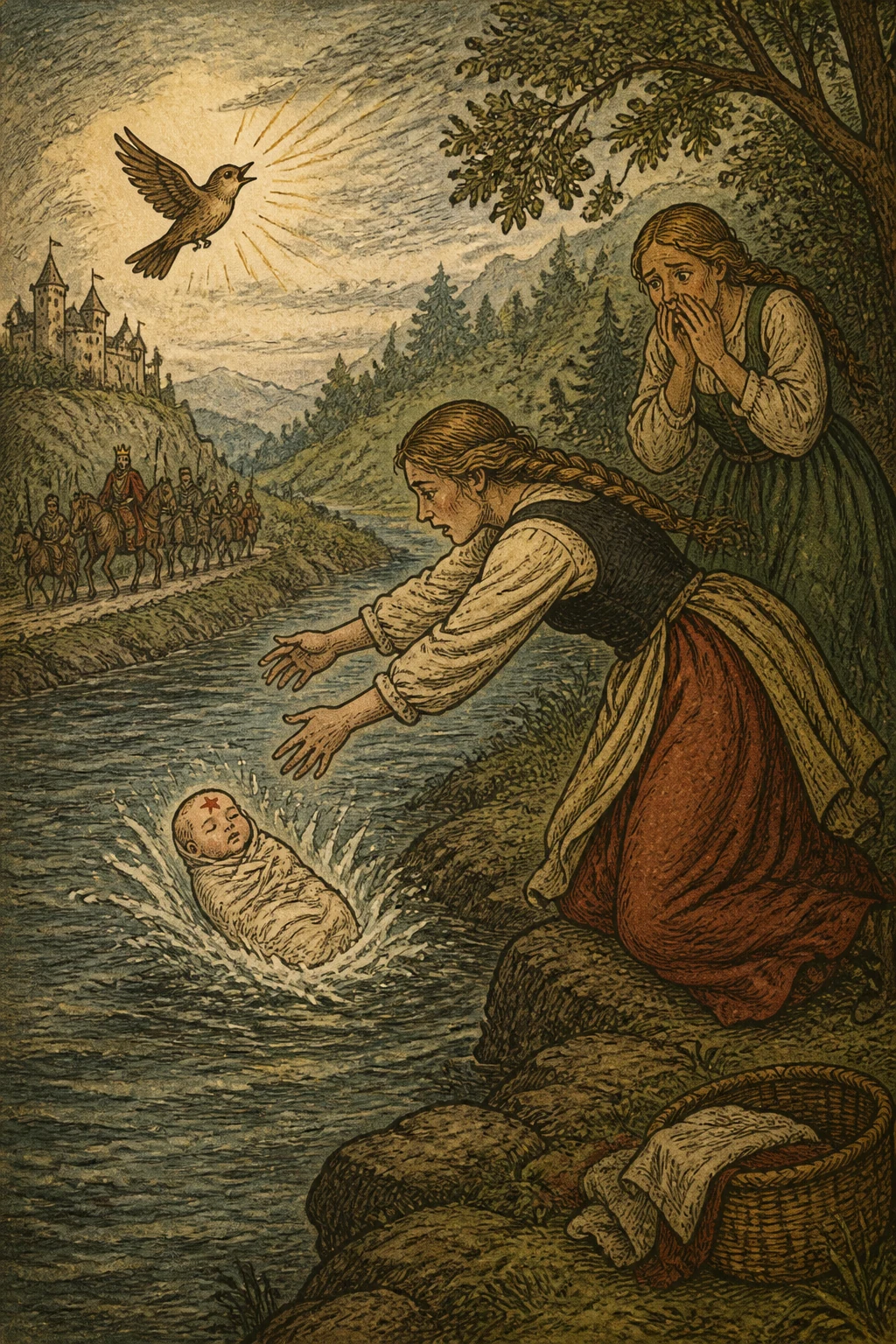
But the box did not sink. It floated like a little boat, and not a single drop of water seeped inside. So it drifted along until it reached a mill two miles from the king’s capital, where it caught against the weir. A miller’s lad, who luckily happened to be standing there, noticed it and drew it toward him with a hook, expecting to find a great treasure. But when he opened it, there lay a beautiful boy, perfectly well and lively. He took him to the miller and his wife, who had no children of their own. They were delighted and said, “God has sent him to us.” They cared well for the foundling, and he grew up with every virtue.
One day the king took shelter in the mill during a thunderstorm and asked the miller and his wife whether the tall boy was their son. “No,” they answered, “he is a foundling. Fourteen years ago he floated down to the weir in a box, and the miller’s lad pulled him out of the water.” Then the king knew that this could be none other than the child of good fortune he had thrown into the water, and he said, “My good people, could the boy take a letter to the queen for me? I will give him two gold pieces for his trouble.” “As Your Majesty commands,” they answered, and told the boy to make ready. Then the king wrote a letter to the queen, saying, “As soon as the boy arrives with this letter, he is to be killed and buried, and all this must be done before I return.”
The boy set off with the letter, but lost his way and came that evening to a great forest. In the darkness he saw a little light, went toward it, and reached a small house. When he stepped inside, an old woman was sitting quite alone by the fire. She was startled at the sight of him and said, “Where have you come from, and where are you going?” “I come from the mill,” he answered, “and I am on my way to the queen, to whom I must deliver a letter. But I have lost my way in the forest, and I should like to stay here for the night.” “You poor boy,” said the woman, “you have come to a robbers’ den, and when they return they will kill you.” “Let whoever will come,” said the boy. “I am not afraid. Besides, I am so tired I cannot go any farther.” He stretched out on a bench and fell asleep.
Soon afterward the robbers came home and angrily asked what strange boy was lying there. “Oh,” said the old woman, “he is an innocent child who lost his way in the forest, and I took him in out of pity. He is to carry a letter to the queen.” The robbers broke open the letter and read it, and it said that the boy was to be put to death as soon as he arrived. Even the hardhearted robbers felt pity. Their leader tore up the letter and wrote another, saying that as soon as the boy arrived, he was to be married to the king’s daughter. Then they let him sleep peacefully on the bench until morning, and when he woke, they gave him the letter and showed him the right road.
When the queen received the letter and read it, she did as it said and ordered a splendid wedding feast. The king’s daughter was married to the child of good fortune, and since the young man was handsome and kind, she lived happily and contentedly with him.
After some time the king returned to his castle and found that the prophecy had come true and the child of good fortune was married to his daughter. “How did this happen?” he said. “I gave quite a different order in my letter.” The queen handed him the letter and told him to see for himself what it said. The king read it and realized that it had been exchanged for another. He asked the young man what had happened to the letter entrusted to him, and why he had brought a different one instead. “I know nothing about it,” he answered. “It must have been exchanged during the night, while I was asleep in the forest.”
Full of anger, the king said, “You shall not get off so easily. Whoever wishes to have my daughter must fetch me three golden hairs from the Devil’s head in hell. Bring me what I ask, and you may keep my daughter.” In this way the king hoped to be rid of him forever. But the child of good fortune answered, “I will gladly fetch the golden hairs. I am not afraid of the Devil.”
Then he took his leave and set out on his travels. The road brought him to a great city, where the watchman at the gate asked what trade he knew and what knowledge he possessed. “I know everything,” answered the child of good fortune. “Then you can do us a favor,” said the watchman, “by telling us why the fountain in our marketplace, which once flowed with wine, has run dry and no longer gives even water.” “You shall learn the answer,” he replied. “Only wait until I return.” He went on and came to another city, where the gatekeeper again asked what trade he knew and what knowledge he possessed. “I know everything,” he answered. “Then you can do us a favor and tell us why a tree in our city, which once bore golden apples, no longer puts forth even a leaf.” “You shall learn the answer,” he replied. “Only wait until I return.” He went on and came to a broad river that he had to cross. The ferryman asked what trade he knew and what knowledge he possessed. “I know everything,” he answered. “Then you can do me a favor,” said the ferryman, “and tell me why I must keep ferrying back and forth and am never relieved.” “You shall learn the answer,” he replied. “Only wait until I return.”
Once he had crossed the river, he found the entrance to hell. Inside, everything was black and sooty. The Devil was not at home, but his grandmother sat there in a broad armchair. “What do you want?” she asked, though she did not look so very wicked. “I should like three golden hairs from the Devil’s head,” he answered, “or I cannot keep my wife.” “That is a great deal to ask,” she said. “If the Devil comes home and finds you, it will cost you your life. But I pity you, and I will see whether I can help.” She turned him into an ant and said, “Creep into the folds of my skirt. You will be safe there.” “Yes,” he answered, “that is all very well, but there are three other things I should like to know: why a fountain that once flowed with wine has run dry and no longer gives even water; why a tree that once bore golden apples no longer puts forth even a leaf; and why a ferryman must keep crossing back and forth without ever being relieved.” “Those are difficult questions,” she answered, “but keep still and quiet, and listen carefully to what the Devil says when I pull out the three golden hairs.”
At nightfall the Devil came home. Scarcely had he stepped inside when he sensed something amiss. “I smell, I smell human flesh,” he said. “Something is not right here.” He peered into every corner and searched, but could find nothing. His grandmother scolded him. “I have only just swept the place and put everything in order,” she said, “and now you are turning it all upside down again. You always have human flesh in your nostrils! Sit down and eat your supper.” When he had eaten and drunk, he grew mellow, laid his head in his grandmother’s lap, and told her to pick the lice from his hair for a while. Before long he dozed off, puffing and snoring. Then the old woman took hold of a golden hair, pulled it out, and laid it beside her. “Ouch!” cried the Devil. “What are you doing?”
“I had a bad dream,” answered his grandmother, “and caught hold of your hair.” “What did you dream?” asked the Devil. “I dreamed that a fountain in a marketplace, which once flowed with wine, had dried up and would not give even water. What could be the cause?” “Ha! If only they knew!” answered the Devil. “There is a toad sitting under a stone in the fountain. If they kill it, the wine will flow again.”
His grandmother picked through his hair again until he fell asleep and snored so loudly that the windows shook. Then she pulled out the second hair. “Ow! What are you doing?” the Devil cried angrily. “Do not be cross,” she answered. “I did it in my sleep.” “What have you dreamed this time?” he asked. “I dreamed that in a certain kingdom there stood a fruit tree that once bore golden apples, but now would not put forth even a leaf. What could be the reason?”
“Ha! If only they knew!” answered the Devil. “A mouse is gnawing at its root. If they kill it, the tree will bear golden apples again, but if it goes on gnawing much longer, the tree will wither away altogether. But leave me in peace with your dreams. If you disturb my sleep once more, you will get a slap.” His grandmother soothed him and picked through his hair again until he had fallen asleep and was snoring. Then she took hold of the third golden hair and pulled it out. The Devil sprang up, shouting, and was about to treat her very roughly, but she calmed him once more and said, “Who can help having bad dreams?”
“What did you dream, then?” he asked, for he was curious all the same. “I dreamed of a ferryman who complained that he had to keep ferrying back and forth and was never relieved. What could be the cause?” “Ha! The fool!” answered the Devil. “When someone comes and wants to cross, he must put the pole into that person’s hand. Then the other will have to do the ferrying, and he will be free.” Now that his grandmother had pulled out the three golden hairs and the three questions had been answered, she left the old fiend in peace, and he slept until daybreak. When the Devil had gone out again, the old woman took the ant from the fold of her skirt and restored the child of good fortune to his human form.
“There are your three golden hairs,” she said. “I trust you heard what the Devil said about your three questions.” “Yes,” he answered, “I heard it and will remember it well.” “Then you have all you need,” she said, “and may go on your way.” He thanked the old woman for helping him in his hour of need, left hell, and was delighted that everything had turned out so well. When he reached the ferryman, the man asked for the answer he had promised. “Take me across first,” said the child of good fortune, “and then I will tell you how to free yourself.” Once he had reached the farther bank, he gave him the Devil’s advice: “When someone else comes and wants to be ferried across, simply put the pole into his hand.”
He went on and came to the city where the barren tree stood, and there the watchman also wanted his answer. So he told him what he had heard from the Devil: “Kill the mouse that is gnawing at its root, and it will bear golden apples again.” The watchman thanked him and rewarded him with two donkeys laden with gold, which followed him on his way. Last of all he came to the city whose fountain had run dry. There he told the watchman what the Devil had said: “There is a toad sitting under a stone in the fountain. You must find it and kill it, and the fountain will flow plentifully with wine again.” The watchman thanked him and likewise gave him two donkeys laden with gold.
At last the child of good fortune arrived home to his wife, who was overjoyed to see him again and to hear how well everything had gone. He brought the king what he had demanded, the Devil’s three golden hairs, and when the king saw the four donkeys laden with gold, he was delighted and said, “Now all the conditions have been met, and you may keep my daughter. But tell me, dear son-in-law, where did all that gold come from? These are mighty treasures!” “I crossed a river,” he answered, “and picked it up there. It lies on the bank instead of sand.” “Can I fetch some too?” asked the king eagerly. “As much as you like,” he answered. “There is a ferryman on the river. Have him take you across, and you can fill your sacks on the other side.”
The greedy king set out in all haste, and when he reached the river, he beckoned to the ferryman to take him across. The ferryman came and told him to step aboard, and when they reached the farther bank, he put the pole into the king’s hand and sprang away. From that day on, the king had to do the ferrying as punishment for his sins. “Is he still ferrying?” “Why, of course. No one is likely to have taken the pole from him.”
Izvirnik
Ein Märchen der Brüder Grimm
Es war einmal eine arme Frau, die gebar ein Söhnlein, und weil es eine Glückshaut umhatte, als es zur Welt kam, so ward ihm geweissagt, es werde im vierzehnten Jahr die Tochter des Königs zur Frau haben.
Es trug sich zu, dass der König bald darauf ins Dorf kam, und niemand wusste, dass es der König war, und als er die Leute fragte, was es Neues gäbe, so antworteten sie: "Es ist in diesen Tagen ein Kind mit einer Glückshaut geboren: was so einer unternimmt, das schlägt ihm zum Glück aus. Es ist ihm auch vorausgesagt, in seinem vierzehnten Jahre solle er die Tochter des Königs zur Frau haben."
Der König, der ein böses Herz hatte und über die Weissagung sich ärgerte, ging zu den Eltern, tat ganz freundlich und sagte: "Ihr armen Leute, überlasst mir euer Kind, ich will es versorgen." Anfangs weigerten sie sich, da aber der fremde Mann schweres Gold dafür bot und sie dachten: "Es ist ein Glückskind, es muss doch zu seinem Besten ausschlagen," so willigten sie endlich ein und gaben ihm das Kind.
Der König legte es in eine Schachtel und ritt damit weiter, bis er zu einem tiefen Wasser kam; da warf er die Schachtel hinein und dachte: "Von dem unerwarteten Freier habe ich meine Tochter geholfen."
Die Schachtel aber ging nicht unter, sondern schwamm wie ein Schiffchen, und es drang auch kein Tröpfchen Wasser hinein. So schwamm sie bis zwei Meilen von des Königs Hauptstadt, wo eine Mühle war, an dessen Wehr sie hängen blieb. Ein Mahlbursche, der glücklicherweise da stand und sie bemerkte, zog sie mit einem Haken heran und meinte grosse Schätze zu finden, als er sie aber aufmachte, lag ein schöner Knabe darin, der ganz frisch und munter war. Er brachte ihn zu den Müllersleuten, und weil diese keine Kinder hatten, freuten sie sich und sprachen: "Gott hat es uns beschert." Sie pflegten den Findling wohl, und er wuchs in allen Tugenden heran.
Es trug sich zu, dass der König einmal bei einem Gewitter in die Mühle trat und die Müllersleute fragte, ob der grosse Junge ihr Sohn wäre. "Nein," antworteten sie, "es ist ein Findling, er ist vor vierzehn Jahren in einer Schachtel ans Wehr geschwommen, und der Mahlbursche hat ihn aus dem Wasser gezogen." Da merkte der König, dass es niemand anders als das Glückskind war, das er ins Wasser geworfen hatte, und sprach: "Ihr guten Leute, könnte der Junge nicht einen Brief an die Frau Königin bringen, ich will ihm zwei Goldstücke zum Lohn geben?" - "Wie der Herr König gebietet," antworteten die Leute, und hiessen den Jungen sich bereit halten. Da schrieb der König einen Brief an die Königin, worin stand: "Sobald der Knabe mit diesem Schreiben angelangt ist, soll er getötet und begraben werden, und das alles soll geschehen sein, ehe ich zurückkomme."
Der Knabe machte sich mit diesem Briefe auf den Weg, verirrte sich aber und kam abends in einen grossen Wald. In der Dunkelheit sah er ein kleines Licht, ging darauf zu und gelangte zu einem Häuschen. Als er hineintrat, sass eine alte Frau beim Feuer ganz allein. Sie erschrak, als sie den Knaben erblickte, und sprach: "Wo kommst du her und wo willst du hin?" - "Ich komme von der Mühle," antwortete er, "und will zur Frau Königin, der ich einen Brief bringen soll; weil ich mich aber in dem Walde verirrt habe, so wollte ich hier gerne übernachten." - "Du armer Junge," sprach die Frau, "du bist in ein Räuberhaus geraten, und wenn sie heim kommen, so bringen sie dich um." - "Mag kommen, wer will," sagte der Junge, "ich fürchte mich nicht; ich bin aber so müde, dass ich nicht weiter kann," streckte sich auf eine Bank und schlief ein.
Bald hernach kamen die Räuber und fragten zornig, was da für ein fremder Knabe läge. "Ach," sagte die Alte, "es ist ein unschuldiges Kind, es hat sich im Walde verirrt, und ich habe ihn aus Barmherzigkeit aufgenommen: er soll einen Brief an die Frau Königin bringen." Die Räuber erbrachen den Brief und lasen ihn, und es stand darin, dass der Knabe sogleich, wie er ankäme, sollte ums Leben gebracht werden. Da empfanden die hartherzigen Räuber Mitleid, und der Anführer zerriss den Brief und schrieb einen andern, und es stand darin, sowie der Knabe ankäme, sollte er sogleich mit der Königstochter vermählt werden. Sie liessen ihn dann ruhig bis zum andern Morgen auf der Bank liegen, und als er aufgewacht war, gaben sie ihm den Brief und zeigten ihm den rechten Weg.
Die Königin aber, als sie den Brief empfangen und gelesen hatte, tat, wie darin stand, hiess ein prächtiges Hochzeitsfest anstellen, und die Königstochter ward mit dem Glückskind vermählt; und da der Jüngling schön und freundlich war, so lebte sie vergnügt und zufrieden mit ihm.
Nach einiger Zeit kam der König wieder in sein Schloss und sah, dass die Weissagung erfüllt und das Glückskind mit seiner Tochter vermählt war. "Wie ist das zugegangen?" sprach er, "ich habe in meinem Brief einen ganz andere Befehl erteilt." Da reichte ihm die Königin den Brief und sagte, er möchte selbst sehen, was darin stände. Der König las den Brief und merkte wohl, dass er mit einem andern war vertauscht worden. Er fragte den Jüngling, wie es mit dem anvertrauten Briefe zugegangen wäre, warum er einen andern dafür gebracht hätte. "Ich weiss von nichts," antwortete er, "er muss mir in der Nacht vertauscht sein, als ich im Walde geschlafen habe."
Voll Zorn sprach der König: "So leicht soll es dir nicht werden, wer meine Tochter haben will, der muss mir aus der Hölle drei goldene Haare von dem Haupt des Teufels holen; bringst du mir, was ich verlange, so sollst du meine Tochter behalten. " Damit hoffte der König ihn auf immer los zu werden. Das Glückskind aber antwortete: "Die goldenen Haare will ich wohl holen, ich fürchte mich vor dem Teufel nicht."
Darauf nahm er Abschied und begann seine Wanderschaft. Der Weg führte ihn zu einer grossen Stadt, wo ihn der Wächter an dem Tore ausfragte, was für ein Gewerbe er verstände und was er wüsste. "Ich weiss alles," antwortete das Glückskind. "So kannst du uns einen Gefallen tun," sagte der Wächter, "wenn du uns sagst, warum unser Marktbrunnen, aus dem sonst Wein quoll, trocken geworden ist, und nicht einmal mehr Wasser gibt." - "Das sollt ihr erfahren," antwortete er, "wartet nur, bis ich wiederkommen. Da ging er weiter und kam vor eine andere Stadt, da fragte der Torwächter wiederum, was für ein Gewerb er verstünde und was er wüsste. "Ich weiss alles," antwortete er. "So kannst du uns einen Gefallen tun und uns sagen, warum ein Baum in unserer Stadt, der sonst goldene Äpfel trug, jetzt nicht einmal Blätter hervortreibt." - "Das sollt ihr erfahren," antwortete er, "wartet nur, bis ich wiederkommen. Da ging er weiter, und kam an ein grosses Wasser, über das er hinüber musste. Der Fährmann fragte ihn, was er für ein Gewerbe verstände und was er wüsste. "Ich weiss alles," antwortete er. "So kannst du mir einen Gefallen tun," sprach der Fährmann, "und nur sagen, warum ich immer hin- und herfahren muss und niemals abgelöst werde." - "Das sollst du erfahren," antwortete er, "warte nur, bis ich wiederkomme.
Als er über das Wasser hinüber war, so fand er den Eingang zur Hölle. Es war schwarz und russig darin, und der Teufel war nicht zu Haus, aber seine Ellermutter sass da in einem breiten Sorgenstuhl. "Was willst du?" sprach sie zu ihm, sah aber gar nicht so böse aus. "Ich wollte gerne drei goldene Haare von des Teufels Kopf," antwortete er, "sonst kann ich meine Frau nicht behalten." - "Das ist viel verlangt," sagte sie, "wenn der Teufel heim kommt und findet dich, so geht dir's an den Kragen; aber du dauerst mich, ich will sehen, ob ich dir helfen kann." Sie verwandelte ihn in eine Ameise und sprach: "Kriech in meine Rockfalten, da bist du sicher." - "Ja," antwortete er, "das ist schon gut, aber drei Dinge möchte ich gerne noch wissen, warum ein Brunnen, aus dem sonst Wein quoll, trocken geworden ist, jetzt nicht einmal mehr Wasser gibt: warum ein Baum, der sonst goldene Äpfel trug, nicht einmal mehr Laub treibt: und warum ein Fährmann immer herüber- und hinüberfahren muss und nicht abgelöst wird." - "Das sind schwere Fragen," antwortete sie, "aber halte dich nur still und ruhig, und hab acht, was der Teufel spricht, wann ich ihm die drei goldenen Haare ausziehe."
Als der Abend einbrach, kam der Teufel nach Haus. Kaum war er eingetreten, so merkte er, dass die Luft nicht rein war. "Ich rieche, rieche Menschenfleisch," sagte er, "es ist hier nicht richtig." Dann guckte er in alle Ecken und suchte, konnte aber nichts finden. Die Ellermutter schalt ihn aus: "Eben ist erst gekehrt," sprach sie, "und alles in Ordnung gebracht, nun wirfst du mir's wieder untereinander; immer hast , du Menschenfleisch in der Nase! Setze dich nieder und iss dein Abendbrot." Als er gegessen und getrunken hatte, war er milde, legte der Ellermutter seinen Kopf in den Schoss und sagte, sie sollte ihn ein wenig lausen. Es dauerte nicht lange, so schlummerte er ein, blies und schnarchte. Da fasste die Alte ein goldenes Haar, riss es aus und legte es neben sich. "Autsch!" schrie der Teufel, "was hast du vor?"
"Ich habe einen schweren Traum gehabt," antwortete die Ellermutter, "da hab ich dir in die Haare gefasst." - "Was hat dir denn geträumt?" fragte der Teufel. "Mir hat geträumt, ein Marktbrunnen, aus dem sonst Wein quoll, sei versiegt, und es habe nicht einmal Wasser daraus quellen wollen, was ist wohl schuld daran?" - "He, wenn sie's wüssten!" antwortete der Teufel, "es sitzt eine Kröte unter einem Stein im Brunnen, wenn sie die töten, so wird der Wein schon wieder fliessen."
Die Ellermutter lauste ihn wieder, bis er einschlief und schnarchte, dass die Fenster zitterten. Da riss sie ihm das zweite Haar aus. "Hu! was machst du?" schrie der Teufel zornig. "Nimm's nicht übel," antwortete sie, "ich habe es im Traum getan." - "Was hat dir wieder geträumt?" fragte er. "Mir hat geträumt, in einem Königreiche ständ ein Obstbaum, der hätte sonst goldene Äpfel getragen und wollte jetzt nicht einmal Laub treiben. Was war wohl die Ursache davon?"
"He, wenn sie's wüssten!" antwortete der Teufel, "an der Wurzel nagt eine Maus, wenn sie die töten, so wird er schon wieder goldene Äpfel tragen, nagt sie aber noch länger, so verdorrt der Baum gänzlich. Aber lass mich mit deinen Träumen in Ruhe, wenn du mich noch einmal im Schlafe störst, so kriegst du eine Ohrfeige." Die Ellermutter sprach ihn zu gut und lauste ihn wieder, bis er eingeschlafen war und schnarchte. Da fasste sie das dritte goldene Haar und riss es ihm aus. Der Teufel fuhr in die Höhe, schrie und wollte übel mit ihr wirtschaften, aber sie besänftigte ihn nochmals und sprach: "Wer kann für böse Träume!"
"Was hat dir denn geträumt?" fragte er, und war doch neugierig. "Mir hat von einem Fährmann geträumt, der sich beklagte, dass er immer hin- und herfahren musste, und nicht abgelöst würde. Was ist wohl schuld?" - "He, der Dummbart! " antwortete der Teufel, "wenn einer kommt und will überfahren, so muss er ihm die Stange in die Hand geben, dann muss der andere überfahren, und er ist frei." Da die Ellermutter ihm die drei goldenen Haare ausgerissen hatte und die drei Fragen beantwortet waren, so liess sie den alten Drachen in Ruhe, und er schlief, bis der Tag anbrach. Als der Teufel wieder fortgezogen war, holte die Alte die Ameise aus der Rockfalte, und gab dem Glückskind die menschliche Gestalt zurück.
"Da hast du die drei goldenen Haare," sprach sie, "was der Teufel zu deinen drei Fragen gesagt hat, wirst du wohl gehört haben." - "Ja," antwortete er, "ich habe es gehört und will's wohl behalten." - "So ist dir geholfen," sagte sie "und nun kannst du deiner Wege ziehen." Er bedankte sich bei der Alten für die Hilfe in der Not, verliess die Hölle und war vergnügt, dass ihm alles so wohl geglückt war. Als er zu dem 'Fährmann kam, sollte er ihm die versprochene Antwort geben. "Fahr mich erst hinüber," sprach das Glückskind, "so will ich dir sagen, wie du erlöst wirst," und als er auf dem jenseitigen Ufer angelangt war, gab er ihm des Teufels Rat "wenn wieder einer kommt und will übergefahren sein, so gib ihm nur die Stange in die Hand."
Er ging weiter und kam zu der Stadt, worin der unfruchtbare Baum stand, und wo der Wächter auch Antwort haben wollte. Da sagte er ihm, wie er vom Teufel gehört hatte, "tötet die Maus, die an seiner Wurzel nagt, so wird er wieder goldene Äpfel tragen." Da dankte ihm der Wächter und gab ihm zur Belohnung zwei mit Gold beladene Esel, die mussten ihm nachfolgen. Zuletzt kam er zu der Stadt, deren Brunnen versiegt war. Da sprach er zu dem Wächter, wie der Teufel gesprochen hatte: "Es sitzt eine Kröte im Brunnen unter einem Stein, die müsst ihr aufsuchen und töten, so wird er wieder reichlich Wein geben." Der Wächter dankte und gab ihm ebenfalls zwei mit Gold beladene Esel.
Endlich langte das Glückskind daheim bei seiner Frau an, die sich herzlich freute, als sie ihn wiedersah und hörte, wie wohl ihm alles gelungen war. Dem König brachte er, was er verlangt hatte, die drei goldenen Haare des Teufels, und als dieser die vier Esel mit dem Golde sah, ward er ganz vergnügt und sprach: "Nun sind alle Bedingungen erfüllt und du kannst meine Tochter behalten. Aber, lieber Schwiegersohn, sage mir doch, woher ist das viele Gold? Das sind ja gewaltige Schätze!" - "Ich bin über einen Fluss gefahren," antwortete er, "und da habe ich es mitgenommen, es liegt dort statt des Sandes am Ufer." - "Kann ich mir auch davon holen?" sprach der König und war ganz begierig." So viel Ihr nur wollt," antwortete er, "es ist ein Fährmann auf dem Fluss, von dem lasst Euch überfahren, so könnt Ihr drüben Eure Säcke füllen."
Der habsüchtige König machte sich in aller Eile auf den Weg, und als er zu dem Fluss kam, so winkte er dem Fährmann, der sollte ihn übersetzen. Der Fährmann kam und hiess ihn einsteigen, und als sie an das jenseitige Ufer kamen, gab er ihm die Ruderstange in die Hand und sprang davon. Der König aber musste von nun an fahren zur Strafe für seine Sünden. "Fährt er wohl noch?" - "Was denn? es wird ihm niemand die Stange abgenommen haben."