Waltey
Dionizova popotovanja in kaznovanje nasprotnikov
Apolodorjeva knjižnica · ApolodorO besedilu
Dionizova popotovanja in kaznovanje nasprotnikov
- Vir
- Apolodorjeva knjižnica
- Avtor
- Apolodor
- Jezik branja
- English
- Jezik izvirnika
- Ancient Greek
- Čas branja
- 9 min branja
- Obseg
- 7 strani
- Naslov izvirnika
- Book 3 chapter 5
O izvirniku
Apolodorjeva knjižnica
Strnjen zemljevid grških mitov, rodov, junakov in pošasti. Bralni jezik je English, izvirnik pa prihaja iz vira Apolodorjeva knjižnica v jeziku Ancient Greek.
Besedilo
Dionizova popotovanja in kaznovanje nasprotnikov
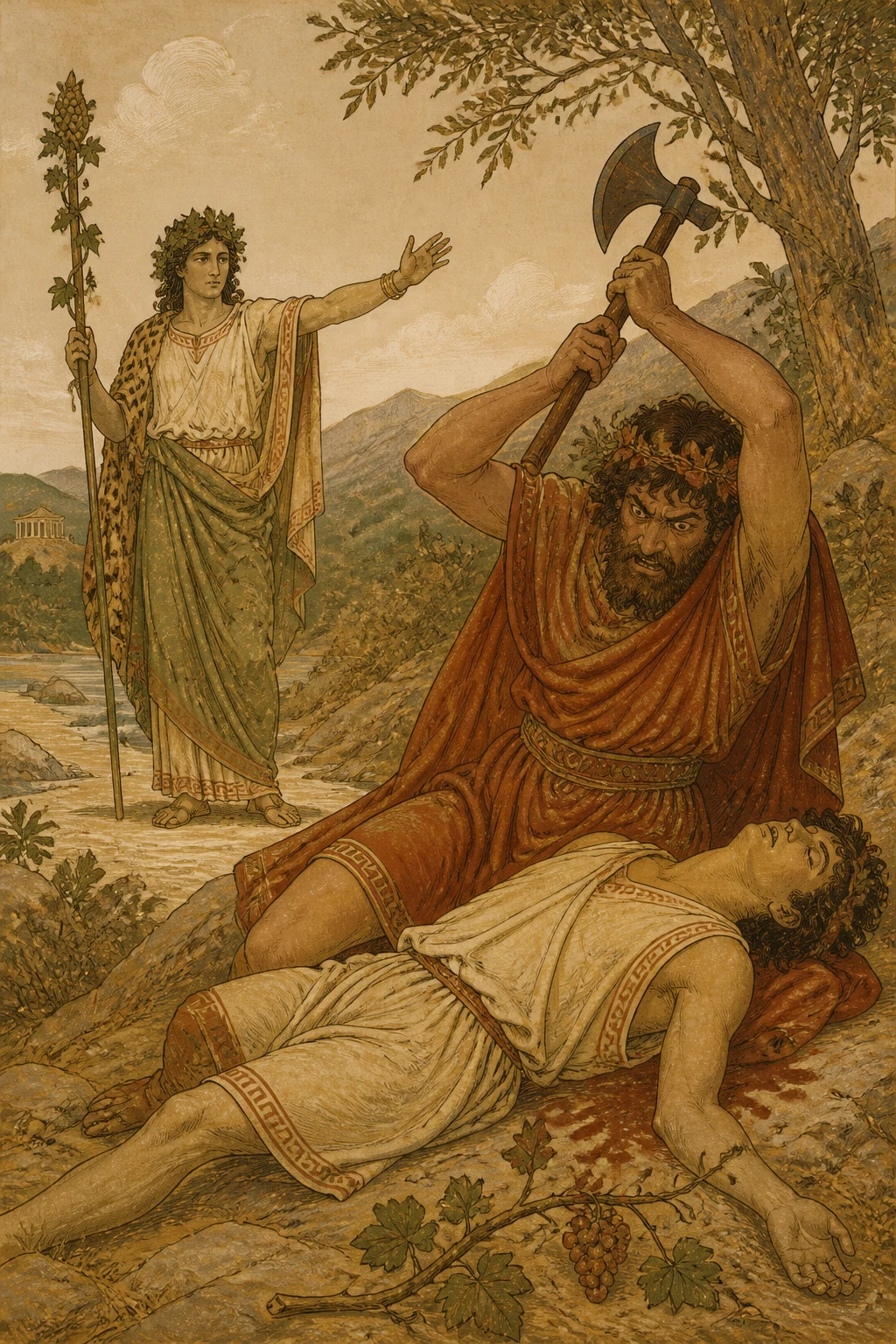
1. After discovering the vine, Dionysus was driven mad by Hera and wandered through Egypt and Syria. He was first welcomed by Proteus, king of the Egyptians, and later came to Cybela in Phrygia. There Rhea purified him and taught him the rites of initiation; and after receiving his sacred dress from her, he hastened through Thrace toward India. But Lycurgus, son of Dryas, who ruled the Edonians dwelling beside the river Strymon, was the first to treat him with violence and drive him out. Dionysus took refuge in the sea with Thetis, daughter of Nereus, while the Bacchants and the host of Satyrs who followed him were taken captive. Then the Bacchants were suddenly freed, and Dionysus drove Lycurgus mad. In his madness, Lycurgus struck his son Dryas with an axe and killed him, believing that he was cutting a vine branch; only after mutilating the boy did he recover his senses. But the land remained barren, and the god declared through an oracle that it would bear fruit if Lycurgus were put to death.
When the Edonians heard this, they took him to Mount Pangaeum and bound him there. There, by the will of Dionysus, he was torn apart by horses and died.
2. After passing through Thrace and all of India, where he set up pillars, Dionysus came to Thebes and compelled the women to leave their homes and celebrate his rites on Mount Cithaeron. But Pentheus, the son of Echion and Agave, who had received the kingdom from Cadmus, tried to prevent this. When he went to Cithaeron to spy on the Bacchants, his mother Agave tore him limb from limb in her madness, for she thought he was a wild beast. Having shown the Thebans that he was a god, Dionysus came to Argos. There too, because the people refused to honor him, he drove the women mad; and in the mountains they ate the flesh of the infants they carried at their breasts.
3. Wishing to cross from Icaria to Naxos, he hired a trireme belonging to Tyrrhenian pirates. They took him aboard but sailed past Naxos and made for Asia, intending to sell him. But he turned the mast and oars into snakes and filled the vessel with ivy and the sound of pipes. Driven mad, the pirates fled into the sea and became dolphins. Thus mortals came to honor him as a god. He brought his mother up from Hades, named her Thyone, and ascended with her into heaven.
4. Cadmus left Thebes with Harmonia and came to the Encheleans. They were at war with the Illyrians, and the god declared through an oracle that they would defeat the Illyrians if they took Cadmus and Harmonia as their leaders. They obeyed, appointed the two to lead them against the Illyrians, and were victorious. Cadmus became king of the Illyrians, and a son, Illyrius, was born to him. Later he and Harmonia were transformed into serpents and sent by Zeus to the Elysian Plain.
5. Polydorus became king of Thebes, married Nycteis, daughter of Nycteus son of Chthonius, and fathered Labdacus. Like Pentheus before him, Labdacus perished because he held similar views. He left a son, Laius, only a year old, and while the child was still young, Lycus, the brother of Nycteus, seized power. The two brothers had fled from Euboea after killing Phlegyas, the son of Ares and Dotis the Boeotian, and had settled in Hyria. Through their connection with Pentheus they had become citizens of Thebes. Lycus, having been elected commander of the army by the Thebans, laid hold of the sovereign power. After reigning for twenty years, he was killed by Zethus and Amphion for the following reason. Antiope was a daughter of Nycteus, and Zeus lay with her. When she became pregnant, her father threatened her, and she fled to Epopeus in Sicyon and married him. In despair, Nycteus killed himself, charging Lycus to exact vengeance from Epopeus and Antiope. Lycus marched against Sicyon and captured it, killed Epopeus, and led Antiope away as a prisoner. On the journey she gave birth to two sons at Eleutherae in Boeotia. They were exposed, but a herdsman found them and brought them up, calling one Zethus and the other Amphion. Zethus tended herds of cattle, while Amphion practiced singing to the lyre, which Hermes had given him. Meanwhile Lycus kept Antiope imprisoned, and both he and his wife Dirce mistreated her. One day her bonds fell away of their own accord, and she escaped unseen and came to her sons’ dwelling, hoping they would take her in. Recognizing their mother, they killed Lycus, bound Dirce to a bull, and, when she was dead, cast her into the spring named Dirce after her.
Having taken power, they fortified the city, the stones following the music of Amphion’s lyre, and drove Laius into exile. While living in the Peloponnese, Laius was received as a guest by Pelops. He taught Pelops’s son Chrysippus to drive a chariot, fell in love with him, and carried him off.
6. Zethus married Thebe, from whom the city of Thebes took its name, and Amphion married Niobe, daughter of Tantalus. She bore seven sons—Sipylus, Eupinytus, Ismenus, Damasichthon, Agenor, Phaedimus, and Tantalus—and as many daughters: Ethodaea, or, according to some, Neaera, Cleodoxa, Astyoche, Phthia, Pelopia, Astycrateia, and Ogygia. Hesiod, however, says that they had ten sons and ten daughters; Herodorus, two sons and three daughters; and Homer, six sons and six daughters.
Proud of her many children, Niobe declared that she was more blessed in her offspring than Leto. In anger, Leto urged Artemis and Apollo against them. Artemis shot down the daughters in their home, while Apollo killed all the sons together as they hunted on Cithaeron. Of the sons, Amphion survived, and of the daughters, the elder Chloris, whom Neleus married. According to Telesilla, however, the survivors were Amyclas and Meliboea. Amphion too was shot down by the gods. Niobe herself left Thebes and went to her father Tantalus at Sipylus. There she prayed to Zeus and was changed into stone; and tears flow from that stone by night and day.
7. After Amphion’s death, Laius took over the kingdom. He married a daughter of Menoeceus, whom some call Jocasta and others Epicaste. Though the god had warned him through an oracle not to father a child, since the child would kill his father, Laius lay with his wife while drunk. When the child was born, he pierced its ankles with pins and gave it to a shepherd to expose. The shepherd left it on Cithaeron, but herdsmen belonging to Polybus, king of Corinth, found the infant and brought it to his wife Periboea. She took it in and passed it off as her own. After tending its ankles, she named it Oedipus, giving it this name because its feet were swollen. When the boy grew to manhood, surpassing his companions in strength, they taunted him out of envy with being a supposititious child. He questioned Periboea but could learn nothing from her, so he went to Delphi to inquire about his true parents. The god told him not to return to his homeland, for he would kill his father and lie with his mother. On hearing this, and believing himself the son of those who were said to be his parents, he stayed away from Corinth. As he traveled through Phocis in a chariot, he encountered Laius, also riding in a chariot, on a narrow road. Polyphontes, Laius’s herald, ordered him to make way, and when he refused and delayed, killed one of his horses. Enraged, Oedipus killed both Polyphontes and Laius, and went on to Thebes.
8. Damasistratus, king of Plataea, buried Laius, and Creon, son of Menoeceus, took over the kingdom. During his reign, a great calamity befell Thebes. Hera sent the Sphinx, whose mother was Echidna and whose father was Typhon. She had the face of a woman, the breast, feet, and tail of a lion, and the wings of a bird. Having learned a riddle from the Muses, she seated herself on Mount Phicium and put it to the Thebans. The riddle was this: What is it that has one voice, yet becomes four-footed, two-footed, and three-footed? An oracle had told the Thebans that they would be rid of the Sphinx when they solved the riddle, so they often gathered together to discover its meaning. But whenever they failed, she seized one of them and devoured him. After many had perished, and last of all Creon’s son Haemon, Creon proclaimed that he would give both the kingdom and Laius’s wife to whoever solved the riddle. Oedipus heard the proclamation and solved it, saying that the answer to the Sphinx’s riddle was a human being: as an infant, a person is four-footed, moving on all four limbs; in maturity, two-footed; and in old age takes a staff as a third support. The Sphinx then threw herself from the acropolis, while Oedipus took over the kingdom and unwittingly married his mother. By her he fathered two sons, Polynices and Eteocles, and two daughters, Ismene and Antigone. Some, however, say that his children were born to him by Euryganeia, daughter of Hyperphas.
9. When the truth that had lain hidden was later revealed, Jocasta hanged herself, and Oedipus blinded himself and was driven from Thebes. He laid curses upon his sons, who had watched him being expelled from the city without coming to his aid. With Antigone he came to Colonus in Attica, where the sacred precinct of the Eumenides stands, and sat down there as a suppliant. Theseus received him, and not long afterward he died.
Izvirnik
Book 3 chapter 5
Naslednje strani prikazujejo izvirno besedilo za primerjavo.
Source ID: apollodorus_bib_3_5 Citation: Apollodorus, Bibliotheca 3.5 1. Διόνυσος δὲ εὑρετὴς ἀμπέλου γενόμενος, Ἥρας μανίαν αὐτῷ ἐμβαλούσης περιπλανᾶται Αἴγυπτόν τε καὶ Συρίαν. καὶ τὸ μὲν πρῶτον Πρωτεὺς αὐτὸν ὑποδέχεται βασιλεὺς Αἰγυπτίων, αὖθις δὲ εἰς Κύβελα τῆς Φρυγίας ἀφικνεῖται, κἀκεῖ καθαρθεὶς ὑπὸ Ῥέας καὶ τὰς τελετὰς ἐκμαθών, καὶ λαβὼν παρʼ ἐκείνης τὴν στολήν, ἐπὶ Ἰνδοὺς διὰ τῆς Θράκης ἠπείγετο. Λυκοῦργος δὲ παῖς Δρύαντος, Ἠδωνῶν βασιλεύων, οἳ Στρυμόνα ποταμὸν παροικοῦσι, πρῶτος ὑβρίσας ἐξέβαλεν αὐτόν. καὶ Διόνυσος μὲν εἰς θάλασσαν πρὸς Θέτιν τὴν Νηρέως κατέφυγε, Βάκχαι δὲ ἐγένοντο αἰχμάλωτοι καὶ τὸ συνεπόμενον Σατύρων πλῆθος αὐτῷ. αὖθις δὲ αἱ Βάκχαι ἐλύθησαν ἐξαίφνης, Λυκούργῳ δὲ μανίαν ἐνεποίησε Διόνυσος. ὁ δὲ μεμηνὼς Δρύαντα τὸν
παῖδα, ἀμπέλου νομίζων κλῆμα κόπτειν, πελέκει πλήξας ἀπέκτεινε, καὶ ἀκρωτηριάσας αὐτὸν ἐσωφρόνησε. τῆς δὲ γῆς ἀκάρπου μενούσης, ἔχρησεν ὁ θεὸς καρποφορήσειν αὐτήν, ἂν θανατωθῇ Λυκοῦργος. Ἠδωνοὶ δὲ ἀκούσαντες εἰς τὸ Παγγαῖον αὐτὸν ἀπαγαγόντες ὄρος ἔδησαν, κἀκεῖ κατὰ Διονύσου βούλησιν ὑπὸ ἵππων διαφθαρεὶς ἀπέθανε. 2. διελθὼν δὲ Θρᾴκην καὶ τὴν Ἰνδικὴν ἅπασαν, στήλας ἐκεῖ στήσας ἧκεν εἰς Θήβας, καὶ τὰς γυναῖκας ἠνάγκασε καταλιπούσας τὰς οἰκίας βακχεύειν ἐν τῷ Κιθαιρῶνι. Πενθεὺς δὲ γεννηθεὶς ἐξ Ἀγαυῆς Ἐχίονι, παρὰ Κάδμου εἰληφὼς τὴν βασιλείαν, διεκώλυε ταῦτα γίνεσθαι, καὶ παραγενόμενος εἰς Κιθαιρῶνα τῶν Βακχῶν κατάσκοπος ὑπὸ τῆς μητρὸς Ἀγαυῆς κατὰ μανίαν ἐμελίσθη· ἐνόμισε γὰρ αὐτὸν θηρίον εἶναι. δείξας δὲ Θηβαίοις ὅτι θεός ἐστιν, ἧκεν εἰς Ἄργος, κἀκεῖ πάλιν οὐ
τιμώντων αὐτὸν ἐξέμηνε τὰς γυναῖκας. αἱ δὲ ἐν τοῖς ὄρεσι τοὺς ἐπιμαστιδίους ἔχουσαι παῖδας τὰς σάρκας αὐτῶν ἐσιτοῦντο. 3. βουλόμενος δὲ ἀπὸ τῆς Ἰκαρίας εἰς Νάξον διακομισθῆναι, Τυρρηνῶν λῃστρικὴν ἐμισθώσατο τριήρη. οἱ δὲ αὐτὸν ἐνθέμενοι Νάξον μὲν παρέπλεον, ἠπείγοντο δὲ εἰς τὴν Ἀσίαν ἀπεμπολήσοντες. ὁ δὲ τὸν μὲν ἱστὸν καὶ τὰς κώπας ἐποίησεν ὄφεις, τὸ δὲ σκάφος ἔπλησε κισσοῦ καὶ βοῆς αὐλῶν· οἱ δὲ ἐμμανεῖς γενόμενοι κατὰ τῆς θαλάττης ἔφυγον καὶ ἐγένοντο δελφῖνες. ὣς δὲ αὐτὸν θεὸν ἄνθρωποι ἐτίμων, ὁ δὲ ἀναγαγὼν ἐξ Ἅιδου τὴν μητέρα, καὶ προσαγορεύσας Θυώνην, μετʼ αὐτῆς εἰς οὐρανὸν ἀνῆλθεν.
4. ὁ δὲ Κάδμος μετὰ Ἁρμονίας Θήβας ἐκλιπὼν πρὸς Ἐγχελέας παραγίνεται. τούτοις δὲ ὑπὸ Ἰλλυριῶν πολεμουμένοις ὁ θεὸς ἔχρησεν Ἰλλυριῶν κρατήσειν, ἐὰν ἡγεμόνας Κάδμον καὶ Ἁρμονίαν ἔχωσιν. οἱ δὲ πεισθέντες ποιοῦνται κατὰ Ἰλλυριῶν ἡγεμόνας τούτους καὶ κρατοῦσι. καὶ βασιλεύει Κάδμος Ἰλλυριῶν, καὶ παῖς Ἰλλυριὸς αὐτῷ γίνεται. αὖθις δὲ μετὰ Ἁρμονίας εἰς δράκοντα μεταβαλὼν εἰς Ἠλύσιον πεδίον ὑπὸ Διὸς ἐξεπέμφθη.
5. Πολύδωρος δὲ Θηβῶν βασιλεὺς γενόμενος Νυκτηίδα γαμεῖ, Νυκτέως τοῦ Χθονίου θυγατέρα, καὶ γεννᾷ Λάβδακον. οὗτος ἀπώλετο, μετὰ Πενθέα ἐκείνῳ φρονῶν παραπλήσια. καταλιπόντος δὲ Λαβδάκου παῖδα ἐνιαυσιαῖον Λάιον, τὴν ἀρχὴν ἀφείλετο Λύκος, ἕως οὗτος ἦν παῖς, ἀδελφὸς ὢν Νυκτέως. ἀμφότεροι δὲ ἀπὸ Εὐβοίας φυγὸντες, ἐπεὶ Φλεγύαν ἀπέκτειναν τὸν Ἄρεος καὶ Δωτίδος τῆς Βοιωτίδος, Ὑρίαν κατῴκουν, καὶ διὰ τὴν πρὸς Πενθέα οἰκειότητα ἐγεγόνεσαν πολῖται. αἱρεθεὶς οὖν Λύκος πολέμαρχος ὑπὸ Θηβαίων ἐπέθετο τῇ δυναστείᾳ, καὶ βασιλεύσας ἔτη εἴκοσι, φονευθεὶς ὑπὸ Ζήθου καὶ Ἀμφίονος θνήσκει διʼ αἰτίαν τήνδε. Ἀντιόπη θυγάτηρ ἦν Νυκτέως· ταύτῃ Ζεὺς συνῆλθεν. ἡ δὲ ὡς ἔγκυος ἐγένετο, τοῦ πατρὸς ἀπειλοῦντος εἰς Σικυῶνα ἀποδιδράσκει πρὸς Ἐπωπέα
καὶ τούτῳ γαμεῖται. Νυκτεὺς δὲ ἀθυμήσας ἑαυτὸν φονεύει, δοὺς ἐντολὰς Λύκῳ παρὰ Ἐπωπέως καὶ παρὰ Ἀντιόπης λαβεῖν δίκας. ὁ δὲ στρατευσάμενος Σικυῶνα χειροῦται, καὶ τὸν μὲν Ἐπωπέα κτείνει, τὴν δὲ Ἀντιόπην ἤγαγεν αἰχμάλωτον. ἡ δὲ ἀγομένη δύο γεννᾷ παῖδας ἐν Ἐλευθεραῖς τῆς Βοιωτίας, οὓς ἐκκειμένους εὑρὼν βουκόλος ἀνατρέφει, καὶ τὸν μὲν καλεῖ Ζῆθον τὸν δὲ Ἀμφίονα. Ζῆθος μὲν οὖν ἐπεμελεῖτο βουφορβίων, Ἀμφίων δὲ κιθαρῳδίαν ἤσκει, δόντος αὐτῷ λύραν Ἑρμοῦ. Ἀντιόπην δὲ ᾐκίζετο Λύκος καθείρξας καὶ ἡ τούτου γυνὴ Δίρκη· λαθοῦσα δέ ποτε, τῶν δεσμῶν αὐτομάτως λυθέντων, ἧκεν ἐπὶ τὴν τῶν παίδων ἔπαυλιν, δεχθῆναι πρὸς αὐτῶν θέλουσα. οἱ δὲ ἀναγνωρισάμενοι τὴν μητέρα, τὸν μὲν Λύκον κτείνουσι, τὴν δὲ Δίρκην δήσαντες ἐκ ταύρου ῥίπτουσι θανοῦσαν εἰς κρήνην τὴν ἀπʼ ἐκείνης καλουμένην Δίρκην.
παραλαβόντες δὲ τὴν δυναστείαν τὴν μὲν πόλιν ἐτείχισαν, ἐπακολουθησάντων τῇ Ἀμφίονος λύρᾳ τῶν λίθων, Λάιον δὲ ἐξέβαλον. ὁ δὲ ἐν Πελοποννήσῳ διατελῶν ἐπιξενοῦται Πέλοπι, καὶ τούτου παῖδα Χρύσιππον ἁρματοδρομεῖν διδάσκων ἐρασθεὶς ἀναρπάζει. 6. γαμεῖ δὲ Ζῆθος μὲν Θήβην, ἀφʼ ἧς ἡ πόλις Θῆβαι, Ἀμφίων δὲ Νιόβην τὴν Ταντάλου, ἣ γεννᾷ παῖδας μὲν ἑπτά, Σίπυλον Εὐπίνυτον Ἰσμηνὸν Δαμασίχθονα Ἀγήνορα Φαίδιμον Τάνταλον, θυγατέρας δὲ τὰς ἴσας, Ἐθοδαΐαν (ἢ ὥς τινες Νέαιραν) Κλεόδοξαν Ἀστυόχην Φθίαν Πελοπίαν Ἀστυκράτειαν Ὠγυγίαν. Ἡσίοδος δὲ δέκα μὲν υἱοὺς δέκα δὲ θυγατέρας, Ἡρόδωρος δὲ δύο μὲν ἄρρενας τρεῖς δὲ θηλείας, Ὅμηρος δὲ ἓξ μὲν υἱοὺς ἓξ δὲ θυγατέρας φησὶ γενέσθαι.
εὔτεκνος δὲ οὖσα Νιόβη τῆς Λητοῦς εὐτεκνοτέρα εἶπεν ὑπάρχειν· Λητὼ δὲ ἀγανακτήσασα τήν τε Ἄρτεμιν καὶ τὸν Ἀπόλλωνα κατʼ αὐτῶν παρώξυνε, καὶ τὰς μὲν θηλείας ἐπὶ τῆς οἰκίας κατετόξευσεν Ἄρτεμις, τοὺς δὲ ἄρρενας κοινῇ πάντας ἐν Κιθαιρῶνι Ἀπόλλων κυνηγετοῦντας ἀπέκτεινεν. ἐσώθη δὲ τῶν μὲν ἀρρένων Ἀμφίων, τῶν δὲ θηλειῶν Χλωρὶς ἡ πρεσβυτέρα, ᾗ Νηλεὺς συνῴκησε. κατὰ δὲ Τελέσιλλαν ἐσώθησαν Ἀμύκλας καὶ Μελίβοια, ἐτοξεύθη δὲ ὑπʼ αὐτῶν καὶ Ἀμφίων, αὐτὴ δὲ Νιόβη Θήβας ἀπολιποῦσα πρὸς τὸν πατέρα Τάνταλον ἧκεν εἰς Σίπυλον, κἀκεῖ Διὶ εὐξαμένη τὴν μορφὴν εἰς λίθον μετέβαλε, καὶ χεῖται δάκρυα νύκτωρ καὶ μεθʼ ἡμέραν τοῦ λίθου.
7. μετὰ δὲ τὴν Ἀμφίονος τελευτὴν Λάιος τὴν βασιλείαν παρέλαβε. καὶ γήμας θυγατέρα Μενοικέως, ἣν ἔνιοι μὲν Ἰοκάστην ἔνιοι δὲ Ἐπικάστην λέγουσι, χρήσαντος τοῦ θεοῦ μὴ γεννᾶν (τὸν γεννηθέντα γὰρ πατροκτόνον ἔσεσθαι) ὁ δὲ οἰνωθεὶς συνῆλθε τῇ γυναικί. καὶ τὸ γεννηθὲν ἐκθεῖναι δίδωσι νομεῖ, περόναις διατρήσας τὰ σφυρά. ἀλλʼ οὗτος μὲν ἐξέθηκεν εἰς Κιθαιρῶνα, Πολύβου δὲ βουκόλοι, τοῦ Κορινθίων βασιλέως, τὸ βρέφος εὑρόντες πρὸς τὴν αὐτοῦ γυναῖκα Περίβοιαν ἤνεγκαν. ἡ δὲ ἀνελοῦσα ὑποβάλλεται, καὶ θεραπεύσασα τὰ σφυρὰ Οἰδίπουν καλεῖ, τοῦτο θεμένη τὸ ὄνομα διὰ τὸ τοὺς πόδας ἀνοιδῆσαι. τελειωθεὶς δὲ ὁ παῖς, καὶ διαφέρων τῶν ἡλίκων ῥώμῃ, διὰ φθόνον ὠνειδίζετο ὑπόβλητος. ὁ δὲ πυνθανόμενος παρὰ τῆς Περιβοίας μαθεῖν οὐκ ἠδύνατο· ἀφικόμενος δὲ εἰς Δελφοὺς περὶ τῶν ἰδίων ἐπυνθάνετο γονέων. ὁ δὲ θεὸς
εἶπεν αὐτῷ εἰς τὴν πατρίδα μὴ πορεύεσθαι· τὸν μὲν γὰρ πατέρα φονεύσειν, τῇ μητρὶ δὲ μιγήσεσθαι. τοῦτο ἀκούσας, καὶ νομίζων ἐξ ὧν ἐλέγετο γεγεννῆσθαι, Κόρινθον μὲν ἀπέλιπεν, ἐφʼ ἅρματος δὲ διὰ τῆς Φωκίδος φερόμενος συντυγχάνει κατά τινα στενὴν ὁδὸν ἐφʼ ἅρματος ὀχουμένῳ Λαΐῳ. καὶ Πολυφόντου (κῆρυξ δὲ οὗτος ἦν Λαΐου) κελεύοντος ἐκχωρεῖν καὶ διʼ ἀπείθειαν καὶ ἀναβολὴν κτείναντος τῶν ἵππων τὸν ἕτερον, ἀγανακτήσας Οἰδίπους καὶ Πολυφόντην καὶ Λάιον ἀπέκτεινε, καὶ παρεγένετο εἰς Θήβας.
8. Λάιον μὲν οὖν θάπτει βασιλεὺς Πλαταιέων Δαμασίστρατος, τὴν δὲ βασιλείαν Κρέων ὁ Μενοικέως παραλαμβάνει. τούτου δὲ βασιλεύοντος οὐ μικρὰ συμφορὰ κατέσχε Θήβας. ἔπεμψε γὰρ Ἥρα Σφίγγα, ἣ μητρὸς μὲν Ἐχίδνης ἦν πατρὸς δὲ Τυφῶνος, εἶχε δὲ πρόσωπον μὲν γυναικός, στῆθος δὲ καὶ βάσιν καὶ οὐρὰν λέοντος καὶ πτέρυγας ὄρνιθος. μαθοῦσα δὲ αἴνιγμα παρὰ μουσῶν ἐπὶ τὸ Φίκιον ὄρος ἐκαθέζετο, καὶ τοῦτο προύτεινε Θηβαίοις. ἦν δὲ τὸ αἴνιγμα· τί ἐστιν ὃ μίαν ἔχον φωνὴν τετράπουν καὶ δίπουν καὶ τρίπουν γίνεται· χρησμοῦ δὲ Θηβαίοις ὑπάρχοντος τηνικαῦτα ἀπαλλαγήσεσθαι τῆς Σφιγγὸς ἡνίκα ἂν τὸ αἴνιγμα λύσωσι, συνιόντες εἰς ταὐτὸ πολλάκις ἐζήτουν τί τὸ λεγόμενόν ἐστιν, ἐπεὶ δὲ μὴ εὕρισκον, ἁρπάσασα ἕνα κατεβίβρωσκε. πολλῶν δὲ ἀπολομένων, καὶ τὸ
τελευταῖον Αἵμονος τοῦ Κρέοντος, κηρύσσει Κρέων τῷ τὸ αἴνιγμα λύσοντι καὶ τὴν βασιλείαν καὶ τὴν Λαΐου δώσειν γυναῖκα. Οἰδίπους δὲ ἀκούσας ἔλυσεν, εἰπὼν τὸ αἴνιγμα τὸ ὑπὸ τῆς Σφιγγὸς λεγόμενον ἄνθρωπον εἶναι· γίνεσθαι, γὰρ τετράπουν βρέφος ὄντα τοῖς τέτταρσιν ὀχούμενον κώλοις, τελειούμενον δὲ δίπουν, γηρῶντα δὲ τρίτην προσλαμβάνειν βάσιν τὸ βάκτρον. ἡ μὲν οὖν Σφὶγξ ἀπὸ τῆς ἀκροπόλεως ἑαυτὴν ἔρριψεν, Οἰδίπους δὲ καὶ τὴν βασιλείαν παρέλαβε καὶ τὴν μητέρα ἔγημεν ἀγνοῶν, καὶ παῖδας ἐτέκνωσεν ἐξ αὐτῆς Πολυνείκη καὶ Ἐτεοκλέα, θυγατέρας δὲ Ἰσμήνην καὶ Ἀντιγόνην. εἰσὶ δὲ οἳ γεννηθῆναι τὰ τέκνα φασὶν ἐξ Εὐρυγανείας αὐτῷ τῆς Ὑπέρφαντος.
9. φανέντων δὲ ὕστερον τῶν λανθανόντων, Ἰοκάστη μὲν ἐξ ἀγχόνης ἑαυτὴν ἀνήρτησεν, Οἰδίπους δὲ τὰς ὄψεις τυφλώσας ἐκ Θηβῶν ἠλαύνετο, ἀρὰς τοῖς παισὶ θέμενος, οἳ τῆς πόλεως αὐτὸν ἐκβαλλόμενον θεωροῦντες οὐκ ἐπήμυναν. παραγενόμενος δὲ σὺν Ἀντιγόνῃ τῆς Ἀττικῆς εἰς Κολωνόν, ἔνθα τὸ τῶν Εὐμενίδων ἐστὶ τέμενος, καθίζει ἱκέτης, προσδεχθεὶς ὑπὸ Θησέως, καὶ μετʼ οὐ πολὺν χρόνον ἀπέθανεν.
Nadaljuj z branjem