Prevod
Once upon a time there was a poor woman who gave birth to a little son. Because he came into the world with a caul over him, it was foretold that in his fourteenth year he would marry the king’s daughter.
Now it happened that soon afterward the king came to the village, though no one knew who he was. When he asked the people what news there was, they answered, “A child was born here a few days ago with a caul over him. Whatever such a child undertakes is sure to turn out well. It has also been foretold that in his fourteenth year he will marry the king’s daughter.”
The king, who had a wicked heart and was angered by the prophecy, went to the parents, put on a friendly manner, and said, “You poor people, give me your child, and I will provide for him.” At first they refused, but when the stranger offered them a great deal of gold, they thought, “He is a child of good fortune; it must turn out for his good.” So at last they consented and gave him the child.
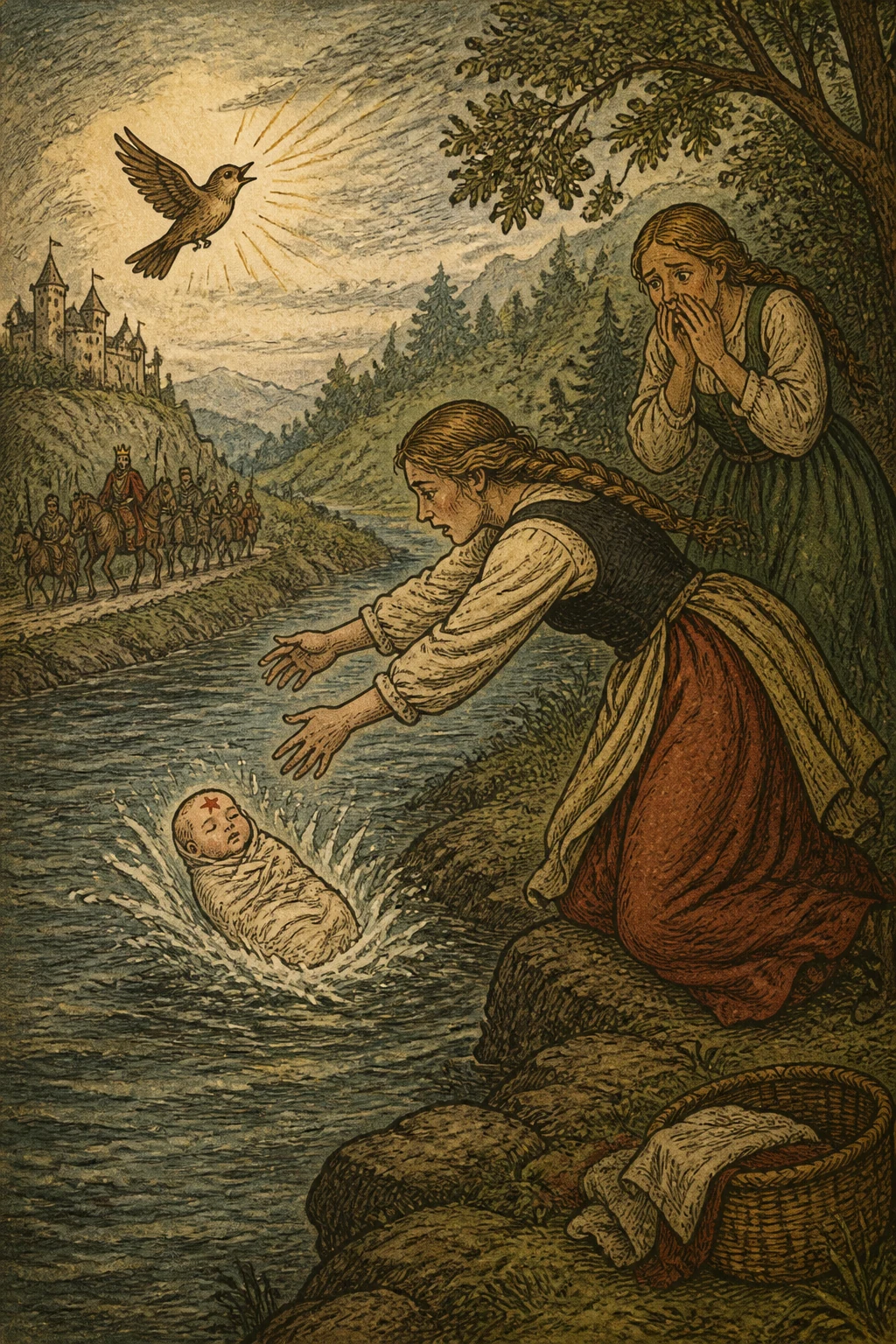
The king put him in a box and rode on until he came to a deep stretch of water. There he threw the box in, thinking, “Now I have rid my daughter of this unexpected suitor.”
But the box did not sink. It floated like a little boat, and not a single drop of water seeped inside. So it drifted along until it reached a mill two miles from the king’s capital, where it caught against the weir. A miller’s lad, who luckily happened to be standing there, noticed it and drew it toward him with a hook, expecting to find a great treasure. But when he opened it, there lay a beautiful boy, perfectly well and lively. He took him to the miller and his wife, who had no children of their own. They were delighted and said, “God has sent him to us.” They cared well for the foundling, and he grew up with every virtue.
One day the king took shelter in the mill during a thunderstorm and asked the miller and his wife whether the tall boy was their son. “No,” they answered, “he is a foundling. Fourteen years ago he floated down to the weir in a box, and the miller’s lad pulled him out of the water.” Then the king knew that this could be none other than the child of good fortune he had thrown into the water, and he said, “My good people, could the boy take a letter to the queen for me? I will give him two gold pieces for his trouble.” “As Your Majesty commands,” they answered, and told the boy to make ready. Then the king wrote a letter to the queen, saying, “As soon as the boy arrives with this letter, he is to be killed and buried, and all this must be done before I return.”
The boy set off with the letter, but lost his way and came that evening to a great forest. In the darkness he saw a little light, went toward it, and reached a small house. When he stepped inside, an old woman was sitting quite alone by the fire. She was startled at the sight of him and said, “Where have you come from, and where are you going?” “I come from the mill,” he answered, “and I am on my way to the queen, to whom I must deliver a letter. But I have lost my way in the forest, and I should like to stay here for the night.” “You poor boy,” said the woman, “you have come to a robbers’ den, and when they return they will kill you.” “Let whoever will come,” said the boy. “I am not afraid. Besides, I am so tired I cannot go any farther.” He stretched out on a bench and fell asleep.
Soon afterward the robbers came home and angrily asked what strange boy was lying there. “Oh,” said the old woman, “he is an innocent child who lost his way in the forest, and I took him in out of pity. He is to carry a letter to the queen.” The robbers broke open the letter and read it, and it said that the boy was to be put to death as soon as he arrived. Even the hardhearted robbers felt pity. Their leader tore up the letter and wrote another, saying that as soon as the boy arrived, he was to be married to the king’s daughter. Then they let him sleep peacefully on the bench until morning, and when he woke, they gave him the letter and showed him the right road.
When the queen received the letter and read it, she did as it said and ordered a splendid wedding feast. The king’s daughter was married to the child of good fortune, and since the young man was handsome and kind, she lived happily and contentedly with him.
After some time the king returned to his castle and found that the prophecy had come true and the child of good fortune was married to his daughter. “How did this happen?” he said. “I gave quite a different order in my letter.” The queen handed him the letter and told him to see for himself what it said. The king read it and realized that it had been exchanged for another. He asked the young man what had happened to the letter entrusted to him, and why he had brought a different one instead. “I know nothing about it,” he answered. “It must have been exchanged during the night, while I was asleep in the forest.”
Full of anger, the king said, “You shall not get off so easily. Whoever wishes to have my daughter must fetch me three golden hairs from the Devil’s head in hell. Bring me what I ask, and you may keep my daughter.” In this way the king hoped to be rid of him forever. But the child of good fortune answered, “I will gladly fetch the golden hairs. I am not afraid of the Devil.”
Then he took his leave and set out on his travels. The road brought him to a great city, where the watchman at the gate asked what trade he knew and what knowledge he possessed. “I know everything,” answered the child of good fortune. “Then you can do us a favor,” said the watchman, “by telling us why the fountain in our marketplace, which once flowed with wine, has run dry and no longer gives even water.” “You shall learn the answer,” he replied. “Only wait until I return.” He went on and came to another city, where the gatekeeper again asked what trade he knew and what knowledge he possessed. “I know everything,” he answered. “Then you can do us a favor and tell us why a tree in our city, which once bore golden apples, no longer puts forth even a leaf.” “You shall learn the answer,” he replied. “Only wait until I return.” He went on and came to a broad river that he had to cross. The ferryman asked what trade he knew and what knowledge he possessed. “I know everything,” he answered. “Then you can do me a favor,” said the ferryman, “and tell me why I must keep ferrying back and forth and am never relieved.” “You shall learn the answer,” he replied. “Only wait until I return.”
Once he had crossed the river, he found the entrance to hell. Inside, everything was black and sooty. The Devil was not at home, but his grandmother sat there in a broad armchair. “What do you want?” she asked, though she did not look so very wicked. “I should like three golden hairs from the Devil’s head,” he answered, “or I cannot keep my wife.” “That is a great deal to ask,” she said. “If the Devil comes home and finds you, it will cost you your life. But I pity you, and I will see whether I can help.” She turned him into an ant and said, “Creep into the folds of my skirt. You will be safe there.” “Yes,” he answered, “that is all very well, but there are three other things I should like to know: why a fountain that once flowed with wine has run dry and no longer gives even water; why a tree that once bore golden apples no longer puts forth even a leaf; and why a ferryman must keep crossing back and forth without ever being relieved.” “Those are difficult questions,” she answered, “but keep still and quiet, and listen carefully to what the Devil says when I pull out the three golden hairs.”
At nightfall the Devil came home. Scarcely had he stepped inside when he sensed something amiss. “I smell, I smell human flesh,” he said. “Something is not right here.” He peered into every corner and searched, but could find nothing. His grandmother scolded him. “I have only just swept the place and put everything in order,” she said, “and now you are turning it all upside down again. You always have human flesh in your nostrils! Sit down and eat your supper.” When he had eaten and drunk, he grew mellow, laid his head in his grandmother’s lap, and told her to pick the lice from his hair for a while. Before long he dozed off, puffing and snoring. Then the old woman took hold of a golden hair, pulled it out, and laid it beside her. “Ouch!” cried the Devil. “What are you doing?”
“I had a bad dream,” answered his grandmother, “and caught hold of your hair.” “What did you dream?” asked the Devil. “I dreamed that a fountain in a marketplace, which once flowed with wine, had dried up and would not give even water. What could be the cause?” “Ha! If only they knew!” answered the Devil. “There is a toad sitting under a stone in the fountain. If they kill it, the wine will flow again.”
His grandmother picked through his hair again until he fell asleep and snored so loudly that the windows shook. Then she pulled out the second hair. “Ow! What are you doing?” the Devil cried angrily. “Do not be cross,” she answered. “I did it in my sleep.” “What have you dreamed this time?” he asked. “I dreamed that in a certain kingdom there stood a fruit tree that once bore golden apples, but now would not put forth even a leaf. What could be the reason?”
“Ha! If only they knew!” answered the Devil. “A mouse is gnawing at its root. If they kill it, the tree will bear golden apples again, but if it goes on gnawing much longer, the tree will wither away altogether. But leave me in peace with your dreams. If you disturb my sleep once more, you will get a slap.” His grandmother soothed him and picked through his hair again until he had fallen asleep and was snoring. Then she took hold of the third golden hair and pulled it out. The Devil sprang up, shouting, and was about to treat her very roughly, but she calmed him once more and said, “Who can help having bad dreams?”
“What did you dream, then?” he asked, for he was curious all the same. “I dreamed of a ferryman who complained that he had to keep ferrying back and forth and was never relieved. What could be the cause?” “Ha! The fool!” answered the Devil. “When someone comes and wants to cross, he must put the pole into that person’s hand. Then the other will have to do the ferrying, and he will be free.” Now that his grandmother had pulled out the three golden hairs and the three questions had been answered, she left the old fiend in peace, and he slept until daybreak. When the Devil had gone out again, the old woman took the ant from the fold of her skirt and restored the child of good fortune to his human form.
“There are your three golden hairs,” she said. “I trust you heard what the Devil said about your three questions.” “Yes,” he answered, “I heard it and will remember it well.” “Then you have all you need,” she said, “and may go on your way.” He thanked the old woman for helping him in his hour of need, left hell, and was delighted that everything had turned out so well. When he reached the ferryman, the man asked for the answer he had promised. “Take me across first,” said the child of good fortune, “and then I will tell you how to free yourself.” Once he had reached the farther bank, he gave him the Devil’s advice: “When someone else comes and wants to be ferried across, simply put the pole into his hand.”
He went on and came to the city where the barren tree stood, and there the watchman also wanted his answer. So he told him what he had heard from the Devil: “Kill the mouse that is gnawing at its root, and it will bear golden apples again.” The watchman thanked him and rewarded him with two donkeys laden with gold, which followed him on his way. Last of all he came to the city whose fountain had run dry. There he told the watchman what the Devil had said: “There is a toad sitting under a stone in the fountain. You must find it and kill it, and the fountain will flow plentifully with wine again.” The watchman thanked him and likewise gave him two donkeys laden with gold.
At last the child of good fortune arrived home to his wife, who was overjoyed to see him again and to hear how well everything had gone. He brought the king what he had demanded, the Devil’s three golden hairs, and when the king saw the four donkeys laden with gold, he was delighted and said, “Now all the conditions have been met, and you may keep my daughter. But tell me, dear son-in-law, where did all that gold come from? These are mighty treasures!” “I crossed a river,” he answered, “and picked it up there. It lies on the bank instead of sand.” “Can I fetch some too?” asked the king eagerly. “As much as you like,” he answered. “There is a ferryman on the river. Have him take you across, and you can fill your sacks on the other side.”
The greedy king set out in all haste, and when he reached the river, he beckoned to the ferryman to take him across. The ferryman came and told him to step aboard, and when they reached the farther bank, he put the pole into the king’s hand and sprang away. From that day on, the king had to do the ferrying as punishment for his sins. “Is he still ferrying?” “Why, of course. No one is likely to have taken the pole from him.”