Prevod
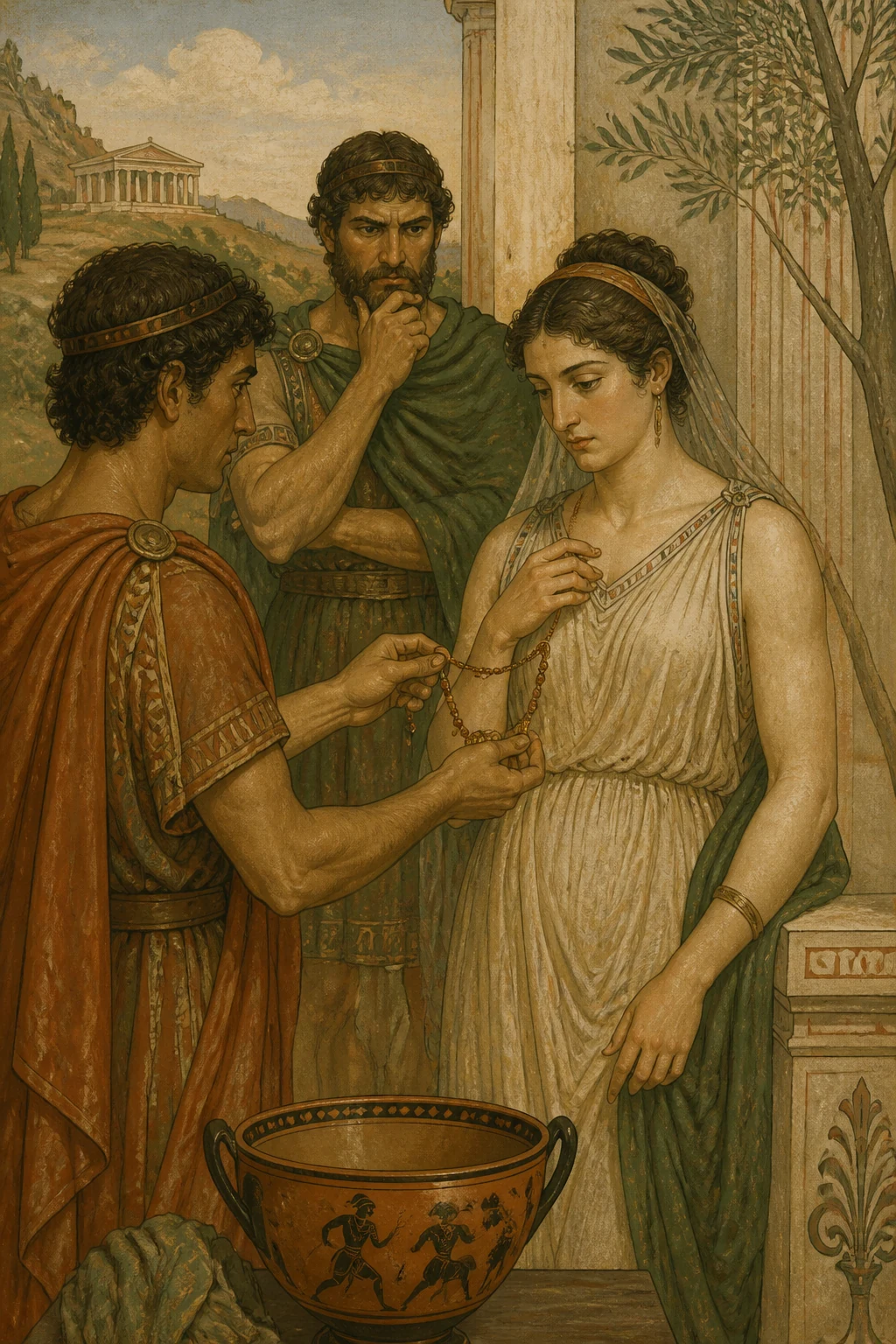
1. When Pandion died, his sons divided their inheritance: Erechtheus received the kingship, and Butes the priesthood of Athena and Poseidon Erechtheus. Erechtheus married Praxithea, daughter of Phrasimus and Diogeneia, the daughter of Cephisus, and had three sons, Cecrops, Pandorus, and Metion, and four daughters, Procris, Creusa, Chthonia, and Orithyia, whom Boreas carried off. Butes married Chthonia, Xuthus married Creusa, and Cephalus, son of Deion, married Procris. In return for a golden crown, Procris slept with Pteleon; when Cephalus discovered her, she fled to Minos. He fell in love with her and persuaded her to sleep with him. But no woman who slept with Minos could survive: because he slept with many women, Pasiphae had put a spell on him, so that whenever he lay with another woman, he discharged venomous creatures into her private parts, and in this way the women died.
Now Minos possessed a swift hound and a javelin that never missed its mark. In return for these, Procris slept with him, first giving him a root of Circe’s to drink so that he would do her no harm. But afterward, fearing Minos’s wife, she returned to Athens, reconciled herself with Cephalus, and went hunting with him, for she was a huntress. While she was pursuing game in a thicket, Cephalus, not knowing she was there, cast his javelin and struck and killed her. He was tried on the Areopagus and sentenced to perpetual exile.
2. Boreas carried off Orithyia as she was playing beside the river Ilissus and lay with her. She bore him two daughters, Cleopatra and Chione, and two winged sons, Zetes and Calais. These sailed with Jason and died while pursuing the Harpies, though Acusilaus says that Heracles killed them near Tenos.
3. Cleopatra married Phineus and bore him two sons, Plexippus and Pandion. Though he had these children by Cleopatra, Phineus married Idaea, daughter of Dardanus. She falsely accused her stepsons before Phineus of violating her, and Phineus believed her and blinded them both.
When the Argonauts sailed past with Boreas, they punished him.
4. Chione lay with Poseidon. She gave birth to Eumolpus without her father’s knowledge and, to avoid discovery, threw the child into the sea. But Poseidon rescued him, carried him to Ethiopia, and gave him to Benthesicyme, his daughter by Amphitrite, to bring up. When Eumolpus came of age, Benthesicyme’s husband gave him one of his two daughters in marriage. But he also attempted to rape his wife’s sister, and for this he was banished. With his son Ismarus he went to Tegyrius, king of the Thracians, who gave his daughter in marriage to Eumolpus’s son. Later Eumolpus was discovered plotting against Tegyrius, and fled to the Eleusinians, with whom he formed a friendship.
After Ismarus died, Tegyrius sent for Eumolpus, who returned, settled their former quarrel, and succeeded to the kingship. When war broke out between the Eleusinians and the Athenians, the Eleusinians summoned him, and he fought on their side with a large force of Thracians. Erechtheus consulted the oracle about securing victory for the Athenians, and the god declared that he would win the war if he sacrificed one of his daughters. He sacrificed his youngest daughter, and the others also killed themselves; for, according to some, they had sworn an oath to one another to die together. In the battle that followed the sacrifice, Erechtheus killed Eumolpus,
5. but Poseidon destroyed both Erechtheus and his house. Cecrops, the eldest of Erechtheus’s sons, became king. He married Metiadusa, daughter of Eupalamus, and fathered Pandion. Pandion succeeded Cecrops as king, but was driven out in a revolt by the sons of Metion. He went to Pylas at Megara and married his daughter Pylia. Later he also became king of the city: for Pylas killed his father’s brother Bias and gave the kingship to Pandion, while he himself went with a company of people to the Peloponnese and founded the city of Pylos. While Pandion was living at Megara, four sons were born to him: Aegeus, Pallas, Nisus, and Lycus. Some, however, say that Aegeus was the son of Scyrius, and that Pandion passed him off as his own.
6. After Pandion’s death, his sons marched against Athens, drove out the sons of Metion, and divided the realm into four parts; but Aegeus held supreme power. He married first Meta, daughter of Hoples, and then Chalciope, daughter of Rhexenor. As no child was born to him, he grew fearful of his brothers and went to the Pythian priestess to consult the oracle about fathering children. The god answered him: “Do not loose the wineskin’s jutting neck, noblest of men, until you reach the heights of Athens.” Perplexed by the oracle, he set out for Athens again.
7. Passing through Troezen, he was welcomed by Pittheus, son of Pelops. Pittheus understood the oracle, made Aegeus drunk, and put him to bed with his daughter Aethra. That same night Poseidon also lay with her. Aegeus instructed Aethra, if she bore a son, to bring him up without revealing who his father was. He left a sword and sandals beneath a rock, telling her that when the boy was strong enough to roll the rock aside and take them up, she should send him away with them. Aegeus himself returned to Athens and held the Panathenaic games, in which Androgeus, son of Minos, defeated all his rivals. Aegeus sent him against the Marathonian bull, which killed him. Some say, however, that while he was traveling to Thebes for the games of Laius, his fellow competitors ambushed and killed him out of envy. When news of his death reached Minos, he was sacrificing to the Graces on Paros. He threw the garland from his head and stopped the flute, but nevertheless completed the sacrifice. Hence to this day sacrifices are offered to the Graces on Paros without flutes or garlands.
8. Not long afterward, Minos, who commanded the sea, brought his fleet against Athens. He captured Megara, where Nisus, son of Pandion, was king, and killed Megareus, son of Hippomenes, who had come from Onchestus to help Nisus. Nisus too died, betrayed by his daughter. He had a purple hair in the middle of his head, and an oracle had declared that he would die if it were pulled out. His daughter Scylla fell in love with Minos and plucked out the hair.
After capturing Megara, Minos tied the girl by her feet to the stern of his ship and drowned her. As the war dragged on and he could not capture Athens, he prayed to Zeus to grant him vengeance upon the Athenians. Famine and plague fell upon the city. At first, in obedience to an ancient oracle, the Athenians slaughtered the daughters of Hyacinthus—Antheis, Aegleis, Lytaea, and Orthaea—on the tomb of Geraestus the Cyclops. Their father Hyacinthus had come from Lacedaemon and settled in Athens. When this brought no relief, they consulted the oracle about deliverance. The god told them to give Minos whatever recompense he chose. They therefore sent to Minos and allowed him to demand satisfaction. Minos ordered them to send seven youths and as many maidens, unarmed, to be devoured by the Minotaur. The creature was confined in a labyrinth, from which no one who entered could escape, for its intricate windings concealed and blocked the way out. It had been built by Daedalus, son of Eupalamus, who was the son of Metion and Alcippe. Daedalus was a master architect and the first inventor of statues. He had fled Athens after throwing Talos, the son of his sister Perdix, from the Acropolis. Talos was his pupil, and Daedalus feared that the boy’s talent would surpass his own: for Talos had found a snake’s jawbone and used it to saw through a thin piece of wood.
When the body was discovered, Daedalus was tried on the Areopagus and condemned, and fled to Minos. There he helped Pasiphae, who had fallen in love with Poseidon’s bull, by fashioning a wooden cow, and built the labyrinth into which the Athenians sent seven youths and as many maidens each year to be devoured by the Minotaur.