Prevod
1. Cecrops, a son of the earth whose body combined the forms of a man and a serpent, was the first king of Attica. He named the land Cecropia after himself, though it had previously been called Acte. In his time, they say, the gods resolved to take possession of cities in which each would receive honors of their own. Poseidon was therefore the first to come to Attica, and, striking the middle of the Acropolis with his trident, he brought forth a pool of seawater, which is now called the Erechtheis.
After him came Athena. Taking Cecrops as witness to her claim, she planted an olive tree, which is still shown in the sanctuary of Pandrosus. When the two fell into a dispute over the country, Zeus intervened and appointed judges—not Cecrops and Cranaus, nor Erysichthon, as some have said, but the twelve gods. By their judgment the country was awarded to Athena, after Cecrops testified that she had been the first to plant the olive tree. Athena therefore named the city Athens after herself, while Poseidon, furious with anger, flooded the Thriasian plain and submerged Attica beneath the sea.
2. Cecrops married Agraulus, daughter of Actaeus, and had a son, Erysichthon, who died childless, and three daughters, Agraulus, Herse, and Pandrosus. Agraulus and Ares had a daughter, Alcippe. When Halirrhothius, the son of Poseidon and the nymph Euryte, attempted to rape her, Ares caught him and killed him. Poseidon brought charges against Ares, who was tried on the Areopagus before the twelve gods and acquitted.
3. Herse and Hermes had a son, Cephalus. Eos fell in love with him and carried him off; after lying with him in Syria, she bore a son, Tithonus. His son was Phaethon, whose son was Astynous, whose son was Sandocus. Sandocus came from Syria to Cilicia, founded the city of Celenderis, and married Pharnace, daughter of Megassares, king of the Hyrieans, by whom he had a son, Cinyras. Cinyras came to Cyprus with a company of followers and founded Paphos. There he married Metharme, daughter of Pygmalion, king of Cyprus, and fathered Oxyporus and Adonis, as well as three daughters, Orsedice, Laogore, and Braesia. Through the wrath of Aphrodite, these daughters lay with foreign men and ended their lives in Egypt.
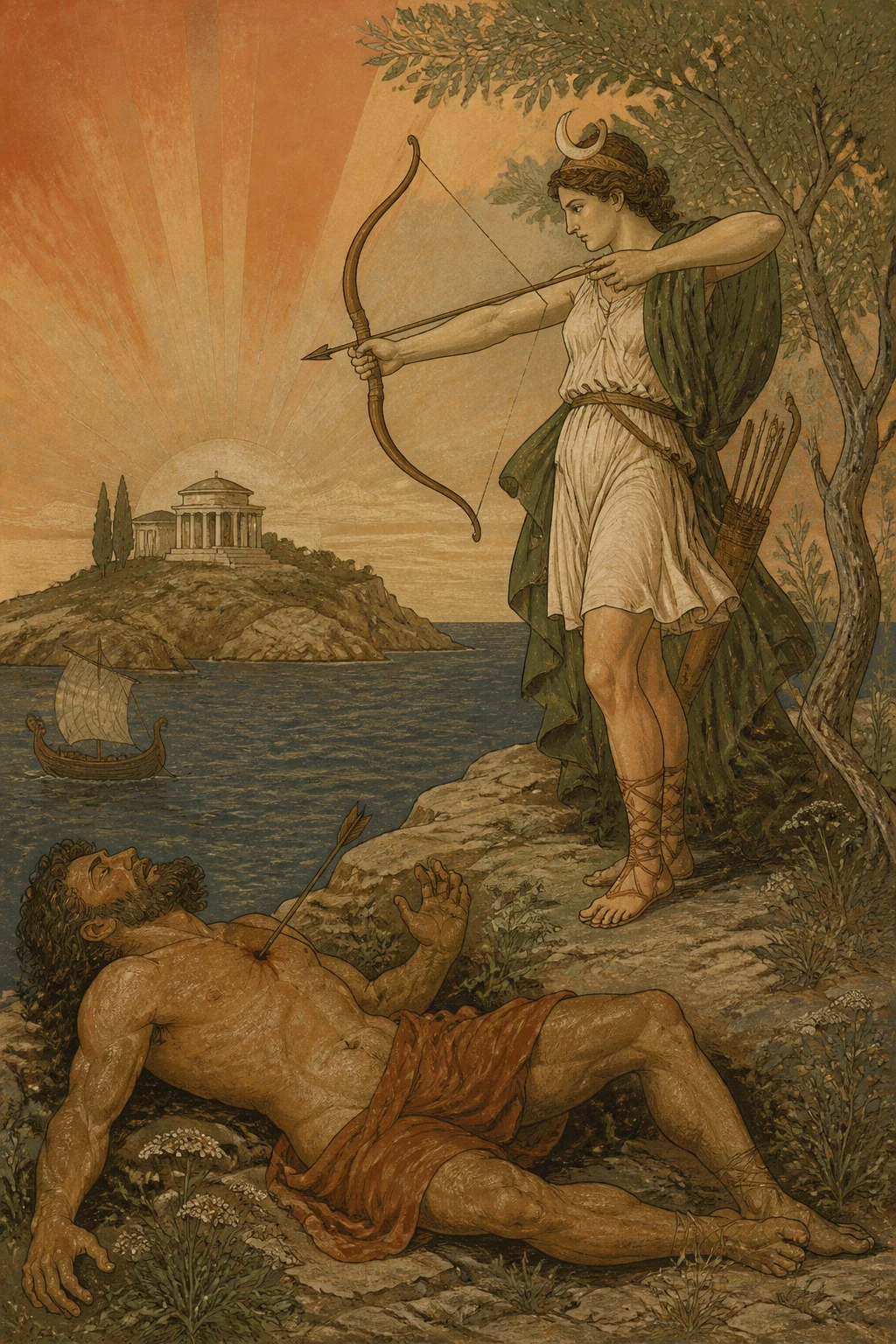
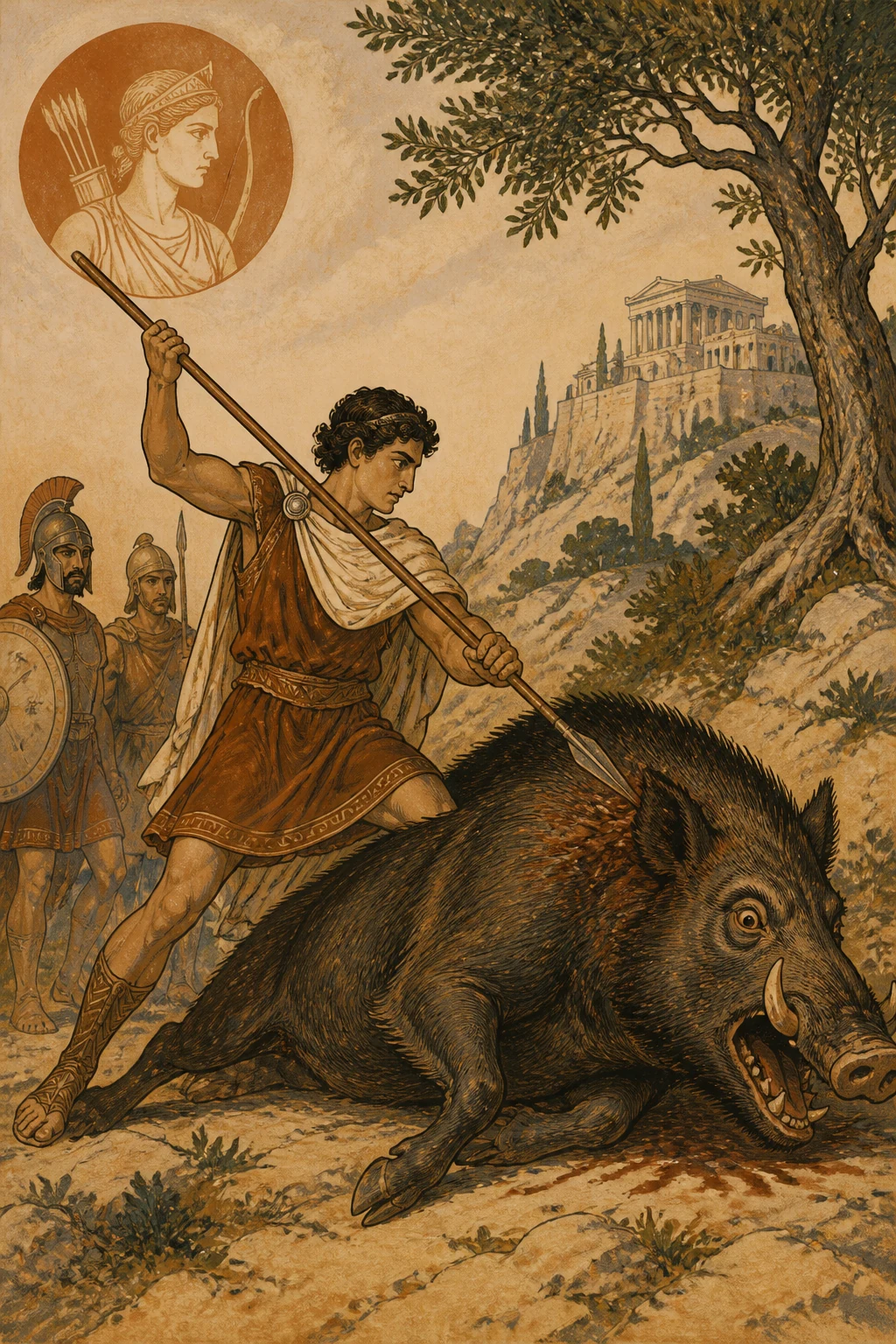
4. While Adonis was still a boy, he was struck by a boar while hunting and died through the anger of Artemis. Hesiod, however, says that he was the son of Phoenix and Alphesiboea, while Panyasis says that he was the son of Theias, king of the Assyrians, who had a daughter named Smyrna. Through the wrath of Aphrodite, whom she failed to honor, Smyrna fell in love with her father. With her nurse as an accomplice, she shared her father's bed for twelve nights without his knowing who she was. When he discovered the truth, he drew his sword and pursued her. As he was about to overtake her, she prayed to the gods to make her disappear. Taking pity on her, the gods changed her into the tree they call myrrh. Ten months later, the tree split open, and the child called Adonis was born. Because of his beauty, Aphrodite hid him in a chest while he was still an infant and, without the other gods' knowledge, entrusted him to Persephone. But when Persephone saw him, she refused to give him back. The dispute was brought before Zeus, who divided the year into three parts and decreed that Adonis should spend one part as he pleased, one with Persephone, and the third with Aphrodite. Adonis gave his own share to Aphrodite as well. Later, while hunting, Adonis was struck by a boar and died.
5. After Cecrops died, Cranaus, another son of the earth, became king. It was during his reign, they say, that the flood of Deucalion occurred. He married Pedias, daughter of Mynes, from Lacedaemon, and had three daughters, Cranae, Cranaechme, and Atthis. When Atthis died, still a maiden, Cranaus named the country Atthis after her.
6. Amphictyon drove out Cranaus and became king. Some say he was a son of Deucalion, others that he sprang from the earth. After he had reigned for twelve years, Erichthonius drove him out. Some say that Erichthonius was the son of Hephaestus and Atthis, daughter of Cranaus; others that he was the son of Hephaestus and Athena, in the following way. Athena came to Hephaestus because she wanted weapons made. He, having been abandoned by Aphrodite, was overcome with desire for Athena and began to pursue her, but she fled. When, with great difficulty—for he was lame—he caught up with her, he tried to force himself upon her. Being chaste and a virgin, she resisted him, but he spilled his seed upon the goddess's leg.
In disgust, she wiped the seed off with a piece of wool and threw it to the ground. As she fled and the seed fell upon the earth, Erichthonius was born. Athena reared him in secret from the other gods, wishing to make him immortal. She placed him in a chest and entrusted it to Pandrosus, daughter of Cecrops, forbidding her to open it. But Pandrosus's sisters opened it out of curiosity and saw a serpent coiled beside the infant. Some say they were killed by the serpent itself; others say that Athena's anger drove them mad and they threw themselves from the Acropolis. Reared by Athena herself in her sanctuary, Erichthonius drove out Amphictyon and became king of Athens. He set up the wooden image of Athena on the Acropolis, established the festival of the Panathenaea, and married Praxithea, a naiad nymph, by whom he had a son, Pandion.
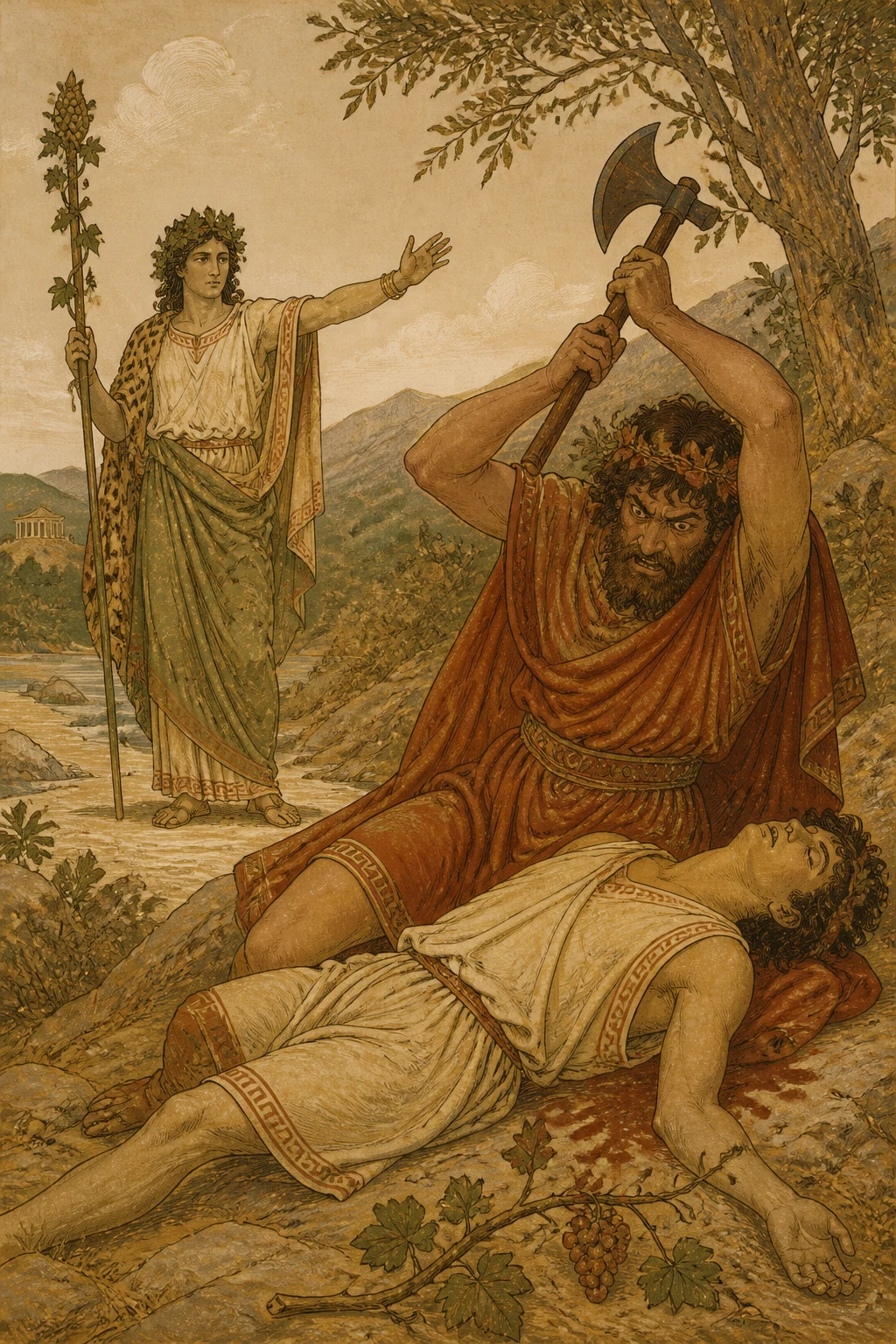
7. When Erichthonius died and was buried in that same sanctuary of Athena, Pandion became king. During his reign Demeter and Dionysus came to Attica. Celeus welcomed Demeter at Eleusis, while Icarius welcomed Dionysus, who gave him a vine cutting and taught him how to make wine. Wishing to share the god's gifts with mankind, Icarius went to some shepherds. They tasted the drink and, delighted by it, drank freely without mixing it with water; then, believing they had been poisoned, they killed him. When daylight came, they realized what they had done and buried him. His daughter Erigone went in search of her father, and his faithful dog Maera, who had accompanied Icarius, showed her where his body lay. After mourning her father bitterly, she hanged herself.
8. Pandion married Zeuxippe, his mother's sister, and had two daughters, Procne and Philomela, and twin sons, Erechtheus and Butes. When war broke out with Labdacus over the boundaries of their lands, he called upon Tereus, son of Ares, to come from Thrace to help him. With his aid he won the war and gave Tereus his daughter Procne in marriage. Tereus had a son by her, Itys, but then fell in love with Philomela and violated her too, saying that Procne was dead, though he was keeping her hidden in the countryside. He then married Philomela and shared her bed, and cut out her tongue. But she wove letters into a robe and through them made her sufferings known to Procne. Procne sought out her sister, killed her son Itys, boiled him, and served him to Tereus for dinner without his knowing what he ate. Then she fled in haste with her sister. When Tereus discovered what had happened, he seized an axe and pursued them. Overtaken at Daulia in Phocis, they prayed to the gods to turn them into birds. Procne became a nightingale and Philomela a swallow; Tereus too was transformed into a bird and became a hoopoe.