O besedilu
Hekaba in padec Troje
- Vir
- Ovidove preobrazbe
- Avtor
- Ovid
- Jezik branja
- English
- Jezik izvirnika
- Latin
- Čas branja
- 10 min branja
- Obseg
- 8 strani
- Naslov izvirnika
- Hecuba and the Fall of Troy
O izvirniku
Ovidove preobrazbe
Pesniški tok antičnih preobrazb, kjer bogovi, ljudje in narava stalno menjavajo obliko. Bralni jezik je English, izvirnik pa prihaja iz vira Ovidove preobrazbe v jeziku Latin.
Besedilo
Hekaba in padec Troje
The victor sets sail for the homeland of Hypsipyle and famous Thoas, the land infamous for the slaughter of its men of old, to bring back the Tirynthian hero’s weapons, his arrows. When he had brought them back to the Greeks, their master with them, and the last hand had finally been laid upon the savage war, Troy and Priam fell together. Priam’s unhappy wife, after losing everything, lost even her human form and startled foreign skies with her strange new barking, where the long Hellespont narrows to a strait.
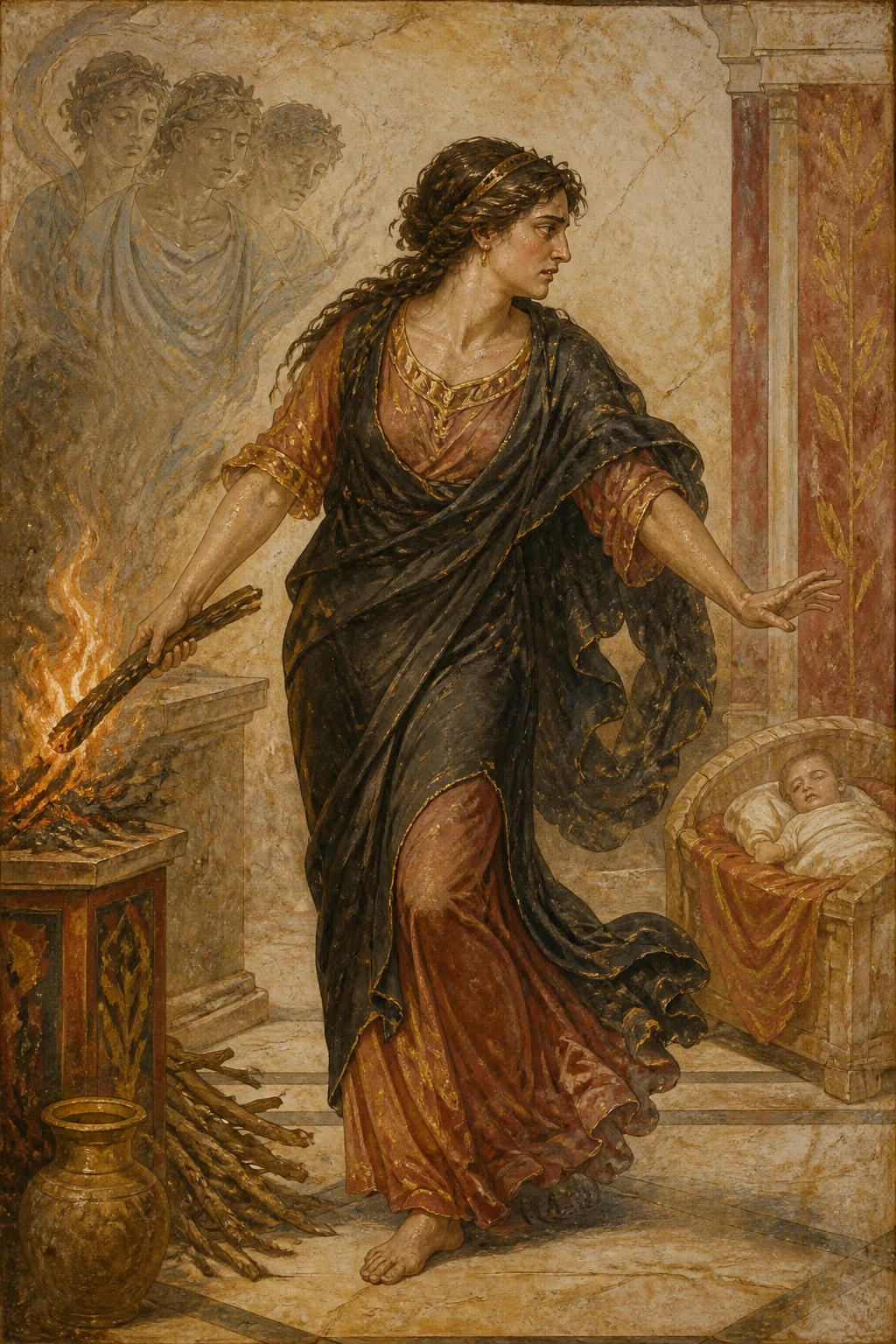
Ilium was burning, and the flames had not yet subsided; Jupiter’s altar had drunk the scant blood of aged Priam, and Phoebus’ priestess, dragged by her hair, stretched her hands to heaven, all in vain. The Trojan mothers clung to the images of their ancestral gods while they still could, and held fast to the burning temples, but the victorious Greeks dragged them away, an enviable prize.
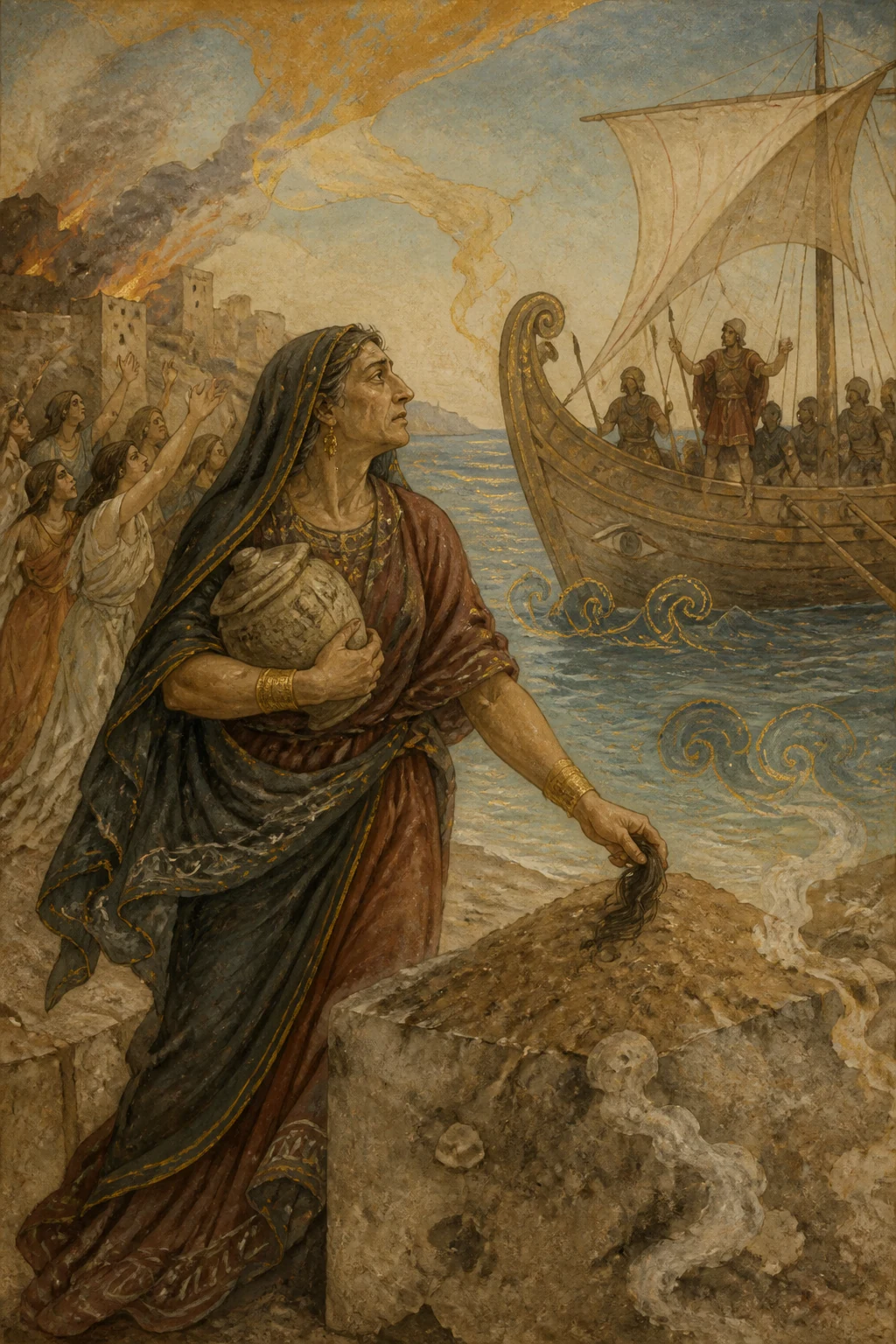
Astyanax was hurled from the very towers from which he had often watched his father, pointed out by his mother, fighting for him and defending his forefathers’ kingdom. And now the north wind urged departure; the sails filled and rustled in the following breeze, and the sailors called for them to seize it. “Farewell, Troy! We are torn away!” cried the Trojan women, kissing the earth and leaving their homeland’s smoking roofs.
Last to board the fleet—a pitiful sight!— was Hecuba, found among the tombs of her children. As she clasped their graves and kissed their bones, Dulichian hands dragged her away. Yet she gathered the ashes of one son, Hector, and carried them with her in her bosom. On Hector’s tomb she left a lock of her gray hair, a poor offering to the dead: her hair and tears. Opposite the place where Troy once stood lies a land inhabited by Bistonian men. There stood the wealthy palace of Polymestor, to whom your father secretly entrusted you, Polydorus, to be reared far from the fighting in Phrygia: a wise plan, had he not added great riches, a reward
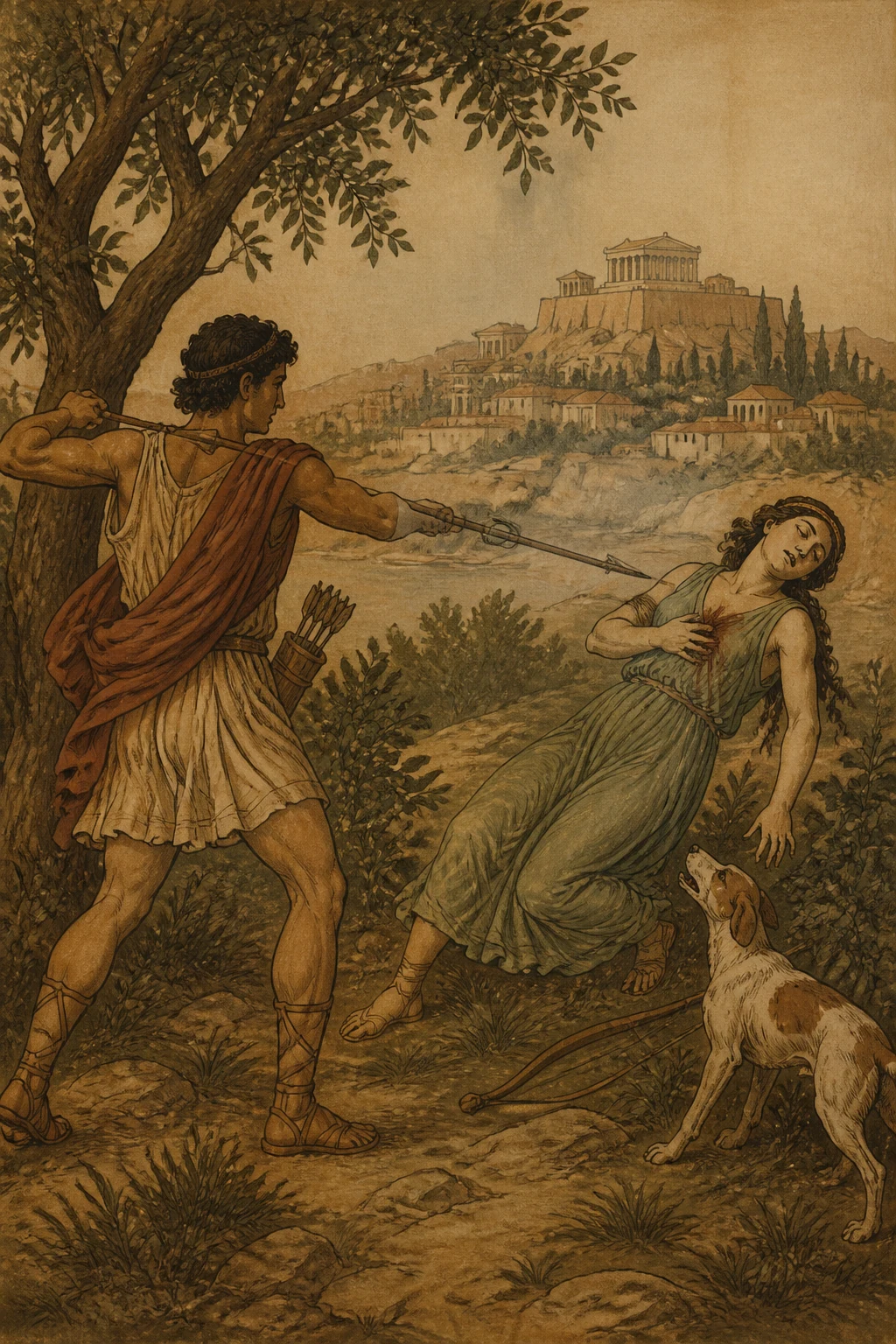
for murder, a spur to an avaricious heart. When the fortunes of the Phrygians fell, the godless king of Thrace took up his sword and plunged it into his foster child’s throat, then, as though the crime could be disposed of with the body, hurled the lifeless boy from a cliff into the waves below. The son of Atreus had moored his fleet on the Thracian shore, waiting for calmer seas and a friendlier wind.
Here suddenly, as tall as he had been in life, Achilles rose from the earth as it split wide open, his threatening face recalling the look he had worn when he fiercely drew his sword against unjust Agamemnon. “Do you sail away forgetful of me, Greeks?” he said. “Has all gratitude for my courage been buried with me? Do not let it be so! That my tomb may not go unhonored, let Polyxena be slaughtered to appease Achilles’ shade!”
He spoke, and his companions obeyed the merciless ghost. Torn from her mother’s arms, whose almost sole comfort she now was, the brave, ill-fated maiden, with courage beyond a woman’s, was led to the mound and made a victim at that dreadful tomb. True to herself, when she was brought to the cruel altar and understood the savage rite prepared for her, when she saw Neoptolemus standing there, sword in hand, his eyes fixed upon her face, “Take my noble blood at once!” she said.
“There is no need to wait. Plunge your blade into my throat or breast!” And she bared both throat and breast. “Surely I, Polyxena, would never wish to serve anyone. Yet no divinity will you appease with such a sacrifice! I only wish my death could be hidden from my mother! The thought of her hinders me and lessens my joy in death, though it is not my death she should lament, but her own life.
Only stand back, so that I may go free to the shades of Styx, if my request is just, and keep your manly hands from touching a maiden! Free blood will be more welcome to him, whoever he may be, whom you mean to appease by killing me. Yet if these last words of mine move any of you—the daughter of King Priam, now a captive, begs you—return my body to my mother without ransom.
Let her buy the sorrowful right of burial not with gold, but with tears! Once, when she could, she paid in gold as well.” She finished, but the people could not hold back the tears she held back herself. Even the priest wept as, unwillingly, he drove the blade into her offered breast. Her knees gave way, and she sank to the earth, keeping her expression fearless to the very end.
Even then, as she fell, she took care to cover what should be hidden, preserving the grace of her maiden modesty. The Trojan women received her and counted again the children of Priam they had mourned, and all the blood one house had shed. They lamented you, maiden, and you, who so lately were a king’s wife, called the mother of kings, the image of flourishing Asia, now a poor portion even among the spoils, whom victorious Ulysses would not have wanted for his own, except that you had borne Hector: scarcely could Hector find his mother a master!
She clasped the body, emptied of so brave a soul, and the tears she had so often shed for homeland, sons, and husband she shed for this child too, pouring them into her wounds. She covered her face with kisses and beat her breast as she had so often done, trailing her gray hair in the clotted blood, and, tearing at her breast, said these words among many others: “Daughter, your mother’s last sorrow—for what else remains?— daughter, you lie dead, and I see your wounded breast, my own wound.
So that I should lose none of my children without bloodshed, you too bear a wound! Yet I thought that, being a woman, you were safe from the sword. A woman, you too have fallen by the sword, and the same man who destroyed so many of your brothers has destroyed you: Achilles, the ruin of Troy, who robbed me of my children. But when he fell to the arrows of Paris and Phoebus, I said, ‘Now surely Achilles need no longer be feared!’ Even now I still had cause to fear him: the very ashes of the buried man rage against our family; even in his tomb we have felt our enemy.
It was for the grandson of Aeacus that I bore so many children! Mighty Ilium lies fallen, and our people’s suffering has ended in terrible disaster— but it has ended. For me alone Troy still stands, and my grief runs on. Only lately supreme in all things, strong in so many sons-in-law, children, daughters-in-law, and my husband, now I am dragged away, an exile, destitute, torn from my loved ones’ tombs, a gift for Penelope. As I draw out the wool she sets me, she will point me out to the women of Ithaca and say, ‘This is Hector’s famous mother; this is Priam’s wife!’ And now, after so many losses, you, who alone relieved your mother’s grief, have appeased an enemy’s tomb!
I have borne an offering for my enemy’s dead! Why do I endure, hard as iron? Why do I linger? For what do you preserve me, lingering old age? Why, cruel gods, do you prolong an old woman’s stubborn life, unless to make her see fresh deaths? Who could have thought that Priam might be called happy after Troy’s destruction? Happy in his death, he does not see you murdered, my daughter, and he left life and kingdom together.
But you, royal maiden, will surely be endowed with funeral honors, and your body laid within your ancestors’ tomb. Such is not our house’s fortune! Your mother’s gifts will be tears and a handful of foreign sand! We have lost everything. One reason remains for me to endure life a little longer: his mother’s dearest child, now my only son, once the youngest of my boys, Polydorus, entrusted to the Thracian king upon this coast.
Meanwhile, why do I delay washing these cruel wounds with water, and this face spattered with pitiless blood?” She spoke and went down to the shore with an old woman’s steps, tearing her white hair. “Trojan women, give me a jar,” the unhappy mother had said, so that she could draw clear water. Then she saw Polydorus’ body washed up on the shore, and the dreadful wounds that Thracian weapons had made!
The Trojan women cried out. She was struck dumb with grief; grief itself swallowed both her voice and the tears that welled within her. Like a block of solid stone she stood numb, now fixing her eyes on the ground before her, now raising her fierce gaze to the sky, now looking at her dead son’s face, now at his wounds— his wounds above all—and armed herself, marshaling her anger.
As soon as it blazed up, as though she were still a queen, she resolved on vengeance, wholly absorbed in imagining his punishment. As a lioness rages when robbed of her suckling cub and, finding tracks, pursues the enemy she cannot see, so Hecuba, once she had mingled anger with grief, remembering her courage and forgetting her years, went to Polymestor, the author of that dreadful murder, and asked to speak with him: she wished, she said, to show him a hidden store of gold left behind, for him to give her son.
The Thracian believed her and, driven by his accustomed greed, came to a secluded place. Then, with deceitful words of kindness, “Do not delay, Hecuba,” he said. “Give your son your gifts! Everything you give, and all you gave before, shall be his: I swear it by the gods above.” Fiercely she watched him speaking and swearing falsely, and seethed with swelling rage.
Then she seized him, called upon the band of captive mothers, and plunged her fingers into his treacherous eyes, tearing them from their sockets—anger made her ruthless. She thrust her hands within and, stained with his guilty blood, scooped out not his eyes, for they were gone, but the hollows where his eyes had been. Enraged by their king’s calamity, the Thracians began to assail the Trojan woman with showers of stones and weapons. But she chased a stone they threw with a hoarse growl, snapping at it, and when she opened her jaws to speak, she barked instead. The place still stands and takes its name from what occurred; and long remembering her former sorrows, she howled mournfully even then through the Sithonian fields.
Her fate had moved her own Trojans and her Greek enemies; it had moved all the gods as well, all so deeply that even Jupiter’s wife and sister herself denied that Hecuba deserved such suffering.
Izvirnik
Hecuba and the Fall of Troy
Naslednje strani prikazujejo izvirno besedilo za primerjavo.
Source ID: ovid_metamorphoses_story_086 Citation: Ovid, Metamorphoses 13.399-13.575 Original language: Latin Source: PerseusDL canonical-latinLit Source URL: https://github.com/PerseusDL/canonical-latinLit/blob/master/data/phi0959/phi006/phi0959.phi006.perseus-lat2.xml Segmentation certainty: medium 399: Victor ad Hypsipyles patriam clarique Thoantis 400: et veterum terras infames caede virorum 401: vela dat, ut referat Tirynthia tela, sagittas.
402: Quae postquam ad Graios, domino comitante, revexit, 403: imposita estque fero tandem manus ultima bello, 404: Troia simul Priamusque cadunt: Priameia coniunx 405: perdidit infelix hominis post omnia formam 406: externasque novo latratu terruit auras, 407: longus in angustum qua clauditur Hellespontus. 408: Ilion ardebat, neque adhuc consederat ignis, 409: exiguumque senis Priami Iovis ara cruorem 410: combiberat tracta atque comis antistita Phoebi 411: non profecturas tendebat ad aethera palmas.
412: Dardanidas matres patriorum signa deorum, 413: dum licet, amplexas succensaque templa tenentes 414: invidiosa trahunt victores praemia Grai. 415: Mittitur Astyanax illis de turribus, unde 416: pugnantem pro se proavitaque regna tuentem 417: saepe videre patrem monstratum a matre solebat. 418: Iamque viam suadet boreas, flatuque secundo 419: carbasa mota sonant, iubet uti navita ventis.
420: “Troia, vale! rapimur” clamant, dant oscula terrae 421: Troades et patriae fumantia tecta relinquunt. 422: Ultima conscendit classem (miserabile visu!) 423: in mediis Hecube natorum inventa sepulcris: 424: prensantem tumulos atque ossibus oscula dantem 425: Dulichiae traxere manus, tamen unius hausit 426: inque sinu cineres secum tulit Hectoris haustos; 427: Hectoris in tumulo canum de vertice crinem, 428: inferias inopes, crinem lacrimasque reliquit.
429: Est, ubi Troia fuit, Phrygiae contraria tellus, 430: Bistoniis habitata viris: Polymestoris illic 431: regia dives erat, cui te commisit alendum 432: clam, Polydore, pater Phrygiisque removit ab armis, 433: consilium sapiens, sceleris nisi praemia magnas 434: adiecisset opes, animi inritamen avari. 435: Ut cecidit fortuna Phrygum, capit impius ensem 436: rex Thracum iuguloque sui demisit alumni 437: et, tamquam tolli cum corpore crimina possent, 438: exanimem scopulo subiectas misit in undas.
439: Litore Threicio classem religarat Atrides, 440: dum mare pacatum, dum ventus amicior esset. 441: Hic subito, quantus cum viveret esse solebat, 442: exit humo late rupta similisque minanti 443: temporis illius vultum referebat Achilles, 444: quo ferus iniustum petiit Agamemnona ferro, 445: “inmemores” que “mei disceditis” inquit “Achivi, 446: obrutaque est mecum virtutis gratia nostrae?
447: Ne facite! utque meum non sit sine honore sepulcrum, 448: placet Achilleos mactata Polyxena manes!” 449: Dixit, et inmiti sociis parentibus umbrae, 450: rapta sinu matris, quam iam prope sola fovebat, 451: fortis et infelix et plus quam femina virgo 452: ducitur ad tumulum diroque fit hostia busto. 453: Quae memor ipsa sui, postquam crudelibus aris 454: admota est sensitque sibi fera sacra parari, 455: utque Neoptolemum stantem ferrumque tenentem 456: utque suo vidit figentem lumina vultu, 457: utere iamdudum generoso sanguine!” dixit, 458: “nulla mora est: aut tu iugulo vel pectore telum
459: conde meo! (iugulumque simul pectusque retexit) 460: scilicet haud ulli servire Polyxena vellem. 461: haud per tale sacrum numen placabitis ullum! 462: Mors tantum vellem matrem mea fallere posset! 463: Mater obest minuitque necis mihi gaudia, quamvis 464: non mea mors illi, verum sua vita gemenda est. 465: Vos modo, ne Stygios adeam non libera manes, 466: ite procul, si iusta peto, tactuque viriles 467: virgineo removete manus! Acceptior illi, 468: quisquis is est, quem caede mea placare paratis, 469: liber erit sanguis. Siquos tamen ultima nostri 470: verba movent oris (Priami vos filia regis,
471: nunc captiva rogat), genetrici corpus inemptum 472: reddite, neve auro redimat ius triste sepulcri, 473: sed lacrimis! Tunc, cum poterat, redimebat et auro.” 474: Dixerat, at populus lacrimas, quas illa tenebat, 475: non tenet; ipse etiam flens invitusque sacerdos 476: praebita coniecto rupit praecordia ferro. 477: Illa super terram defecto poplite labens 478: pertulit intrepidos ad fata novissima vultus.
479: Tunc quoque cura fuit partes velare tegendas, 480: cum caderet, castique decus servare pudoris. 481: Troades excipiunt deploratosque recensent 482: Priamidas et quid dederit domus una cruoris, 483: teque gemunt, virgo, teque, o modo regia coniunx, 484: regia dicta parens, Asiae florentis imago, 485: nunc etiam praedae mala sors, quam victor Ulixes 486: esse suam nollet, nisi quod tamen Hectora partu 487: edideras: dominum matri vix repperit Hector!
488: Quae corpus complexa animae tam fortis inane, 489: quas totiens patriae dederat natisque viroque, 490: huic quoque dat lacrimas lacrimas in vulnera fundit 491: osculaque ore tegit consuetaque pectora plangit 492: canitiemque suam concreto in sanguine verrens 493: plura quidem, sed et haec laniato pectore dixit: 494: “Nata, tuae (quid enim superest?) dolor ultime matris, 495: nata, iaces, videoque tuum, mea vulnera, pectus, 496: et ne perdiderim quemquam sine caede meorum, 497: tu quoque vulnus habes! At te, quia femina, rebar 498: a ferro tutam: cecidisti et femina ferro, 499: totque tuos idem fratres, te perdidit idem,
500: exitium Troiae nostrique orbator, Achilles. 501: At postquam cecidit Paridis Phoebique sagittis, 502: “nunc certe,” dixi, “non est metuendus Achilles!rsquo; 503: Nunc quoque mi metuendus erat: cinis ipse sepulti 504: in genus hoc saevit, tumulo quoque sensimus hostem. 505: Aeacidae fecunda fui! Iacet Ilion ingens, 506: eventuque gravi finita est publica clades, — 507: sed finita tamen; soli mihi Pergama restant, 508: in cursuque meus dolor est: modo maxima rerum, 509: tot generis natisque potens nuribusque viroque, 510: nunc trahor exul, inops, tumulis avulsa meorum, 511: Penelopae munus; quae me data pensa trahentem
512: matribus ostendens Ithacis “haec Hectoris illa est 513: clara parens, haec est” dicet “Priameia coniunx!” 514: Postque tot amissos tu nunc, quae sola levabas 515: maternos luctus, hostilia busta piasti! 516: Inferias hosti peperi! Quo ferrea resto? 517: Quidve moror? Quo me servas, annosa senectus? 518: Quo, di crudeles, nisi uti nova funera cernam, 519: vivacem differtis anum? Quis posse putaret 520: felicem Priamum post diruta Pergama dici?
521: Felix morte sua est, nec te, mea nata, peremptam 522: adspicit et vitam pariter regnumque reliquit. 523: At, puto, funeribus dotabere, regia virgo, 524: condeturque tuum monumentis corpus avitis. 525: Non haec est fortuna domus: tibi munera matris 526: contingent fletus peregrinaeque haustus harenae! 527: Omnia perdidimus: superest, cur vivere tempus 528: in breve sustineam, proles gratissima matri, 529: nunc solus, quondam minimus de stirpe virili, 530: has datus Ismario regi Polydorus in oras.
531: Quid moror interea crudelia vulnera lymphis 532: abluere et sparsos inmiti sanguine vultus?” 533: Dixit et ad litus passu processit anili, 534: albentes lacerata comas. “Date, Troades, urnam” 535: dixerat infelix, liquidas hauriret ut undas: 536: adspicit eiectum Polydori in litore corpus 537: factaque Threiciis ingentia vulnera telis! 538: Troades exclamant: obmutuit illa dolore, 539: et pariter vocem lacrimasque introrsus obortas 540: devorat ipse dolor, duroque simillima saxo 541: torpet et adversa figit modo lumina terra, 542: interdum torvos sustollit ad aethera vultus,
543: nunc positi spectat vultum, nunc vulnera nati 544: vulnera praecipue, seque armat et instruit iram.” 545: Qua simul exarsit, tamquam regina maneret, 546: ulcisci statuit poenaeque in imagine tota est, 547: utque furit catulo lactente orbata leaena 548: signaque nacta pedum sequitur, quem non videt, hostem, 549: sic Hecube, postquam cum luctu miscuit iram, 550: non oblita animorum, annorum oblita suorum, 551: vadit ad artificem dirae, Polymestora, caedis 552: conloquiumque petit: nam se monstrare relictum 553: velle latens illi, quod nato redderet, aurum.
554: Credidit Odrysius praedaeque adsuetus amore 555: in secreta venit. Tum blando callidus ore 556: “tolle moras, Hecube,” dixit, “da munera nato! 557: Omne fore illius quod das, quod et ante dedisti, 558: per superos iuro.” Spectat truculenta loquentem 559: falsaque iurantem tumidaque exaestuat ira 560: atque ita correpto captivarum agmina matrum 561: invocat et digitos in perfida lumina condit 562: expellitque genis oculos (facit ira nocentem) 563: immergitque manus, foedataque sanguine sonti 564: non lumen (neque enim superest), loca luminis haurit.
565: Clade sui Thracum gens inritata tyranni 566: Troada telorum lapidumque incessere iactu 567: coepit. At haec missum rauco cum murmure saxum 568: morsibus insequitur, rictuque in verba parato 569: latravit, conata loqui: locus exstat et ex re 570: nomen habet, veterumque diu memor illa malorum 571: tum quoque Sithonios ululavit maesta per agros. 572: illius Troasque suos hostesque Pelasgos, 573: illius fortuna deos quoque moverat omnes, 574: sic omnes, ut et ipsa Iovis coniunxque sororque 575: eventus Hecubam meruisse negaverit illos.
Nadaljuj z branjem