Prevod
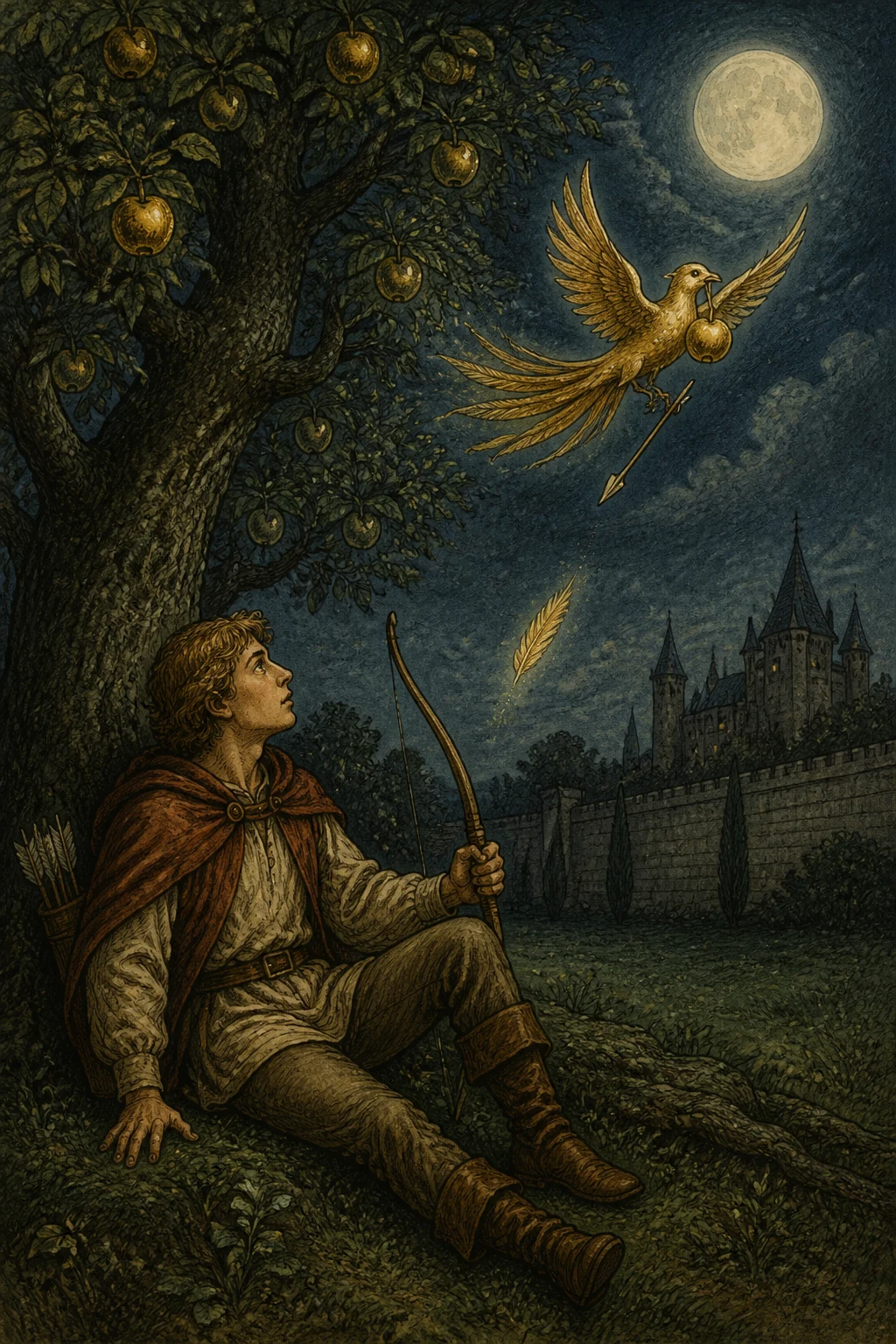
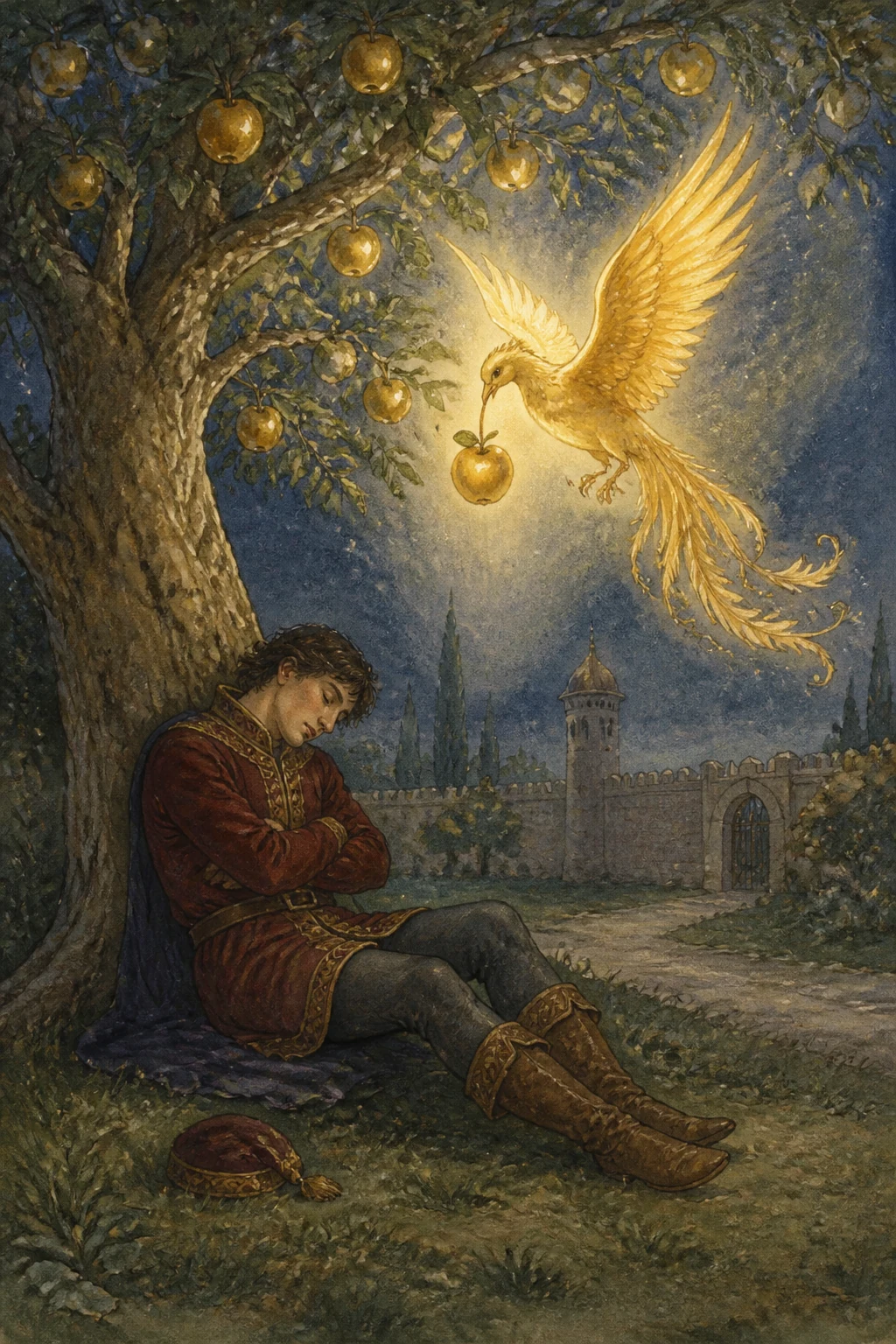
Once upon a time, as never before, and so on. There lived an emperor and an empress, and they had three sons. Beside their palace was a very beautiful garden. The emperor loved flowers so dearly that he took great pleasure in admiring them and tending the garden himself. At the far end of this garden grew an apple tree made entirely of gold. The emperor was beside himself with joy to have in his garden a tree unlike any other in the world. He was forever walking around it, gazing at it from every side, unable to feast his eyes enough. Then one day he saw the tree put forth buds, blossom, shed its flowers, and bear fruit; toward evening the apples began to ripen. The emperor smiled beneath his mustache, and his mouth watered at the thought that the next day he would have golden apples upon his table, a thing unheard of until then. The next morning, scarcely had daylight broken when the emperor was in the garden, eager to see the golden apples and satisfy his longing to gaze at them. But he was struck dumb when, instead of ripe golden apples, he saw that the tree had budded anew, while the apples were nowhere to be found. While he was still standing there, he saw the tree blossom, its flowers fall, and its fruit appear once more. His spirits revived a little, and he contented himself with waiting until the following day. But the next morning there were no apples to be found. The emperor was dreadfully upset and ordered guards to be posted to catch the thief. But that was easier said than done! Every day the tree blossomed, shed its flowers, and bore fruit, which began to ripen toward evening. During the night the apples ripened, and someone came and took them without the emperor’s men knowing a thing about it. It seemed a bewitched business: whoever was taking the apples was making a mockery of the emperor and all his guards. By now it was not so much the lack of golden apples at his table that troubled the emperor; what vexed him most was that he had never so much as seen the first ripe fruit of this tree. He grew so sorrowful over it that he was almost ready to step down from his throne and give it to whoever would undertake to catch the thief. His sons must have guessed his thoughts, for they came before him and begged to be allowed to keep watch themselves. Great was the emperor’s joy when he heard his eldest son pledge to lay hands on the thief. He gave them leave, and they set about the task. The eldest son kept watch that day, but met with the same disgrace as all the guards before him. The next day the middle son took his turn, but he proved no better and returned to his father with his head hanging. They said that until midnight they managed well enough, but afterward such drowsiness overcame them that they could no longer stand; they fell into a deep sleep and knew nothing more. The youngest son listened without a word. Then, when his elder brothers had finished telling what had happened to them, he too asked his father’s leave to keep watch. Sad as his father was that no brave fellow could be found to catch the apple thief, he laughed when he heard him. Yet after much pleading he consented. The youngest son prepared for his vigil. When evening came, he took his quiver of arrows, his bow, and his sword, and went into the garden. He chose a secluded spot, far from any tree or wall, so that he would have nothing to lean against. He decided to stand upon the stump of a felled tree, so that if he grew sleepy and nodded, he would fall and wake himself. This he did, and after falling a couple of times, he shook off his sleepiness and remained wide awake, no longer troubled by drowsiness. And so he passed his first night. Toward dawn, when sleep is sweetest, he heard a fluttering like a flock of birds drawing near. He pricked up his ears and heard someone stripping the apples from the tree. He took an arrow from his quiver, fitted it to his bow, and let fly, but nothing stirred. He shot another, and again nothing. When he loosed the third, the fluttering sounded once more, and he understood that the flock of birds must have flown away. He went up to the golden apple tree and saw that the thief had not had time to take all the apples. He had taken what he could, but some still remained. As the prince stood there, he thought he saw something shining on the ground. He bent down and picked it up. And what do you think it was? Two feathers made entirely of gold. As soon as day broke, he gathered a few apples, set them on a golden platter, and, with the feathers in his cap, went to present them to his father. At the sight of the apples, the emperor nearly lost his wits for joy, but he mastered himself. He had it proclaimed throughout the city that his youngest son had succeeded in bringing him apples and had discovered that the thief was a bird. Făt-Frumos asked his father’s leave to go in search of the thief. His father wanted to hear no more of thieves, now that God had granted him the sight of the apples he had so long desired. But the emperor’s youngest son would not leave matters there, and persisted until the emperor allowed him to go and seek the thief. He made ready for his journey, and when he was about to leave, he took the golden feathers from his cap and gave them to his mother, the empress, to keep until his return. He took a change of clothes and money for his expenses, slung his quiver over his back, fastened his sword at his left hip, and, with his bow in one hand and the other about his faithful servant’s neck, set off. On and on they went, traveling a long, long way, until they reached the wilderness. Here they halted, and after consulting his faithful servant, he decided to head east. After traveling a good distance farther, they came to a thick, tangled forest. Groping their way through its dense undergrowth, for there was no other way to pass, they caught sight in the distance of an enormous wolf with a copper forehead. At once they prepared to defend themselves. When they were within bowshot, Făt-Frumos raised his bow and took aim. Seeing this, the wolf cried, “Stop, Făt-Frumos! Do not shoot me, for one day I may be of great service to you.” Făt-Frumos heeded him and lowered his bow. The wolf came closer and asked where he was going and what he sought in woods where no human foot had ever trodden. Făt-Frumos told him the whole story of the apples in his father’s garden and said that he was now searching for the thief. The wolf told him that the thief was the emperor of the birds. Whenever he came to steal the apples, he gathered the swiftest birds in flight and brought them in a flock to pick the fruit. This bird was to be found in the kingdom on the edge of the forest. He added that the whole neighborhood complained of the fruit it stole from their gardens, and showed them the shortest and easiest road. Then he gave him a lovely little apple and said, “Take this little apple, Făt-Frumos. Whenever you need me, look at it and think of me, and I shall be there at once.” Făt-Frumos accepted the apple and tucked it into his bosom. Then he took his leave and set off with his faithful servant. Making their way through the forest thickets, they reached the city where the bird was kept. He made inquiries in the city and was told that the emperor of that land kept it in a golden cage in his garden. That was all he needed to know. He circled the imperial court a few times, taking careful note of everything around it. When evening came, he returned with his faithful servant and hid at a corner, waiting until everyone within had settled down for the night. Then his servant bent down to give him a foothold, and Făt-Frumos climbed onto his back, from there onto the top of the wall, and jumped into the garden. The instant he laid his hand upon the cage, the bird cried out, and before you could say a word he found himself surrounded by a host of birds, some small and some large, all shrieking in their own tongues. They raised such an uproar that every servant in the palace awoke. Coming into the garden, they found Făt-Frumos with the cage in his hand, the birds swooping at him to tear him to pieces while he defended himself. The servants seized him and took him before the emperor, who had also risen to see what had happened. The emperor recognized him as soon as he saw him and said, “I am sorry, Făt-Frumos, that this should have happened. Had you come in friendship, or begged me for the bird, I might have been persuaded to give it to you willingly. But now that you have been caught red-handed, as the saying goes, our customs demand that you die. And your name will remain stained with the disgrace of theft.” “This bird, illustrious emperor,” Făt-Frumos replied, “has robbed us several times of the golden apples from the tree in my father’s garden, and that is why I came to seize it.” “What you say may be true, Făt-Frumos, but here I have no power to act against our customs. Only some great service rendered to our empire can save you from both disgrace and death.” “Tell me what service I must perform, and I shall attempt it.” “If you succeed in bringing me the wild mare kept at the court of my neighboring emperor, you shall leave with your honor intact, and I shall give you the bird and its cage.” Făt-Frumos agreed, and that very day he set off with his faithful servant. When he reached the neighboring emperor’s court, he learned all he could about the mare and the walls surrounding the palace. Then, when evening came, he and his faithful servant took up a position at a corner of the court where he thought they would be well concealed. There he saw two servants leading the mare about and marveled at her beauty. She was white, and her halter was gilded and set with precious stones that shone like the sun. Around midnight, when sleep is sweetest, Făt-Frumos told his faithful servant to bend down. He climbed onto his back, then onto the wall, and jumped into the emperor’s courtyard. And now there he was, playing the thief! He groped his way forward on tiptoe until he reached the stable. Opening the door, he took hold of the halter and led the mare after him. But as soon as she reached the stable door, she gave such a neigh that the air rang and the whole courtyard and palace echoed. Everyone sprang up at once, seized Făt-Frumos, and took him before the emperor, who had risen too. The emperor recognized Făt-Frumos the moment he saw him. He rebuked him for the shameful deed he had been about to commit, told him that the customs of his land condemned thieves to death, and said he had no power to oppose those customs. Făt-Frumos truthfully related the whole story of the apples, the bird, and what the neighboring emperor had told him to do. Then the emperor said, “If you can bring me Zâna Crăiasă, Făt-Frumos, perhaps I shall be able to save you from death and leave your name unstained.” Făt-Frumos undertook the task and set off with his faithful servant. On the road he remembered the little apple. He drew it from his bosom, looked at it, and thought of the wolf. In the blink of an eye, the wolf was there. “What do you wish, Făt-Frumos?” he asked. “What can I wish?” he replied. “This and that has happened to me. How am I to bring this venture to a happy end?” “Is that all that troubles you? Leave it to me, and consider the business as good as done.” So all three set off toward Zâna Crăiasă’s dwelling. When they drew near, they halted in a forest from which they could see the fairy’s shining palace. They agreed that Făt-Frumos and his faithful servant should wait at the foot of an old tree until the wolf returned. And what a splendid palace the fairy had! Even the wolf marveled at its beauty and at the good order of everything about it. When he arrived, he found a way to slip into the garden. And what should he see there? Not a single tree was green. Their leaves had fallen, and their branches and twigs stood bare. On the ground the fallen leaves were dry as tinder. Only one thicket of roses was still green and full of buds, some just beginning to open and others already in bloom.
To reach it, the wolf had to walk on tiptoe so as not to rustle the dry leaves, and he hid in that flowering thicket. As he crouched there on the watch, Zâna Crăiasă came out of the palace with twenty-four maidservants to take a walk in the garden. When the wolf saw her, he very nearly forgot why he had come and gave himself away, but he mastered himself. For she was so beautiful that her like had never been seen, nor was there another such upon the face of the earth. Her hair, my friend, was pure gold, and her long, thick tresses reached down to her calves. One glance from those great eyes, black as blackberries, could make a man lovesick. Her eyebrows were so finely arched that they seemed drawn with a pen, and her skin was whiter than the foam of milk. After strolling around the garden a few times, with her maidservants following, she came to the rose thicket to pick some flowers. Then the wolf, who was hidden among the bushes, sprang out, caught her in his arms, and away he went. Her maidservants scattered in fright like young partridges. The wolf ran without stopping and laid her, unconscious, in Făt-Frumos’s arms. At the sight of her he lost his senses, but the wolf reminded him that he was a brave man, and he recovered himself. Many emperors had tried to carry her off, but had perished in the attempt. Făt-Frumos’s heart went out to her, and he could no longer bear the thought of giving her to another. When Zâna Crăiasă came out of her swoon and found herself in Făt-Frumos’s arms, she said, “So you are the wolf who carried me off. Yours I shall be.” Făt-Frumos answered, “Mine you shall be, and we shall never part until death.” Then they talked together, and each told the other the whole course of their adventures. Seeing the love that had sprung up between them, the wolf said, “Leave it to me. I shall arrange everything as you wish.” And they set off back the way they had come. On the road the wolf turned three somersaults and became the very image of Zâna Crăiasă. Clearly, this wolf had magical powers. They agreed that Făt-Frumos’s faithful servant should wait with Zâna Crăiasă at the foot of a great tree in the forest until Făt-Frumos returned with the wild mare. When he reached the emperor who owned the mare, Făt-Frumos handed over the false Zâna Crăiasă. The moment the emperor saw her, his heart melted, and he was seized with a longing for her beyond all telling. “Your valor, Făt-Frumos,” the emperor said, “has saved you from both disgrace and death. And now I shall reward you as well by giving you the mare.” As soon as Făt-Frumos had the mare and her marvelous halter in his hands, he hurried away. He set Zâna Crăiasă upon the mare and rode off with her, passing beyond the borders of that empire. Meanwhile, the emperor at once gathered his counselors and set off for the church to marry Zâna Crăiasă. But at the church door the false fairy turned three somersaults and became a wolf again, snapping his jaws and baring his teeth at the emperor’s courtiers. At the sight, they froze with terror. Then, when they had recovered a little, they chased after him with shouts and jeers. But the wolf—just watch him go! He lengthened his wolfish stride and was off, my friend, so fast that they could not lay a hand on him. He caught up with Făt-Frumos and his companions and went on with them. When they drew near the court of the emperor who owned the bird, they repeated the trick they had played upon the other emperor. The wolf changed into the wild mare and was led before the emperor, who was beside himself with joy at the sight of her. After receiving Făt-Frumos with great courtesy, the emperor said, “You have escaped both disgrace and death, Făt-Frumos. I shall keep my imperial word, and my gratitude shall be with you always.” He gave the order, and the bird was brought at once, cage and all. Făt-Frumos accepted it, took his leave, and departed. When he reached the forest where he had left Zâna Crăiasă, the mare, and his faithful servant, they all set off together toward his father’s empire. The emperor who had received the mare ordered his whole army and the great lords of his realm out into the open country, where he intended to appear before them mounted upon the famous mare. When the soldiers saw him, they all cried as one, “Long live the emperor, who has gained such a treasure! And long live the mare, who makes you appear in such splendor!” And indeed, my friend, the mare came on with the emperor upon her back, her feet scarcely touching the ground, as though she were flying. They held a race, but there was no hope of anyone coming near that mare, for she left them all behind. When she was a good distance away, she suddenly stopped, threw the emperor to the ground, turned three somersaults, and became a wolf once more. Then he took to his heels and ran and ran until he caught up with Făt-Frumos. When the time came to part, the wolf said to him, “This time all your wishes have been fulfilled. Take care, as long as you live, never again to desire things beyond your power to obtain, for no good will come of it.” Then they parted, each going his own way. When word reached his father’s empire that the youngest son was returning, everyone, great and small, came out to welcome him with the honors due to him. Great was the joy of all when they saw him with a bride whose like was not to be found upon the face of the earth, and with treasures such as had never been heard of. As soon as he arrived, Făt-Frumos ordered a stable to be built for the mare, and he placed the bird in its cage in the part of the palace overlooking the garden. Then his father ordered the wedding preparations to be made. A few days later Făt-Frumos married Zâna Crăiasă, spread a great feast for good and bad alike, and they celebrated for three whole days and three whole nights. After that they lived in happiness, for Făt-Frumos had nothing left to wish for. And they may be living still, if they have not died. And I mounted a saddle, and so on.