Prevod
Once upon a time, as never before, and so on. Once there was a great boyar’s son who, after wandering through many lands and exploring every corner of them, was returning to his estate. As he passed through a hemp field, he saw three girls working among the hemp. He went on his way, minding his own business, without paying any heed to what the girls were saying. But when certain words reached his ears, they roused him from his thoughts. He turned towards the girls and asked, “What did you say, girls?” “If that boyar’s son passing this way were to marry me, I would clothe his whole household with a single spindle,” said the eldest girl. “If that boyar’s son passing this way were to marry me, I would feed his whole household with a single loaf,” said the middle girl. “If that boyar’s son passing this way were to marry me, I would bear him two princely children, golden through and through,” said the youngest girl. When the girls had repeated what they had said, he stood pondering. “Well now, what can this mean?” Then, after thinking it over a little longer, he said to the youngest, “My girl, I like your words better than your sisters’. If you will come with me, I will take you for my wife, only you must keep your promise.” And how could the girl have refused? For he was a fine young fellow, tall as a fir tree, handsome and charming beyond measure. The girl blushed as red as a peony; then, after a little more thought, she held out her hand and said:
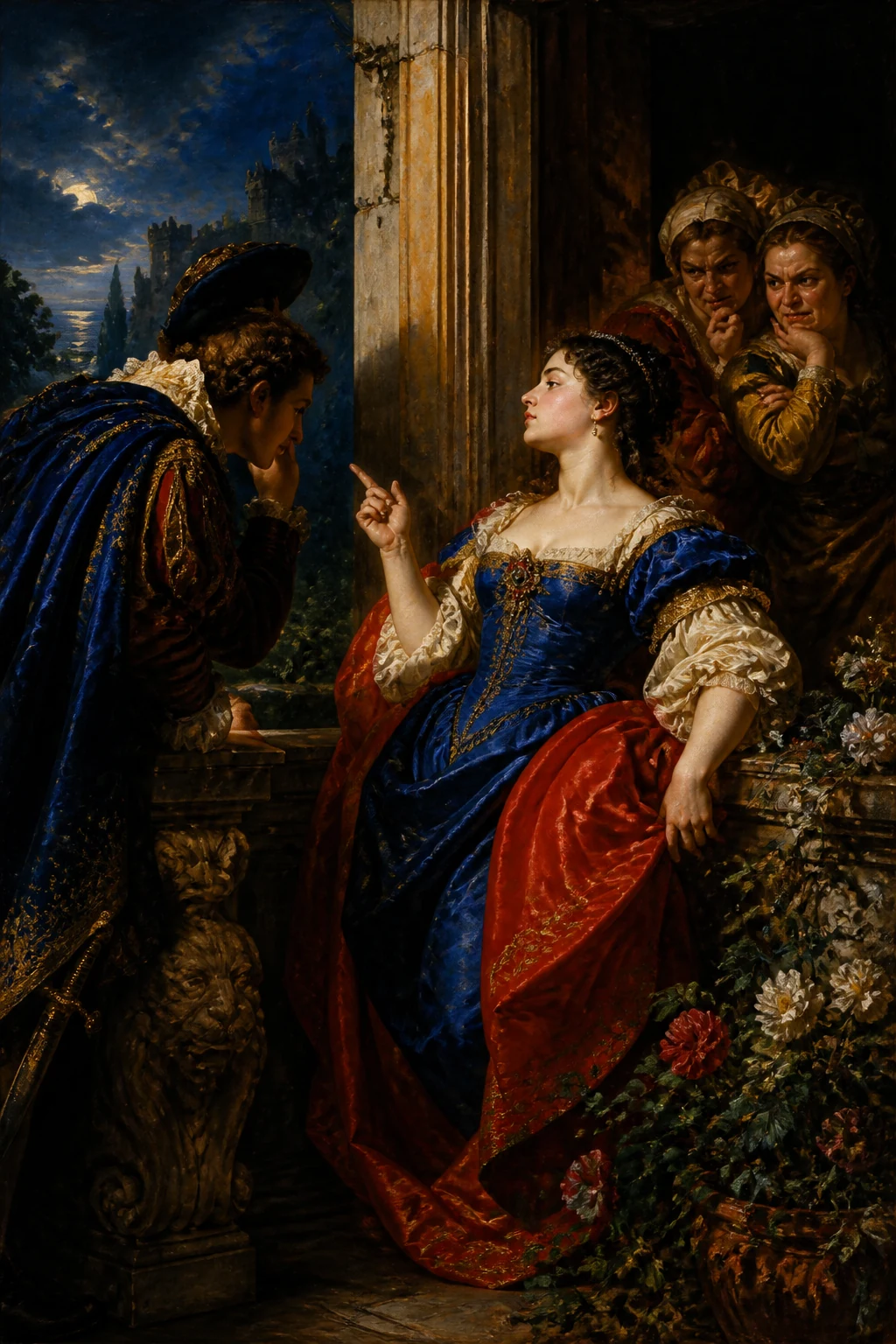
“Well, may good come of it. If you are meant for me, neither shall I escape you nor you escape me, no matter who may try to stand in our way.” The boyar’s son took the girl and brought her to his estates. There he had a palace the like of which she had never seen. They were married, and held a wedding whose fame spread through many lands, and did all that was fitting to establish their married household. Before long, the girl found herself with child, as women do. When the boyar’s son heard the news, he could scarcely contain his joy, and at once ordered a cradle made entirely of silk in which to lay the children. When he had first brought his wife home, he had given her a maid, the daughter of an old Gypsy woman who eked out a living about the boyar’s courtyard on whatever the household would spare her. No sooner did that accursed crow set eyes on the girl than she conceived an evil design against her. When the time came for the birth, the boyar’s son was away on business. The mistress of the house sent the Gypsy maid to fetch a midwife. She brought her own mother. As soon as the old woman arrived, she said, “Our gracious lady, bless your dear eyes! Hereabouts it is the custom for ladies about to give birth to climb into the loft, while the midwife stands at the hatch with a sieve to catch the children.” The lady answered, “Very well, Granny. If that is the custom here, let us do so.” Poor innocent that she was, it never crossed her mind that this concealed the foulest of tricks. She knew her own heart was pure. She had done good to everyone. She therefore never imagined that anyone could harbour so much as the shadow of an evil thought against her. She believed the old woman. And, climbing into the loft, she gave birth, just as she had promised, to two princely children, golden through and through, into the sieve the Gypsy woman held beneath the hatch. When the viper of a crow saw such beautiful babies, what did she do to disgrace her mistress? She hurried away and buried the children in the dung heap beside the stable, then took two puppies from a dog that had lately whelped and showed them to her mistress, saying, “There, my lady, see what you have brought into the world.” “How can such a thing be?” the lady answered. And the filthy crow began to quarrel with her mistress. One said it was so; the other said it could not be. Meanwhile, the boyar’s son came home. The Gypsy woman went out to meet him and, showing him the sieve with the puppies, said, “Look what a fine gift your chosen wife has given you! Thank goodness God put it into your head to bring her a faithful servant like me to stay beside her. Otherwise, who knows how she might have hoodwinked you and made a laughingstock of you?” The boyar’s son flew into a rage at such a disgrace, and to punish his wife he married the Gypsy woman and made his former wife a servant. The poor woman saw plainly the injustice done to her, but, having no one to turn to, she held her tongue and endured, trusting that God would shed His mercy upon her and one day bring her innocence to light. Some time passed, and lo and behold, two apple trees sprang from the dung heap where the children had been buried. Their bark was overlaid with gold, and shone like daylight when the night was pitch-dark. They grew in a day as other trees grow in a year, and before long they were tall. The Gypsy woman, who knew the wickedness she had committed, took fright at the beauty of the apple trees and said to her husband, the children’s father, “You know, I have a mind to ask you to cut down those apple trees growing beside the stable, and make two planks from them for our bed, since we are still a few planks short.” “Come now, woman,” answered the boyar’s son, “how can we cut down such splendid apple trees? Can’t you see they are the stuff of fairy tales? Who else has trees like these?” “Be that as it may, I have set my heart on your cutting them down. If you will not, I shall never again eat bread and salt from the same plate as you.” Unable to rid himself of her nagging, the boyar’s son had the apple trees cut down and made into planks, which were laid upon the bed, and they slept on them. During the night, the Gypsy woman heard the planks speaking. “Sister,” said one—for the children were a boy and a girl—“sister, is your burden heavy?” “Heavy indeed,” answered the girl, “for the Gypsy woman lies upon me. And is your burden heavy?” “Mine is not heavy,” said the boy, “for Father lies upon me.” When the Gypsy woman realized that the words of the planks would be her undoing if the boyar’s son heard them, not a wink of sleep touched her eyes until morning. “Husband,” said the accursed crow as soon as day broke, “cut up those planks you put on the bed yesterday, for I had dreadful dreams last night.” “Come now, woman,” he answered, “how can we cut up such beautiful planks?” “I neither know nor care. If you will not cut them up, I shall go and throw myself into a ravine.” To escape her clamour, the boyar’s son had the planks chopped into little splinters. Then the wicked woman stopped up every hole in the house and put the wood on the fire to burn. Nevertheless, two little sparks slipped up the chimney and fell into the garden. Where they fell, two stems of basil sprang up at once. The boyar had a little lamb that roamed about his courtyard. It strayed into the garden, ate the basil, and immediately its fleece turned to gold. So beautiful did the lamb become that nowhere in the world could another be found to equal it. The Gypsy woman nearly burst with spite when she saw it, for she understood that this boded her no good. After a little while, finding her husband in a pleasant mood, she said, “How I should relish a little meat from that lamb of ours!” “Do not even think of such a thing,” answered the boyar’s son, “for that lamb is dear to me.”
Seeing that this time her words had no effect, the Gypsy woman turned to trickery. She pretended to be ill. For a whole week she tormented her husband with her groans. One night she feigned a sudden start from sleep, and when her husband asked what had happened, she answered, “I dreamed that a wise woman came to me and told me that if I wished to recover, I must ask you to slaughter that lamb of ours, so that we might eat its pluck.” “Nonsense, wife!” he answered. “What are you saying? Where in all the world has anyone seen so beautiful a lamb? How could we slaughter it? Better to summon every healer in the land to give you medicines that will make you well.” “This is the only cure for me,” she told him. “If you will not slaughter the lamb, I can only think you wish me dead.” With no way out, the boyar’s son had the lamb slaughtered and sent to the kitchen to be cooked. The viper hurried straight to the kitchen and gave orders for what was to be done with the lamb, so that nothing of it should remain. She sent its entrails to the stream with a trusted servant to be washed, after counting even the smallest length of gut, and warned the woman that she would answer with her head if she lost so much as a scrap. While washing them in the stream, the servant somehow tore off a little piece. In her fear, she let it float away. Then she returned home, brought back all the entrails, and handed them over to be counted again. The next day, the boyar’s former wife went to the stream with her wooden pail to fetch water. Looking downstream, she saw two little children on a bank, playing with two golden apples that lit up the earth, and she stayed there until evening, gazing at them longingly, for the thought came to her that they might be her own children. When she returned home, the filthy crow began to beat her. But she said, “Do not beat me any more, mistress, for what my eyes have seen you could gaze at for a whole week and still not have your fill.” Hearing this, the crow went there herself, and indeed she too remained gazing at the children. How could she have remembered to go away, with such unheard-of beauty before her? The children played and tumbled about so merrily that it made one glad to be alive simply to watch them. The she-devil stood rooted to the spot, staring. Then the children’s mother came and roused her from her stupor. “You see, mistress, did I not tell you that you could never have your fill of such beauty, however long you looked?” The accursed woman conceived an evil design against them and kept plotting how she might destroy them. Meanwhile, crowds upon crowds came to look at the children. Among the onlookers was an old woman, wiser than most, who longed to have them for her own. She went home and brought back a little distaff and a small staff. With these she went to the water’s edge and, holding them out, called to the children in a sweet and tender voice. No sooner did the children see these things than they hurried towards them: the girl seized the distaff and the boy the staff. The old woman took them with her, dressed them in some rags, and brought them home. Not long afterwards, the boyar called a work gathering, inviting all the boys and girls in the village to string pearls. The old woman went too, with her children. The boyar’s son sat among the company, where everyone was talking of this and that, telling jokes and asking riddles. He happened to be in good spirits that day and said, “Do you know what, children? Instead of chattering away with jokes and all sorts of nonsense, each of you had better tell a tale.” Everyone agreed with one voice that the boyar’s idea was a good one. Some told one story, others another, until the turn came for the old woman’s children to tell theirs. But, shy as God had made them, they answered, “Well now, Master Boyar, what can we tell? We do not know a single tale.” “Come, do not be so coy. Tell us whatever you can.” Then the boy began: “Once upon a time there were three girls working in a hemp field—string yourselves, pearls! And a great boyar’s son passed that way—string yourselves, pearls! The eldest girl said, ‘If that boyar’s son were to marry me, I would clothe his whole household with a single spindle’—string yourselves, pearls! The middle girl said, ‘If that boyar’s son passing this way were to marry me, I would feed his whole household with a single loaf’—string yourselves, pearls! The youngest girl said, ‘If that boyar’s son were to marry me, I would bear him two princely children, golden through and through’—string yourselves, pearls! The boyar’s son married the youngest girl, and when he brought her home he gave her a Gypsy woman’s daughter to serve her.” As soon as the accursed Gypsy woman heard the beginning of such a tale, she began to say, “An ember, and a coal—hush, boy, tell no more.” But the boyar said, “A coal, and an ember—tell on, boy, tell on.” The boy began again: “Time passed, and the boyar’s wife found herself with child. When the hour of birth came, the boyar was not at home. His wife sent the Gypsy woman to fetch a midwife, and she brought her own mother—string yourselves, pearls! As soon as her old mother arrived, she said that thereabouts it was the custom for ladies giving birth to climb into the loft, while the midwife waited at the hatch with a sieve. The lady believed her. She climbed into the loft and bore two princely children, golden through and through—string yourselves, pearls! When the crow saw this marvel, she went and buried the children in the dung heap beside the stable, and put two newborn puppies in the sieve. These she showed the boyar, telling him that such were the offspring his wife had borne him—string yourselves, pearls! The boyar grew angry with his wife and punished her by making her the Gypsy woman’s servant, while he took the Gypsy woman for his wife. From the dung heap grew two apple trees with golden bark. As soon as the Gypsy woman saw them, she nagged the boyar until he cut them down and made them into bed planks. That night, when they lay down, the plank beneath the boyar said, ‘Sister, is your burden heavy?’ ‘Heavy indeed, for the Gypsy woman lies upon me. And is your burden heavy?’ ‘Mine is not heavy, for Father lies upon me’—string yourselves, pearls!” Again the Gypsy woman broke in: “An ember, and a coal—hush, boy, tell no more.” But the boyar spoke up too: “An ember, and a coal—tell on, boy, tell on.” The boy continued: “Then the wicked woman, who had heard what the planks were saying, pressed her husband until he had them chopped up. She broke them into splinters and put them on the fire. Two little sparks flew up the chimney and fell into the garden. From those sparks sprang two stems of basil. The boyar had a little lamb. It strayed into the garden and ate the basil. At once its fleece turned golden—string yourselves, pearls! When the crow saw this wonder, she pretended to be ill and asked her husband to slaughter the lamb, saying she would recover if she ate some of it. He refused. She persisted. And to escape her nagging, for her tongue would never be still, he had it slaughtered—string yourselves, pearls! The Gypsy woman sent a trusted servant to wash the lamb’s entrails in the river, and so that not the smallest length of gut should go missing, she counted them out to her. As the servant washed them, a little scrap broke off, and she let it float down the river. It came to rest on a gravel bank, and from it we emerged—string yourselves, pearls!” And, wonder of wonders, the pearls threaded themselves without the children so much as laying a hand on them. The accursed Gypsy woman kept saying, for she could see where all this was leading, “An ember, and a coal—hush, boy, tell no more.” But the boyar, whose heart seemed to find comfort in the boy’s words, urged him on, saying, “A coal, and an ember—tell on, boy, tell on.” “An old woman took us from there and brought us to her house, where she is raising us as her own children. The boyar, the master of this estate, held a gathering, and we came too. And here we are, just as our mother bore us—string yourselves, pearls!” All who were present stared wide-eyed at the child telling the tale, scarcely able to believe what their ears were hearing. Then the boy ended his story by saying, “And if you do not believe us, look and see for yourselves.” At once they stripped off their filthy rags and stood there shining so brightly that no one could bear to look at them. Their father sprang forward immediately and gathered them into his arms. He felt them nestle against his heart, and then he knew them for his own children. Their mother came too, weeping tears as big as fists, and embraced them. They wept for joy that God had brought them all together again, and rejoiced with the joy of angels. Then the boyar, bitterly grieved at the Gypsy woman’s deceit and treachery, ordered two unbroken stallions brought from the herd. He had the Gypsy woman tied to their tails, together with a sack of walnuts, and let the horses loose to run wherever they pleased. Wherever a walnut fell, a piece of her fell too, until not so much as a speck of dust remained of her. And I mounted a saddle, and so on.